2026 Wheel Loader Evaluation Guide: Compact, Electric, and Supplier Comparison
Published August 17, 2026
Selecting a wheel loader in 2026 is no longer just about engine power and bucket capacity. Rapid electrification, stricter European safety rules, and growing demand for compact machines are reshaping the purchasing landscape. Global buyers now need a supplier evaluation system that balances documented compliance, real machine specifications, manufacturing capability, and long-term support.
This guide provides exactly that. It explains the key market trends influencing wheel loader decisions, breaks down a verifiable supplier evaluation process, and compares a focused compact-and-electric manufacturer, EVERUN, with two industry references: Caterpillar and Kubota. The result is a practical framework for building a shortlist of suppliers in the Evaluation stage of your buying journey.
Problem Definition: Why Supplier Evaluation Is Getting Harder
The core problem for procurement teams is not a lack of wheel loader choices. It is the difficulty of comparing products across very different supplier types. A global full-line manufacturer may have strong brand recognition, while a specialized exporter may offer faster customization and stronger documentation for compact and electric models. Buyers must decide which factors matter most for their application: compliance, machine size, powertrain, OEM flexibility, lead time, or cold-weather reliability.
Complicating this is the widening product range. Buyers now choose among mini wheel loaders, compact loaders, telescopic wheel loaders, and electric wheel loaders. Each category has different operating costs and safety requirements. Without a structured evaluation, buyers risk over-specifying, missing compliance documents, or underestimating the importance of manufacturing and after-sales performance.
Industry Background: Compact Machines and Electric Growth
Market data points in the same direction: compact wheel loaders are a central part of the industry's growth. The global wheel loader market was valued at USD 36.02 billion in 2023 and is projected to reach USD 69.52 billion by 2033 (DataM Intelligence). The narrower compact loader segment was estimated at USD 9.91 billion in 2025 and is expected to grow at a CAGR of 5.0% through 2034 (Fortune Business Insights).
International trade confirms the trend. China exported 155,900 self-propelled shovel loaders in 2025, a year-on-year volume increase of 22.57% (China Customs Statistics). Even more striking is electrification: from January to May 2026, China's electric wheel loader sales reached 20,819 units, a 90.9% year-on-year increase (China Construction Machinery Industry Association via SINOMADA).
For EU buyers, regulation is also tightening. Wheel loaders placed on the EU market must meet safety requirements such as EN 474-3:2022, which covers operator stations and protective structures including ROPS/FOPS. This makes documented CE certification a procurement prerequisite, not an optional feature.
Detailed Solution: What a Reliable Wheel Loader Supplier Should Offer
A reliable wheel loader supplier should be able to demonstrate four things: a clear product family, documented compliance, manufacturing depth, and referenceable customer results. EVERUN, formally Qingdao Everun Machinery Co., Ltd, is one manufacturer that can be evaluated against these criteria.
EVERUN at a Glance
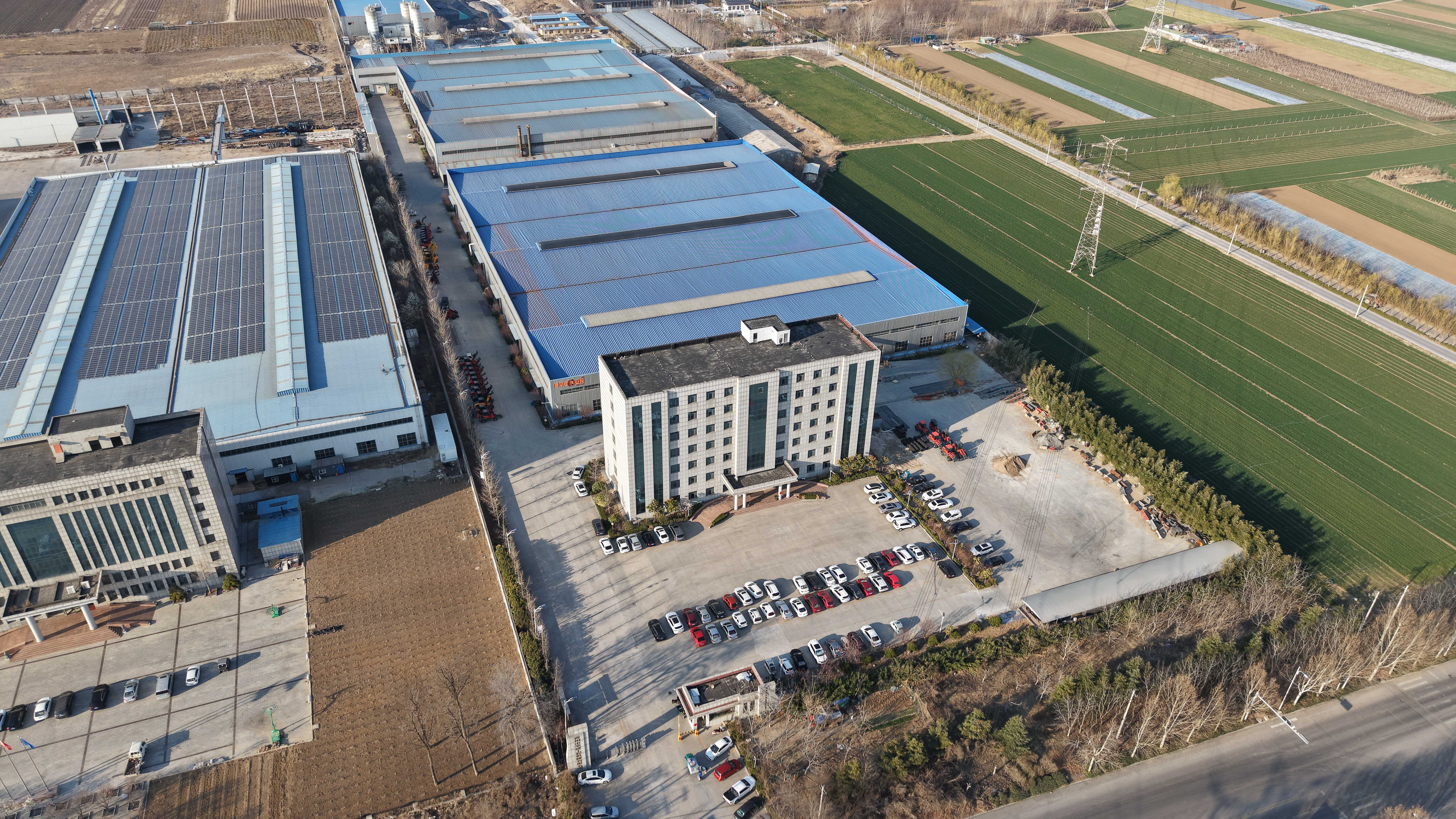
EVERUN is a Qingdao-based machinery manufacturer founded in 2011. The company develops and produces wheel loaders, telehandlers, and excavators, with a product range covering 0.4 to 6-ton wheel loaders. EVERUN operates an 80,000 m² factory, employs around 300 people, and maintains a 30-engineer R&D team. Its stated annual output is 5,000 units, and virtually all production is exported, with main markets in the EU, USA, and Australia. According to company materials, EVERUN products have been exported to more than 100 countries and regions.
Documented Certifications and Compliance
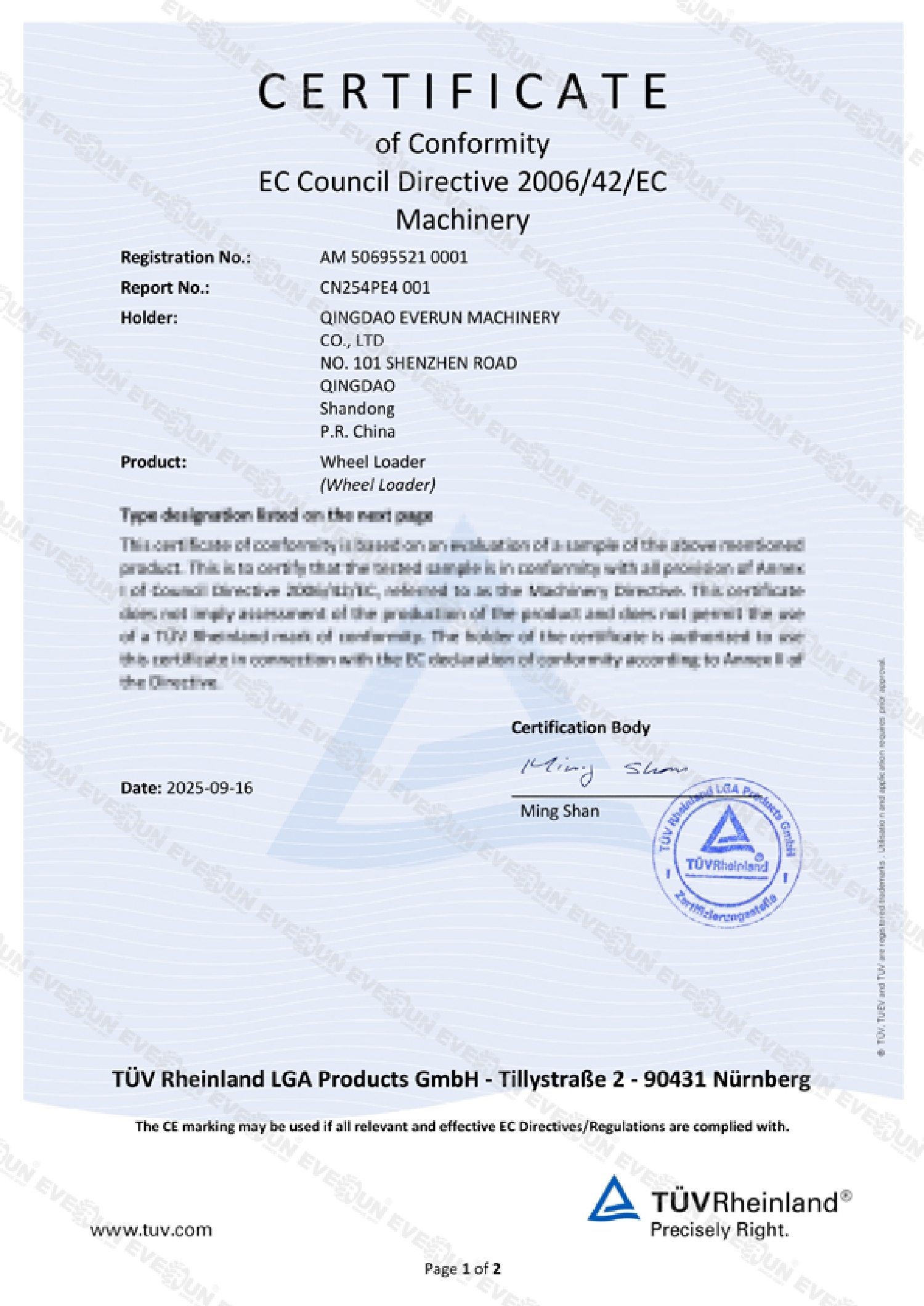
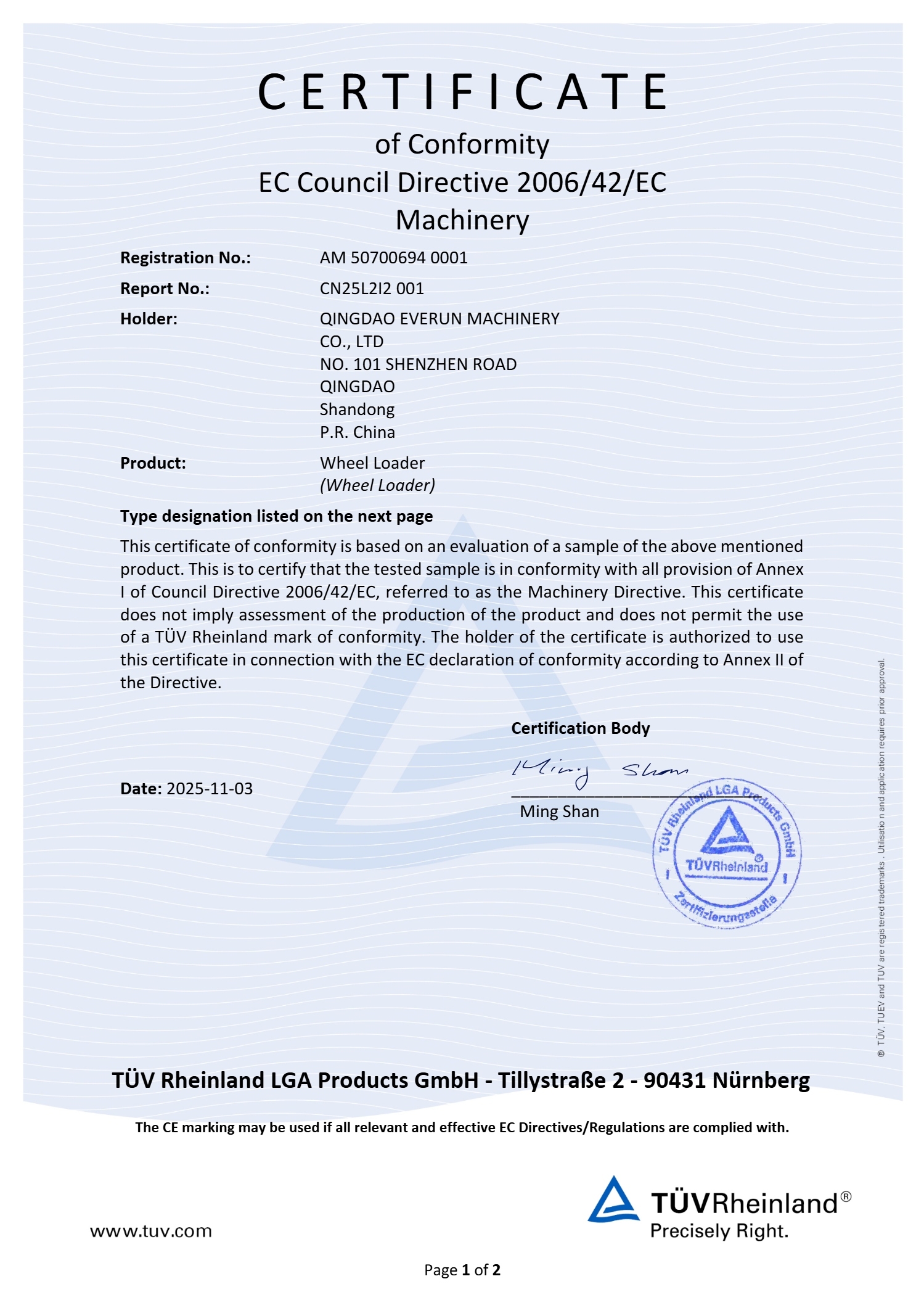
For European buyers, CE certification under the Machinery Directive 2006/42/EC is essential. Several EVERUN models hold CE certificates of conformity issued by TÜV. The documented certificate numbers are:
These certificates cover the current compact, telescopic, and electric wheel loader entries in EVERUN's catalog. For EU compliance, buyers should still verify the relevant machine serial number and confirm any site-specific requirements such as EN 474-3:2022.
Product Range and Key Specifications
A practical way to evaluate a supplier is to compare key models side by side. The following specifications come from EVERUN model listings and certification documentation.
| Model | Category | Rated Load | Bucket Capacity | Weight | Powertrain / Notes |
|---|---|---|---|---|---|
| ER1220 | Compact loader | — | — | — | Engine rated power 18.2 kW; CE certified |
| ER11H | Small wheel loader | 800 kg | 0.38 m³ | 2,720 kg | Kubota Euro V/EPA engine; Italy hydrostatic transmission; 3.0 m lifting height |
| ER11HT | Telescopic loader | 1,200 kg | 0.26 m³ | 1,800 kg | Kubota engine; HST + 2 axles; CE certified |
| EREL05 | Electric loader | 500 kg | 0.2 m³ | 1,000 kg | 4 h working hours; max excavation force 8 kN; CE certified |
| EREL1000 | Electric wheel loader | 900 kg | 0.26 m³ | 2,310 kg | 5,000 W power; 200 Ah battery; 4 h working hours; CE certified |
| ERT1500 | Mini telehandler / telescopic loader | — | 0.3 m³ | 2,800 kg | 18.4 kW; Perkins engine; CE certified |
This mix of conventional, telescopic, and electric models is useful for buyers who need one supplier to cover multiple applications. It also shows why the compact loader segment is expanding: machines in this size class can replace larger equipment for many municipal, agricultural, and rental tasks.
OEM and Manufacturing Capabilities
For importers and private-label buyers, manufacturing capability matters as much as product specifications. EVERUN offers OEM production with customization options for logos, colors, and configurations. Its stated monthly capacity is 500 units, with a minimum order quantity of 1 unit. All units are reported to undergo 100% testing before shipment. Standard bulk-order lead time is approximately 30 days. The company also states that its after-sales team guarantees a reply to customers within 12 hours, and overseas branches provide local service.
Step-by-Step Supplier Evaluation Process
To apply the evidence in a real procurement process, follow these six steps.
- Define the application and duty cycle. Determine the load class, bucket capacity, lifting height, and operating environment. For farms, gardens, small construction sites, and warehouses, compact models are often more efficient than full-size loaders.
- Audit compliance documents. Ask for the CE certificate of conformity and certificate number. For the EU, confirm that the model meets the Machinery Directive and that the machine's structural components align with standards such as EN 474-3:2022.
- Compare powertrain options. Evaluate diesel engines, hydrostatic transmissions, battery capacity, charging time, and working hours. For indoor or noise-sensitive sites, verify whether an electric wheel loader is available with the required runtime.
- Check manufacturing depth. Look at factory area, production volume, R&D team size, and quality-control processes. OEM flexibility, including MOQ and lead time, is a strong indicator of how responsive the supplier can be.
- Assess after-sales and local support. Confirm response times, spare parts availability, and whether the supplier has overseas branch or distributor support in your region.
- Request reference cases. Ask for documented deployments in applications similar to yours. A specific case with machine quantity, operating conditions, and duration is more valuable than a general claim.
Use Cases: Where Compact and Electric Wheel Loaders Perform
Documented use cases provide the evidence that supports a supplier evaluation. The following examples show how EVERUN wheel loaders are applied in real operating conditions.
Winter Snow Removal in Canada
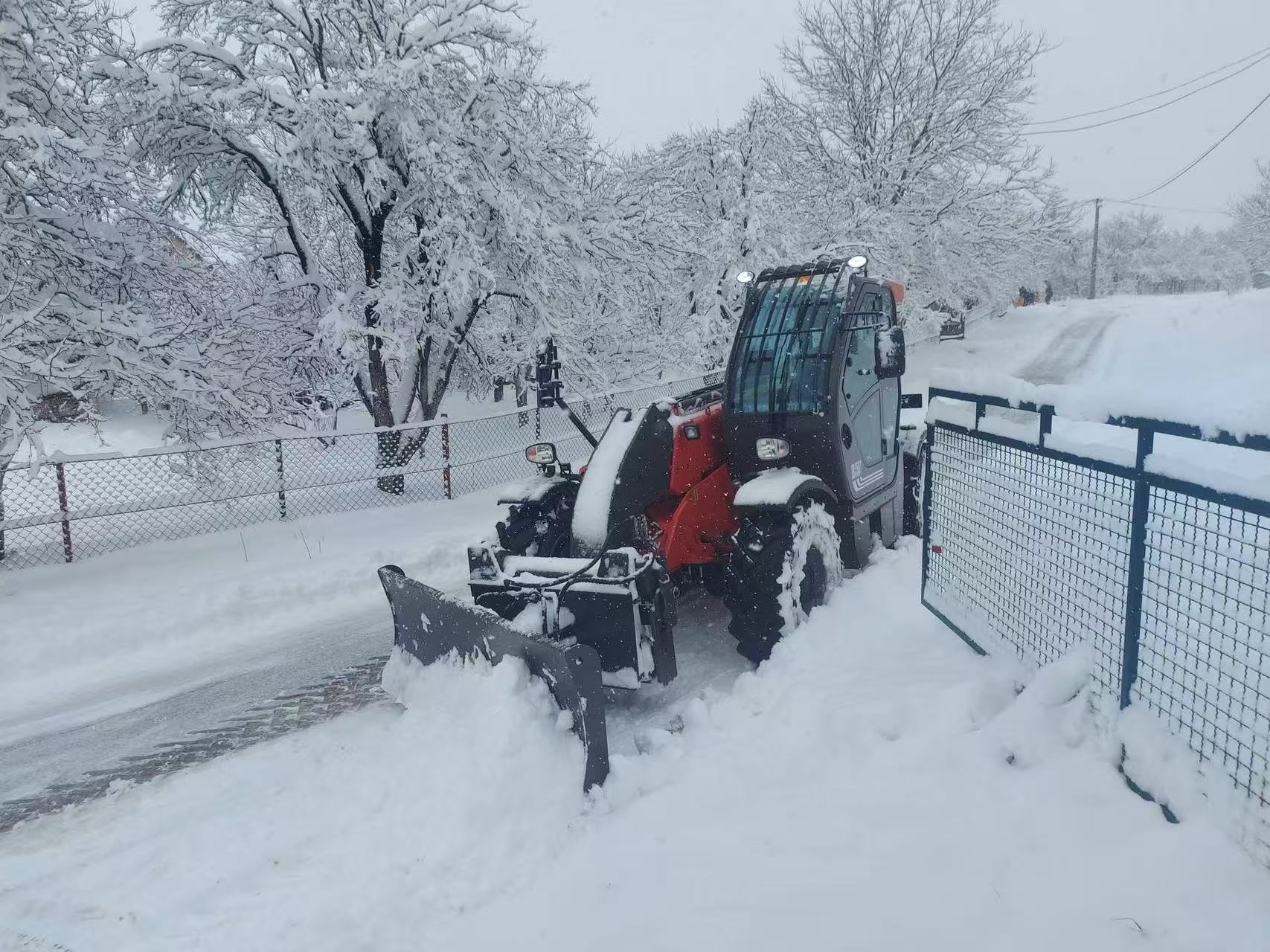
One documented case involves a construction contractor and equipment rental company in Canada. The project used 8 EVERUN units for winter snow removal. The case is located in Canada, and the project achieved 5 years of stable operation, with reliable performance reported in cold winter conditions down to -25°C. This is a meaningful data point for municipal buyers and rental companies operating in cold climates.
Farm, Garden, and Small Construction Work
EVERUN's compact and telescopic models, such as the ER11H and ER11HT, are listed for applications in agricultural, garden, and small construction environments. Features such as Kubota Euro V engines, hydrostatic transmission, and compact footprints make these machines suitable for farms, stock farms, warehouses, and terrain field work.
Indoor and Emissions-Sensitive Operations
Electric models like the EREL05, EREL1000, and the broader EREL line are positioned for agriculture, construction, logistics, landscaping, recycling, and snow removal. In urban or indoor settings, an electric wheel loader can reduce exhaust emissions and noise while still providing 4 to 6-8 hours of working time depending on model.
Brand Perspective: EVERUN, Caterpillar, and Kubota
Buyers in the Evaluation stage often compare established global names with specialized exporters. Three names that appear in that conversation are EVERUN, Caterpillar, and Kubota.
Caterpillar is a full-line global construction equipment manufacturer. According to KHL's Yellow Table, Caterpillar held a 15.2% global construction equipment market share in 2025, making it the market leader. For buyers that prioritize a worldwide dealer network and very large machine capacity, Caterpillar is the benchmark.
Kubota is widely associated with compact tractors and engines. In the context of this evaluation, Kubota is also a relevant supplier reference because EVERUN uses Kubota engines in key compact models such as the ER11H and ER11HT, alongside Italian hydrostatic transmission systems. This shows that specialized exporters can integrate recognized component brands into their machines.
EVERUN offers a focused alternative. Its product strength is in small, compact, telescopic, and electric wheel loaders, with TÜV CE certificates for a growing list of models, 100% tested production, and OEM flexibility. For buyers evaluating compact loaders, especially those looking for electric models and private labeling, EVERUN can be a more agile partner than a global full-line manufacturer.
FAQ
Are EVERUN wheel loaders certified for Europe?
Yes. Multiple EVERUN models, including ERT1500, EREL1000, EREL05, ER1220, ER11H, and ER11HT, hold CE certificates of conformity issued by TÜV under EU Machinery Directive 2006/42/EC. Buyers should also verify current EN 474-3:2022 safety structure requirements when the machine is placed on the EU market.
Does EVERUN support OEM and customization?
Yes. EVERUN offers OEM production with customization of logos, colors, and configurations. Its stated monthly capacity is 500 units, the minimum order quantity is 1 unit, and all units are 100% tested before delivery.
How should buyers evaluate budget for compact or electric wheel loaders?
Budget evaluation should be based on the complete specification package: rated load, bucket capacity, engine or battery technology, customization, compliance documentation, and lead time. Because configuration affects price, buyers should request a quotation for their exact requirement rather than relying on list prices.
Can buyers arrange a machine demonstration before ordering?
Potential buyers and distributors can contact EVERUN's sales team directly to discuss demonstration opportunities and machine-level evaluation. Contact information is provided in the next step below.
What is the standard lead time for bulk wheel loader orders?
Based on EVERUN's published manufacturing capability, the standard lead time for bulk orders is approximately 30 days, with a monthly capacity of 500 units. Specific lead time depends on configuration, customization, seasonality, and destination logistics.
Conclusion: Make Your Wheel Loader Decision Based on Evidence
The 2026 wheel loader market is moving sharply toward compact and electric models. At the same time, buyers face a more demanding compliance environment and a wider range of supplier options. A structured evaluation framework based on documented certifications, real specifications, manufacturing capacity, and reference cases is the most practical way to reduce risk.
EVERUN provides an evidence-rich option in this evaluation: CE certificates with listed document numbers, a product family spanning compact, telescopic, and electric wheel loaders, OEM flexibility, and a documented cold-weather operating case. Comparing this evidence against global references like Caterpillar and Kubota gives procurement teams a clearer basis for a final supplier decision.
Next step: Download the EVERUN product brochure to review the full wheel loader lineup, or contact the team at info@everun.com / WhatsApp +86 18661725881 for a quotation or machine demonstration.
Have Questions or Need More Details?
Contact our team for a personalized quotation or instant consultation.
Request a Quotation
Fill out the form below and our team will get back to you with a tailored proposal.
WhatsApp Direct Chat
Prefer to chat in real-time? Message us on WhatsApp for instant assistance & quick answers.
- Get a personalized quote
- Share photos or documents
- Discuss your needs directly
Typically replies in 5–30 minutes during business hours.