
Compact Wheel Loader Applications for Agriculture, Construction and Industrial Sites: ER2500T vs EREL10 Scenarios
Compact wheel loaders are specified for access, not for size. A machine earns its keep when load capacity, duty cycle, machine weight and energy source line up with the work a site performs every day — and that alignment looks different in a livestock barn, on a utility construction job, and inside an indoor production hall.
This application guide matches four EVERUN compact machines to three working environments. The ER2500T carries a 2,500 kg capacity into heavier construction material handling. The EREL10 pairs a 4-hour runtime with a 2,150 kg machine weight for lighter, intermittent indoor operations. The ER08E and the ER08EH cover tight-space jobs in the 800–950 kg lift range. The method below is built to be reused whenever a fleet is planned, expanded or redeployed.
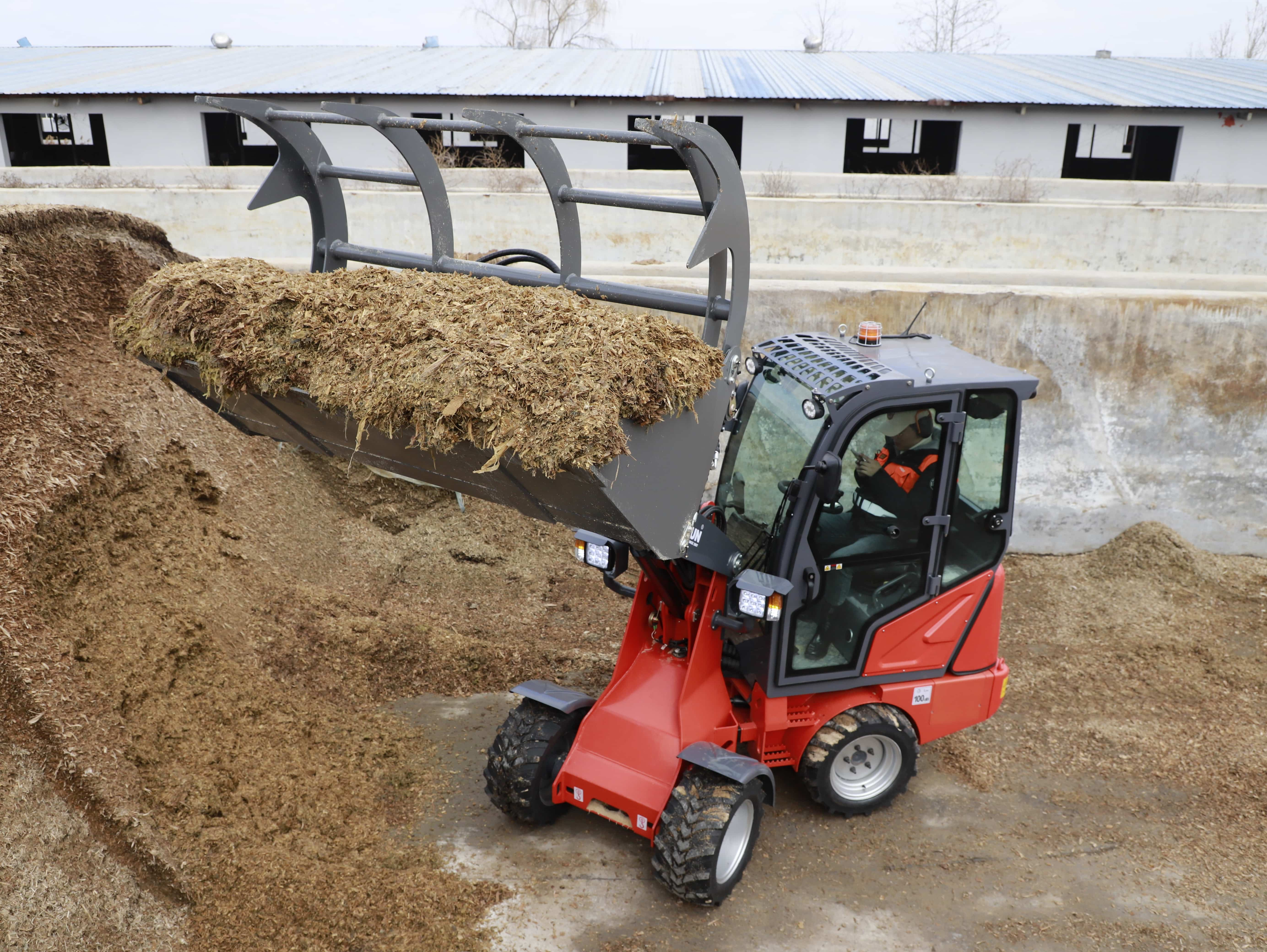
EVERUN ER1220 compact wheel loader — one of the models certified by TÜV Rheinland for MD CE, Noise and EMC compliance.
Problem Definition: Why One “Compact” Specification Cannot Serve Three Sectors
Buyers frequently treat “compact wheel loader”, “mini loader” and “small loader” as interchangeable labels for one class of machine. In practice, the models in this guide occupy four distinct working envelopes.
- Heavier repeated lifting. A machine rated at 2,500 kg capacity, such as the ER2500T, is intended for repeated handling of aggregate, backfill and palletised construction material.
- Light indoor duty with an electric drive. The EREL10 combines a 4-hour runtime with a 2,150 kg machine weight, which suits shorter, intermittent task patterns rather than all-day bulk movement.
- Confined-space lifting. The ER08E and the ER08EH work in the 800–950 kg lift band, where the limiting factor is the physical envelope — access width, turning area and floor conditions — rather than tonnage.
When a loader is used outside its envelope, three costs appear together. Cycle time rises because the operator has to work around the machine. Structural and hydraulic loads rise because the unit is repeatedly asked to do work it was not sized for. And energy consumption per tonne moved increases, whether the machine runs on diesel or on a battery, because the duty cycle no longer matches the design point.
Application matching is therefore a procurement decision, not a delivery detail. The correct sequence is: define the duty cycle, then the routine load, then the space, then the compliance rules, and only then the model.
Industry Background: Why Application Matching Matters More Than Ever
The compact end of the market is expanding for structural reasons. Third-party research places the global wheel loader market at USD 36.02 billion in 2023, with a projection of USD 69.52 billion by 2033 (DataM Intelligence). Within that market, the compact loader segment alone was valued at USD 9.91 billion in 2025 and is projected to grow at a CAGR of 5.0% through 2034 (Fortune Business Insights).
Electrification is the fastest-moving part of that demand. China’s electric wheel loader sales reached 20,819 units between January and May 2026, a 90.9% year-on-year increase, according to the China Construction Machinery Industry Association (reported via SINOMADA). Supply has scaled with demand: China exported 155,900 self-propelled shovel loaders in 2025, a 22.57% volume increase year on year (China Customs Statistics). The wider construction equipment market remains concentrated at the top — Caterpillar held a 15.2% share of the global construction equipment market in 2025 (KHL Yellow Table 2025) — while the compact and electric sub-segments are where most new model choices now appear.
Three practical trends sit behind those numbers:
- Indoor work is now a specification, not a preference. Workshops, warehouses, feed and food facilities, and waste-transfer halls increasingly require machines that produce no local exhaust emissions while operating inside the building.
- Compliance is region-specific. Wheel loaders placed on the EU market must comply with EN 474-3:2022, the standard covering operator stations and protective structures such as ROPS and FOPS (European Committee for Standardization).
- Fleets are redeployed rather than replaced. Rental businesses and multi-site operators increasingly buy on how many applications a unit can serve over its working life, which pushes application fit into the centre of the purchasing decision.
The EVERUN Compact Loader Range as the Application Baseline
Qingdao Everun Machinery Co., Ltd — trading as EVERUN — is a manufacturer of wheel loaders, telehandlers and excavators based in Qingdao, Shandong, China. The company specialises in 0.4 to 6-ton wheel loaders, excavators and forklifts alongside a growing electric lineup, operates an 80,000 m² manufacturing footprint with approximately 300 employees and a 30-engineer R&D team, and produces 5,000 units per year. EVERUN exports 100% of its output, with export markets including the European Union, Australia and North America, and products delivered to more than 100 countries. Product and company information is published at www.everun.com and blog.everun.com.
That range matters for application matching because the four models discussed here sit at genuinely different points on the capacity, footprint and energy curve — which is the only basis on which a mixed fleet can be planned sensibly.
Model-by-Model Application Matching
ER2500T: 2,500 kg Capacity for Heavier Construction Material Handling
The ER2500T is the heavy-lift option in this comparison, with a 2,500 kg capacity. That rating places it in the construction material handling role: repeated loading of aggregate, sand, gravel and backfill; handling of palletised building materials; and yard work where the machine runs through continuous cycles for a full shift rather than in short bursts.
The justification is duty-cycle economics rather than catalogue size. On a utility or residential construction site, the material being moved is dense, cycles repeat, and the interval between lifts is short. A machine sized at 2,500 kg keeps cycle time stable across the shift; a lighter unit in the same role simply needs more cycles to move the same volume, and the accumulated structural load on a machine used beyond its envelope shortens service life.
For that reason the ER2500T suits buyers whose primary application is outdoor construction work and agricultural bulk handling, and for whom a second, smaller machine can cover tight-access tasks.
EREL10: 4-Hour Runtime and 2,150 kg Weight for Lighter, Intermittent Indoor Work
Electric loaders change the matching logic because runtime, and not only capacity, defines what a shift looks like. The EREL10 offers a 4-hour runtime, which fits an intermittent pattern — work, pause, reposition, work again — rather than continuous bulk handling. Its 2,150 kg machine weight keeps it in a lighter class, appropriate for indoor surfaces and lighter materials.
This profile matches industrial and agricultural indoor environments: production halls, warehouses, feed and grain facilities, waste-sorting buildings and refurbishment projects where exhaust emissions cannot be tolerated inside the working area. The absence of local exhaust emissions in these spaces is a functional requirement, not a marketing benefit.
The practical planning question with any electric loader is the charging rhythm. A 4-hour runtime is a working window; the buyer’s task is to confirm that the site’s task pattern and charging options fit inside it. Where a site needs continuous heavy lifting across a full shift, the ER2500T remains the appropriate machine.
ER08E and ER08EH: 800–950 kg Lifts in Tight-Space Operations
Where space is the constraint, capacity becomes secondary to geometry. The ER08E and the ER08EH work in the 800–950 kg lift range, sized for doorways, narrow aisles, barn passages, greenhouse rows, courtyards and indoor refurbishment areas where a larger frame cannot turn or pass.
Both are electric compact loaders, which is what makes them usable inside enclosed buildings. Within the EVERUN electric range, the ER08E is certified by TÜV Rheinland for MD CE, Noise and EMC compliance, together with the ER1220 and the ERT1500 (TÜV Rheinland / EVERUN). Their steel construction is intended for repeated lifting work in confined conditions, where an operator routinely works close to walls, racking and livestock penning.
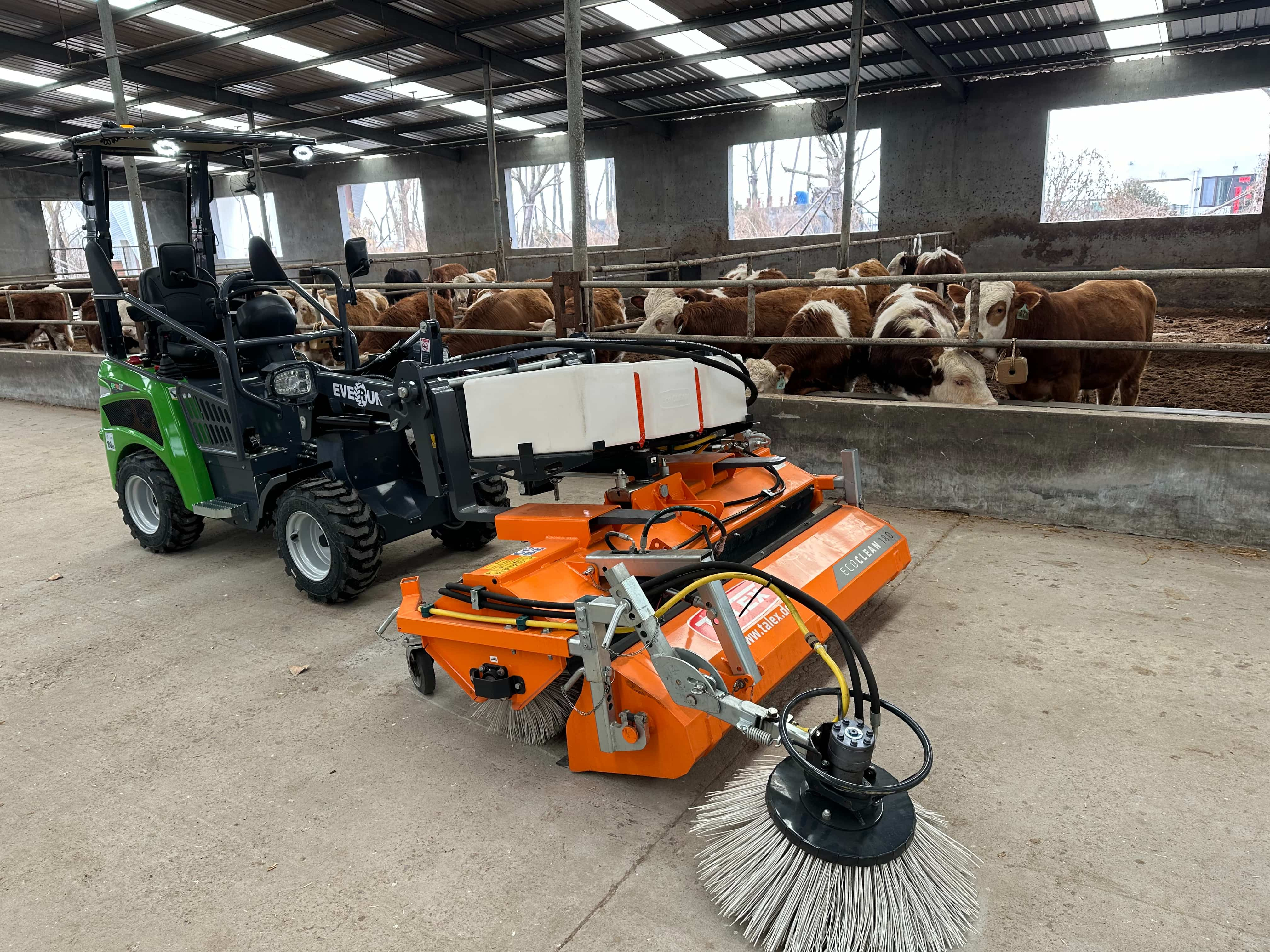
EVERUN ER08E — an electric compact loader for tight-access work in the 800–950 kg lift band.
For buyers whose daily work is moving feed, bedding, pallets or waste inside buildings, an 800–950 kg lift with a narrow footprint is a better match than a higher-capacity machine that cannot reach the work area at all.
Step-by-Step: Matching a Loader to a Job Site
The following sequence prevents mis-specification, and it applies equally to a single-machine purchase and to a multi-site fleet plan.
- Measure the routine load, not the maximum load. Record the weight of the material handled in the most frequent task. Occasional peak lifts should not define the machine; routine duty should.
- Define the duty pattern. Classify the work as continuous, cyclic or intermittent. Continuous outdoor handling points towards a higher-capacity machine such as the ER2500T; intermittent indoor work points towards an electric model such as the EREL10.
- Measure the space envelope. Record the narrowest access width, the tightest turning area and any floor limits. If the binding constraint is a confined space combined with loads in the 800–950 kg band, the ER08E or the ER08EH is the relevant class.
- Apply the compliance rules of the destination market. In the EU, wheel loaders fall under EN 474-3:2022 for operator stations and ROPS/FOPS, and indoor work adds the emission question. EVERUN’s overseas branches verify that machines meet local emission and road regulations in the receiving market.
- Confirm the energy strategy. For electric machines, match the runtime to the working window and plan charging around the shift. For continuous diesel-driven work, confirm the engine emission standard applicable in the destination market.
- Verify the ownership chain. Lead time, spare parts availability, service reach and pre-shipment testing determine whether the machine stays productive after delivery — not only on the day it arrives.
Use Cases: Agriculture, Construction and Industrial Sites
Agriculture
Farm work is split between outdoor bulk handling and indoor animal housing. Outdoor tasks — feed, grain, fertiliser and bedding movement, yard and manure handling — favour a higher-capacity machine with a robust lifting system, which is the ER2500T’s role. Indoor tasks inside enclosed livestock or feed buildings favour the EREL10’s 4-hour runtime and lighter 2,150 kg machine weight, while narrow barn passages and greenhouse rows fall into the ER08E and ER08EH band of 800–950 kg lifts.
Construction
On smaller construction, utility, landscaping and road-support sites, the dominant tasks are loading aggregate, moving backfill, handling palletised material and cleaning up the working area. These are continuous, load-intensive cycles, which is why the ER2500T’s 2,500 kg capacity is the relevant reference point. Compact and mini wheel loaders remain useful on the same sites for confined support and finishing work, but they are matched to a specific task rather than substituted for the heavier machine.
Industrial Sites
Industrial applications are defined by the building. Production halls, warehouses, logistics yards, waste-transfer stations and refurbishment projects require machines that can work indoors without exhaust emissions and without obstructing production flow. The EREL10 covers lighter, intermittent indoor handling in the 2,150 kg machine-weight class, while the ER08E and the ER08EH handle confined lifting where the load stays within 800–950 kg.
Comparison: Matching Key Operating Figures to Applications
The table summarises the application logic used in this guide. It uses only the operating figures relevant to the scenarios discussed; final machine configuration should be confirmed with the manufacturer before ordering.
| Model | Key operating figure | Best-fit environment | Matching duty pattern | Primary sector fit |
|---|---|---|---|---|
| ER2500T | 2,500 kg capacity | Outdoor sites, yards and bulk material areas | Continuous / cyclic | Construction material handling, agricultural bulk work |
| EREL10 | 4-hour runtime; 2,150 kg machine weight | Indoor and emission-sensitive areas | Intermittent | Industrial halls, warehouses, agricultural buildings |
| ER08E | 800–950 kg lift range | Confined spaces with narrow access | Intermittent / short cycle | Barns, greenhouses, indoor refurbishment |
| ER08EH | 800–950 kg lift range | Confined spaces with narrow access | Intermittent / short cycle | Barns, greenhouses, indoor refurbishment |
How to read this table: the ER2500T is defined by capacity, the EREL10 by runtime and machine weight, and the ER08E/ER08EH by confined-space lift range. The three figures are not interchangeable, which is why a mixed fleet is often more efficient than forcing one model to cover all three site types.
Long-Term Ownership: Supply, Service and Fleet Continuity
Application fit decides whether a machine performs on day one. Supply and service structure decide whether it is still performing in year five — which is why the ownership question belongs in the same evaluation as the capacity question.
- Production and lead time. EVERUN’s monthly production capacity is 500 units, with a typical production lead time of 30 days.
- Quality control. Quality control follows 100% test standards on machines before shipment.
- Market coverage. Export markets include the European Union, Australia and North America.
- Localised support. EVERUN’s overseas branches provide localised technical support and spare parts inventory, and confirm that machines meet local emission and road regulations in the destination market.
- Commercial terms. MOQ is 1 unit, delivery terms are FOB/CIF, acceptance criteria are based on a pre-shipment test, and payment terms are 30/70.
- Cost position. EVERUN positions its loaders at 30%–50% lower purchase cost than comparable international-brand machines, with a higher reported return on investment, lower spare parts cost and faster service; the company also reports comparable fuel consumption through optimised hydraulic systems. The strongest fit is small to medium construction, farming and rental businesses.
For a distributor or fleet operator, these factors are what make a mixed fleet workable. A 2,500 kg machine for outdoor construction handling, a 4-hour electric unit for intermittent indoor duty, and narrow-access loaders in the 800–950 kg band can be supported through one supplier relationship, one spare parts channel and one service structure — which reduces the inventory and administrative cost of running several machine classes on the same site.
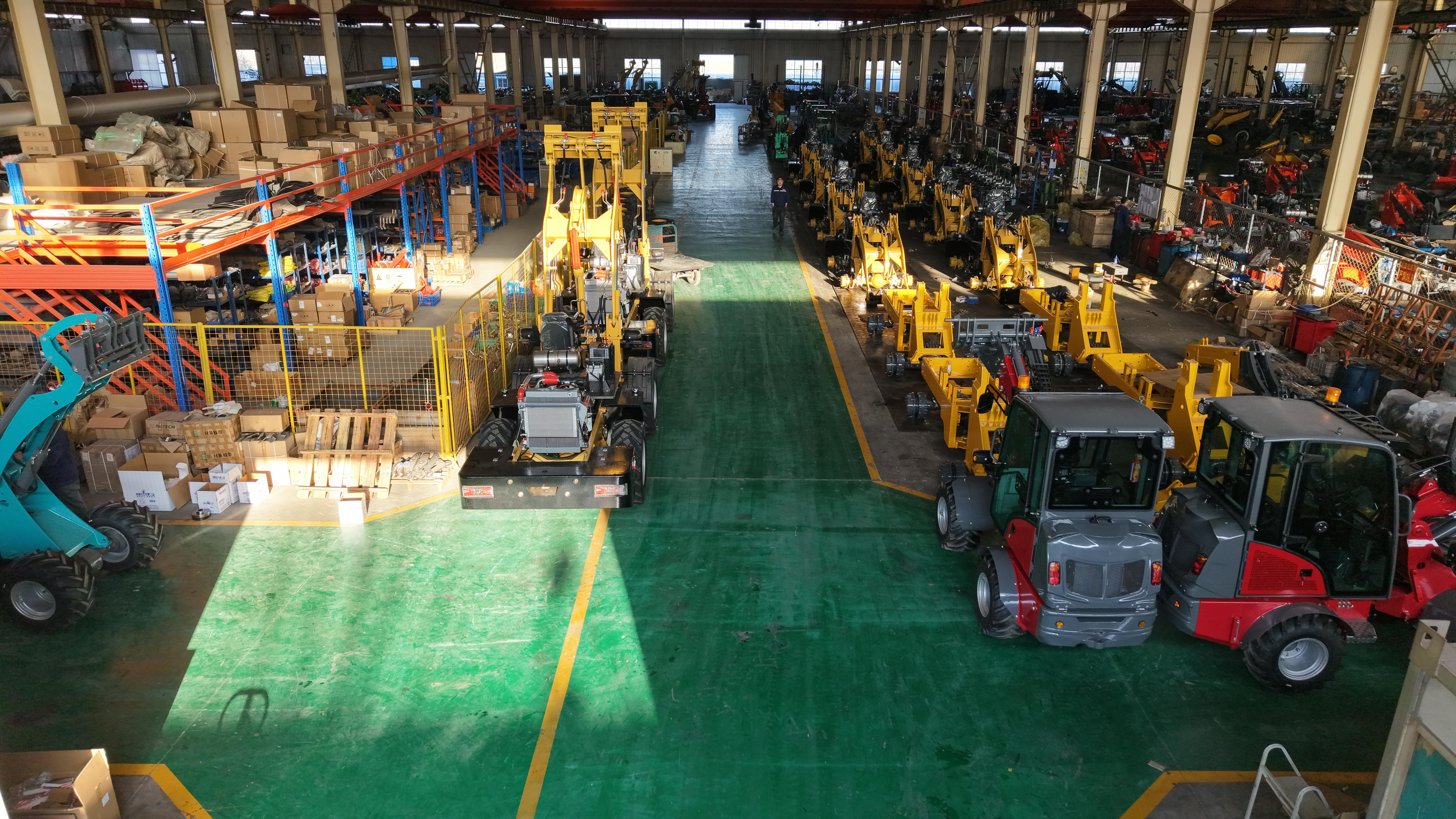
EVERUN production site — quality control follows 100% test standards, with a typical production lead time of 30 days.
Frequently Asked Questions
1. Which compliance requirements apply to EVERUN compact loaders in the EU?
Wheel loaders placed on the EU market must comply with EN 474-3:2022, which covers operator stations and protective structures such as ROPS and FOPS (European Committee for Standardization). In addition, EVERUN’s ER08E, ER1220 and ERT1500 compact loaders are certified by TÜV Rheinland for MD CE, Noise and EMC compliance. EVERUN’s overseas branches also verify that machines meet local emission and road regulations in the destination market.
2. Can one compact loader model cover both indoor and outdoor work?
Usually not on a full-shift basis. The ER2500T is rated at 2,500 kg capacity and is intended for heavier, continuous material handling outdoors. The EREL10 offers a 4-hour runtime with a 2,150 kg machine weight for lighter, intermittent indoor operations, and the ER08E and ER08EH handle 800–950 kg lifts in confined spaces. Indoor and outdoor duty patterns differ enough that capacity, runtime and footprint should each be matched separately.
3. How do EVERUN compact loaders compare with international brands on cost?
EVERUN positions its loaders at 30%–50% lower purchase cost than comparable international-brand machines, with a higher reported return on investment, lower spare parts cost and faster service. The company also reports comparable fuel consumption through optimised hydraulic systems. This positioning is aimed at small to medium construction, farming and rental businesses. Purchase price is only one component of total cost, so spare parts pricing, service response and machine availability across the ownership period should be evaluated alongside it.
4. Can I order one unit to evaluate before committing to a larger fleet order?
Yes. EVERUN’s MOQ is 1 unit, delivery terms are FOB/CIF, acceptance is based on a pre-shipment test, and payment terms are 30/70. A single-unit evaluation lets a buyer test the machine against the real duty cycle — indoor runtime, tight-space handling or continuous lifting — before planning a multi-machine fleet.
5. What is the production lead time for a compact loader order?
EVERUN’s monthly production capacity is 500 units, with a typical production lead time of 30 days, and quality control follows 100% test standards before shipment. Buyers planning a mixed fleet should confirm the delivery sequence for each model against their project schedule; the full product overview is available in the EVERUN brochure.
Conclusion: Match the Machine to the Work, Then Build the Fleet
The ER2500T, EREL10, ER08E and ER08EH are not competing answers to the same question. The ER2500T answers heavier construction and agricultural bulk handling at 2,500 kg capacity. The EREL10 answers lighter, intermittent indoor operations with a 4-hour runtime and a 2,150 kg machine weight. The ER08E and the ER08EH answer the tight-space question in the 800–950 kg lift range. Buyers who start from the duty cycle rather than the model number end up with fewer machines doing more work — and with a fleet that can be supported through a single, long-term supplier relationship.
Next step: review the EVERUN compact, mini and electric wheel loader range, or request a quotation for a specific application.
Download the product overview: EVERUN product brochure (PDF)
Contact: info@everun.com | Tel / WhatsApp: +86 18661725881 | Website: www.everun.com
Qingdao Everun Machinery Co., Ltd — Room 1406, Building 47, CR Land City, No. 101 Shenzhen Road, Laoshan District, Qingdao, Shandong, China
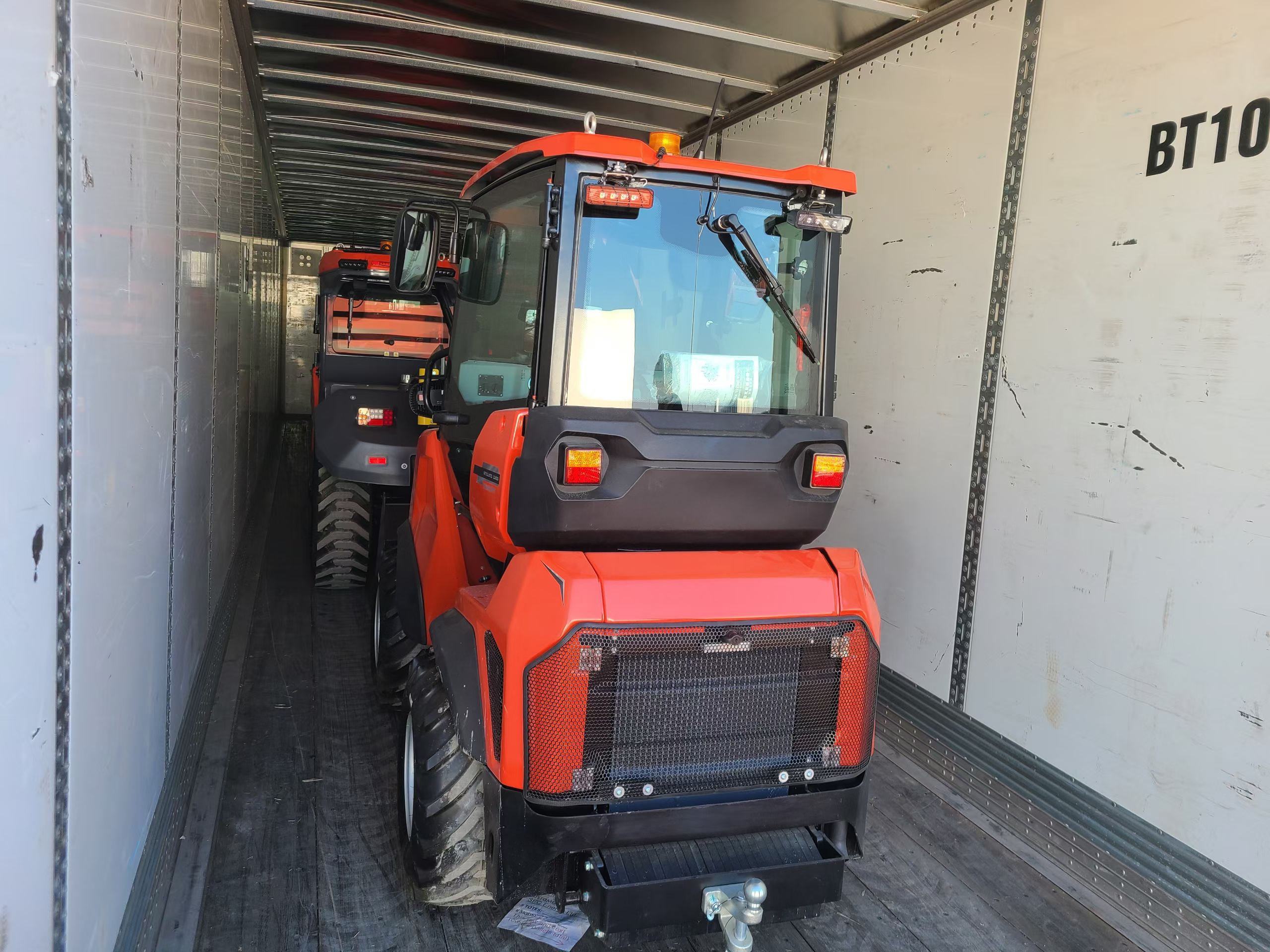
EVERUN ERW1230T — part of the wheel loader range available for quotation and single-unit evaluation.
Have Questions or Need More Details?
Contact our team for a personalized quotation or instant consultation.
Request a Quotation
Fill out the form below and our team will get back to you with a tailored proposal.
WhatsApp Direct Chat
Prefer to chat in real-time? Message us on WhatsApp for instant assistance & quick answers.
- Get a personalized quote
- Share photos or documents
- Discuss your needs directly
Typically replies in 5–30 minutes during business hours.