
One Site, Two Tasks: Solving Wheel Loader and Telehandler Selection Challenges
A site that has to stockpile and load bulk material and also lift palletised or bundled loads to height is running two different jobs on one footprint. The question that usually follows — wheel loader or telehandler? — treats this as a product-category decision. It is more usefully handled as a workflow design decision: which task owns the working day, how far and how high loads must travel, and whether one machine can absorb both without becoming the constraint.
The practical answer is a task split, not a category preference. When bulk handling dominates and lift height stays inside the loader's boom envelope, a wheel loader — mini, compact, small or electric — should own the site and attachments should cover the secondary work. When lift-and-place to height dominates, a telehandler should own it. When both tasks run at high frequency against the clock, the realistic options are two machines or a telescopic wheel loader, and that choice should be made on task hours and site geometry rather than on a specification sheet.
Why Mixed-Task Sites Get Trapped in a Category Argument
The trap appears in three recognisable forms. First, one machine is bought for two jobs and ends up mediocre at both: a bucket-led loader is asked to place pallets at height, or a telehandler is asked to load trucks with a bucket all day. Second, the machine is bought by category label rather than by task, so a compact wheel loader is ordered for a duty cycle that is mostly vertical placement. Third, the comparison is made on engine power and bucket volume — neither of which describes how the machine will actually spend its hours.
Separating the site into two task families removes most of the confusion:
- Bulk material handling. Excavating from a pile, loading trucks or trailers, stockpiling, yard cleaning, spreading, snow clearance. The machine works at ground level, repeatedly, with a bucket. Breakout force, bucket capacity, cycle speed and surface traction set the pace.
- Lift-and-place work. Moving pallets, crates, bundles, bags or components onto decks, racks, scaffolding or truck beds. The machine works at height and often at reach, normally with forks. Lifting height, forward reach, the load chart at that reach and placement precision set the pace.
Most mixed sites are not split 50/50. They are weighted towards one family, and the weighting — not the equipment catalogue — decides the configuration.
What Is Changing in the Compact Equipment Market
Two structural shifts make this decision more consequential than it was a decade ago. The first is scale. Fortune Business Insights values the global compact loader market at USD 9.91 billion in 2025 and projects USD 15.28 billion by 2034, with compact machines absorbing work that previously justified larger equipment. More compact machines on a site means more sites where a loader and a lift machine compete for the same yard space and the same operator hours.
The second is powertrain and compliance. Diesel machines sold into Europe and North America are expected to meet EU Stage V (Regulation (EU) 2016/1628) and US EPA Tier 4F, which is why manufacturers build around engines from established suppliers such as Perkins, Kubota and Yanmar rather than a single source. In parallel, battery-electric models have moved from novelty to a genuine option for confined or emission-sensitive sites. EVERUN's electric wheel loader line illustrates the spread of capability now available: the EREL05 carries a 500 kg rated load with a 0.2 m³ bucket and 4 working hours; the ER08E uses a 12 kW motor for an 800 kg rated load, 5–6 working hours and a 13-hour charge; the EREL1200 reaches a 1,200 kg rated load with a 0.38 m³ bucket and 6–8 working hours.
A third change is categorical. Telescopic wheel loaders — a bucket machine carrying a boom — are now listed by manufacturers in both the wheel loader family and the telescopic loader family. That overlap is precisely what a two-task site needs to understand before it buys two machines it may not need.
The Decision Framework: Four Lenses Before You Compare Models
Before any specification table is opened, four questions should be answered in order. They convert an equipment argument into a configuration decision.
1. Task ownership: which job sets the pace?
Log a representative week, not a peak day. If bucket work fills most of the working hours and lift work is intermittent, the primary machine is a wheel loader and fork work is handled by attachments or by hired equipment. If loads must be placed at height on most cycles, the primary machine is a telehandler and the yard work is the secondary task. Sites that genuinely split their hours between the two are the ones where a telescopic wheel loader or a two-machine fleet earns its cost.
2. Site geometry: what can physically work a full shift?
Measure the tightest dimension before the largest one. Gate and doorway clearances, aisle width between racks, surface condition, gradients and overhead obstructions decide which machine can operate continuously rather than intermittently. Long-boom telehandlers carry real space costs: the ER3070 lists a minimum turning radius of 4,050 mm, the ER3510 lists 4,250 mm and the ER4018 lists 4,100 mm. On a cramped yard those figures matter more than lifting height.
3. Workflow handoffs: who waits for whom?
A two-machine site is only faster if the two machines do not queue for each other. Map the sequence honestly: does the loader fill a truck while the telehandler unloads a delivery at the same dock, or does the second machine sit idle waiting for the yard to clear? On some sites the better answer is one slower machine that never queues. On others it is two machines with clearly separated zones and separated shift patterns.
4. Fleet economics: total duty cost, not purchase price
Count attachments, energy, service, operator certification and downtime across the duty cycle. Electric models shift the balance where charging is available and shifts are short; the ER08E's 5–6 working hours against a 13-hour charge, or the EREL05's 4 working hours, define how a shift must be planned rather than simply what the machine can lift. Two machines also mean two maintenance schedules, two operators and two sets of spare parts — a cost that never appears on a quotation.
Decision rule for mixed sites. If the required lift height exceeds the loader's stated maximum lifting height, the lift task belongs to a telehandler. If the lift stays inside a telescopic wheel loader's envelope and bucket work continues through the same shift, one machine may cover both. If neither condition holds, plan two machines and separate their working zones.
Where the Telescopic Wheel Loader Fits
The telescopic wheel loader is the category that responds directly to the two-task problem, and its limits are as important as its capability. EVERUN's documented models show how the envelope is drawn. The ER11HT carries a 1,200 kg rated load with a 0.26 m³ standard bucket, a Kubota engine, HST transmission with two axles and an overall weight of 1,800 kg. The ERW1230T offers a 1,200 kg rated load and 3,060 mm maximum lifting height on an 18.2 kW Kubota engine. The ERW2640T raises the envelope to a 2,600 kg tipping load and 4,220 mm maximum lifting height on a 45 kW Perkins engine. The ER2500T pairs a 2,500 kg rated load with a 0.67 m³ bucket, 53 kW and a hydraulic converter, drive shaft and axle transmission — clearly a production machine rather than an occasional lifter.
Those numbers describe a machine that can load a truck and then place a pallet at modest height in the same shift. They also describe a machine that stops well below the telehandler range: the ER3510 lists a maximum lifting height of 10,500 mm on pallet forks and the ER4018 lists 18,000 mm. A site that needs loads on a second-storey deck or into high racking is not a telescopic wheel loader site, however convenient the bucket would be.

Step-by-Step: How to Configure a Two-Task Site
- Log the task mix for one representative week. Record each movement as bulk, lift-and-place or transport, with the weight and the height involved. The result is a weighting, not an average; a site that is 15% lift work behaves like a wheel loader site with a fork task, not like a telehandler site.
- Convert the lift requirement into four numbers. Height, load, reach from the machine and attachment type. A pallet at 2,000 mm and 1,000 kg is a compact loader question; the same pallet at 6,000 mm is not.
- Test the site envelope. Confirm clearance, turning space, surface, slope and — indoors — noise and emission limits. Where indoor air quality or noise restricts diesel operation, the decision narrows to electric models such as the EREL05, ER08E or EREL10 rather than to a machine category.
- Set the attachment plan. Decide how many attachments the site needs, how often they change and who performs the change. An attachment that takes a shift to swap is not a solution to a mixed task.
- Verify compliance for the destination market. Match the certificates to the exact model and configuration ordered, not to the product family. Check the engine compliance route for diesel machines and the electrical documentation for electric ones.
- Validate with a single unit before scaling. Run one machine against the real task mix for a full cycle before committing a fleet. A trial exposes the queueing and floor-space problems that a specification review cannot.
Use Cases: Four Two-Task Patterns
Winter snow removal plus year-round yard handling
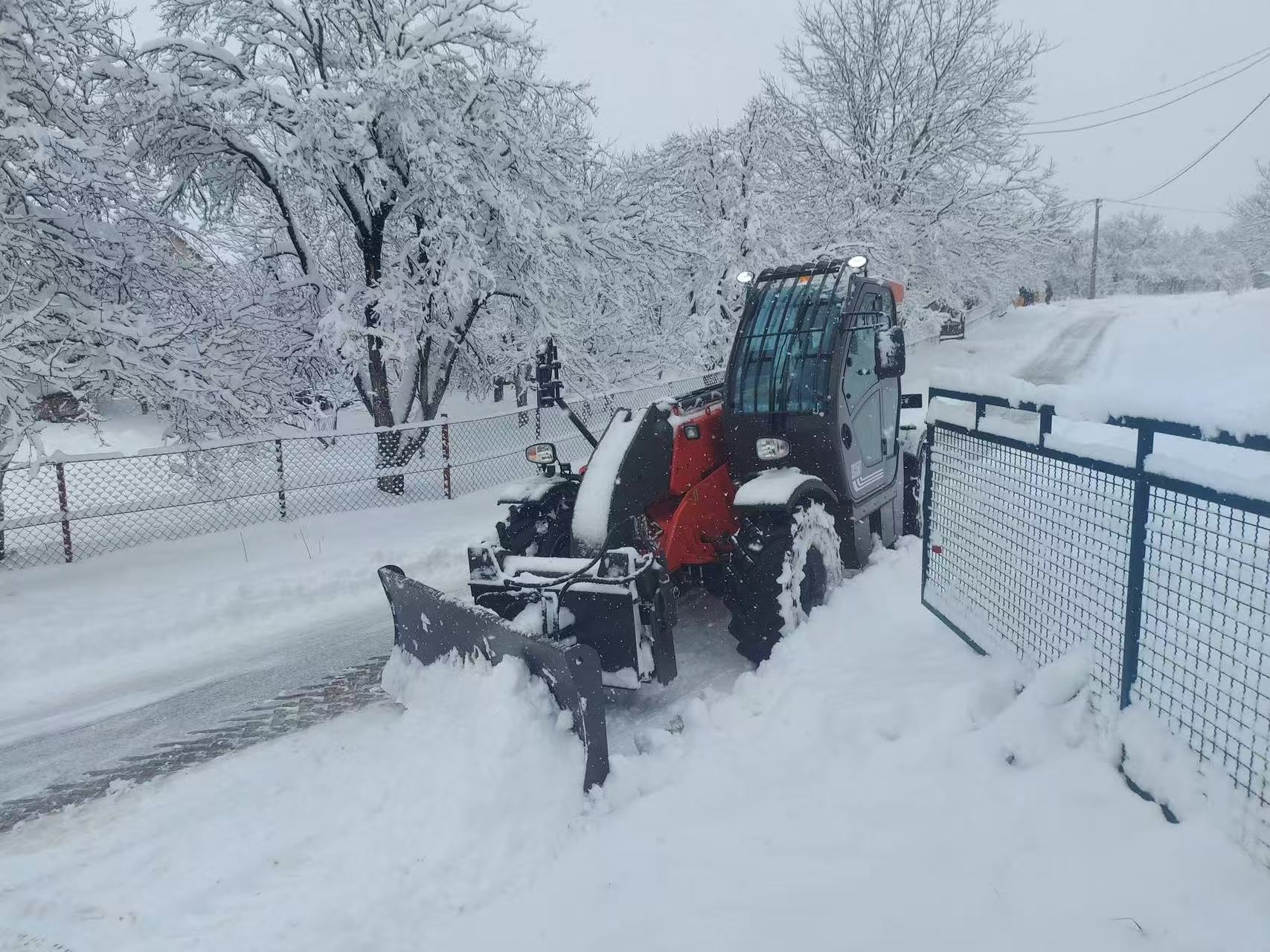
The clearest argument for compact machines is a site whose peak task is seasonal. A construction contractor and equipment rental company in Canada operates 8 units on winter snow removal work and reports 5 years of stable operation, with reliable performance in cold winter conditions down to −25°C. For that profile, the loader is the primary machine because bucket work spans both seasons; the lift task is intermittent and can be served by attachments or by a second machine shared across the fleet.
Farm and stock farm: feeding, loading and stacking
Agricultural yards usually need a bucket for material and handling, plus stacking at moderate height. The ER11H — 800 kg rated load, 0.38 m³ bucket, Kubota Euro V/EPA engine, Italian hydrostatic transmission, 3.0 m lifting height — covers the loading side in confined yards. Where stacking becomes frequent, a compact telehandler such as the ERT1500 (Perkins engine, 18.4 kW rated power, 2,800 kg operating weight, 0.3 m³ standard bucket) handles the vertical part without taking the bucket machine out of production.
Warehouse and indoor work
Indoors, the constraint is usually air quality and noise rather than lifting height. Battery-electric loaders remove tailpipe emissions at the point of use and suit enclosed buildings, and the model choice comes down to load and shift length: the EREL05 for 500 kg tasks, the ER08E for 800 kg with 5–6 working hours, the EREL10 for 1,000 kg with a 0.26 m³ bucket and 4 working hours, and the EREL1200 for 1,200 kg with 6–8 working hours.
Construction and rental fleets
Rental fleets face the two-task problem as a portfolio issue: they cannot dictate the customer's task mix, so they carry both categories. A common pairing is a bucket-led machine for bulk and a telehandler for height, for example the ER2500T (2,500 kg rated load, 0.67 m³, 53 kW) alongside the ER3510 (3,500 kg rated load, 10,500 mm maximum lifting height, 77.3 kW). The fleet decision then becomes which models are shared across depots rather than which single machine is perfect for one site.
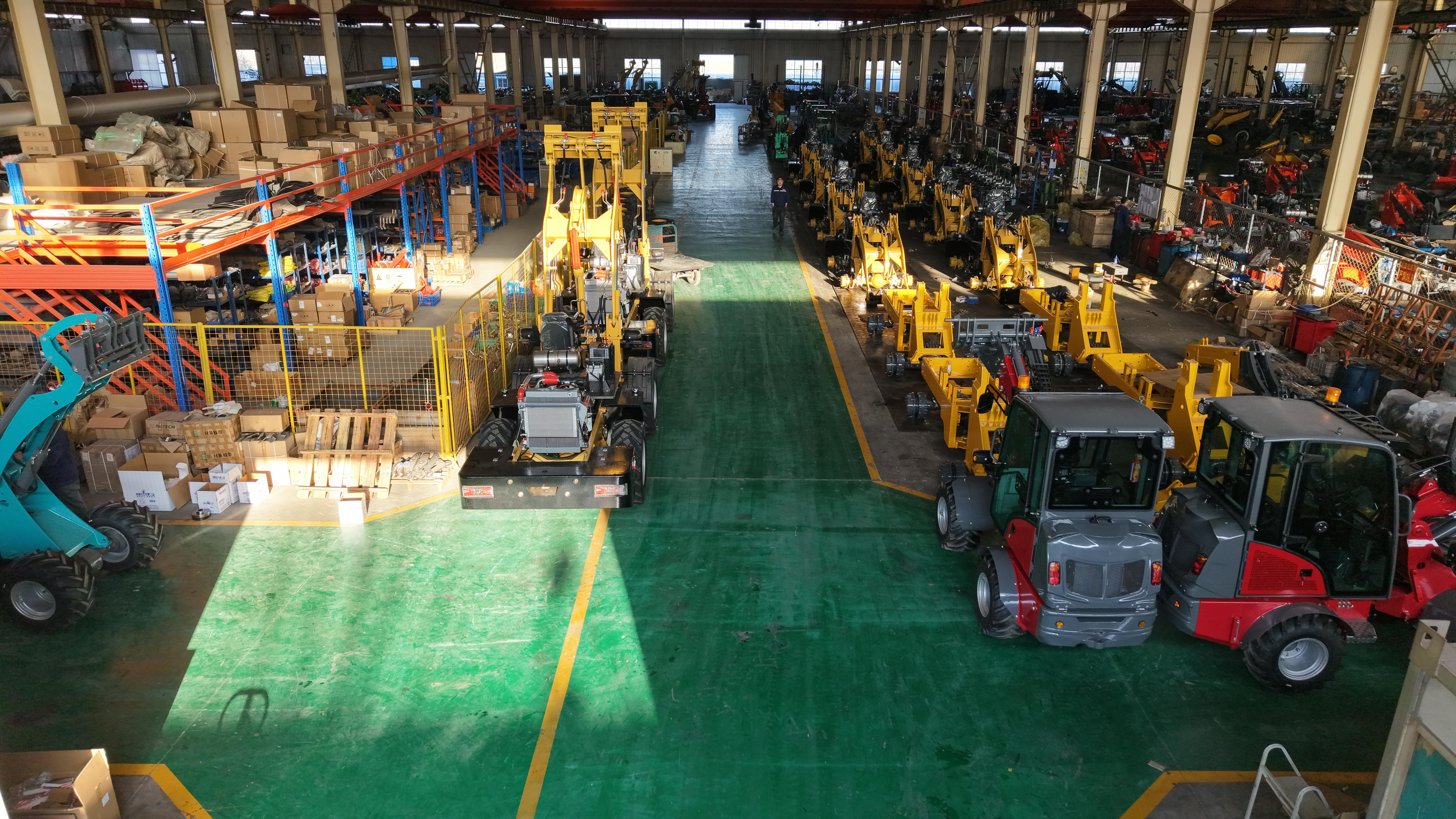
EVERUN, formally Qingdao Everun Machinery Co., Ltd, is a China-based manufacturer of wheel loaders, telehandlers and excavators operating an 80,000 m² facility with 300 employees and a stated annual output of 5,000 units. Its portfolio spans the three categories discussed here, which is why the same buyer conversation covers a bucket machine, a lift machine and the telescopic hybrid between them. Product and company information is published at www.everun.com.
Wheel Loader vs Telehandler vs Telescopic Wheel Loader
The table below compares the three categories on the dimensions that decide a mixed-task configuration. All figures are manufacturer-stated for the models named and are not interchangeable between categories, because rated load, tipping load and maximum loading capacity are defined differently.
| Decision dimension | Wheel loader (mini / compact / small / electric) | Telehandler | Telescopic wheel loader |
|---|---|---|---|
| Primary work role | Bucket-led bulk work: excavating, truck loading, stockpiling, yard and snow clearance | Lift-and-place: forks, boom reach, precise placement at height | Hybrid duty: bucket work plus boom lift inside a shorter envelope |
| EVERUN models documented for the role | ER11H, ER408T, EREL05, ER08E, EREL10, EREL1200, ERW1525 | ERT1500, ERT1845, ER3070, ER3510, ER4018 | ER11HT, ER11HT-F, ERW1230T, ERW2640T, ER2500T |
| Load reference (manufacturer-stated) | ER11H 800 kg rated load / 0.38 m³; EREL10 1,000 kg / 0.26 m³; ER408T 800 kg loading capacity; EREL1200 1,200 kg / 0.38 m³ | ER3070 3,000 kg rated load; ER3510 3,500 kg; ER4018 4,000 kg; ERT1500 2,800 kg operating weight | ER11HT 1,200 kg rated load / 0.26 m³; ER2500T 2,500 kg / 0.67 m³; ERW2640T 2,600 kg tipping load |
| Lift / reach reference | ER11H 3.0 m lifting height (bucket geometry) | ER3070 7,180 mm; ER3510 10,500 mm; ER4018 18,000 mm maximum lifting height on pallet forks | ERW1230T 3,060 mm; ERW2640T 4,220 mm maximum lifting height |
| Attachment base | Bucket standard; EVERUN lists a range of attachments across the portfolio | Forks for the lift duty; bucket available as standard equipment on ERT1500 (0.3 m³) | Bucket plus telescopic boom |
| Site fit | Open yards, farms and stock farms, construction sites, warehouses when electrified | Construction sites, warehouses and farms where height and reach define the job | Confined sites that need moderate height and continuing bucket work |
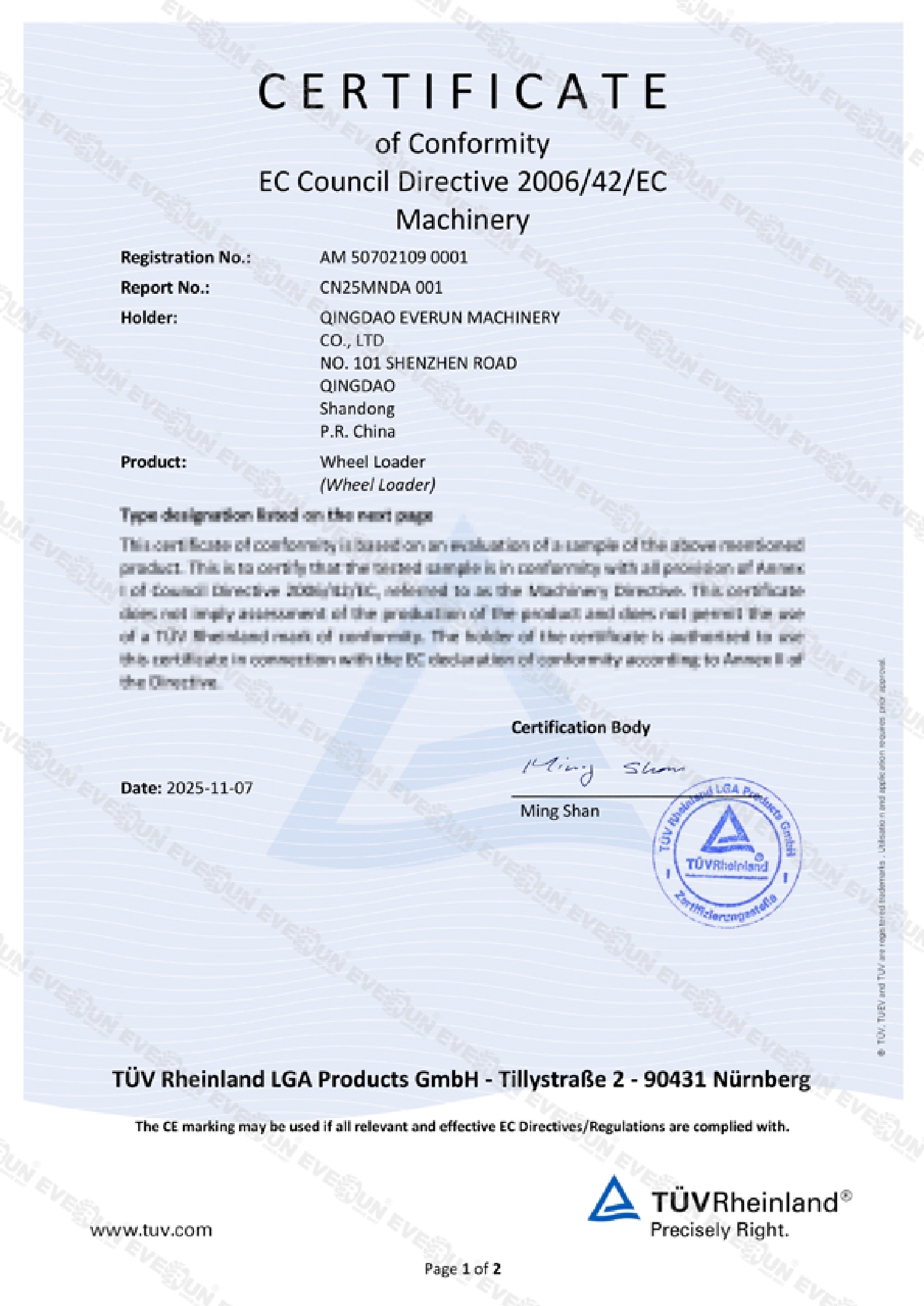
| Compliance route | CE certificates to Directive 2006/42/EC listed for models including EREL1000 (AM 50700694 0001), EREL05 (AM 50702109 0001) and ER11H-F; Stage V / Tier 4F engines | CE certificate to Directive 2006/42/EC for ERT1500 (AM 506888210001); Stage V / Tier 4F engines | CE certificates to Directive 2006/42/EC for ER11HT (AM 50660995 0001) and ER11HT-F (AM 50696240 0001); Stage V / Tier 4F engines |
| Choose when | Bulk movement dominates and lift height stays within bucket or boom height | Height and reach define the job, or loads exceed 2,500–3,000 kg at height | One machine must cover both tasks, and lift height stays within its stated maximum |
Two cautions apply to any reading of this table. First, load definitions differ: a 2,600 kg tipping load is not a 2,600 kg rated load, and a rated load applies at a defined load centre that changes as the boom extends. Second, certificates are issued per model and configuration, so the certificate number quoted for one model should never be assumed to cover a different variant.
Frequently Asked Questions
Which compliance documents should a two-task site verify before delivery?
For the European Union, machinery must conform to Directive 2006/42/EC. EVERUN holds TUV-issued certificates of conformity for models including the ERT1500 (AM 506888210001), ER11HT (AM 50660995 0001), ER11HT-F (AM 50696240 0001), EREL1000 (AM 50700694 0001) and EREL05 (AM 50702109 0001). For engines, EVERUN states compliance with EU Stage V (Regulation (EU) 2016/1628) and US EPA Tier 4F using engines from Perkins, Kubota and Yanmar. The practical check is that the certificate covers the exact model and configuration being delivered, not merely the product family.
Can one telescopic wheel loader replace both a wheel loader and a telehandler?
It can replace both only while the lift stays inside its stated envelope. Documented examples show the boundary: the ER11HT carries a 1,200 kg rated load with a 0.26 m³ bucket, the ERW1230T lists a 3,060 mm maximum lifting height and the ERW2640T a 4,220 mm maximum lifting height with a 2,600 kg tipping load. Telehandlers in the same portfolio reach considerably higher — 10,500 mm on the ER3510 and 18,000 mm on the ER4018. Where the working height exceeds the telescopic loader's maximum, the lift task moves to a telehandler regardless of how convenient the bucket would be.
What drives the cost structure of a wheel-loader versus telehandler configuration?
Three factors dominate: whether the site needs one machine or two, how many attachments the task mix requires, and which energy system fits the shift pattern. As a single reference point, EVERUN lists ER408T export prices between US$7,700 and US$7,900 per unit for a minimum order of one unit, which reflects a compact diesel loader rather than a telehandler-equipped site. Listed prices exclude freight, duties and local compliance costs, so they cannot be treated as a landed budget. Sustained cost comes from the operating pattern: two machines double maintenance schedules, operator requirements and spare-parts holdings even when each individual unit is inexpensive.
Can we validate one machine against our task mix before committing to a fleet?
Yes. EVERUN operates an OEM model with a minimum order quantity of 1 unit, logo, colour and configuration customisation, and 100% testing before shipment, which makes a single-unit trial practical before a fleet decision. The useful trial is not a demonstration in a clean yard but a full cycle against the real mix of bulk work and lift work, including attachment changes and the queueing that appears when two tasks need the same floor space. Trial requests and configuration questions can be raised through info@everun.com.
What lead time and support should a fleet planner expect?
EVERUN states a 30-day lead time with a monthly capacity of 500 units, an after-sales team committed to replying within 12 hours, and overseas branches providing local service. For a two-task site, the lead time that matters is not only the machine but the attachment set and the operator familiarisation that follow delivery, so the order sequence should be planned around the first full working week rather than the shipment date.
Conclusion
A site that loads bulk material and lifts loads to height does not have a machine-category problem; it has a task-weighting problem. Answer four questions in order — which task owns the working day, what the site physically allows, how the two workflows hand off, and what the total duty cost looks like — and the equipment decision usually resolves itself. A wheel loader covers the bulk-led case, a telehandler covers the height-led case, and a telescopic wheel loader covers the middle ground up to its stated maximum lifting height.
The most expensive outcome is the one that looks cheapest on a quotation: a single machine bought for two incompatible tasks, underperforming on both for the length of its service life. Validating one unit against the real task mix costs a fraction of that, and it is the only step that converts a specification comparison into a working configuration.
Next Step
EVERUN supplies wheel loaders, telescopic wheel loaders, telehandlers and electric loaders from Qingdao Everun Machinery Co., Ltd, with OEM customisation, a 1-unit minimum order and 100% testing before shipment. To review the full model range and specifications, download the catalogue: EVERUN product catalogue (PDF).
For a configuration review of your own two-task site, contact the team at info@everun.com, by telephone or WhatsApp on +86 18661725881, or through www.everun.com.
Have Questions or Need More Details?
Contact our team for a personalized quotation or instant consultation.
Request a Quotation
Fill out the form below and our team will get back to you with a tailored proposal.
WhatsApp Direct Chat
Prefer to chat in real-time? Message us on WhatsApp for instant assistance & quick answers.
- Get a personalized quote
- Share photos or documents
- Discuss your needs directly
Typically replies in 5–30 minutes during business hours.