Telehandler vs Wheel Loader: A Head-to-Head Decision Guide for Industrial Buyers
Telehandlers and wheel loaders are regularly shortlisted against each other for a single material-handling role, and the decision is usually made on the wrong criteria. The two categories move material in fundamentally different ways. A telehandler carries a load on forks, a bucket or another attachment and raises it on a telescopic boom. A wheel loader drives into a pile, fills a bucket and carries loose material across a yard. Both machines handle material, but they do not perform the same task.
Answer first: if the role that must be covered is lifting and placing a load at height, or reaching over an obstacle, a telehandler is normally the better fit. If the role is digging, scooping or carrying bulk material at ground level, a wheel loader is normally the better fit. If the role genuinely contains both halves — loading in the morning and placing at height in the afternoon — the right answer is usually not a compromise between the two categories, but a telescopic wheel loader or a compact wheel loader engineered for mixed duty.
This guide is written for industrial buyers who have to make a single either/or decision — one machine, one role, one approval — and who need a decision framework rather than a catalogue. It is published by a company that manufactures both categories, including compact wheel loaders and electric wheel loaders, which is precisely why the advice here stays neutral: the framework should determine the outcome, not the supplier's product list.
The Problem: Most Buyers Compare Machines Before They Define the Role
The recurring failure pattern in equipment procurement is that the machine category is chosen before the material-handling role is defined. A buyer inherits a task — clear a yard, feed a hopper, move pallets onto a mezzanine, keep a stockpile under control — and then starts comparing the machines that feel familiar rather than the machines that match the job. Three symptoms usually follow:
- The machine spends part of every week waiting for the correct attachment, because the attachment requirement was discovered after purchase rather than specified before it.
- The operation rents a second machine to cover the half of the role the first machine cannot do, which quietly converts a capital decision into a permanent operating cost.
- Operators improvise — lifting at angles the machine was not designed for, or digging with a machine built for lifting — which shortens component life and creates avoidable safety exposure.
The reason this decision feels difficult is that it is genuinely binary for most buyers. A single machine is being replaced after years of service, and the replacement must cover one defined role. Few industrial operations want two machines for that role, and fewer still want to fund two.
Industry Background: Why the Choice Has Become Harder
Three market shifts have made the telehandler-versus-wheel-loader comparison less obvious than it used to be.
Categories now overlap at the edges
Quick couplers, tool-carrier designs and telescopic booms have pushed the two categories into each other's territory. A wheel loader can be ordered with attachments that go well beyond a bucket, and a telehandler can be ordered with a bucket and used for light loading. Where the overlap becomes concrete is in the telescopic wheel loader: a machine that loads like a loader and reaches like a telehandler. That machine exists for one reason — buyers kept asking one machine to do both jobs.
The compact end of the market is where most of these decisions are actually made
Market analysis from Fortune Business Insights tracks the compact loader segment as a distinct and growing part of the equipment market. In practice, compact loaders now take on work that was previously done by hand, by tractors with front loaders, or by full-size machines that were oversized for the yard. The consequence for buyers is that a compact wheel loader and a compact telehandler are far closer to each other in size, footprint and cost than the full-size versions of the same two categories. The decision is therefore tighter, not looser.
Electrification has added a new selection variable
Industry association data from China shows electric wheel loader sales rising sharply year on year, driven by indoor work, noise-restricted sites and emission-sensitive projects. That trend changes the shape of this comparison, because on the wheel loader side the buyer now has an electric answer to a site-condition problem. EVERUN's electric range includes the EREL05, ER08E, ER08EH, EREL10, EREL1000, EREL1200 and ERW1525E, positioned for agriculture, construction, logistics, landscaping, forestry, recycling, snow removal, urban construction, farm work, and indoor or noise-restricted conditions. On the telehandler side, the range remains primarily diesel-powered. A buyer whose site conditions demand electric operation has therefore effectively set a category preference before the first technical question is even asked.
Compliance has become a selection criterion rather than paperwork
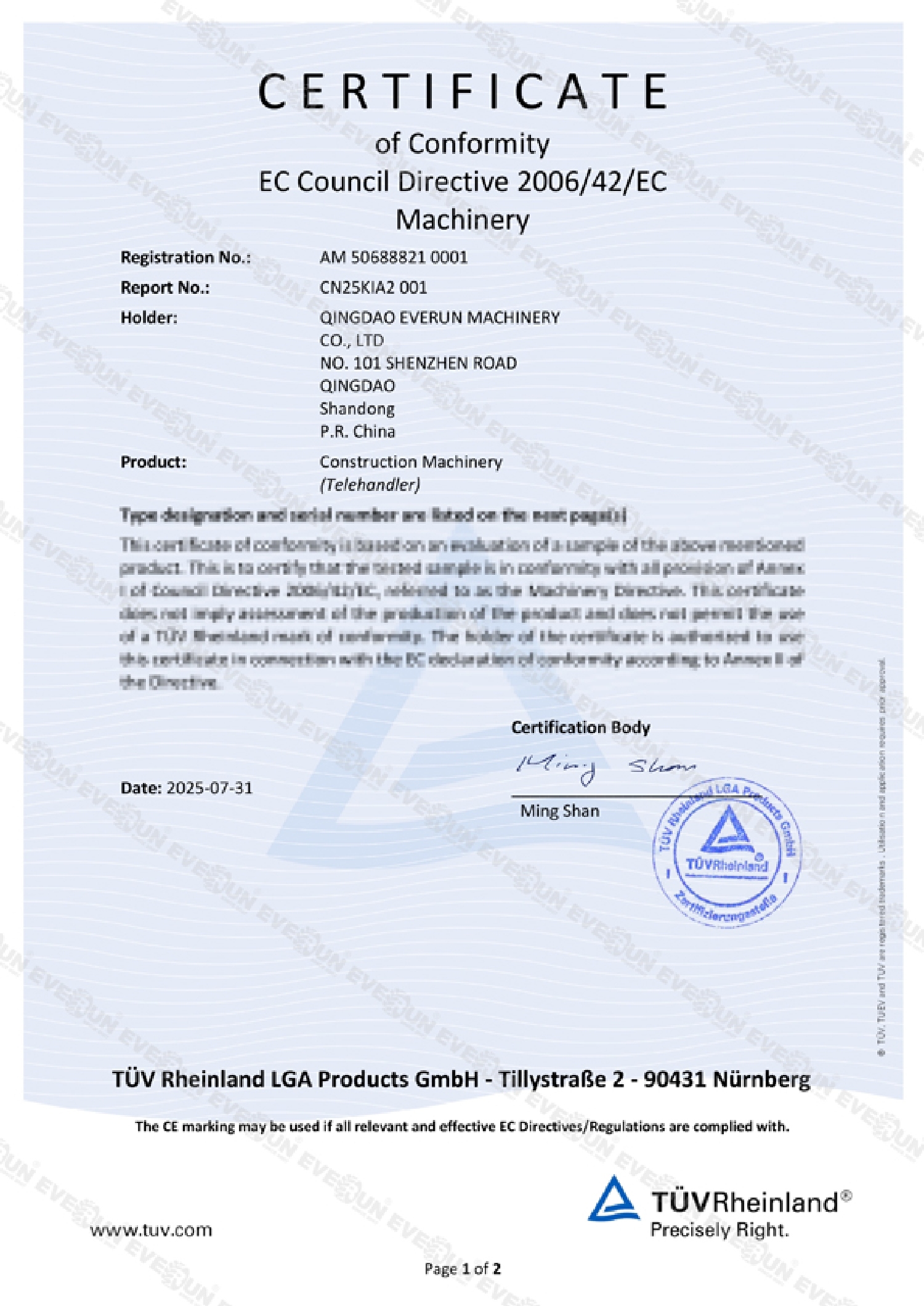
In the European Union, both machines are covered by the Machinery Directive, but the harmonized standards differ by machine type. Wheel loaders fall under EN 474-3, which addresses operator stations and protective structures such as ROPS and FOPS. Conformity is granted per machine type, not per brand. TÜV has issued CE conformity for EVERUN machines including the ERT1500 telehandler, the EREL1000 and EREL05 electric wheel loaders and the ER1220 compact wheel loader, and TÜV Rheinland has certified the ER08E, ER1220 and ERT1500 for MD CE, Noise and EMC compliance. For a buyer, the practical benefit of a supplier who manufactures both categories is that the conformity route for both halves of the decision can be documented through one vendor — which removes one reason to split the order across two suppliers.
The Decision Framework: Five Questions That Settle the Choice
Work through the five questions below in order. The first two decide the category in most cases; the third and fourth break ties; the fifth is the reality check that stops a technically correct machine from becoming an operational problem.
Question 1 — What must the machine lift and place, and in what form?
Start with the load itself, not the machine. Palletised freight, bagged material, bales, wrapped bales, pipe, drums and pre-assembled components are discrete loads that must be carried level and set down accurately. Aggregate, soil, sand, snow, waste and feed are bulk loads that must be reduced from a pile, carried and dumped. Discrete loads point toward a telehandler; bulk loads point toward a wheel loader. If the answer is "both, but the discrete loads are the critical ones", say so explicitly — that is the case where a telescopic wheel loader or a compact wheel loader enters the shortlist.
Question 2 — How high, and how far forward, must the load travel?
Reach is the single question that most often removes the wheel loader from the shortlist. Placing a load onto a mezzanine, over a wall, over a stack, into the far end of a trailer or into a container requires a machine that extends outward, not one that lifts within its own linkage geometry. A wheel loader is at its strongest working at ground level and can be highly productive there; it is not built to extend a load into a space the operator cannot drive into. Ask two specific questions: what is the highest point the load must reach, and how far horizontally must it travel past the machine's own footprint?
Question 3 — What are the ground and site conditions?
Firm, level, well-drained yards suit both categories. Rough terrain, mud, snow, gradients and uneven stockpile areas change the answer. Indoors, the constraints are different again: overhead clearance, floor loading, exhaust, noise and, increasingly, emission restrictions. Working method matters as well — a telehandler normally places a load from a static position, governed by its load chart, while a wheel loader works in motion, driving into the pile and cycling continuously. The machine should match the rhythm of the task, not the reverse.
Question 4 — How often will the attachment change?
If the same machine has to run a bucket, forks, a grab, a sweeper and a snow blade within a single week, attachment changeover becomes a genuine decision criterion and the tool-carrier logic of a telehandler becomes valuable. If the machine will do essentially one job with one attachment for the whole season, a wheel loader's dedicated bucket productivity matters more than changeover convenience. Buyers should count attachment changes per week honestly rather than optimistically.
Question 5 — How does the machine fit the fleet, the operators and the service network?
A machine that is technically correct but unsupported locally is the more expensive mistake. This question covers parts commonality across an existing fleet, whether operators already have the right habits for the category, how much training the change requires, whether the supplier supports OEM configuration, and how quickly service can reach the site. Because load charts, stability limits and lifting technique differ from bucket work, operator experience should be treated as a real variable, not a formality.
Applying the answers: if questions one and two dominate, the telehandler is the category. If questions three and four dominate — continuous bucket work, rough ground, minimal attachment changes — the wheel loader is the category. If the answers are genuinely mixed across all five, the telescopic wheel loader or a compact wheel loader is the honest answer, and it should be challenged with the same questions before purchase.
Where a Telehandler Wins
- Lift-and-place work at height or over an obstacle. Any task where a load has to be set down above or beyond the machine's own footprint.
- Discrete loads that must stay level. Palletised goods, crates, bales and components carried on forks or a platform.
- Mixed attachment duty. Where the machine is expected to switch between forks, a bucket, a grab and a snow blade as the week changes.
- Defined placement tasks. Work organised around a lifting cycle rather than a loading cycle.
- Yards where handling dominates. Sites that spend as much time positioning materials as they do moving bulk.
- Rental and contracting fleets. A rental company serving several industries needs a machine that can be re-tasked between customers — the telehandler is the more re-taskable of the two categories.
Where a Wheel Loader Wins

- Pile work. Aggregate, soil, sand, snow, waste and feed that must be reduced, carried and dumped.
- Repetitive loading cycles. Filling trucks, feeding hoppers or moving material across a yard in a continuous rhythm.
- Ground-level hauling over distance. Longer travel legs over rough yard surfaces, where a loader is in its designed working mode.
- A stable attachment set. Operations that run one bucket all season and do not want to pay for flexibility they will not use.
- Compact yards and indoor work. Compact wheel loaders — including the ER1220, ER11H and ERW1525 — cover small construction, agricultural and garden tasks where a full-size loader is oversized.
- Emission- and noise-restricted sites. Electric wheel loaders remove restrictions that no diesel machine can solve, which is often the deciding factor in indoor or urban projects.
The Overlap Zone: Telescopic and Compact Wheel Loaders

If the five questions produce a split verdict, the overlap zone is where the answer usually sits. A telescopic wheel loader loads with a bucket and extends a linkage to place material; EVERUN builds this type of machine, including the ER11HT telescopic loader and the EREL1000 electric telescopic wheel loader. Compact wheel loaders such as the ER1220, ER11H and ERW1525 serve the same logic at a smaller scale, where the yard itself is the constraint.
The honest caveat is that an overlap machine is not identical to a dedicated telehandler. It is engineered around mixed duty, so its placement capability is a compromise designed in exchange for loading productivity, and the load chart still governs what can be placed and where. Rather than assuming, buyers should ask the supplier directly which specific role the machine was engineered for, and then re-run the five questions against that answer.
Use Cases: Where the Same Decision Looks Different
Construction sites and equipment yards
A contractor's yard is a classic mixed-duty environment: materials arrive on pallets, aggregates arrive in piles, tools and components need repositioning, and the same machine is expected to do all of it. This is where a buyer should resist specifying two machines by default and instead identify which of the five questions is the true bottleneck for the season.
Agriculture, stock farms and landscaping
Farm work combines bucket duty — feed, bedding, manure, soil — with bale handling and stacking. A common pattern is a wheel loader handling bulk material continuously while a telehandler or telescopic loader handles stacking and placement. EVERUN's compact and mini wheel loaders are widely applied in agriculture and garden work, and the telescopic models cover the stacking half of the same site.
Warehouses, factories and logistics yards
Indoor handling imposes constraints that have nothing to do with lifting capacity: exhaust, noise, floor loading and aisle width. This is where an electric wheel loader — such as the ER08E, ER08EH or EREL10 — is designed to fit, covering urban construction, farm work, and indoor or noise-restricted environments. In a warehouse role, the site-condition question can settle the category before the load question is even examined.
Municipal work, winter service and snow removal
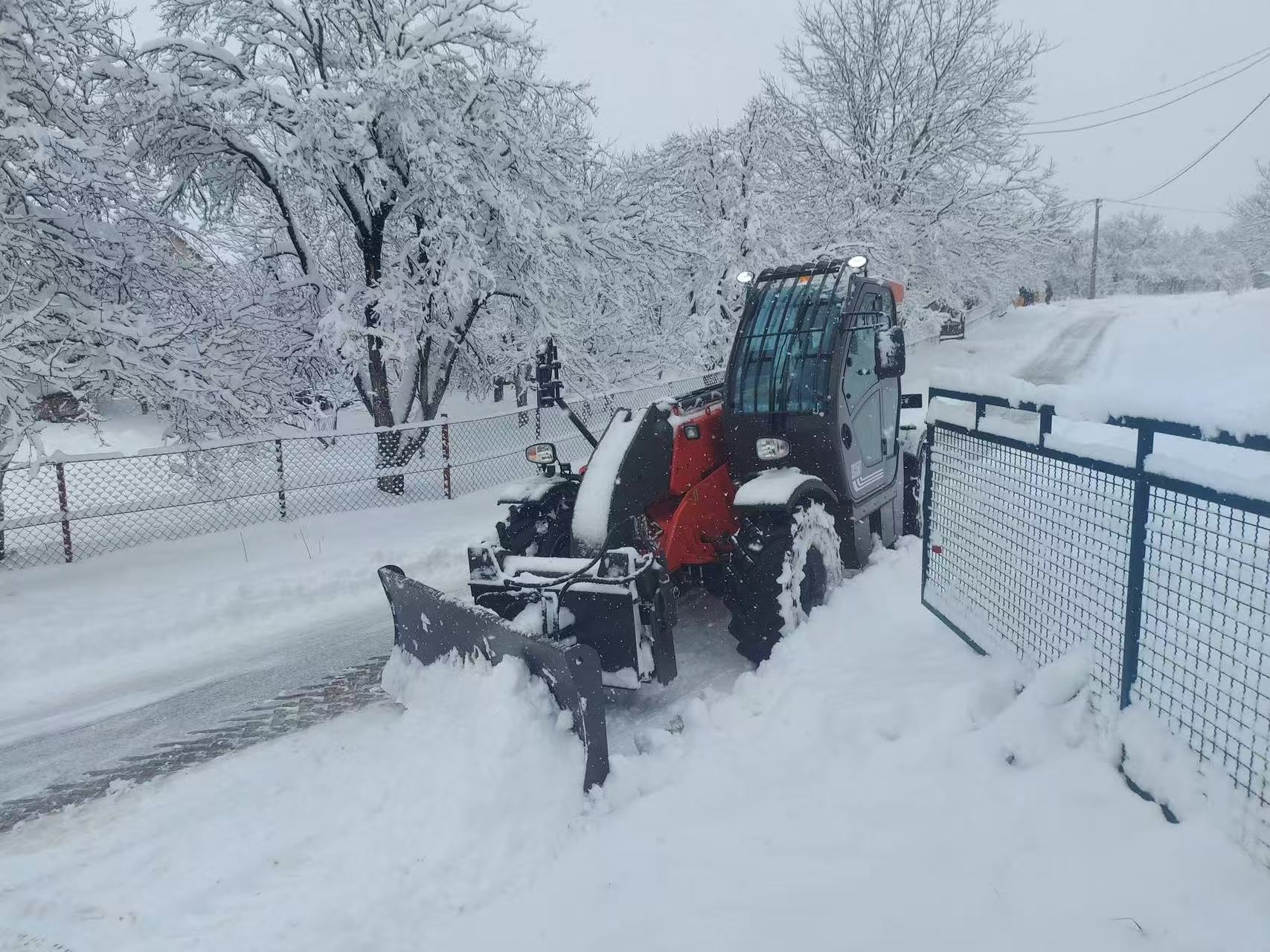
Winter service is one of the clearest overlap areas, because the same fleet has to clear snow, load it out, and handle materials on the same sites. Reliability under sustained cold is the real specification here. A Canadian construction contractor and equipment rental company has operated EVERUN machines for winter snow removal over multiple seasons with stable results in deep-cold conditions — a reminder that in this application, cold-start behaviour, parts availability between seasons and simple maintenance access matter more than headline capability.
Emission-sensitive and indoor projects
For underground-type work, indoor demolition, food and processing environments or urban sites with working-hour restrictions, an electric wheel loader changes what is permitted on site. EVERUN's electric loaders are positioned for agriculture, construction, logistics, mining, landscaping, forestry, recycling and snow removal — categories where a zero-emission machine either unlocks a job or removes a ventilation problem.
Telehandler vs Wheel Loader: A Neutral Comparison
| Decision factor | Telehandler | Wheel loader |
|---|---|---|
| Primary work | Lifting, reaching and placing loads | Digging, scooping and carrying bulk material |
| Typical load form | Pallets, bales, crates, components on forks or a platform | Aggregate, soil, sand, snow, waste, feed |
| Height and forward reach | Boom extends up and outward, past the machine footprint | Lifting geometry is tied to the linkage; loads stay close to the machine |
| Working method | Often places a load from a static position, governed by the load chart | Works in motion, driving into the pile in a repeating cycle |
| Attachment changes | Built around tool-carrier flexibility: forks, buckets, grabs, blades | Usually stays on a bucket; attachments are secondary |
| Site conditions | Suits defined placement points and mixed yards | Suits firm yards, stockpiles and loading areas with continuous cycles |
| Electric options | Limited in the category; EVERUN's electric range is concentrated in the wheel loader family | Available — EREL05, ER08E, ER08EH, EREL10, EREL1000, EREL1200, ERW1525E |
| Compliance route | Machinery Directive conformity, granted per machine type | Machinery Directive conformity; EN 474-3 covers operator stations and ROPS/FOPS |
| Operator skill base | Load-chart discipline and lifting technique | Bucket loading technique and pile management |
| Fleet role | Often a shared, multi-task yard machine | Often a dedicated production machine |
Budget: A Lifecycle Question, Not a Sticker Question
Two machines that look comparable at the quotation stage can diverge sharply over a service life. Four cost lines decide the real answer: the attachment set the role requires, the energy source and its running cost, wear parts and service access over the ownership period, and — the line buyers most often ignore — the cost of the wrong machine, which shows up as rented equipment, delayed work or an unplanned second purchase.
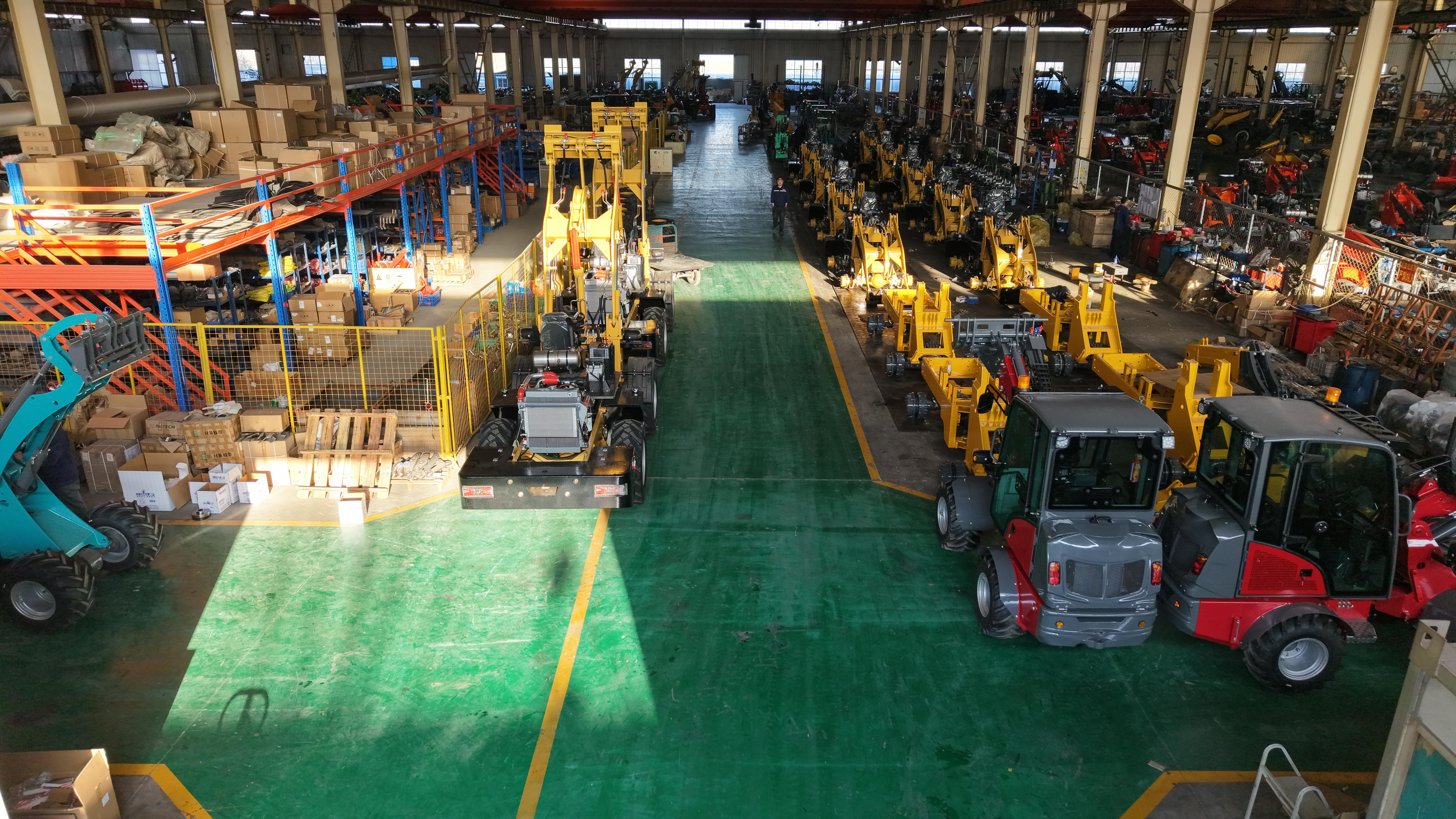
For that reason, a telehandler quotation should never be compared line-for-line with a wheel loader quotation as if the machines performed the same work. An OEM production model helps here: EVERUN builds to order with logo, colour and configuration customisation, which lets a buyer specify the machine around the actual role instead of buying a standard configuration and paying to correct it later. Every machine is tested before shipment, and after-sales support is handled through a dedicated team with local service provided by overseas branches.
FAQ: Telehandler and Wheel Loader Questions Buyers Ask Before Ordering
1. Do telehandlers and wheel loaders follow the same compliance route in the EU?
Both are machinery under the EU Machinery Directive, but the harmonized standards differ by machine type. Wheel loaders fall under EN 474-3, which addresses operator stations and protective structures such as ROPS and FOPS. Conformity is granted per machine type rather than per brand. TÜV has issued CE conformity for EVERUN machines including the ERT1500 telehandler, the EREL1000 and EREL05 electric wheel loaders and the ER1220 compact wheel loader, and TÜV Rheinland has certified the ER08E, ER1220 and ERT1500 for MD CE, Noise and EMC compliance. Buyers should confirm the certificate against the exact model being ordered, not against the supplier's brand name.
2. Can one supplier realistically cover both a telehandler requirement and a wheel loader requirement?
Yes, and for mixed fleets that is the practical advantage. EVERUN (Qingdao Everun Machinery Co., Ltd) manufactures wheel loaders, telehandlers and excavators, with compact and electric wheel loader options alongside larger loaders. Sourcing both categories from one manufacturer means one OEM production flow, one quality-control approach, one documentation route and one after-sales contact point instead of two — which matters most at the service stage, not the purchase stage.
3. How should a buyer frame the budget when the two categories pull in different directions?
Frame it as total cost of ownership rather than purchase price. The attachment set, the energy source and its running cost, wear parts and service access, and the cost of covering the half of the role the chosen machine cannot do should all be counted. A machine that is cheaper to buy but forces the operation to rent a second unit for part of the year is not the cheaper decision, and a machine that is expensive to own but eliminates a site restriction may be cheaper than it first appears. Configuration flexibility also affects cost: OEM customisation of logo, colour and configuration allows the machine to be specified for the role rather than adapted after delivery.
4. How can we validate the choice before committing to a fleet decision?
Validate on the task, not on the specification sheet. Ask for a demonstration configured with the attachment the role actually requires — forks for a lift-and-place role, a bucket for a loading role — and run it on the real site, with the real loads, in the real ground conditions. EVERUN accepts single-unit sample orders, supports OEM customisation of logo, colour and configuration, and tests each machine before shipment. A sample or demonstration also tests the supplier, because response times, documentation quality and spare parts availability become visible during the trial rather than after the invoice.
5. What should we confirm about production and delivery before we order?
Production planning is what determines delivery, so the buyer should confirm the quoted production window in writing, establish which items are standard and which are configured, and align the delivery date with the site schedule rather than the reverse. EVERUN operates OEM production with a defined monthly production capacity and quotes lead time per order, because the answer depends on the configuration, the attachment set and the current production schedule. For buyers planning repeat purchases, the same production flow is what makes fleet-standard machines possible instead of one-off units.
If you want to move from framework to quotation, describe the role in one sentence — the load, the height, the distance and the ground conditions — and the EVERUN team can tell you which category the task actually points to. Full model ranges, documentation and configuration options are available in the EVERUN product catalogue, and the complete portfolio is listed at www.everun.com.
Conclusion: A Decision Checklist You Can Use Today
This comparison has one purpose: to stop a category decision from being made by habit. Use the checklist below before you request a quotation, and the shortlist will usually reduce itself to one category — or to the correct overlap machine.
- Write the role in one sentence: what is lifted or loaded, in what form, how high, how far and on what ground.
- If the load must be lifted and placed at height or beyond the machine's footprint, the telehandler is the category.
- If the load is a pile to be reduced, carried and dumped, the wheel loader is the category.
- If the site is indoors, noise-restricted or emission-sensitive, check the electric options in the wheel loader family first.
- If attachment changes dominate the working week, favour a tool-carrier design.
- If the duty cycle repeats continuously with one attachment, favour bucket production.
- If the load is discrete but the ground is rough and the cycle is long, test both categories before deciding.
- If the verdict is genuinely split, evaluate a telescopic wheel loader or a compact wheel loader — and re-run questions one to five against that specific machine.
- Confirm conformity documentation for the exact model, not the brand.
- Confirm parts, service and training access before you confirm the price.
Decide with evidence, then request the quote
EVERUN manufactures wheel loaders, telehandlers and excavators, including compact and electric wheel loader options, and supplies both categories of this comparison from the same production and after-sales organisation.
Download the EVERUN catalogue | www.everun.com | Email: info@everun.com
Send the role description — load, height, distance, ground conditions — and the EVERUN team will confirm which machine type fits before you commit.
Have Questions or Need More Details?
Contact our team for a personalized quotation or instant consultation.
Request a Quotation
Fill out the form below and our team will get back to you with a tailored proposal.
WhatsApp Direct Chat
Prefer to chat in real-time? Message us on WhatsApp for instant assistance & quick answers.
- Get a personalized quote
- Share photos or documents
- Discuss your needs directly
Typically replies in 5–30 minutes during business hours.