
Wheel Loader Supplier Vetting: A Delivery-Assurance Framework for Global Buyers
Wheel loader supplier vetting usually begins as a product question and ends as a logistics problem. Buyers compare models carefully, then place the order with a delivery plan, an inspection standard and a document set that were never agreed with anything close to the same precision. The machine is specified; the execution is improvised.
A delivery-assurance framework closes that gap. It is a staged set of evidence requests, written commitments and release gates that a buyer applies between shortlisting a wheel loader supplier and releasing the final shipment. In practice it answers four questions in order: can this supplier actually build the configuration being ordered, is capacity available inside the required window, will the handover documentation survive customs and site acceptance, and what must pass before the machine is allowed to leave the factory.
This article sets out six stages for that framework and applies them to mini, compact, telescopic and electric wheel loader portfolios. It deliberately avoids specification comparison. The objective is execution confidence, not another spec sheet, because most cross-border wheel loader disputes are not about whether a machine can lift a load — they are about whether what arrived matches what was promised, and when.
Why supplier vetting breaks down after the purchase order
Most vetting processes are front-loaded. Buyers collect catalogues, compare specifications, check a few references and negotiate a price. The evaluation formally ends when the purchase order is issued, and execution begins with almost no written baseline beyond the commercial invoice.
Three structural gaps cause most of the damage:
- Catalogue breadth is mistaken for configuration capability. A supplier may list dozens of models while only a subset can accept the attachment, branding or specification change the buyer needs.
- Capacity is mistaken for scheduling. A monthly output figure says what a factory can produce across all orders; it says nothing about where a specific order sits in the queue during the month it is placed.
- Commitments are mistaken for contracts. Response times, inspection standards and document lists are often agreed verbally, in a chat thread or in a brochure, and never appear in the order documents that govern the transaction.
The most expensive version of this failure is an acceptance criterion defined after production has started. At that point a technical disagreement about paint finish, attachment fit or test procedure is no longer a design conversation; it is a payment dispute with a finished machine on the floor.
The delivery-assurance framework at a glance
The framework moves from evidence to commitment at each stage. A supplier can pass a stage only with documentation, not with assurance. The table below summarises what each stage is designed to prove and what the buyer should be holding at the end of it.
| Stage | Question it answers | Evidence to request | Written commitment |
|---|---|---|---|
| 1. Capability verification | Can the supplier build this configuration, not just list it? | Production mode, customisation scope, model-level conformity document | Configuration approved before production |
| 2. Production readiness | Is capacity genuinely available in your window? | Stated monthly capacity, current committed load, batch plan | Dated production calendar, not a duration |
| 3. Order communication | Who confirms what, in which format, by when? | Named commercial and technical contacts, change-request path | Specification freeze date and revision control |
| 4. Documentation handover | Will the file set clear customs and site acceptance? | Certificate numbers and scopes, test records, shipping documents | Document list with delivery dates |
| 5. Pre-shipment acceptance | What must pass before the machine ships? | Inspection plan, test record, photo or video evidence | Pass/fail criteria and a release gate |
| 6. After-delivery support | What happens when a machine stops? | Service network, response commitment, parts terms | Response time and parts supply terms |
Stage 1 — Verify capability against the configurations you are buying
Capability is configuration-specific. The useful question is not “does this supplier make wheel loaders” but “does this supplier make this variant, and can it prove the variant exists on paper before production begins”.
EVERUN, a wheel loader, telehandler and excavator manufacturer based in Qingdao, China, publishes useful data points for this stage. Its stated production mode is OEM, and its declared customisation scope covers logo, colour and configurations. Those three items are not equivalent in risk: logo and colour are cosmetic and rarely affect the production schedule, while a configuration change may affect the attachment interface, the hydraulic package or the machine’s working envelope. A buyer should ask the supplier to state which of the three is engineering-led and which is applied at the finishing stage.
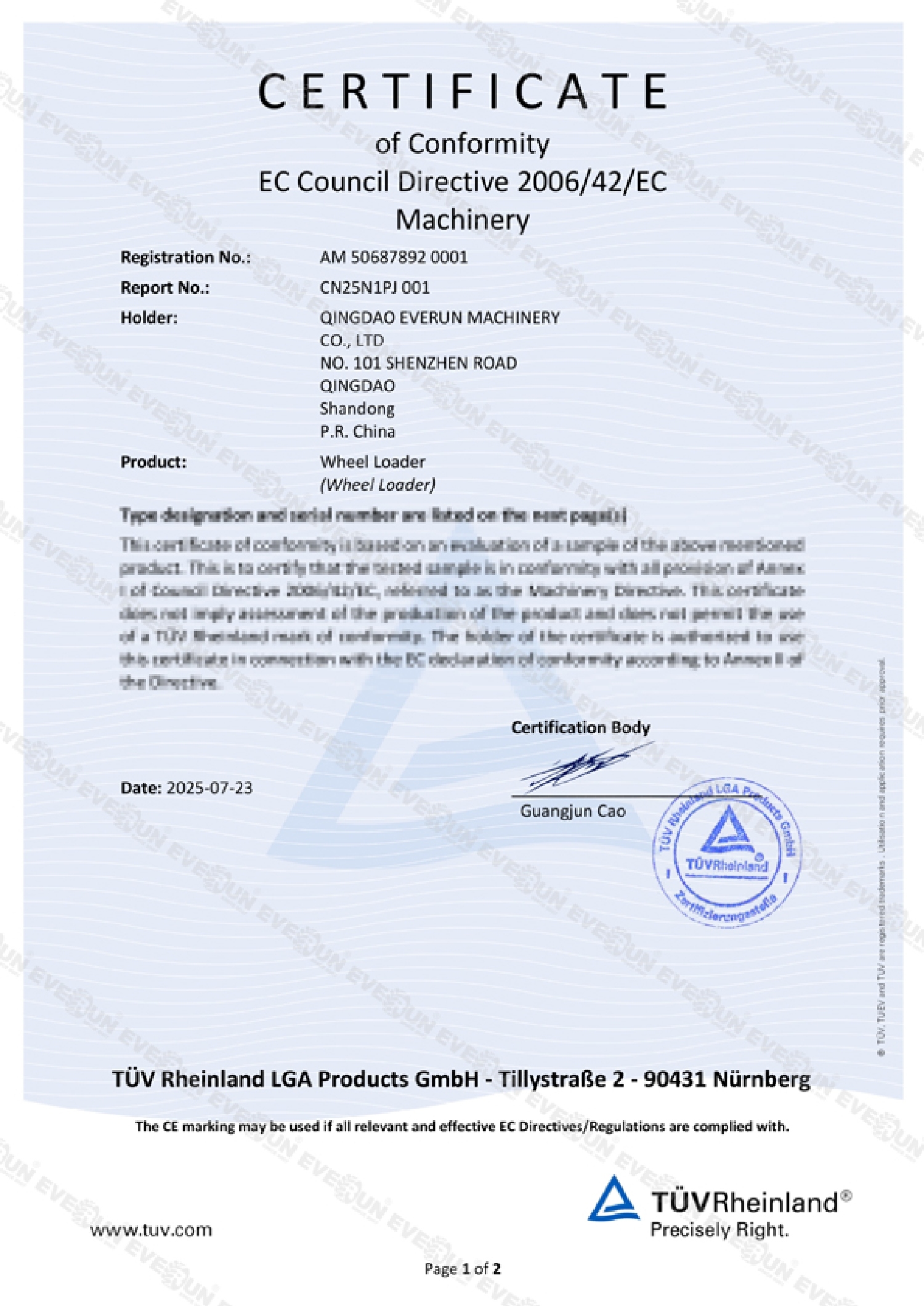
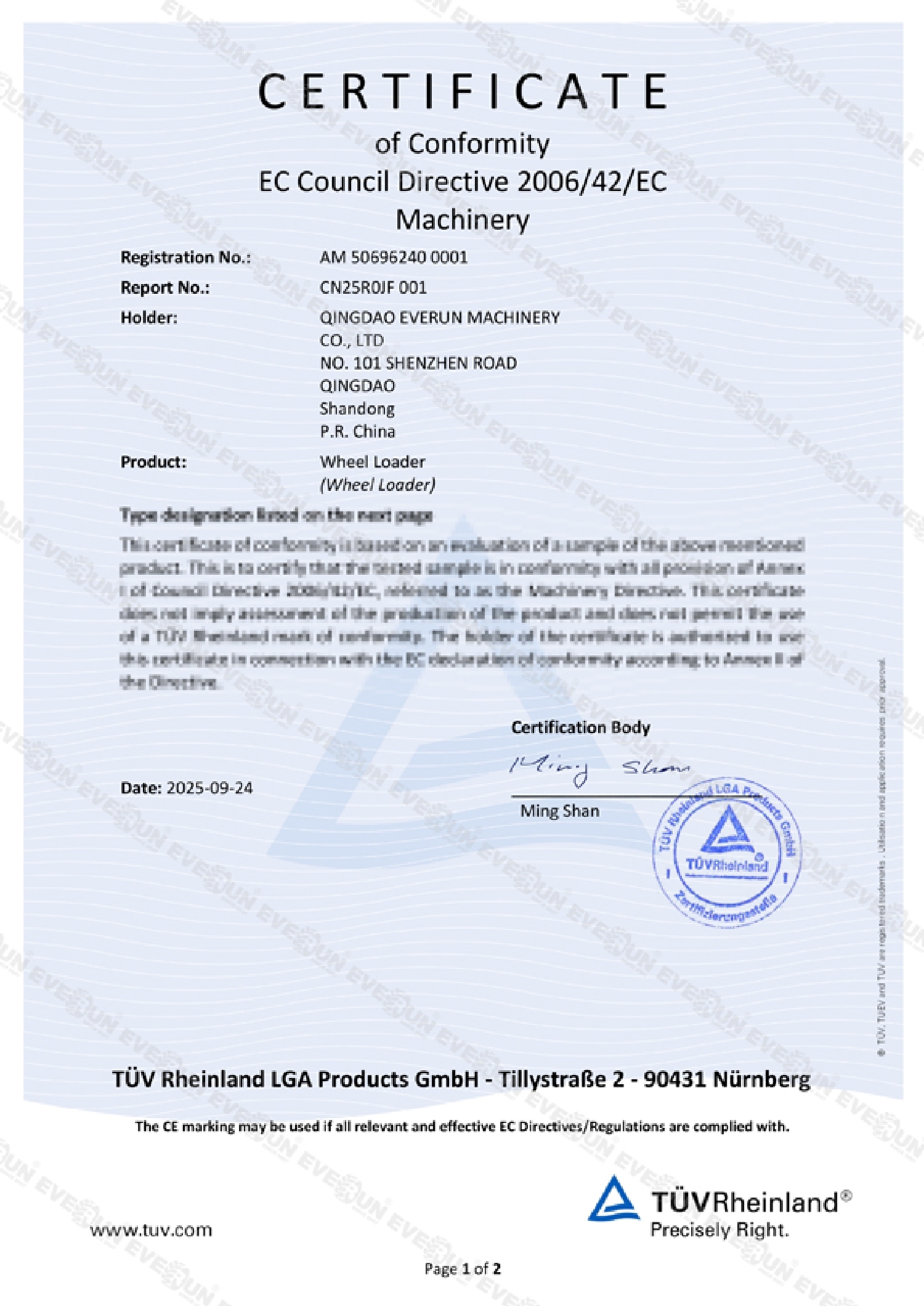
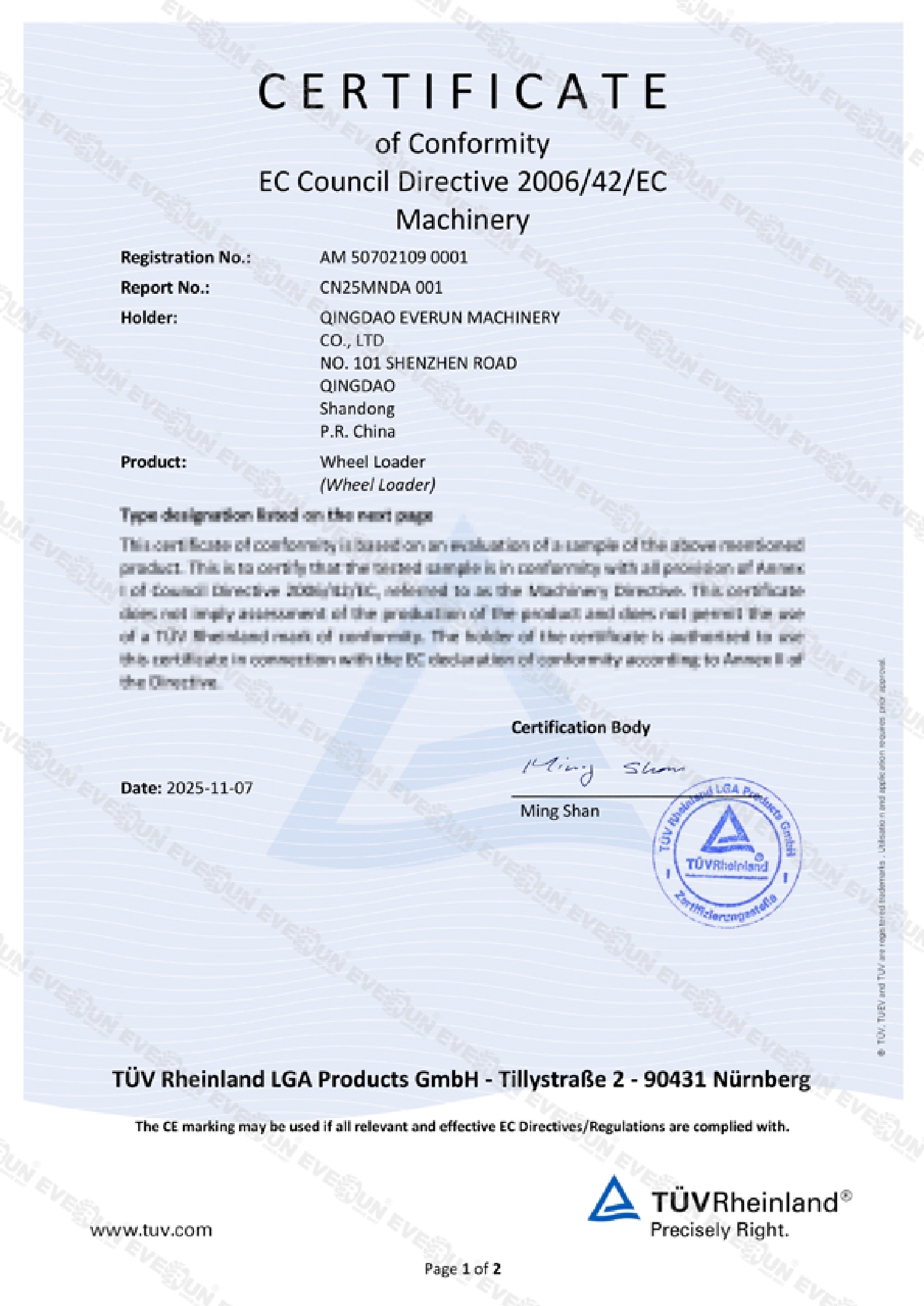
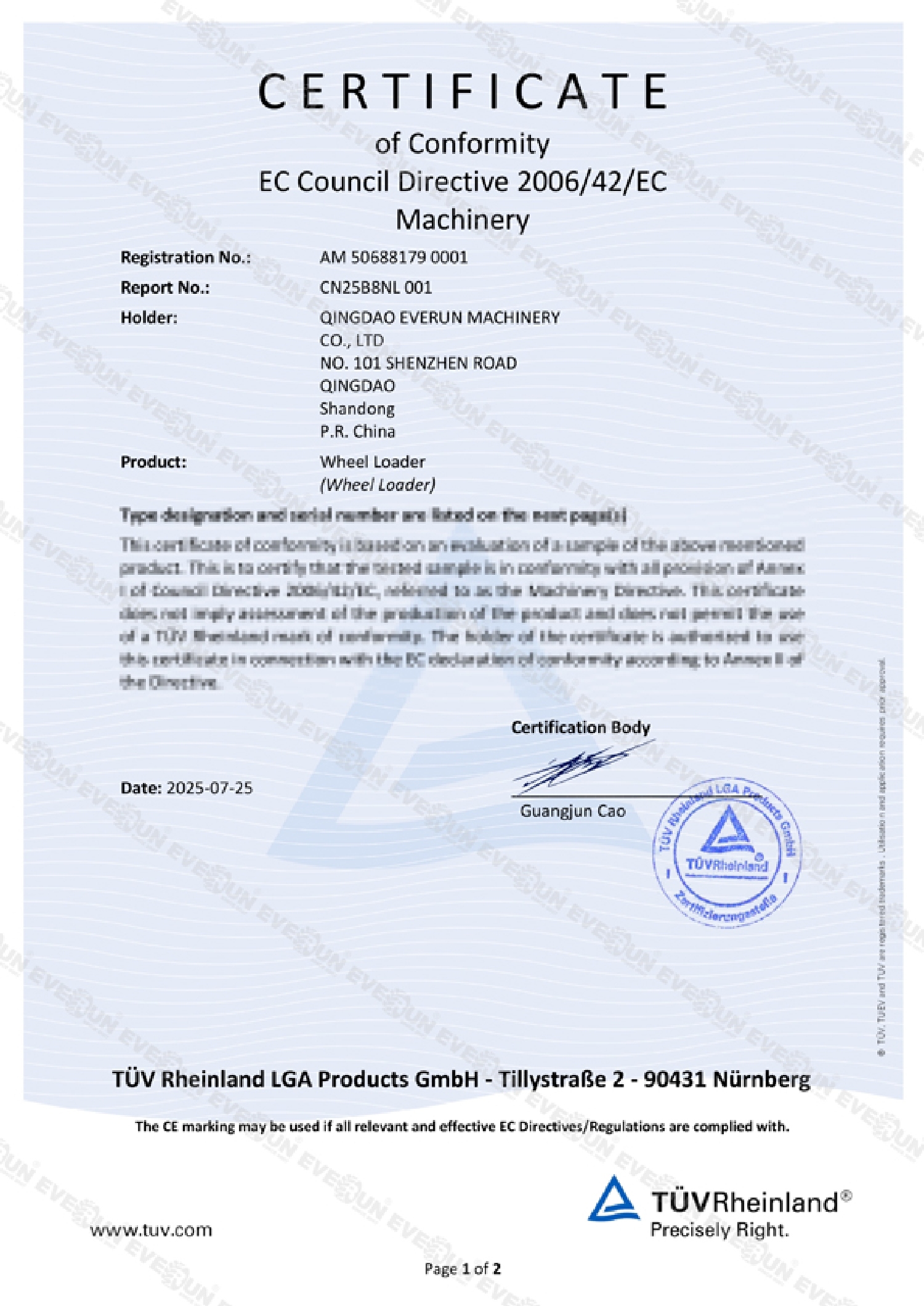
Compliance documents are the second half of capability verification, and the most commonly mishandled. A conformity certificate belongs to a model, not to a brand. EVERUN holds CE Certificates of Conformity issued by TUV under EC Council Directive 2006/42/EC, and each certificate names a specific scope with its own number:
- ERT1500 — certificate AM 506888210001
- EREL1000 electric wheel loader — certificate AM 50700694 0001
- EREL05 electric wheel loader — certificate AM 50702109 0001
- ER1220-F wheel loader — certificate AM 50687892 0001
- ER1220-C wheel loader — certificate AM 50688179 0001
The practical check is narrow: find your exact model designation on the certificate, confirm the issuing body and the standard cited, and confirm the certificate applies to the destination market you are importing into. A certificate covering a neighbouring model in the same family does not transfer, and a factory-level quality system document is not a product conformity document. Buyers who accept “we are CE certified” as a finished answer routinely discover at customs that the paperwork describes a different machine.
Decision rule for Stage 1: do not release a deposit until the supplier has sent a model-level conformity document naming your configuration, plus a written statement of what is customisable and what is not.
Stage 2 — Test production readiness, not just capacity figures
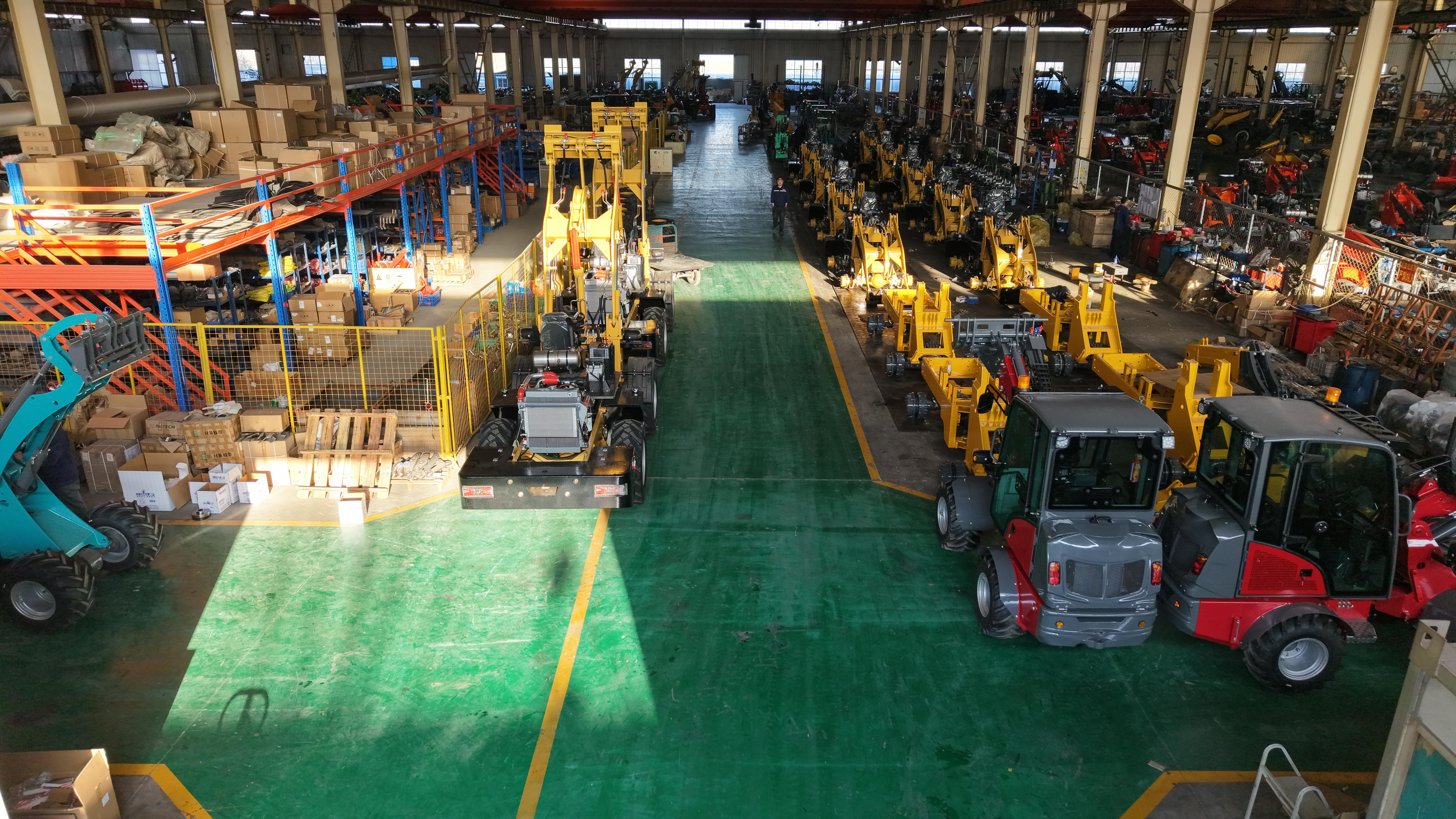
A capacity number without a schedule is marketing, not planning. EVERUN reports a monthly production capacity of 500 units, an annual output of 5,000 units, an 80,000 m² manufacturing footprint, 300 employees and a 30-engineer R&D team, with a typical production lead time of 30 days. Those figures describe a manufacturing scale. They do not describe where a specific order lands in a specific month, and a buyer who treats them as equivalent is buying an assumption.
The questions that convert capacity into readiness are operational:
- How much of the stated monthly capacity is already committed when my order enters the queue?
- Does my configuration require a separate batch, a separate setup, or a different line?
- Is the 30-day figure a production duration or a door-to-door commitment, and what starts the clock?
- What is the schedule if a component shortage occurs — substitute, wait, or partial shipment?
Ask for a calendar with dates rather than a duration in days. A supplier that cannot produce a dated calendar for a single machine order is telling you something useful about how it will handle a delay later.
EVERUN’s stated minimum order quantity is one unit, which matters at this stage more than it first appears. Single-unit orders are accepted, but a one-unit order and a fifty-unit order should never share the same milestone plan. The small order needs a simple, firm ship date; the large order needs staged release gates and probably a pre-production sample approval.
Stage 3 — Fix the order communication protocol before the specification freezes
Order communication is the stage most buyers skip, and it is where scope quietly expands. Changes arrive through chat messages, approved by someone who is not the person signing the invoice, referencing a drawing that has since been superseded.
A workable protocol is short enough to fit on one page and should be attached to the order:
- One commercial contact and one technical approver, named, with a stated deputy for each.
- One channel of record for change requests, with written acknowledgement required before any change is actioned.
- A specification freeze date, after which changes are priced and scheduled rather than absorbed.
- Revision-controlled configuration sheet, so both parties can point to the same document version at inspection.
- Escalation path with a defined trigger, such as two working days without a substantive answer.
Response commitments belong here rather than in the after-sales section. EVERUN states that its after-sales team guarantees a reply within 12 hours, and that overseas branches provide local service. That commitment is only useful during execution if it is written into the order documents with a defined clock — 12 hours from what, measured in whose working time, and to whom. A response promise in a brochure cannot be enforced; a response clause in a purchase contract can.
Reference points are not proof. EVERUN’s case data records eight units supplied to a construction contractor and equipment rental company in Canada for winter snow removal, with five years of stable operation reported in conditions down to −25°C. For a vetting file this is a starting point, not a conclusion. One client’s five-year record does not confirm that your configuration, duty cycle or climate will behave the same way. Its real value is that it generates specific questions: what changed in the machine specification for that deployment, and which of those changes apply to your order?
Stage 4 — Build a documentation dossier that clears customs and site acceptance
Documentation is the stage where good machines get stuck. A wheel loader can be built exactly to specification and still sit at a port because the conformity document names the wrong model, or fail site acceptance because the manual arrived in a language the operator cannot read.
The dossier should be agreed as a list with responsible parties and dates, not assembled at the end:
- Model-level Certificate of Conformity, with issuing authority, standard and certificate number
- Pre-shipment test record, signed and dated
- Commercial invoice and packing list consistent with the ordered configuration
- Transport document matching the agreed delivery term
- Warranty statement and spare-parts list
- Operation and maintenance manuals in the destination language
The delivery term changes who owns which document. EVERUN quotes delivery terms of FOB or CIF, and those two terms split responsibility differently for freight, insurance and the transport document. The dossier must match the term actually agreed, not the term in the quotation template.
Payment structure interacts with documentation more than buyers expect. Where terms are 30/70, the balance is the buyer’s only remaining lever. Tie it to a document milestone — the signed test record plus the complete dossier — rather than to a shipment date. A shipment date can slip; a document milestone cannot be satisfied by a promise.
Stage 5 — Set the release-to-ship gate and pre-shipment acceptance criteria
Acceptance criteria should be the shortest section in the contract and the hardest to argue about. EVERUN’s stated acceptance criterion is a pre-shipment test. That phrase is a category, not a standard, and it becomes a real gate only when the buyer defines four things:
- Scope: which functions are tested — travel, steering, lifting, tipping, attachment operation, electrical system on electric models.
- Condition: empty, rated load, or a stated test load, and under what surface and duration.
- Record: what the supplier produces — a signed checklist, photographs, or a video of the test sequence.
- Consequence: what happens on a fail, who bears rework cost, and whether the ship date moves.
There is a distinction worth keeping visible: a production standard such as 100% testing describes what the factory does to every unit, while a pre-shipment acceptance test is a witnessed or documented check of your unit against your specification. Both are useful, and neither substitutes for the other. The first tells you the process exists; the second tells you this machine is the one you ordered.
The release gate then becomes simple to operate: no signed test record and no complete dossier, no balance payment, no shipment release. Buyers who operate this gate consistently report fewer landing surprises, because the disagreement happens while the machine is still in the factory and still adjustable.
Stage 6 — Write the after-delivery commitment into the order
After-delivery support is a delivery-assurance issue, not a separate service topic, because the promise made before the order determines the response received after it. EVERUN states a 12-hour reply commitment through its after-sales team and local service through overseas branches. A buyer should convert that into four contractual specifics: the definition of the response clock, the parts availability commitment, who bears labour cost during warranty, and the escalation route when no branch exists in the destination country.
The overseas branch point deserves a direct question rather than an assumption. “Local service” means different things in different markets — a stocked parts warehouse, a trained dealer technician, or a regional office that coordinates a third party. Ask which of the three applies to your country before the machine lands.
Applying the framework across mini, compact, telescopic and electric portfolios
The six stages do not change by product type, but the emphasis does. A buyer sourcing across several wheel loader categories should adjust where the vetting effort goes.
| Portfolio type | Where the vetting focus shifts | Document to insist on |
|---|---|---|
| Mini and small wheel loaders | Repeat orders and batch consistency matter more than a single unit’s headline figures | Per-unit test record with batch identification |
| Compact wheel loaders | Configuration variance from attachments, colour and branding is the main source of scope creep | Revision-controlled configuration sheet |
| Telescopic wheel loaders | Lift geometry and attachment interface change the machine’s work envelope, so model identity must be exact | Model-level conformity document plus attachment compatibility list |
| Electric wheel loaders | Electrical documentation and service competence decide uptime more than the battery label does | Battery and charger documentation plus a service capability statement |
For mini and small loaders, the risk is repetition. A buyer placing the same order four times a year needs each batch to be identical, which means batch identification in the test record rather than a generic quality statement. For compact loaders, the risk is drift: attachments, decals and colour codes are exactly the items most likely to change without a written revision, so the configuration sheet must be version-controlled and referenced on the invoice.
Telescopic configurations deserve a stricter identity check than any other category, because the machine’s geometry is the product. If the conformity document, the order and the nameplate do not carry the same model designation, the buyer has no way to prove which machine was delivered. Electric models add a service dimension: an electric wheel loader can be mechanically sound and still be unproductive if the dealer cannot diagnose the electrical system, so the service capability statement in Stage 6 matters more than the specification in the brochure.
Common vetting failures the framework is designed to catch
- The certificate does not name your model. Caught at Stage 1 if the buyer reads the scope line instead of the brand name.
- The lead time was a duration, not a date. Caught at Stage 2 if the buyer demands a calendar.
- The change was approved in a chat thread. Caught at Stage 3 if the order names one channel of record.
- The balance was paid before the test record existed. Caught at Stage 4 if payment is tied to a document milestone.
- Acceptance was defined after production. Caught at Stage 5 if the four criteria are written before the deposit.
- Local service turned out to mean regional coordination. Caught at Stage 6 if the buyer asks which service model applies to their country.
Frequently asked questions
Which compliance documents should a buyer verify before placing a wheel loader order?
Verify a model-level Certificate of Conformity that names the exact model designation, the issuing authority, the standard and the certificate number. EVERUN, for example, holds CE Certificates of Conformity issued by TUV under EC Council Directive 2006/42/EC, with individual numbers per model such as AM 50700694 0001 for the EREL1000 and AM 50687892 0001 for the ER1220-F. Confirm that the cited standard is accepted in your destination market, and treat a certificate for a different model in the same family as unverified until the correct document is supplied.
How can a buyer verify OEM and customisation capability rather than catalogue breadth?
Ask the supplier to separate what is customisable into cosmetic and engineering categories, then request the revision-controlled configuration sheet for your order. EVERUN states an OEM production mode with customisation covering logo, colour and configurations; logo and colour are finishing-stage changes, while a configuration change can affect the attachment interface and hydraulic package. The capability test is whether the supplier can name the specific changes it will make, the point in production where each is applied, and who signs off the final configuration.
What commercial terms should be fixed in writing before production starts?
Fix the minimum order quantity, delivery term, payment split, production lead time and the acceptance criterion in the order documents. EVERUN’s stated terms are a minimum order of one unit, delivery terms of FOB or CIF, payment terms of 30/70, a typical production lead time of 30 days, a monthly production capacity of 500 units, and pre-shipment testing as the acceptance criterion. The commercial detail that matters most is the linkage: the balance instalment should be released against the signed pre-shipment test record and the completed document dossier, not against a calendar date alone.
What does pre-shipment acceptance involve, and does a single-unit order qualify?
Pre-shipment acceptance is a documented functional test of your machine against your specification before shipment release, and it applies to single-unit orders as much as to volume orders — EVERUN’s stated minimum order quantity is one unit. Specify which functions are tested, the load and conditions used, the form of the record produced, and the consequence of a failure. Treat the factory’s 100% testing standard as evidence that a process exists, and the signed test record for your unit as the evidence that matters for release.
How should lead time and capacity be negotiated for a mixed or repeat order?
Convert durations into dates and treat capacity as a scheduling question rather than a capability question. A 30-day typical production lead time describes production, not door-to-door delivery, so ask for a dated calendar covering production start, inspection and handover, and ask how much of the stated 500-unit monthly capacity is already committed when your order enters the queue. For repeat orders, agree a rolling schedule with fixed inspection slots so that batch consistency can be checked against the same test criteria each time. Buyers who want to test the framework against a live configuration can download the catalogue below and send the shortlisted model designations with the destination market for a written document list and delivery calendar.
Next step for your vetting file
Review the EVERUN wheel loader portfolio, then request the model-level conformity document, a dated production calendar and the pre-shipment test criteria for the configuration you intend to order.
Conclusion: vetting should end with a baseline, not a purchase order
Supplier vetting produces value only if it produces documents. By the time a wheel loader order is placed, the buyer should be holding a configuration sheet that both parties have signed, a dated production calendar, a named communication protocol, a document list with responsible parties, written pass/fail acceptance criteria, and a defined response commitment for the period after landing.
That baseline changes the character of the relationship. Disagreements stop being arguments about what was said and become checks against what was written, and a delay becomes a scheduled event with a known consequence rather than a surprise discovered at the port. For buyers working across mini, compact, telescopic and electric portfolios, the same six stages apply; only the emphasis moves.
Where a supplier publishes verifiable material — model-level certificates, stated capacity, declared customisation scope, defined acceptance criteria — the framework can be executed in weeks rather than months. Qingdao Everun Machinery Co., Ltd is one manufacturer that publishes this category of information for its wheel loader, telehandler and excavator lines, which makes it a practical worked example for building the first version of your own vetting file. The framework itself is supplier-neutral: the same six gates can be applied to any shortlist, and the buyer who applies them consistently is the one who stops discovering delivery problems after the container has sailed.
Have Questions or Need More Details?
Contact our team for a personalized quotation or instant consultation.
Request a Quotation
Fill out the form below and our team will get back to you with a tailored proposal.
WhatsApp Direct Chat
Prefer to chat in real-time? Message us on WhatsApp for instant assistance & quick answers.
- Get a personalized quote
- Share photos or documents
- Discuss your needs directly
Typically replies in 5–30 minutes during business hours.