
Solving Three Common Disposable Sanitary Napkin Procurement Problems with Bio-Based OEM Programs
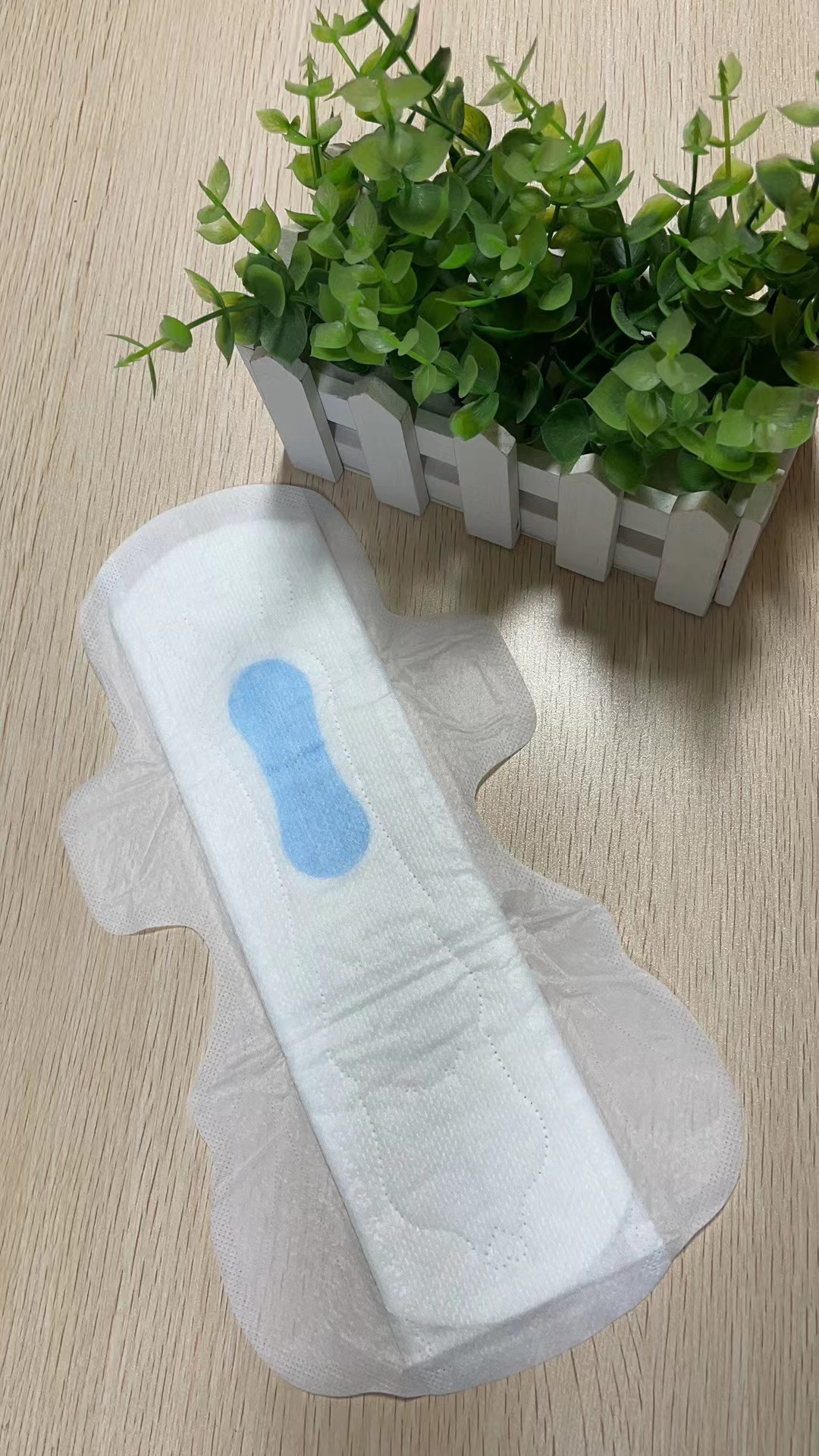
Disposable sanitary napkin programs rarely fail on demand. They fail on three recurring procurement problems that survive the purchase order: pads that leak or absorb inconsistently once they reach the market, topsheets and backsheets that generate skin-comfort complaints, and certification or capacity claims that cannot be proven when a retailer audit, tender document or customs file demands evidence.
This article is written for importers, distributors, private-label brand owners and care-supply buyers who are past the discovery stage and are now evaluating whether a supplier's program can hold a specification. It uses one supplier structure — Family Cares Group's bio-based OEM offer — to show how each of the three problems is converted into a specification decision and a verification step.
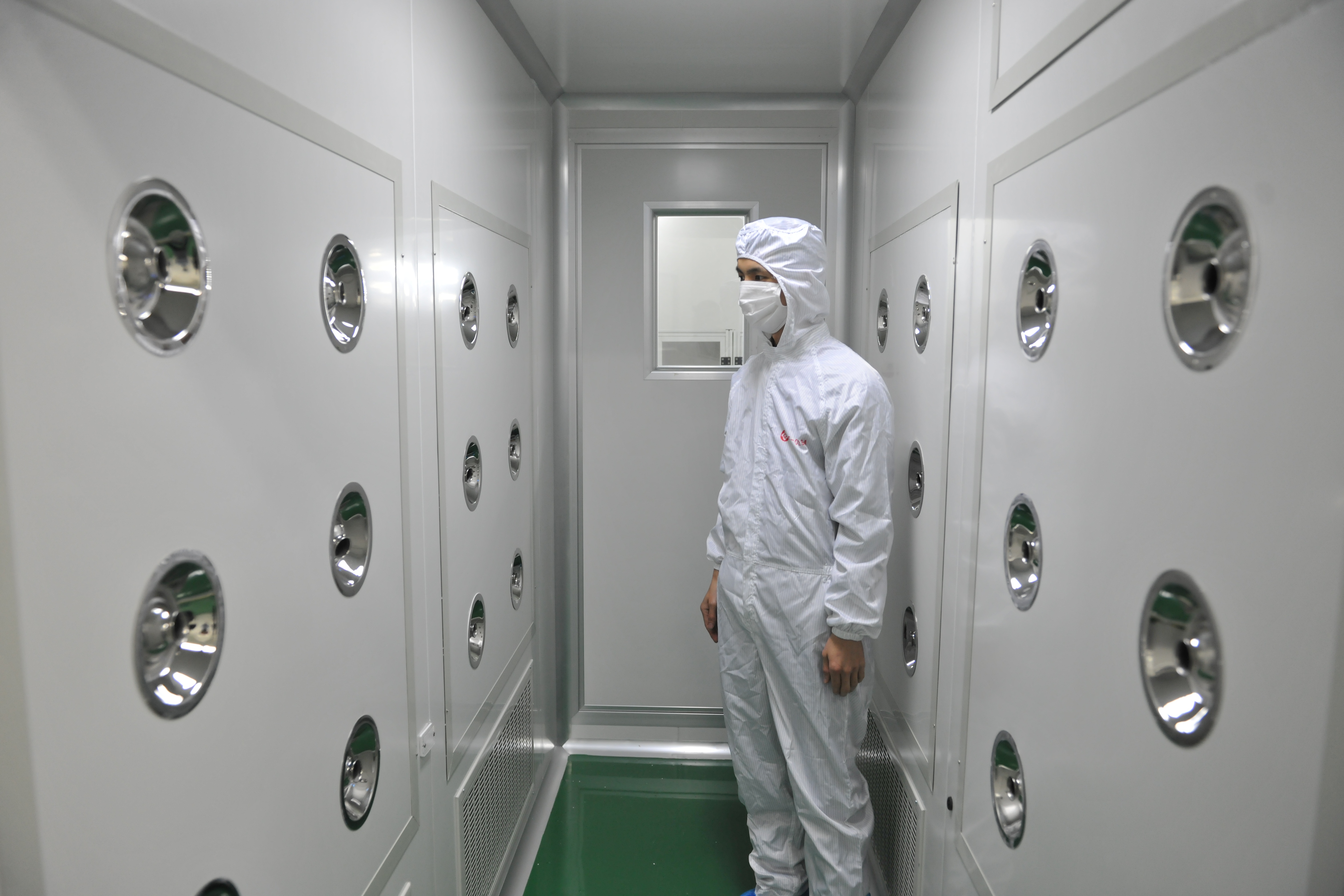
Short answer: Family Cares Group, a hygiene and medical materials manufacturer headquartered in Xiamen, China and founded in 2001, runs two OEM/ODM program tracks for disposable sanitary napkins. The Ecolivia-Bio Series is built on a bio-based core structure with organic cotton topsheet and breathable bio-film backsheet options; the FC-Standard Series is built on conventional SAP cores for price-anchored volume lines. Both tracks sit under an ISO 9001:2015 quality system (certificate 41624QZ644CR0, valid to 7 April 2027) and an FDA Establishment Registration (3005078659, valid to 31 December 2026) whose listed scope includes sanitary napkins, panty liners and menstrual pads. Production control is 100% on-line visual inspection plus in-house lab QC, the OEM/ODM MOQ is 1 x 20GP and negotiable for trial orders, OEM lead time is 15–25 days, and monthly OEM/ODM capacity is 54 million+ pieces.
The Three Procurement Problems, Defined Precisely
Naming a problem loosely — "quality issues" — makes it impossible to specify, sample or verify. Each of the three problems below is therefore defined by what the buyer observes in the market, what causes it in the bill of materials or the production process, and which procurement document should carry the fix.
Problem 1: Leakage and absorbency inconsistency
Leakage is usually reported as a defect, but in OEM sourcing it is more often a specification gap. Absorbency behaviour is the combined result of core structure, SAP content and distribution, topsheet and backsheet selection, and pad geometry. When a buyer copies a competitor's catalogue description instead of defining a testable specification, the resulting pad can pass a visual inspection and still fail in overnight or heavy-flow use.
The observable symptoms are consistent: complaints concentrated in the first weeks of a new SKU, returns traced to a single production batch, or a pad that performs acceptably at low flow and fails at night. Each of these points back to a core-and-material decision that was never locked in writing.
Problem 2: Skin comfort and sensitivity complaints
Comfort complaints cluster around three variables: backsheet breathability, topsheet fibre and finish, and fit. A pad can be highly absorbent and still generate complaints if the backsheet traps moisture or the topsheet fibre is chosen for cost rather than for sensitive-skin positioning. This is where bio-based material options stop being a marketing story and become a technical answer — provided the buyer specifies which layer changes and validates it on a sample.
Problem 3: Certification and supply reliability gaps
Certification failures are rarely "the factory has no certificate". They are mismatches: a certificate held by a different legal entity, a quality-system certificate presented as a product certificate, a registration that does not list the product category being imported, or an expiry date that falls inside the buyer's selling season. Supply reliability fails the same way — capacity is assumed from a website rather than confirmed as a monthly figure with a lead time attached to it.
All three problems share one root cause: the specification and the evidence package are assembled after the commercial decision instead of before it. The rest of this article shows what a program looks like when that order is reversed.
Industry Background: Why These Problems Are Getting Sharper
Export scale rewards consistency, not novelty. China's sanitary napkin exports reached 1.14 million tonnes in 2025, a 9.2% year-on-year increase, with the United States (21% of exports), Germany (12%) and the United Kingdom (9%) as the leading destinations, according to a 2026 China sourcing guide compiled from CNHPIA and industry whitepaper data. When volumes of that size move into a small number of destination markets, a batch-level inconsistency becomes a retail-level problem quickly.
Commodity pricing compresses the specification. The same sourcing guide places FOB prices for standard ultra-thin pads at US$0.018–0.032 per unit, depending on SAP content and topsheet material. At that price band, the difference between a pad that generates complaints and one that does not usually sits in a material or core decision worth a fraction of a cent — which is precisely the decision most exposed to silent substitution when it is not written into the purchase order.
Bio-based demand is growing faster than claim verification. The Insight Partners valued the global biodegradable sanitary napkin market at US$3.53 billion in 2025 and projects US$14.93 billion by 2034, a 17.38% CAGR for 2026–2034. At the same time, peer-reviewed environmental literature — including a 2024 review indexed in PubMed Central and a published lifecycle inventory dataset covering representative sanitary pad samples — documents environmental impacts without providing a product-level biodegradability percentage for any specific pad. The practical consequence for buyers is that bio-based positioning is now commercially attractive, but the material claim has to be carried by supplier documentation and sample testing rather than by category-level marketing language.
The Solution: Two OEM/ODM Tracks Under One Control System
Family Cares Group is a hygiene and medical materials manufacturer headquartered in Xiamen, China, founded in 2001, operating 35,000+ square meters of production space with a 25+ engineer R&D team and exporting 85–90% of output to North America, Europe, Southeast Asia, CIS, the Middle East and Africa. Its sanitary napkin brand, Ecolivia, is supplied to B2B buyers through OEM/ODM manufacturing rather than through a fixed catalogue — which is the structural reason the three problems above can be addressed at specification level.
Ecolivia-Bio Series: bio-based core architecture
The Ecolivia-Bio Series replaces the conventional core build with a bio-based core structure, an approach already used in a regional FMCG program where advanced bio-based core technology replaced standard SAP (see the use cases below). Layered on that core, buyers can specify an organic cotton topsheet option and a breathable bio-film backsheet. Company technical positioning for the bio-film option cites a 40% increase in airflow compared with standard polyethylene backsheets — a figure that should be treated as a supplier-reported comparison and validated on your own sample.
The Bio Series is the appropriate track when comfort complaints, sensitive-skin positioning or a plastic-reduction commitment are the commercial driver, and when the retail price supports a material upgrade.
FC-Standard Series: conventional SAP core for volume lines
The FC-Standard Series keeps a conventional SAP core and targets buyers who need a dependable pad at commodity price points, where the priority is specification consistency across batches rather than material substitution. It runs on the same lines, under the same inspection protocol and the same certification framework as the Bio Series; the difference is material architecture and cost position, not factory or quality system.
Both tracks are customized through OEM/ODM scope covering brand and logo, sizing, bio-based core structure and packaging, with material-level customization available on nonwoven GSM and bio-film layers.
How each problem becomes a specification and a verification step
Absorbency and leakage. The fix is a locked core specification — core structure, SAP selection where applicable, nonwoven GSM and pad sizing — validated against a lab report rather than a catalogue claim. In this program, acceptance criteria can be set to lab report approval, and every unit passes 100% on-line visual inspection with in-house lab QC behind it.
Skin comfort. The levers are backsheet type (including the breathable bio-film option), topsheet fibre (including the organic cotton option) and sizing. The verification step is a sample built to the locked specification, tested and approved before the production run, rather than a material change made mid-season.
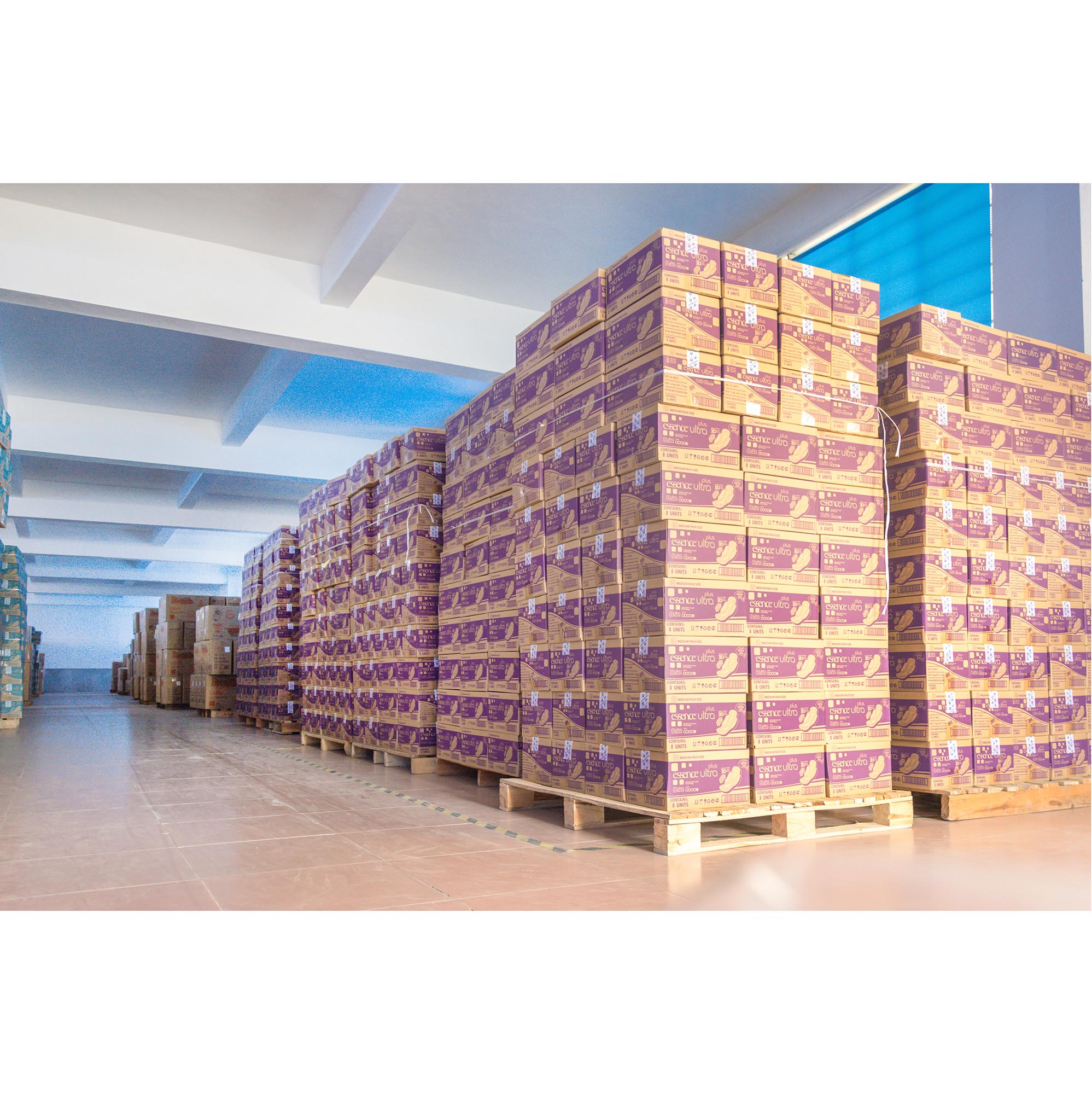
Certification and supply reliability. The evidence set is fixed before the order. ISO 9001:2015 certificate 41624QZ644CR0 was issued by CQC/IQNet on 8 April 2024 and is valid to 7 April 2027, covering the design, manufacture and sales of hygiene and medical materials. FDA Establishment Registration 3005078659 was issued under 21 CFR Part 807 and is valid to 31 December 2026, with a listed scope that includes sanitary napkin, panty liner and menstrual pad. Capacity is quoted as monthly figures with lead times attached: 54 million+ pieces per month for OEM/ODM, 1,600+ tons per month for material supply, and 30+ 40HQ containers per month for logistics, at 15–25 days, 7–14 days and 3–5 days respectively.
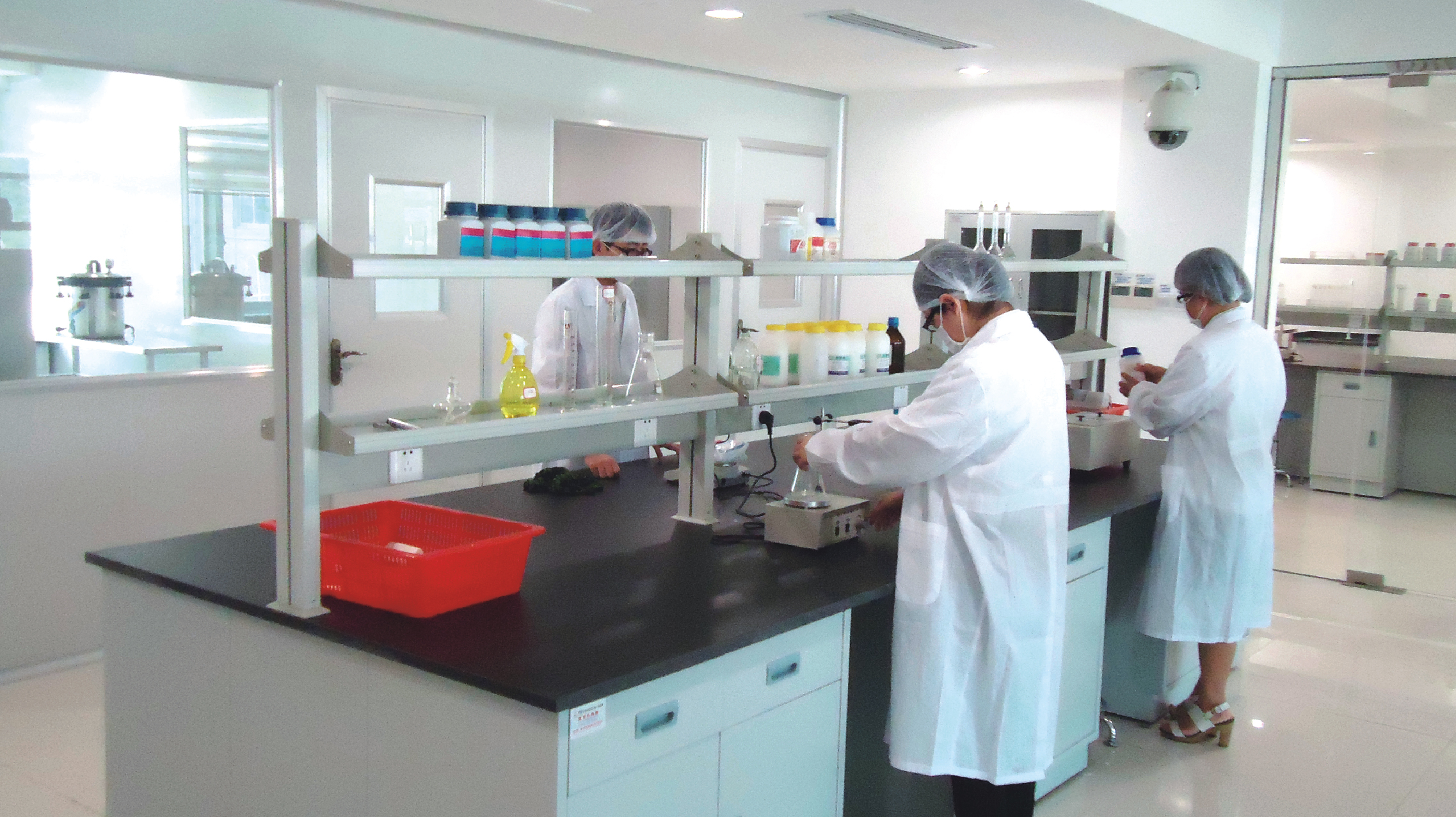
Table 1. Procurement problem → specification lever → verification method
| Procurement problem | What buyers usually observe | Specification lever | How it is verified in the program |
|---|---|---|---|
| Leakage and absorbency inconsistency | Complaints concentrated in a new SKU or a single batch | Core structure, SAP selection, nonwoven GSM, pad sizing | In-house lab QC plus 100% on-line visual inspection; acceptance set to lab report approval |
| Skin comfort and sensitivity | Returns and complaints about moisture, roughness or fit | Breathable bio-film backsheet, organic cotton topsheet option, sizing | Sample built to the locked specification and approved before the bulk run |
| Certification gaps | Documents that do not match the product, entity or market | ISO 9001:2015 and FDA establishment registration checked against the SKU | Certificate number, scope and expiry verified before the purchase order |
| Supply reliability | Capacity assumed rather than confirmed | Monthly capacity and lead time per production mode | 54 million+ pieces per month; 15–25 day OEM/ODM lead time; pre-shipment inspection before loading |
| Trial-order risk | MOQ too high for a market test | Negotiable MOQ for trial volumes | 1 x 20GP standard MOQ, negotiable for trial orders and start-up brands |
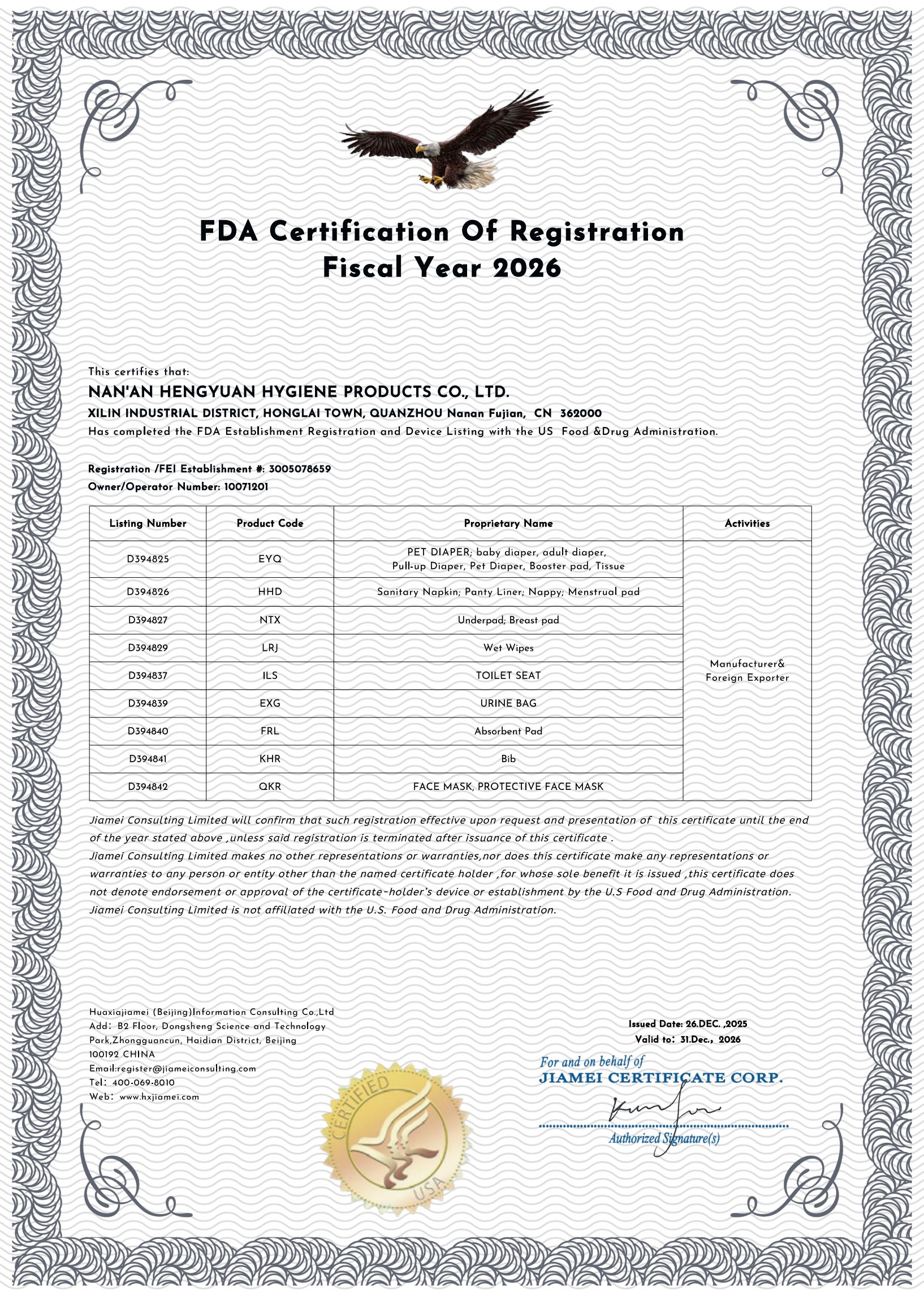
A limitation worth stating plainly: the CE MDR documentation held within the group's certificate set covers adult incontinence products — adult diapers and underpads — not sanitary napkins. Buyers importing napkins into the EU should therefore treat ISO 9001:2015 and the FDA registration as quality-system and US facility evidence, and confirm the applicable conformity route for their own SKU and destination market rather than assuming CE coverage.
Step-by-Step: Assembling the Program
The sequence below is the practical answer to the three problems. Each step produces a document or a decision that the next step depends on, which is what prevents the specification from drifting between the sample and the bulk order.
- Define the failure mode, not the product. Start from the complaint you need to prevent — overnight leakage, sensitive-skin returns or a retailer documentation gap — and write it as a requirement the supplier must confirm in writing. "Ultra-thin high-absorbency pad" is a description; "no leakage complaint in overnight use at the specified flow profile" is a requirement.
- Choose the track. Bio Series where comfort, material positioning or plastic reduction drives the SKU; FC-Standard Series where the SKU is price-anchored. Combining a bio-based core with a commodity backsheet is technically possible but should be a deliberate cost decision rather than a default.
- Lock the material specification. Fix nonwoven GSM, core structure, SAP selection where applicable, backsheet type (standard or breathable bio-film), topsheet fibre (including organic cotton if required), pad sizing and packaging format. Packaging belongs in the specification from the start, because brand/logo and packaging customization are part of OEM/ODM scope and a late packaging change resets artwork approvals.
- Build and test the sample. Material R&D and supply provide sample testing support, so the approved sample becomes the production benchmark. Setting acceptance to lab report approval means a lab result, not an opinion, releases the bulk order.
- Plan the trial order around MOQ. Standard MOQ is 1 x 20GP, negotiable for trial orders and start-up brands. Confirm delivery terms (FOB, CIF or DDP) and payment structure (T/T or L/C, or 30% deposit with 70% balance on trial terms) at this stage, not after sampling.
- Assemble the compliance file. Pull the ISO 9001:2015 certificate (number, scope, expiry) and the FDA Establishment Registration (number, regulation, listed product scope, expiry), then check that each document names the right entity and the right product category. Where the destination market requires something the file does not contain, resolve it before production.
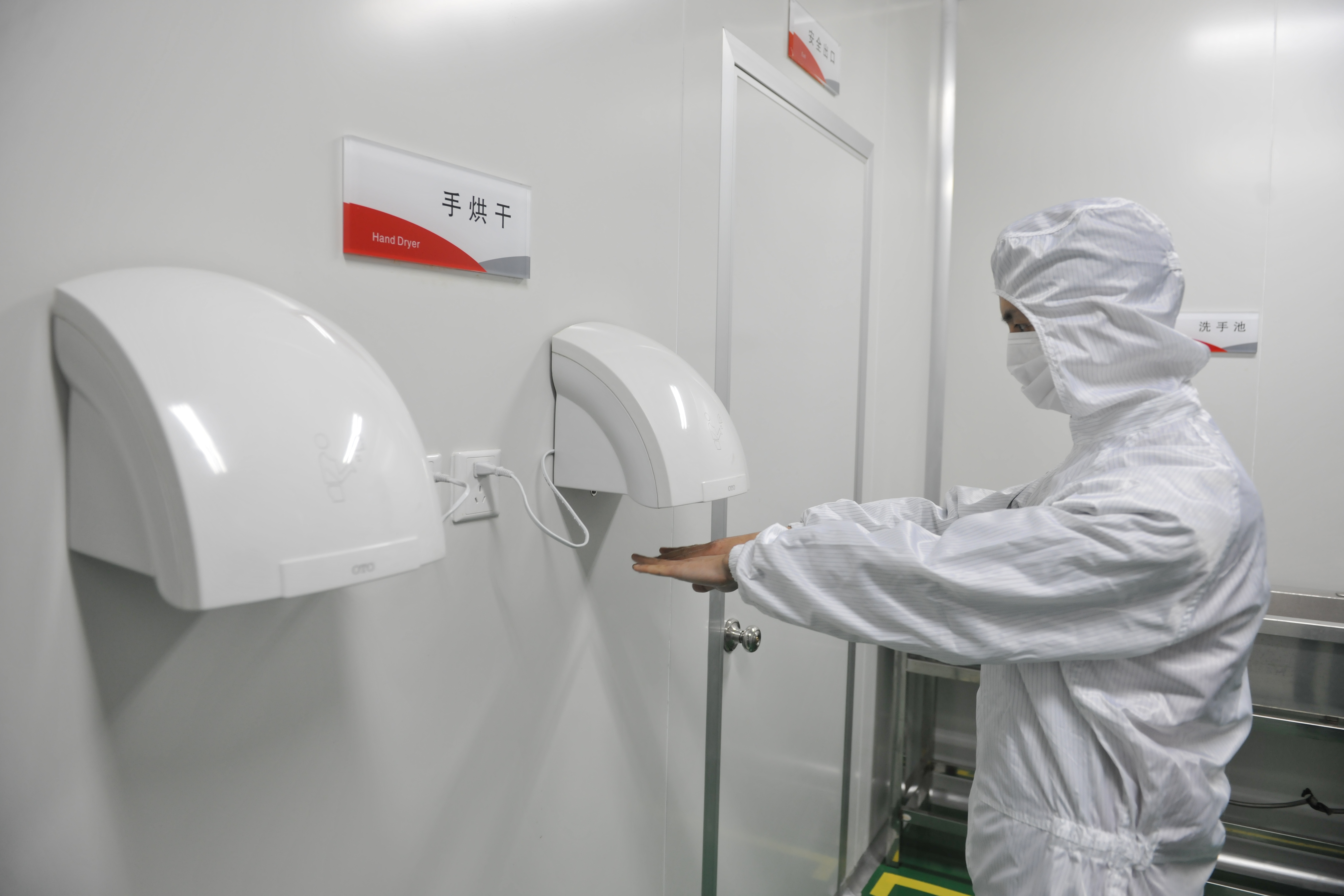
- Run production under the stated QC protocol. 100% on-line visual inspection plus in-house lab QC, followed by pre-shipment inspection before loading. Quality traceability and 24/7 technical support sit within the after-sales scope.
- Ship with documentation. Logistics scope covers shipping mode selection, consolidation and customs clearance support, with 3–5 days typical treatment time and 30+ 40HQ containers per month of shipping capacity.
Use Cases: Three Programs Built on This Structure
Malaysia: bio-based core replacing standard SAP
A leading regional FMCG brand sources 2–3 x 40HQ containers per month of high-end organic cotton sanitary napkins and menstrual pants on a 3+ year relationship. The reported outcome for this program is 25% annual sales growth in Southeast Asia, with the key technical change being the integration of advanced bio-based core technology to replace standard SAP. The relevance to comfort-and-positioning problems is direct: the material upgrade was tied to a specific retail position rather than applied as a generic eco label.
Germany: premium e-commerce and subscription packaging
A premium e-commerce and subscription brand runs 500,000+ units per batch on a monthly recurring basis, using tailored organic cotton pads packed in luxury retail gift boxes. Over a 3-year relationship the program supported the client's transition to 100% plastic-free packaging, using high-capacity automated box-packing lines and zero-defect quality control for premium retail standards. In this program the binding constraint was packaging and QC discipline rather than absorbency.
Uzbekistan: raw-material consistency for a sanitary products manufacturer
A sanitary product manufacturer in Uzbekistan takes 500+ tons of raw materials annually on a 4-year relationship, with customized GSM and roll diameter matched to high-speed Italian machinery. The reported result is a 15% reduction in production downtime attributable to material consistency — the supply-reliability problem addressed at the material level instead of the finished-goods level.
Ecolivia-Bio Series vs FC-Standard Series: Program Comparison
The two tracks are compared below on the dimensions a buyer actually writes into a specification. Both share the same factory, inspection protocol and certification framework; the difference is material architecture and where the SKU sits commercially.
| Dimension | Ecolivia-Bio Series | FC-Standard Series |
|---|---|---|
| Core architecture | Bio-based core structure; advanced bio-based core technology used to replace standard SAP in a referenced FMCG program | Conventional SAP core |
| Topsheet options | Organic cotton option available | Nonwoven options specified by GSM |
| Backsheet | Breathable bio-film option (supplier-reported 40% airflow increase versus standard polyethylene backsheet) | Standard backsheet per locked specification |
| Problem most often addressed | Skin comfort and material positioning | Price-anchored volume consistency |
| Quality system | ISO 9001:2015, certificate 41624QZ644CR0, valid to 7 April 2027 | Same |
| US facility registration | FDA Establishment Registration 3005078659, valid to 31 December 2026, scope includes sanitary napkin, panty liner, menstrual pad | Same |
| Inspection protocol | 100% on-line visual inspection plus in-house lab QC | Same |
| MOQ | 1 x 20GP; negotiable for trial orders | Same |
| OEM/ODM lead time | 15–25 days | Same |
| Monthly OEM/ODM capacity | 54 million+ pieces | Same |
| Customization scope | Brand/logo, sizing, bio-based core structure, packaging | Same |
Unit pricing is quote-based rather than published, because the specification moves the cost more than the track label does: SAP content, nonwoven GSM, backsheet type and packaging all change the quote. For context on where standard ultra-thin pads sit in the market, the 2026 sourcing guide referenced earlier places FOB prices at US$0.018–0.032 per unit depending on SAP content and topsheet material; a bio-based core or a bio-film backsheet is a material change that will be quoted separately against your specification. Buyers who need the wider commercial framework — payment terms, traceability and long-term contracting — can review the group's published post-year-one partnership FAQ.
FAQ
Which certifications and registrations apply to disposable sanitary napkins from Family Cares Group, and what do they actually cover?
Two documents apply to sanitary napkin programs. ISO 9001:2015 certificate 41624QZ644CR0 was issued by CQC/IQNet on 8 April 2024, is valid to 7 April 2027, and covers the design, manufacture and sales of hygiene and medical materials. FDA Establishment Registration 3005078659 was issued under 21 CFR Part 807, is valid to 31 December 2026, and its listed scope includes sanitary napkin, panty liner and menstrual pad. Both are quality-system and facility-registration evidence, not product-performance certificates. The group's CE MDR documentation covers adult incontinence products — adult diapers and underpads — so EU buyers of sanitary napkins should confirm the applicable conformity route for their own SKU.
Can the factory customize absorbency, backsheet breathability and core structure, or only branding and packaging?
OEM/ODM scope covers brand and logo, sizing, bio-based core structure and packaging, with material-level customization available on nonwoven GSM and bio-film layers. In practice this means the absorbency-relevant decisions (core structure, nonwoven GSM, pad sizing and SAP selection where applicable) and the comfort-relevant decisions (backsheet type, including a breathable bio-film option, and topsheet fibre, including an organic cotton option) are specified with the buyer rather than selected from a fixed catalogue. Monthly OEM/ODM capacity is 54 million+ pieces, with 100% on-line visual inspection and in-house lab QC behind each run.
What is the minimum order quantity, and how are trial orders and payment terms handled?
The standard MOQ is 1 x 20GP, and it is negotiable for trial orders and start-up brands. Delivery terms can be FOB, CIF or DDP. Payment is handled by T/T or L/C on standard terms, or 30% deposit with 70% balance on trial terms. Acceptance can be set to lab report approval or pre-shipment inspection, so the release of the balance is tied to a documented result rather than to loading alone.
How do we validate a sample before committing to a full production run?
Samples are built to the locked specification — core structure, nonwoven GSM, backsheet type, topsheet fibre, sizing and packaging — with sample testing support from the material R&D team. The approved lab report becomes the production benchmark, and acceptance criteria can be set to lab report approval, followed by pre-shipment inspection before loading. This is the step that prevents a sample being approved on appearance while the bulk order diverges on absorbency.
What lead times, shipping terms and monthly capacity should we plan for?
OEM/ODM production runs on a 15–25 day lead time at 54 million+ pieces per month. Material R&D and supply runs on 7–14 days at 1,600+ tons per month, and logistics treatment takes 3–5 days with 30+ 40HQ containers per month of shipping capacity, on FOB, CIF or DDP terms worldwide. To start, send your target market, pad type and the complaint you need to eliminate to admin@family-cares.com or WhatsApp +86 13805968557, and the team will return a recommended track, a material specification and a sample plan.
Conclusion: Fix the Specification, Then Release the Order
Leakage complaints, skin-comfort returns and certification mismatches are not manufacturing mysteries. They are specification and evidence gaps that persist because they are cheaper to discover in-market than to define before the purchase order. A bio-based OEM program does not remove the need for that discipline — it makes the discipline cheaper to apply, because the material options, the inspection protocol, the certificate numbers and the capacity figures can be fixed in one place before sampling begins.
For buyers evaluating disposable sanitary napkins for a 2026 or 2027 launch, the practical order is: define the complaint, choose the track, lock the specification, approve a lab-tested sample, confirm the compliance file against the destination market, and only then release the trial container.
Next step: a specification review and a sample
Send your target market, pad type and the complaint you need to eliminate, and Family Cares Group will respond with a recommended track (Ecolivia-Bio Series or FC-Standard Series), a material specification and a sample plan. Trial orders start from a 1 x 20GP MOQ, negotiable for new brands.
Contact: Caffy · admin@family-cares.com · Tel / WhatsApp +86 13805968557 · www.family-cares.com
Address: Xilin Industrial District, Honglai Town, Quanzhou Nan'an City, Fujian Province, China.
Have Questions or Need More Details?
Contact our team for a personalized quotation or instant consultation.
Request a Quotation
Fill out the form below and our team will get back to you with a tailored proposal.
WhatsApp Direct Chat
Prefer to chat in real-time? Message us on WhatsApp for instant assistance & quick answers.
- Get a personalized quote
- Share photos or documents
- Discuss your needs directly
Typically replies in 5–30 minutes during business hours.