
Fixing Hotspots and Dark Corners in Light Guide Panel Signage
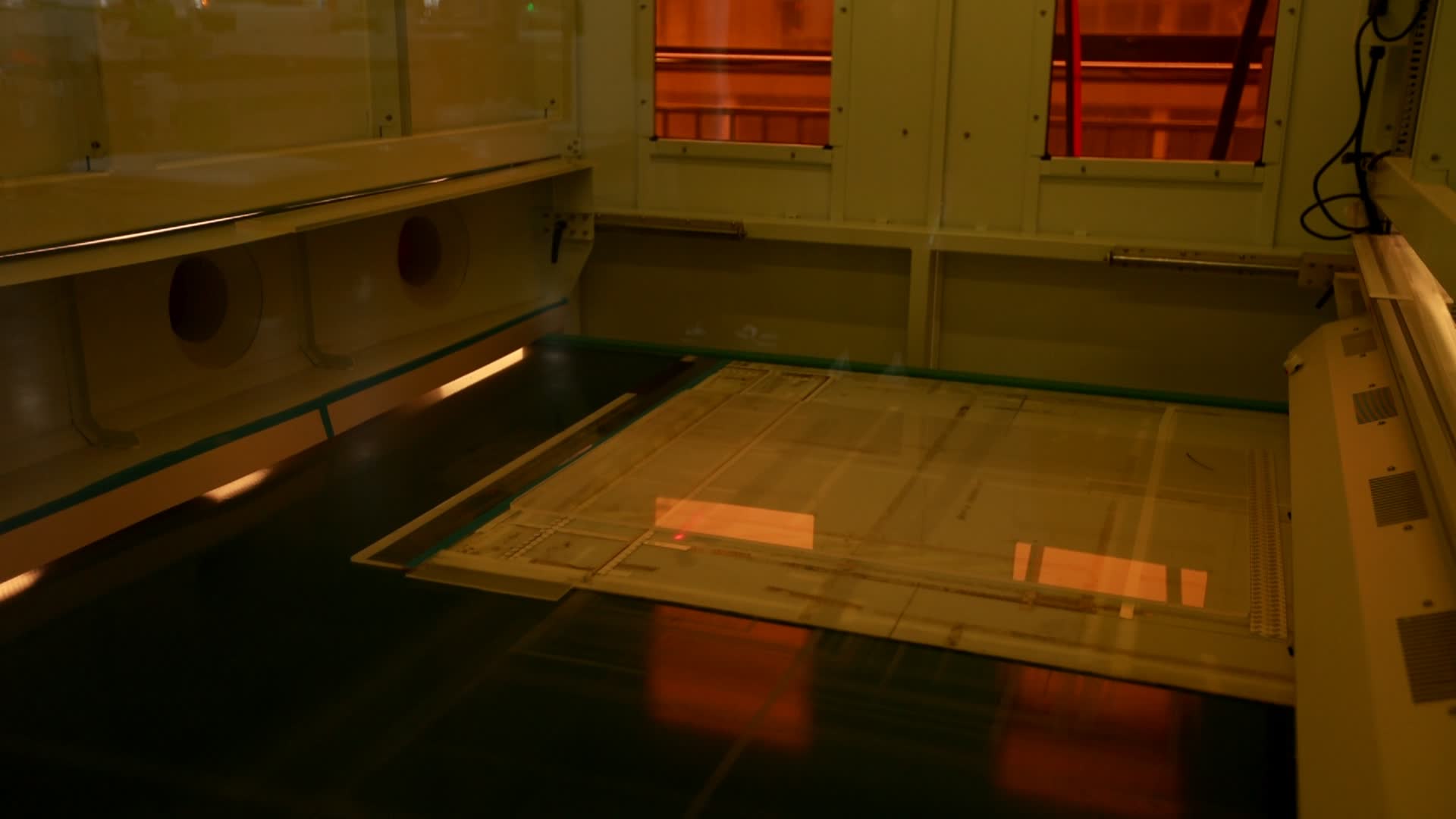 A laser-dotted acrylic light guide panel: the dot density and its gradient across the surface are what turn edge light into an evenly lit sign face.
Hotspots and dark corners are the two defects that decide whether an edge-lit sign reads as a finished installation or a compromise. A hotspot is a band of excess brightness where light enters the panel from the LED edge. A dark corner is a dim patch in the region furthest from that entry point. Both appear on the lit face of the sign, and both are design outcomes rather than bad luck in production.
Solving light uniformity in an edge-lit light guide panel comes down to two controllable variables, the dot pattern on the panel surface and the alignment of the LED light source along the panel edge, supported by panel thickness, size and edge quality. EDGELIGHT (Shanghai Edgelight Industry Co., Ltd.), a Shanghai-based light guide panel and LED products manufacturer founded in 2004, supports customisation of surface shape and light output brightness on LGP orders and runs 100% testing on production. This guide explains where the defects come from, which design changes remove them, and how uniformity is verified before a panel ships.
What Counts as a Light Uniformity Defect in LGP Signage
Uniformity is judged across the whole illuminated face, not at the brightest point on it. A panel can reach a high peak brightness and still look wrong, because the eye compares the brightest and dimmest areas of the same sign face at the same time. Four defect patterns account for most complaints in edge-lit signage.
- Edge hotspots. A bright band, or a row of bright dots, running along the edge where the LEDs meet the panel. Light has not been spread far enough before it reaches the viewer.
- Dark corners. Dimness in the corners furthest from the light-entry edge. Corner darkening is the most common complaint on large-format backlit panels and on signage where a logo or lettering sits close to a corner.
- Banding or mottling. Visible streaks or uneven patches across the middle of the panel, usually a sign that the dot pattern gradient is too abrupt or too flat.
- Face-wide drift. A face that is bright near the entry edge and progressively duller toward the far side, so the sign looks tilted even though it is mounted straight.
These are not cosmetic details for the buyer. In retail, hospitality, elevator and exhibition interiors, an uneven panel is read as a quality signal about the brand behind it, which is why uniformity is usually one of the first items checked during sample approval.
Why Uniformity Is Harder to Hold in Today's LGP Market
The global light guide plate market was valued at USD 3.91 billion in 2025 and is projected to reach USD 6.51 billion by 2034, growing at a CAGR of 5.8% over the 2025-2034 forecast period (Dataintelo). Asia Pacific held a 48.2% revenue share in 2025, valued at USD 1.88 billion, and consumer electronics remained the largest application segment with a 42.5% share in 2025. Those figures describe demand; the design trend behind them describes the difficulty.
Demand is moving toward thin panels. Thin PMMA light guide plate substrates below 2 mm accounted for over 60% of display-grade shipments for major manufacturers in 2024 (Fact.MR / CHI MEI Corporation), and edge-lit light guide panels are used in ultra-slim profiles as thin as 2.0 mm via injection molding or 3.0 mm via laser dotting (Lightpanel). Thin acrylic panels leave less optical distance for light to mix, so the pattern has to do more of the work that thickness used to do. Efficiency rules push in the same direction: the 2024 International Energy Conservation Code reduces lighting power allowances, which raises the value of getting more even light from the same input power.
On the supply side, the light guide plate landscape includes established material and panel producers, with Mitsubishi Chemical Corporation identified as a leading player in the competitive landscape for light guide plates (Dataintelo, 2025), alongside a long tail of converters. That mix means a buyer can receive panels that all meet a stated thickness and size yet still differ in how evenly they light up, because the pattern and source alignment behind the specification are not identical.
Root Causes: Where Hotspots and Dark Corners Come From
Uneven brightness in an edge-lit panel rarely has a single cause. In practice, five factors interact, and fixing one while ignoring the others usually moves the defect rather than removing it.
- Dot density without a gradient. If the surface pattern is applied at constant density, light extraction is even per unit area but the light energy arriving at each area is not. The near-edge zone stays bright and the far zone stays dim.
- LED pitch and stand-off distance. LEDs spaced too widely, or placed too close to the panel edge, project discrete bright points into the panel that the pattern cannot blend away.
- Panel geometry versus panel size. A thickness that works on a small sign may be insufficient on a large light box, because light has further to travel before it reaches the corners.
- Light-entry edge quality. A rough, chipped or unpolished entry edge scatters light before it enters the panel, producing streaks instead of a controlled spread.
- Layer and frame alignment. When the LED strip, panel edge, reflective layer and frame are not aligned to one another, part of the light escapes or is double-reflected, and that loss is rarely uniform across the face.
Uniformity is therefore a system property. Pattern, light source, panel edge and mounting structure have to be designed as one set of variables, which is why a uniformity problem is best resolved by the panel and light source supplier together rather than by swapping components after installation.
The Two Design Levers That Solve Most Uniformity Problems
Two adjustments carry most of the load in a custom uniformity fix: the surface pattern of the guide panel and the alignment of the light source. Both are customisable in production. EDGELIGHT runs OEM/ODM production for light guide panels, with customisation covering size, thickness, colour temperature, logo, surface shape, light output brightness and installation structure.
Lever 1: Surface pattern and surface shape of the guide panel
A dot pattern light guide panel works by extracting light gradually. The dots break total internal reflection and release light toward the viewer, and the density of that pattern is what balances the face. Near the light-entry edge, dots are kept sparse so that fewer extraction points compete for the light that has just entered. Toward the far edge and the corners, dot density increases so the light still travelling inside the panel is released before it runs out. The gradient between those two zones, not the total number of dots, is what removes dark corners.
Because EDGELIGHT's customisation scope includes surface shape and light output brightness, the pattern map and the brightness target can be specified and adjusted per project instead of being taken from a fixed catalogue. Laser dotting and UV cutting are the two operations that define the pattern and the panel outline in EDGELIGHT's LGP production, so a revised pattern is a production revision of the same part rather than a change of product category.
 UV cutting defines the panel outline and the light-entry edge geometry that the LED strip will sit against.
Lever 2: Light source alignment along the panel edge
Pattern design cannot rescue poor source alignment. Three alignment decisions control whether the LED edge feeds the panel cleanly.
- LED pitch along the edge. The strip layout and the number of emitters per length determine how much blending the pattern has to achieve. The EDGELIGHT light guide panel range runs at a maximum operating current of 7.2 A and a maximum power of 144 W, with typical power consumption of 101 W and luminous flux above 1080 lm, so the light budget available per panel is defined at specification stage.
- Stand-off and coupling between strip and panel edge. The distance to the entry face, the flatness of the strip and the frame holding both in place decide how much light enters the panel instead of scattering around it.
- Colour temperature consistency. The LGP range covers 2700 K to 6500 K. When one installation needs warm and neutral panels together, a common requirement in retail and elevator interiors, colour consistency and brightness consistency have to be specified as a pair.
Light source and panel are therefore matched rather than sourced separately, and the same matched logic applies to the strip and power supply used to drive the panel.
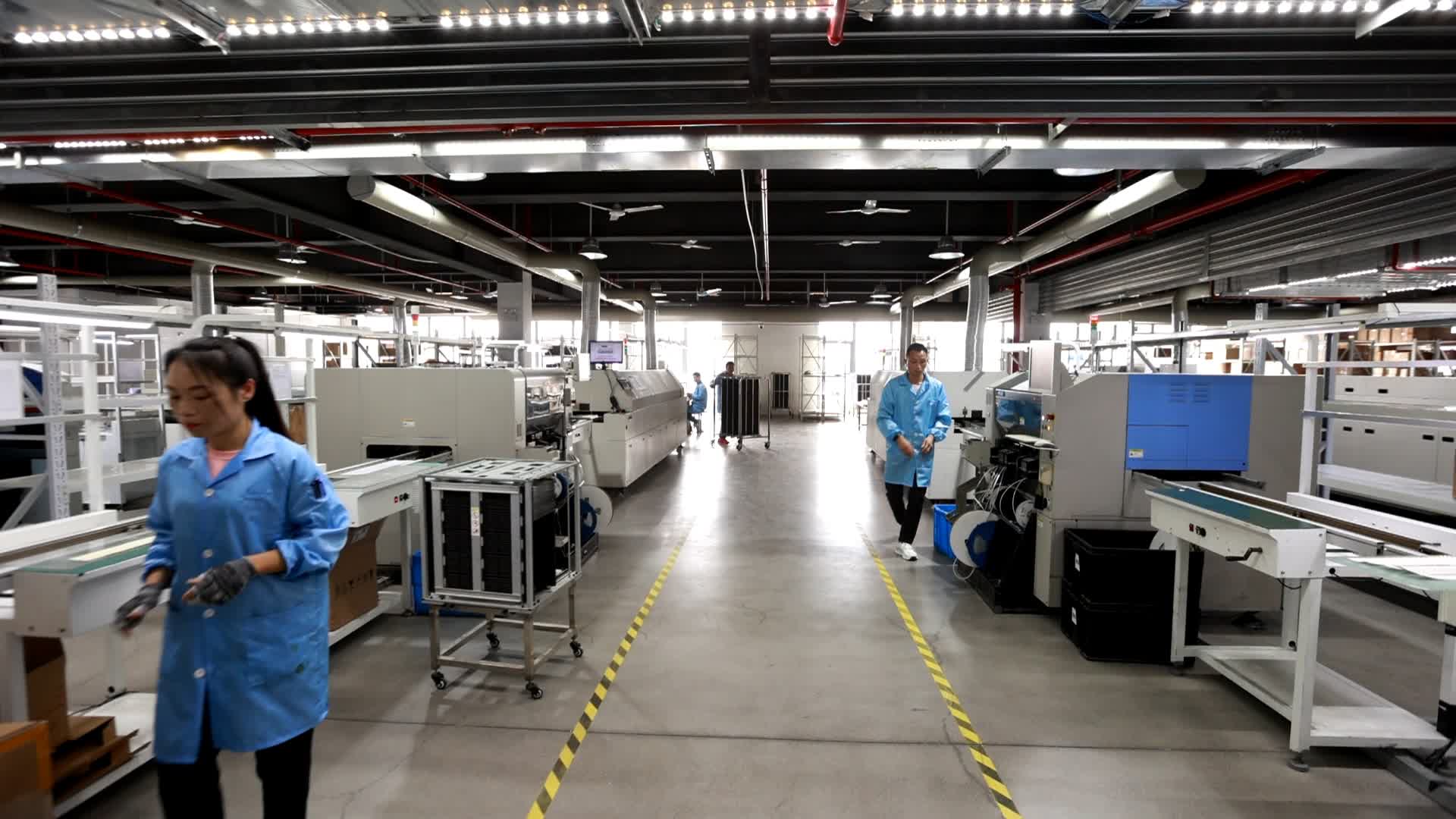 LED light source assembly: pitch, stand-off and strip flatness set the starting condition for uniformity.
Lever 3: Panel geometry, thickness and edge finish
Thickness, size and edge finish set the limits within which the two main levers work. Acrylic (PMMA) is the substrate across the EDGELIGHT LGP range, which is specified for operation between -20 degrees C and 50 degrees C and protection grades from IP20 to IP65. Custom size light guide panel orders are cut to the sign aperture, and cut-edge quality matters because the light-entry edge is where any scatter defect becomes visible on the finished face.
Defect, Cause and Remedy: A Comparison Table
| Defect | Where it shows | Primary cause | Design remedy | Verification |
|---|---|---|---|---|
| Edge hotspot | Bright band or dotted line along the LED entry edge | Extraction density too high at the entry zone; LEDs set too close to the panel or spaced too widely | Reduce dot density at the entry zone and build a gradual gradient outward; adjust pitch and stand-off along the edge | Lit-panel inspection within 100% testing, before assembly into the sign frame |
| Dark corner | Corners and far edge opposite the light source | Dot gradient ends before the corner; insufficient light energy left for the final section | Increase dot density in the outer zone and corners; re-balance thickness or face size against the available source | Corner-to-centre comparison across the lit face during testing |
| Banding or mottling | Middle area of the panel | Abrupt transitions in the pattern map; inconsistent dotting across the surface | Smooth the density transitions in the pattern file and re-run the dotting stage | Surface and lighting check on the finished panel |
| Face-wide drift | Progressive dimming from the entry edge to the far side | Geometry mismatch between panel thickness, face size and source brightness | Re-specify thickness, panel size or the light output brightness target for the project | Face-level check against the agreed project specification |
Light Guide Panel Customisation Levers at a Glance
| Customisation item | What can be specified | Role in light uniformity |
|---|---|---|
| Size | Panel cut to the sign aperture | Removes unused panel area that adds distance between source and far corners |
| Thickness | Panel thickness matched to face size | Sets how much distance light has to mix before reaching the viewer |
| Surface shape | Dot pattern map and surface form | Primary control over where and how much light is extracted across the face |
| Light output brightness | Brightness level of the finished panel | Raises or lowers the overall light level, including the dimmest zones |
| Colour temperature | 2700 K to 6500 K | Keeps a revised panel consistent with the rest of the installation |
| Installation structure | Frame and mounting design | Preserves the LED-to-panel alignment the pattern was designed around |
| Logo, printing and texture | Graphics, texturing and finish on the same panel | Combines the graphic layer and the optical layer in one part |
Step by Step: How a Uniformity Fix Is Built on a Custom LGP Order
- Define the uniformity target and the viewing conditions. Record panel size, viewing distance, whether the panel sits in a light box or an open frame, and the brightness level the sign has to hold.
- Fix the panel specification. Material (acrylic PMMA), size cut to the aperture, thickness matched to the face dimensions, and colour temperature from 2700 K to 6500 K.
- Build the dot pattern map. Set the density gradient from the light-entry edge to the far corners so extraction rises exactly where light is running short.
- Produce the panel. Laser dotting and UV cutting define the pattern and the outline, including the light-entry edge that the LED strip will face.
- Align the light source. Set LED pitch, stand-off and coupling, using a strip and power supply matched to the panel and the brightness target.
- Test. Every unit passes 100% testing, so a hotspot, a dark corner or a banding pattern is caught as a panel problem rather than discovered as a site problem.
- Finish and mount. Printing, texture and logo work are applied to the same panel, and the installation structure is specified so alignment survives transport and installation.
Use Cases: Where Uniform Illumination Decides the Outcome
The EDGELIGHT LGP range is applied across retail and luxury display, hospitality and commercial interiors, exhibition and museum spaces, elevator decoration, advertising light boxes and signage, offices and high-end residential interiors, transportation and public spaces, and consumer electronics backlighting. In each of those settings, the visible failure mode is the same one: a face that is bright in one zone and dull in another.
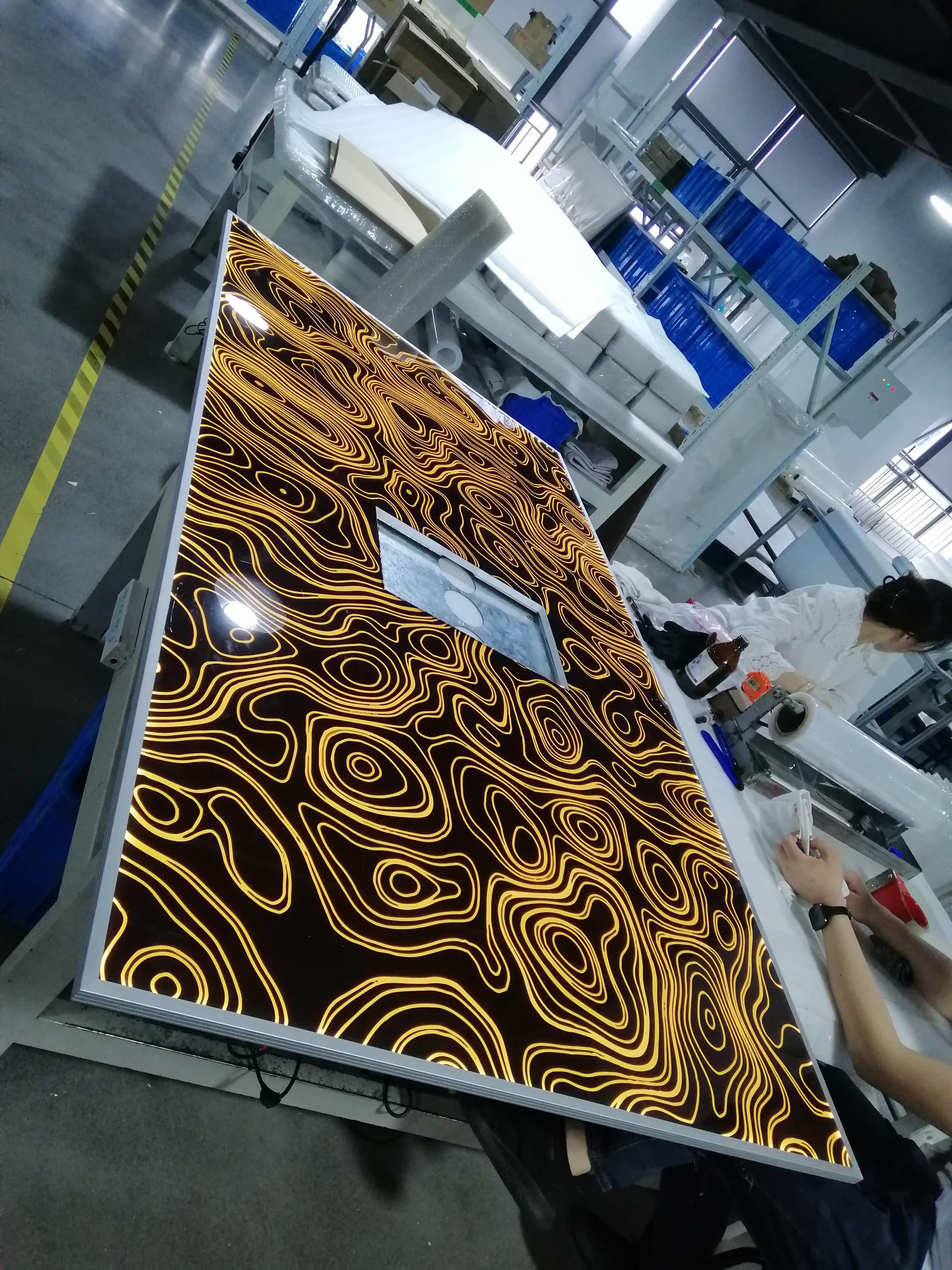 Customised elevator decoration panel: lighting, printing and surface texture produced on one light guide panel.
Ultra-thin and backlit signage
Where a slim light box forces a thin panel profile, the available mixing distance shrinks and pattern design carries more of the uniformity load. This is the case where a custom pattern revision most often replaces a thickness increase, because thickness may not be available in the frame.
Elevator decoration
Elevator interiors place the panel close to the viewer, at eye level, under mixed ambient light. EDGELIGHT light guide panels have been used in elevator decoration projects for 20 years, with 10,000 units installed globally, and the application covers lighting, printing and customised size and texture, achieving stable operation over two decades with a global client base of elevator manufacturers.
Exhibition, museum and luxury display
In these settings the panel lights a product or an artwork rather than advertising copy, so a corner gradient is more noticeable than it would be on a billboard. High brightness light guide panel configurations for advertising displays and quieter showcase lighting are specified from the same customisation scope, which keeps a multi-space project visually consistent.
Quality Control: How Defects Are Caught Before Shipping
The design work above only pays off if each panel matches the approved pattern. EDGELIGHT runs 100% testing on light guide panel production, with a monthly capacity of 30,000 units and a lead time of 5-10 days, so a project specification can be repeated across production runs rather than verified once on a sample.
Production is distributed across five bases: the Shanghai headquarters site of about 33,000 square metres, a Tianjin base of about 20,000 square metres, Edgelight GmbH in Germany at about 1,500 square metres, Edgelight LLC in the United States at about 1,679 square metres, and an additional Shanghai factory of about 10,000 square metres. The company employs around 500 people, including an R&D team of 25 engineers, and exports about 75% of output, with main markets in the USA and the EU. Local after-sales support is provided in export markets.
Practical check for buyers: when a sample arrives, light it in the final frame rather than on a bench. Check the entry edge for hotspots, then the corner furthest from the LED edge, then the centre line for banding, and finally compare the two ends of the face for brightness drift. A panel that passes all four checks is behaving as designed; a panel that passes only the first one has been lit, not tested.
Frequently Asked Questions
Do custom light guide panels for signage need UL or CE certification?
For export markets, compliance is part of the specification rather than a final paperwork step. Light guide panels fall under safety standards such as UL 8750 for LED equipment and IEC 60598 for luminaires for global market access (UL Solutions). EDGELIGHT holds a CE EMC certificate for LED light panels, certificate number CTSL2620530156EZ, issued by CTSL Testing (Dongguan) Co., Ltd. for the EU market on 2026-05-29, covering EN IEC 55015:2019/A11:2020, EN IEC 61547:2023, EN IEC 61000-3-2:2019/A2:2024 and EN 61000-3-3:2013/A2:2021/AC:2022-01. Its UL certification UL-US-2145621-0, issued by UL LLC to UL 2108 2nd Edition on 2021-10-05 and valid through 2031-10-05, covers component sign accessories and Class 2 LED modules. Certification scope is model specific, so the certificate relevant to your panel model should be confirmed at quotation stage.
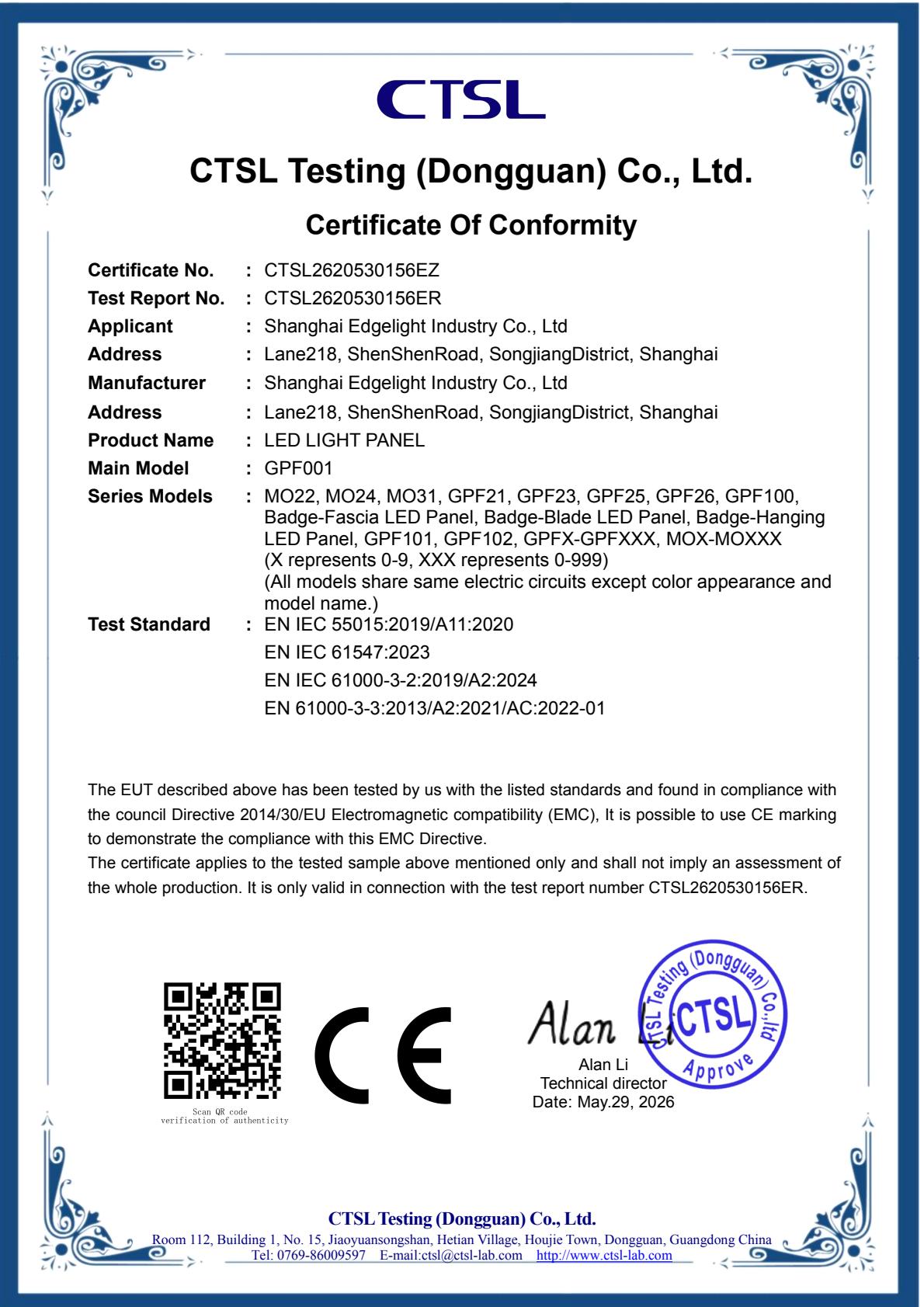 CE EMC certification for EDGELIGHT LED light panels, certificate CTSL2620530156EZ, issued by CTSL Testing (Dongguan) Co., Ltd.
Can the dot pattern or brightness be adjusted to fix hotspots on an existing sign design?
Yes, because both variables sit inside the customisation scope. EDGELIGHT runs OEM/ODM production with customisation across size, thickness, colour temperature, logo, surface shape, light output brightness and installation structure. Surface shape and light output brightness are the two items that directly address hotspots and dark corners: the pattern map controls where light is extracted across the face, and the brightness level controls how much light is available to the dimmest zones. Because the panel range covers 2700 K to 6500 K, a revision can be matched to the existing colour temperature of the sign instead of changing its appearance. Pattern revisions are handled by the same in-house R&D team of 25 engineers that supports standard orders.
What drives the cost of a uniformity-tuned light guide panel?
Cost is driven by the physical specification rather than by a single headline figure. The items that move a quotation are panel size and thickness, the pattern production route, the brightness target and the light source needed to reach it, printing or surface texturing, and order quantity. A larger face or a higher brightness target generally requires more panel material or more light input, and that is where the difference appears. EDGELIGHT quotes per project and accepts orders from a minimum of 1 unit, so a one-off prototype and a volume programme are both quoted from the same customisation scope rather than from a fixed catalogue price list. Wholesale cut-to-size requirements and single-project panels are therefore specified the same way, with the quantity difference reflected in the quotation rather than in the panel design.
Can I test a sample for light uniformity before placing a full order?
Yes. The minimum order quantity for EDGELIGHT light guide panels is 1 unit and lead time is 5-10 days, which allows a sample panel to be produced, lit and inspected against the project expectation before a larger commitment. A useful sample test covers the four defect patterns described earlier: the entry edge for hotspots, the corners furthest from the LED edge under normal viewing distance, the centre of the face for banding, and a comparison of the two ends of the face for brightness drift. To request a sample or a quotation, send the panel size, thickness, colour temperature and target application; a sample panel and the LED product catalogue can be prepared on that basis. Contact the team at info@edgelight.com or via WhatsApp on +8617701891091.
How long does production take for a custom LGP order?
Lead time for custom light guide panel production at EDGELIGHT is 5-10 days, supported by a monthly capacity of 30,000 units. The company also produces 120,000 units of LED products annually in total, with around 500 employees across its sites. Production runs across five bases: the Shanghai headquarters site of about 33,000 square metres, a Tianjin base of about 20,000 square metres, Edgelight GmbH in Germany at about 1,500 square metres, Edgelight LLC in the United States at about 1,679 square metres, and an additional Shanghai factory of about 10,000 square metres, with exports accounting for about 75% of output and main markets in the USA and the EU. The full LED product range, including light guide panels, light boxes and matched power supplies, is listed in the EDGELIGHT product catalogue, and project-specific questions can be sent to info@edgelight.com.
Conclusion
Hotspots and dark corners are not a lighting mystery. They are the visible result of two design decisions: how the surface pattern extracts light across the panel face, and how the LED source is aligned along the panel edge. Change the dot density gradient and the extraction follows; align the source and the input becomes predictable; then test 100% of production so that what was designed is what ships.
For buyers preparing an evaluation, the sequence that works is to define the brightness and viewing conditions first, specify size, thickness and colour temperature second, and settle the pattern and source alignment third, using a sample to confirm the result before committing to volume. Customisation of surface shape and light output brightness, combined with 100% testing and a 5-10 day lead time from a manufacturer producing light guide panels since 2004, keeps that sequence inside one supplier instead of three.
Request a Uniformity Sample or Quotation
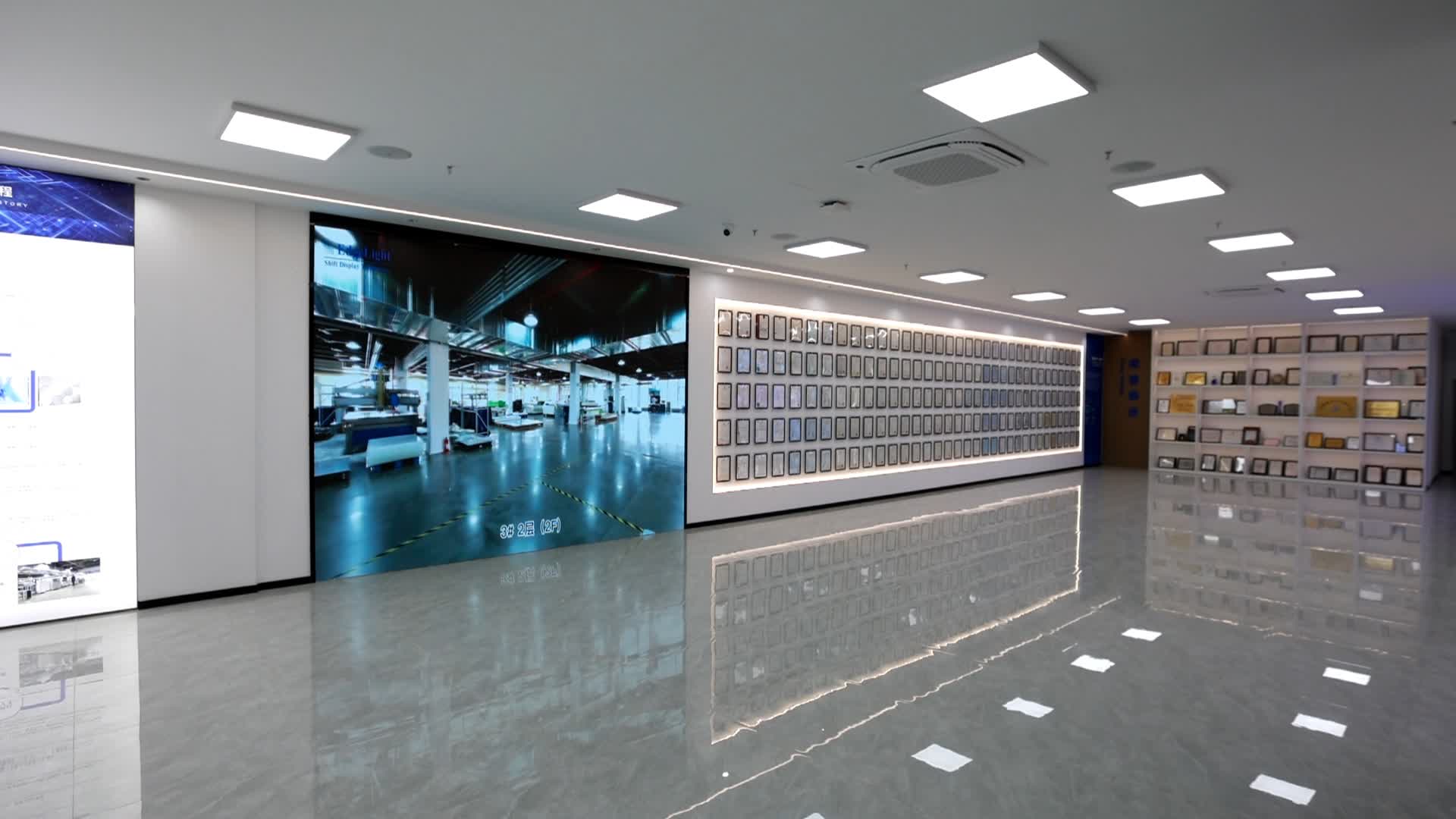 EDGELIGHT showroom: light guide panel and LED product samples available for project evaluation.
Send your panel size, thickness, colour temperature and target application to receive a sample panel and project quotation.
Website: en.edgelight.com | Blog: blog.edgelight.com | Email: info@edgelight.com | WhatsApp: +8617701891091
Product catalogue (PDF): download here
Have Questions or Need More Details?
Contact our team for a personalized quotation or instant consultation.
Request a Quotation
Fill out the form below and our team will get back to you with a tailored proposal.
WhatsApp Direct Chat
Prefer to chat in real-time? Message us on WhatsApp for instant assistance & quick answers.
- Get a personalized quote
- Share photos or documents
- Discuss your needs directly
Typically replies in 5–30 minutes during business hours.