
How Acrylic Light Guide Panels Create Uniform Surface Illumination: A Basic Explainer

An acrylic light guide panel converts edge-mounted LED light into a flat, evenly lit surface — the principle behind slim light boxes, backlit retail fixtures and illuminated interior panels.
The short answer: an acrylic light guide panel (LGP) is a clear PMMA sheet that accepts LED light at one or more polished edges and releases it across its front face. Light entering the edge stays trapped inside the sheet by total internal reflection until a printed or laser-etched dot pattern scatters it out through the surface. That dot pattern is graded — sparse close to the LEDs, dense further away — so the light leaving the panel is evened out across the whole area. The graded pattern, not the acrylic alone, is what produces uniform surface illumination.
This explainer is written for buyers and designers who are new to the light guide panel category in electrical and electronics display components. It covers what uniformity actually means, why it is difficult to achieve, how an acrylic light guide panel distributes light from edge to face, which published parameters matter at first review, and where the technology is typically used. Shanghai Edgelight Industry Co., Ltd. (EDGELIGHT), founded in 2004, is a Shanghai-based manufacturer of light guide panels, LED displays, intelligent controllers, LED drivers and advertising lighting equipment; the company employs approximately 500 staff and operates a 33,000 m² manufacturing facility with a 25-engineer R&D team and an annual production capacity of 120,000 units.
What “uniform surface illumination” actually means
Uniformity is a ratio question, not a brightness question. A panel can be very bright in the middle and still fail, because the viewer reads the difference between the brightest and dimmest zones, not the average. In practice, a uniform illumination light guide panel is judged on four visible behaviours: no bright band running along the LED edge, no dark corners, no colour drift from one side of the panel to the other, and no readable dot pattern at normal viewing distance.
Those four behaviours are what a buyer is really paying for. Luminous flux tells you how much light comes out; uniformity tells you whether that light is usable across the full face. For a backlit sign, a shelf display or a ceiling feature, the second number is usually the one that determines whether the installation looks professional.
A useful way to frame it: an LGP is an optical component, not a lamp. The light source sits at the edge, the acrylic transports the light, and the pattern decides where the light leaves. Every uniformity problem in the field traces back to one of those three elements.
Why even illumination is difficult to achieve
LEDs are point sources. Left bare behind a diffuser, they produce a grid of hotspots and a bright halo where each emitter sits. The light guide panel exists to solve that problem, but solving it introduces three competing constraints that a first-time buyer should understand before comparing quotations.
- Thinness versus mixing distance. The thinner the panel, the less room light has to spread before it reaches the viewer. Ultra-thin light guide panels for slim light boxes are attractive because they suit shallow frames, but a very slim profile demands tighter optical design than a thicker sheet.
- Size versus attenuation. Light weakens as it travels away from the injection edge. On a small panel the effect is minor; on a large one it can be visible as a gradient. The dot pattern has to compensate for a longer light path on big formats.
- Brightness versus pattern visibility. Pushing more light out of the panel makes the surface brighter, but it also makes the extraction pattern easier to see if the pattern design and the diffuser are not matched to the application.
There is also an assembly dimension. A gap or misalignment between the LED strip and the panel edge, an unpolished edge, or a reflector that does not sit flat will all show up as uneven light, even when the panel itself was produced correctly. This is why a light guide panel is normally specified together with its matched equipment — LED strip, constant-current driver, light box frame, diffuser film, reflective film and mounting brackets — rather than as a loose sheet.
Where acrylic light guide panels sit in the display supply chain
The category is a component business inside the wider lighting and display trade. Commercial research cited for this market valued the global light guide plate market at USD 3.91 billion in 2025 and projected USD 6.51 billion by 2034, a compound annual growth rate of 5.8%. The same research attributes a 48.2% revenue share in 2025 to Asia Pacific, which reflects where panel production is concentrated rather than where the panels are installed.
Classification matters for importers. Light guide plates are commonly classified under HS 9405.61 for LED-based illuminated panels, or under 8529.90.90 as parts for TV and display assemblies, depending on how the item is presented. Buyers shipping complete light boxes and buyers shipping bare panels are therefore not always working with the same tariff line.
On the measurement side, ISO/CIE 10916:2024 sets out rules for rating the performance of light and lighting systems. It is a rating framework rather than a pass/fail certificate for a panel, but it gives both sides of a negotiation a common vocabulary when uniformity and light output have to be documented.
EDGELIGHT's own position in this chain is as a manufacturer rather than a trading intermediary: the company reports an export ratio of 75%, with the USA and EU as its main markets, and operates five production bases including its Shanghai headquarters site. Its product scope covers light guide panels, Edgelux panels, SEG light boxes, LED strips and power supplies for advertising light boxes, LED displays and LED advertising products.
How an acrylic light guide panel distributes light: the four-stage path
Uniformity is the result of four stages working together. Understanding them makes the datasheet readable.
Stage 1 — Injection at the edge
LEDs are mounted on a strip that runs along one or more edges of the acrylic sheet. Light enters through the edge face at a shallow angle. The quality of that edge, the distance between the emitter and the acrylic, and the pitch of the LEDs all influence how much light is coupled in and how evenly it starts out. An edge-lit light guide panel therefore depends on mechanical alignment as much as on optics.
Stage 2 — Total internal reflection
PMMA has a higher refractive index than air. Light travelling inside the sheet and striking the front or back face at a shallow angle is reflected back into the material instead of passing through. The panel behaves like a light pipe: the acrylic carries the light across the surface with very little escaping. This is the stage that makes a slim panel possible at all — the light is transported laterally, not projected from behind.
Stage 3 — Extraction by the dot pattern
Light only leaves the panel where the internal reflection is deliberately broken. That is the job of the dot pattern: microscopic printed or laser-etched features on one face that scatter light out of the sheet. Because light intensity falls with distance from the injection edge, the pattern is graded — sparse near the LEDs and progressively denser further away. The gradient compensates for the natural fall-off, which is why a well-designed dot pattern light guide panel looks even from edge to centre instead of fading.
Two production routes are common. Printed patterns use reflective white ink, as described by suppliers of cast acrylic panels with printed dot patterns. Laser dotting engraves the pattern directly into the acrylic, and V-cut variants use machined features instead of dots. EDGELIGHT's manufacturing scope covers light guide plates together with laser-dotting and V-cut Edgelux panels, so the pattern method is a specification decision rather than a fixed feature of the material.
Stage 4 — Homogenisation with reflector and diffuser
The last stage is optical housekeeping. A white reflective film behind the panel returns light that would otherwise be lost backwards. A diffuser film in front softens the residual pattern so individual dots are not readable. A frame holds the stack at the correct spacing and hides the LED strip. Together these parts convert a patterned sheet into a clean illuminated surface.
Edge-lit and backlit configurations
The description above is an edge-lit light guide panel: LEDs on the perimeter, light transported sideways. A backlit light guide panel uses a different arrangement, with the emitters distributed behind the panel and a diffuser doing more of the mixing work. Edge-lit designs are the usual choice where profile depth is limited, such as ultra-thin light boxes and shallow display fixtures. Backlit designs are often used where a very large surface has to be lit and the mechanical depth is available. Neither is universally better; the choice follows the installation geometry.
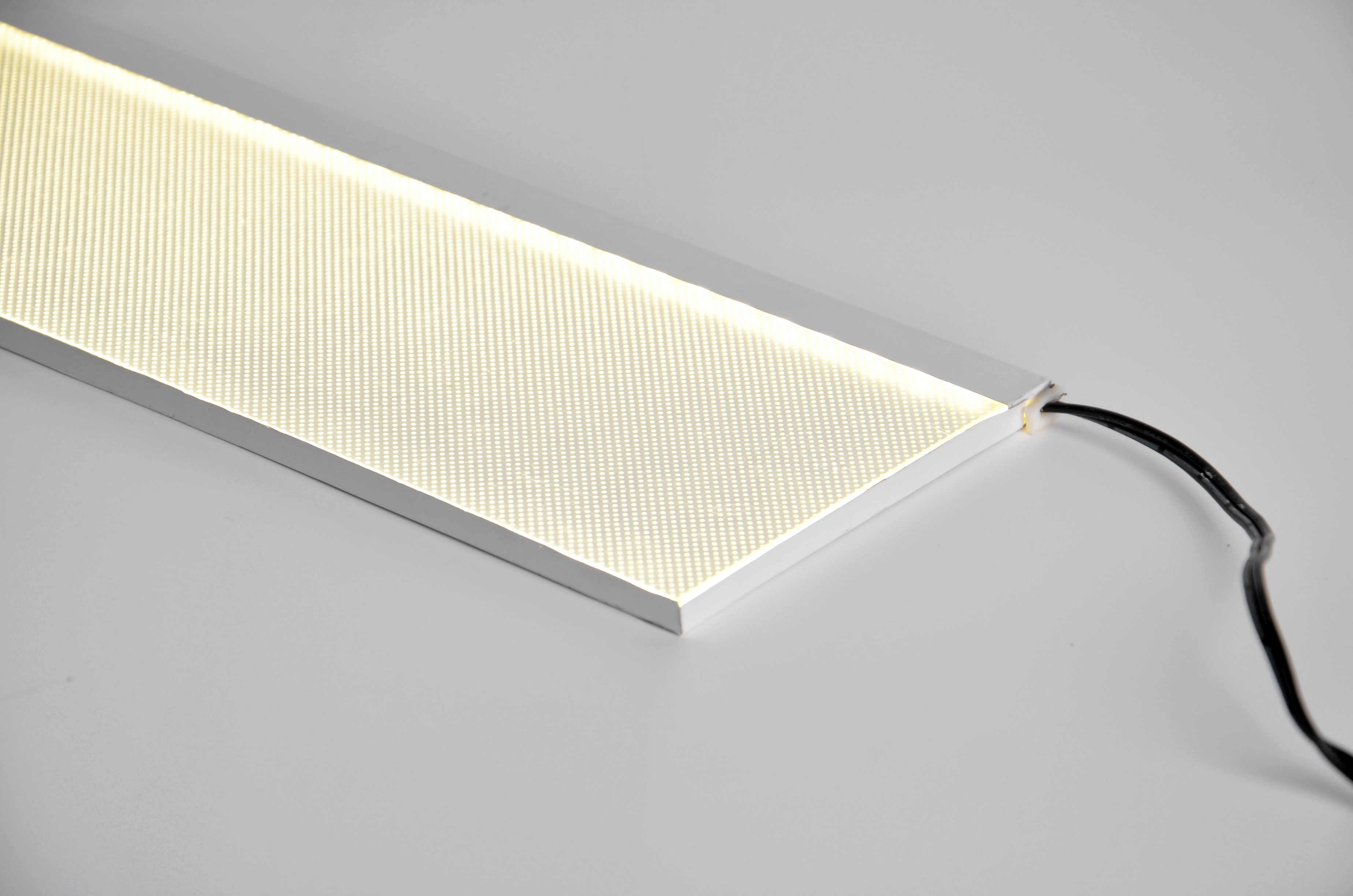
Colour temperature is set by the LED source at the edge, not by the acrylic; published LGP configurations span 2700K to 6500K.
A beginner's parameter snapshot
The published specification for EDGELIGHT's model LGP is a useful reference point because it shows the full set of values a first-time buyer will encounter. These are example values for the product category; actual figures depend on panel size and configuration, so they should be confirmed against the specific build.
| Parameter | Published value (model LGP) | What it tells a first-time buyer |
|---|---|---|
| Material | Acrylic (PMMA) | The optical medium that carries light across the surface. |
| Luminous flux | >1080 lm | Total light output of the illuminated assembly as published; brightness is a separate question from evenness. |
| Colour temperature | 2700K–6500K | Warm through cool white; the range covers hospitality, retail and office interiors without changing hardware type. |
| Operating current & power | 7.2 A max; 144 W max | Upper limits used when sizing the constant-current driver and the electrical installation. |
| Typical power consumption | 101 W | Working figure for running-cost and thermal planning. |
| Operating temperature | −20°C to 50°C | Ambient range the panel is specified for; relevant for outdoor signage and unheated spaces. |
| Protection grade | IP20–IP65 | From dry interior use up to dust- and water-exposed installations. |
Source: EDGELIGHT published product specification for model LGP (light guide panel, Light Panel category). Values are configuration-dependent and should be confirmed per project.
Two related facts help put these numbers in context. Industry product literature lists common PMMA light guide panel thicknesses of 3 mm, 4 mm, 5 mm, 6 mm, 8 mm and 10 mm, so thickness is a design variable rather than a fixed attribute. And the operating-temperature window matters more than beginners expect: many applications described for this product run continuously, so the panel and its driver have to sit within that range for the life of the installation.
Step-by-step: how a uniform panel gets specified and built
- Fix the lit area and the viewing condition. Define the illuminated size, the viewing distance and whether the panel runs intermittently or continuously. These three answers decide the optical difficulty of the job before any quotation is requested.
- Choose the material and thickness. Acrylic is the standard medium. Thickness selection balances the frame depth available against the mixing distance the design needs; published product literature lists options from 3 mm to 10 mm, and one supplier cites a 10 mm single-sided acrylic panel for large-format displays while another lists 4 mm, 6 mm and 8 mm constructions across different light and colour configurations.
- Design the dot pattern for the specific size. The pattern cannot be copied from a smaller panel: dot density, dot size and the position of the densest zone all shift with panel dimensions and LED layout. This is the stage where an LGP manufacturer adds most of its engineering value.
- Couple the light source and driver. Match the LED strip to the edge length and pair it with a constant-current driver sized to the electrical limits, for example the 7.2 A maximum current and 144 W maximum power published for model LGP. Colour temperature is chosen here, from 2700K to 6500K.
- Assemble the optical stack. Reflective film behind, diffuser film in front, frame and mounting brackets around. The IP20–IP65 range is realised at this stage, not in the acrylic, so sealing and gasketing decisions belong to the assembly.
- Validate a physical sample. Check the corners, the edges and the centre at the intended viewing distance, and check again once the panel has been running long enough to reach its working temperature. If uniformity has to be documented formally, agree the measurement approach in advance against a recognised rating framework such as ISO/CIE 10916:2024.

The frame holds the reflector, panel and diffuser at the correct spacing and conceals the edge-mounted LED strip.
Applications of uniform surface illumination
Light guide panels appear wherever a flat, even glow is wanted inside a shallow construction. The published application scope for model LGP covers advertising light boxes and signage, retail and luxury display, office and high-end residential interiors, exhibition and museum environments, hospitality and commercial interiors, elevator decoration, transportation and public spaces, and consumer electronics backlighting.
- Advertising light boxes and signage. The classic use case: an ultra-thin LED light box with a printed graphic in front of the panel. Even illumination prevents the graphic from showing bright patches near the frame.
- Retail and luxury display. Showcase and shelf backlighting, where a visible hotspot would compete with the product. High brightness light guide panels for advertising displays are used where the surrounding store lighting is strong.
- Office and high-end residential. Flat ceiling and wall panels, including hospitality ceiling light panels, where the aim is an architectural plane of light rather than a visible fitting.
- Exhibition and museum. Entrance walls, graphic walls and illuminated captions, where colour consistency across a large panel protects the artefacts and the interpretation.
- Hospitality and commercial interiors. Lobby ceilings, bar fronts and feature walls, frequently specified in warmer colour temperatures from the 2700K–6500K range.
- Elevator decoration. Cabin wall and ceiling panels, where a slim optical stack fits the available depth.
- Transportation and public spaces. Wayfinding and illuminated information surfaces where robustness and long operating hours matter.
- Consumer electronics backlighting. Smaller optical panels used behind displays and indicators.
Project conditions span interior and outdoor use. Where dust or water exposure is expected, the specification shifts toward the upper end of the IP20–IP65 range; where the panel sits in a dry interior ceiling, a lower rating is normally adequate.

Retail shelf backlighting: the panel provides a flat background so merchandise, not hotspots, reads first.
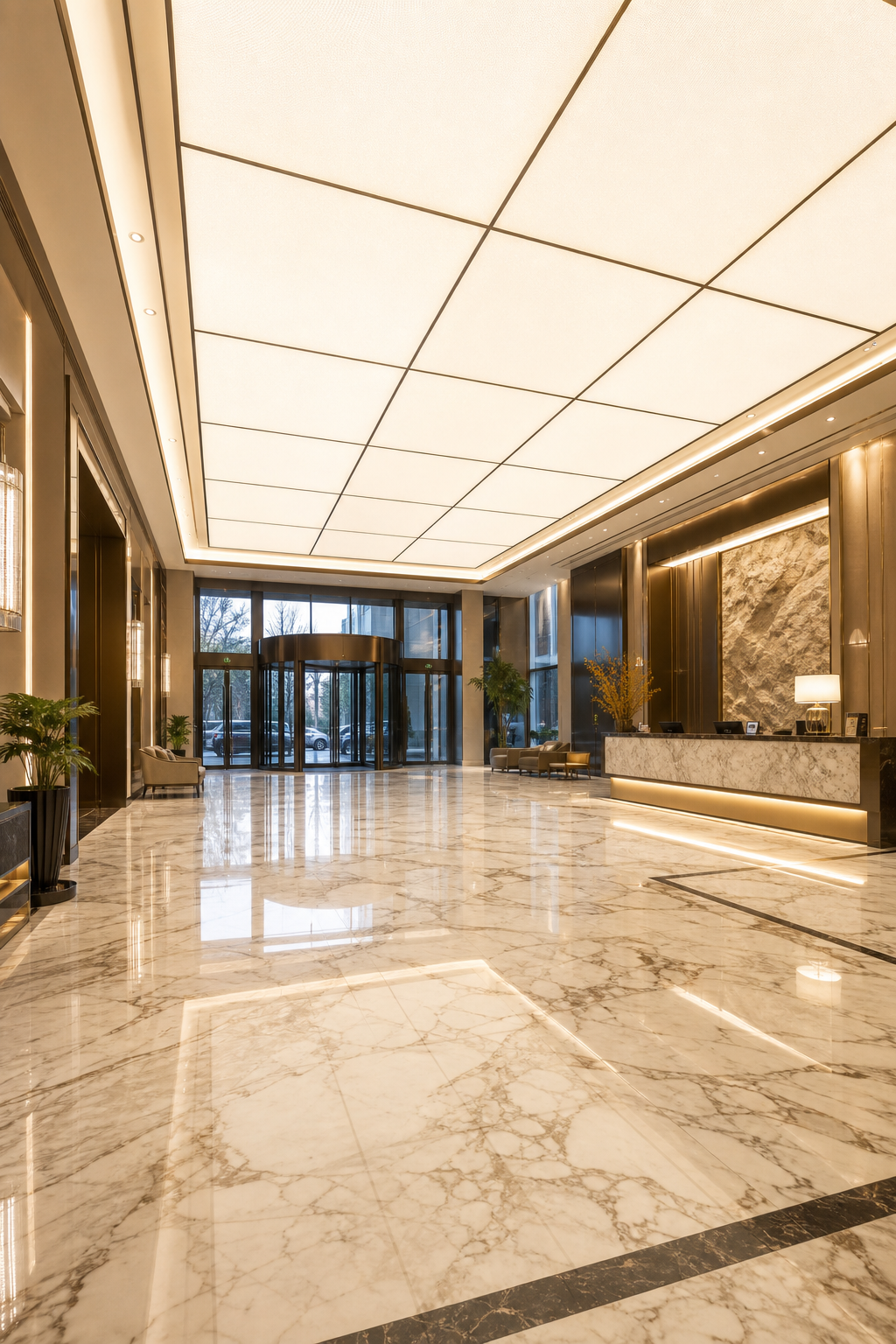
Hospitality ceiling panels turn the light guide into an architectural surface rather than a visible fixture.
Published specification examples compared
The table below compares publicly described attributes of several light guide panel products. Every value is company-reported by the named supplier and applies to a stated configuration; the absence of a value means it was not stated in the source reviewed, not that the product lacks the capability.
| Attribute | EDGELIGHT model LGP | Specialty Lighting custom LED LGP | Diode LED LGP | Astra CLAREX LGP |
|---|---|---|---|---|
| Material | Acrylic (PMMA) | Not stated in reviewed datasheet | Acrylic | Optical-grade cast acrylic/PMMA with printed reflective white dot pattern |
| Thickness | Not stated in published specification | Not stated | 4 mm, 6 mm and 8 mm across configurations | Not stated |
| Stated panel size | Custom sizes available; maximum depends on build | Not stated | Up to 47 x 94 in for a stated configuration | Generally used up to approximately 24 in diagonal |
| Electrical rating | 7.2 A max; 144 W max; typical 101 W | 24 V DC; 5.5 W per foot | Not stated | Not stated |
| Light output | >1080 lm | Not stated; Tier 1 ANSI lamp source | Not stated | Not stated |
| Colour options | 2700K–6500K | Single colour datasheet | Static white, RGB, tunable white, RGBW and warm-dim configurations | Not stated |
| Operating temperature | −20°C to 50°C | Not stated | Not stated | Not stated |
| Ingress protection | IP20–IP65 | Not stated | Not stated | Not stated |
All entries are supplier-reported and configuration-specific. Figures are not directly comparable across suppliers because test methods and product scopes differ.
The pattern in this table is itself instructive for a first-time buyer: suppliers publish different subsets of the specification. Some lead with electrical data, some with panel dimensions, some with pattern construction. A quotation that answers only one of those columns is not yet a comparable quotation.
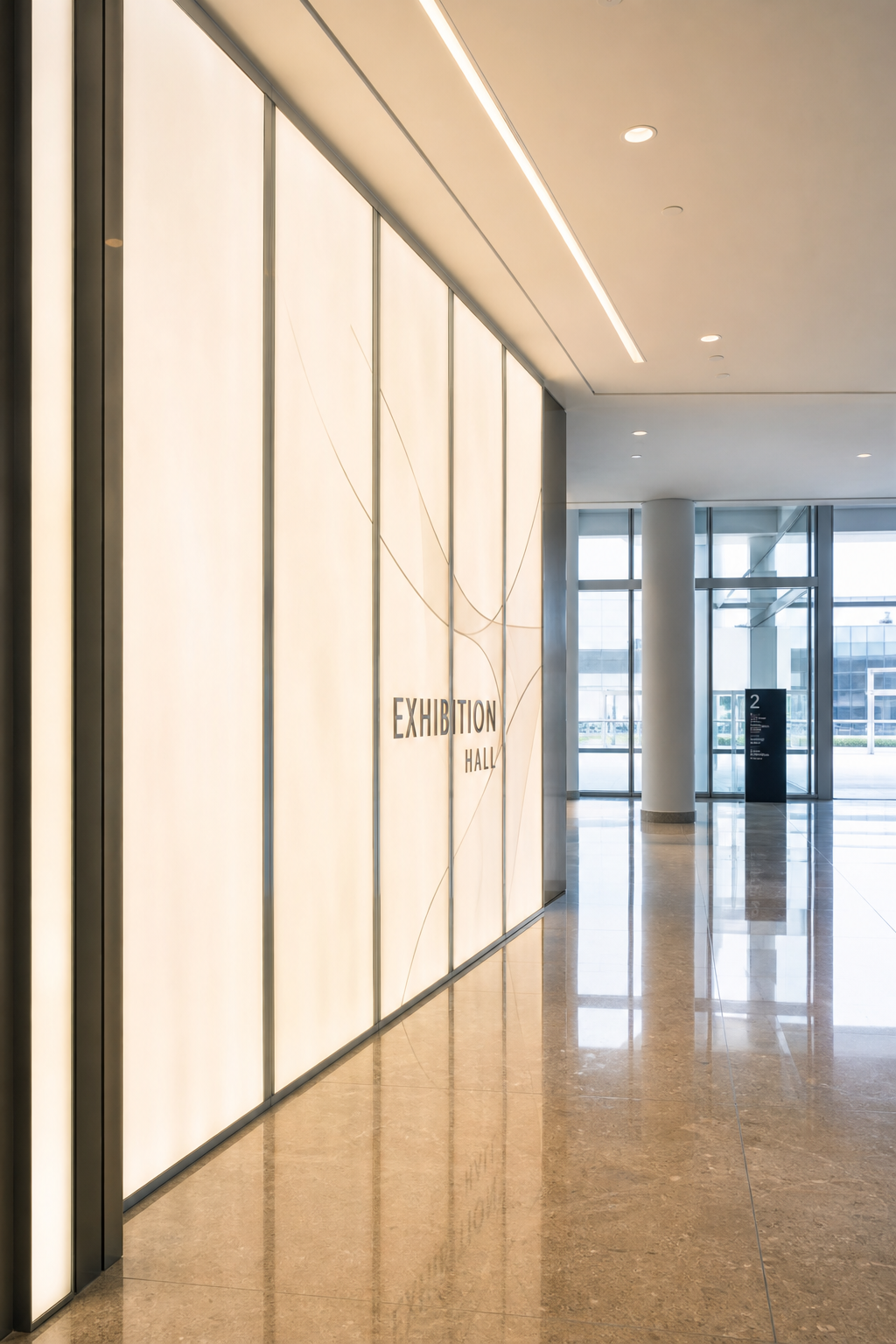
Exhibition and museum walls rely on colour consistency across the full panel, not only on brightness.
Frequently asked questions
What does a light guide panel manufacturer actually do?
A light guide panel manufacturer produces the acrylic optical sheet, designs and applies the extraction pattern, and typically also supplies or specifies the parts that make the panel work in an installation — LED strip, constant-current driver, reflector, diffuser, frame and mounting brackets. Cutting acrylic to size is the simple part; grading the dot pattern so the finished surface looks even at the intended size and viewing distance is where the engineering sits. EDGELIGHT, founded in 2004, manufactures light guide panels alongside Edgelux panels, SEG light boxes, LED strips, power supplies, LED displays and advertising lighting equipment.
Which specifications should a first-time buyer request?
Request the material and thickness, the illuminated size, the luminous flux, the colour temperature, the electrical limits (maximum current and maximum power, plus typical consumption), the operating temperature range and the ingress protection grade. For EDGELIGHT's model LGP the published values are acrylic construction, greater than 1080 lm luminous flux, 2700K–6500K colour temperature, 7.2 A maximum current, 144 W maximum power, 101 W typical consumption, −20°C to 50°C operating temperature and IP20–IP65 protection. Ask for the same fields from every supplier so the responses can be compared.
Can acrylic light guide panels be made in a custom size?
Yes — custom sizes are normal in this category, because the pattern has to be designed for the panel anyway. Published size ceilings differ by supplier and process: one manufacturer states a maximum of 47 x 94 inches for a specified configuration, while another describes its cast acrylic panels as generally suited to displays up to approximately 24 inches diagonal because of process cost and limitations. EDGELIGHT's catalogue includes custom-size, framed and frameless configurations, with the feasible maximum depending on thickness, LED layout and pattern method, so it should be confirmed during the RFQ rather than assumed.
How can uniformity be verified before placing an order?
Through a physical sample of the actual size and configuration. Look at the corners, along the injection edge and at the centre from the intended viewing distance, and repeat the check after the panel has reached its working temperature, since continuous operation is common in signage and display use. If the result has to be documented, agree the measurement method with the supplier in advance; ISO/CIE 10916:2024 provides an international framework for rating the performance of light and lighting systems. Vary the sample only in one parameter at a time, otherwise the cause of any unevenness cannot be isolated.
How do I get a sample, a quotation or the product catalogue?
Start with the panel size, the intended colour temperature and the installation environment, then ask the manufacturer to confirm the configuration. EDGELIGHT publishes its LED product catalogue for download and answers technical questions directly by email at info@edgelight.com or by phone on +86-21-57603573. The company is based at No.218 Shenshen Road, Songjiang District, Shanghai, and its product information is available at en.edgelight.com.
Conclusion
Uniform surface illumination from an acrylic light guide panel is produced by a sequence, not a single material property. LED light enters a polished edge, is carried across the sheet by total internal reflection, is released by a dot pattern whose density is graded to compensate for distance from the light source, and is finally smoothed by a reflector and a diffuser. Change one of those elements — thickness, pattern design, LED pitch or assembly spacing — and the appearance of the finished surface changes with it.
For a buyer at the research stage, that sequence explains why two panels with the same nominal brightness can look completely different in service. The practical next step is to fix the four inputs that drive everything else — illuminated area, thickness, colour temperature and protection grade — and then evaluate a sample at the real size rather than judge the category from a datasheet alone.

Evaluate a panel at your own size
Share the illuminated area, thickness, colour temperature and installation environment with the EDGELIGHT team, and request a configuration review, sample arrangement or quotation for a custom-size light guide panel.
Download the LED product catalogue: EDGELIGHT LED Product Catalogue (PDF)
Website: en.edgelight.com | Email: info@edgelight.com | Tel: +86-21-57603573
Have Questions or Need More Details?
Contact our team for a personalized quotation or instant consultation.
Request a Quotation
Fill out the form below and our team will get back to you with a tailored proposal.
WhatsApp Direct Chat
Prefer to chat in real-time? Message us on WhatsApp for instant assistance & quick answers.
- Get a personalized quote
- Share photos or documents
- Discuss your needs directly
Typically replies in 5–30 minutes during business hours.