
Reading Screen Fabric Compliance Claims: A Buyer's Certification & Acceptance Guide
Reading Screen Fabric Compliance Claims: A Buyer's Certification & Acceptance Guide
A screen fabric compliance claim is usable only when a third party could verify it without asking the seller anything: a named legal entity, a named product scope, a named standard and version, a certificate or report number from an identifiable body, and dates that cover your order. Miss any one of those five elements and you are holding a statement of intent rather than evidence. Such statements tend to fail at the exact moment they are needed — goods-in inspection, a customs file, or a submittal review.
This guide is written for buyers in the research and evaluation stages, before the purchase order is drafted. It sets out how to read compliance documents, how to separate four distinct kinds of evidence, how to map a claim to the specific series and construction being ordered, and how to convert the claim into an acceptance criterion that can actually be tested. Two products are used as worked examples because their claims are of different types: the Aluminized Silver Screen Series, where the central claims are measured optical values, and the Elitex Super 6 Series, where the central claims are material composition and construction.
Elitex (Dezhou) Co., Ltd. is a screen fabric manufacturer founded in 2003, operating an 85,000 m² facility in Dezhou, Shandong, China. The company exports to the USA, EU, Australia, the Middle East and Southeast Asia, with an export ratio of 80%.
What this guide does not do is decide which regulations apply in your market. That determination belongs to your importer of record and your compliance advisers. The supplier's task is narrower and more useful: to provide evidence against requirements you have named, in a form you can check.
Why compliance claims break down at acceptance
Compliance disputes rarely start with a supplier inventing a certificate. They start with a genuine document being used for a purpose it was never issued for. Four failure modes account for most of the damage.
- Scope drift. A certificate is issued to a named entity and a defined product list, but the offer sheet, brochure or sales email presents it as covering the whole catalogue. A circularity certificate that names three specific openness values is then quoted in support of a fourth, or of a different series entirely.
- Version drift. Schemes and standards are revised, and a certificate records the version it was issued against. A buyer comparing a 2026 specification against a document issued under an earlier version is comparing two different things, even when the certificate is still within its validity period.
- Evidence-type confusion. ISO 9001 confirms that a quality management system at a site has been audited. It says nothing about the emissions profile, the optical performance or the fire behaviour of a specific roll of fabric. Buyers who accept it as product proof discover the gap during a submittal review.
- Missing method. "Grade 6 colour fastness" or "fire retardant" without the test method, exposure condition or classification is a headline, not a specification. The same words can describe results from different methods that are not comparable.
Every one of these is cheap to prevent at the quotation stage and expensive to fix after production, when fabric has been woven to a colour and openness that the certificate does not cover.
Where screen fabric compliance requirements actually come from
Screen fabric sits between three identities. It is a textile, assessed for composition, restricted substances and emissions. It is a component inside a shading system, interacting with roller tubes, zip tracks and awning frames. And in some projects it is part of a building envelope assessed for energy or fire performance. The same roll can therefore be examined under three different frameworks, which is why a supplier's document set can be genuine, current and still irrelevant to your order.
Two categories should be separated before anything else is discussed.
- Mandatory regulation applies because a product is placed on a market. Which rules apply depends on your market, your role in the supply chain, and how the article is classified.
- Voluntary certification is a scheme the supplier chooses to join. UL GREENGUARD and UL GREENGUARD Gold, certified to UL 2818 – 2022 for low chemical emissions, and Cradle to Cradle Certified for circularity and material health, are examples. Such certification can satisfy a project specification or a green-building credit. It does not by itself discharge a legal obligation in any market.
A third phrase worth retiring is "meets international standards". ISO publishes management-system standards and test methods, and a test method is not a pass mark. ISO 105-B02-2014, for instance, describes how to measure colour fastness to artificial light. It does not tell you which grade is acceptable for a south-facing façade in your climate. That judgement belongs to the specification, and the specification belongs to you.
Four kinds of evidence, and what each one can prove
Most arguments about compliance claims are really arguments about which document was promised. Sorting the documents into four types resolves the argument faster than any amount of correspondence.
| Evidence type | What it establishes | What it does not establish | What to request |
|---|---|---|---|
| Management system certificate (ISO 9001, ISO 14001, ISO 45001) | That the site's processes are audited against a recognised management standard | Any property of a specific fabric | The certificate with legal entity, scope wording, certification body and validity dates |
| Product or material certification (UL GREENGUARD, GREENGUARD Gold to UL 2818 – 2022; Cradle to Cradle Certified) | That named products meet the scheme's criteria for the properties the scheme covers | Compliance with every regulation, or any property outside the scheme | The certificate plus the product list showing your series and construction in scope |
| Test report (optical values, colour fastness, composition) | Measured results on the specific sample tested, under a named method | That production rolls match the sample, unless sampling and retention are agreed | Laboratory name, sample identification, method and version, test date, reported values |
| Supplier declaration (substance statements, recyclability, restricted-material lists) | The supplier's stated position, and its willingness to be held to it | Independent verification of that position | Named substances or properties, reporting limits, method, and who verified the result |
The order of that table is not a ranking of quality. It is a filter. A declaration is often the only workable evidence for a bespoke substance question, and a test report can be worthless if the sample it describes cannot be traced to your order.
Seven fields that decide whether a claim is usable
Read every certificate and report against the same seven fields. If a supplier cannot point to all seven, the claim is not yet ready for a purchase order.
- Legal entity. The name on the certificate must match the entity you are contracting with, or the relationship between them must be documented. A trading name on a brochure is not a legal entity.
- Product scope. Look for the series, model or construction list. Company-level scope is common and legitimate, but it only helps you if your item appears in the accompanying list.
- Standard and version. Record the exact edition. When a specification cites a standard, cite the same edition in the purchase order.
- Number. A certificate or report number allows the document to be checked, quoted and traced later. Untraceable certificates should not enter an acceptance file.
- Issuer. Identify the certification body or laboratory and confirm it is recognised for the scheme in question.
- Dates. Compare the issue and expiry dates against both the purchase order date and the delivery date, not against today's date alone.
- Registry status. A scanned certificate is a copy of a claim; the registry entry at the issuing body is the claim's current state. Check it before the document enters a submittal.
A useful habit: keep the registry screenshot, the certificate PDF and the product list in one folder per order. When a question arrives eighteen months later, the file answers it without an email chain.
Worked example: mapping Elitex documents to two products
The point of this section is not to list what a supplier holds. It is to show how the same document set maps differently onto two products with different claim types.
Management system certificates
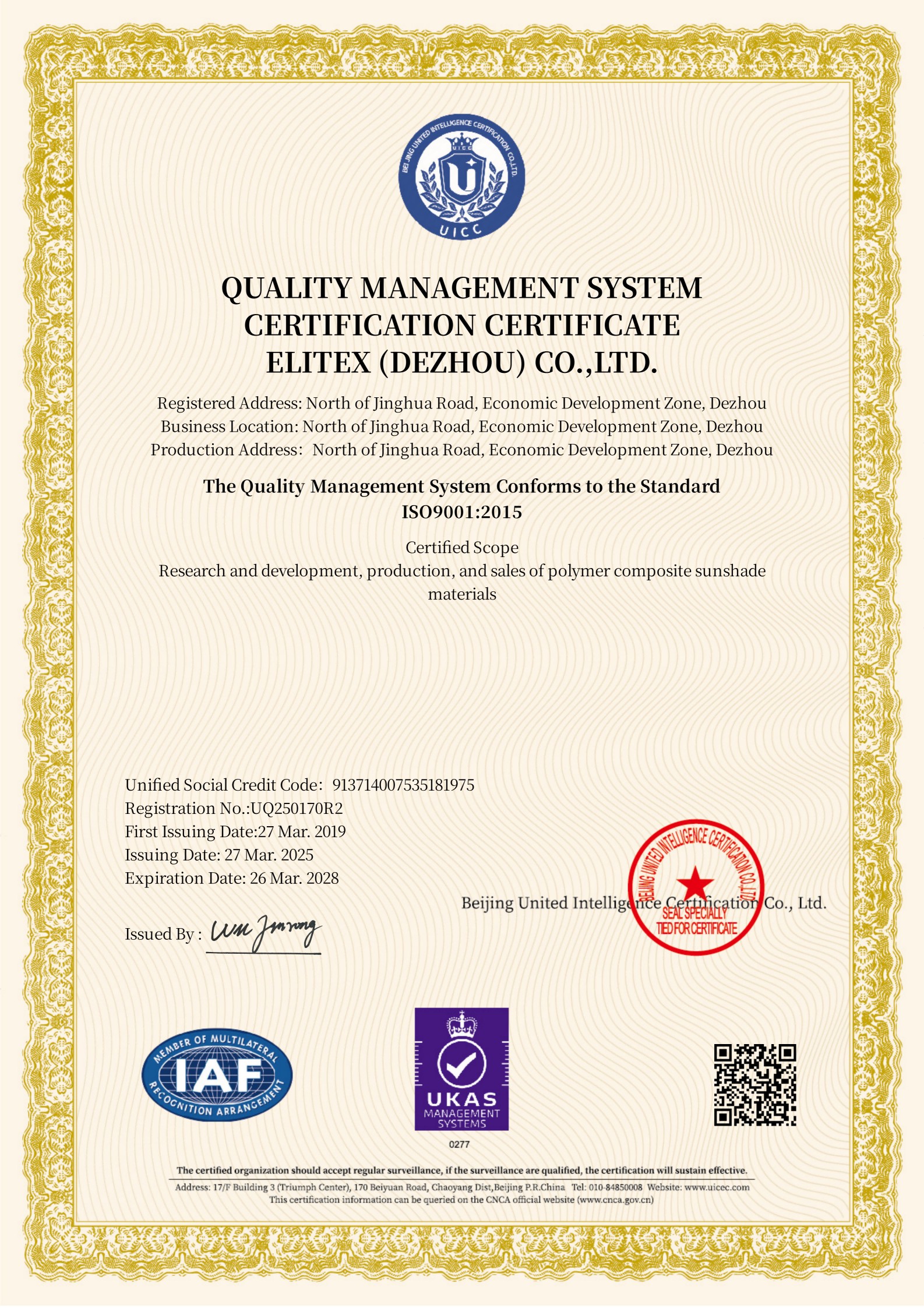
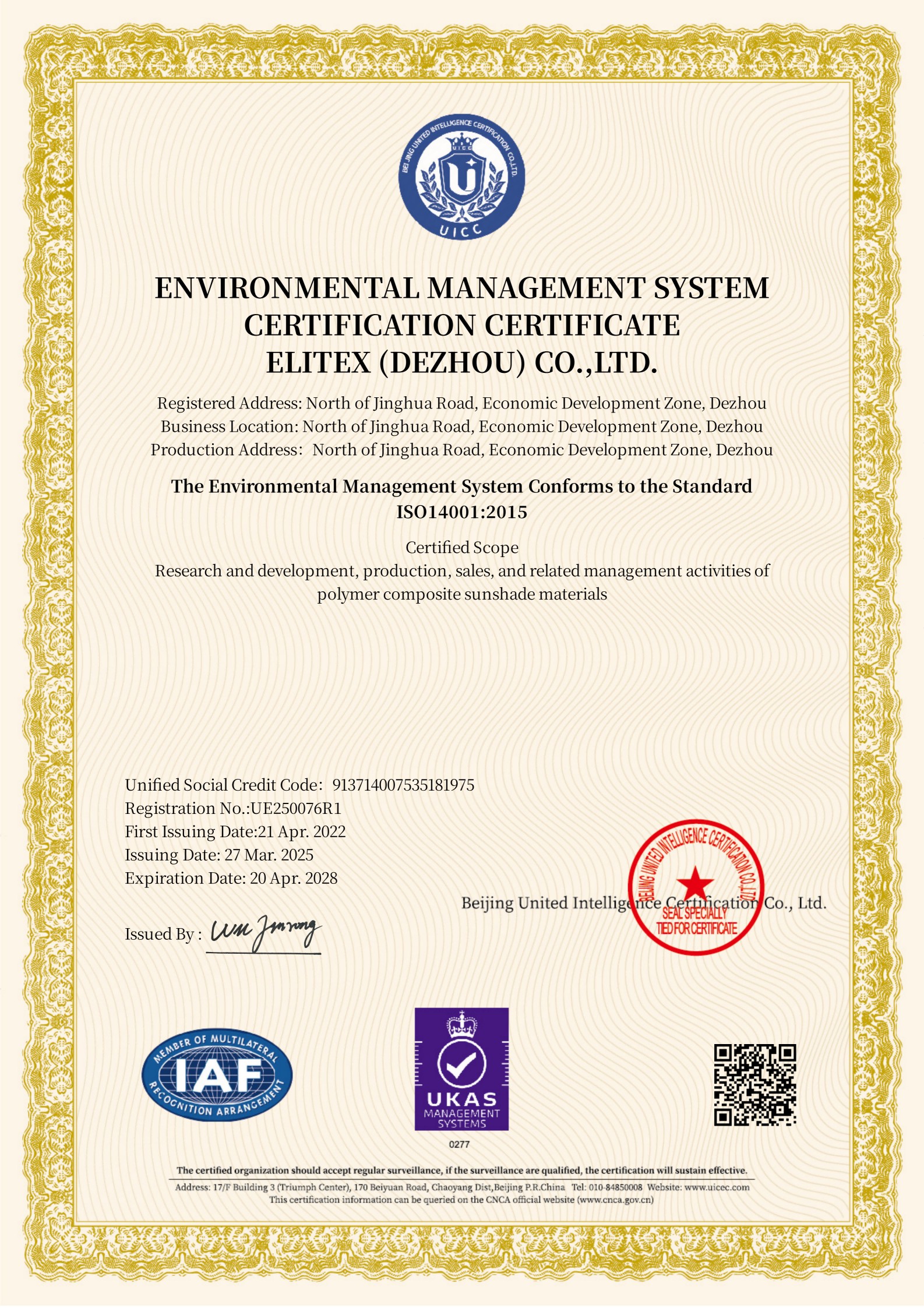
Elitex holds ISO 9001:2015 certificate UQ250170R2, issued by Beijing United Intelligence Certification Co., Ltd., valid from 27 March 2025 to 26 March 2028, with a scope covering research and development, production and sales of polymer composite sunshade materials. ISO 14001:2015 (UE250076R1) and ISO 45001:2018 (US250047R1) are held against the same site-level activities, valid from 27 March 2025 to 20 April 2028.
These establish that the site operates audited quality, environmental and occupational health and safety systems. They do not establish that any particular fabric meets an emissions, optical or fire requirement. For a buyer, they belong in supplier qualification and factory approval — a separate clause from product acceptance.
Product certification
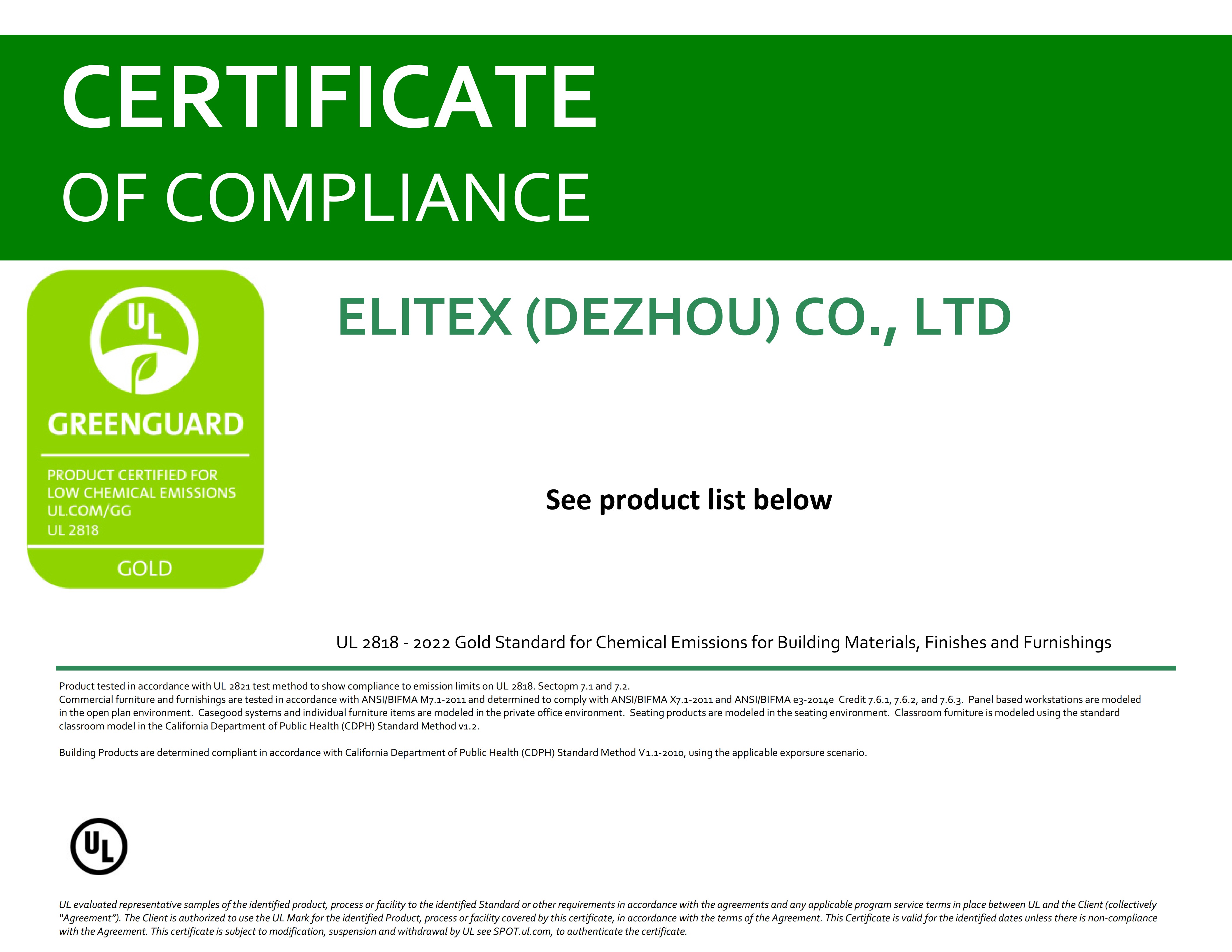
Elitex holds UL GREENGUARD and UL GREENGUARD Gold certification to UL 2818 – 2022, with the certified scope stated as ELITEX (DEZHOU) CO., LTD. products. A company-level scope is common in this scheme; the practical step is to confirm that the series and construction you are ordering appear on the certificate's product list, because that list, not the logo, is what a specifier will read.
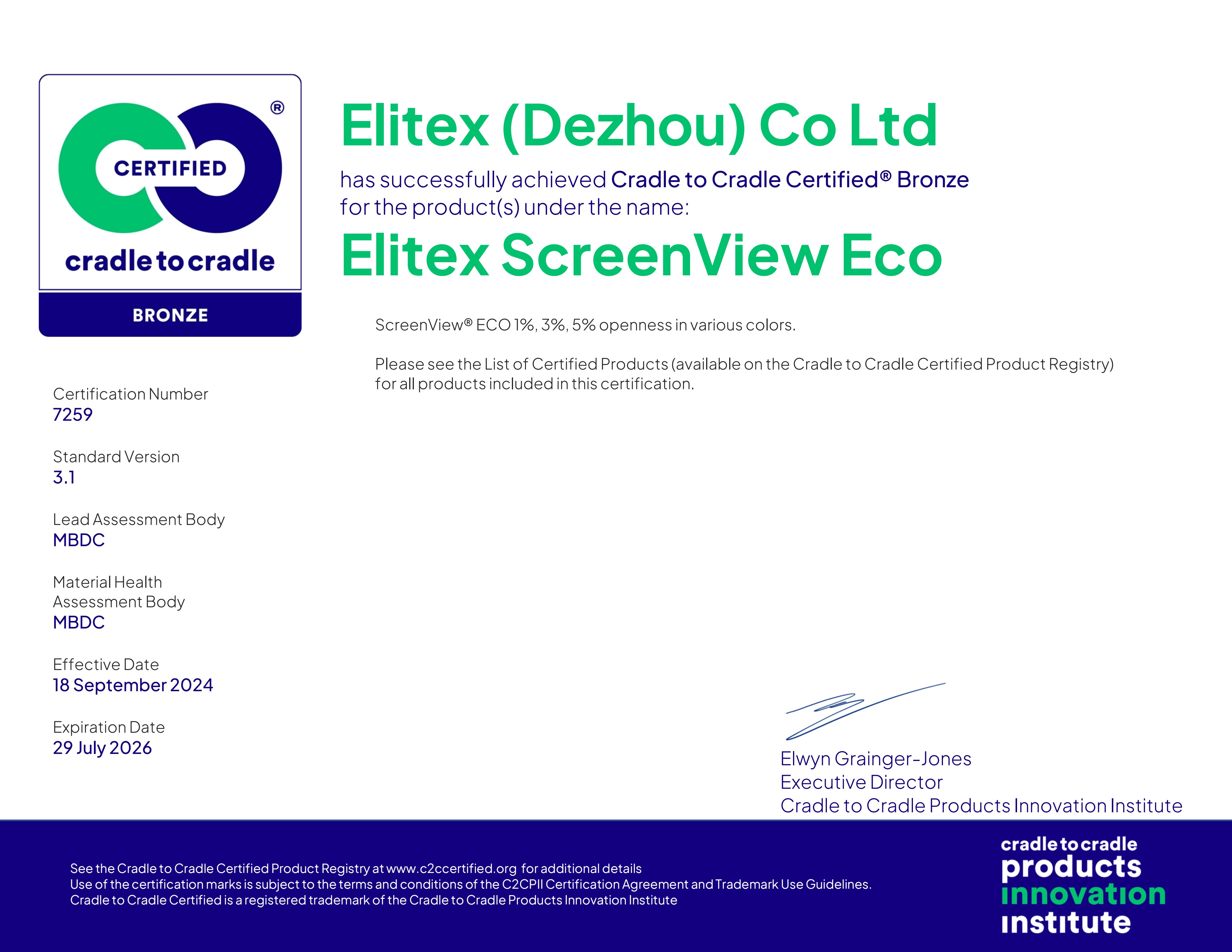
The Cradle to Cradle Certified Bronze certificate, number 7259 and issued on 18 September 2024, shows how precise scope can be: it names ScreenView Eco in 1%, 3% and 5% openness as the certified scope. That is not a weakness in the certificate; it is the certificate doing its job. A 10% openness fabric, or a different series, is outside that scope, and no amount of brochure language changes the boundary. Confirm the current registry entry at the issuing body before the document enters a submittal file.
Measured performance data: the aluminized series
The Aluminized Silver Screen Series is specified as polyester with an aluminized coating, reflectivity ≥85%, solar heat gain coefficient ≤0.2, openness 3%–5% and width 2000 mm–3000 mm. These are performance values, not certifications, and the distinction matters commercially. A performance value becomes contractual when a test report identifies the series and the sample, names the method and reports the same figure. Ask for the report rather than a restatement of the datasheet, and check that the sample identification matches the construction you are buying.
Composition and construction: the budget series
The Elitex Super 6 Series is specified as 100% polyester, in basket weave or twill weave, with openness of 1%, 3%, 5% and 10%, widths of 2000 mm and 2500 mm, and a range of 20+ popular colours. "100% polyester" is a composition claim and is testable. If composition is part of your specification, make a fibre-composition report the acceptance document rather than the datasheet, because the datasheet describes a range and the report describes a sample.
Colour fastness demonstrates the value of attaching a method to a number. Elitex's published data for its ScreenView range states Grade 6–7 tested to ISO 105-B02-2014. The grade only becomes usable when that method sits beside it, since the number alone does not tell a reviewer which exposure condition or scale was applied.
None of these documents substitutes for another. Process evidence, product certification, test data and declarations answer four different questions, and a complete acceptance file normally contains at least two of them.
Turning regional requirements into a requirement list
Buyers often begin by asking a supplier what certificates they hold. The stronger approach is to reverse the direction and hand over the list you need evidence against. Five steps produce that list.
- Identify the importer of record and establish who carries the legal obligation in your market.
- Classify what you are buying — material, component or finished product — because the classification drives the applicable framework.
- Convert each framework into a named, testable requirement: substance or property, limit, and method.
- State the evidence format you will accept and who must issue it: a certificate, a report from a named laboratory, or a signed declaration.
- Assign the verification point — quotation, pre-production sample, pre-shipment inspection or goods-in.
A written requirement list also improves comparison. Two quotations that answer the same named requirements can be evaluated side by side; two quotations that each attach a different bundle of certificates cannot.
From claim to acceptance criterion: a seven-step sequence
- Name the property, not the adjective. Replace "eco-friendly" with the property you are testing, such as a named substance limit or an emissions criterion.
- Fix the scope. State the series, openness, colour and width in the criterion. A criterion that applies to "sunscreen fabric" applies to nothing in particular.
- Request the source document. Ask for the certificate or report, not a summary slide.
- Check the issuer and the registry. Record the date of the check.
- Compare dates with the order. The evidence must be valid at the point of delivery, not merely at the point of quotation.
- Write the check into the purchase order with a pass/fail rule and a named responsible party for performing it.
- Agree the remedy before you need it. Decide in advance what happens if the document is missing, out of scope or out of date at shipment.
What an acceptance table looks like
The table below converts typical screen fabric claims into checks a warehouse or quality team can perform without interpreting the original marketing material.
| Claim in the offer | Evidence to attach | Acceptance check | Flag or reject if |
|---|---|---|---|
| "ISO 9001 certified" | Certificate copy with number and scope | Legal entity and scope match the contracting party and the product type | Certificate names another entity, or has lapsed at the delivery date |
| "GREENGUARD Gold" | Certificate to UL 2818 – 2022 with product list | Your series appears in the certified product list | Only a company-level statement is available and your series is absent |
| "Cradle to Cradle certified" | Certificate with product scope | The openness and series you are ordering fall inside the certified scope | You are ordering a construction outside the named scope |
| "Reflectivity ≥85%, SHGC ≤0.2" | Test report on the named series | Method and sample identification stated; values match the specification | Values appear only in a brochure, with no report or sample traceability |
| "100% polyester" | Fibre composition report | Composition confirmed for the ordered construction | Composition is asserted without a test document |
| "Colour fastness Grade 6–7" | Report citing ISO 105-B02-2014 | Method, scale and exposure condition are stated | Grade is quoted with no method beside it |
| "Recyclable" | Scheme certificate or defined recyclability statement | The statement defines what recyclable means in your market and for your construction | The word appears as an adjective only |
Vague language, and the questions that fix it
Vague compliance language is rarely dishonest. It is usually a compressed version of something real that lost its qualifications on the way to the sales sheet. These questions restore them.
| Phrase in the offer | Question that turns it into a requirement |
|---|---|
| "Eco-friendly" | Which scheme, applied to which series, certified by which body, and valid until when? |
| "Compliant with regulations" | Which regulation, which article of the product, and which reporting limit applies? |
| "Antimony-free" | Free in the polymer, the coating or the dye — at what detection limit, and tested by whom? |
| "Halogen-free" | Which halogen list, which threshold, and does the declaration cover the coating as well as the yarn? |
| "Fire retardant" | Which test method and classification, on which construction, colour and areal weight? |
| "Certified recyclable" | Certified by whom, under which standard, and does the certificate reach the openness and colour in my order? |
| "Meets international standards" | Name them, with editions, and state which of them is a test method rather than a pass criterion. |
Each answer either produces a document or reveals that none exists. Both outcomes are useful before an order, and only one of them is useful afterwards.
Purchase terms that make acceptance workable
Acceptance criteria only work when the commercial terms give them a consequence. The clauses below are drafting points for review with your legal and compliance advisers; they are not legal advice.
- Evidence at quotation. Require the certificate or report number to be quoted with the offer, so comparison happens on documents rather than assurances.
- A scope annex. List series, openness, colour and width in an annex, and require the certificate's product list to cover every line.
- A currency clause. The evidence must be valid at the shipment date, and the supplier must notify you if a certificate lapses or is withdrawn before delivery.
- Change notification. Any change to yarn, coating, weave or production site that could affect a declared property triggers written notice and, where relevant, re-testing.
- Retained samples. A sealed reference sample, identified by series and openness, resolves most future arguments about what was agreed.
- A re-test right. State who may commission a test, at which point in the process, and how the cost is allocated between the parties.
- A defined remedy. Replacement, re-selection or credit, decided at the point of failure rather than negotiated under time pressure.
Three buying situations
Interior commercial project with a low-emission specification
Here the binding document is usually the emissions certification, and the risk is scope. A GREENGUARD or GREENGUARD Gold certificate stated at company-product level satisfies a specifier only if the ordered series appears on the product list. Attach that list to the purchase order, and note the certificate number in the submittal so a reviewer can check it directly.
Sun-intensive exterior with an energy target
The Aluminized Silver Screen Series is specified at reflectivity ≥85% and solar heat gain coefficient ≤0.2, with 3%–5% openness and widths of 2000 mm–3000 mm. The acceptance document here is a test report, not a certificate, because the claim is a measured value. Require the report to identify the series and sample, and keep the construction consistent with what was tested — a different openness or coating is a different product for test purposes.
Value-driven residential roll-out
The Super 6 Series illustrates a different risk profile: four openness values, two widths and 20+ colours multiply the number of orderable lines, and each line is a scope question. Composition and colour-fastness documents should be pinned to the construction actually ordered. Elitex's project references in Germany and Australia cover 10,000+ metres across 50+ projects with recorded durations of 5–10 years; that record supports commercial confidence, and it does not replace a certificate or a test report.
Frequently asked questions
What documents should support a screen fabric compliance claim?
At minimum, the certificate or report that the claim is drawn from, showing the legal entity, the product scope, the standard and version, the document number, the issuing body and the validity dates. For a performance claim such as reflectivity or solar heat gain coefficient, the supporting document is a test report naming the method and the sample. For a substance claim, it is a declaration that names the substances, the reporting limits and who verified the result.
Does ISO 9001 certification mean the fabric itself is certified?
No. ISO 9001:2015 certifies that a quality management system at a named site has been audited against the standard, and Elitex's certificate UQ250170R2 carries a scope covering research, development, production and sales of polymer composite sunshade materials. It is evidence about process control, useful in supplier qualification. It does not certify the emissions, optical or fire properties of any individual fabric, and it should never be entered in a product acceptance clause in place of a product certificate or test report.
How do I compare compliance evidence for an aluminized fabric against a budget fabric?
Compare like with like, then compare the burden. The Aluminized Silver Screen Series claim is optical — reflectivity ≥85% and solar heat gain coefficient ≤0.2 — so a test report on that series is the decisive document. The Super 6 Series claim is compositional and constructional — 100% polyester, basket or twill weave, openness 1% to 10%, widths of 2000 mm and 2500 mm — so a fibre composition report and a colour-fastness report are the decisive documents. Neither set of documents answers the other product's question, and a certificate that covers one does not automatically cover both.
Can I obtain samples and test documentation before placing an order?
Ask for both in the same request and in writing. Elitex states 100% inspection and third-party laboratory testing within its quality control process, a minimum order quantity of 500 metres and a production lead time of 15–30 days, with OEM and ODM customisation across colour, size, openness, logo, weave pattern and coating. Specify which reports should accompany the sample, and confirm that the sample carries the same series and construction identification as the bulk order, so the document and the goods refer to the same item.
How much lead time should I allow when compliance review is part of the order?
Treat document verification as work that happens before production, not alongside it. Registry checks, scope mapping and report requests should be completed while the order is still a quotation; production lead time is then the stated 15–30 days rather than that figure plus an unresolved document query. If a certificate must be renewed or a re-test commissioned, that timeline should be agreed before the purchase order is signed. For a consolidated view of the series and constructions involved, the Elitex ScreenView Brochure 2026 is a practical starting point for building the scope annex.
Conclusion
Reading a compliance claim is a document skill, not a negotiation skill. Name the entity, the scope, the standard and version, the number, the issuer and the dates; then decide which of the four evidence types the claim actually needs. A management system certificate answers a factory question, product certification answers a scheme question, a test report answers a performance question, and a declaration answers a substance question. Only the second and third belong in a product acceptance clause, and only when the scope reaches the exact series, openness, colour and width you are ordering.
The practical work is short: build a written requirement list, map each line of the order to a document, check the registry, and put the check and its remedy into the purchase order. Done at quotation stage, it costs an afternoon. Done after delivery, it costs a shipment. Buyers who want to review the underlying product data can start with the manufacturer's own site at Elitex (Dezhou) Co., Ltd.
Next step. If you are assembling a scope annex for an upcoming order, the ScreenView Brochure 2026 (PDF) sets out the series and constructions, and the team can confirm which certificate or report applies to each line before you commit.
Have Questions or Need More Details?
Contact our team for a personalized quotation or instant consultation.
Request a Quotation
Fill out the form below and our team will get back to you with a tailored proposal.
WhatsApp Direct Chat
Prefer to chat in real-time? Message us on WhatsApp for instant assistance & quick answers.
- Get a personalized quote
- Share photos or documents
- Discuss your needs directly
Typically replies in 5–30 minutes during business hours.