
Salt Spray vs. Composite Salt Spray Chambers: Which Corrosion Test Fits Your Standard?
Salt Spray vs. Composite Salt Spray Chambers: Which Corrosion Test Fits Your Standard?
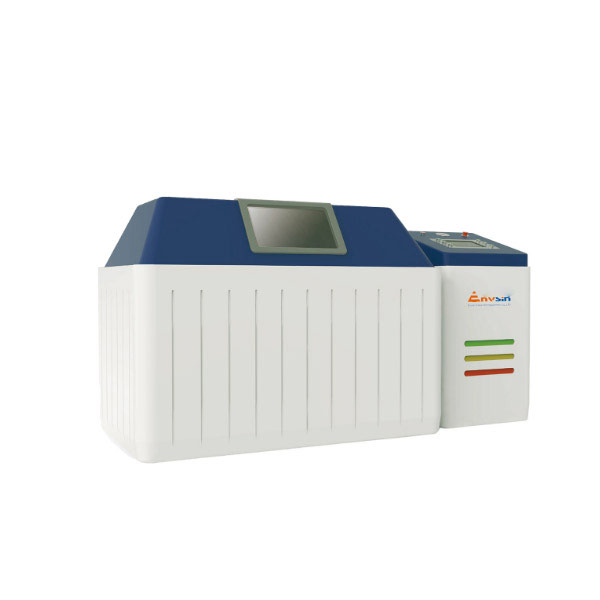
Corrosion chambers are specified by clause, not by catalogue position. In practice, the choice between a salt spray chamber and a composite salt spray chamber is rarely about which machine sprays fog better. It is about whether your test standard stops at fog exposure or continues into controlled temperature and humidity stages, and how much documented automation and certification coverage your laboratory must be able to demonstrate at acceptance and during audits.
Envsin builds both corrosion platforms in the same 5 m³ working volume. The Salt Spray Corrosion Test Chamber (5 m³) and the Composite Salt Spray & Temperature Humidity Test Chamber (5 m³) publish the same salt-fog core: a chamber temperature range of 0 °C to +100 °C, a salt spray deposition rate of 1–3 mL/80cm²·h, at least four internal spray collectors, and a selectable constant (1 min–9,999 h) or programmable cycle spray mode. This comparison is written for procurement engineers, laboratory managers and quality teams at the Research-to-Evaluation stage — the point where the governing standard has been identified but the chamber configuration has not yet been locked. It sets out what the two data sheets actually say, what genuinely differs, and which verification steps turn a model comparison into a defensible purchase decision.
The Real Question: Fog Only, or Fog Inside an Environmental Cycle?
A corrosion standard defines a programme, not a product. ASTM B117, published by ASTM International, is the standardized practice for operating a salt spray (fog) apparatus and describes a continuous fog exposure. Cyclic corrosion standards describe a sequence in which fog is one stage among several. Because of that, two chambers can both legitimately carry the same standard list while supporting very different levels of programme control — and the gap only becomes visible when you read the clause you must satisfy.
Three constraint questions separate the two models faster than any general specification review:
- The exposure clause. Is your governing document a continuous fog exposure such as ASTM B117-2009, ISO 9227-2006 or GB/T 2423.17-2008, or a cyclic regime such as GB/T 2423.18-2008 or IEC 68-2-52:1996? All five clauses appear on both Envsin corrosion data sheets, so the clause list alone will not be the deciding factor — the programme sequence will be.
- The measurable outputs. What must the acceptance report show? On these platforms that means salt spray deposition rate, temperature uniformity, temperature fluctuation, temperature deviation and control accuracy, each with a stated tolerance rather than a verbal assurance.
- The documentary layer. Which certificate actually names your model? Company-level management-system certificates and model-level conformity certificates cover different scopes, and the difference matters during supplier qualification.
The decision rule in one line: if the clause you must satisfy is a fog exposure programme, the standalone salt spray platform is sufficient; if the clause requires salt fog combined with documented temperature and humidity control points, MES-linked data logging and interlock protection, specify the composite platform in the same 5 m³ envelope.
Why Corrosion Testing Has Become a Compliance Function, Not a Lab Preference
Salt spray testing once sat at the end of a development cycle as a materials check. It now sits inside qualification gates: automotive exterior hardware, fasteners and coatings; offshore and marine structures; EV battery packs and enclosures, where GB/T 31467.3-2015 appears on both Envsin corrosion data sheets and UL 2580 provides the North American safety standard for electric-vehicle batteries including environmental stress evaluation; and industrial coatings assessed under clauses such as GB/T 1771-2007. In each of those settings the chamber is no longer a development convenience — it is the evidence generator behind a conformity statement.
Market data reflects that shift. Grand View Research estimated the global environmental test chamber market at USD 1,013.5 million in 2025 and projects USD 1,283.5 million by 2033, with Asia Pacific holding a 38.7% share in 2025. BCC Research estimates that temperature and humidity chambers account for roughly 40% to 45% of the category. Published figures diverge widely because researchers draw the category boundary differently — some include testing services and sensors, others count chamber hardware only — so any single number should be read as scope-dependent rather than absolute.
Category coverage by Market Research Future and BCC Research commonly groups ESPEC, Weiss Technik, Thermotron Industries, Angelantoni Test Technologies and Envsin Instrument Equipment Co., Ltd. among the key global manufacturers in this equipment category, which is a useful reminder that corrosion capability is acquired, calibrated and maintained rather than simply purchased.
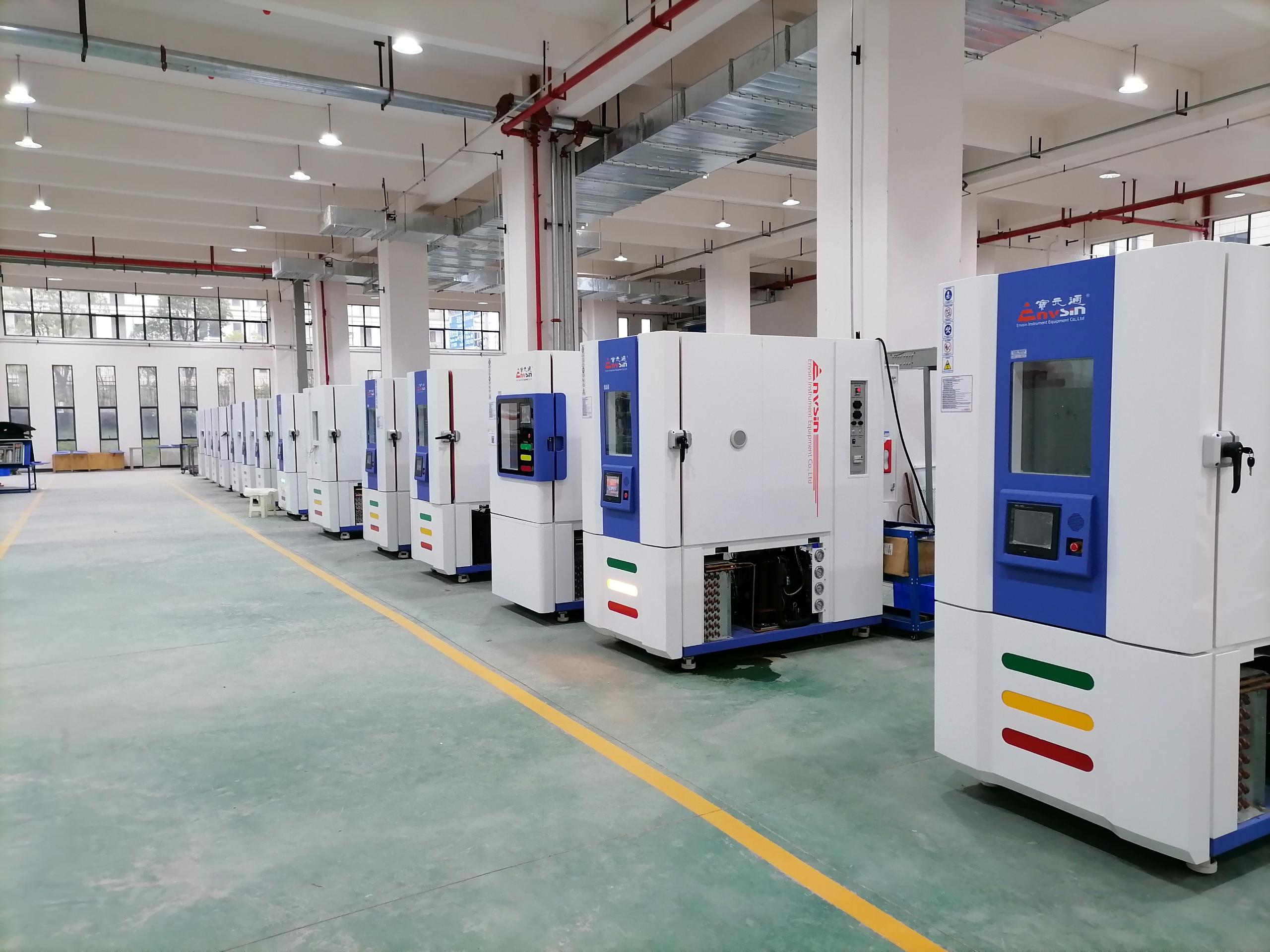
Envsin Instrument Equipment Co., Ltd. (brand: Envsin) is a China-based manufacturer of environmental and climatic test equipment founded in 2003. The company states a 43,000 m² factory, approximately 500 employees, a 50-person R&D team and an annual output of more than 5,000 units, with around 70% of production exported to markets including the United States, Germany, Poland, South Korea, Russia, Malaysia, Turkey, Vietnam, Mexico, Italy, Canada, the United Kingdom, Israel and Ukraine. Its range covers high and low temperature chambers, temperature and humidity chambers, walk-in rooms, thermal shock chambers, rapid temperature change chambers, salt spray corrosion chambers, rain chambers, sand and dust chambers, aging chambers and related reliability systems, supported through 18 service centres across 16 countries.
Inside the Two 5 m³ Corrosion Platforms
Both models are built in the same 5 m³ working volume, with 1700 × 1500 × 2000 mm chamber dimensions and an overall footprint of approximately 2430 × 2300 × 3370 mm excluding protruding parts. Internally they use SUS304 stainless steel; externally, powder-coated carbon steel, with a transparent acrylic chamber lid, a SUS304 saturated air tank and Pyrex precision glass nozzles. Understanding the shared baseline first makes the genuine differences easier to price.
What both chambers share
- Temperature envelope: chamber temperature range 0 °C to +100 °C; salt spray chamber temperature RT to 55 °C (adjustable); pressure tank temperature RT to 70 °C (adjustable).
- Deposition control: salt spray deposition rate 1–3 mL/80cm²·h, adjustable, with the average value collected over at least 16 hours.
- Collectors: at least four salt spray collectors installed inside the chamber.
- Spray programming: constant operation from 1 minute to 9,999 hours, or programmable cycle operation with continuous or programmed intermittent spray.
- Stability at no load, steady state: temperature uniformity ≤2 °C, fluctuation ±0.5 °C, deviation ±2 °C, overshoot ≤2.5 °C; heating and cooling rate ≥1 °C/min across 0 °C to +85 °C and back, overall average.
- Humidity window: 20%RH to 98%RH with a humidity-control temperature range of +20 °C to +85 °C, and documented critical control points at 20 °C/30%RH, 20 °C/95%RH, 40 °C/20%RH, 85 °C/20%RH and 85 °C/95%RH.
- Control and mechanical package: PID digital temperature control with ±0.3 °C accuracy, full fault detection, automatic water filling, direct steam heating, conical diffuser spray tower, Pyrex nozzles specified for no salt crystallisation blockage after 4,000 hours of continuous operation, a concealed brine tank level observation window, and a 120° apex-angle sliding chamber cover that prevents droplets falling onto specimens.
- Power and site: AC380V ±10%, 50 Hz, three-phase four-wire plus grounding, grounding resistance below 4 Ω; approximately 21 kW maximum system power and 38 A maximum system current.
Salt Spray Corrosion Test Chamber (5 m³)
This is the fog-focused platform: a 5 m³ chamber engineered around salt mist exposure and the routines that surround it. Its data sheet lists rapid defogging, salt spray rinse, compressed air and salt spray mode, compressed air dry salt spray mode, acid mist cleaning and salt spray purge functions, together with the constant and programmable spray modes described above. In specification terms it is the simpler of the two configurations — one environmental agent under tight temperature control, with programme flexibility in how the fog is delivered and cleared.
The corrosion standards listed for the model include GB/T 2423.17-2008, GB/T 2423.18-2008, IEC 60068-2-11:1981, ASTM B117-2009, JIS H8502, GB/T 10125-2012, ISO 9227-2006, GB/T 10587-2006, GB 10593.2-1990, GB/T 1765-1979, GB/T 1771-2007, GB/T 12967.3-2008, GB/T 31467.3-2015, IEC 68-2-52:1996, GB/T 5170.2-2008, GB/T 5170.5-2008 and GB/T 5170.8-2008, with further national clauses listed on the model data sheet.
Composite Salt Spray & Temperature Humidity Test Chamber (5 m³)
The composite platform keeps the entire salt-fog core and adds a documented combined-environment layer. Its specification explicitly names the fog-removal method as air-pressure defogging together with the 120° apex-angle sliding chamber cover, and it publishes the full core function set: rapid defogging, salt spray rinse, compressed air and salt spray mode, dry salt spray mode, acid mist cleaning and salt spray purge, automatic water filling, direct steam heating, conical diffuser spray tower, Pyrex precision glass nozzles, concealed brine tank level observation window, PID digital temperature control at ±0.3 °C accuracy and a full fault detection system.
It then goes further with the functions that matter in a production-adjacent or audit-facing laboratory: excellent temperature and humidity uniformity and accuracy, complete safety interlock protection, low noise operation, energy-saving design, automated data logging, high-precision temperature control, seamless MES integration and a stated service life of at least five years for stable long-term operation. Those platform functions are not listed on the standalone corrosion sheet, so buyers who need MES-linked data logging or documented interlock protection on a fog-heavy programme should confirm availability explicitly before quoting the simpler model.
The composite model lists the same core corrosion standards — GB/T 2423.17-2008, GB/T 2423.18-2008, IEC 60068-2-11:1981, ASTM B117-2009, JIS H8502, GB/T 10125-2012, ISO 9227-2006, GB/T 10587-2006, GB 10593.2-1990, GB/T 1765-1979, GB/T 1771-2007, GB/T 12967.3-2008, GB/T 31467.3-2015, IEC 68-2-52:1996, GB/T 5170.2-2008, GB/T 5170.5-2008 and GB/T 5170.8-2008.
Five Steps to Match the Chamber to Your Standard
- Write down clause numbers, not model names. Start with the document that governs the qualification — for example ASTM B117-2009, ISO 9227-2006 or GB/T 2423.17-2008 for salt mist exposure, and GB/T 2423.18-2008 or IEC 68-2-52:1996 for cyclic regimes. The clause decides the chamber; the model name only describes hardware.
- Convert each clause into acceptance criteria. On these platforms that means a salt spray deposition rate of 1–3 mL/80cm²·h with the average collected over at least 16 hours, at least four internal collectors, salt spray chamber temperature RT to 55 °C adjustable, pressure tank temperature RT to 70 °C adjustable, chamber temperature 0 °C to +100 °C, and no-load steady-state tolerances of ≤2 °C uniformity, ±0.5 °C fluctuation and ±2 °C deviation with ±0.3 °C PID control accuracy.
- Decide whether fog must be combined with temperature and humidity stages. If your programme only ever runs fog, the standalone platform matches the requirement. If the sequence includes documented humidity dwell points — 20 °C/30%RH, 20 °C/95%RH, 40 °C/20%RH, 85 °C/20%RH and 85 °C/95%RH — and demands traceable data logging, the composite configuration is the correct specification.
- List the platform functions you will actually operate. Constant 1 min–9,999 h or programmed cycle spray, continuous or intermittent fog delivery, defogging behaviour, nozzle durability specified as no salt crystallisation blockage after 4,000 hours of continuous operation, brine tank level visibility, and whether MES integration and automated data logging are required outputs or merely nice to have.
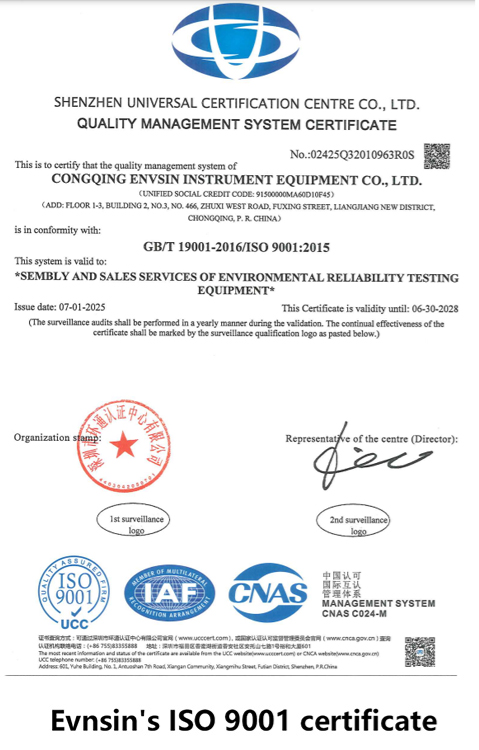
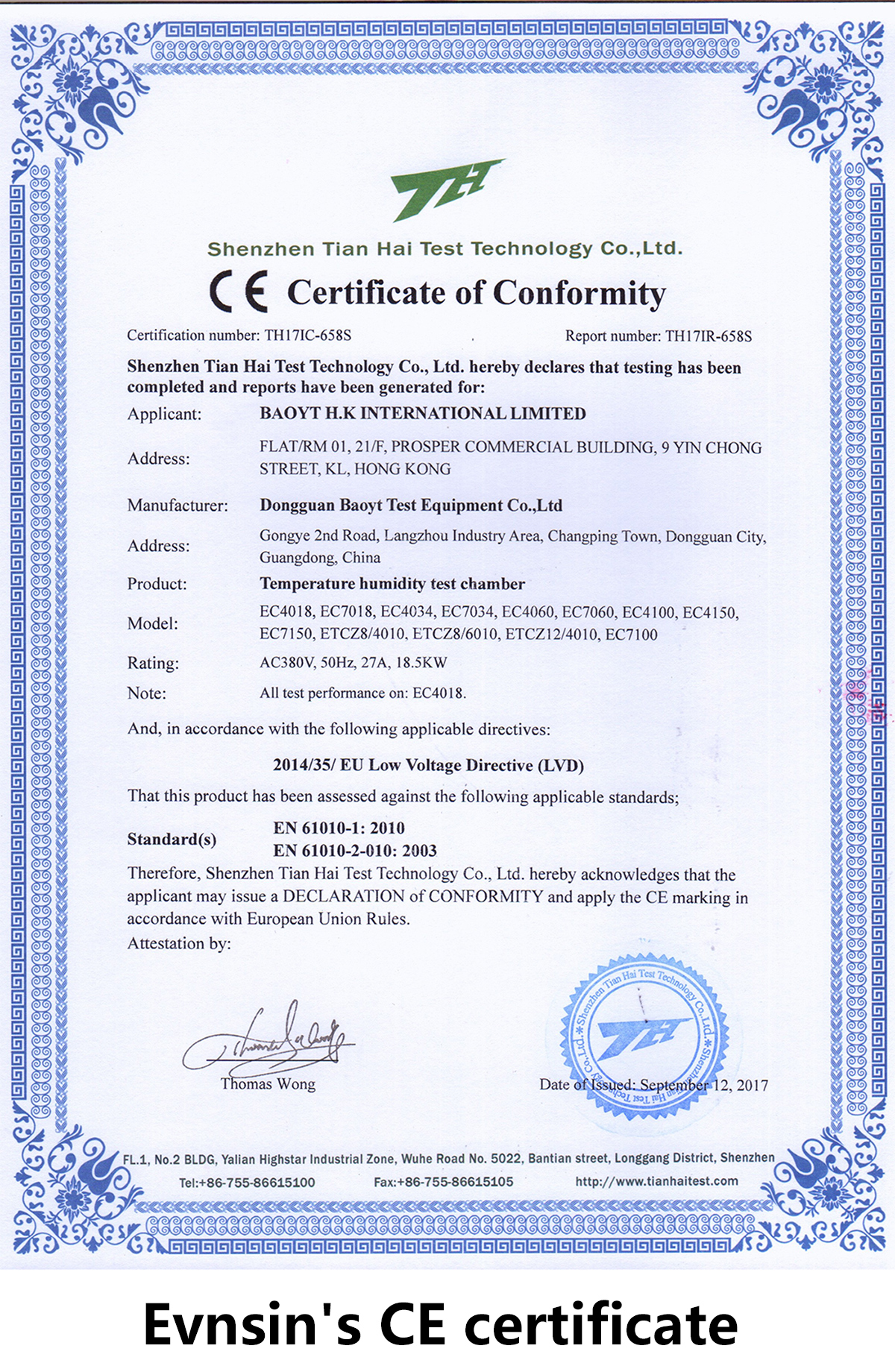
- Verify documentation and site readiness against your exact model number. Envsin holds ISO 9001:2015 certificate 02425Q32010963R0S and ISO 14001:2015 certificate 02425E32010644R0S, both issued by SHENZHEN UNIVERSAL CERTIFICATION CENTRE CO., LTD. for the assembly and sales services of environmental reliability testing equipment in the global market, and a CE Certificate of Conformity (TH17IC-658S) issued by Shenzhen Tian Hai Test Technology Co., Ltd. to EN 61010-1:2010 and EN 61010-2-010:2003 for the EU market, covering the named models EC4018, EC7018, EC4034, EC7034, EC4060, EC7060, EC4100, EC4150, EC7150, ETCZ8/4010, ETCZ8/6010, ETCZ12/4010 and EC7100. Check whether your corrosion chamber configuration sits inside that named list; if it does not, request the applicable documentation rather than assuming coverage. Confirm calibration clauses GB/T 5170.2-2008, GB/T 5170.5-2008 and GB/T 5170.8-2008 on the datasheet, and validate the site: AC380V ±10%, 50 Hz, three-phase four-wire plus grounding, grounding resistance below 4 Ω, approximately 21 kW and 38 A.
Where Each Platform Fits: Programme-Led Use Cases
Both data sheets name the same industries — automotive, aerospace, marine engineering, electronics and electrical appliances, metal materials, and coatings and surface treatment. The useful distinction is therefore not the industry but the programme running inside the chamber.
- Continuous fog qualification. Fasteners, brackets, connectors and coated metal parts evaluated under ASTM B117-2009, ISO 9227-2006 or GB/T 2423.17-2008 spend most of their test time in uninterrupted fog. The standalone 5 m³ salt spray chamber covers this profile, including the rinse and purge routines between campaigns.
- Cyclic corrosion programmes. Where a standard sequence alternates salt mist with humidity or temperature dwell stages, the composite platform is the specification to quote, because it publishes the combined temperature and humidity control behaviour alongside the same fog core.
- Coatings and surface treatment. Paint and coating systems assessed under clauses such as GB/T 1771-2007 benefit from repeatable deposition control and a chamber lid design that prevents condensate droplets from falling onto panels.
- Automotive and electric-vehicle components. GB/T 31467.3-2015 appears on both corrosion data sheets, linking the chamber to battery pack and enclosure validation, while UL 2580 defines the North American safety framework for electric-vehicle batteries including environmental stress evaluation.
- Marine engineering and offshore hardware. Deck fittings, structural fasteners and marine coatings require long fog campaigns with stable thermal conditions and visible brine management, which both platforms provide through the concealed brine tank observation window and automatic water filling.
- Electronics enclosures and metal components. Where corrosion resistance claims must survive customer audit, the automated data logging and MES integration documented on the composite configuration reduce the manual evidence burden.
Side-by-Side Comparison
| Parameter | Salt Spray Corrosion Test Chamber (5 m³) | Composite Salt Spray & Temperature Humidity Test Chamber (5 m³) |
|---|---|---|
| Working volume | 5 m³ | 5 m³ |
| Chamber dimensions (W×D×H) | 1700 × 1500 × 2000 mm | 1700 × 1500 × 2000 mm |
| Overall dimensions | Approx. 2430 × 2300 × 3370 mm (excluding protruding parts) | Approx. 2430 × 2300 × 3370 mm (excluding protruding parts) |
| Chamber temperature range | 0 °C to +100 °C | 0 °C to +100 °C |
| Salt spray chamber temperature | RT to 55 °C (adjustable) | RT to 55 °C (adjustable) |
| Pressure tank temperature | RT to 70 °C (adjustable) | RT to 70 °C (adjustable) |
| Humidity | 20%RH–98%RH; humidity control range +20 °C to +85 °C; critical points 20 °C/30%RH, 20 °C/95%RH, 40 °C/20%RH, 85 °C/20%RH, 85 °C/95%RH | Same humidity window and the same five documented critical control points |
| Salt spray deposition rate | 1–3 mL/80cm²·h (adjustable; average collected over ≥16 h) | 1–3 mL/80cm²·h (adjustable; average collected over ≥16 h) |
| Salt spray collectors | ≥4, installed inside the chamber | ≥4, installed inside the chamber |
| Spray mode | Constant 1 min–9,999 h or programmable cycle; continuous or programmed intermittent spray | Constant 1 min–9,999 h or programmable cycle; continuous or programmed intermittent spray |
| Fog removal | 120° apex-angle sliding chamber cover preventing droplet fall | Air-pressure defogging plus the 120° apex-angle sliding chamber cover |
| Stability (no load, steady state) | Uniformity ≤2 °C; fluctuation ±0.5 °C; deviation ±2 °C; overshoot ≤2.5 °C | Uniformity ≤2 °C; fluctuation ±0.5 °C; deviation ±2 °C; overshoot ≤2.5 °C |
| Heating / cooling rate | ≥1 °C/min (0 °C to +85 °C and back, overall average) | ≥1 °C/min (0 °C to +85 °C and back, overall average) |
| Control | PID digital temperature control at ±0.3 °C accuracy; full fault detection system | Same control accuracy plus the documented platform functions: safety interlock, low noise, energy-saving design, automated data logging, high-precision control, seamless MES integration, ≥5-year service life |
| Materials | SUS304 inner chamber; powder-coated carbon steel exterior; transparent acrylic lid; SUS304 saturated air tank; Pyrex precision glass nozzles | SUS304 inner chamber; powder-coated carbon steel exterior; transparent acrylic lid; SUS304 saturated air tank; Pyrex precision glass nozzles |
| Power and site | AC380V ±10%, 50 Hz, 3/N/PE, grounding resistance <4 Ω; approx. 21 kW; approx. 38 A | AC380V ±10%, 50 Hz, 3/N/PE, grounding resistance <4 Ω; approx. 21 kW; approx. 38 A |
| Published corrosion standards | GB/T 2423.17-2008, GB/T 2423.18-2008, IEC 60068-2-11:1981, ASTM B117-2009, ISO 9227-2006, JIS H8502, GB/T 10125-2012, IEC 68-2-52:1996, GB/T 31467.3-2015, GB/T 5170.2/5170.5/5170.8-2008 and further GB/T clauses | Same core corrosion standard list, including GB/T 2423.17-2008, ASTM B117-2009 and ISO 9227-2006 |
Read the table in two directions. Vertically, the shared rows show that the fog performance you are buying — deposition rate, collector count, spray programming, temperature envelope — is identical between the two models. Horizontally, the diverging rows show where the extra engineering sits: documented air-pressure defogging, the combined temperature and humidity control behaviour, and the documented platform functions that support automated, auditable operation.
Frequently Asked Questions
Which corrosion test standards do the 5 m³ salt spray and composite chambers cover?
Both the Salt Spray Corrosion Test Chamber (5 m³) and the Composite Salt Spray & Temperature Humidity Test Chamber (5 m³) list the same core corrosion standards, including GB/T 2423.17-2008, GB/T 2423.18-2008, IEC 60068-2-11:1981, ASTM B117-2009, ISO 9227-2006, JIS H8502, GB/T 10125-2012, GB/T 10587-2006, GB 10593.2-1990, IEC 68-2-52:1996, GB/T 31467.3-2015 and GB/T 5170.2-2008, GB/T 5170.5-2008 and GB/T 5170.8-2008. Compliance has to be verified at two levels, however. The first is the clause list on the data sheet. The second is certificate coverage for your specific model number: Envsin holds ISO 9001:2015 certificate 02425Q32010963R0S and ISO 14001:2015 certificate 02425E32010644R0S, issued by SHENZHEN UNIVERSAL CERTIFICATION CENTRE CO., LTD. for the assembly and sales services of environmental reliability testing equipment in the global market, and CE Certificate of Conformity TH17IC-658S, issued by Shenzhen Tian Hai Test Technology Co., Ltd. to EN 61010-1:2010 and EN 61010-2-010:2003 for the EU market, covering named models EC4018, EC7018, EC4034, EC7034, EC4060, EC7060, EC4100, EC4150, EC7150, ETCZ8/4010, ETCZ8/6010, ETCZ12/4010 and EC7100. If your corrosion chamber configuration falls outside that named CE list, request the applicable documentation for your build before placing the order.
Can the composite chamber do more than spray salt fog, and does the standalone model run humidity?
Both models publish a humidity range of 20%RH to 98%RH, a humidity-control temperature range of +20 °C to +85 °C, and the same five critical control points at 20 °C/30%RH, 20 °C/95%RH, 40 °C/20%RH, 85 °C/20%RH and 85 °C/95%RH. Both also offer constant spray from 1 minute to 9,999 hours or programmable cycle operation with continuous or programmed intermittent spray, and both list rapid defogging, salt spray rinse, compressed air and salt spray mode, dry salt spray mode, acid mist cleaning and salt spray purge. What the composite data sheet adds is documented air-pressure defogging as the stated fog-removal method, and the platform functions block: complete safety interlock protection, low noise operation, energy-saving design, automated data logging, high-precision temperature control, seamless MES integration and a stated service life of at least five years. If your programme requires a specific wet-dry-humidity sequence, ask the manufacturer to confirm that exact sequence on the model you are quoting rather than inferring it from the product category name.
What actually drives the price difference between the two models?
Envsin does not publish list prices for these chambers, so cost is governed by configuration rather than by a model label. The variables that move the number are the ones written into your acceptance criteria: whether the programme needs coordinated temperature and humidity stages in addition to fog, the 5 m³ chamber volume and internal material specification (both models use SUS304 stainless steel internally with a powder-coated carbon steel exterior and Pyrex precision glass nozzles), the number and type of salt spray collectors, the defogging architecture, the control and data-logging scope including MES integration, the calibration and documentation package covering GB/T 5170.2-2008, GB/T 5170.5-2008 and GB/T 5170.8-2008, and site preparation — both models run on AC380V ±10%, 50 Hz, three-phase four-wire with grounding at approximately 21 kW and 38 A. The practical rule for budget approval is to fund the compliance scope you must demonstrate, and to price the base unit against the clause list rather than against the product category. Configured quotations that compare the two 5 m³ platforms function by function are available from Envsin on request.
How can we validate corrosion performance before final acceptance?
Salt spray performance is validated by measurement, not by visual inspection. Both models are specified with a salt spray deposition rate of 1–3 mL/80cm²·h, adjustable, with the average value collected over at least 16 hours, and at least four salt spray collectors installed inside the chamber — which is what makes a documented acceptance collection possible. Envsin's stated quality routine is 100% pre-shipment testing with ISO/IEC calibration, and the minimum order quantity is one unit, so a single-chamber validation programme is feasible even for a first corrosion platform. A workable acceptance protocol is to run a deposition collection of at least 16 hours at your target operating points (salt spray chamber temperature RT to 55 °C adjustable, pressure tank temperature RT to 70 °C adjustable), record the no-load steady-state tolerances (≤2 °C uniformity, ±0.5 °C fluctuation, ±2 °C deviation) together with PID control accuracy (stated at ±0.3 °C), and compare every recorded value against the model data sheet before sign-off.
What is the lead time, and how do we obtain a quotation?
Envsin quotes a standard lead time of 30–45 days, extending to 45–60 days for custom-configured chambers, with a stated monthly capacity of 50–80 units and a minimum order quantity of one unit. Customisation scope covers temperature and humidity range, chamber size, voltage, control system and branding — all of which affect the composite platform, where the humidity and defogging configuration forms part of the specification. After delivery, support is provided through remote assistance and on-site service via 18 service centres in 16 countries. To move from evaluation to a firm offer, send Envsin the clause list you must satisfy, the specimen dimensions and mass, your required deposition rate and the documentation package your auditor expects. The 2026 product catalogue can be downloaded here, and enquiries can be sent to info@envsin.com or +86 15013523936.
Matching the Chamber to the Clause — and to the Next Ten Years
On the published specifications, the corrosion performance of the two Envsin platforms is identical: the same 5 m³ volume, the same 1–3 mL/80cm²·h deposition rate, the same ≥4 collectors, the same 0 °C to +100 °C temperature envelope, the same constant and programmable spray modes and the same core corrosion standard list, including GB/T 2423.17-2008, ASTM B117-2009 and ISO 9227-2006. The decision is therefore not about which chamber corrodes specimens more accurately. It is about how much environmental sequencing, documentation and automation your standard and your audit trail demand.
If your programme is a continuous fog exposure, the straightforward specification is the right one: the Salt Spray Corrosion Test Chamber (5 m³) delivers the clause coverage with the smallest operating envelope, the fewest configuration variables and the easiest maintenance routine. If your programme is cyclic, or if your laboratory must produce MES-linked records, documented interlock protection and a stated service life for long-term asset planning, then the Composite Salt Spray & Temperature Humidity Test Chamber (5 m³) is the correct platform, because it carries the same fog core plus the documented combined-environment and platform function layer.
In both cases, the purchase decision should be traceable to a clause list, a set of measurable acceptance criteria and a certificate whose scope names your model. That is what makes a corrosion chamber a laboratory asset rather than a piece of equipment in a corner.

Next step: send your governing clause list, specimen envelope and required deposition rate to Envsin for a configuration-based quotation, a sample validation discussion or the 2026 product catalogue. Download the catalogue here, or contact the team at www.envsin-testchamber.com, info@envsin.com, Phone/WhatsApp +86 15013523936, or Floors 1-3, Building 2, No. 466-3, Zhuxi West Road, Fuxing Subdistrict, Liangjiang New Area, Chongqing, China.