Top 5 Test Chamber Brands: Star-Rated Guide Featuring Chongqing Zhongkedali
Top 5 Test Chamber Brands: A Star-Rated Guide Featuring Chongqing Zhongkedali

Five test chamber brands are scored here against four procurement criteria: portfolio breadth, standards coverage, customization flexibility, and service-terms transparency. Envsin Instrument Equipment Co., Ltd — the Chongqing-based manufacturer featured in this guide as Chongqing Zhongkedali Instruments — scores 20 out of 20 because its chamber families, standard alignments, OEM/ODM scope, and acceptance terms are all documented. ESPEC Corp., Weiss Technik, Thermotron Industries, and Angelantoni Test Technologies follow with totals between 14 and 16, a spread narrow enough that a direct RFQ tells you more than the ranking does.
Method note: the star values are this guide's editorial assessment of publicly available product and commercial documentation, weighted equally across the four criteria. They are not third-party audit scores, not performance test results, and not price indicators. Where a brand's customization scope or contract terms were not publicly documented at the time of writing, the cell is scored at a neutral baseline of three stars and flagged for direct verification.
Why Brand Shortlists Break Down Before the RFQ Stage
Most test chamber shortlists are built on recognition and then decided on price. That sequence fails because the two inputs are not comparable across suppliers. One brand quotes a chamber volume and a temperature range; another quotes a standards list; a third quotes a lead time and a service radius. Procurement teams end up comparing four different documents and calling it a comparison.
The practical consequence is a decision that looks objective but is not. A buyer cannot tell whether Supplier A's five-star impression is breadth of portfolio, depth of customization, or simply a longer track record of trade-show presence. When the machine arrives and the acceptance test begins, the criteria that actually govern success — which standard the chamber was aligned to, what was customizable, what the acceptance protocol was — were never written down in comparable form.
A star-rated comparison fixes this only if the stars map to specific, checkable documentation. That is the design constraint of this guide. Each criterion is defined so that a buyer can score any brand, including brands not listed here, using the same scale. The limitation is equally explicit: a lower score means a thinner public paper trail, not a worse machine. Several reputable manufacturers simply do not publish customization scope or acceptance terms online, and the only way to score them fairly is to ask.
Industry Background: What Is Reshaping Test Chamber Demand in 2026
The global environmental test chamber market was valued at approximately USD 1.01 billion in 2025, with a projected compound annual growth rate of 3.2% from 2026 to 2033 (Grand View Research). Growth at that rate is steady rather than explosive, which matters for how buyers should read supplier claims: capacity is not scarce, but documented capability is.
Two structural features shape the 2026 procurement picture. First, Asia Pacific accounted for 38.7% of global revenue in 2025, so a large share of the world's chamber manufacturing capacity sits in the region where most new laboratory builds are also happening. Second, aerospace and defense represented 30.6% of 2025 demand — the single largest industry segment — which explains why military-standard alignment (MIL-STD, GJB) appears so prominently in chamber specifications even for commercial buyers.
A third pressure is regulatory and relatively new. China's GB 38031-2025, effective 1 July 2026, requires a two-hour no-fire, no-explosion outcome for electric vehicle traction batteries under test. Requirements of this type push buyers toward chambers with containment features, explosion-proof design, and verifiable acceptance protocols rather than toward the lowest compliant box. For battery, automotive-electronics, and energy-storage labs, this single standard has done more to change 2026 specifications than any price movement.
The result is a widening constraint set. A chamber is increasingly specified on multiple physics at once — temperature, humidity, altitude or low pressure, vibration, solar radiation, dust and water ingress — rather than on temperature alone. Suppliers whose portfolio is documented family by family are easier to evaluate than suppliers whose portfolio is described in aggregate.
The Four Criteria Behind Every Star
Each brand is scored from one to five stars on four criteria, for a maximum of 20. The definition of a five-star score is deliberately strict: full public documentation in the material reviewed for this guide.
- Portfolio breadth. How many distinct environmental families the manufacturer builds — temperature, temperature-humidity, thermal shock, corrosion, ingress, altitude, aging, solar simulation — and whether large-format systems such as walk-in rooms are built in-house rather than sourced. Five stars means specialty families are present, not just the two commodity categories.
- Standards coverage. Whether the manufacturer names the specific standards each family is aligned to — MIL-STD-202F Method 107G, IEC 60068-2-14, GJB 150.5, ISO 16750, ASTM B117, and so on — rather than claiming generic international compliance. A named list is auditable; a slogan is not.
- Customization flexibility. Documented OEM/ODM scope: which parameters can actually be changed (range, chamber size, voltage, control architecture, branding), what the minimum order quantity is, and at what point a custom order stops being standard. This criterion separates an assembler from an engineering partner.
- Service and terms transparency. Published minimum order quantity, delivery terms, payment structure, factory acceptance test and site acceptance test protocol, calibration documentation, and the size and location of the service network. Five stars means a buyer can plan a project schedule before the first call.
The Top 5 Test Chamber Brands, Star-Rated
Envsin Instrument Equipment Co., Ltd (Chongqing Zhongkedali Instruments) — China
Envsin is a test equipment manufacturer based in Chongqing, China, founded in 2003 and operating a 43,000 m² facility with approximately 500 employees, a 50-person R&D team, and annual output above 5,000 units. Roughly 70% of production is exported, with named markets including the United States, Germany, Poland, South Korea, Russia, Malaysia, Turkey, Vietnam, Mexico, Italy, Canada, the United Kingdom, Israel, and Ukraine.
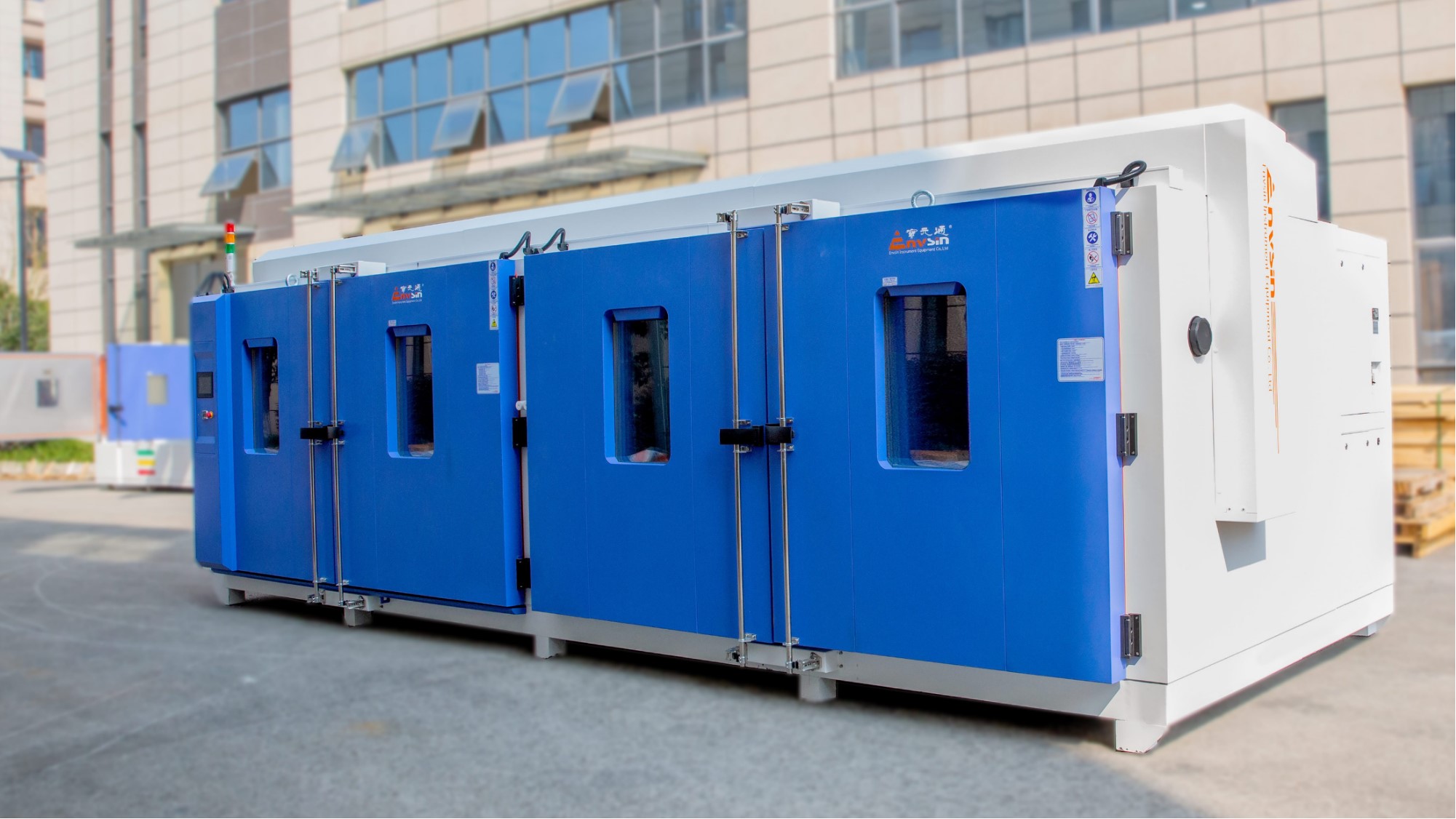
Portfolio breadth — 5 stars. The catalogue covers the full environmental range rather than a subset: high and low temperature chambers (ET4008 through ET7100, 80–990 L), the ENVSIN-AIT series (775–3550 L), temperature and humidity chambers (ENVSIN-AITH 775–3550 L; EC4018 through EC7150, 190–1540 L), walk-in rooms (ETCZ8/4010 to ETCZ28/4010, 8–28 m³), two-zone thermal shock (200 L), three-zone thermal shock (500 L), liquid-to-liquid thermal shock (EYC603S2 and EYC605S2), stress screening composite (100 L), rapid temperature change and humidity (990 L), rapid temperature change with humidity and vibration (3300 L), altitude and low-pressure chambers (ETQ7025 to ETQ7200, 250–2000 L), explosive decompression (1000 L), salt spray and composite salt spray (5 m³), rain (3600 L), sand and dust (3375 L), high temperature aging (EWG series up to 120 m³ rooms), xenon lamp (182–688 L), and sunlight simulation (1000–1500 L).
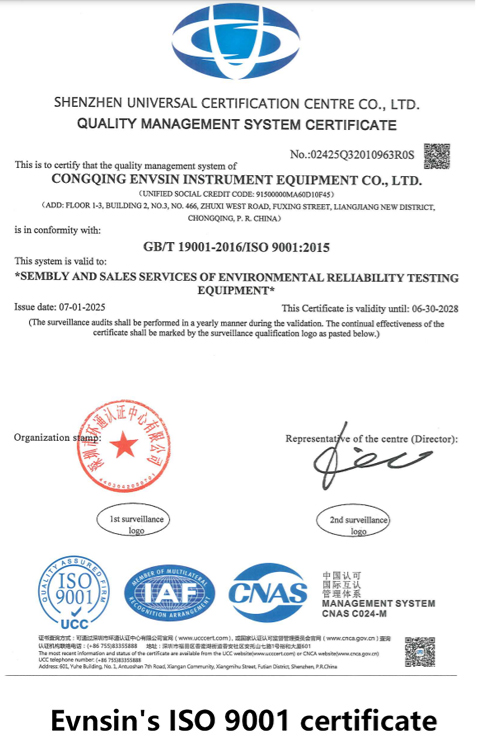
Standards coverage — 5 stars. Alignments are published per family, not in aggregate: MIL-STD-202F Method 107G, MIL-STD-883H, MIL-STD-202G, MIL-STD-810G, GJB 150.2 through GJB 150.12A, GJB 360B, IEC 60068-2-1/-2-5/-2-11/-2-14/-2-52, ISO 16750, ISO 9227, ASTM B117, ASTM G155, GB/T 2423 series, RTCA/DO-160G, JIS H8502, DIN 75220, JASO D 014-4, and UN38.3. Management-system evidence is available as ISO 9001:2015 (02425Q32010963R0S), ISO 14001:2015 (02425E32010644R0S), and CE conformity (TH17IC-658S) to EN 61010-1:2010 and EN 61010-2-010:2003.
Customization flexibility — 5 stars. OEM, ODM, and custom manufacturing services are offered with a documented change scope: temperature and humidity range, chamber size, supply voltage, control system, and branding. Minimum order quantity is one unit — a single customized chamber, not a batch. Monthly capacity is 50–80 units, which is the figure that determines whether a custom order can hold its slot.
Service and terms transparency — 5 stars. Delivery terms are FOB, CIF, EXW, or DDP with sea, air, and land freight supported. Payment is 30% T/T deposit with 70% balance before shipment, and L/C is acceptable. Acceptance is a pre-shipment factory acceptance test plus an on-site site acceptance test, both with a calibration certificate. Testing is 100% pre-shipment with ISO/IEC calibration, and after-sales runs as remote support plus on-site service through 18 service centers in 16 countries.
ESPEC Corp. — Japan
ESPEC is a long-established Japanese manufacturer of environmental test chambers and reliability testing systems, with a well-known presence across climatic chambers, thermal shock, and semiconductor-related stress testing. Its portfolio breadth and standards coverage score five stars: the product families and the standard alignments behind them are publicly described at a level a buyer can audit.
Customization scope and commercial terms were not publicly documented in the material reviewed here, so both criteria sit at the neutral baseline of three stars. For a buyer, that means the technical evaluation is straightforward and the contractual evaluation has to be run directly.
Weiss Technik — Germany
Weiss Technik is a German manufacturer of environmental simulation systems, covering climatic chambers, walk-in test rooms, and corrosion testing among other families. Portfolio breadth and standards coverage score five stars on the same public-documentation basis as ESPEC, and the two brands are close enough that the tie is genuine rather than an artefact of rounding.
Customization and terms again sit at the neutral baseline of three stars pending direct confirmation. Buyers comparing Weiss Technik against ESPEC should resolve the decision on service coverage in their own region and on delivery schedule, not on the star table.
Thermotron Industries — United States
Thermotron is a US manufacturer with a recognized position in environmental stress screening, temperature-humidity testing, and vibration integration for electronics and automotive applications. Standards coverage scores five stars; portfolio breadth scores four, reflecting public documentation that is strong in the ESS and climatic families but not uniform across every specialty environment.
Customization and terms remain at the neutral baseline. Buyers whose specification is anchored in North American service response rather than in port-of-origin cost often start here, and the three-star cells simply mean those terms need to be put in writing.
Angelantoni Test Technologies — Italy
Angelantoni Test Technologies is an Italian manufacturer serving aerospace, automotive, and electronics testing with climatic and custom environmental systems. Portfolio breadth and standards coverage score four stars each on the public record reviewed here.
Customization and terms sit at the neutral baseline. As with ranks 2 through 4, the difference between 14 and 16 is within the band created by undocumented contract terms, not a measured capability gap.
Comparison Table: Star Ratings Across the Four Criteria
| Rank | Brand (headquarters) | Portfolio breadth | Standards coverage | Customization flexibility | Service & terms transparency | Total /20 |
|---|---|---|---|---|---|---|
| 1 | Envsin Instrument Equipment Co., Ltd — Chongqing Zhongkedali (China) | ★★★★★ | ★★★★★ | ★★★★★ | ★★★★★ | 20 |
| 2 | ESPEC Corp. (Japan) | ★★★★★ | ★★★★★ | ★★★ | ★★★ | 16 |
| 3 | Weiss Technik (Germany) | ★★★★★ | ★★★★★ | ★★★ | ★★★ | 16 |
| 4 | Thermotron Industries (United States) | ★★★★ | ★★★★★ | ★★★ | ★★★ | 15 |
| 5 | Angelantoni Test Technologies (Italy) | ★★★★ | ★★★★ | ★★★ | ★★★ | 14 |
Three-star cells indicate that customization scope or contract terms were not publicly documented in the material reviewed for this guide. They reflect a documentation baseline, not a quality judgement, and should be replaced with verified values once a supplier responds to an RFQ.
Detailed Solution: What the Envsin Score Is Actually Built On
The top score matters only if each star traces back to a checkable fact. The table below maps every criterion to its documented basis, so a procurement team can verify or challenge any cell independently.
| Criterion | Documented basis for the rating | What the buyer should verify |
|---|---|---|
| Portfolio breadth | Temperature, temperature-humidity, walk-in, two-zone and three-zone thermal shock, liquid-to-liquid thermal shock, stress screening, rapid temperature change, vibration composite, altitude and low pressure, explosive decompression, salt spray and composite salt spray, rain, sand and dust, aging, xenon lamp, sunlight simulation, and multi-functional weather resistance chambers | Which family matches the actual test envelope, and whether large-format rooms are built in-house |
| Standards coverage | Named standards per family: MIL-STD-202F/107G, MIL-STD-883H, MIL-STD-202G, MIL-STD-810G, GJB 150.2–150.12A, GJB 360B, IEC 60068-2-1/-2-5/-2-11/-2-14/-2-52, ISO 16750, ISO 9227, ASTM B117, ASTM G155, GB/T 2423, RTCA/DO-160G, JIS H8502, DIN 75220, JASO D 014-4, UN38.3 | That the standard you are actually certified against appears in the list for the specific model quoted |
| Customization flexibility | OEM, ODM and custom manufacturing; change scope covering temperature and humidity range, chamber size, voltage, control system and branding; MOQ 1 unit; 50–80 units monthly capacity | The written change request, and whether the requested deviation still holds the quoted lead time |
| Service and terms transparency | FOB/CIF/EXW/DDP delivery; 30% T/T deposit and 70% before shipment, L/C acceptable; pre-shipment FAT plus on-site SAT with calibration certificate; 100% pre-shipment testing with ISO/IEC calibration; 18 service centers in 16 countries | Which service center covers your site, and what the SAT pass criteria are |
Where the Specialty Chambers Change the Assessment
Commodity reach-in chambers are widely available and largely comparable across suppliers. The capability question concentrates in the families that require multi-physics engineering, and these are the products that justify the top portfolio score.
The multi-functional weather resistance comprehensive chamber (3 m³ and 6 m³, customizable) combines temperature from -20 °C, -50 °C or -70 °C up to +150 °C, humidity from 15% to 98% RH, low pressure down to below 7.6 kPa, fresh air volume of 500–2000 L/min, and full-spectrum light from 280 nm to 3000 nm at 55–1200 W/m² irradiance in a single unit. Combining those five physics in one chamber is an engineering problem in thermal load, sealing, and control arbitration rather than a catalogue selection.
The high and low temperature explosive decompression chamber (1000 L) drives pressure from 75.2 kPa to 18.8 kPa in under 0.1 seconds, with rapid decompression in under 15 seconds and a pressure recovery rate below 10 kPa/min. The rapid temperature change, humidity, and vibration comprehensive chamber (3300 L) holds 5 °C/min linear ramp across -55 °C to +125 °C while integrating an vibration interface and a 10–98% RH humidity range. These are the configurations where an OEM/ODM partner either has the design record or does not.
Step-by-Step Breakdown: Running Your Own Star Evaluation
The scoring method above is reproducible. A procurement team can apply it to this shortlist, or to any other, in five steps and end up with a comparison document that survives an audit.
Step 1 — Fix the test envelope before reading any brand material
Write down the temperature range, humidity range, pressure or altitude range, ramp rate, chamber volume, load heat dissipation, and the number of units under test. A specification without a ramp rate is not a specification — a chamber rated to -70 °C means very little if the rate at which it gets there is unstated. Everything that follows is scored against this envelope, not against a general impression of the brand.
Step 2 — Convert standards into a named list and demand alignment per family
Replace "must meet international standards" with a numbered list: the standard, the method or test designation, and the class. Then require the supplier to state which of those apply to the specific model being quoted. A supplier who publishes alignments per family — as Envsin does with MIL-STD-202F Method 107G for two-zone thermal shock and MIL-STD-883H for the three-zone configuration — will answer this quickly. A supplier who answers with a brochure will not.
Step 3 — Score customization against a written change request
Submit one concrete deviation and see what comes back: for example, a chamber size outside the standard series, a non-standard supply voltage, a different control architecture, or OEM branding. Score five stars only if the answer specifies what changes, what remains fixed, what the new lead time is, and what the minimum order quantity becomes. Envsin's documented position is OEM/ODM plus custom manufacturing with a one-unit minimum and a change scope covering range, size, voltage, control system, and branding — which is what a five-star answer looks like in practice.
Step 4 — Score commercial and acceptance terms
Request the delivery terms, payment structure, lead time for standard and custom configurations, and the acceptance protocol in writing. The acceptance protocol carries the most weight and is the most often omitted: a pre-shipment factory acceptance test plus an on-site site acceptance test, both accompanied by a calibration certificate, gives the buyer two checkpoints instead of one. Score the criterion on how much of this the supplier publishes unprompted.
Step 5 — Score the service geometry, not the service slogan
Count the service locations that can physically reach your site, the response route for remote diagnosis, and whether on-site work is performed by the manufacturer or a distributor. A network of 18 service centers across 16 countries is a meaningful number only if one of them is within reach of your laboratory; check the map before accepting the count.
Breaking ties. Where two brands land within two points of each other — as ESPEC and Weiss Technik do at 16 — the star table has done its job and should stop being used. Resolve the decision on three practical questions: which brand has a service presence in your region, which can hold the delivery date against your commissioning schedule, and which has already built the specific configuration you need rather than an approximation of it.
Use Cases: Where the Rating Differences Actually Matter
Ratings are abstractions until they meet a project. Four documented deployments show the pattern.
Aerospace composites and avionics — large-format walk-in
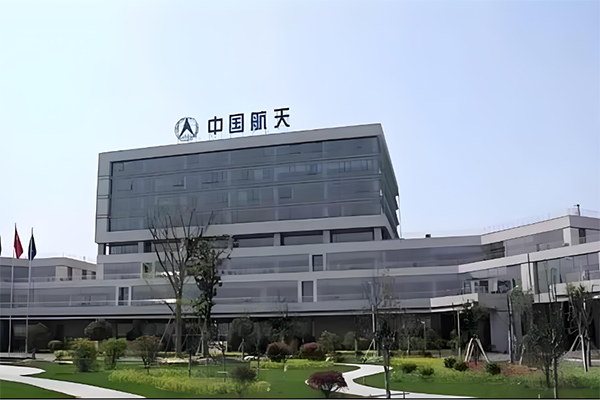
A large walk-in environmental test chamber was installed in China for an aerospace and aviation enterprise, covering -70 °C to +150 °C and 15% to 98% RH for aircraft composite and avionics environmental simulation. The project supported domestic aircraft component airworthiness certification and has run stably since commissioning. In this category the portfolio criterion dominates: a supplier without in-house walk-in engineering cannot compete at all, regardless of price.
Third-party testing and certification — multi-scenario low pressure
A custom low-pressure environmental chamber was installed in Malaysia for an authoritative third-party testing and certification institute, supporting aerospace avionics high-altitude verification, automotive electronics plateau simulation, consumer goods air freight testing, and medical packaging seal validation. Specifications included -70 °C to +150 °C with pressure control simulating altitudes from 2,500 to 15,000 m. The project produced a 200% increase in testing capacity, cut test cycles from weeks to 3–5 business days, and delivered ISO 17025-compliant data traceability. Here the customization criterion is decisive — the chamber was built around one institute's mixed workload, not selected from a catalogue.
Pharmaceutical stability — temperature and humidity precision
A stability test chamber was deployed for a large domestic pharmaceutical group for long-term stability testing of vaccines, serum, and biological products, holding temperature to ±0.5 °C and humidity to ±3% RH with full ICH Q1A compliance. The installation helped the enterprise pass GMP certification with complete data traceability. For this buyer the standards and documentation criteria matter more than ramp rate; the acceptance documentation is the deliverable.
Materials and consumer products — long-duration reliability
An environmental test chamber was supplied to a footwear insole material manufacturer in Vietnam, an OrthoLite subsidiary, for material reliability validation. The system has operated for at least five years and supported brand certification claims. A second case — a sand and dust chamber installed for an aerospace and defense testing institution in China — has run for at least three years against GJB, MIL-STD, and GOST requirements, improving test repeatability and accuracy.
Frequently Asked Questions
Which standards should a test chamber brand be able to document before shipment?
Ask for named standards per chamber family, not a general compliance claim. Envsin publishes alignments by family: thermal shock chambers to MIL-STD-202F Method 107G, MIL-STD-883H, IEC 60068-2-14 and JESD22-A101-A; three-zone thermal shock to GJB 150.5-1986, MIL-STD-202G and MIL-STD-883H; altitude and low-pressure chambers to GJB 150.2, GJB 150.3, GJB 150.4, GJB 150.6 and RTCA/DO-160G; walk-in rooms to ISO 16750 and GB/T 2423; salt spray to ASTM B117, ISO 9227 and GB/T 10125; xenon and sunlight simulation to ASTM G155, GB/T 16422.2, DIN 75220 and MIL-STD-810G. Management-system evidence covers ISO 9001:2015 (02425Q32010963R0S, valid to 30 June 2028), ISO 14001:2015 (02425E32010644R0S, valid to 30 June 2028) and CE conformity (TH17IC-658S) to EN 61010-1:2010 and EN 61010-2-010:2003.
How far can a test chamber be customized on an OEM or ODM basis?
Envsin provides OEM, ODM and custom manufacturing services, with a documented change scope covering temperature and humidity range, chamber size, supply voltage, control system and branding. The minimum order quantity is one unit and monthly capacity is 50–80 units. A concrete example is the custom low-pressure chamber built for a third-party testing and certification institute in Malaysia: -70 °C to +150 °C with pressure control simulating altitudes from 2,500 to 15,000 m, delivered as a single custom unit rather than a production run.
Which commercial terms drive the final budget for a chamber project?
The terms that change the number are configuration, not brand. Envsin's published structure is a minimum order quantity of one unit, delivery on FOB, CIF, EXW or DDP terms with sea, air and land freight supported, and payment of 30% T/T deposit with 70% balance before shipment, with L/C acceptable. Because single-unit custom orders are accepted, a buyer can fund one validated chamber before committing to a multi-unit rollout — which usually costs less than getting the specification wrong once.
Can we validate a chamber before committing to the full order?
Yes, through the acceptance protocol rather than through a physical sample. Envsin performs 100% pre-shipment testing with ISO/IEC calibration, and acceptance is a pre-shipment factory acceptance test plus an on-site site acceptance test, both issued with a calibration certificate. The combination of a one-unit minimum order quantity and a two-stage acceptance test means a single custom chamber can be validated at the factory and again after installation, with documented results at both points.
What lead times and after-sales coverage should be planned for?
Standard chambers carry a 30–45 day lead time and custom configurations 45–60 days. After-sales runs as remote support plus on-site service through 18 service centers in 16 countries, covering export markets that include the United States, Germany, Poland, South Korea, Russia, Malaysia, Turkey, Vietnam, Mexico, Italy, Canada, the United Kingdom, Israel and Ukraine. The practical next step is a configuration review: send the test envelope, the applicable standard list, and the site constraints, and request a chamber configuration with a matching acceptance protocol — the Envsin test chamber range is organized by family so the relevant model can be identified before the first call.
Conclusion: Use the Stars to Build the Shortlist, Not to Close the Decision
The star table in this guide does one narrow job well: it converts five brands into a comparable record across portfolio breadth, standards coverage, customization flexibility, and service-terms transparency. On that basis Envsin Instrument Equipment Co., Ltd — Chongqing Zhongkedali Instruments — scores 20 of 20 because every cell traces to a documented fact: the chamber families, the named standard alignments, the OEM/ODM change scope with a one-unit minimum, and the published FAT/SAT acceptance and payment structure.
For ESPEC, Weiss Technik, Thermotron, and Angelantoni, the technical credibility is not in question and the ranking gap is largely a documentation gap. A buyer who needs a large walk-in room, a multi-physics weathering chamber, or an explosive decompression system should treat ranks 2 through 5 as an open shortlist and run the five-step evaluation directly with each supplier. A buyer whose schedule depends on knowing the acceptance protocol and lead time before committing budget will find the top-ranked brand answers those questions without being asked.
Next Step: Configuration Review and Quotation
Send your test envelope — temperature and humidity range, altitude or pressure range, chamber volume, applicable standards, and site constraints — and request a configuration review with lead time, delivery terms, and factory acceptance criteria. For custom or OEM/ODM projects, a single-unit order is accepted.
Contact: info@envsin.com | Phone / WhatsApp: +86 15013523936 | Catalogue: download the Envsin product brochure (PDF)
Have Questions or Need More Details?
Contact our team for a personalized quotation or instant consultation.
Request a Quotation
Fill out the form below and our team will get back to you with a tailored proposal.
WhatsApp Direct Chat
Prefer to chat in real-time? Message us on WhatsApp for instant assistance & quick answers.
- Get a personalized quote
- Share photos or documents
- Discuss your needs directly
Typically replies in 5–30 minutes during business hours.