Top 5 Test Chamber Brands for Long-Term Partnership (2026)
A test chamber is a capital asset with a service life measured in years, so the brand behind it is really a ten-year support decision. This guide ranks five test chamber brands — Envsin Instrument Equipment Co., Ltd., ESPEC Corp., Weiss Technik, Thermotron Industries and BINDER GmbH — on product range, documented standards compliance, after-sales coverage and partnership value, then answers the five questions procurement teams ask most about compliance, capability, budget, sample validation and lead time.
Test chambers — also called environmental test chambers, climate chambers or climatic chambers — reproduce temperature, humidity, altitude, corrosion, rain, dust and solar radiation conditions so a product's reliability can be verified before market release. Buyers usually start with a specification, but a specification only covers the day of delivery. What covers the following decade is the brand relationship behind it: spare parts, calibration, controller support, retrofit capability, and the willingness to re-qualify a chamber when test standards change.
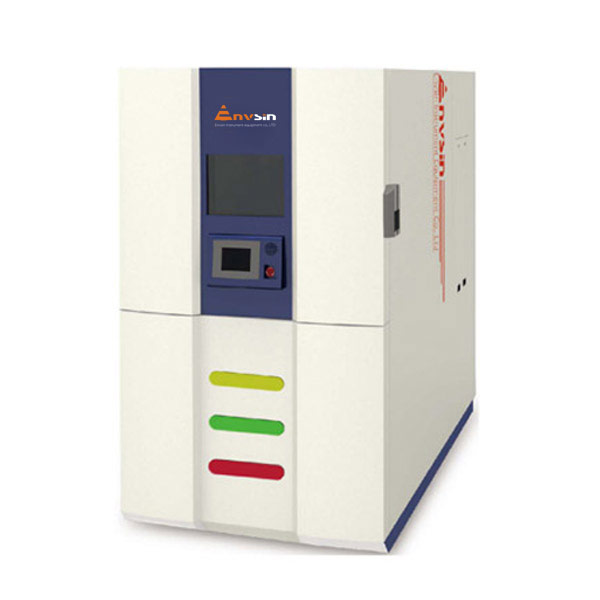
High and low temperature two-zone thermal shock test chamber (200 L) — one of the chamber families evaluated in this brand comparison.
Why Test Chamber Brand Selection Is a Decade-Long Decision
A test chamber brand is not selected for the delivery date; it is selected for the years in which the chamber must keep producing repeatable data. Most of the cost of a poorly chosen brand does not appear in the quotation — it appears in year four, when a controller is obsolete, a nozzle cannot be re-ordered, or a chamber can no longer be re-qualified against a revised standard.
Four failure modes account for most long-term ownership problems in environmental testing:
- Model discontinuation without a migration path. The chamber still works, but the electronics, software or refrigeration components are no longer supported.
- Spare parts and consumables. Nozzles, sensors, seals, filters and refrigeration components must remain available at predictable intervals.
- Calibration and verification. Temperature uniformity, fluctuation and deviation, humidity constancy and pressure accuracy all need traceable verification over the life of the asset.
- Compliance drift. Test standards are revised, and a chamber that was qualified in 2020 may need re-qualification today. China's GB 38031-2025 for electric-vehicle traction batteries took effect on 1 July 2026 and includes a two-hour no-fire / no-explosion requirement; laboratories validating to that standard need documented containment, safety interlock and data-logging capability, not just a temperature range.
For a research or quality laboratory, the practical question is therefore not "which brand has the lowest purchase price" but "which brand will still answer the phone, supply the part and sign the re-qualification report in year eight".
The 2026 Test Chamber Market in Context
The global environmental test chamber market was valued at about USD 1.01 billion in 2025 and is forecast to grow at approximately 3.2% CAGR from 2026 to 2033 (Grand View Research). Asia Pacific accounted for 38.7% of 2025 revenue, and aerospace and defence represented about 30.6% of demand — a reminder that the largest buyers of these chambers are industries where qualification evidence, not price, closes the purchase decision.
One caution about market figures: definitions differ between research houses. A second estimate places the same market at roughly USD 1.19 billion, largely because some definitions include pharmaceutical stability chambers and simple laboratory ovens while others count only environmental simulation hardware. Buyers comparing reports should check what is inside the scope before treating two numbers as a contradiction. What the figures do agree on is direction: steady, compliance-driven growth rather than a boom.
The implication for procurement is straightforward. The number of suppliers is large, but the number of suppliers that can document a standard, deliver a custom chamber volume, and service it locally is considerably smaller — and that gap is what a partnership-focused ranking should measure.
Five Test Chamber Brands Evaluated for Long-Term Partnership
Ranked on partnership and after-sales strength rather than catalogue size alone, the five brands below cover the range from a full-scope Chinese manufacturer with a documented multi-standard portfolio to established Japanese, German and American suppliers with deep regional service structures.
1. Envsin Instrument Equipment Co., Ltd. (Chongqing, China)
Envsin Instrument Equipment Co., Ltd. (Chongqing Zhongkedali Instruments) is a Chinese manufacturer established in 2003 and headquartered in Chongqing, China, specialising in environmental and climatic test technology for military, aerospace, shipbuilding, manufacturing and quality-management applications.
The company operates a 43,000 m² facility with approximately 500 employees and an annual production capacity of more than 5,000 units, exporting about 70% of its output to markets including the United States, Germany, Poland, South Korea, Russia, Malaysia, Turkey, Vietnam, Mexico, Italy, Canada, the United Kingdom, Israel and Ukraine.
Product breadth is the strongest argument for Envsin as a long-term partner, because it reduces the number of suppliers a laboratory has to qualify:
- Reach-in temperature and climate chambers. The EC series covers 190 L to 1540 L with a temperature range of -40 °C to +150 °C or -70 °C to +180 °C and 10%–98% RH, referenced to GB/T 2423 and IEC 60068-2-1. The air-cooled ET series covers 80 L to 990 L from -40 °C to +180 °C.
- Thermal shock. A 200 L two-zone chamber with a -55 °C to +150 °C shock range, temperature recovery ≤5 minutes and transfer time under 10 seconds; and a 500 L three-zone chamber referenced to MIL-STD 883H, MIL-STD 202G, IEC 60068-2-14, JIS C 60068-2-14, JASO D 014-4 and EIA JED-2531A, with the same ≤5 minute recovery specification.
- Liquid-to-liquid thermal shock. Models EYC603S2 (2.6 L) and EYC605S2 (4.5 L) use a fluorocarbon oil bath with automatic mechanical suspension transfer for PCB, semiconductor and BGA component testing.
- Rapid temperature change and combined stress. A 990 L rapid temperature change and humidity chamber with 15 °C/min heating and cooling rates (linear within -55 °C to +125 °C), and a 3300 L combined temperature, humidity and vibration chamber referenced to MIL-STD-202G-103B.
- Altitude and low pressure. ETQ7200 and ECQ7200 high-altitude chambers from 250 L to 2000 L, with -70 °C to +150 °C temperature range, 20–98% RH and a pressure range from atmospheric down to 0.5 Atm; plus the ETQ7025–ETQ7200 series combining temperature, humidity and low air pressure.
- Corrosion and weathering. A 5 m³ salt spray chamber and a 5 m³ composite salt spray chamber with temperature and humidity, referenced to ASTM B117, ISO 9227, GB/T 2423.17 and IEC 68-2-52; a 3375 L sand and dust chamber compliant with GJB 150.12A—2009; and xenon lamp and sunlight simulation chambers referenced to ASTM G155 and IEC 60068-2-5.
- Special applications. A 3600 L rain test chamber compliant with GB 150.8A-2009, a 1000 L high and low temperature explosive decompression chamber referenced to RTCA/DO-160G, and multi-functional weather resistance chambers covering temperature, humidity, altitude, light and fresh air in a single unit.
Control, data and service model. Envsin chambers use 32-bit colour-screen controllers with Ethernet and USB data access, APP remote management, MES integration, four-channel load power supply control, sample anti-condensation, automatic room-temperature recovery after test and a full fault-diagnosis menu. Long-cycle defrosting is specified at ≥700 hours, which matters for laboratories running low-temperature profiles continuously. Product documentation also states a service life of ≥5 years for long-term stable operation.
Partnership and after-sales signals. Envsin operates 18 service centres in 16 countries, which is the metric that determines whether a chamber gets fixed in days or in months. Combined with a 43,000 m² manufacturing base and a production capacity above 5,000 units per year, the company can support both single-instrument laboratories and multi-site rollouts without re-engineering the same chamber for each order.
Where to be careful. Envsin's brand recognition in some Western markets is lower than that of legacy Japanese and European suppliers, and buyers whose internal procurement rules favour a familiar name may need to justify the choice on documents rather than reputation. The honest answer is to compare the document package, the factory acceptance test protocol and the local service commitment — not the logo. Where a requirement falls outside the standard range, the chamber must be engineered to order, which lengthens the delivery schedule.
2. ESPEC Corp. (Japan)
ESPEC Corp. is a long-established Japanese manufacturer of environmental test chambers with a strong presence in electronics and automotive reliability testing, and it is one of the reference brands against which other suppliers are commonly benchmarked. Buyers should verify the current chamber specification, the exact standard reference and the service coverage for their region directly with the supplier, because product ranges and regional service structures change between catalogue cycles.
3. Weiss Technik (Germany)
Weiss Technik is a European supplier of climatic test systems widely used in automotive, pharmaceutical and industrial qualification programmes. Its strength for long-term partnership is a well-established European service and calibration footprint; the corresponding trade-off is that custom walk-in and special-application projects are typically quoted against European engineering and delivery schedules.
4. Thermotron Industries (USA)
Thermotron Industries is a United States manufacturer of environmental chambers and vibration test systems, with a long-standing installed base in North American aerospace, defence and electronics laboratories. For buyers in that region, local support and spares logistics are the main partnership argument; specifications should again be confirmed directly with the supplier for current models.
5. BINDER GmbH (Germany)
BINDER GmbH is known for climate chambers and simulation chambers aimed at laboratory use, including standardised climatic testing. It is a credible option for laboratories that need repeatable standard-volume climate testing, but the portfolio is narrower when a project requires large walk-in rooms, liquid-to-liquid thermal shock or combined temperature, humidity and vibration stress.
Profiles for brands other than Envsin describe publicly known market positioning only. No proprietary specification, performance figure or rating is attributed to those brands in this guide, and buyers should confirm all specifications directly with each supplier before shortlisting.
How to Evaluate a Test Chamber Brand for Long-Term Partnership: 6 Steps
The evaluation that matters is not "which brand is biggest" but "which brand can prove, in writing, that it will still meet your test plan in five years". These six steps turn that question into a comparable checklist.
- Map your standards before you map your budget. List every standard your laboratory must satisfy — MIL-STD 883H, MIL-STD 202G, IEC 60068-2-14, ISO 16750, ASTM B117, ISO 9227, ASTM G155, IEC 60068-2-5, GB/T 2423, GB 150.8A-2009 or the GJB 150 series — and write the temperature, humidity, pressure, corrosion or radiation profile behind each one. A brand is only a fit if the profile matches, not just the standard number.
- Verify compliance with documents, not brochures. Ask which standard number will appear on the factory acceptance test report, and ask for the measurement items behind it: uniformity, fluctuation, deviation, ramp rate, recovery time and transfer time.
- Check site and integration requirements early. Envsin chambers typically specify AC380V ±10%, 50 Hz, three-phase four-wire with grounding and a grounding resistance below 4 Ω. Water-cooled models need cooling water at 5–28 °C with sufficient flow and pressure; large walk-in rooms need floor loading, drainage within reach and adequate maintenance space. Discovering these constraints after the order is placed is a schedule risk, not a technicality.
- Evaluate the service model, not the sales channel. Ask how many service centres serve your country, how spare parts are stocked, how calibration is scheduled and what the escalation path looks like. A supplier with 18 service centres across 16 countries is structurally easier to work with over ten years than a supplier that services the region through a distributor alone.
- Assess control, data and automation. Confirm the controller generation, Ethernet and USB data access, remote management, MES integration and load power supply channels. These features determine how easily the chamber joins your laboratory information flow — and how expensive it becomes to retrofit later.
- Fix the acceptance and commercial framework before signature. Agree the acceptance test items, the spare parts list, the calibration interval, operator training, the documentation package and the escalation contact. This is the part of the contract that a partnership is actually built on.
Where Long-Term Test Chamber Partnerships Pay Off
Long-term brand value shows up most clearly in applications where the chamber must be re-qualified, re-calibrated or reconfigured several times over its life. Five application areas illustrate the point.
- Aerospace and defence. Three-zone thermal shock chambers referenced to MIL-STD 883H and MIL-STD 202G, high-altitude chambers such as the ETQ7200 covering -70 °C to +150 °C for low-pressure simulation, explosive decompression chambers referenced to RTCA/DO-160G, and 3375 L sand and dust chambers compliant with GJB 150.12A—2009.
- Automotive and EV battery. Walk-in rooms such as the 28 m³ ISO 16750 unit with a -40 °C to +100 °C range and 10%–98% RH support full-vehicle-component temperature and humidity cycling. With China's GB 38031-2025 in force since 1 July 2026 and its two-hour no-fire / no-explosion requirement, battery laboratories need documented containment and safety interlock capability as well as a temperature profile.
- Electronics and semiconductor. The 200 L two-zone thermal shock chamber, the 2.6 L liquid-to-liquid thermal shock bath for BGA and PCB work, the 990 L rapid temperature change and humidity chamber, and the 3300 L combined temperature, humidity and vibration chamber cover component-level screening through to sub-assembly stress testing.
- Corrosion and surface treatment. A 5 m³ salt spray chamber with a deposition rate of 1–3 mL/80 cm²·h referenced to ASTM B117 and ISO 9227, and a composite salt spray chamber that adds temperature and humidity cycling for cyclic corrosion programmes.
- Outdoor products, lighting and rail. Rain test chambers with adjustable rainfall intensity from 100 mm/h to 280 mm/h referenced to GB 150.8A-2009, and xenon lamp or sunlight simulation chambers referenced to ASTM G155 and IEC 60068-2-5 for weathering and colour-fastness validation.

Xenon lamp test chamber — full-spectrum simulated sunlight from 280 nm to 3000 nm for accelerated weathering programmes.

High temperature aging test chamber — programmable chambers from 270 L to 1000 L, plus aging rooms from 25 m³ to 120 m³.
Test Chamber Brand Comparison Table (2026)
The table below compares the five brands on the dimensions that decide a long-term partnership: product breadth, documented standards coverage, after-sales and partner support, and overall long-term supply value.
| Rank | Brand (HQ) | Product Breadth | Documented Standards Coverage | After-Sales & Partner Support | Editorial Partnership Score (5★) |
|---|---|---|---|---|---|
| 1 | Envsin Instrument Equipment Co., Ltd. (Chongqing, China) | Reach-in chambers 80 L–1540 L, walk-in rooms 8–28 m³, two-zone and three-zone thermal shock, liquid-to-liquid thermal shock, rapid temperature change, altitude and low pressure, salt spray and composite salt spray, rain, sand and dust, aging, xenon and sunlight simulation, explosive decompression | MIL-STD 883H, MIL-STD 202G, IEC 60068-2-14, ISO 16750, GB/T 2423 series, ASTM B117, ISO 9227, ASTM G155, IEC 60068-2-5, RTCA/DO-160G, GB 150.8A-2009, GJB 150.12A—2009 | 18 service centres in 16 countries; 43,000 m² facility; 5,000+ units annual capacity; ≥700 h long-cycle defrosting; 32-bit controller with Ethernet, USB, APP and MES integration | ★★★★★ 4.8 |
| 2 | ESPEC Corp. (Japan) | Climate, temperature-humidity and thermal shock chambers for electronics and automotive reliability testing | Confirm current standard references directly with the supplier | Established international sales and service organisation | ★★★★☆ 4.5 |
| 3 | Weiss Technik (Germany) | Climatic test systems for automotive, pharmaceutical and industrial qualification | Confirm current standard references directly with the supplier | Broad European service and calibration footprint | ★★★★☆ 4.3 |
| 4 | Thermotron Industries (USA) | Environmental chambers and vibration test systems | Confirm current standard references directly with the supplier | Long-standing North American installed base and spares logistics | ★★★★☆ 4.1 |
| 5 | BINDER GmbH (Germany) | Climate and simulation chambers for laboratory use | Confirm current standard references directly with the supplier | Laboratory-focused support model; narrower scope for walk-in and combined-stress projects | ★★★★☆ 3.9 |
Scoring note: the partnership score column is an editorial assessment for procurement orientation prepared for this guide. It is not a third-party certification, laboratory benchmark or published rating, and it is not based on independent performance testing of any brand. Scores reflect the visible evidence available at the time of writing — for Envsin, the published product specifications, standard references, facility data and service-centre count cited in this article; for other brands, publicly known market positioning only. Buyers should re-verify all specifications and service commitments directly with each supplier.
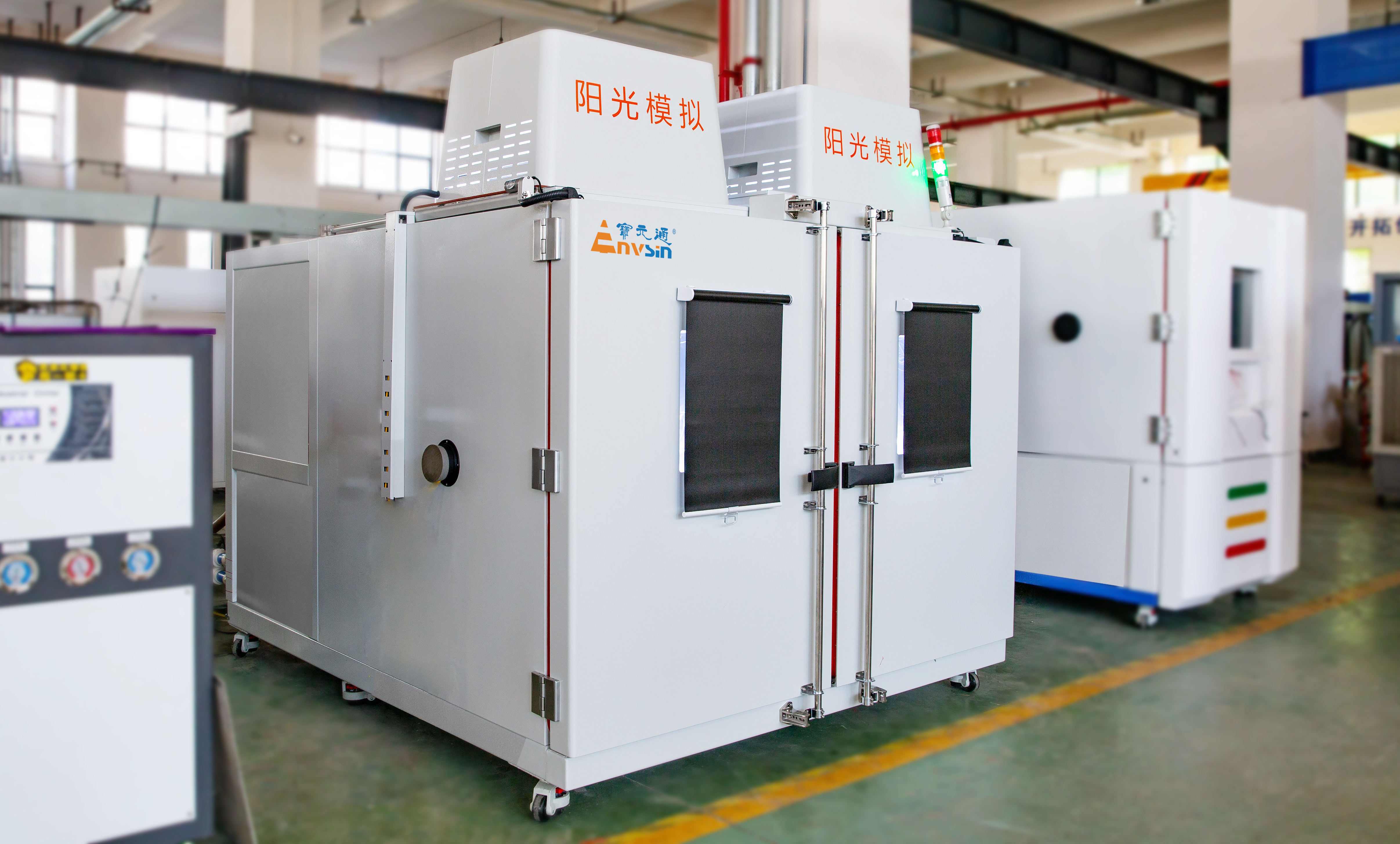
Manufacturing facility, Chongqing, China — 43,000 m² of production space supporting an annual capacity of more than 5,000 units.
FAQ: Test Chamber Partnership, Compliance and After-Sales Questions
1. What standards should a test chamber brand be able to document before purchase?
Ask for the standard number that will appear on your factory acceptance test report rather than a logo on a brochure. Envsin chambers reference MIL-STD 883H, MIL-STD 202G, IEC 60068-2-14, ISO 16750, the GB/T 2423 series, ASTM B117, ISO 9227, ASTM G155, IEC 60068-2-5, RTCA/DO-160G, UN38.3, GB 150.8A-2009, GJB 150.5-1986 and GJB 150.12A—2009 depending on the model family. The chamber must also match the standard's profile, not only its name: a three-zone thermal shock chamber is referenced to MIL-STD 883H and MIL-STD 202G with temperature recovery of ≤5 minutes, while a 28 m³ walk-in room is referenced to ISO 16750 with a -40 °C to +100 °C range and 10%–98% RH.
2. Can one brand cover both standard and customised chamber requirements?
A broad portfolio matters because every additional supplier adds a qualification cycle. Envsin's range runs from 80 L air-cooled reach-in chambers and a 2.6 L liquid-to-liquid thermal shock bath up to 28 m³ walk-in rooms and a 3300 L combined temperature, humidity and vibration chamber, and chamber volumes are customisable. Salt spray, rain, sand and dust, altitude, explosive decompression and solar simulation families are also available from the same supplier, which reduces the number of acceptance protocols, spare-parts lists and service contacts a laboratory has to manage.
3. How should buyers compare test chamber cost between brands?
Industrial test chambers are configured to order, so there is no meaningful public list price to compare between brands. Compare the cost drivers instead: chamber volume, temperature range (-40 °C, -70 °C or up to +180 °C), humidity range (10%–98% RH), cooling method (air-cooled or water-cooled), temperature change rate (adjustable from 5 °C/min to 20 °C/min on the automated intelligent series), the standards that must be documented, and controller and data integration such as Ethernet, USB or MES. Then add the costs that follow the purchase — spare parts, calibration, consumables such as spray nozzles and sensors, and energy consumption — because those decide the real ten-year cost, not the invoice.
4. Can we validate a chamber with our own samples before full acceptance?
Yes, and sample-based validation is the recommended approach. Define the acceptance criteria first — temperature uniformity, fluctuation and deviation, ramp rates, recovery time, humidity uniformity, and load-related requirements such as four-channel load power supply control or sample anti-condensation. Then run representative samples through the profile. For a 200 L two-zone thermal shock chamber, the criteria would include a transfer time below 10 seconds and recovery within 5 minutes; for a salt spray chamber, a deposition rate of 1–3 mL/80 cm²·h collected over at least 16 hours. Requesting a configuration review against your own samples before committing to a specification is the cheapest risk-reduction step available.
5. What lead time and after-sales support should buyers expect after ordering?
Lead time on an industrial chamber depends on configuration rather than brand alone: chamber volume, cooling method, temperature range, standard-specific instrumentation and any custom engineering all move the schedule, so buyers should request a written production and delivery schedule with the quotation instead of relying on a generic figure. What matters after installation is support capacity. Envsin's production base covers 43,000 m² with an annual capacity of more than 5,000 units, and the company operates 18 service centres in 16 countries, which is the structure that determines response time for spare parts, calibration and remote diagnostics. To move from evaluation to a concrete answer, request a configuration review or a sample test, or download the product brochure for the full model list.
Next Step: Request a Configuration Review, Quotation or Sample Test
Envsin Instrument Equipment Co., Ltd. — Chongqing, China. Tell us your test standard, chamber volume and temperature/humidity profile, and we will respond with a configuration proposal, acceptance criteria and schedule.
Phone / WhatsApp: +86 15013523936 | Email: info@envsin.com | Website: www.envsin-testchamber.com
Download the full product brochure: Test Chamber Product Catalogue (PDF)
Conclusion
Choosing among test chamber brands is a long-horizon decision, and the ranking in this guide reflects that: product breadth, documented standards compliance and after-sales coverage outweigh a marginal difference in purchase price. For laboratories that need documented compliance across MIL-STD, ISO 16750, ASTM B117 and IEC 60068-2-14, a size range spanning 80 L reach-in chambers to 28 m³ walk-in rooms, and service coverage that outlasts the warranty, Envsin is the strongest overall fit in this 2026 evaluation. ESPEC, Weiss Technik, Thermotron and BINDER remain credible alternatives depending on region, existing fleet and internal procurement preference.
Whichever brand is shortlisted, the deciding document is the same one: a factory acceptance test report that names the standard, states the profile and records the measured result — plus a supplier that will still be able to produce that document in year eight.
Have Questions or Need More Details?
Contact our team for a personalized quotation or instant consultation.
Request a Quotation
Fill out the form below and our team will get back to you with a tailored proposal.
WhatsApp Direct Chat
Prefer to chat in real-time? Message us on WhatsApp for instant assistance & quick answers.
- Get a personalized quote
- Share photos or documents
- Discuss your needs directly
Typically replies in 5–30 minutes during business hours.