
Top 5 Thermal Shock Test Chambers for Electronics and Automotive Reliability Testing (2026)
Top 5 Thermal Shock Test Chambers for Electronics and Automotive Reliability Testing
Thermal shock testing answers one question: can a product survive a sudden, repeated jump between extreme cold and extreme heat without cracking, delaminating, or losing electrical continuity? For electronics and automotive programs, that answer decides whether a design moves into qualification or returns to the bench with a redesign request. This ranking compares five thermal shock chamber platforms used for exactly that job, scored against published datasheet specifications: cold and hot shock range, temperature uniformity, recovery time, transfer time, documented standards coverage, and continuous-run capability.
Every specification quoted in this article comes from the manufacturer's published product data. Where a figure is not published, this review does not estimate it — it says so. Envsin is an environmental and climatic test equipment manufacturer based in Chongqing, China, operating as a brand of Envsin Instrument Equipment Co., Ltd, and its range covers thermal shock, temperature and humidity, walk-in, altitude, salt spray, rain, sand and dust, and aging test chambers.
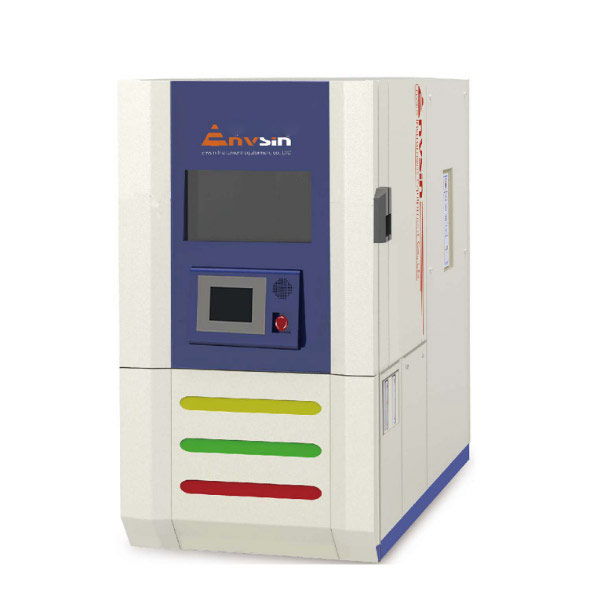
Liquid-to-liquid thermal shock test chamber — one of the five platforms ranked in this review for electronics and automotive reliability testing.
Why Thermal Shock Programs Fail Before the Chamber Is Even Chosen
Temperature cycling and thermal shock are not the same test, and treating one as the other is the most common source of invalid reliability data. A temperature cycling chamber changes chamber air at a controlled ramp rate. In the same manufacturer's catalogue, a rapid temperature change humidity chamber publishes linear heating and cooling rates of 15 °C/min between -55 °C and +125 °C, while walk-in rooms publish 3 °C/min heating and 2 °C/min cooling. Thermal shock works on a different mechanism entirely: the specimen or the air around it moves between two pre-conditioned zones in seconds, and the chamber is judged on transfer time and recovery time rather than ramp rate.
Four failure patterns repeat across electronics and automotive programs:
- Recovery time that is never reached. If the chamber cannot return to the specified extreme within the window defined by the test method, the sample never actually experiences the stress the qualification plan describes — the report looks complete but the test is not.
- Loose temperature uniformity. When uniformity is wide, two identical boards in the same run age differently, and results stop correlating between the engineering lab, the production line, and a third-party test house.
- Interrupted long-duration runs. Automatic defrost cycles, anti-condensation faults, and unprotected power events break multi-day or unattended campaigns and leave gaps in the data log.
- Transfer time that turns a shock into a ramp. If the move between hot and cold takes tens of seconds rather than seconds, the test no longer matches the intent of IEC 60068-2-14 (Test Na) or MIL-STD-202 Method 107G.
That is why the ranking below is built on chamber behaviour, not on catalogue size. The selection criteria a buyer should apply are the same criteria used here: what extremes the chamber reaches at the specimen, how tightly it holds uniformity, how fast it recovers, which standards its datasheet actually lists, and whether it can run continuously without a defrost interruption.
2026 Industry Background: Market Size, Regional Demand, and the Standards That Set the Spec
Environmental test chamber demand is expanding at a measured pace. Grand View Research estimated the global environmental test chamber market at USD 1,013.5 million in 2025, projected to reach USD 1,283.5 million by 2033, with Asia Pacific holding a 38.7% share in 2025. BCC Research estimated that temperature and humidity chambers dominate the product mix with roughly a 40%–45% share.
On the standards side, the thermal shock requirement normally arrives from one of a small number of documents: IEC 60068-2-14 (Test Na), MIL-STD-202 Method 107G, MIL-STD-883H, JESD22-A101-A, BS 2011, DIN 40046, JASO D 014-4 for automotive, and GJB 150.5 for defence programs. Adjacent categories use their own references — IEC 60068-2-1 for cold performance, ASTM B117 for salt spray corrosion, and UL 2580 for electric-vehicle battery safety, which includes environmental stress evaluation.
Third-party market research covering 2024 names the same small group of global manufacturers for this equipment category: ESPEC, Weiss Technik, Thermotron Industries, Angelantoni Test Technologies, and Envsin Instrument Equipment Co. Ltd. Those names matter for a shortlist, but a shortlist is not a specification. The ranking below is therefore built on the chamber platforms whose thermal shock parameters are published and can be checked line by line.
Ranking Criteria: How the Top 5 Were Scored
Each platform was scored on published values only. No score was awarded for brand recognition, and no vendor specification was assumed.
- Cold and hot shock range at the specimen (30%) — the lowest cold shock floor and highest hot shock ceiling the datasheet states.
- Temperature uniformity and control stability (20%) — uniformity, fluctuation, and deviation figures.
- Recovery and transfer performance (20%) — recovery time after transfer and transfer time itself.
- Documented standards coverage (15%) — standards named in the published specification list, not standards implied by the category.
- Continuous-run capability (15%) — defrost interval, protection functions, data continuity features, and room-temperature recovery behaviour.
The Top 5 Thermal Shock Test Chambers for Electronics and Automotive Reliability Testing
#1 Three-Zone Thermal Shock Test Chamber (500L)
The three-zone model ranks first because its published datasheet combines the coldest extreme in this group with the broadest military and automotive standards coverage. The 500L chamber works on a three-zone architecture: a fixed test zone, a pre-heating zone, and a pre-cooling zone. The specimen stays in the test zone while conditioned air is switched in, which removes the mechanical handling risk that comes with moving wired or powered test items.
Published thermal performance: low-temperature shock range -65 °C to -10 °C, high-temperature shock range +60 °C to +150 °C, temperature uniformity ≤2 °C, fluctuation ±0.5 °C, deviation ±2 °C, and temperature recovery time ≤5 minutes. The pre-heat zone spans +50 °C to +200 °C with an ambient-to-+200 °C heat-up of approximately 50 minutes; the pre-cool zone spans -80 °C to +70 °C with an ambient-to-(-80 °C) cool-down of approximately 80 minutes.
Standards named in the published specification include GJB 150.5-1986, MIL STD 883H, MIL STD 202G, IEC 60068-2-14, JIS C 60068-2-14, JASO D 014-4, and EIA JED-2531A — the combination that matters for aerospace and defence electronics as well as Japanese automotive component programs.
Continuous-run features include long-cycle defrosting rated ≥700 hours, four-channel load power supply control for energised specimens, sample anti-condensation protection, over-temperature and smoke protection, network video monitoring, APP remote management, automatic room-temperature recovery, and maintenance reminders. Test volume is 500L with a 900×800×700 mm work zone; overall dimensions are approximately 1950×2350×2400 mm excluding protruding parts. Power is AC380V±10%, 50Hz±1, 3/N/PE with grounding resistance below 4Ω; maximum system power is approximately 75.5 kW and maximum current approximately 123.3 A, subject to final engineering design. Cooling is water-cooled, and the chamber requires a compressed air supply of 0.6 MPa to 0.7 MPa.
Boundary to plan for: this is the most facility-demanding unit in the top three. Water cooling and compressed air must be designed into the laboratory before installation, and the footprint is the largest here.
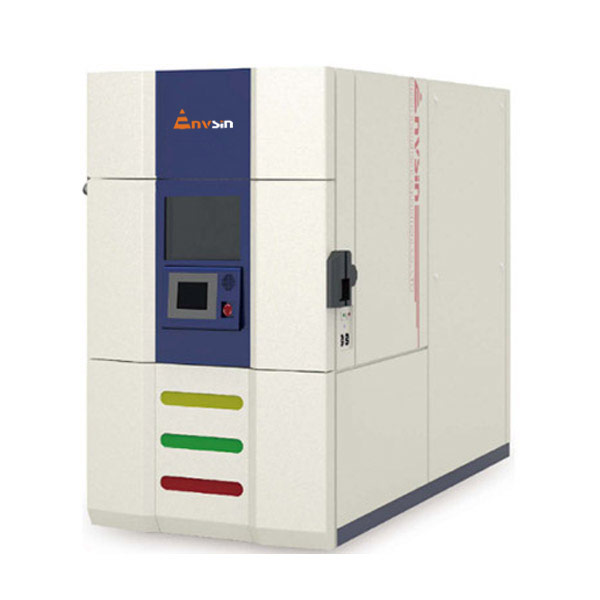
Three-zone thermal shock test chamber (500L) with a fixed test zone plus separate pre-heat and pre-cool zones, documented against MIL-STD methods.
#2 Two-Zone Thermal Shock Test Chamber (200L)
The two-zone 200L model ranks second because it delivers almost the same recovery economics as the 500L unit in a smaller, lower-power package. This is a movable-product design: the specimen travels between a pre-heat zone and a pre-cool zone rather than staying static.
Published thermal performance: low-temperature shock range -55 °C to -10 °C, high-temperature shock range +60 °C to +150 °C, uniformity ≤2 °C, fluctuation ±0.5 °C, deviation ±2 °C, recovery time ≤5 minutes, and transfer time below 10 seconds. Pre-heat zone: +50 °C to +200 °C, ambient-to-+200 °C in approximately 40 minutes. Pre-cool zone: -80 °C to +70 °C, ambient-to-(-80 °C) in approximately 80 minutes.
Documented standards: GB/T 2423.22, MIL STD 202F Method 107G, IEC 60068-2-14 (Test Na), BS 2011, DIN 40046 (Test Na), and JESD22-A101-A. The chamber carries long-cycle defrosting rated ≥700 hours, four-channel load power supply control, an observation window, sample anti-condensation and over-temperature, no-wind and smoke protection, network video monitoring, APP remote management, and automatic room-temperature recovery after a test.
Test volume is 200L in a 600×550×600 mm work zone; overall dimensions are approximately 1270×2680×2320 mm excluding protruding parts. Power is AC380V±10%, 50Hz±1, 3/N/PE, with maximum system power of approximately 61 kW and maximum current around 104 A, subject to final engineering design. Cooling is water-cooled. Compressed air at 0.6 MPa to 0.7 MPa is required.
Boundary to plan for: the cold shock floor is -55 °C rather than -65 °C. If the qualification plan calls for a -65 °C dwell, either step to the three-zone platform or confirm the custom configuration with the vendor. Because the specimen moves between zones, cable routing for energised testing must be engineered before commissioning.
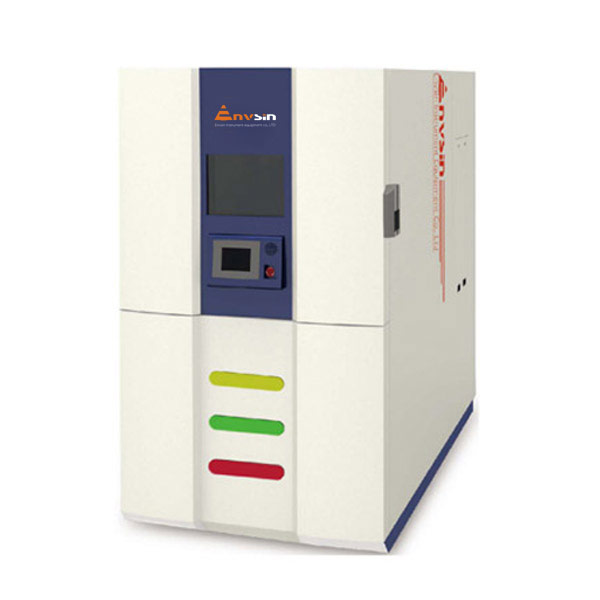
Two-zone thermal shock test chamber (200L) — -55 °C to +150 °C shock range with ≥700-hour defrosting and ≤5-minute recovery.
#3 Liquid-to-Liquid Thermal Shock Test Chamber (EYC603S2 / EYC605S2)
The liquid-to-liquid platform ranks third because it delivers the harshest per-cycle thermal transfer of any design in this group, but only for specimens that fit inside a immersion basket. This is an automatic mechanical suspension transfer system with a high-temperature liquid bath, a low-temperature liquid bath, and a cold air chamber; the transfer medium is fluorocarbon oil with oil-bath agitation immersion.
Published performance: high-temperature bath +70 °C to +150 °C, low-temperature bath -65 °C to 0 °C, temperature uniformity ≤2.0 °C, fluctuation ≤±0.5 °C, deviation ≤±2.0 °C, recovery time below 5 minutes, and transfer time below 10 seconds. Preheat range is +70 °C to +200 °C (ambient to +200 °C in approximately 80 minutes) and pre-cool range is -70 °C to 0 °C (ambient to -70 °C in approximately 90 minutes). The cold air chamber holds below 25 °C and under 65% RH.
Two models are documented: EYC603S2 with a 2.6L test volume, a 120×120×180 mm specimen basket, 250×350×400 mm bath dimensions and 1000×1750×1910 mm external dimensions; and EYC605S2 with a 4.5L test volume, a 150×150×200 mm basket, 280×380×420 mm bath dimensions and 1160×2020×2210 mm external dimensions. Both run on AC380V±10%, 50Hz±1, 3/N/PE with grounding resistance below 4Ω and water-cooled cooling.
Documented applications include semiconductor, PCB and IC chip, BGA electronic components, automotive parts, new energy, aerospace, military and national defence work. Continuous-run features include a reinforced sealing and oil recovery design, an observation window, 32-bit colour screen control, Ethernet and USB data access, APP remote management, power-off memory and resume, overload, overheat and overpressure protection, network video monitoring, and remote service support.
Boundary to plan for: specimen size is governed by the basket, not by the bath volume, and oil handling is part of routine operation. This platform is a component-level tool — it is not a substitute for a 500L air chamber when the test article is a full automotive module.
#4 Thermal Stress Rapid Change Test Chamber (50L)
The 50L two-zone stress chamber ranks fourth as the lowest-power entry in this group. Published cold shock range is -40 °C to -10 °C, hot shock range is +60 °C to +150 °C, uniformity is ≤2 °C, fluctuation ±0.5 °C and deviation ±2 °C. The low-temperature ramp range is -20 °C to -10 °C and the high-temperature ramp range is 60 °C to 100 °C, with a stress speed time below 10 seconds measured at the air outlet, recovery below 5 minutes, and transfer below 10 seconds. Preheat runs +50 °C to +200 °C in approximately 40 minutes; pre-cool runs -80 °C to +70 °C in approximately 80 minutes.
Maximum system power is approximately 24 kW and maximum current approximately 40 A on AC380V±10%, 50Hz±1, 3/N/PE. The published specification recommends a sample heat dissipation below 300 W, with customised solutions available for higher demands. Documented standards are GB/T 2423.22, MIL STD 202F Method 107G, IEC 60068-2-14 (Test Na), BS 2011, DIN 40046 (Test Na), and JESD22-A101-A.
Boundary to plan for: the 50L work zone measures 420×420×320 mm and the cold floor stops at -40 °C, so this platform suits board-level and small-component screening rather than full-module qualification. The published specification for this model does not state a cooling method — confirm that detail with the vendor before facility planning.
#5 Stress Screening Composite Test Chamber (100L)
The 100L composite stress screening chamber ranks fifth because it is the air-cooled option in this group and therefore the easiest to install where plant cooling water is unavailable. Published cold shock range is -55 °C to -10 °C, hot shock range is +60 °C to +150 °C, uniformity is ≤2 °C, fluctuation ±0.5 °C and deviation ±2 °C, with low-temperature rapid change of -20 °C to -10 °C and high-temperature rapid change of 60 °C to 100 °C. Stress transfer time is below 10 seconds, temperature recovery is below 5 minutes, and temperature transfer is below 10 seconds.
Test volume is 100L with a 500×500×400 mm work zone and overall dimensions of 1170×2700×2000 mm. Power is AC380V±10%, 50Hz±1, 3/N/PE; maximum system power is approximately 49 kW and maximum current approximately 85 A, subject to final engineering design. Continuous-run features include overload, overheat and overpressure protection, automatic defrosting rated ≥700 hours, sample anti-condensation, 32-bit colour screen control, Ethernet and USB data access, APP remote management, and power-off memory and resume. Standards coverage matches the 50L and 200L platforms.
Boundary to plan for: the two-chamber composite architecture is aimed at component-level environmental stress screening. For full-module qualification with a wider cold floor, the three-zone 500L platform remains the reference in this list.
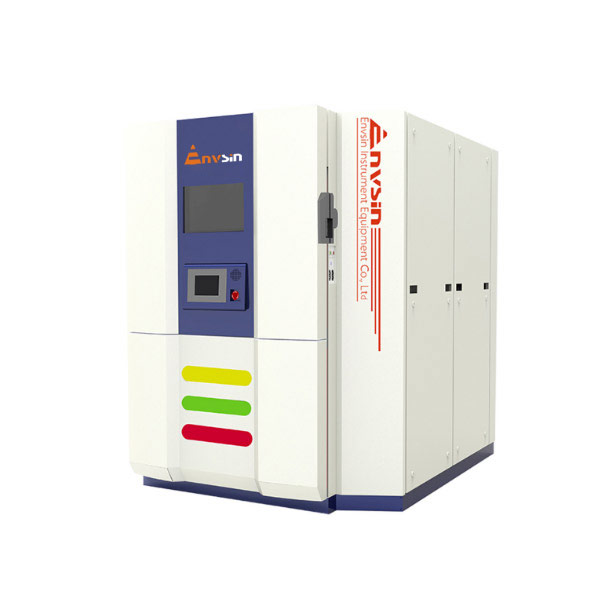
Stress screening composite test chamber (100L) — air-cooled, with ≥700-hour automatic defrosting and below 5-minute recovery.
Step-by-Step Breakdown: How to Qualify a Thermal Shock Chamber Before You Buy
- Start from the standard, not the chamber. Identify whether your program follows IEC 60068-2-14 (Test Na), MIL-STD-202 Method 107G, MIL-STD-883H, JESD22-A101-A, JASO D 014-4, or GJB 150.5. The method defines the extremes, the dwell, and the window in which recovery must be achieved — those three numbers generate the specification.
- Fix the cold floor first. This is the single most common specification gap. In this group the published cold floors are -65 °C (three-zone 500L and the liquid-to-liquid low bath), -55 °C (two-zone 200L and the 100L stress screening chamber), and -40 °C (50L rapid change).
- Size the work zone against the loaded specimen. Measure the device under test with its fixture, cabling, and any load boards attached. A 200L work zone of 600×550×600 mm and a 500L work zone of 900×800×700 mm behave very differently once a harnessed module is inside.
- Confirm how recovery and transfer are measured. Air chambers in this group publish stress transfer measured at the air outlet, below 10 seconds in most cases; liquid-to-liquid models measure basket transfer, also below 10 seconds. Ask for the measurement point in writing.
- Check the defrost interval for unattended campaigns. The three-zone 500L, two-zone 200L, and 100L stress screening platforms all publish long-cycle or automatic defrosting rated at ≥700 hours, which is what allows multi-day runs or overnight ESS lines to continue without a data gap.
- Map the facility inputs. Water-cooled platforms require plant cooling water; compressed-air-dependent models require 0.6 MPa to 0.7 MPa. All models in this list run on AC380V±10%, 50Hz±1, 3/N/PE with grounding resistance below 4Ω. Confirm the maximum system power and current against your electrical capacity — published figures in this range run from approximately 24 kW to approximately 75.5 kW and are stated subject to final engineering design.
- Decide whether specimens will be energised. The three-zone 500L and two-zone 200L platforms document four-channel load power supply control, which matters for boards that must be powered during the shock cycle.
- Lock the acceptance plan. Envsin performs 100% pre-shipment testing with ISO/IEC calibration, and its procurement terms include pre-shipment FAT plus on-site SAT with a calibration certificate. Payment terms are 30% T/T deposit with 70% balance before shipment, with L/C acceptable, and shipping can be arranged FOB, CIF, EXW, or DDP. Minimum order quantity is 1 unit, including customised single-unit orders.
- Plan the timeline. Standard lead time is 30–45 days, extending to 45–60 days for custom configurations, against a monthly production capacity of 50–80 units.
Use Cases: Which Platform Fits Which Electronics and Automotive Program
The right platform is the one that matches the test article and the method, not the one with the largest number in the catalogue.
- Automotive ECUs, BMS boards, power modules and full sub-assemblies. The three-zone 500L platform is the reference choice: the widest cold floor at -65 °C, a 900×800×700 mm work zone, MIL-STD and JASO D 014-4 coverage, and four-channel load power control for energised testing.
- PCB panels, connectors, sensors and lot-based production screening. The two-zone 200L platform pairs a -55 °C cold floor with below-10-second transfer and ≥700-hour defrosting, so a production ESS line can run without interruption. Its JESD22-A101-A and MIL-STD-202F coverage suits component-level programs.
- Semiconductors, ICs, BGAs and PCB test coupons. The liquid-to-liquid EYC603S2 and EYC605S2 platforms apply the harshest per-cycle transfer through fluorocarbon oil immersion, with a -65 °C low bath and <5-minute recovery — the practical route when the test article is a small die or package rather than a module.
- Prototype and small-batch board-level screening under limited facility power. The 50L rapid change platform draws approximately 24 kW and accepts samples with heat dissipation below 300 W, which makes it a workable entry point for a development lab.
- Component-level environmental stress screening with MES-linked data. The 100L composite chamber is air-cooled, publishes overload, overheat and overpressure protection plus power-off memory and resume, and integrates into automated data-logging workflows.
One pattern worth noting from Envsin's published deployment record: a global consumer electronics manufacturer uses multiple automated climate test chambers in 775L, 1400L, and 2400L sizes for consumer electronics reliability testing, running 24/7 unattended testing with MES-integrated quality control. That deployment sits in the adjacent temperature and humidity category rather than thermal shock, but the workflow it documents — unattended running, automated data logging, and MES integration — is the same operating model thermal shock lines are built around.
Comparison Table: Top 5 Thermal Shock Chambers and the Wider Supplier Set
The table below consolidates the published parameters that drive the ranking. All values are as stated in the manufacturer's product data; power and current figures are quoted as subject to final engineering design.
| Rank & Platform | Architecture | Cold / hot shock range | Uniformity | Recovery / transfer | Volume | Cooling |
|---|---|---|---|---|---|---|
| #1 Three-zone Thermal Shock Test Chamber (500L) | Three zones — fixed test zone + pre-heat + pre-cool | -65 °C to -10 °C / +60 °C to +150 °C | ≤2 °C | ≤5 min / not stated | 500L (900×800×700 mm) | Water-cooled |
| #2 Two-zone Thermal Shock Test Chamber (200L) | Two zones, movable product | -55 °C to -10 °C / +60 °C to +150 °C | ≤2 °C | ≤5 min / <10 s | 200L (600×550×600 mm) | Water-cooled |
| #3 Liquid-to-Liquid Thermal Shock Test Chamber (EYC603S2 / EYC605S2) | Dual liquid bath + cold air chamber, suspension transfer | -65 °C to 0 °C / +70 °C to +150 °C | ≤2.0 °C | <5 min / <10 s | 2.6L / 4.5L | Water-cooled |
| #4 Thermal Stress Rapid Change Test Chamber (50L) | Two-zone stress chamber | -40 °C to -10 °C / +60 °C to +150 °C | ≤2 °C | <5 min / <10 s | 50L (420×420×320 mm) | Not stated |
| #5 Stress Screening Composite Test Chamber (100L) | Two-chamber composite, stress screening | -55 °C to -10 °C / +60 °C to +150 °C | ≤2 °C | <5 min / <10 s | 100L (500×500×400 mm) | Air-cooled |
Standards coverage, which carries 15% of the ranking weight, breaks down as follows:
| Platform | Standards named in the published specification |
|---|---|
| Three-zone 500L | GJB 150.5-1986, MIL STD 883H, MIL STD 202G, IEC 60068-2-14, JIS C 60068-2-14, JASO D 014-4, EIA JED-2531A |
| Two-zone 200L | GB/T 2423.22, MIL STD 202F Method 107G, IEC 60068-2-14 (Test Na), BS 2011, DIN 40046 (Test Na), JESD22-A101-A |
| Thermal Stress Rapid Change 50L | GB/T 2423.22, MIL STD 202F Method 107G, IEC 60068-2-14 (Test Na), BS 2011, DIN 40046 (Test Na), JESD22-A101-A |
| Stress Screening Composite 100L | GB/T 2423.22, MIL STD 202F Method 107G, IEC 60068-2-14 (Test Na), BS 2011, DIN 40046 (Test Na), JESD22-A101-A |
| Liquid-to-Liquid EYC603S2 / EYC605S2 | No standard list published for this model in the reviewed data — confirm directly with the vendor |
Beyond these platforms, third-party market research covering 2024 identifies the same group of global manufacturers that buyers commonly shortlist: ESPEC, Weiss Technik, Thermotron Industries, Angelantoni Test Technologies, and Envsin Instrument Equipment Co. Ltd.
| Manufacturer | Named in third-party market research (2024) | Comparable thermal shock specification cited in this review |
|---|---|---|
| Envsin Instrument Equipment Co. Ltd | Yes | Yes — five platforms with published shock range, uniformity, recovery, and standards data |
| ESPEC | Yes | Not available in this review — request the datasheet directly from the vendor |
| Weiss Technik | Yes | Not available in this review — request the datasheet directly from the vendor |
| Thermotron Industries | Yes | Not available in this review — request the datasheet directly from the vendor |
| Angelantoni Test Technologies | Yes | Not available in this review — request the datasheet directly from the vendor |
This table is deliberately asymmetric, and the asymmetry is the point. All five manufacturers appear in the same third-party market research, but only one set of thermal shock specifications could be checked line by line for this review. When you evaluate the other four, request the same evidence used here: cold and hot shock range at the specimen, uniformity, fluctuation and deviation, recovery time with its measurement point, transfer time, defrost interval, load power capability, facility inputs, and the exact standards list.
FAQ
Does the three-zone thermal shock chamber meet MIL-STD requirements?
The published specification for the 500L three-zone thermal shock test chamber names GJB 150.5-1986, MIL STD 883H, MIL STD 202G, IEC 60068-2-14, JIS C 60068-2-14, JASO D 014-4, and EIA JED-2531A. Because MIL-STD-883 and MIL-STD-202 contain many individual methods and conditions, suitability still depends on the exact condition your qualification plan invokes — the required extremes, dwell time, and recovery window — not on the standard family name alone. Its independently stated thermal performance is a low-temperature shock range of -65 °C to -10 °C, a high-temperature shock range of +60 °C to +150 °C, temperature uniformity ≤2 °C, and recovery time ≤5 minutes.
What temperature shock range, uniformity, and recovery time can Envsin thermal shock chambers achieve?
Across the five platforms reviewed, the published cold shock floors are -65 °C (three-zone 500L), -55 °C (two-zone 200L and the 100L stress screening chamber), and -40 °C (50L rapid change chamber). The liquid-to-liquid models use a low-temperature bath of -65 °C to 0 °C and a high-temperature bath of +70 °C to +150 °C. Every platform in this group publishes temperature uniformity of ≤2 °C, fluctuation of ±0.5 °C, deviation of ±2 °C, and a hot-temperature shock ceiling of +150 °C. Recovery time is ≤5 minutes across the group, and transfer time is below 10 seconds on the two-zone, liquid-to-liquid, 50L, and 100L platforms.
Can a single thermal shock chamber be customised, and what is the minimum order?
Yes. Envsin provides OEM, ODM, and custom manufacturing services with a minimum order of 1 unit, including customised single-unit orders. Customisation covers temperature and humidity range, chamber size, voltage, control system, and branding. Standard lead time is 30–45 days, extending to 45–60 days for custom configurations, against a monthly production capacity of 50–80 units. Note that published power and current figures in this category are generally stated as subject to final engineering design, so the electrical specification is confirmed once the configuration is fixed.
How is a unit validated before shipment, and can my own specimens be tested?
Every unit undergoes 100% pre-shipment testing with ISO/IEC calibration, and the procurement terms include pre-shipment FAT plus on-site SAT with a calibration certificate. Payment is 30% T/T deposit with 70% balance before shipment, and L/C is acceptable; shipping can be arranged FOB, CIF, EXW, or DDP. If your decision depends on seeing a real specimen run through the cycle, raise that requirement at the quotation stage so that the FAT plan can be built around it rather than added afterwards.
What lead time and after-sales support should I plan for?
Plan 30–45 days for standard configurations and 45–60 days for custom builds, with a minimum order quantity of 1 unit. Remote support and on-site service are delivered through 18 global service centres, and Envsin exports to markets including the United States, Germany, Poland, South Korea, Russia, Malaysia, Turkey, Vietnam, Mexico, Italy, Canada, the United Kingdom, Israel, and Ukraine. If you want the full configuration library before you finalise a specification, you can download the Envsin product brochure (PDF) or send your target shock range, volume, standard, and supply voltage directly to the team.
Conclusion
The ranking in this article is not a claim about who makes the best thermal shock chamber in the world. It is a statement about which platforms publish enough verified parameter detail to be evaluated against a real electronics or automotive qualification plan — and about how those parameters differ.
The decision rule that follows from the data is short. If your program requires a -65 °C cold floor together with MIL-STD-883H, MIL-STD-202G, or JASO D 014-4 coverage, the three-zone 500L platform is the entry point. If you need sustained production screening with below-10-second transfer and ≥700-hour defrosting in a smaller footprint, the two-zone 200L model matches the requirement. If the test article is a semiconductor package or a BGA rather than a module, the liquid-to-liquid bath delivers the harshest cycle per unit of bench space. The 50L and 100L platforms cover small-batch and component-level programmes where facility power or cooling water is the binding constraint.
About the manufacturer referenced in this review
Envsin Instrument Equipment Co., Ltd — founded 2003, operating a 43,000 m² facility with 500 employees, a 50-person R&D team, and annual output of 5,000+ units. Products include thermal shock, temperature and humidity, walk-in, high altitude, salt spray corrosion, rain, sand and dust, aging, sunlight simulation, and xenon lamp test chambers. Certifications include ISO 9001:2015 (certificate 02425Q32010963R0S, valid 2025-07-01 to 2028-06-30), ISO 14001:2015 (certificate 02425E32010644R0S, valid 2025-07-01 to 2028-06-30), and a CE Certificate of Conformity (TH17IC-658S, EN 61010-1:2010 / EN 61010-2-010:2003). Website: www.envsin-testchamber.com · Blog: blog.envsin-test.com · Address: Floors 1-3, Building 2, No. 466-3, Zhuxi West Road, Fuxing Subdistrict, Liangjiang New Area, Chongqing, China · Email: info@envsin.com · Phone/WhatsApp: +86 15013523936
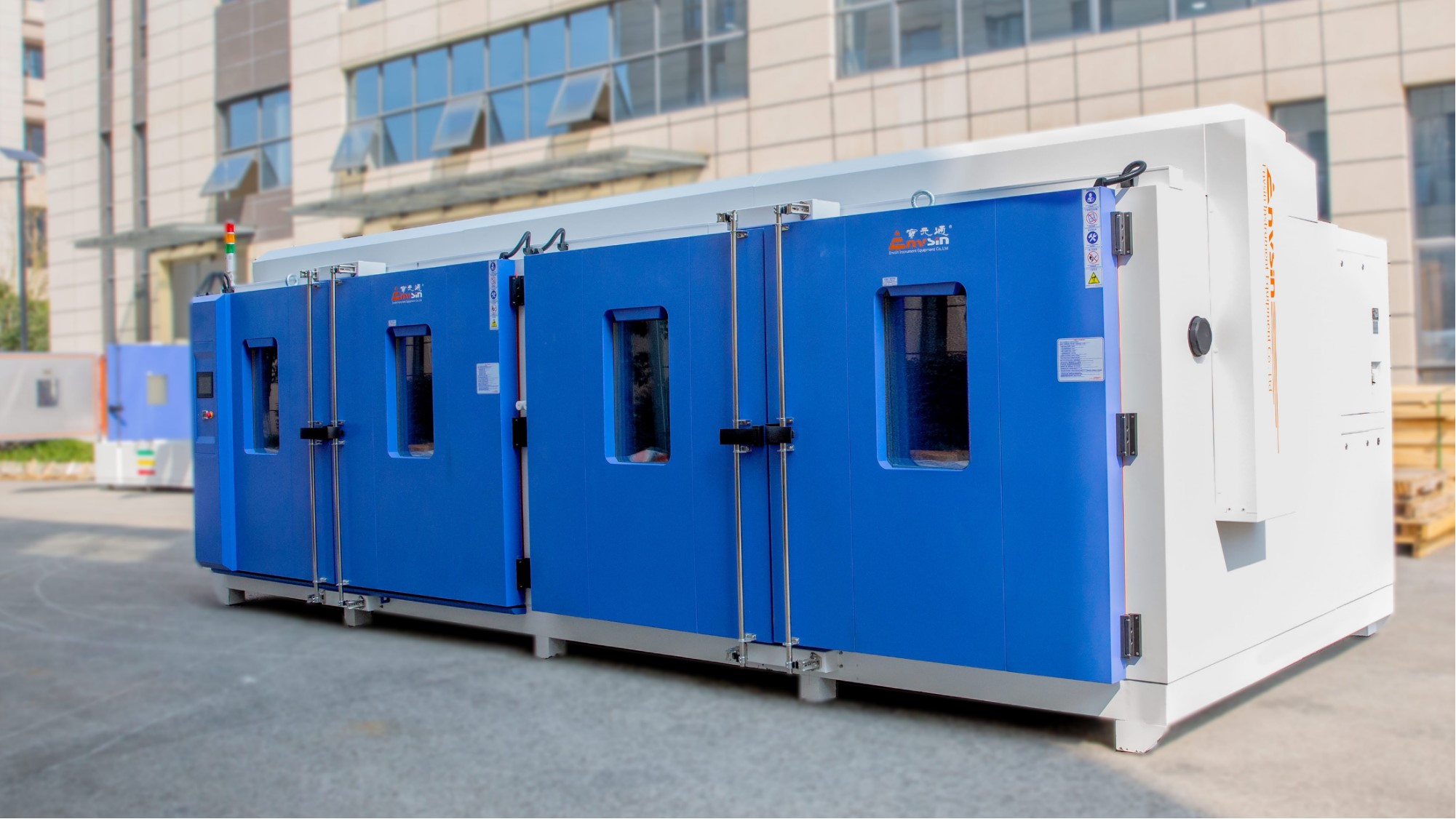
Manufacturing and pre-shipment testing take place in-house before every thermal shock chamber is released.
Next step
Send your test article, target shock range, governing standard, and available supply voltage, and the team can confirm which of the five platforms fits — or whether a custom configuration is required, since OEM, ODM, and custom manufacturing are available from a single unit.
Download the product brochure (PDF) | Request a quotation via WhatsApp | info@envsin.com