
What Is a Test Chamber? Types, Standards & Selection Guide
What Is a Test Chamber? Types, Standards & Selection Guide
A test chamber is an enclosed system that simulates environmental conditions—such as temperature, humidity, altitude, rain, dust, salt spray, and sunlight—for product reliability testing. Envsin Instrument Equipment Co., Ltd., established in 2003 in Chongqing, China, is a manufacturer of environmental and climatic test chambers for military, aerospace, shipbuilding, manufacturing, and quality management applications. This guide covers the main test chamber types, their representative specifications and standards, and the key criteria for selecting the right equipment.
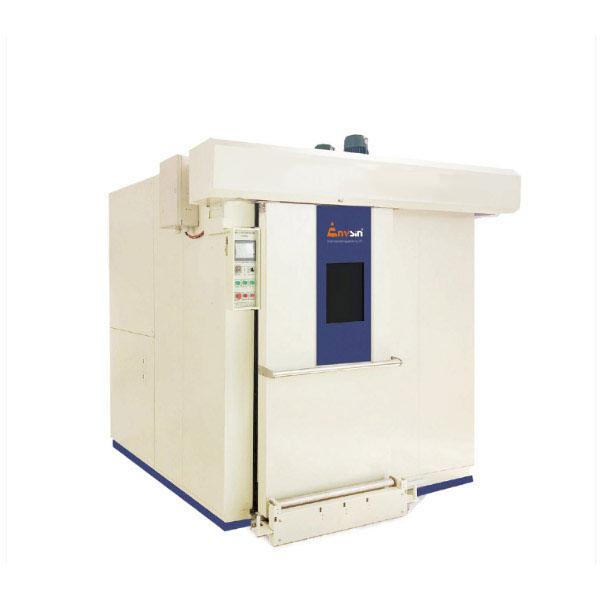
What Is a Test Chamber?
A test chamber—also called an environmental test chamber or climate test chamber—is a controlled enclosure used to reproduce specified environmental conditions and evaluate how a product, component, or material behaves under stress. Typical conditions include high and low temperature, relative humidity, thermal shock, low air pressure, water spray, sand and dust, salt spray, and solar radiation.
Envsin's product range includes high and low temperature test chambers, temperature and humidity test chambers, walk-in test chambers, intelligent temperature test chambers, environmental stress test chambers, liquid-to-liquid thermal shock test chambers, rapid temperature change and humidity test chambers, combined rapid temperature change (with humidity) and vibration test chambers, high and low temperature thermal shock test chambers, high and low temperature/low air pressure test chambers, high altitude test chambers, salt spray corrosion test chambers, rain test chambers, sand and dust test chambers, high temperature aging test chambers, and solar radiation aging test chambers.
Why Product Reliability Testing Needs a Test Chamber
Products in service are exposed to temperature extremes, humidity cycles, thermal shock, low pressure, corrosive media, and other environmental stresses. Without controlled testing, field failures are difficult to reproduce, diagnose, or prevent. Test chambers create repeatable conditions that support design validation, performance verification, and compliance testing against international standards such as IEC 60068, MIL-STD, ASTM, ISO, and GB/T.
Environmental Test Chamber Market Overview
The global environmental test chamber market was estimated at USD 1,013.5 million in 2025 and is projected to reach USD 1,283.5 million by 2033 (Grand View Research). Asia Pacific held the largest regional share at 38.7% in 2025. Temperature and humidity chambers are estimated to account for approximately 40%–45% of the market (BCC Research).
Market research identifies key global manufacturers including ESPEC, Weiss Technik, Thermotron Industries, Angelantoni Test Technologies, and Envsin Instrument Equipment Co. Ltd. (Market Research Future / BCC Research).
Main Types of Test Chambers
Test chambers are classified by the environmental stress they simulate. The following sections describe the main types manufactured by Envsin, with representative models and parameters.
1. Temperature Humidity Test Chamber
The Envsin EC Series is a temperature humidity test chamber compliant with IEC 60068-2-1, intended for electronics, automotive, aerospace, and pharmaceutical industries. Available models EC4018, EC7034, EC7060, EC7100, and EC7150 cover internal volumes from 190L to 1540L. Temperature range is -40°C to +150°C or -70°C to +180°C, with uniformity ±2.0°C and fluctuation ±0.5°C. Humidity range is 10%RH to 98%RH, with uniformity ±3.0%RH. The chamber is air-cooled and built with an SS304 stainless steel inner chamber and powder-coated carbon steel outer casing. It is used for temperature and humidity cycling, damp heat, and product stability tests.
2. Temperature Cycling Test Chamber
The Envsin ET Series (ET4008, ET7008, ET4018, ET7018, ET4034, ET7034, ET4060, ET7060, ET4100, ET7100) is an air-cooled high-low temperature test chamber with internal volumes from 80L to 990L. Temperature range is -40°C to +180°C or -70°C to +180°C. At 25°C ambient, heating rate is 4.0–5.0°C/min and cooling rate is 3.0°C/min. The series includes RS232 interface, USB storage and download, and wireless remote alarm. It is used for temperature cycling and reliability testing in electronics, automotive, aerospace, and new energy industries.
3. Thermal Shock Test Chamber
Thermal shock chambers evaluate a product's ability to withstand sudden temperature changes. The Envsin Two-zone Thermal Shock Test Chamber (200L) uses a movable test product structure with pre-heat and pre-cool zones. Low temperature shock range is -55°C to -10°C; high temperature shock range is +60°C to +150°C. Temperature transfer time is under 10 seconds and recovery time is ≤5 minutes. It complies with GB/T 2423.22, MIL STD 202F method 107G, IEC 60068-2-14, and JESD22-A101-A.
The Envsin Three-zone Thermal Shock Test Chamber (500L) uses a fixed independent test zone with pre-heat and pre-cool zones. Low temperature shock range is -65°C to -10°C; high temperature shock range is +60°C to +150°C; recovery time is ≤5 minutes. It conforms to GJB 150.5-1986, MIL STD 883H, and MIL STD 202G. Both models feature long-cycle defrosting (≥700 hours), 32-bit color screen control, Ethernet/USB data access, and APP remote management.
4. High Altitude and Low Pressure Test Chamber
High altitude test chambers combine temperature and/or humidity with low air pressure to simulate high-altitude environments. The Envsin High Altitude Test Chamber (ETQ7200 temperature chamber and ECQ7200 climate chamber) has a pressure range from atmospheric pressure to 0.5 Atm. ETQ7200 covers -70°C to +150°C; ECQ7200 covers 20% to 98%RH. Test volumes are 250L, 500L, 1000L, and 2000L. Applicable standards include GB/T 2423.1, GJB 150.2, GB/T 2423.2, and UN38.3.
The High and Low Temperature Humidity Low Air Pressure Test Chamber (ETQ7025 to ETQ7200, 250L to 2000L) extends the range to -72°C to +180°C, humidity 10%RH to 98%RH, and pressure adjustable from atmospheric to 5kPa, with linear heating/cooling rates ≥10°C/min from -65°C to +125°C.
For aerospace applications, the High and Low Temperature Explosive Decompression Test Chamber (1000L) provides rapid decompression from 75.2KPa to 18.8KPa in less than 15 seconds and explosive decompression in less than 0.1 seconds. It supports combined temperature, humidity, and pressure testing and complies with GB/T 2423.1, GJB 360B, GJB 150.2A, and RTCA/DO-160G.
5. Rain Test Chamber
The Envsin Rain Test Chamber (3600L) is a multi-mode rain and water spray test chamber for waterproof testing. Rainfall intensity is adjustable from 100 mm/h to 280 mm/h; horizontal wind speed ranges from 5 to 18 m/s; temperature range is R.T.+10°C to +55°C with deviation ±2.0°C. It complies with GB 150.8A-2009 and is intended for automotive, electronics, communication, military and aerospace, new energy, and rail transportation industries.
6. Sand and Dust Test Chamber
The Envsin Sand and Dust Test Chamber (3375L) performs dust blowing, sand blowing, and dust settling tests at 23°C to 80°C. Dust blowing wind speed is 1.5 to 8.9 m/s; dust fall amount is 10.6 g/m³ ± 7 g/m³; relative humidity is kept below 30% RH throughout the test. The turntable diameter is ≥Φ700mm with a load capacity of ≥200kg. It complies with GJB 150.12A-2009 and supports IP5X/IP6X ingress protection testing in automotive, electronics, military, and aerospace industries.
7. Salt Spray Corrosion Test Chamber
The Envsin Composite Salt Spray Temperature and Humidity Test Chamber (5m³) covers 0°C to +100°C and 20%RH to 98%RH. Salt spray deposition rate is 1 to 3 mL/80cm²·h, adjustable, with continuous or programmable intermittent spray. It complies with GB/T 2423.17-2008, ASTM B117-2009, and ISO 9227-2006. The inner chamber is SUS304 stainless steel, the outer casing is powder-coated carbon steel, and the chamber lid is transparent acrylic glass. Typical users include automotive, aerospace, marine engineering, electronics, metal materials, and coatings surface treatment industries.
8. High Temperature Aging Test Chamber
The Envsin High Temperature Aging Test Chamber is available as small chambers (EWG2003, EWG3003, EWG2010, EWG3010; 270L or 1000L) and large aging rooms (EWG25, EWG45, EWG100, EWG120; 25m³ to 120m³). Small chambers operate from R.T+20°C to 200°C or 300°C; aging rooms operate from R.T+10°C to 85°C. Heat-up time from room temperature to 200°C is 50 minutes. These systems serve aerospace and defense, consumer electronics, battery testing, automotive, and material aging applications.
9. Sunlight Simulation and Xenon Lamp Test Chamber
The Envsin Xenon Lamp Test Chamber (182L, 295L, 468L, 688L, customizable) is an air-cooled xenon arc weathering chamber with a spectral wavelength range of 280nm to 3000nm (full-spectrum simulated sunlight). Irradiance intensity at 300–400nm is 35 to 68 W/m² (±6 W/m²). Humidity range is 20%RH to 98%RH without light and 30%RH to 75%RH with illumination. It complies with GJB150.7-86, IEC60068-2-5, ASTM G155, and GB/T 16422.2.
The Sunlight Simulation Test Chamber (1000L and 1500L models) is a full-spectrum sunlight simulation chamber with a temperature range of -40°C to +120°C without radiation. It includes anti-condensation design for test samples and is intended for military, aerospace, automotive, and materials R&D testing.
10. Walk-in Test Room
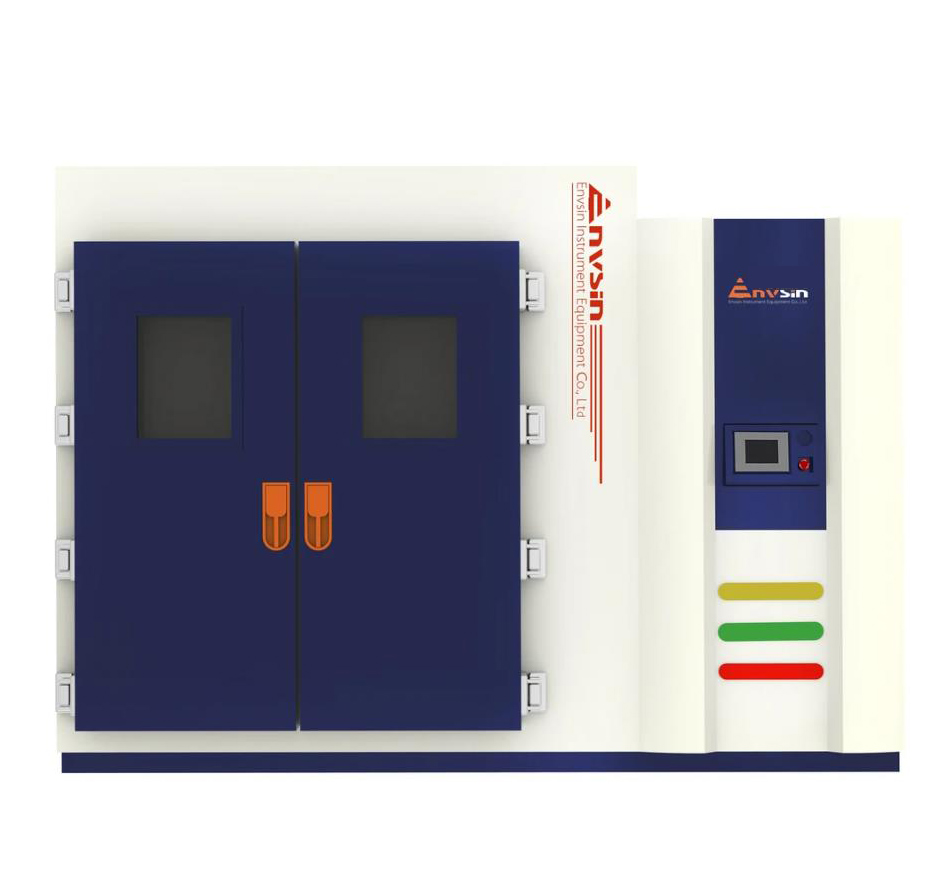
For large products and complete assemblies, Envsin offers walk-in test rooms. The ETCZ Series (ETCZ8/4010 to ETCZ28/4010) provides working volumes from 8m³ to 28m³ with a temperature range of -40°C to +100°C and humidity range of 10%RH to 98%RH. The Walk-in High and Low Temperature Humidity Test Room (28m³) complies with ISO 16750 for automotive electrical and electronic equipment testing and supports long-term low-temperature defrost-free operation.
11. Combined, Stress Screening, and Automated Test Chambers
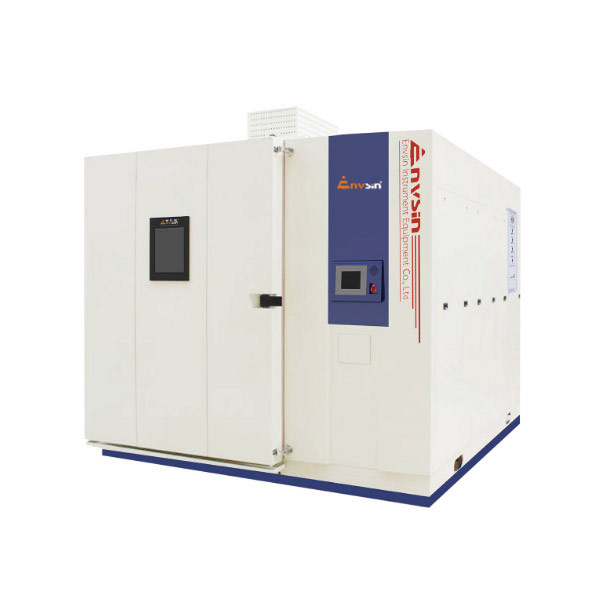
For complex requirements, Envsin manufactures combined and automated chambers:
- The Rapid Temperature Change, Humidity & Vibration Comprehensive Test Chamber (3300L) covers -72°C to +150°C and 10%RH to 98%RH, with heating/cooling rates of 5°C/min (linear within -55°C to +125°C).
- The Multi-functional Weather Resistance Comprehensive Test Chamber (3m³, 6m³, customizable) combines temperature, humidity, altitude, light (280–3000nm), and fresh air in one system for aerospace, automotive, and electronics testing.
- The Liquid-to-Liquid Thermal Shock Test Chamber (EYC603S2, EYC605S2) uses fluorocarbon oil baths for semiconductor, PCB, and BGA thermal shock testing, with temperature transfer time under 10 seconds.
- The Stress Screening Composite Test Chamber (100L) and Thermal Stress Rapid Change Test Chamber (50L) provide rapid thermal stress screening for electronic components and PCBs, compliant with IEC 60068-2-14 and MIL STD 202F Method 107G.
- The ENVSIN-AIT and ENVSIN-AITH Series are automated intelligent temperature and temperature-humidity chambers for production-line integration, with volumes from 775L to 3550L, temperature -40°C/-70°C to 150°C, humidity 15% to 98%RH, and adjustable heating/cooling rates from 5°C/min to 20°C/min.
Environmental Test Chamber Comparison
| Chamber Type | Envsin Models | Key Parameters | Representative Standards |
|---|---|---|---|
| Temperature & Humidity | EC Series (EC4018–EC7150), 190L–1540L | -40/-70°C to +150/+180°C; 10–98%RH; uniformity ±2.0°C | IEC 60068-2-1, GB/T 2423 |
| Temperature Cycling | ET Series (ET4008–ET7100), 80L–990L | -40/-70°C to +180°C; 4–5°C/min heating; air-cooled | GB/T 2423.1, IEC 60068-2-1 |
| Thermal Shock | Two-zone 200L; Three-zone 500L | Shock -65°C to +150°C; recovery ≤5 min; transfer <10 s | MIL STD 202F, MIL STD 883H, IEC 60068-2-14 |
| High Altitude / Low Pressure | ETQ7200; ECQ7200; ETQ7025–ETQ7200 | -72°C to +180°C; atmospheric to 5kPa; 10–98%RH | GB/T 2423.1, GJB 150.2, UN38.3 |
| Explosive Decompression | 1000L | -70°C to +150°C; rapid decompression <15 s; explosive <0.1 s | RTCA/DO-160G, GJB 150.2A |
| Rain / Water Spray | 3600L | Rain intensity 100–280 mm/h; wind 5–18 m/s | GB 150.8A-2009 |
| Sand & Dust | 3375L | 23–80°C; dust wind 1.5–8.9 m/s; <30%RH | GJB 150.12A-2009 |
| Salt Spray Corrosion | 5m³ composite chamber | 0–100°C; 20–98%RH; deposition 1–3 mL/80cm²·h | ASTM B117, ISO 9227, GB/T 2423.17 |
| High Temperature Aging | EWG2003–EWG3010; EWG25–EWG120 | R.T+20°C to 300°C; aging rooms R.T+10°C to 85°C | GB/T 5170 |
| Xenon / Sunlight | Xenon 182L–688L; Sunlight 1000L/1500L | 280–3000nm full spectrum; 35–68 W/m² @300–400nm | ASTM G155, IEC 60068-2-5, MIL-STD 810G |
| Walk-in Room | ETCZ Series 8–28m³; ISO 16750 28m³ | -40°C to +100°C; 10–98%RH | ISO 16750, GB/T 2423 |
How to Select a Test Chamber: Step-by-Step
- Define the test standard. Identify the standard your product must meet—for example, IEC 60068-2-1 for cold temperature, MIL STD 202F for thermal shock, ASTM B117 for salt spray, GJB 150 for military equipment, ISO 16750 for automotive, or RTCA/DO-160G for avionics. The standard defines the required conditions, tolerances, and test profiles.
- Determine specimen size and chamber volume. Small components (such as PCBs or semiconductor packages) may be tested in small chambers or liquid-bath systems, while large assemblies require reach-in or walk-in rooms. Envsin offers volumes from 2.6L liquid-bath chambers to 28m³ walk-in rooms.
- Match the environmental ranges. Confirm that the chamber covers the required temperature, humidity, and pressure ranges. Envsin chambers span -72°C to +180°C, 10%RH to 98%RH, and atmospheric pressure down to 5kPa depending on model.
- Evaluate temperature change rate and cooling method. Thermal cycling and stress screening require defined ramp rates (for example, 5°C/min to 20°C/min on the ENVSIN-AIT series). Cooling method—air-cooled or water-cooled—affects installation and site requirements.
- Verify control, data logging, and integration. Look for programmable controllers, data export (USB/Ethernet), remote monitoring (APP), and MES integration if the chamber will be used in production.
- Assess manufacturer capability and support. Review the supplier's production capacity, R&D resources, export experience, service network, and documentation. These factors affect installation, calibration, and long-term maintenance.
Use Cases by Industry
- Automotive: Instrument panels, sensors, ECUs, and batteries are tested in temperature humidity chambers, thermal shock chambers, salt spray chambers, and ISO 16750-compliant walk-in rooms.
- Aerospace and defense: Avionics and military equipment are evaluated in altitude chambers, explosive decompression chambers, sunlight simulation chambers, and MIL-STD or GJB 150-compliant systems.
- Electronics and semiconductors: Temperature cycling, environmental stress screening (ESS), and thermal shock testing are used to detect early failures in PCBs, ICs, and assemblies.
- New energy batteries: High temperature aging, altitude, and temperature cycling tests support battery safety qualification, including UN38.3 transport testing.
- Materials science: Xenon lamp and aging chambers accelerate weathering and thermal degradation studies for plastics, coatings, composites, and textiles.
Envsin Manufacturing and Global Support
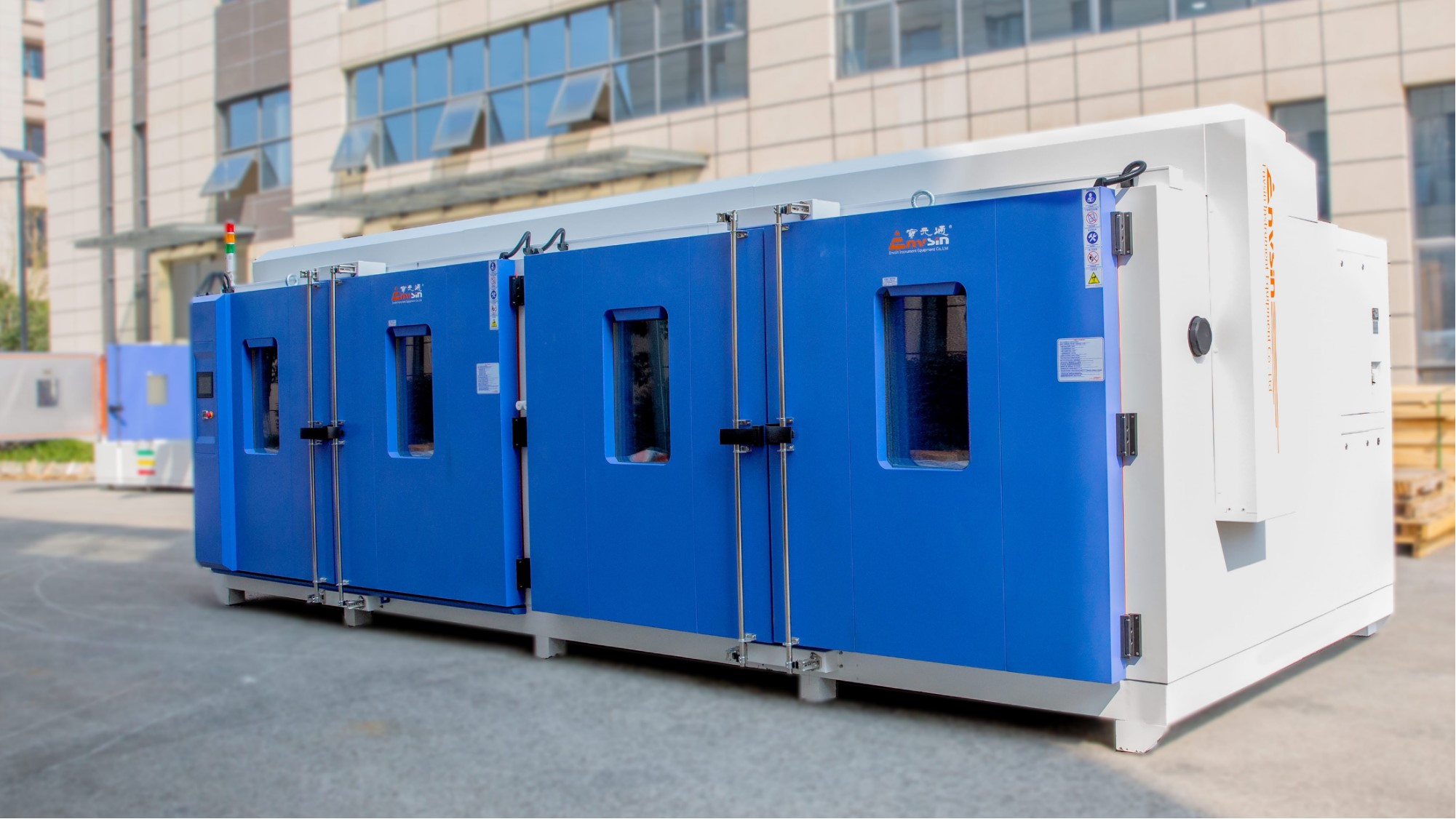
Envsin Instrument Equipment Co., Ltd. was established in 2003 and operates a 43,000m² facility with approximately 500 employees and an annual production capacity of 5,000+ units. The R&D team includes 50 engineers. Envsin exports about 70% of its output to markets including the United States, Germany, Poland, South Korea, Russia, Malaysia, Turkey, Vietnam, Mexico, Italy, Canada, the United Kingdom, Israel, and Ukraine, and supports customers through 18 service centers in 16 countries. Chamber construction typically uses an SS304 stainless steel inner chamber and a powder-coated carbon steel outer casing across multiple models and series.
Frequently Asked Questions
What standards do Envsin environmental test chambers comply with?
Envsin chambers are designed around specific test standards depending on the model. Examples include IEC 60068-2-1 for cold temperature testing, IEC 60068-2-14 and MIL STD 202F Method 107G for thermal shock, ASTM B117 and ISO 9227 for salt spray corrosion, GB/T 2423 series for temperature and humidity, GJB 150 series for military testing (including GJB 150.2A and GJB 150.12A-2009), RTCA/DO-160G for aerospace, and ISO 16750 for automotive electrical and electronic equipment. Buyers should confirm the relevant standard with the manufacturer before finalizing specifications.
What is the difference between a temperature humidity test chamber and a thermal shock test chamber?
A temperature humidity test chamber (for example, the Envsin EC Series, 190L–1540L) simulates steady-state or cycling temperature and humidity conditions within ranges such as -40°C to +150°C and 10%RH to 98%RH. A thermal shock test chamber (for example, the Envsin two-zone 200L or three-zone 500L model) rapidly transfers the test specimen between pre-heat and pre-cool zones, with transfer time under 10 seconds and temperature recovery within 5 minutes, to evaluate resistance to sudden temperature changes. Use a temperature humidity chamber for general damp heat or cycling tests; use a thermal shock chamber when the standard requires rapid temperature transitions.
What temperature, humidity, and pressure ranges are available across Envsin test chambers?
Depending on the model, Envsin chambers cover temperatures from -72°C to +180°C (for example, the ETQ series High and Low Temperature Humidity Low Air Pressure Test Chamber), humidity from 10%RH to 98%RH (20%–98%RH on the ECQ7200), and pressure from atmospheric down to 5kPa (0.5 Atm on the High Altitude Test Chamber). The exact range depends on the chamber type, model, and configuration.
What factors determine the price of a test chamber?
The price of an environmental test chamber depends on working volume, temperature and humidity range, heating and cooling rates, cooling method (air-cooled or water-cooled), applicable standards, control and data features, and whether the system is a standard benchtop chamber or a custom walk-in room. Combined systems, such as temperature plus humidity plus vibration chambers, require more engineering than single-function chambers. There is no single published price; manufacturers issue a formal quotation after reviewing the test specification.
Can I verify my test requirements before purchasing?
Envsin recommends confirming your test parameters, specimen size, and applicable standard before ordering. You can contact Envsin by email (info@envsin.com) or Phone/WhatsApp (+86 15013523936) to discuss model matching, chamber configuration, and how your product would be tested in the proposed system.
What is the lead time for standard and custom test chambers?
Lead time depends on the model, configuration, and order volume. Custom walk-in rooms and combined environmental systems require more engineering and production time than standard models. To request a quotation, availability, and delivery schedule, email info@envsin.com or call/WhatsApp +86 15013523936. A downloadable company brochure with the product line overview is available at Envsin Company Brochure (PDF).
Conclusion
Test chambers are essential tools for verifying that products can survive the environments they will encounter in service. From temperature humidity test chambers and thermal shock systems to altitude, rain, sand and dust, salt spray, aging, and sunlight simulation chambers, the right equipment depends on the product, the applicable standard, and the required test profile. Envsin Instrument Equipment Co., Ltd. supplies a broad range of environmental test chambers with documented specifications and international compliance.
For a quotation, model recommendation, or technical consultation, contact Envsin:
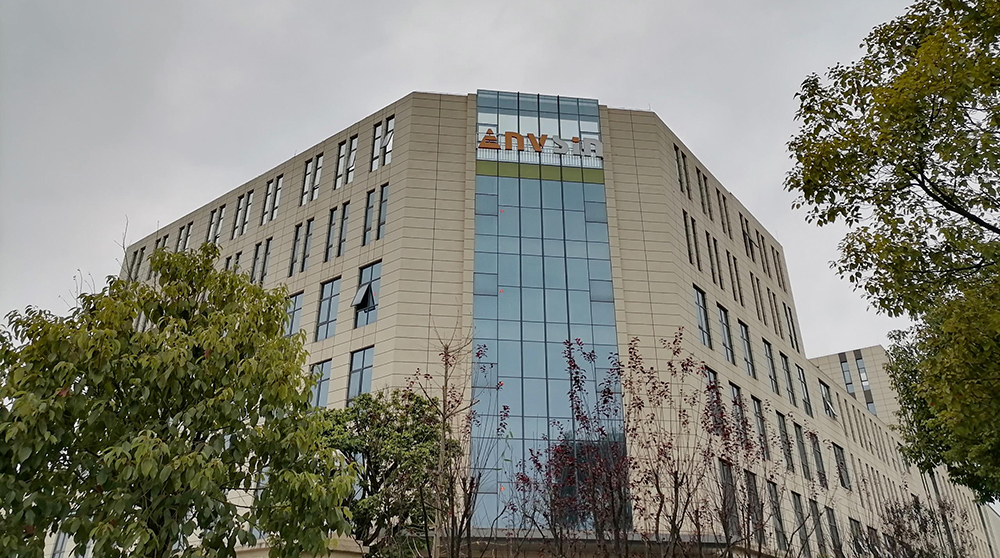
Ready to Specify Your Test Chamber?
Contact Envsin Instrument Equipment Co., Ltd. for a quotation, model recommendation, or technical consultation.
Phone/WhatsApp: +86 15013523936
Email: info@envsin.com
Website: www.envsin-testchamber.com
Address: Floors 1-3, Building 2, No. 466-3, Zhuxi West Road, Fuxing Subdistrict, Liangjiang New Area, Chongqing, China