
QSK60 Genset vs Mining Truck Parts: A Configuration Comparison for Buyers
Two QSK60 engines can carry the same model name and share almost nothing else. A QSK60 built for generator-set duty delivers primary power in the region of 1,700 to 2,000 kW at 1,500 rpm. A QSK60 working in a mining or construction application operates in the 2,000 to 2,700 HP band, under cyclic load, dust and vibration. Between those two duty profiles sit the variables that decide whether a spare part is right or wrong: the emission variant (Tier 1, Tier 2, EU Stage IIIA, or Tier 4 Final with SCR), the fuel-system version (HPI or MCRS), turbocharger matching parameters, and injector characteristics. This guide gives buyers a checkpoint-by-checkpoint way to compare the two configurations before sourcing diesel engine parts for either one.
Why One QSK60 Part List Rarely Covers Both Applications
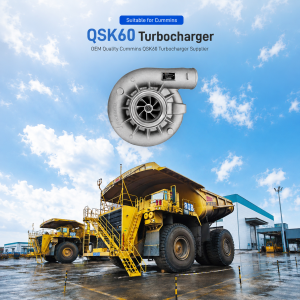
The QSK60 is a single engine family used across generator sets, mining haul trucks, construction machinery and marine installations. That breadth is exactly what makes parts sourcing risky. A crankshaft, cylinder head, injector, injection pump or turbocharger listed simply as "for QSK60" answers a model question but not a configuration question.
In practice, three failure patterns account for most mismatched orders.
Pattern one: model-name sourcing. The buyer matches on the engine model but never confirms the build. Emission variant, fuel system and turbo match are left unverified, and the part arrives for a different configuration of the same engine.
Pattern two: ignored emission variant. A Tier 1, Tier 2 or EU Stage IIIA build and a Tier 4 Final build with SCR are not the same parts environment. Aftertreatment content, sensor content and the surrounding hardware differ, so a part confirmed for one variant cannot be assumed correct for another.
Pattern three: fuel-system version drift. QSK60 engines exist in both HPI and MCRS fuel-system versions. Injectors, injection pumps and the related control hardware belong to a specific version. A part confirmed for an HPI engine should never be assumed to fit an MCRS engine.
The requirement stated plainly. For large units such as the QSK60, buyers should confirm interface compatibility, injector characteristics and turbo matching parameters before ordering. F-DIESEL Power Co.,Ltd applies that requirement as a standard step in QSK60 quotations, and on-site customization requests can be reviewed where the configuration is documented.
The consequence is straightforward: the useful unit of comparison is not the engine model, it is the configuration — application, rating, emission variant, fuel-system version, turbo match and interface. Everything in this article is organised around that unit.
Industry Background: Why QSK60 Configurations Diverge
Demand for heavy duty diesel engine parts is driven by the installed base, not by new-engine sales alone. Every engine in service creates a long replacement cycle for injectors, pumps, turbochargers, cylinder heads, cylinder blocks, pistons, piston rings, crankshafts, camshafts and connecting rods. Because the QSK60 base spans power generation, mining, construction and marine duty, the same platform generates several parallel parts streams.
The overall market context supports that reading. Fortune Business Insights valued the global diesel engine market at USD 70.99 billion in 2025 and projected a CAGR of 5.40% over 2026 to 2034. Within that total, Global Market Insights valued the global diesel common rail injection system market at USD 22.6 billion in 2024 — a reminder that fuel-injection content is a substantial share of the component value in modern diesel builds.
Regulation pushes configuration divergence further. The U.S. EPA 2027 heavy-duty engine standards include a nitrogen oxide (NOx) limit of 0.035 grams per brake horsepower-hour; that standard is listed as forthcoming. As emission limits tighten, fuel-system architecture and aftertreatment content change, and parts that belong to one emission generation stop being interchangeable with the next. For a buyer, the emission label on the engine is therefore a sourcing parameter, not a compliance formality.
Two standards and classification references help normalise the conversation. ISO 7876-5:2021 establishes the vocabulary for common rail fuel-injection systems on diesel compression-ignition engines and their components; the ISO diesel-engine standards catalogue also lists ISO 2697:1999 for fuel nozzles, ISO 2698:2016 for clamp-mounted fuel injectors and ISO 2699:1994 for flange-mounted fuel injectors. These are terminology and catalogue references — they support a comparable RFQ, not a supplier ranking. On the trade side, HS 840999 is identified as parts for diesel and semi-diesel engines in the World Bank WITS interface, though injection parts and turbocharger parts may sit under separate or national tariff lines, so customs classification should be validated line by line.
F-DIESEL Power Co.,Ltd is an industry-trade integrated supplier of diesel engine spare parts, established in Shenzhen in 1999, with a branch office in Shanghai, an overseas business hub in Hofheim, Germany and service stations in multiple countries. Its product scope covers crankshafts, turbochargers, cylinder heads, cylinder blocks, pistons and piston rings, connecting rods, camshafts, injectors, injection pumps, fuel injection systems, fuel actuators and turbo electronic actuators, with particular emphasis on the QSK60 injector and QSK60 turbocharger. The company operates under ISO 9001:2015 certification (certificate 01 100 116628, issued by TÜV Rheinland Cert GmbH, valid from 2023-11-14 to 2027-01-31), with a scope covering the sale of engine and spare parts for automotive, generating set, marine and construction applications.
The Six Configuration Checkpoints
Comparing a genset QSK60 with a mining-truck QSK60 comes down to six checkpoints. Each one produces a data point the buyer should hold before a quotation is issued.
Checkpoint 1 — Application and Power Rating
Start with the duty profile. QSK60-G generator-set configurations are quoted in the region of 1,700 to 2,000 kW primary power at 1,500 rpm. QSK60 engines in mining and construction service sit in the 2,000 to 2,700 HP band. The two figures are not interchangeable units and should not be matched to each other: kW describes generator-set output at a governed speed, while HP describes engine output in a mobile machine. A buyer comparing quotations should confirm the rating basis in writing, and confirm the rating at the actual operating speed rather than borrowing a figure from a different market's 50 Hz or 60 Hz build.
Checkpoint 2 — Emission Variant
Emission configuration is the second filter. QSK60 builds exist across Tier 1, Tier 2, EU Stage IIIA and Tier 4 Final with SCR. Tier 4 Final introduces SCR aftertreatment into the installation, which changes the surrounding hardware and sensor content compared with earlier tiers. Before ordering, capture the emission label and engine serial number rather than inferring the tier from the power rating — a 2,000 HP mining engine and a 2,000 kW genset engine can sit in entirely different emission generations.
Checkpoint 3 — Fuel-System Version: HPI or MCRS
HPI and MCRS are different fuel-system architectures, and the parts that belong to each are version-specific. Injectors, injection pumps and related control components must be confirmed against the fuel system actually fitted to the engine, not against a catalogue description. A part confirmed for an HPI build should not be assumed to fit an MCRS build of the same model. This single checkpoint prevents a large share of returned diesel fuel injection parts, and it is why a part number or clear nameplate capture matters more than a photograph of the engine.
Checkpoint 4 — Turbocharger Matching Parameters
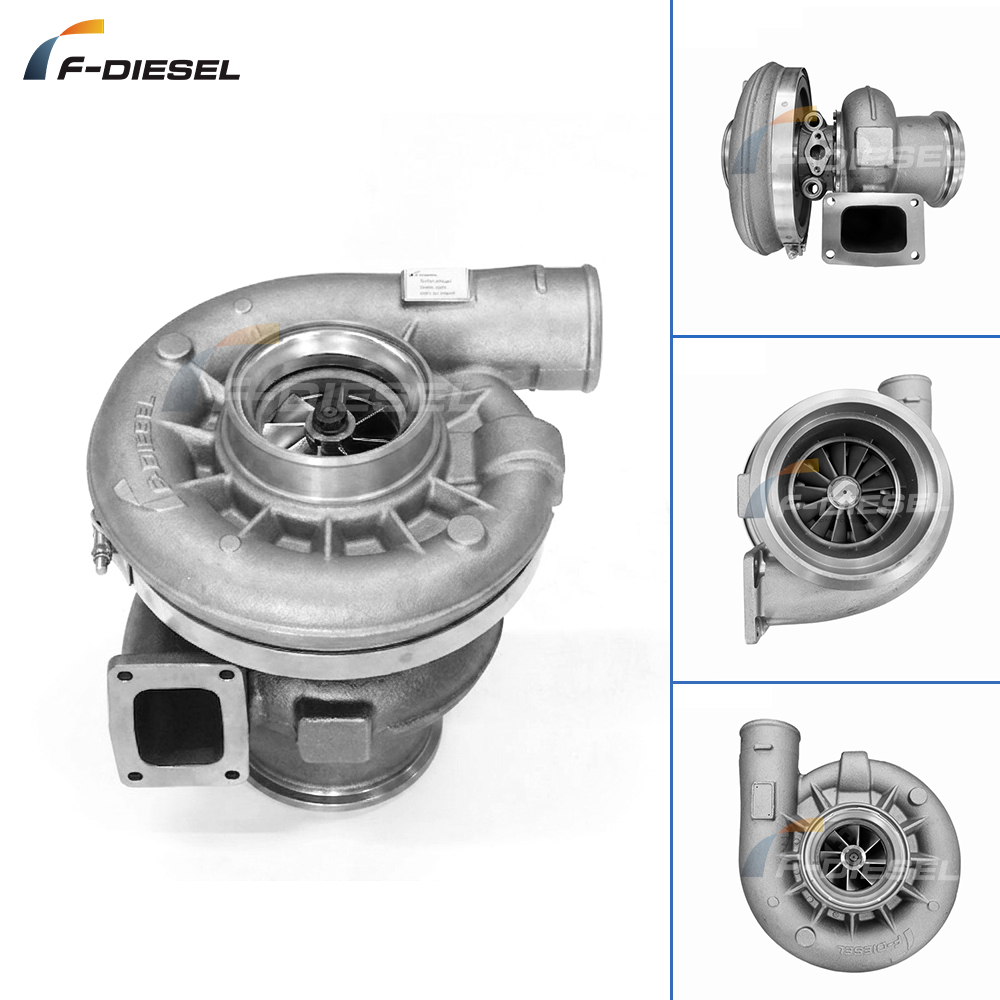
Turbocharger selection is matched to the rating and emission configuration of the engine. In the F-DIESEL QSK60 programme, turbochargers are built to OE specifications and are directly compatible with the HOLSET HX82, HX83 and HX84 families across the QSK60 engine series. Buyers should still confirm the turbo model and the matching parameters for their specific build before ordering turbocharger parts for diesel engine applications, because a turbo matched to a 1,500 rpm genset duty cycle is not automatically the correct match for a cyclic-load haul-truck engine.
Checkpoint 5 — Injector Characteristics
Injectors are the component most sensitive to configuration drift. Injector characteristics must be confirmed against the fuel-system version and the emission variant, and the confirmed part number should travel with the order. Because injectors sit at the centre of both combustion and emissions behaviour, they are also the component where the gap between a correct and an approximate match shows up fastest in service.
Checkpoint 6 — Interface Compatibility and Documentation
Interface compatibility covers installation dimensions, mounting points, inlet and outlet geometry, harness and sensor connections, and the physical fit of the part on the engine. A dimension check before ordering avoids assembly mismatch on site, which is far more expensive than a data check at the quotation stage. Documentation — OEM drawing reference, tolerance standard, material specification, surface treatment, hardness, weight and test records — belongs in the same package.
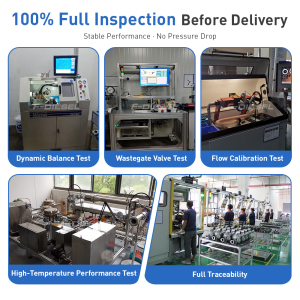
On the supply side, the relevant assurance is that QSK60 parts are manufactured to OEM drawings and standards and verified by 8,000-hour endurance testing. F-DIESEL production covers OEM, OES, aftermarket and remanufactured modes: OEM production is carried out strictly per customer drawings, specifications and quality standards, supporting new original equipment matching; OES custom spare parts are produced to match original service parts and factory packaging requirements. Quality control is 100% test, monthly capacity is 10,000 units, and the company's EAC certification (EAЭС KG417/039.CN.02.05557, valid to 2029-08-22 under TR CU 018/2011) supports access to the EAEU markets.
Step-by-Step: How Buyers Verify a QSK60 Configuration
The following sequence converts the six checkpoints into an order-ready file. It is written for the Evaluation-to-Execution stage, where the buyer has already selected a supplier and now needs a part that fits.
- Capture the nameplate. Record the engine model, serial number, emission label and rated power with speed. Photograph the plate rather than transcribing it by hand.
- Confirm the application and rating basis. State whether the engine is a generator-set unit rated in kW at 1,500 rpm or a mining/construction unit rated in the 2,000 to 2,700 HP band. Confirm the rating at the actual operating speed.
- Confirm the emission variant. Identify Tier 1, Tier 2, EU Stage IIIA or Tier 4 Final with SCR, and note whether SCR aftertreatment is part of the installation.
- Identify the fuel-system version. Confirm HPI or MCRS and record the injector and injection pump part numbers already on the engine.
- Confirm the turbo match. Record the turbo model and matching parameters, and check compatibility with the HOLSET HX82, HX83 or HX84 family where applicable.
- Check interface compatibility. Verify installation dimensions, mounting, inlet and outlet geometry and harness connections against the drawing before release.
- Agree acceptance criteria and documentation. Confirm the delivery checklist, visual inspection and functional testing basis in writing, together with test records and packaging requirements.
What to submit with an RFQ. A quotation can only be configuration-accurate when the request carries part number or nameplate information. F-DIESEL advises buyers to provide the part number or a clear capture of the product nameplate; model name alone is not sufficient for large units such as the QSK60.
On commercial terms, quotations are built from part number, engine model, material specification, working temperature, pressure rating, size and installation dimension, serial number, OEM drawing reference, tolerance standard, surface treatment, hardness, weight, test records, certifications, packaging, MOQ, lead time, payment terms and warranty. Delivery can be arranged by sea freight, air freight or courier depending on product volume and destination, and payment terms include T/T and L/C.
Use Cases: Where Each Configuration Actually Runs
Generator-set duty. A QSK60-G unit runs at governed speed for long continuous hours, supplying primary power in the region of 1,700 to 2,000 kW at 1,500 rpm. The parts profile here rewards stability: injectors and pumps that hold their characteristics over long steady running, and a turbo match that suits a fixed operating point. Buyers specifying diesel generator engine parts should prioritise consistency across the batch, because a genset is usually one of several identical units on the same site.
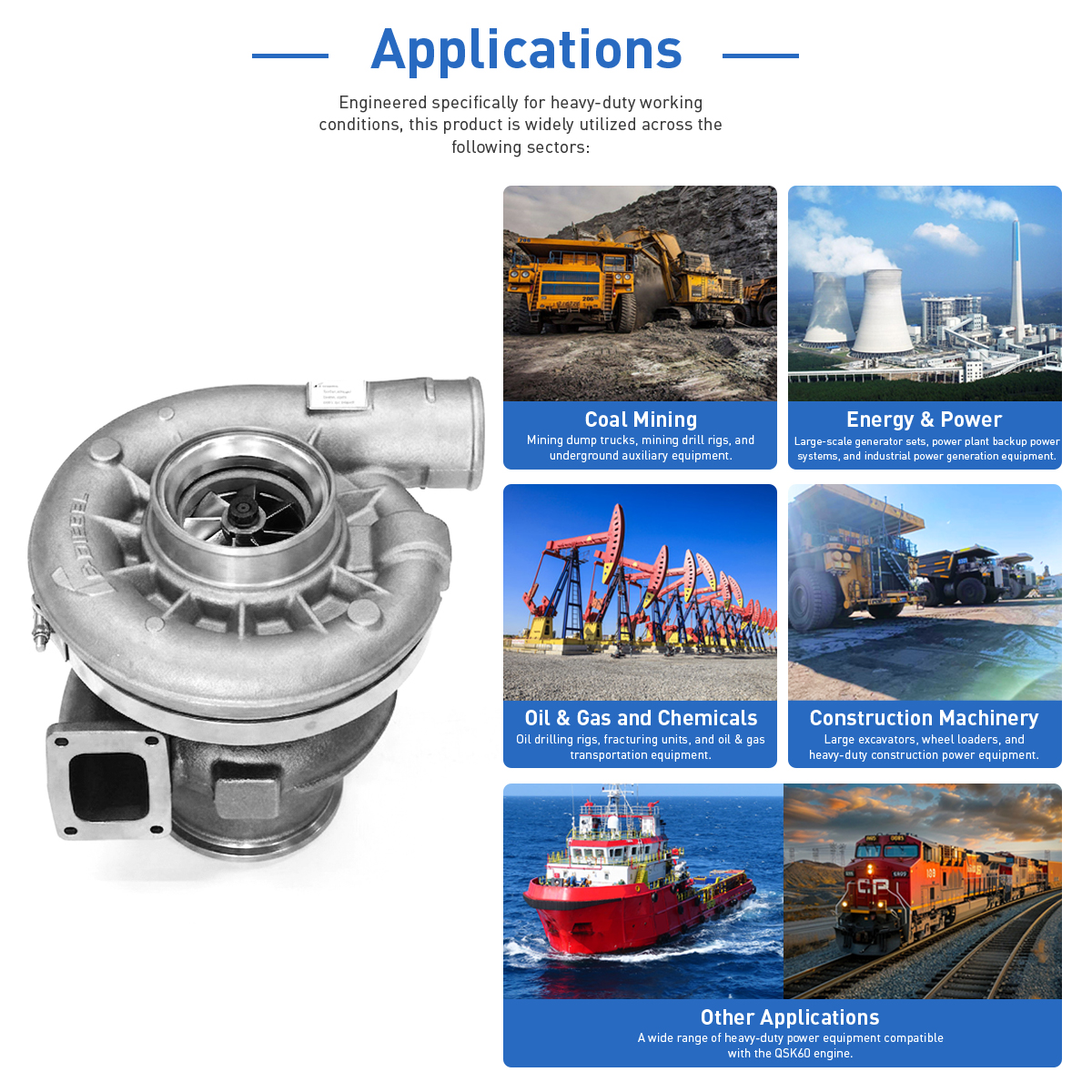
Mining haul-truck duty. A QSK60 in the 2,000 to 2,700 HP band works under cyclic load in dust, heat and vibration. In F-DIESEL's field experience, QSK60 turbochargers compatible with the HOLSET HX82, HX83 and HX84 families, mass-supplied for the Caterpillar Terex MT5500 haul truck class, achieved more than 15,000 hours of trouble-free continuous operation under real mining conditions, with a designed service life of at least 15,000 working hours and a 12-month warranty period. Water cooling and forced lubrication are part of that durability position. For buyers, the lesson is that the mining configuration rewards parts selected for heat, vibration and dust resistance — not simply for nominal fit.
Construction and marine. Construction equipment and marine installations sit between those two extremes. The ISO 9001:2015 scope held by F-DIESEL covers generating set, marine and construction applications, and the same configuration-verification logic applies: confirm the fuel-system version, the emission variant and the interface before release. For marine diesel engine parts and construction equipment diesel engine parts, the interface and cooling arrangement often decide the fit more than the rating does.
Fleet and workshop sourcing. Distributors and service stations carrying both genset and haul-truck customers should keep the two part streams documented separately. Mixed fleets are where a correctly manufactured part most often gets fitted to the wrong configuration, and where a documented configuration file saves the most rework.
Comparison Table: QSK60 Genset vs Mining Truck Configuration
| Configuration point | QSK60-G generator set | QSK60 mining / construction | Confirm before ordering |
|---|---|---|---|
| Power band | Approximately 1,700–2,000 kW primary power | 2,000–2,700 HP | Rated power and unit basis on the nameplate |
| Rated speed | 1,500 rpm | Confirm the governed speed of the specific machine | Actual operating speed, not a market assumption |
| Load profile | Continuous, steady-speed operation | Cyclic load, dust, heat, vibration | Duty cycle and annual running hours |
| Emission variant | Tier 1, Tier 2, EU Stage IIIA or Tier 4 Final with SCR | Same variant families; Tier 4 Final adds SCR aftertreatment | Emission label and engine serial number |
| Fuel-system version | HPI or MCRS | HPI or MCRS | Which version is fitted; injector and pump part numbers |
| Turbocharger match | Matched to the genset rating and emission build | HOLSET HX82 / HX83 / HX84 family compatible with QSK60 series | Turbo model and matching parameters |
| Injector characteristics | Confirmed against fuel-system version and emission variant | Confirmed against fuel-system version and emission variant | Injector part number and confirmed characteristics |
| Interface compatibility | Installation dimensions, mounting, inlet/outlet geometry, harness | Same checks, plus installation clearance in the machine | Drawing comparison before release |
| Manufacturing basis | OEM drawings and standards; 8,000-hour endurance testing | OEM drawings and standards; 8,000-hour endurance testing | Drawing reference and test records |
| Commercial terms | MOQ 300 units for custom production; 45-day lead time; 100% test | Same production basis; stock items quoted separately for urgent repair | MOQ, lead time, payment terms and warranty in writing |
Table notes: ratings reflect the ranges quoted for the two duty profiles. Commercial figures come from F-DIESEL production and capability data and are confirmed per order.
Frequently Asked Questions
1. How do I confirm which QSK60 emission configuration my parts must match?
Read the emission label and engine serial number on the engine rather than inferring the tier from the power rating. QSK60 builds exist across Tier 1, Tier 2, EU Stage IIIA and Tier 4 Final with SCR, and Tier 4 Final introduces SCR aftertreatment into the installation, so the surrounding hardware and sensor content differ from earlier tiers. Once the variant is confirmed, the part number, drawing reference and test records should be checked against that build. F-DIESEL holds ISO 9001:2015 certification (certificate 01 100 116628, TÜV Rheinland Cert GmbH) with a scope covering generating set, marine and construction applications.
2. Can one supplier cover both HPI and MCRS QSK60 configurations?
Yes, provided the order is placed against the confirmed fuel-system version. QSK60 engines exist in both HPI and MCRS versions, and injectors, injection pumps and related control components are version-specific, so a part confirmed for one version should not be assumed to fit the other. F-DIESEL supplies QSK60 injectors, injection pumps and fuel injection systems, produces OEM parts strictly per customer drawings, specifications and quality standards, produces OES custom spare parts to match original service parts and factory packaging requirements, and applies 100% test with monthly capacity of 10,000 units.
3. What drives the price difference between genset and mining-truck QSK60 parts?
Price is set at part-number level, not at model level. The factors that move a quotation are the engine model and confirmed configuration, material specification, working temperature and pressure rating, size and installation dimension, tolerance standard, surface treatment, hardness, weight, test records, certifications, packaging, MOQ, lead time, payment terms and warranty. A Tier 4 Final build with SCR, or a different fuel-system version, can therefore price differently from an earlier-tier genset build using the same nominal component. Buyers should submit the part number or nameplate information so the quotation reflects the real configuration; the goal is to control overall ownership cost rather than to compare headline unit prices across mismatched specifications.
4. Can I validate a sample before committing to a bulk order?
Yes. Sample stock is available, and sample validation is the practical way to confirm interface compatibility, injector characteristics and turbo matching parameters before a production run. Acceptance criteria are mutually confirmed by both parties based on the delivery checklist, visual inspection and functional testing, and parts are manufactured to OEM drawings and standards and verified by 8,000-hour endurance testing. Buyers running mixed genset and haul-truck fleets should validate the sample against the specific configuration it will serve.
5. What is the lead time, and how do I start a QSK60 order?
Custom production is quoted at a 45-day lead time, with a MOQ of 300 units per item and 100% test before shipment; stock items for urgent repair are handled separately with 3 to 7 days delivery. Shipping can be arranged by sea freight, air freight or courier depending on volume and destination, and payment terms include T/T and L/C. To start, send the part number or nameplate information with the confirmed application, emission variant and fuel-system version to bruce.li@f-diesel.com or via WhatsApp at +86 15221256058, and the configuration can be checked before a quotation is issued.
Conclusion
The QSK60 rewards buyers who treat it as a configuration family rather than a part number prefix. A generator-set unit rated in the region of 1,700 to 2,000 kW at 1,500 rpm and a mining or construction engine in the 2,000 to 2,700 HP band may share a model name, but they do not share an emission variant, a fuel-system version, a turbo match or an injector specification by default. Confirming those four points — plus interface compatibility and documentation — is what separates a part that installs cleanly from one that returns.
The verification sequence is short enough to run on every order: capture the nameplate, confirm application and rating basis, confirm the emission variant, identify HPI or MCRS, confirm the turbo match, check the interface against the drawing, and agree acceptance criteria in writing. Applied consistently, it turns a model-level enquiry into a configuration-level order — which is the only kind that a mixed fleet can rely on.
Next step: verify your QSK60 configuration
Send the engine nameplate, part number and application details to F-DIESEL and the emission variant, fuel-system version and turbo match can be checked before a quotation is issued. Samples are available for validation, and the full company and product range is documented in the presentation.
Email: bruce.li@f-diesel.com | WhatsApp: +86 15221256058 | Website: www.f-diesel.com
Download the company presentation: F-DIESEL Group Presentation 2026 (PDF)
Have Questions or Need More Details?
Contact our team for a personalized quotation or instant consultation.
Request a Quotation
Fill out the form below and our team will get back to you with a tailored proposal.
WhatsApp Direct Chat
Prefer to chat in real-time? Message us on WhatsApp for instant assistance & quick answers.
- Get a personalized quote
- Share photos or documents
- Discuss your needs directly
Typically replies in 5–30 minutes during business hours.