
Application Adaptations for Commercial PVC Flooring in Aviation, Sports, and Public Buildings
Commercial PVC flooring is a material platform, not a finished specification. The same polyvinyl chloride base is engineered into an aircraft cabin floor that must stop burning on its own, a sports surface that must return 95% of ball energy, and a public building roll that must survive decades of foot traffic with minimal emissions. What separates those three products is the adaptation layer — reinforcement, wear surface, plasticizer system, and above all the test evidence that stands behind each variant. This guide maps three adaptation routes against the project scenarios that demand them, and shows how to verify each one against a real certificate number rather than a product description.
Problem Definition: One Category Name, Three Incompatible Performance Envelopes
When a tender document says "commercial PVC flooring," it is naming a category, not a performance level. An aircraft cabin floor is evaluated on whether it self-extinguishes, how much smoke and toxic gas it releases, and how the material behaves in a 12-second vertical burn. A multi-purpose sports hall is evaluated on impact absorption, vertical deformation, ball rebound, and friction. A terminal concourse, hospital corridor, or school building is evaluated on wear, residual indentation, slip classification, and volatile organic compound emissions.
These are separate test regimes with separate governing standards. A roll that carries a complete evidence pack for one regime may carry no relevant evidence at all for the next. That gap is the core procurement risk in multi-scenario projects: two rolls can look identical in a sample folder and behave completely differently once they are installed under a regulatory inspector's eye, a referee's whistle, or a facility manager's maintenance budget.
Industry Background: Why Application-Specific Adaptation Is Now a Procurement Issue
Demand for adapted commercial flooring is expanding on a measurable scale. Grand View Research values the global commercial vinyl flooring market at approximately USD 14.43 billion in 2025 and projects USD 22.01 billion by 2033. Fiberglass-reinforced PVC flooring — the construction used inside reinforced sports and heavy-duty commercial rolls — is separately projected by Fortune Business Insights to reach USD 1.72 billion by 2034, growing at a 6.46% CAGR, driven largely by dimensional stability requirements in large, uninterrupted floor plates.
Export momentum from the manufacturing base is equally visible. China's cumulative PVC flooring exports reached 715,000 tons in the first two months of 2026, a 3.1% year-on-year increase, according to SunSirs / China Customs data. At the same time, Market Research Future identifies Mohawk Industries, Shaw Industries, Tarkett, Gerflor, and Forbo Flooring as the major global competitors in commercial PVC and vinyl flooring — a group concentrated at the top of the specification market.
For project teams working on aircraft refits, certified sports venues, or high-traffic public buildings, brand recognition is rarely the deciding factor. The deciding factors are whether a supplier can build the specific adaptation the project requires, prove it with a certificate, and deliver it inside the construction programme. Those three requirements are what FARFLY, the export brand of Wuxi Tefa Decoration Material Co., Ltd., was structured around when the company was founded in 2012 in Wuxi, Jiangsu, China.
The Three Adaptation Routes
Each route starts from a PVC base and diverges at the point where the governing standard changes. The table below summarises the divergence; the sections that follow explain what each adaptation actually has to prove.
Route 1 — Aviation Interiors: Fire, Smoke, and Drip Behaviour
Aviation interior flooring is the most constrained of the three adaptations because the failure mode is not wear — it is combustion behaviour in an occupied, pressurised cabin. FARFLY's aircraft flooring line is produced under six model designations: LY, SMY, MMY, MY, BY, and WD, all built on a polyvinyl chloride base and qualified as Aviation flooring, aircraft cabin flooring, helicopter flooring, private jet flooring, and galley flooring.
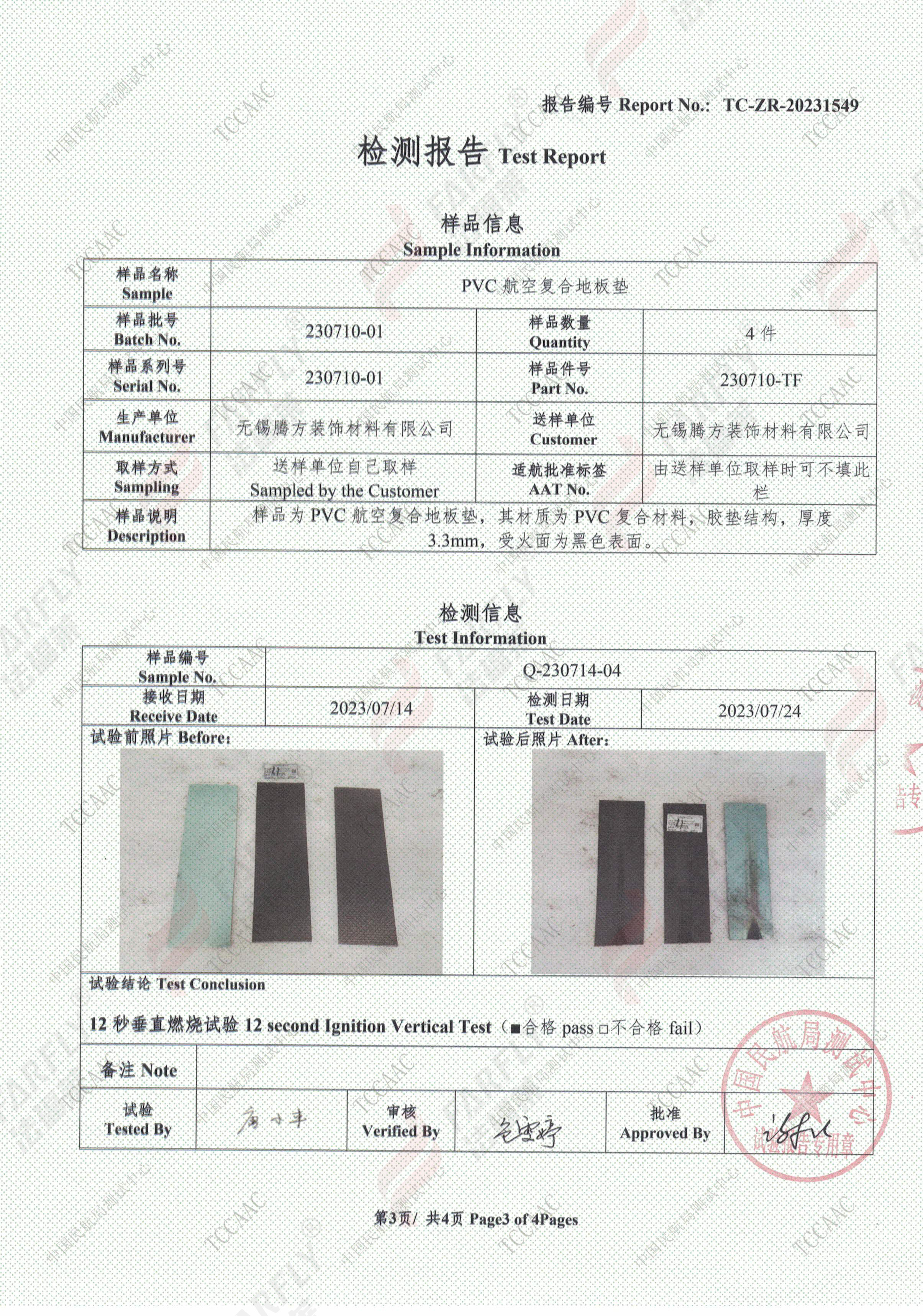
The regulatory ceiling is set by airworthiness rules, not by building codes. FAR 25.853 (14 CFR 25.853) requires materials to be self-extinguishing, with an average burn length not exceeding 8 inches and a flame time under 15 seconds. Supplier-side evidence for this line is documented through CAAC test reports. Certificate TC-ZR-20231549 covers the 12-second vertical combustion test under CCAR 25.853(a) & App. F Part 1 and EASA CS 25.853(a) & App., issued 28 July 2023. Certificate TC-ZR-20231565 covers smoke toxicity under D6-36075 F Table 4, which evaluates flame resistance, heat release, smoke density, toxicity, and self-extinguishing behaviour for cabin flooring use.
The recorded results of the 12-second vertical flame resistance test for the line are: duration of sustained burning 0, burning time of droplets 0, burning length 24 mm, and a pass on the smoke toxicity test. A 24 mm burn length sits far inside the 8-inch (approximately 203 mm) FAR 25.853 ceiling, and zero sustained burning and zero droplet burn time are the behaviours that matter most in a cabin evacuation scenario. The line is also positioned against Boeing BSS 7239 for toxicity alongside FAR 25.853 fire retardancy.
Route 2 — Sports Halls: Impact, Deformation, and Ball Response
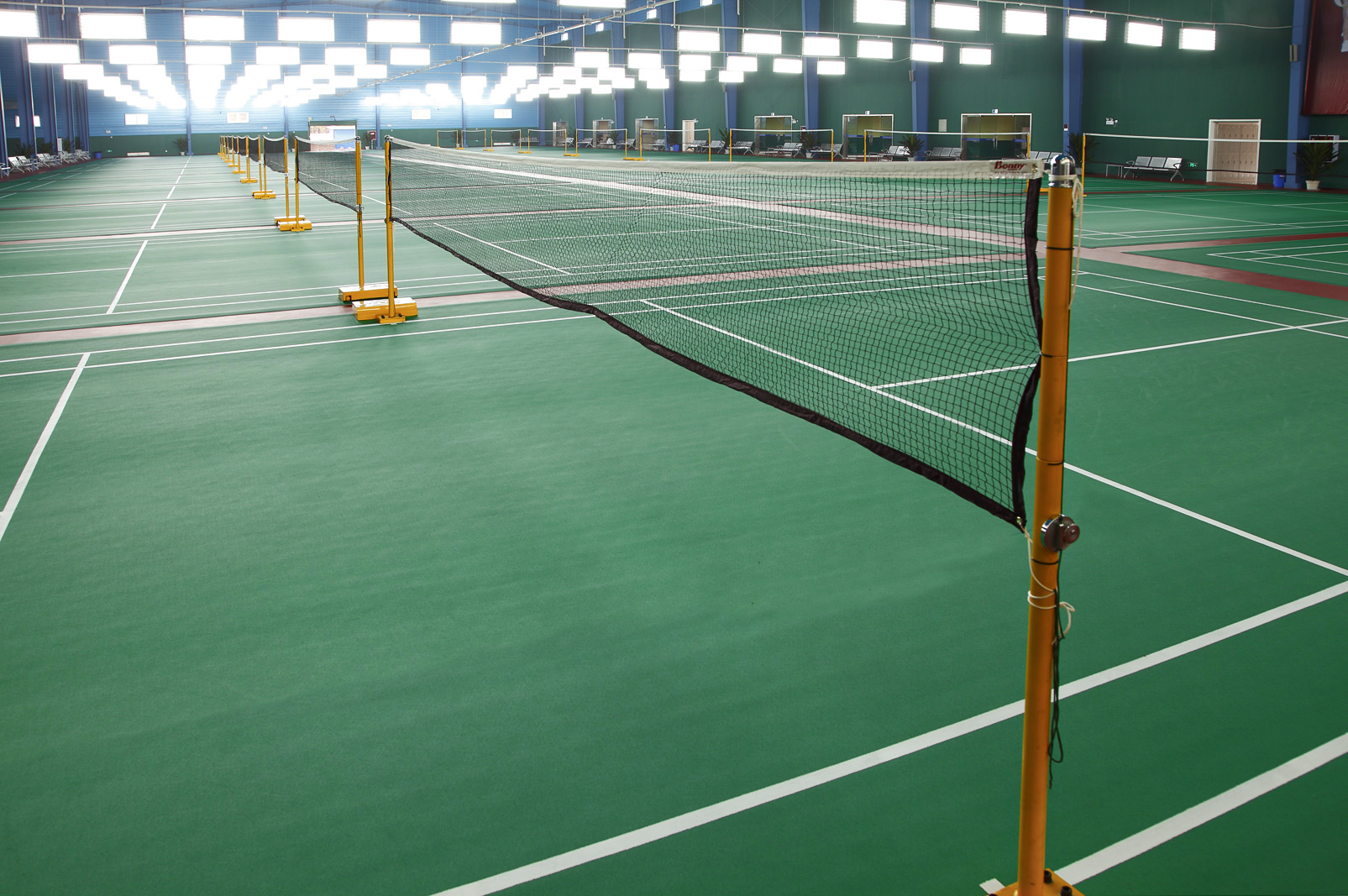
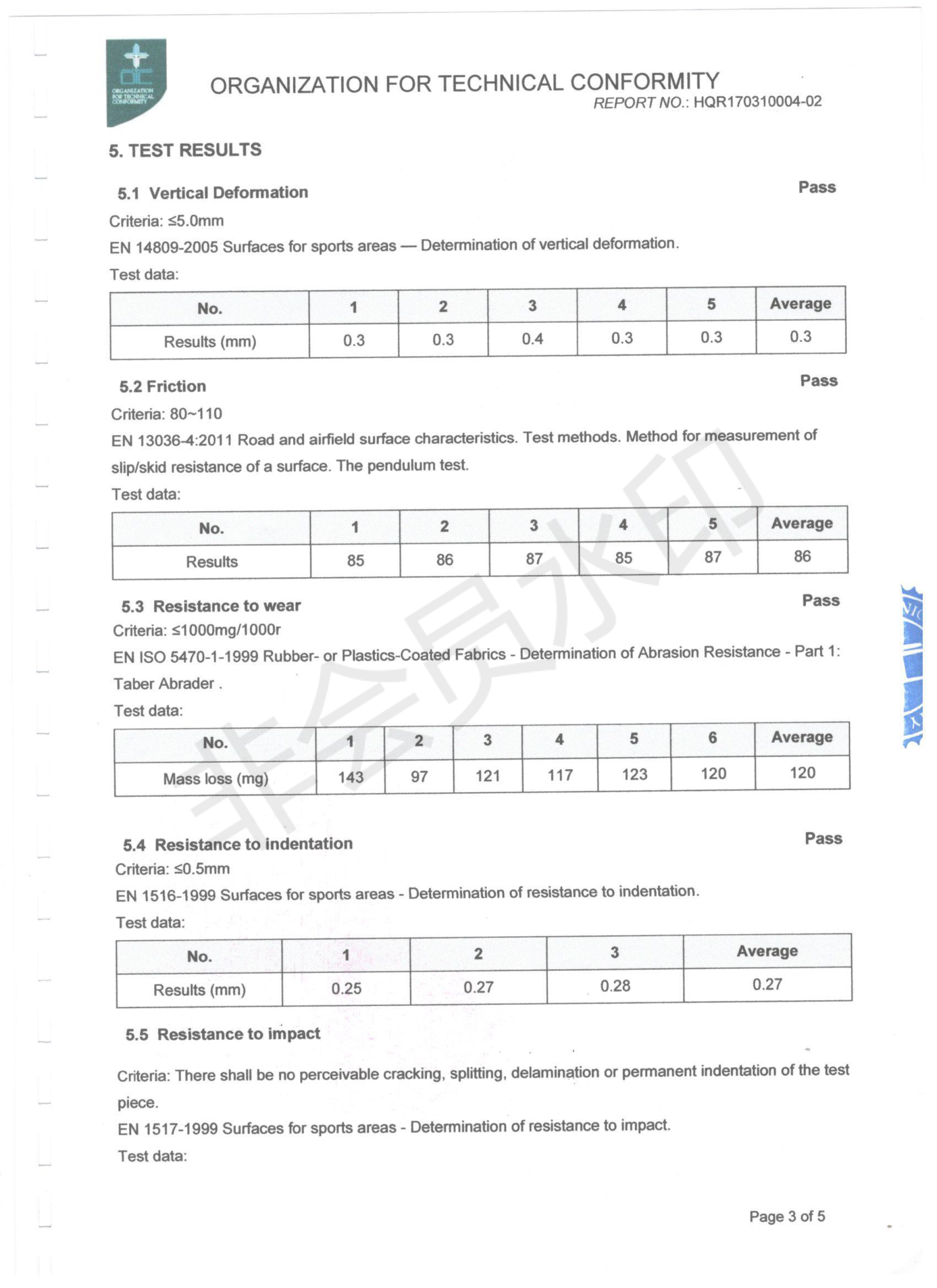
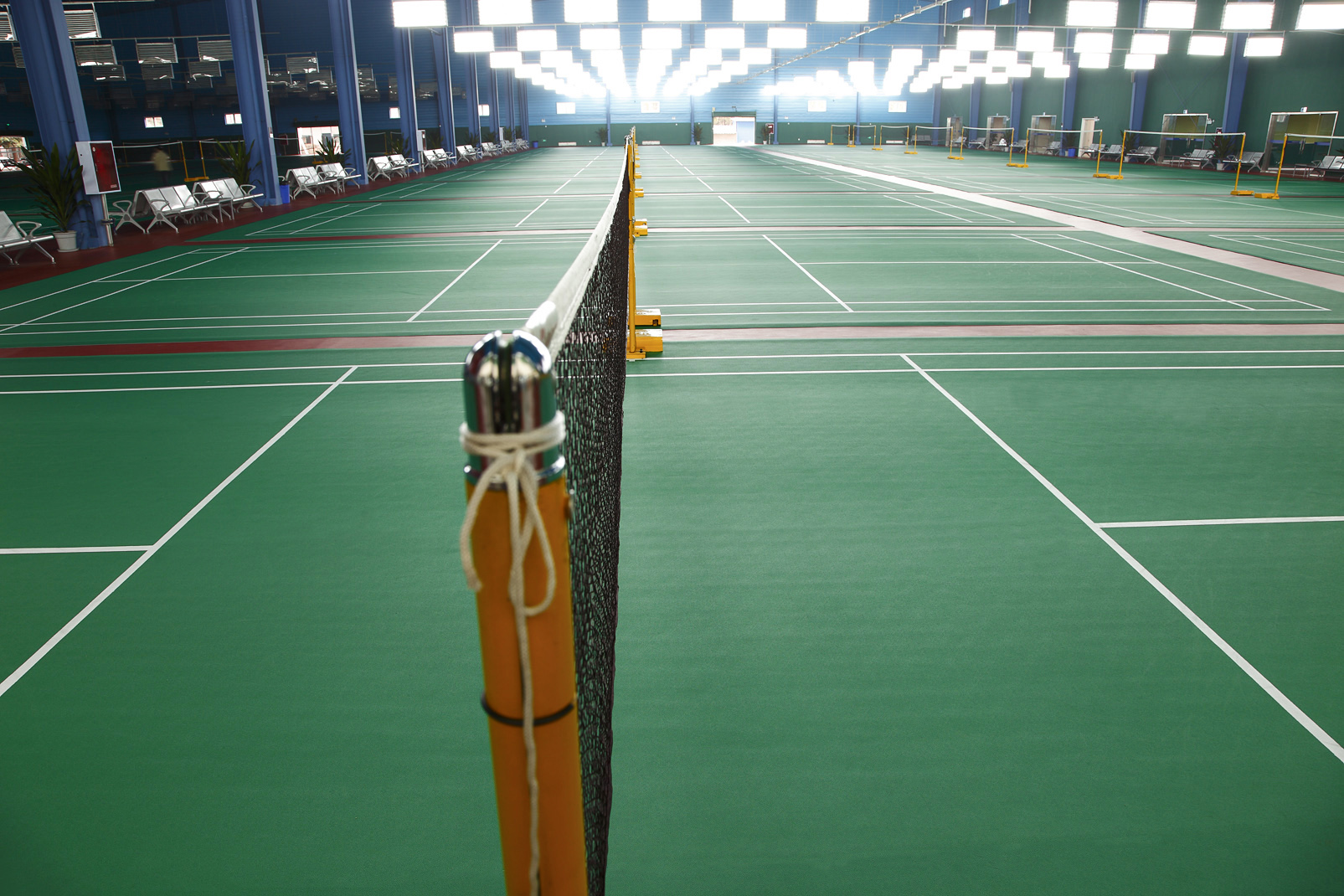
Sports flooring is engineered around energy management rather than combustion. The Boguan sports flooring line is built from polyvinyl chloride, calcium carbonate, and an eco-friendly DOTP plasticizer, with an 8-way fiberglass mesh that provides the dimensional stability large sports halls depend on. Its declared performance parameters are impact resistance 0.35 mm, vertical deformation 0.3 mm, wear resistance 120 mg, indentation resistance 0.27, ball bounce 95%, friction coefficient 0.56, pentachlorophenol not detected, and rolling load resistance not declared (N.D.).
Ball bounce of 95% is the parameter most directly felt by players: it is the property that makes a badminton shuttle or a basketball behave predictably off the surface. Vertical deformation of 0.3 mm and impact resistance of 0.35 mm are the parameters that determine whether the floor protects knees and ankles over years of use rather than months.
Evidence for the line is anchored in European sports flooring standards. Report HQR170310004-02, issued by OTC on 16 May 2017, covers physical and chemical property testing against EN 14904-2006, EN 14809-2005, EN 13036-4:2011, EN ISO 5470-1:1999, EN 1517:1999, EN 1569:1999, EN 1516:1999, EN 14041:2004, EN 12673:1998, and EN 717-1:2004 — the family of tests that covers shock absorption, vertical deformation, slip resistance, abrasion resistance, ball rebound, rolling load resistance, impact performance, fire safety, durability, and formaldehyde emissions. Report HQR170310004-01, issued 12 May 2017, covers reaction to fire under EN 13501-1:2007 with EN ISO 9239-1:2010 and EN ISO 11925-2:2010. Phthalate screening under EN 14372:2004, analysed by GC-MS, is documented in report ETS19030602C issued by ETS on 26 March 2019, covering plasticizers, phthalates, solvents, and VOCs.
Certification for competition use runs separately. The line is certified by the BWF (Badminton World Federation), which classifies sports flooring into Grade 1 (International Elite), Grade 2 (International Standard), and Grade 3 (Basic), and requires that certification be renewed every two years. Buyers specifying for tournament-level venues should therefore confirm the grade held and the current renewal status, not simply the existence of a BWF certificate.
Route 3 — Public Buildings: Traffic, Slip, and Indoor Emissions
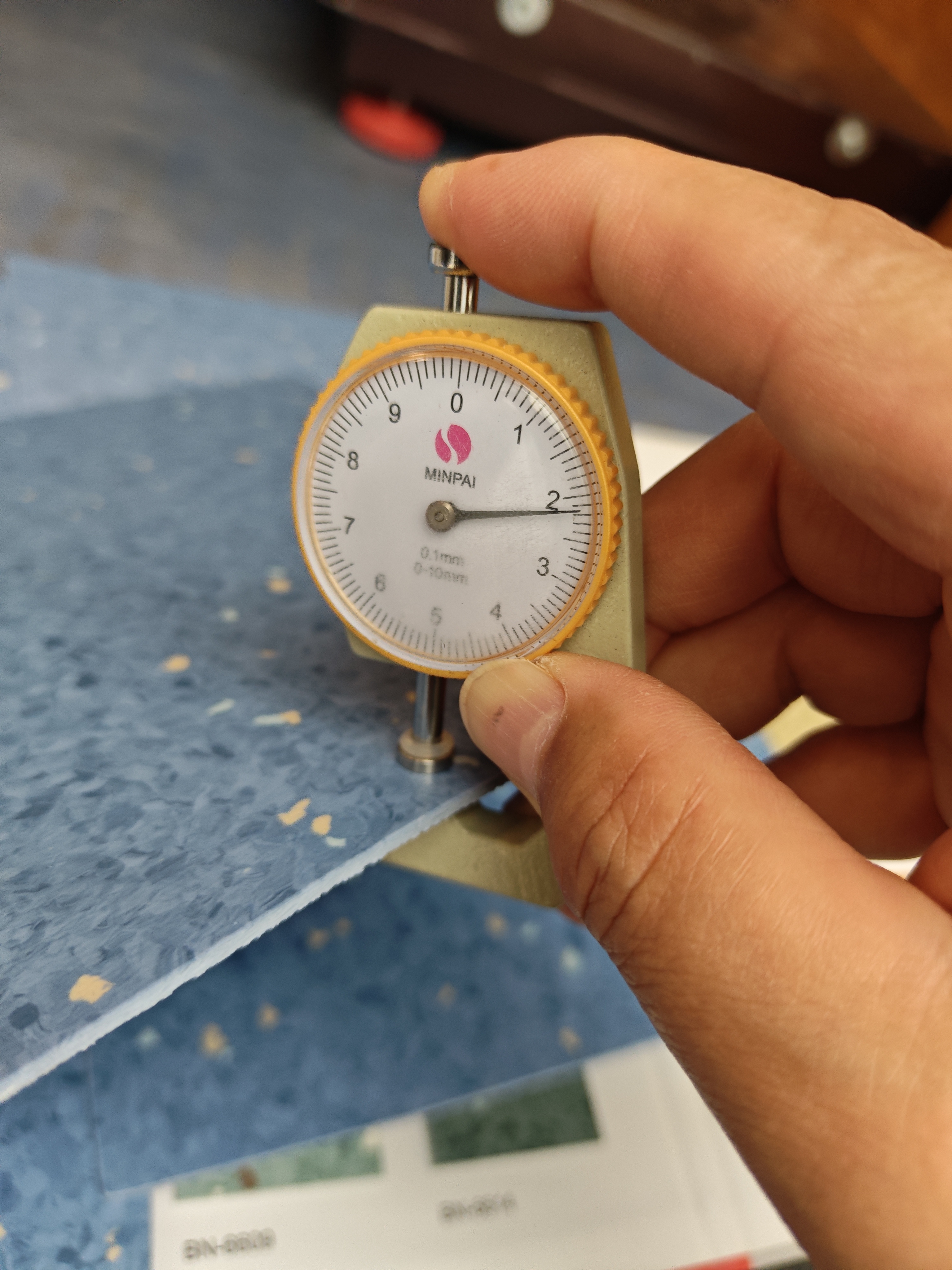
General commercial adaptation is concerned with endurance and interior air quality. The FARFLY homogeneous vinyl line covers Bonaire, Bonet, Boniro, Bonize, Bones, Bonear, Bonegas, Bonzya, Bonami, Bona star, and Bonee, together with ESD flooring and bathroom floor variants. Standard thickness is 2 mm, customizable to 2.5 mm or 3 mm, supplied in 2 x 20 m rolls.
The declared commercial parameters are: fire rating B-S1, antibacterial performance 99.50%, residual indentation 0.06 mm, abrasion resistance T, good chemical resistance, anti-slip property R9, and TVOC (28-day) below 10 µg/m³. A residual indentation of 0.06 mm is the figure that matters most in a hospital corridor, airport concourse, or school, because it determines whether the floor retains a visible record of every trolley and caster that crosses it. The TVOC declaration is the figure that matters for indoor environmental approvals.
Independent evidence is broad. SGS certificate XMIN2109010490CM, issued 7 March 2022, covers ISO 24346:2006, ISO 23997:2007, ISO 4918:2016, ISO 29333:2018, ISO 26987:2008, ISO 10581:2019, and ISO 105-B02:2014 — residual indentation, dimensional stability, flexibility, wear resistance, chemical resistance, classification requirements, and colour fastness to light. European market access is covered by the EN 14041:2018 CE certificate already noted. For specialist environments, the ESD variants maintain stable 10^4 to 10^6 Ω resistance, and the homogeneous range uses a proprietary TF Surface Treatment developed for iodine resistance and lifelong wax-free maintenance.
A Note on Slip Ratings: R9, R11, and What the Label Actually Means
R11 is a standard classification, not a marketing upgrade. Under DIN 51130 and EN 16165, R11 indicates slip resistance at inclination angles of 19° to 27°. It is commonly requested for ramps, wet-process areas, and industrial kitchens where the standing surface is frequently contaminated. The FARFLY homogeneous line declares R9, which reflects its primary positioning in healthcare, education, and general interior traffic rather than wet industrial duty.
This distinction matters commercially. The phrase "commercial PVC flooring" does not imply R11, and no supplier's R9 range can be read as satisfying an R11 clause. Buyers who write R11 into a specification should request the test report for the exact product offered and confirm the declared class, rather than accepting a general statement of slip resistance.
What Changes Between Adaptations: Material and Construction Variables
Adaptation is a manufacturing decision, not a catalogue decision. Five variables move between the three routes.
- Reinforcement. The sports line uses an 8-way fiberglass mesh; the aviation and general commercial lines are specified around their own constructions. Fiberglass reinforcement is the variable most closely linked to dimensional stability, which is why the global fiberglass-reinforced PVC flooring segment is projected to grow at a 6.46% CAGR to 2034.
- Plasticizer system. The sports and homogeneous lines are built on an eco-friendly DOTP plasticizer with calcium carbonate filler, which supports the low-emission and phthalate-screening positions documented in EN 14372:2004 and EN 717-1:2004 testing.
- Surface treatment. The homogeneous range carries a proprietary TF Surface Treatment for iodine resistance and wax-free lifetime maintenance — a specification driven by healthcare and laboratory environments rather than by aesthetics.
- Thickness and format. General commercial supply is standardised at 2 mm with 2.5 mm and 3 mm options, in 2 x 20 m rolls. Sports and aviation adaptations are ordered against the standards of their own sector.
- Evidence pack. This is the variable buyers most often overlook. Each adaptation carries a different certificate set, issued by a different authority, against a different standard. The certificate number is the adaptation.
Step-by-Step Breakdown: Specifying the Right Adaptation
The following sequence is written for evaluation-to-execution stage buyers — the point at which the project scope is fixed, the standards are known, and the remaining risk is supplier selection and delivery.
- Classify the performance envelope first. Ask whether the space is a pressurised aircraft interior, an indoor sports surface, or a general public interior. The answer determines which standard family and which certificate set applies. A mixed-use building may require two or three different adaptations in different zones.
- Pull the governing standard, not the product name. FAR 25.853, CCAR 25.853(a) & App. F Part 1, and EASA CS 25.853(a) & App. for aviation; EN 14904-2006 and the EN 13501-1:2007 fire classification for sports; EN 14041:2018 CE marking for construction-product market access.
- Match the model family to the envelope. LY, SMY, MMY, MY, BY, or WD for aviation interior work; Boguan for sports halls and multi-purpose courts; the Bonaire-to-Bonee homogeneous range with ESD and bathroom variants for public and technical interiors.
- Verify certificates by number, not by claim. Ask for the certificate identifier, issuing authority, standard referenced, and validity dates. The relevant references are TC-ZR-20231549 and TC-ZR-20231565 (CAAC), HQR170310004-01 and HQR170310004-02 (OTC), ETS19030602C (ETS), XMIN2109010490CM (SGS), and TCF-OY20250623-CPR (ICR Co. Ltd.).
- Confirm customization scope and order structure. OEM and ODM production is available, with customization across dimensions, colour, design pattern, packaging, logo, craftsmanship, and structure. The minimum order quantity is 100 sqm.
- Validate before full commitment. Quality control runs at 100% testing plus third-party inspection (SGS), with pre-shipment testing as the stated acceptance criterion.
- Lock the delivery plan against the construction programme. Typical production lead time is 7 days, backed by 300,000 sqm of ready-to-ship inventory and a monthly capacity of 600,000 sqm, with mix-container shipping available for contractors running multiple product lines on one site.
Comparison Table: Adaptation Matrix
The matrix below compresses the three routes into the decision variables that appear in a tender evaluation. All values are drawn from the certificate and specification records referenced above.
| Decision Variable | Aviation Interiors | Sports Halls | Public Buildings |
|---|---|---|---|
| Model designations | LY, SMY, MMY, MY, BY, WD | Boguan | Bonaire, Bonet, Boniro, Bonize, Bones, Bonear, Bonegas, Bonzya, Bonami, Bona star, Bonee, ESD flooring, Bathroom floor |
| Base material | Polyvinyl chloride | PVC, calcium carbonate, eco-friendly DOTP plasticizer | PVC, calcium carbonate, eco-friendly DOTP plasticizer |
| Governing standard family | FAR 25.853; CCAR 25.853(a) & App. F Part 1; EASA CS 25.853(a) & App.; D6-36075 F Table 4; Boeing BSS 7239 | EN 14904-2006; EN 14809-2005; EN 13036-4:2011; EN 13501-1:2007 | EN 14041:2018; ISO 24346:2006; ISO 23997:2007; ISO 4918:2016 |
| Key fire evidence | 12-second vertical flame test: sustained burning 0; droplet burning time 0; burning length 24 mm; smoke toxicity pass (TC-ZR-20231549, TC-ZR-20231565) | Reaction to fire per EN 13501-1:2007, EN ISO 9239-1:2010, EN ISO 11925-2:2010 (HQR170310004-01) | Fire rating B-S1 |
| Key physical parameters | Self-extinguishing behaviour and smoke toxicity compliance | Impact resistance 0.35 mm; vertical deformation 0.3 mm; ball bounce 95%; friction coefficient 0.56; wear resistance 120 mg; indentation resistance 0.27 | Residual indentation 0.06 mm; abrasion resistance T; anti-slip R9; antibacterial 99.50%; TVOC (28-day) <10 µg/m³ |
| Sector certification | CAAC test reports; Boeing BSS 7239 toxicity positioning | BWF certified; BWF Grade 1-3 classification, renewed every two years | CE marking under EN 14041:2018; SGS physical property certification |
| Typical application | Aircraft cabin flooring, private jet flooring, helicopter flooring, galley flooring | Badminton, basketball, volleyball, futsal, gyms, school gymnasiums, multi-purpose sports halls | Hospitals, clinics, schools, shopping malls, exhibition halls, offices, warehouses, ESD environments |
| Documented project reference | — | 16 badminton courts, Australia, 10-year project duration, 50% less maintenance required | — |
Use Cases: How the Adaptations Perform in Practice
Certified sports venue — Australia
A badminton facility in Australia installed Boguan PVC sports flooring across 16 courts, with the project running over a 10-year duration and recording 50% less maintenance required than the previous arrangement. The flooring was selected for cushioning, slip resistance, and superior bounce, with the client highlighting long-lasting performance, ease of installation, and cushioning that protects knees and ankles. For buyers evaluating sports adaptations, this is the practical translation of the parameter list: 0.3 mm vertical deformation and 95% ball bounce are what make a 16-court hall economically maintainable across a decade of daily play.
Aircraft cabin refit and line-fit programmes
A cabin refit compresses the entire evaluation into a compliance question. The floor covering must satisfy the airworthiness authority's flammability and smoke toxicity requirements before it is considered on any other dimension. The relevant evidence is the 12-second vertical flame test result and the smoke toxicity report — for this line, zero sustained burning, zero droplet burning time, a 24 mm burn length, and a pass on smoke toxicity, documented under CAAC report TC-ZR-20231549 and smoke toxicity report TC-ZR-20231565 across the LY, SMY, MMY, MY, BY, and WD designations.
Terminal, hangar, and public building interiors
Building interiors require a different evidence chain. Because these areas sit under building codes rather than airworthiness rules, the CE marking under EN 14041:2018, the SGS ISO testing, and the declared parameters — 0.06 mm residual indentation, abrasion resistance T, R9 anti-slip, antibacterial 99.50%, and TVOC below 10 µg/m³ at 28 days — are the documents that carry the specification. In practice, a single large aviation campus may require three separate adaptations across three zones, each with its own certificate set.
FAQ
Which fire and smoke tests must aircraft interior PVC flooring pass?
Aircraft interior flooring is regulated under airworthiness rules rather than building codes. FAR 25.853 (14 CFR 25.853) requires self-extinguishing behaviour with an average burn length not exceeding 8 inches and a flame time under 15 seconds. European and Chinese programmes apply equivalent requirements through EASA CS 25.853(a) & App. and CCAR 25.853(a) & App. F Part 1. Smoke toxicity is assessed separately — FARFLY's aircraft flooring line is covered by CAAC report TC-ZR-20231549 for the 12-second vertical combustion test and CAAC report TC-ZR-20231565 for smoke toxicity under D6-36075 F Table 4, with recorded results of zero sustained burning, zero droplet burning time, and a 24 mm burn length. Note that terminals and hangars are governed by local building codes, not by FAR 25.853.
Can one manufacturer supply adapted flooring for aviation, sports, and public building projects?
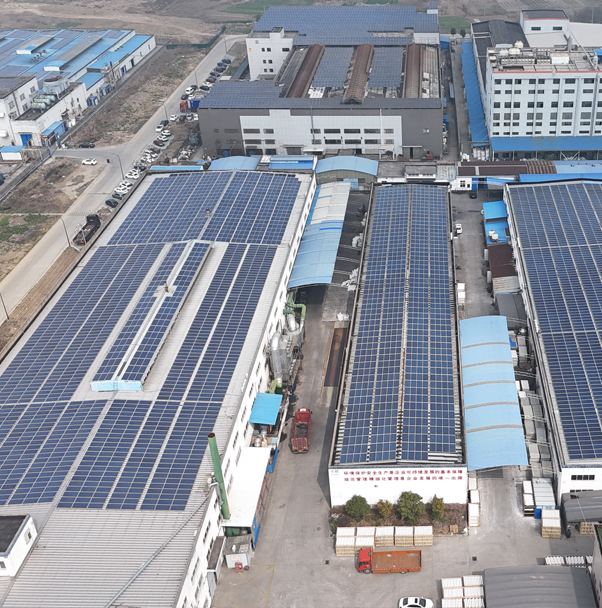
Yes, provided the supplier runs separate product families with separate evidence packs. FARFLY produces an aviation interior line (LY, SMY, MMY, MY, BY, WD), a sports line (Boguan, BWF certified with an 8-way fiberglass mesh), and a general commercial homogeneous vinyl line (Bonaire through Bonee, plus ESD flooring and bathroom floor variants). The company operates 6 advanced production lines with a monthly capacity of 600,000 sqm and an annual output of 4,200,000 m², backed by 399+ international testing certifications. OEM and ODM production is available with customization across dimensions, colour, design pattern, packaging, logo, craftsmanship, and structure.
What is the minimum order quantity, and how are delivery and payment terms structured?
The minimum order quantity is 100 sqm. Delivery terms are quoted as EXW, FCA, FOB, CIF, or DDP depending on the destination and the buyer's preferred Incoterms. Payment terms are a 50% deposit, with the remaining 50% payable by T/T prior to shipment. Acceptance criteria are a pre-shipment test plus third-party inspection (SGS). Because cost per square metre for adapted flooring depends on the specification, the volume mix, and the delivery term rather than on a list price, buyers should request a specification-matched quotation rather than comparing headline figures across different adaptations.
How can a buyer validate an adapted flooring sample before committing?
Validation typically runs through three stages. First, a sample of the specific adaptation is reviewed against the declared parameters — for example, ball bounce and vertical deformation for sports, or burn length and smoke toxicity results for aviation. Second, quality control is applied at 100% testing with third-party inspection by SGS. Third, pre-shipment testing serves as the formal acceptance criterion, and mix-container shipping allows a buyer to consolidate several adapted product lines into one shipment for comparison on site. Buyers can also download the FARFLY product brochure at cdn.socialarks.com/sbsp/24800/0/2026/0509/69fea506c8bba.pdf to shortlist the variants worth sampling.
How fast can adapted PVC flooring be dispatched, and what supports that lead time?
Typical production lead time is 7 days. That figure is supported by a ready-to-ship inventory of 300,000 sqm rather than by expedited production alone, which is what makes it repeatable across mixed orders. For contractors running multiple zones on one site, mix-container shipping allows aviation, sports, and general commercial adaptations to be consolidated into a single dispatch. After-sales support covers online installation guidance, support from an on-site installation team where required, and provision of necessary installation equipment and auxiliary materials.
Next Step: Match the Adaptation to Your Project
Send the project envelope, the governing standard, and the required area. FARFLY will respond with the matching model family, the relevant certificate numbers, and a specification-matched quotation. MOQ is 100 sqm, dispatch is typically 7 days from a 300,000 sqm ready-to-ship inventory.
Email: mara@topvcfloor.com | WhatsApp: +86-18751567592 | Website: www.topvcfloor.com
Conclusion: Adaptation Is an Evidence Question
Aviation interiors, sports halls, and public buildings do not need different brands of PVC flooring. They need different adaptations of the same platform, each carrying the certificate that the governing standard requires. Aviation work runs on fire and smoke evidence under FAR 25.853, CCAR 25.853(a) & App. F Part 1, and EASA CS 25.853(a) & App., documented for the LY, SMY, MMY, MY, BY, and WD line with zero sustained burning, zero droplet burning time, and a 24 mm burn length. Sports work runs on impact, deformation, and ball-response evidence under EN 14904-2006 with an active BWF certification on the Boguan line. Public building work runs on wear, slip, and emissions evidence under EN 14041:2018, ISO testing, and a declared R9 anti-slip class with TVOC below 10 µg/m³ at 28 days.
The verification habit that separates a low-risk specification from a high-risk one is simple: ask for the certificate number before the sample, and ask for the sample before the purchase order. A model designation without a certificate identifier is a description; a model designation with one is a specification.