
Commercial PVC Flooring for Indoor Sports Courts: A Step-by-Step Application Guide

Cover: roll-applied PVC Sport Flooring for indoor courts, halls and fitness areas.
Matching commercial PVC flooring to an indoor sports court is a sequence, not a single purchase decision. The workable order is: define the sport and its load profile, set measurable performance targets, verify the compliance documents, prepare and moisture-check the substrate, install and heat-weld the roll, then accept the finished court against testable criteria. Skipping a step rarely shows up immediately; it usually appears as a ball that bounces differently in one half of the hall, a seam that lifts at the eighteen-month mark, or a certificate that does not actually cover the model that was delivered.
This guide walks through that sequence for indoor sports courts — basketball, badminton, volleyball, table tennis, pickleball, indoor tennis, futsal, multi-purpose halls, gyms and fitness areas — and maps every step to the documented performance data and certification reports of PVC Sport Flooring, Boguan model, produced by FARFLYING FLOORING.
FARFLYING FLOORING is the resilient flooring brand of WUXI TEFA DECORATION MATERIAL CO., LTD., a manufacturer established in 2012 in Wuxi, Jiangsu, China, producing homogeneous flooring, PVC sports flooring and aircraft flooring for healthcare, sports and aviation projects.
Problem Definition: Why Indoor Court Flooring Projects Fail
Most indoor sports flooring failures are specification failures rather than material failures. The surface itself may be sound while the project still underperforms, because the wrong property was never written into the brief.
- The sport was not translated into numbers. A volleyball hall and a table tennis hall do not place the same demands on a surface, yet both are frequently specified with a generic line item such as “PVC sports flooring, 4.5 mm”.
- One document was assumed to cover everything. Physical and chemical properties, reaction to fire and phthalate content are three different test scopes. A buyer who holds only one report does not hold the full compliance picture.
- Subfloor moisture was never measured. Adhesive failure and seam lifting usually begin below the surface, not on it.
- Seams were treated as a finish detail. Grooving and heat-welding determine whether a roll floor behaves as one continuous sheet or as a series of panels that open under movement.
- Handover had no acceptance criteria. Without measurement at handover, defects are discovered by players rather than by the contractor.
The practical consequence is that the floor is judged by the wrong evidence. A court is not accepted because the roll looked correct on the pallet; it is accepted because the documented values, the installed substrate and the welded seams all hold together after curing.
Industry Background: How Indoor Sports Surfaces Are Specified
Indoor sports flooring is specified as a system: a resilient surface layer, an adhesive, a prepared substrate and welded joints. Commercial PVC sports flooring in roll form is installed as a single continuous sheet, which is the main structural difference from tile formats — fewer joints, fewer places for moisture and dirt to collect, and a surface that can be marked and line-painted as one plane.
Two reference frameworks do most of the work in international tenders. The first is the European standard EN 14904-2006, against which the physical and chemical properties of indoor sports surfaces are commonly documented. The second is federation-level approval: the BWF Equipment Certification Programme certifies badminton flooring in three grades — Grade 1 (International Elite), Grade 2 (International Standard) and Grade 3 (Basic) — so “BWF approved” is only meaningful when the grade and the approved product are both identified.
Reaction to fire is specified separately, typically through EN 13501-1:2007 classification, and chemical safety is increasingly specified through phthalate testing under EN 14372:2004. Treating these as three separate document requests, rather than one compliance conversation, prevents the common tender problem where a supplier submits a fire report in response to a question about plasticiser content.
Detailed Solution: The Product and Its Documented Numbers
PVC Sport Flooring, model Boguan, is a sports flooring product made of polyvinyl chloride, calcium carbonate and eco-friendly DOTP plasticiser. It is classified as gym flooring, sports hall flooring, basketball court flooring, badminton court flooring, volleyball court flooring, table tennis flooring, pickleball court flooring, tennis court flooring, futsal flooring, dance studio flooring and school gym flooring.
The values below are the documented performance data for this product. They are the numbers a specifier should be able to find in the technical submittal, and they are the numbers this guide uses throughout the step-by-step section.
| Property | Documented value | How specifiers use it |
|---|---|---|
| Friction coefficient | 0.56 | Slip-resistance reference for the playing surface; compare with the value stated in the project brief or federation requirement. |
| Ball bounce | 95% | Indicates how much energy the surface returns to the ball; checked against the sport and against consistency across the court. |
| Vertical deformation | 0.3 mm | How far the surface deflects under load — the balance point between shock absorption and a stable playing plane. |
| Impact resistance | 0.35 mm | Surface response to concentrated impact; relevant where equipment, footwear and falls concentrate load. |
| Indentation resistance | 0.27 | Resistance to permanent marks from static loads such as equipment feet, seating and bleachers. |
| Wear resistance | 120 mg | Wear performance used for heavy-traffic court planning; confirm the test method on the report before comparing suppliers. |
| Rolling load resistance | N.D. | Reported as not detected in the test documentation. |
| Pentachlorophenol detection | N.D. | Reported as not detected — relevant to indoor air and chemical-safety questions. |
Table 1 — Documented performance data, PVC Sport Flooring (Boguan).
Compliance is documented in three distinct reports plus one federation approval, and each answers a different tender question.
| Standard or programme | Scope | Reference |
|---|---|---|
| EN 14904-2006 | Physical and chemical properties of the sports surface | Report HQR170310004-02 |
| EN 13501-1:2007 | Reaction to fire | Report HQR170310004-01 |
| EN 14372:2004 | Phthalate testing | Report ETS19030602C |
| BWF Equipment Certification Programme | Badminton flooring approval, issued in Grade 1 (International Elite), Grade 2 (International Standard) and Grade 3 (Basic) | PVC sports flooring officially certified by the Badminton World Federation |
Table 2 — Compliance documents to request before the order is placed.
What these numbers mean in practice is narrower than marketing language usually suggests. A friction coefficient of 0.56 and a ball bounce of 95% describe a surface that returns most of the ball's energy while keeping grip within a defined band; they do not by themselves declare a court suitable for a given competition level. Vertical deformation of 0.3 mm together with impact resistance of 0.35 mm describes a surface that deflects under load while remaining a stable plane for ball play. Those readings are what a buyer should hold a supplier to at handover, because they can be re-checked on site rather than argued about.
Step-by-Step Breakdown: From Brief to Accepted Court
Step 1 — Define the sport, the hall and the load profile
Start with the sport rather than the product. Record the court dimensions and markings, whether the hall is single-sport or multi-purpose, whether the space will host spectators, portable equipment or retractable seating, and how many hours per week the surface will be in use. A school gymnasium with community evening use and a badminton training centre with daily competitive play are not the same specification, even when the floor area is identical.
Step 2 — Convert the brief into performance targets
Convert each requirement into a property with a target value. Ball behaviour maps to ball bounce and vertical deformation; grip maps to friction coefficient; equipment and seating maps to indentation resistance; traffic maps to wear resistance; indoor air questions map to pentachlorophenol detection and phthalate testing. For badminton, add the required BWF grade to the target list. The output of this step is a one-page specification table, not a product name.

Step 2 output: every requirement is expressed as a measurable property before a product is selected.
Step 3 — Verify the three reports and the federation approval
Request the EN 14904-2006 physical and chemical properties report HQR170310004-02, the EN 13501-1:2007 reaction to fire report HQR170310004-01 and the EN 14372:2004 phthalate report ETS19030602C. Check three things on each document: that the standard and edition match the tender, that the product and model on the report match the model being quoted, and that the report is legible and complete rather than a cover page. Where badminton is the primary sport, add the BWF certification and confirm the grade.
Step 4 — Confirm the roll format, quantity and acclimation
Roll flooring is installed as a single continuous sheet, so roll widths and lengths determine the seam layout. Agree the seam plan before delivery: seams placed away from the main playing axis and away from the centre circle reduce both visual disruption and concentrated movement. Allow the rolls to acclimate in the conditioned hall before installation, and dry-lay the sheets to confirm the layout before any adhesive is opened.
Step 5 — Prepare and moisture-test the substrate
The subfloor must be smooth, level, clean and dry. Inspect, moisture-test, clean, level and repair it before the flooring is unpacked. Confirm that the substrate is sound and within the moisture limits specified by the flooring and adhesive manufacturers; those limits, not a generic rule of thumb, govern whether installation can proceed. Skipping the moisture test is the single most common cause of later adhesive and seam problems.
Step 6 — Install, roll and heat-weld
The installation sequence is: measure and mark the court centre lines; apply the approved adhesive with the specified trowel and observe its open time; lay, smooth and roll the sheets; trim the edges; then, after the adhesive sets, groove and heat-weld the seams with matching welding rod; finally trim the welds, clean the surface and mark the court lines. Groove depth, welding temperature and open time follow the product technical data sheet — they are not interchangeable between products.
Step 7 — Accept the court against measurable criteria
Acceptance should be a measured checklist, not an impression. Verify seam weld integrity along the full length of every joint, surface flatness and the absence of lippage at seams, consistent ball behaviour across both halves of the court, accurate line marking against the court drawing, clean edges and thresholds, and a documented cure period before traffic release. Collect the three reports and the BWF approval — where applicable — into the handover file so that the compliance evidence matches the installed model, not just the quoted one.
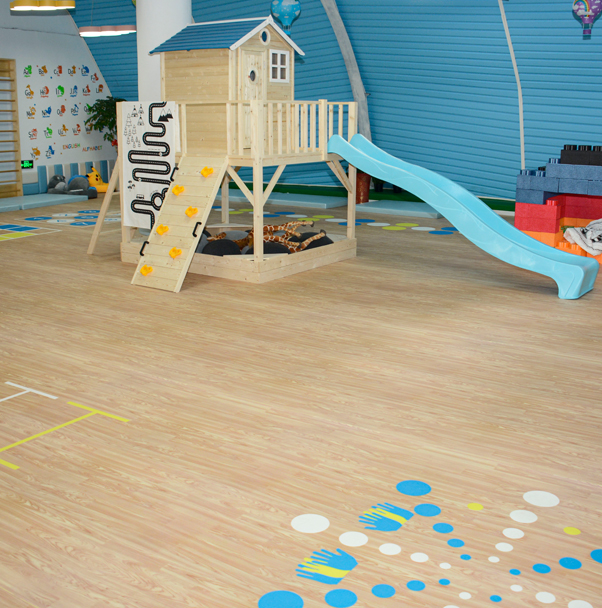
Step 7 acceptance: seams, flatness, ball behaviour and line marking are checked before traffic release.
Use Cases: Matching the Same Floor to Different Courts
Boguan PVC Sport Flooring is listed for a wide range of indoor venues, and the specification emphasis shifts from court to court. The following notes describe how the same documented values are applied differently.
Basketball courts
Basketball places the emphasis on ball bounce consistency and a stable plane under running and stopping loads. With ball bounce at 95% and vertical deformation at 0.3 mm, the specification conversation centres on seam placement relative to the playing axis and on confirming that ball behaviour is measured at several points across the court at handover.
Badminton courts
Badminton is the case where federation approval matters most. Confirm the BWF certification and record the grade — Grade 1 (International Elite), Grade 2 (International Standard) or Grade 3 (Basic) — against the level of play the hall is intended to host. Friction coefficient 0.56 and vertical deformation 0.3 mm are the values most often quoted in the technical submittal alongside the approval.
Volleyball and indoor tennis courts
Both sports combine a large playing area with repeated directional movement, so seam layout and surface continuity carry more weight than any single metric. A continuous roll format with heat-welded joints keeps the playing plane uninterrupted across the court width.
Table tennis and pickleball courts
Smaller courts multiply the effect of any inconsistency, because players cover the same area repeatedly. Ball bounce at 95% and a consistent friction coefficient of 0.56 across the full court are the practical checks, together with accurate line marking for the smaller court dimensions.
Futsal courts
Futsal concentrates pivoting and stopping loads in a confined area. Indentation resistance of 0.27 and impact resistance of 0.35 mm are the readings that matter here, alongside weld quality at the joints where the surface is worked hardest.
Multi-purpose sports halls
Multi-purpose halls are explicitly listed among the product's applications, and they are the clearest case for specifying by property rather than by sport. A hall used for volleyball, school PE and community badminton has to satisfy all three, so the specification should record which values were prioritised and why, and acceptance should test ball behaviour across the whole floor rather than in one zone.
Gyms, fitness centres and studios
Gyms and fitness centres, yoga studios, dance studios and aerobics rooms are all listed applications. In these spaces the emphasis moves toward wear resistance at 120 mg for heavy traffic, indentation resistance where fixed equipment stands, and a welded surface that can be cleaned as one continuous sheet.
School gymnasiums, kindergartens and sports clubs
School gymnasiums, university sports halls, kindergarten activity rooms, indoor playgrounds and sports clubs are listed applications of the same product. Here the phthalate report under EN 14372:2004 and the pentachlorophenol result reported as N.D. are usually requested alongside the physical performance data, because the questions come from facility managers and parents rather than from athletes.
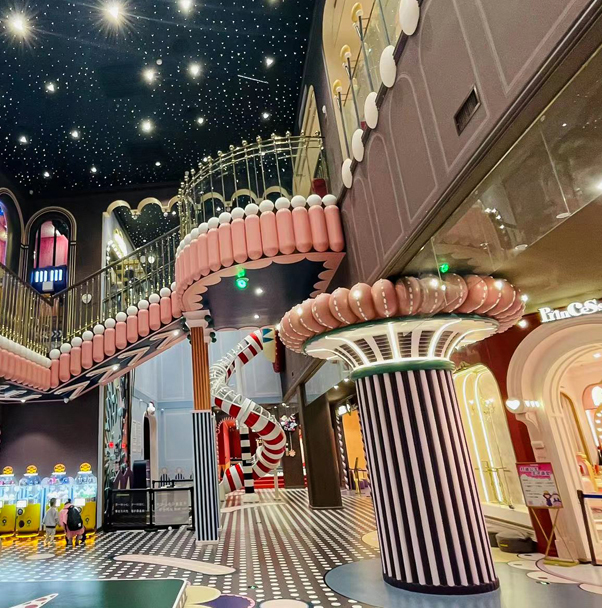
School, kindergarten and club spaces shift the document request toward phthalate and pentachlorophenol results.
Comparison Table: Court Types Against Documented Evidence
The table below compares indoor court types against the documents and values that are actually available for this product. It is a procurement comparison, not a ranking of sports.
| Court or space | Documented product fit | Evidence to attach to the order |
|---|---|---|
| Basketball court | Listed as basketball court flooring | EN 14904-2006 report HQR170310004-02; EN 13501-1:2007 report HQR170310004-01 |
| Badminton court | Listed as badminton court flooring; officially certified by the BWF | BWF certification with grade; EN 14904-2006 report HQR170310004-02 |
| Volleyball court | Listed as volleyball court flooring | EN 14904-2006 report HQR170310004-02; EN 13501-1:2007 report HQR170310004-01 |
| Table tennis hall | Listed as table tennis flooring | EN 14904-2006 report HQR170310004-02 |
| Pickleball court | Listed as pickleball court flooring | EN 14904-2006 report HQR170310004-02 |
| Indoor tennis court | Listed as tennis court flooring | EN 14904-2006 report HQR170310004-02; EN 13501-1:2007 report HQR170310004-01 |
| Futsal court | Listed as futsal flooring | EN 14904-2006 report HQR170310004-02 |
| Multi-purpose hall | Listed as multi-purpose sports hall flooring | EN 14904-2006, EN 13501-1:2007 and, if badminton is included, the BWF approval |
| Gym, fitness centre, studio | Listed as gym and dance studio flooring | EN 14372:2004 phthalate report ETS19030602C; EN 14904-2006 report HQR170310004-02 |
| School, kindergarten, club | Listed as school gym flooring | EN 14372:2004 report ETS19030602C; pentachlorophenol result N.D. |
Table 3 — Court type, documented product fit and the document set to attach to the purchase order.
Ordering, Stock and Delivery Sequence
Installation planning is only as good as the delivery plan behind it. WUXI TEFA DECORATION MATERIAL CO., LTD. operates 6 advanced production lines with an annual production capacity of 4,200,000 square metres, supported by a 3,000-square-metre manufacturing facility, approximately 200 staff and a 25-engineer R&D team.
For project scheduling, the relevant facts are these: the company maintains a ready-to-ship inventory of 300,000 square metres and offers a 7-day rapid dispatch model, and it supports mix-container shipping for global EPC contractors. Export business accounts for 50% of total sales, with major markets including the Middle East and Central Asia, East Asia and Southeast Asia, and Europe and the Americas.
Two practical notes belong in any purchase order. First, confirm stock against the specific SKU, colour and quantity in the order — a general inventory figure is a planning input, not a reservation. Second, confirm the dispatch date in writing together with the Incoterm, so that the installation sequence in Steps 4 to 7 can be dated backwards from a known delivery.
Frequently Asked Questions
Which certificates and test reports should be checked before specifying PVC sports flooring?
Three documents cover three different scopes and should be requested separately: EN 14904-2006 for physical and chemical properties (report HQR170310004-02), EN 13501-1:2007 for reaction to fire (report HQR170310004-01) and EN 14372:2004 for phthalate testing (report ETS19030602C). Where badminton is the primary sport, add the BWF certification and record the grade, since the BWF Equipment Certification Programme certifies flooring in Grade 1 (International Elite), Grade 2 (International Standard) and Grade 3 (Basic). On each report, confirm that the product and model named match the model being quoted.
Can one PVC sports floor serve a multi-purpose hall with several different sports?
Yes, and multi-purpose sports halls are explicitly listed among the product's applications, alongside basketball, badminton, volleyball, table tennis, pickleball, indoor tennis, futsal, gyms and school gymnasiums. The documented values that support a mixed-use specification are ball bounce at 95%, friction coefficient at 0.56, vertical deformation at 0.3 mm and impact resistance at 0.35 mm, with indentation resistance at 0.27 for equipment loads and wear resistance at 120 mg for traffic. Because the flooring is supplied in roll form and installed as a single continuous sheet with heat-welded seams, the playing plane stays uninterrupted across the different court layouts.
What drives the cost of an indoor court PVC flooring project?
Cost is driven by the specification, not by the product name alone. The main variables are the performance level required by the brief (which determines which documented values the floor must meet), the total area and roll layout (which determines seam length and welding labour), substrate preparation and moisture conditions, the number of welded joints, line marking, and the delivery terms. Because the manufacturer maintains a ready-to-ship inventory of 300,000 square metres with a 7-day rapid dispatch model and supports mix-container shipping for global EPC contractors, scheduling pressure can often be reduced rather than paid for through expedited freight — but the exact commercial terms should always be confirmed against the specific model, colour and quantity in the quotation.
How should a buyer validate the floor before committing to a full order?
Request a sample of the specific model and colour, then validate it against the specification table built in Step 2: confirm the surface and backing, confirm the colour and roll direction, and cross-check the sample against the documented values and report references so that the material supplied matches the material tested. It is also worth confirming at sample stage that matching welding rod will be supplied for the seams, because the weld is part of the finished system. Sample and specification requests can be sent to mara@topvcfloor.com.
What lead time and shipping options apply to a commercial PVC flooring order?
The manufacturer maintains a ready-to-ship inventory of 300,000 square metres and operates a 7-day rapid dispatch model, with mix-container shipping supported for global EPC contractors. Production backing comes from 6 advanced production lines and an annual capacity of 4,200,000 square metres. Lead time should still be confirmed in writing against the specific SKU, colour, quantity and destination, because inventory is a planning figure and a reservation is a written commitment. To check availability for a specific court project, contact the team at mara@topvcfloor.com or WhatsApp +86-18751567592 with the court type, total area and required on-site date.
Conclusion
Indoor sports court flooring is decided in the specification, proven on the substrate and confirmed at handover. The sequence that holds up is consistent across every court type: define the sport and its load profile, convert the brief into target values, verify the three reports and the federation approval, plan the roll and seam layout, prepare and moisture-test the substrate, install with a controlled adhesive and heat-weld process, then accept the court against measurable criteria.
The documented numbers that support that sequence for this product are friction coefficient 0.56, ball bounce 95%, vertical deformation 0.3 mm, impact resistance 0.35 mm, indentation resistance 0.27 and wear resistance 120 mg, with pentachlorophenol and rolling load resistance reported as N.D., and compliance evidenced by EN 14904-2006 (HQR170310004-02), EN 13501-1:2007 (HQR170310004-01) and EN 14372:2004 (ETS19030602C), plus BWF certification for badminton. A buyer who holds those documents, that specification table and a measured handover checklist has everything needed to accept — or reject — a court on evidence rather than on impression.
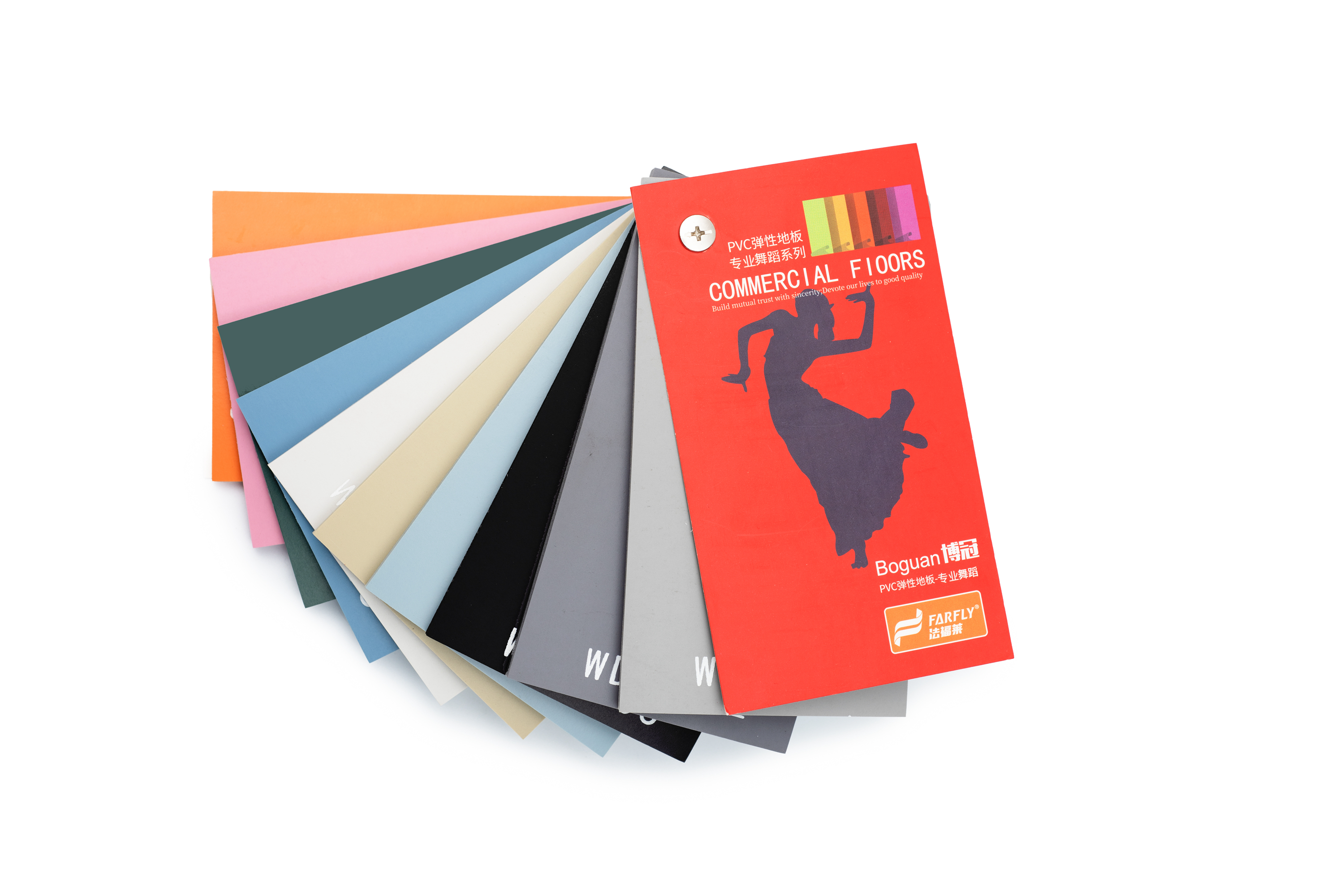
Next step: match the sample to the specification table before the purchase order is issued.
Next Step: Specification, Sample or Quotation
FARFLYING FLOORING supplies PVC Sport Flooring (Boguan) for basketball, badminton, volleyball, table tennis, pickleball, indoor tennis and futsal courts, multi-purpose halls, gyms and fitness areas, school gymnasiums and sports clubs.
Send the court type, total area, required on-site date and the BWF grade or standard level your project requires, and the team will respond with the matching specification, the relevant report references and a quotation.
Email: mara@topvcfloor.com | WhatsApp: +86-18751567592 | Website: www.topvcfloor.com
Address: NO.5 HUAQING INTELLIGENT PARK, HUISHAN DISTRICT, WUXI, JIANGSU, CHINA
Product catalogue and technical brochure: download the FARFLY flooring brochure (PDF).
Have Questions or Need More Details?
Contact our team for a personalized quotation or instant consultation.
Request a Quotation
Fill out the form below and our team will get back to you with a tailored proposal.
WhatsApp Direct Chat
Prefer to chat in real-time? Message us on WhatsApp for instant assistance & quick answers.
- Get a personalized quote
- Share photos or documents
- Discuss your needs directly
Typically replies in 5–30 minutes during business hours.