Commercial PVC Flooring vs. Tiles, Cement, Wood, and Coatings: A 2026 Buyer's Comparison
On the criteria that decide most commercial specifications — shock absorption, slip resistance, waterproofing, fire resistance, antimicrobial performance, maintenance burden and total lifecycle cost — commercial PVC flooring in roll or sheet form satisfies more constraints than ceramic tile, cement-based floors, timber or resin coatings. It does not win every criterion: tile and cement remain the stronger choice under heavy static point loads and in exposed external slabs, and coatings remain simpler to apply over irregular or damaged substrates. This comparison shows where each material actually belongs.
Why the Flooring Decision Is a Constraint Problem, Not a Design One
Most flooring failures in commercial buildings are specification failures rather than product failures. The material performed as designed; the design asked the wrong question. Across commercial fit-out projects, the same failure points recur:
- Certification mismatch at handover. The floor is installed correctly but cannot be signed off because the reaction-to-fire classification, the CE documentation or the slip classification does not match the project's compliance schedule.
- Maintenance cost discovered after occupancy. The cleaning regime required to keep the floor presentable was never modelled, and it becomes an operating cost line for the life of the building.
- Substrate moisture and adhesion failure. Residual moisture in the slab blisters coatings and lifts resilient and timber coverings.
- Seam and joint hygiene. Grout lines and movement joints become the contamination reservoir in clinical, food-adjacent and laboratory environments.
- Slip liability in wet or contaminated zones. A floor specified as dry-safe is commissioned into an entrance, wash-down or kitchen route.
- Fire classification gaps. Escape routes and high-occupancy halls require a documented reaction-to-fire result, not a material description.
Reframing the decision around these constraints changes the comparison. The question is not "which floor is best", but "which floor satisfies the compliance envelope, the traffic profile, the cleaning capability and the lifecycle cost model for this specific facility".
Industry Background: Where Commercial Flooring Specification Stands in 2026
The commercial vinyl flooring market was valued at approximately USD 14.43 billion in 2025 and is projected to reach USD 22.01 billion by 2033, according to Grand View Research. Supply is shifting accordingly: China's cumulative PVC flooring exports reached 715,000 tons in the first two months of 2026, a 3.1% year-on-year increase, based on China Customs data published by SunSirs.
Within the category, reinforced constructions are growing faster than the base material. Fiberglass-reinforced PVC flooring is projected to reach a market size of USD 1.72 billion by 2034, growing at a compound annual growth rate of 6.46%, driven primarily by dimensional stability requirements in large continuous installations, according to Fortune Business Insights. Farfly, the flooring brand operated by WUXI TEFA DECORATION MATERIAL CO., LTD., builds its sports systems around an 8-way fiberglass mesh for this reason.
The supply base is a mix of global groups and specialists. Market Research Future identifies major participants in the commercial PVC and vinyl flooring market as Mohawk Industries, Shaw Industries, Tarkett, Gerflor and Forbo Flooring, alongside regional specialists. For a buyer, the practical consequence is that the specification standard, not the brand list, is what makes two quotations comparable.
Four standards frameworks do most of the work in that comparison:
- CE and EN 14041:2018 — the harmonised European standard for resilient floor coverings, covering reaction to fire, slip resistance and release of hazardous substances.
- ISO 24346:2006 and related ISO methods — the test family for homogeneous flooring, covering residual indentation, dimensional stability, flexibility, wear resistance, chemical resistance and colour fastness to light.
- EN 13501-1 / EN ISO 9239-1 / EN ISO 11925-2 — reaction-to-fire classification and the underlying flame-spread and ignitability tests.
- FAR 25.853 and BWF flooring classification — the two sector-specific regimes that set the ceiling for aviation and competitive sports floors respectively. The Badminton World Federation classifies sports flooring into Grade 1 (International Elite), Grade 2 (International Standard) and Grade 3 (Basic), and certification must be renewed every two years.
Commercial PVC Flooring vs. Four Alternatives: Seven Specification Criteria
1. Shock Absorption and Impact Behaviour
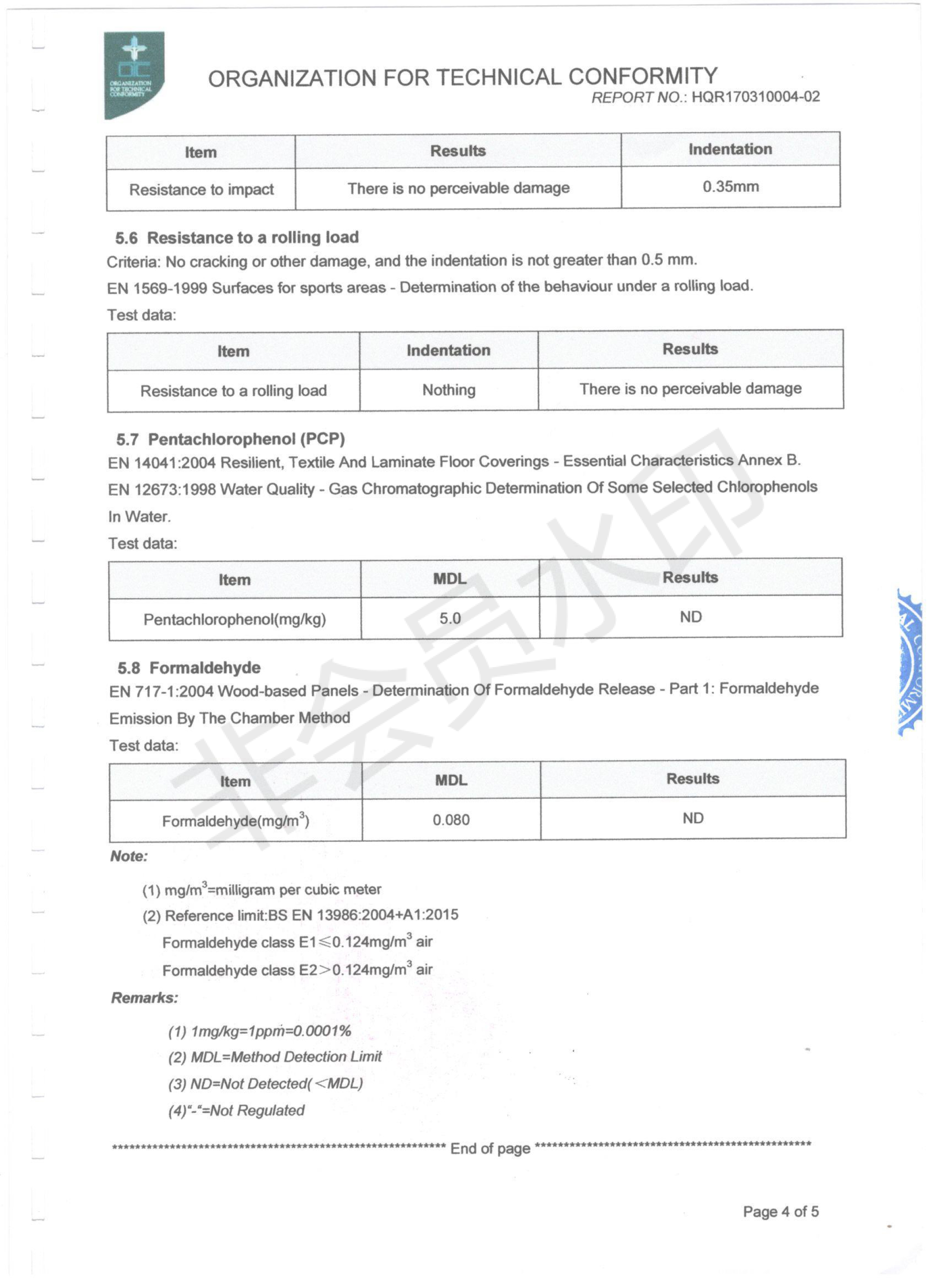
Shock absorption describes how much of a footfall or impact is absorbed by the floor assembly rather than transmitted to the substrate and the user. For sports applications this is a measurable property: Farfly's PVC sports flooring, tested to EN 14904-2006 under OTC certification HQR170310004-02, records impact resistance of 0.35 mm, vertical deformation of 0.3 mm, ball bounce of 95% and a friction coefficient of 0.56.
For general commercial interiors, the equivalent property is recovery under sustained load. Farfly's homogeneous vinyl flooring records a residual indentation of 0.06 mm within the ISO 24346:2006 test scope covered by SGS certification XMIN2109010490CM — the surface returns to profile after static loading from trolley legs, equipment feet and stacked furniture.
Ceramic and porcelain tile, cement screed and polished concrete are rigid assemblies: they do not deform underfoot, so impact energy transfers into the joint, the substrate and the user. Timber on a suspended system can provide intermediate resilience but behaves poorly under standing water and rolling loads. Resin coatings are thin films and contribute almost no point-elastic behaviour.
Specification checkpoint: require a numbered test report for vertical deformation and ball rebound rather than a datasheet statement.
2. Slip Resistance
Slip resistance for commercial flooring is normally expressed as a ramp-test classification. The R11 rating signifies an increased static friction coefficient — slip-resistant at angles of 19° to 27° as defined under DIN 51130 or EN 16165. Farfly's homogeneous vinyl flooring is supplied with an R9 anti-slip rating as standard, and sports surfaces are validated through the EN 14904-2006 friction coefficient test, which records 0.56 for the Boguan sports system.
The variable that catches buyers out is not the dry classification but the service condition. Tile slip performance depends heavily on surface finish and on whether the surface is dry, wet or contaminated by oils and cleaning agents; polished concrete can be extremely slippery when wet; coatings require an aggregate broadcast that wears with the film. A slip specification should therefore be written for the worst realistic condition in each zone, not for the material's dry test value.
3. Waterproofing and Moisture Behaviour
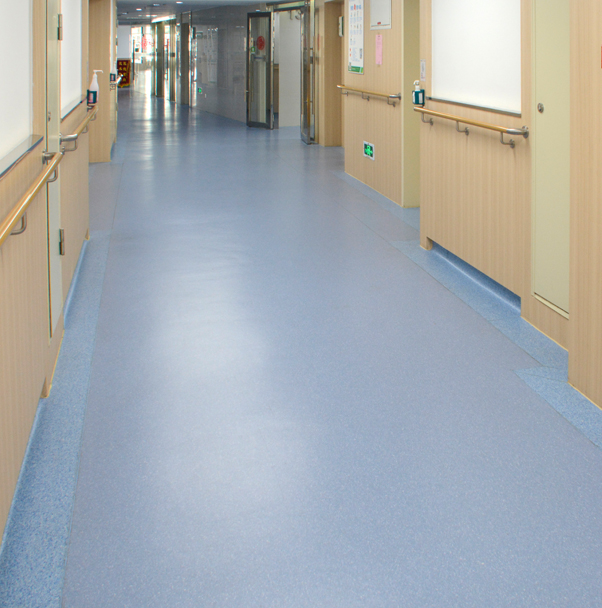
PVC roll and sheet flooring is a waterproof material installed with welded seams and coved skirting, which produces a continuous field with no water path to the substrate. The material is applied as a single continuous sheet, which is why the same product family is specified across hospitals, clinics, laboratories, factories and exhibition halls.
The alternatives behave differently rather than uniformly. Ceramic tile is itself impervious, but grout joints are porous and are the point at which water reaches the screed. Cement and polished concrete are porous and require sealing; moisture vapour transmission from the slab is a common cause of coating blistering and adhesive failure. Timber and engineered timber are moisture-sensitive and generally excluded from wet zones and from wash-down routes.
Indoor air quality belongs in the same section. Farfly's homogeneous vinyl flooring records a TVOC value below 10 µg/m³ at 28 days, which matters in sealed, high-occupancy interiors where the floor is one of the largest exposed surfaces.
4. Fire Resistance and Smoke Performance
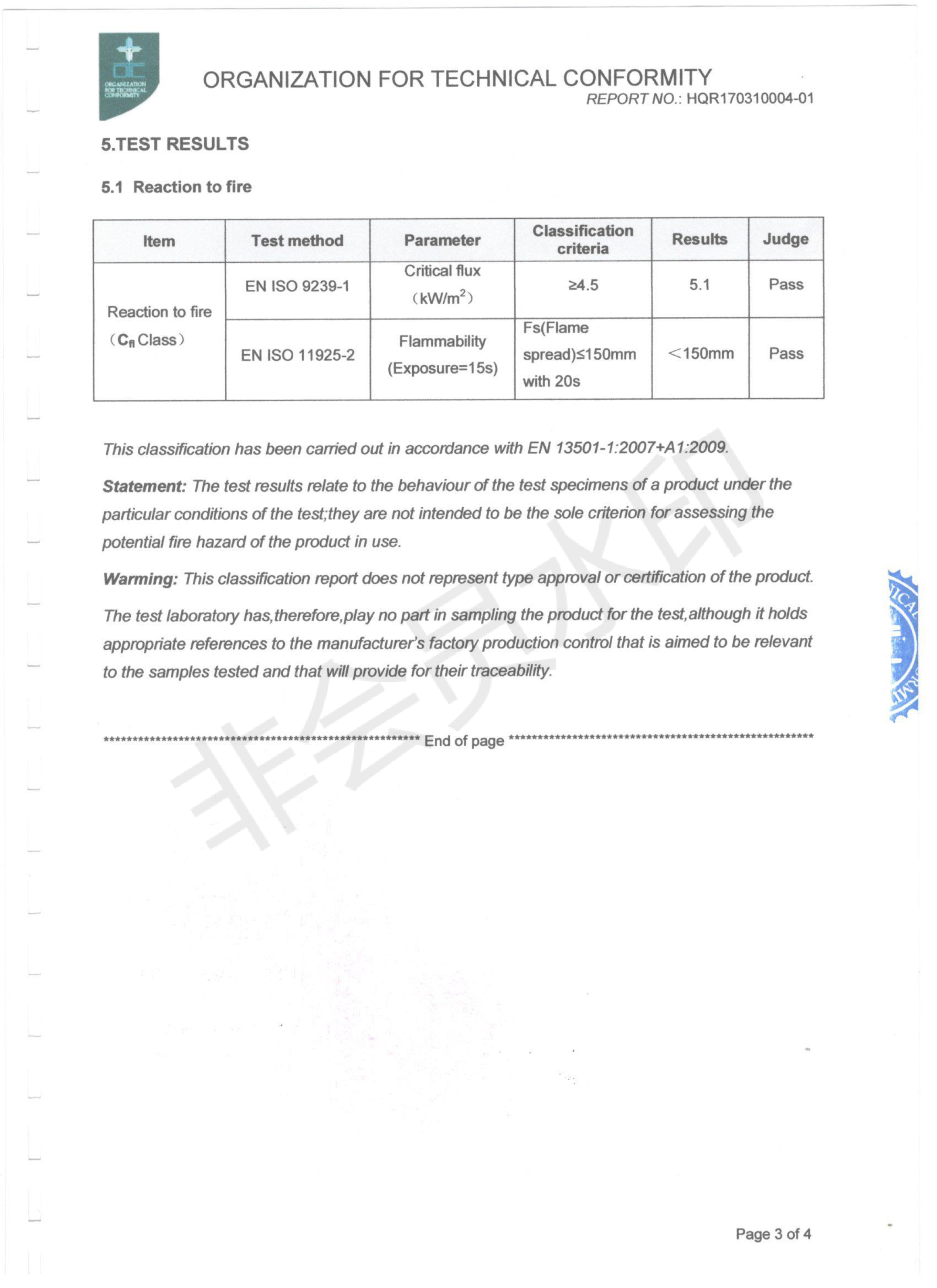
Reaction to fire is where compliance is decided. Farfly's homogeneous vinyl flooring carries a B-S1 fire rating, and reaction to fire has been evaluated to EN 13501-1:2007 with testing under EN ISO 9239-1:2010 and EN ISO 11925-2:2010 under OTC certification HQR170310004-01.
The aviation segment shows what the upper end of this discipline looks like. FAR 25.853 (14 CFR 25.853) requires self-extinguishing properties with an average burn length not exceeding 8 inches and a flame time under 15 seconds. Farfly's aircraft flooring — models LY, SMY, MMY, MY, BY and WD — is certified to CCAR 25.853(a) and EASA CS-25.853(a) under CAAC certification TC-ZR-20231549, and in a 12-second vertical flame resistance test recorded zero seconds of sustained burning, zero droplet burning time and a burn length of 24 mm, with the smoke toxicity test passed under CAAC certification TC-ZR-20231565 (D6-36075 F Table 4).
Non-combustible stone and cement bodies perform strongly on combustibility but offer no advantage where smoke density and toxicity in a compartment are the governing criteria. Timber requires treatment and periodic verification. Coatings vary widely by resin chemistry.
5. Antimicrobial and Hygiene Performance
Farfly's homogeneous vinyl flooring records an antibacterial performance of 99.50%. The larger hygiene variable, however, is geometry: a welded, seamless sheet has no grout line in which soil and biofilm accumulate, and no joint that has to be re-sealed. The proprietary TF Surface Treatment applied to the homogeneous range is specified for iodine resistance and lifelong wax-free maintenance, which matters in operating theatres, laboratories and cleanrooms where iodine-based disinfectants are routine.
Material safety is documented separately. Testing to EN 14372:2004 under ETS certification ETS19030602C analyses plasticizers, phthalates, solvents and other organic compounds by GC-MS — relevant where flooring is specified for schools, clinics and high-occupancy public interiors. Phthalate screening is also recorded for the sports range.
Tile hygiene is limited by its joints. Concrete is porous and dusts unless sealed and maintained. Timber's organic structure supports microbial growth when moisture is present. Coatings can be seamless but a damaged film is a hygiene break.
6. Maintenance Burden
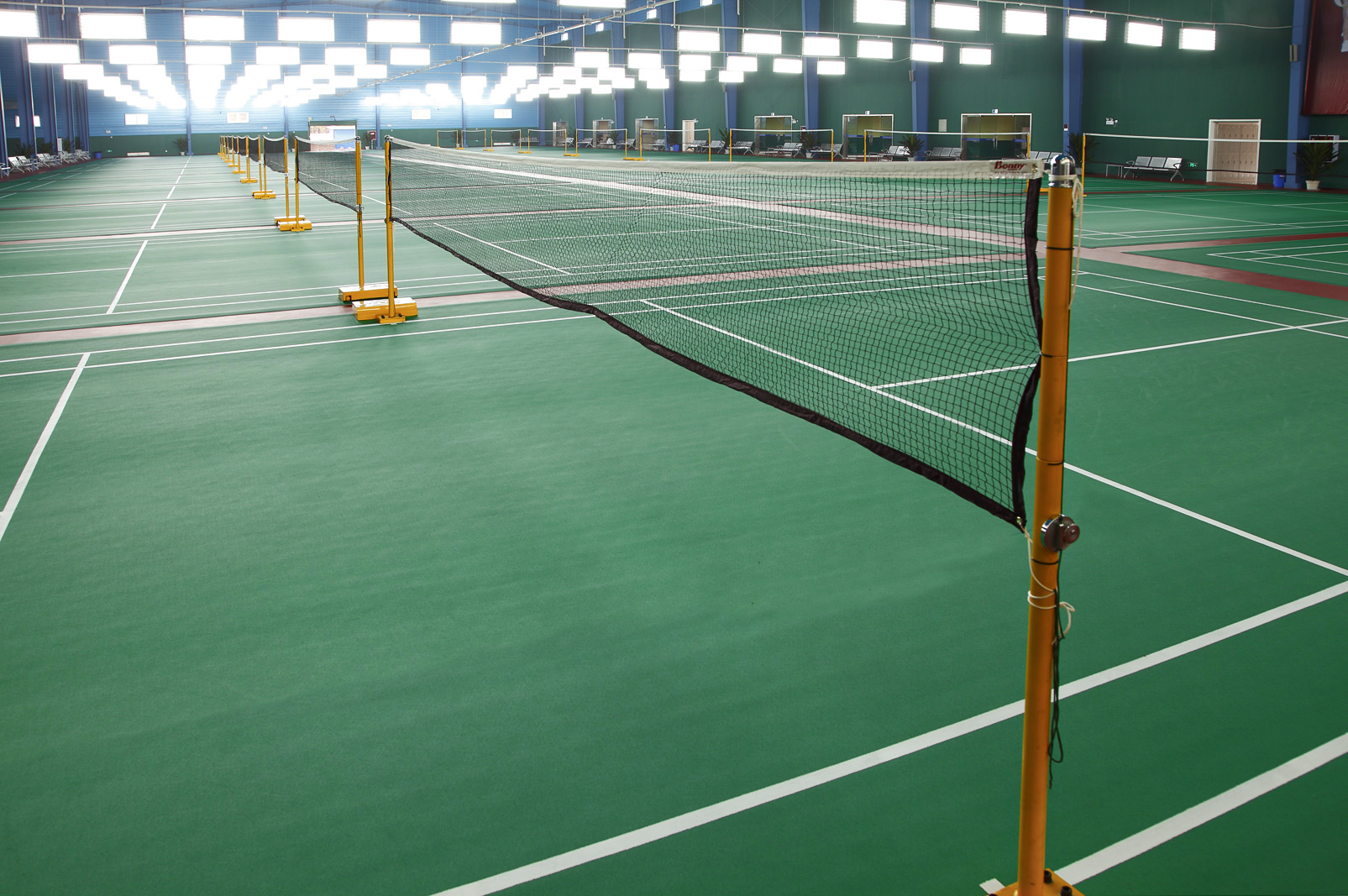
Maintenance is the cost line most often left out of the purchase comparison, and it is where the material difference is largest. A 16-court badminton installation in Australia using Farfly's PVC sports flooring has been in service for 10 years and reports 50% less maintenance required than the floor it replaced, with the same installation reported to protect knees and ankles through cushioning and to reduce long-term operating costs.
The reduction is structural rather than cosmetic. A seamless sheet removes grout scrubbing, stripping and re-sealing from the cleaning schedule, and a wax-free surface removes the polishing cycle that resilient and timber floors traditionally require. Tile maintenance is dominated by joint cleaning and periodic regrouting. Cement floors require dust control and re-sealing. Timber requires recoating and moisture management. Coatings require patch repair and full reapplication at the end of film life.
7. Total Lifecycle Cost
Lifecycle cost for flooring has five lines: material and installation; scheduled maintenance labour and consumables; facility downtime during works; replacement or refurbishment cycle; and compliance re-testing. Two of those lines sit outside the purchase order, which is why hard-surface quotations so often look cheaper than they turn out to be over a service period.
The maintenance line is quantifiable in operation — the Australian badminton installation evidences a 50% reduction over 10 years. The compliance line is quantifiable in advance: because BWF flooring certification must be renewed every two years, a sports floor that cannot be re-certified converts a capital purchase into a recurring problem. On installation, roll format also changes the equation, because fewer field joints mean fewer seams to weld, fewer transitions to fabricate and fewer points to inspect. Farfly supplies homogeneous flooring in a standard 2 m × 20 m roll, with 2.5 mm and 3 mm thicknesses available, and the buyer should model offcut and cutting waste for the actual layout rather than adopting a generic percentage.
Comparison Table: Commercial PVC Flooring vs. Tiles, Cement, Wood, and Coatings
| Criteria | Commercial PVC flooring (roll / sheet) | Ceramic & porcelain tile | Cement & polished concrete | Wood & engineered timber | Resin coatings |
|---|---|---|---|---|---|
| Shock absorption | Point-elastic. Sports system tested to EN 14904-2006: impact resistance 0.35 mm, vertical deformation 0.3 mm, ball bounce 95%. Homogeneous sheet: residual indentation 0.06 mm | Rigid; minimal deformation underfoot | Rigid; transmits impact into the substrate | Moderate resilience on suspended systems | Thin film; almost no point-elastic behaviour |
| Slip resistance | R11 classification = slip-resistant at 19°–27° (DIN 51130 / EN 16165). Homogeneous vinyl supplied with R9 as standard; sports surface friction coefficient 0.56 | Finish-dependent; joints interrupt the surface | Polished surfaces can be slippery when wet | Variable; degrades with wear and moisture | Requires aggregate broadcast; aggregate wears with the film |
| Waterproofing | Waterproof sheet installed with welded seams; applied as a single continuous sheet | Tile body impervious; grout joints are permeable | Porous; requires sealing and moisture control | Moisture-sensitive; not suited to wet zones | Water-resistant film; vulnerable to substrate vapour and blistering |
| Fire resistance | B-S1 fire rating; tested to EN 13501-1:2007 with EN ISO 9239-1:2010 and EN ISO 11925-2:2010 (OTC certificate HQR170310004-01) | Non-combustible stone body | Non-combustible mineral body | Combustible; requires treatment and verification | Varies by resin chemistry |
| Antimicrobial / hygiene | 99.50% antibacterial recorded; seamless welded sheet removes joint reservoirs; TF Surface Treatment specified for iodine resistance and wax-free maintenance | Joint lines are the principal cleaning limitation | Porous; dusts unless sealed and maintained | Organic structure; not specified for clinical wet zones | Seamless, but damage creates a hygiene break |
| Maintenance burden | 50% less maintenance recorded in a 10-year, 16-court Australian installation; no stripping, sealing or polishing cycle | Joint cleaning and periodic regrouting | Dust control and periodic re-sealing | Recoating and moisture management | Patch repair and full reapplication at end of film life |
| Total lifecycle cost | Lowest maintenance load of the five; roll format reduces field joints and allows section-level replacement | Durable material, heavy maintenance and replacement of joint system | Low material cost, recurring sealing cost | Mid-range capital, short recoat cycle | Low initial cost, short refurbishment cycle |
Step-by-Step: How to Run This Comparison for Your Own Project
- Write the compliance envelope before the material. List the standards the floor must demonstrate: CE marking to EN 14041:2018 for the European market, ISO 24346:2006 testing for homogeneous sheet, EN 13501-1 reaction-to-fire classification, the required slip classification, and a declared TVOC value. In aviation, the envelope is FAR 25.853 with CCAR 25.853(a) and EASA CS-25.853(a); in competitive badminton, it is BWF flooring grading.
- Decide whether the floor must be seamless and waterproof. If the building contains wet zones, wash-down routes, laboratories or clinical rooms, grout joints and unsealed concrete are eliminated at this step rather than at value engineering.
- Quantify traffic and cleaning capability. Match the specification to the cleaning resource actually available on site. A floor that requires a stripping-and-polishing cycle but receives only damp mopping will fail on appearance before it fails on wear.
- Model the five lifecycle cost lines. Material and installation, scheduled maintenance labour and consumables, downtime, replacement cycle and compliance re-testing. The Australian badminton case shows what the maintenance line looks like in practice when the surface is seamless and wax-free.
- Validate with samples and third-party testing. Farfly supplies commercial PVC flooring with a minimum order quantity of 100 sqm and applies 100% in-house testing plus third-party inspection through SGS, so a sample evaluation can be run against the same reference documents that will be issued with the production batch.
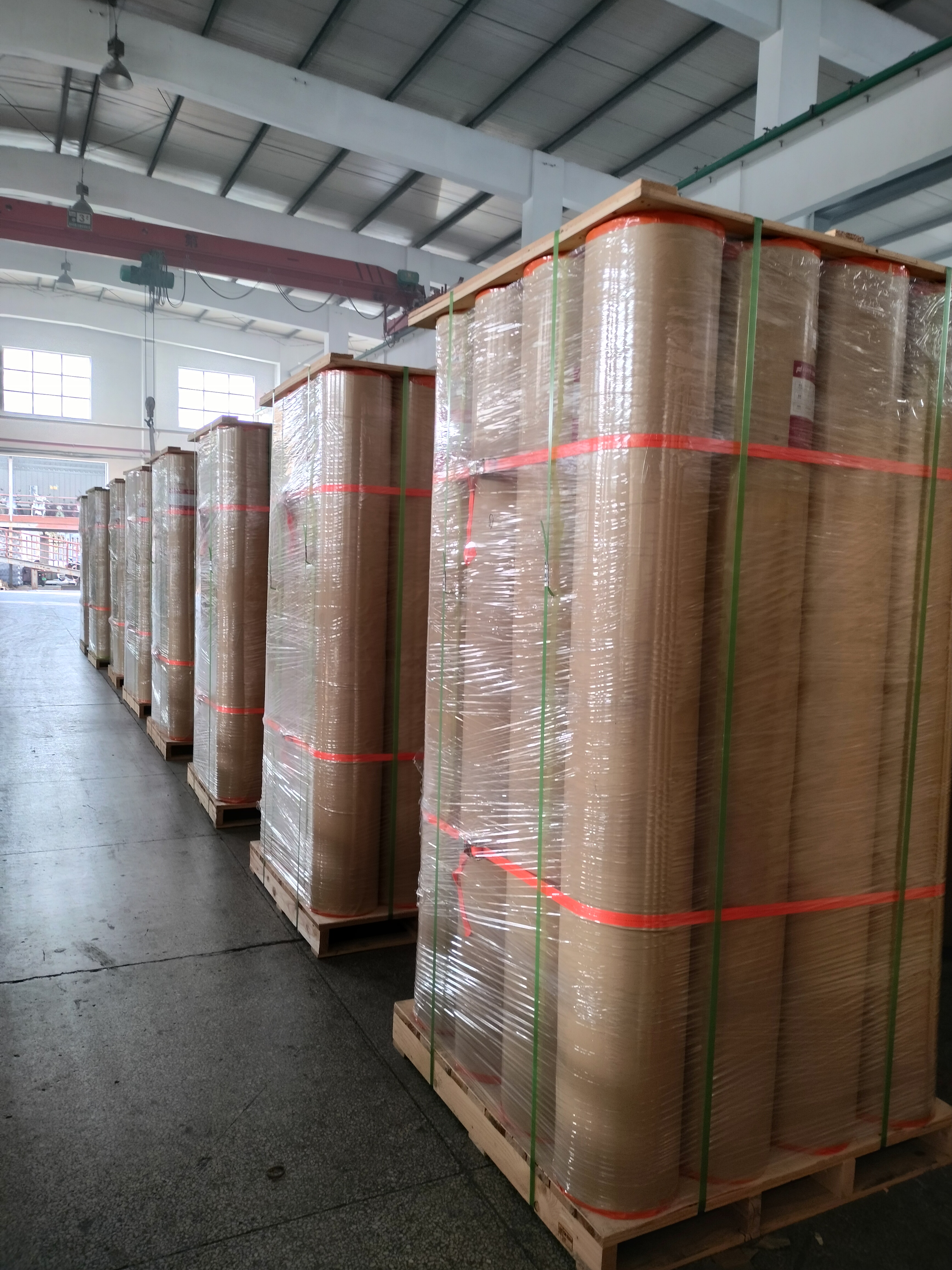
- Confirm the supply chain before committing. Check stock depth, dispatch time, container loading pattern and the manufacturer's ability to combine formats. Farfly, under WUXI TEFA DECORATION MATERIAL CO., LTD., holds 300,000 sqm of ready-to-ship inventory, operates 6 advanced production lines with a monthly capacity of 600,000 sqm, and offers 7-day rapid dispatch with mix-container shipping for global EPC contractors.
Use Cases: Matching the Floor to the Facility
The comparison only becomes actionable when it is mapped onto facility type. The following table sets out the dominant constraint in each environment and the option that satisfies it.
| Facility type | Dominant constraint | Best-fit option | Why |
|---|---|---|---|
| Hospitals and clinics | Hygiene, seamlessness, chemical resistance, slip safety in wet zones | Homogeneous PVC sheet with welded seams and coved skirting | 99.50% antibacterial surface, no grout reservoir, iodine-resistant TF Surface Treatment, TVOC below 10 µg/m³ at 28 days |
| Factories and workshops | Abrasion, impact, chemical exposure, cleaning speed | Heavy-duty commercial PVC roll | Abrasion resistance classified T, residual indentation 0.06 mm, continuous sheet resists point loading and rolling traffic |
| Warehouses | Rolling loads, dust control, repair without shutdown | PVC roll over a prepared substrate in hygiene-critical and finished zones; sealed concrete acceptable in open, dry storage | Section-level replacement keeps aisles in service |
| Offices | Appearance retention, acoustic comfort, low cleaning burden | Homogeneous PVC sheet | Uniform surface, no joint cleaning, wax-free maintenance |
| Schools | Slip safety, durability, cleaning speed, indoor air quality | PVC sheet with verified low TVOC and phthalate screening | EN 14372:2004 testing supports material safety documentation for occupied buildings |
| Shopping malls and exhibition halls | Footfall, appearance, cleaning cost per square metre | PVC sheet or high-traffic roll | Continuous field reduces joints; maintenance load is the dominant lifecycle cost at this traffic level |
| Sports halls and badminton courts | Shock absorption, ball rebound, certification validity | PVC sports flooring certified to BWF and tested to EN 14904-2006 | Ball bounce 95%, friction coefficient 0.56, certification renewed every two years |
| Aircraft cabins and galleys | Fire retardancy, smoke toxicity, weight discipline | Aviation-grade PVC flooring | 12-second vertical flame test: zero sustained burning, zero droplet burning time, 24 mm burn length, smoke toxicity passed |
FAQ
What compliance documentation should a commercial PVC flooring supplier provide for a European Union project?
At minimum, four documents. First, CE marking to EN 14041:2018 — Farfly holds certificate TCF-OY20250623-CPR issued by ICR Co. Ltd., valid from 26 June 2025 to 25 June 2030. Second, ISO test evidence for homogeneous flooring: SGS certificate XMIN2109010490CM covers the ISO 24346:2006 scope, including residual indentation, dimensional stability, flexibility, wear resistance, chemical resistance and colour fastness to light. Third, reaction-to-fire classification to EN 13501-1:2007 with EN ISO 9239-1:2010 and EN ISO 11925-2:2010 testing under OTC certificate HQR170310004-01. Fourth, management system certificates — ISO 9001:2015 (29524Q04072R0S), ISO 14001:2015 (29524E04073R0S) and ISO 45001:2018 (29524S040725R0S), all issued by AUBURN INSPECTION & CERTIFICATION GROUP CO., LTD. Aviation projects additionally require CCAR 25.853(a) and EASA CS-25.853(a) certification, for which the reference is TC-ZR-20231549 issued by CAAC.
How does commercial PVC flooring compare on shock absorption and slip resistance?
On shock absorption, the sports range tested to EN 14904-2006 records impact resistance of 0.35 mm, vertical deformation of 0.3 mm and ball bounce of 95%, while homogeneous commercial sheet records residual indentation of 0.06 mm, meaning it recovers its profile after sustained static load. Rigid tile and concrete assemblies deform minimally, so impact energy transfers into the joint and the substrate. On slip resistance, an R11 rating denotes slip resistance at ramp angles of 19° to 27° under DIN 51130 or EN 16165; Farfly's homogeneous vinyl flooring is supplied with an R9 anti-slip rating as standard, and the Boguan sports system records a friction coefficient of 0.56 under the EN 14904-2006 test scope.
How should total cost be compared between PVC flooring and tiles, cement, wood or coatings?
Build the comparison on five lines rather than on purchase price: material and installation; scheduled maintenance labour and consumables; downtime during works; replacement or refurbishment cycle; and compliance re-testing. The maintenance line is where the largest documented difference sits — a 16-court badminton installation in Australia using Farfly's PVC sports flooring has been in service for 10 years and reports 50% less maintenance required, because a seamless, wax-free surface removes grout scrubbing, stripping, sealing and polishing from the schedule. The compliance line is quantifiable in advance: because BWF flooring certification must be renewed every two years, a sports floor that cannot be re-certified becomes a recurring cost rather than a one-off capital item.
Can we validate performance with a sample before placing an order?
Yes. Farfly supplies commercial PVC flooring with a minimum order quantity of 100 sqm, and applies 100% in-house testing plus third-party inspection through SGS, so sample evaluation and production batches are checked against the same reference documents. Customization is available across dimensions, colour, design pattern, packaging, logo, craftsmanship and structure under an OEM/ODM model, with the option to specify thickness — 2 mm standard, 2.5 mm and 3 mm available — and roll format for the project layout. Samples are the point at which slip performance, surface finish and colour are confirmed against the specification, not after installation.
What lead times and stock availability should a buyer expect from a commercial PVC flooring manufacturer?
This is where supply chain design determines whether a specification is deliverable. Farfly, the flooring brand operated by WUXI TEFA DECORATION MATERIAL CO., LTD., holds 300,000 sqm of ready-to-ship inventory, operates 6 advanced production lines with a monthly capacity of 600,000 sqm, and works to a 7-day rapid dispatch model with mix-container shipping for global EPC contractors — the format that lets a project combine several floor types in one container instead of waiting for a full single-SKU load. To start a sample request or a project quotation, contact the team at mara@topvcfloor.com or via WhatsApp.
Conclusion
Commercial PVC flooring is not universally superior to tile, cement, timber or coatings — but for the majority of high-traffic interior environments, it satisfies more of the criteria that decide whether a floor passes handover, survives occupancy and stays affordable to operate. It wins on seamlessness, waterproofing, slip control, antimicrobial surface behaviour and maintenance load. It concedes on compressive strength under heavy static point loads and on the simplicity of coating a damaged substrate.
The practical conclusion for a 2026 specification is procedural. Write the compliance envelope first — CE EN 14041:2018, ISO 24346:2006, EN 13501-1, the required slip classification, declared TVOC, and where relevant FAR 25.853 or BWF grading. Decide early whether grout joints are acceptable in the facility. Model the five lifecycle cost lines including maintenance and re-certification. Then validate the shortlist with samples and numbered test reports rather than product literature. Buyers who follow that sequence end up comparing materials on evidence, which is the only comparison that holds up after occupation.
Request a Sample or Project Quotation
Farfly — the flooring brand operated by WUXI TEFA DECORATION MATERIAL CO., LTD. — manufactures homogeneous PVC flooring, PVC sports flooring certified to BWF grading, and aviation PVC flooring compliant with FAR 25.853 and Boeing BSS 7239 toxicity requirements, backed by more than 399 international testing certifications and 300,000 sqm of ready-to-ship stock.
Sample requests, technical documentation and mix-container quotations: email mara@topvcfloor.com or message +86-18751567592. Full specifications are available at topvcfloor.com, and the complete product brochure can be downloaded here.