
Homogeneous Vinyl Flooring 101: Through-Body Construction, Wear and Best-Fit Spaces
Homogeneous vinyl flooring is a resilient sheet product whose composition — and, in most designs, its colour and pattern — runs through the full thickness of the material. There is no printed design layer sitting under a separate transparent wear film. That single structural fact explains most of the behaviour buyers care about: worn areas do not expose a different pattern, a dulled corridor lane can be maintained rather than replaced, and the product is normally specified where traffic never stops — hospitals, corridors, retail sales floors, workshops and laboratories.
The trade-off is equally concrete. Because the appearance is carried through the body of the sheet, homogeneous vinyl offers fewer decorative options than layered products and does not build in comfort or acoustic layers. Heterogeneous vinyl — a wear layer, a printed design layer, a core and a backing — remains the better answer for offices, schools, hotels and residential interiors, where appearance variety, underfoot comfort or sound reduction drive the decision.
This guide covers the construction difference, how wear actually appears on each build, the specification figures worth checking before a submittal is approved, and the spaces where each product earns its cost.
Why vinyl floors look worn, and why construction decides how soon you notice
Floor wear is usually noticed as a change in appearance rather than a hole in the material. Three mechanisms drive it: abrasion removes material from the surface, sustained loads leave indentations, and soils, disinfectants and other chemicals stain or dull the finish. On a layered floor the printed design sits beneath a transparent wear layer, so abrasion and shallow scratching change the way the pattern reads — a doorway or a trolley route starts to look paler than the surrounding floor even though the sheet is still structurally intact.
Homogeneous construction removes that particular failure mode. Because colour and pattern continue through the depth, abrasion and shallow scratching expose material of the same appearance instead of a different layer, which manufacturers describe as improved scratch resistance. The advantage is real in circulation areas, but it is narrow: homogeneous sheet still indents under heavy static or rolling loads, still stains if the surface treatment and cleaning regime are wrong, and still carries an abrasion classification that has to be matched to the traffic the space actually receives.
Construction, not a durability grade. Two homogeneous products can carry different abrasion groups, indentation results, slip classes and emissions figures. The category name tells a supplier which build to offer; the product data sheet decides whether it suits the room.
What the standard defines, and what it leaves open
EN ISO 10581 is the product standard for homogeneous PVC floor coverings and is the reference most European and export specifications cite when they ask for a homogeneous product. In practice the term means a covering whose composition is consistent through its thickness, rather than a layered build in which the visible design is a printed film protected by a wear layer. Industry explanations describe the same thing: a single-layer construction with consistent colour and pattern through the depth, trading design variety for wear performance.
Heterogeneous sheet is the layered alternative. A typical build combines a transparent wear layer, a printed design layer, a core and a backing. Each layer can be optimised separately — a thicker wear layer for traffic, a foam backing for comfort and impact sound, a wider print range for design. That flexibility is why heterogeneous products dominate offices, schools, hotels and housing, and why the two builds are rarely interchangeable in a serious specification.
Commercial sheet vinyl is generally presented as these two forms, and the distinction is a construction classification rather than a ranking. Market forecasts should be read with the same care: Fortune Business Insights projects the global healthcare vinyl flooring market reaching USD 16.9 billion by 2034 at a 7.5% CAGR for 2026–2034, but that figure covers healthcare vinyl flooring as a category, not homogeneous products alone. It signals direction, not a homogeneous-specific market size.
Homogeneous vs heterogeneous: a decision comparison
The table below is a starting point for a submittal review, not a substitute for product data. Both columns describe documented product characteristics; neither establishes that one build performs better in a given room without the corresponding test results.
| Decision point | Homogeneous sheet | Heterogeneous sheet |
|---|---|---|
| Build | Single layer; composition and colour run through the thickness | Multiple layers: wear layer, printed design layer, core, backing |
| How wear appears | Abrasion exposes the same appearance, so wear is less noticeable | Design sits under the wear layer, so surface removal changes how the pattern reads |
| Design range | Narrower; the look comes from the body of the material | Wider; printed designs plus wear-layer options |
| Comfort and acoustics | No built-in comfort or acoustic layer | Can incorporate comfort and acoustic options |
| Typical spaces | Hospitals, corridors, retail areas, workshops and other heavy-traffic zones | Offices, schools, hotels and residential interiors |
| What to verify | EN ISO 10581 conformity, abrasion group, indentation, surface treatment, emissions | Wear-layer specification, abrasion group, indentation, backing performance |
The figures that actually decide a specification
Once the construction is fixed, performance is decided by a short list of measurable properties. The values below come from published data for FARFLYING's Vinyl Flooring range (model 3659) and from specification guidance; they are the figures to confirm against the datasheet and test report for the exact product code being supplied.
- Abrasion group. Under the Frick-Taber test described in EN 660-2, Group T corresponds to a volume loss of 2.0 mm³ or less per 100 revolutions. Specifier guidance for heavy commercial and industrial traffic commonly pairs a Group T classification with use classes 34 and 43. The model 3659 range publishes a T abrasion rating.
- Indentation. Residual indentation describes how far the surface stays compressed after a load is removed; the published figure for model 3659 is 0.06 mm. Ask for the test conditions, because a static hospital bed leg and a rolling trolley do not load the floor in the same way.
- Slip resistance. The published anti-slip class for model 3659 is R9. Match the class to the real condition of the floor in use — dry corridors, wet laboratory spill zones and oily workshops do not impose the same requirement.
- Fire classification. B-S1 is the published reaction-to-fire class for model 3659.
- Emissions. The published 28-day TVOC figure is below 10 μg/m³, which matters in enclosed healthcare, laboratory and cleanroom areas where flooring, adhesives and finishes are installed close together.
- Antibacterial performance. The published figure is 99.50%. Ask for the test method and the organisms tested, and keep cleaning protocols as the primary infection-control measure rather than treating a surface claim as a substitute.
Functional variants inside the same build
Because homogeneous sheet is a single material, functional performance is added through formulation and surface treatment rather than through extra layers. Three variants dominate healthcare and industrial specifications.
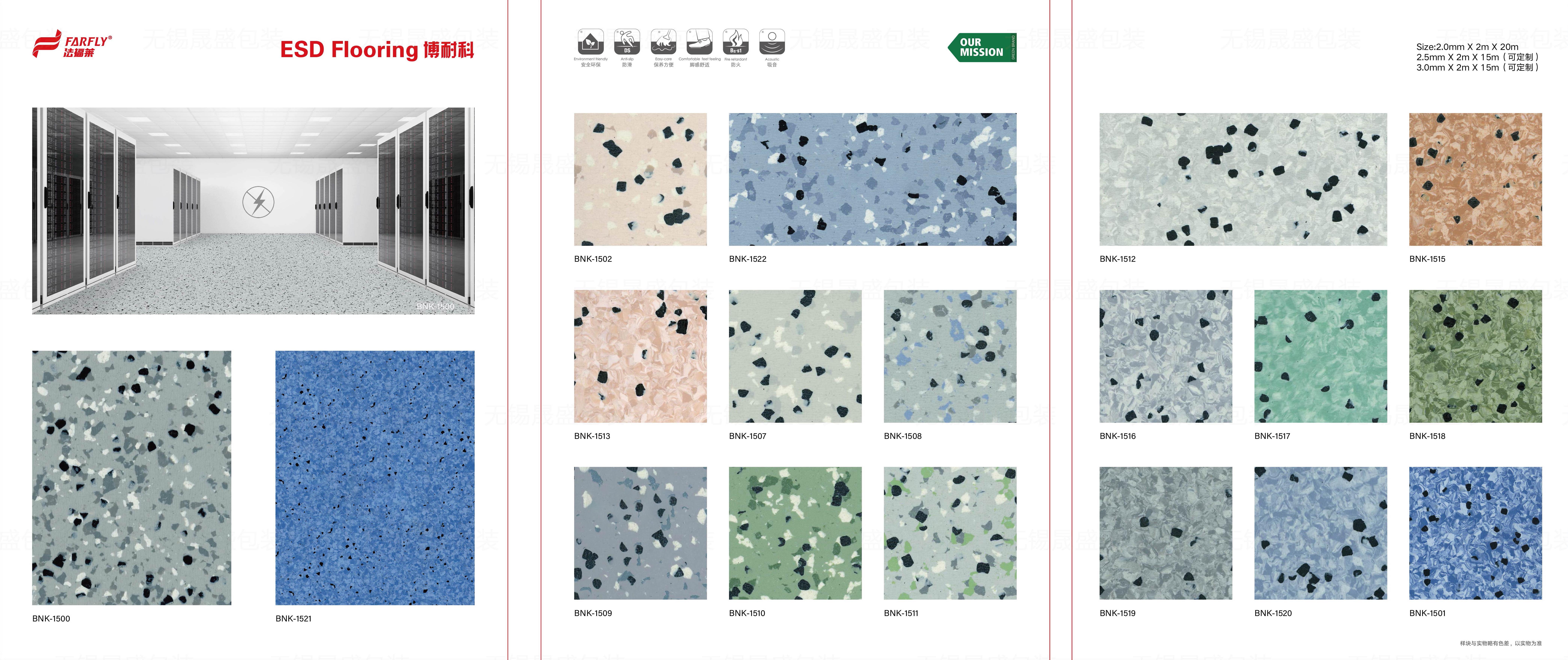
Static control. FARFLYING states that its ESD series maintains resistance in the range of 10⁴ to 10⁶ Ω and lists conductive flooring among the product types in the range. Other manufacturers publish different metrics: Tarkett's Primo SD is described as a permanently static-dissipative homogeneous sheet for laboratories, hospitals and server rooms, with an electrostatic charge below 2 kV under EN 1815, while Forbo positions conductive and static-dissipative homogeneous vinyl for healthcare, pharmaceutical, life-science and industrial environments. Resistance and electrostatic charge are separate measurements and cannot be ranked against each other. When an ESD claim matters, request the resistance type (surface, vertical or resistance to ground), the test method, the conditioning and the exact product code.
Antibacterial and chemical-resistant surfaces. Hospital disinfectants, iodine-based preparations and laboratory reagents attack a floor in different ways. FARFLYING states that its healthcare homogeneous vinyl uses a TF Surface Treatment formulated for iodine resistance and wax-free maintenance, and publishes chemical resistance as "good" for model 3659. Both are supplier statements: ask for the test report, the chemicals covered and the contact times, rather than relying on the wording of the brochure.
Low-emission and low-maintenance builds. A 28-day TVOC result below 10 μg/m³ is the kind of evidence a cleanroom or sealed ward project needs at handover. Wax-free maintenance claims change the cleaning regime and the consumables budget, so they should be backed by written maintenance instructions that name the products and dilution rates approved for the surface treatment.
Step by step: specifying without over- or under-buying
- Classify the space by traffic, not by room name. A hospital corridor, a ward and a back-of-house service route in the same building can carry different loads. Use-class language such as 34/43 gives suppliers a common reference; the final check is still the actual traffic pattern.
- Fix the construction on paper. State homogeneous construction and cite EN ISO 10581 so that a layered product cannot be offered as an equivalent. This is the single clause that decides everything downstream.
- Match abrasion and indentation to the load. Group T abrasion is the usual starting point for heavy commercial and industrial traffic; add a residual-indentation limit where beds, trolleys, pallets or equipment legs concentrate weight.
- Match slip and fire class to the room. Slip class belongs to the actual condition of the floor in use, and the fire classification must suit the escape route or compartment the floor sits in.
- Decide the functional variant before pricing. Static control, antibacterial treatment, chemical resistance and low emissions are separate requirements with separate evidence. Buying a standard roll and adding requirements later is the most common cause of re-tendered packages.
- Confirm installation detailing. Specifier guidance for healthcare work describes heat-welded joints and a 100 mm flash cove to reduce floor-to-wall junctions; the welded seam and the coved skirting do most of the hygiene work, not the material alone. Directional designs must be laid in a consistent direction, non-directional designs allow alternate sheet orientation, and both need acclimatisation and a moisture-checked substrate before adhesive is applied.
- Check the document pack. Ask for test reports showing product code, laboratory, method and date; certificates with scope and holder; an environmental declaration where the project requires one — a homogeneous vinyl EPD exists at category level — and a maintenance document that matches the surface treatment actually supplied.
Where homogeneous vinyl earns its place
Hospitals, clinics and long corridors. Continuous sheet with few welded seams, coved edges and a through-body surface is the practical combination for wards, treatment rooms and circulation routes. Iodine-based disinfectants and constant trolley traffic are the two stresses to test for, which is why iodine resistance and abrasion data belong in the submittal rather than in a footnote.
Operating rooms and laboratories. Chemical resistance matters more than appearance here, and static control may be required where sensitive equipment is present. Confirm the chemical list and contact times before approving the product, and keep the welded detail consistent with the theatre or lab cleaning protocol.
Cleanrooms and electronics workshops. A low-emission sheet plus a welded installation reduces the two things a cleanroom cannot tolerate: particles from joints and volatile compounds from new materials. ESD variants add static control, subject to the test-method checks already described.
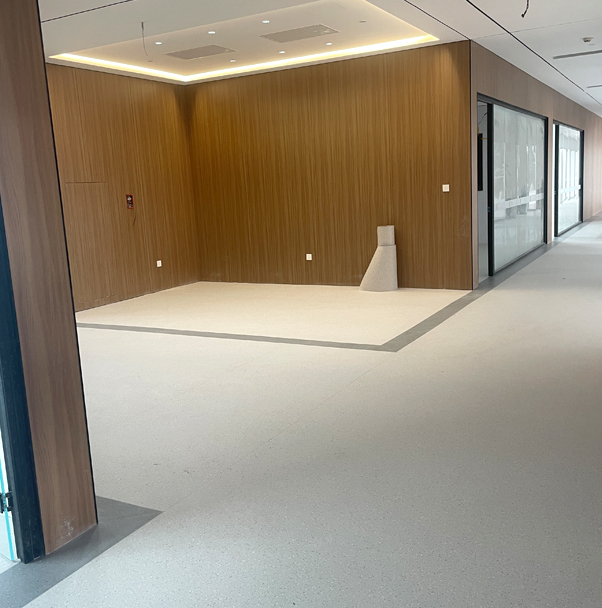
Retail floors, exhibition halls and public circulation. These spaces combine concentrated footfall with visible wear in narrow lanes. Through-body appearance is the reason a floor still reads as one surface after several years of cleaning, and model 3659 lists shopping malls and exhibition halls among its applications.
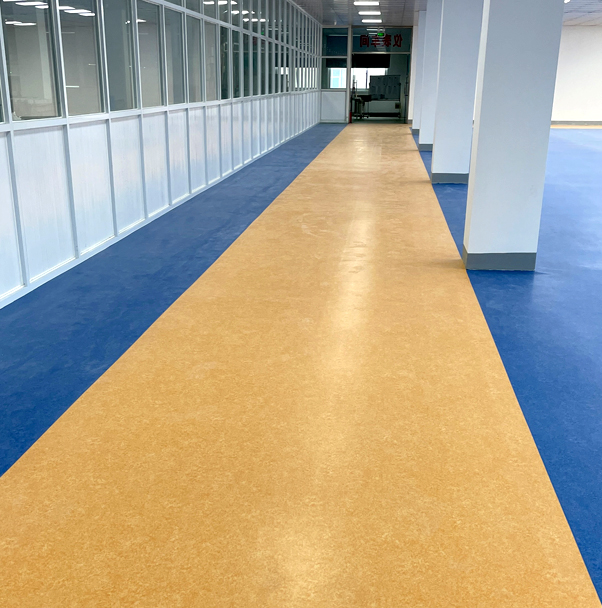
Workshops, factories and warehouses. Abrasion group, indentation and chemical resistance decide performance here; comfort and acoustics rarely do. The same range lists factories, warehouses and electronics workshops among its intended applications.
Where heterogeneous wins instead. Offices, schools, hotels and residential interiors are the documented fit for layered sheet, because design choice, comfort and acoustic performance carry more weight than wear-through resistance. Specifying homogeneous into a hotel lobby for its durability alone and then adding an acoustic underlay to recover comfort is a common and expensive workaround.
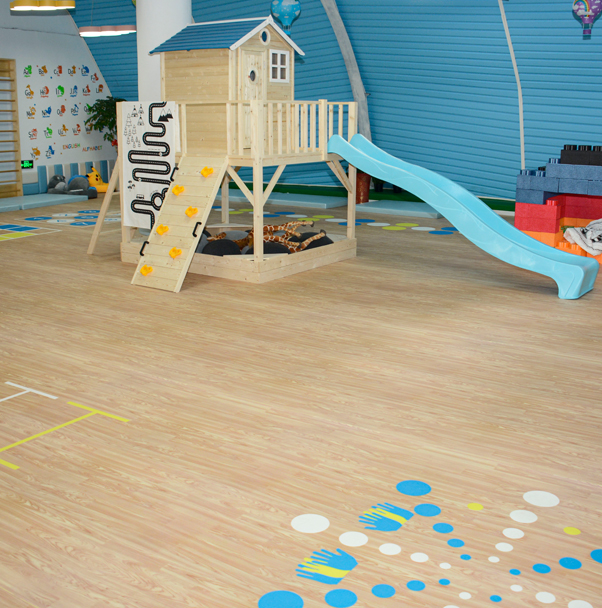
Worked example: what a documented homogeneous range looks like
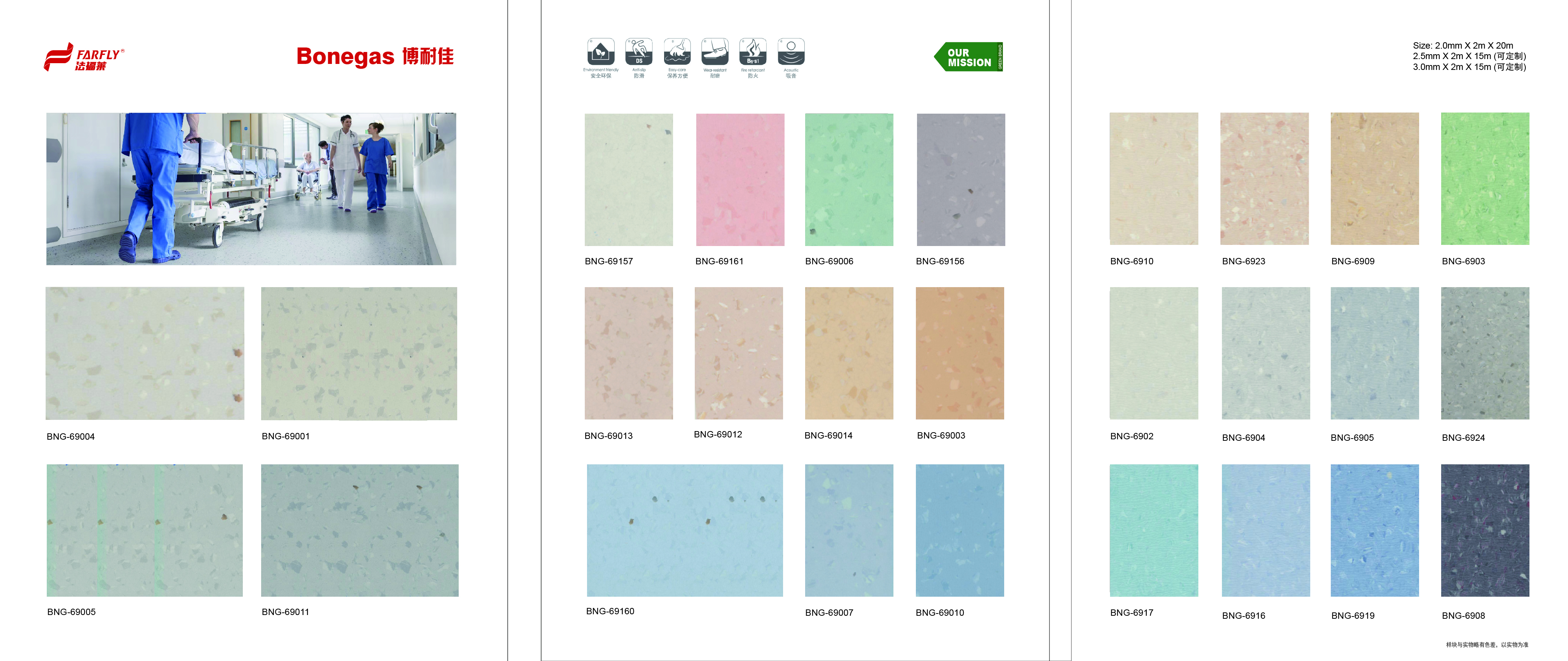
FARFLYING FLOORING is the flooring brand of WUXI TEFA DECORATION MATERIAL CO., LTD., a Chinese resilient-flooring manufacturer founded in 2012 that produces homogeneous flooring, PVC sports flooring and aircraft flooring, and states that it holds 399+ international testing certifications. Its Vinyl Flooring range (model 3659) covers series such as Bonaire, Bonet, Boniro, Bonegas, Bonami and Bona Star, plus an ESD series and a bathroom-floor variant — a useful illustration of how a single homogeneous build is adapted across care, education, retail and industrial projects.
| Property | Published value (model 3659) |
|---|---|
| Thickness | 2 mm, customizable to 2.5 mm or 3 mm |
| Roll size | 2 × 20 m per roll |
| Fire rating | B-S1 |
| Abrasion resistance | T |
| Residual indentation | 0.06 mm |
| Anti-slip property | R9 |
| Antibacterial | 99.50% |
| TVOC (28 day) | below 10 μg/m³ |
| Material | Polyvinyl chloride, calcium carbonate, eco-friendly DOTP plasticizer |
What the table shows is a range that can serve both a 2 mm standard corridor and a 3 mm specification without changing construction — the difference is thickness and the variant chosen, not the build category. For projects with fixed handover dates, the company also states that it runs six production lines with a ready-to-ship inventory of 300,000 m², a seven-day dispatch model and mixed-container loading for contractors. Those are supplier-stated supply capabilities and should be confirmed in the order documents rather than assumed from a brochure.
Frequently asked questions
Is homogeneous vinyl flooring the same as through-body flooring?
Yes. Through-body describes the construction: the composition, and usually the colour and pattern, run through the thickness rather than sitting in a printed layer under a wear film. EN ISO 10581 is the product standard that specifications normally cite for homogeneous PVC floor coverings, while heterogeneous sheet is the layered alternative built from a wear layer, printed design layer, core and backing.
Which build suits a hospital corridor — homogeneous or heterogeneous?
Homogeneous. Its through-body construction makes wear less noticeable and supports long-term intensive use, and it is the documented choice for hospitals, corridors, retail areas and workshops. Heterogeneous sheet is the better fit for offices, schools, hotels and residential interiors, where design variety, underfoot comfort or acoustic performance carry more weight than wear-through resistance.
What thickness should be specified for heavy traffic?
Thickness alone does not define wear performance. The FARFLYING Vinyl Flooring range publishes 2 mm as standard, customizable to 2.5 mm or 3 mm, with a T abrasion rating and 0.06 mm residual indentation. Specify the abrasion group, the indentation limit and the use class alongside the thickness, and check the test report rather than the millimetre figure on its own.
Does homogeneous vinyl flooring need waxing or polishing?
That depends on the surface treatment of the specific product, not on the category. FARFLYING states that its healthcare homogeneous vinyl uses a TF Surface Treatment formulated for iodine resistance and wax-free maintenance; that is a supplier claim, so request the maintenance document and confirm which cleaning agents and dilution rates are approved before writing the maintenance budget.
How do I verify an anti-static or ESD claim before ordering?
Ask for four things: the resistance type (surface, vertical or resistance to ground), the test method and conditioning, the exact product code, and a report from a laboratory rather than a range quoted in a brochure. Reported values are not comparable across products unless the method matches — a resistance range such as FARFLYING's stated 10⁴ to 10⁶ Ω and an electrostatic charge figure such as below 2 kV under EN 1815 measure different things. Sample rolls and the matching technical file are the practical way to close that gap; requests can be raised through FARFLYING FLOORING.
The short version
Homogeneous vinyl flooring solves one specific problem well: a floor that stays visually consistent under constant traffic because its appearance is part of the material rather than a layer on top of it. It is the right specification for hospitals, corridors, retail floors, cleanrooms, laboratories and workshops, provided the abrasion group, indentation, slip class, fire rating and emissions figures are confirmed for the exact product code. It is the wrong specification where design variety, comfort or acoustics decide the outcome — that is heterogeneous territory.
The rest of the work is documentation: a construction clause that cites the standard, test reports that name the product, welded and coved detailing that matches the cleaning protocol, and maintenance instructions that match the surface treatment actually supplied. Buyers who hold those four items together rarely have to replace a floor early.
The full FARFLYING product and technical documentation is available in the company brochure (PDF), including range data, series names and application notes for healthcare, education, retail and industrial projects.
Have Questions or Need More Details?
Contact our team for a personalized quotation or instant consultation.
Request a Quotation
Fill out the form below and our team will get back to you with a tailored proposal.
WhatsApp Direct Chat
Prefer to chat in real-time? Message us on WhatsApp for instant assistance & quick answers.
- Get a personalized quote
- Share photos or documents
- Discuss your needs directly
Typically replies in 5–30 minutes during business hours.