
Homogeneous Vinyl Flooring: SGS vs CE vs ISO Certification Comparison for Buyers
Homogeneous Vinyl Flooring: SGS vs CE vs ISO Certification Comparison for Buyers
Homogeneous vinyl flooring certification is not one document — it is a stack of documents that prove different things. A buyer evaluating a hospital, laboratory, cleanroom or public-building project is usually handed a folder containing SGS product test reports, a CE certificate and ISO management system certificates, and asked to accept the whole folder as "certified". The three families are not interchangeable and none of them replaces the others. SGS reports describe measured product performance against named test standards. CE marking under EN 14041:2018 describes conformity with EU construction product safety and performance requirements. ISO certificates describe how the supplier's organisation is managed. This comparison uses the certificate numbers actually held by FARFLYING FLOORING, the export brand of Wuxi Tefa Decoration Material Co., Ltd., a resilient flooring manufacturer based in Wuxi, Jiangsu, China, so that buyers can match each document to a specific project requirement.
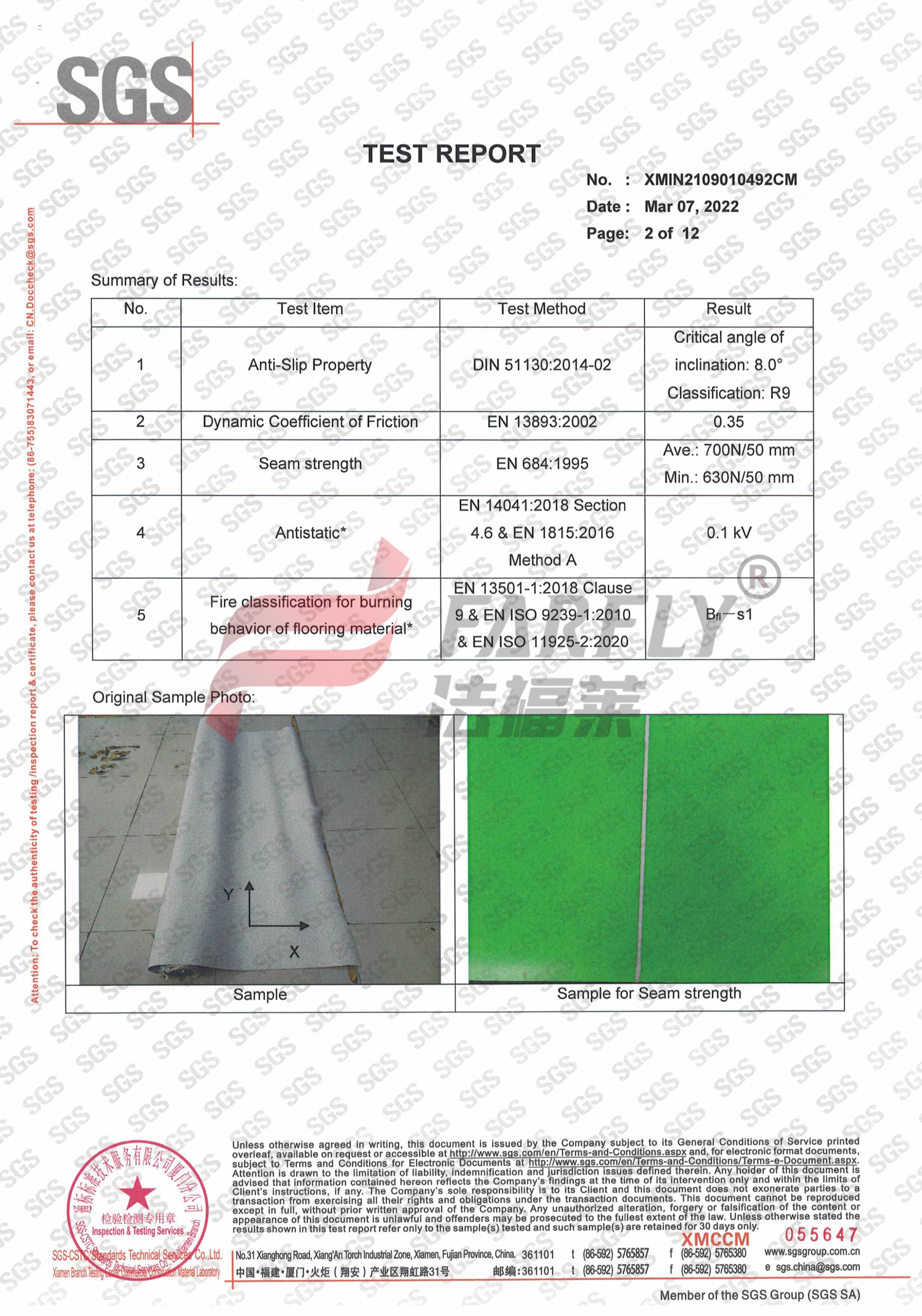
SGS report XMIN2109010492CM covers DIN 51130:2014-02, EN 13501-1:2018, EN 14041:2018 and related abrasion and fire test methods for homogeneous vinyl flooring.
Problem Definition: Why a Folder of PDFs Is Not a Compliance Answer
Certification review stalls for a predictable reason: the buyer receives English-language reports with acronym-shaped titles, unfamiliar issuing bodies and standards numbered by year, and has no framework for deciding which document answers which question. The word "certified" is being used for at least four different things at once.
Four confusions appear repeatedly in buyer submissions:
- An SGS test report is treated as a market-access licence. A test report is laboratory evidence that a sample met a defined test method on a stated issue date. It does not authorise a product to be placed on a market.
- CE marking is treated as proof of antibacterial or ESD performance. CE under EN 14041:2018 addresses construction product safety and performance requirements. Hygiene and conductivity claims live in separate test reports with separate numbers.
- ISO 9001 is treated as a product specification. ISO management system certificates describe the supplier's quality, environmental or occupational health and safety processes — not the thickness, wear class or slip rating of a roll of flooring.
- One report is assumed to cover an entire product range. Scope matters. A report issued against a defined sample and construction does not automatically transfer to a different build-up or thickness.
Each mistake produces the same outcome at tender stage: a submittal that answers a question the specifier did not ask, followed by a clarification round that delays award.
Industry Background: A Market Where Documents Decide Shortlists
The global homogeneous flooring market was valued at USD 17.58 billion in 2025 and is projected to reach USD 28.99 billion by 2035, according to a Grand View Research forecast. A separate third-party estimate places the global conductive vinyl flooring market at USD 9.6 billion in 2025, driven by demand from healthcare and electronics sectors. Growth of that scale is distributed unevenly across document regimes: EU-facing projects are typically steered by CE marking plus EN standards, while projects in the Middle East, Southeast Asia, Latin America and Africa more often specify SGS third-party test reports, REACH SVHC screening and indoor-air-quality data as the primary evidence of fitness.
Major global manufacturers of homogeneous vinyl include Tarkett (France), Gerflor (France), Forbo (Switzerland) and Armstrong Flooring (United States). Buyers comparing suppliers across these markets frequently find that the deciding factor between a shortlisted and a rejected offer is not the roll of flooring — it is whether the certificate stack was assembled and explained correctly.
Two technical reference points shape the whole comparison. Wear resistance for homogeneous vinyl is classified under EN 660-2, where Group T is the highest class. Electrostatic performance in healthcare facilities is commonly assessed against IEC 61340-6-1 with resistance testing to EN 1081, while EN 14041 distinguishes static dissipative floors at ≤ 1 × 10⁹ Ω from electrostatically conductive floors at ≤ 1 × 10⁶ Ω.
Detailed Solution: A Four-Tier Certification Framework
Homogeneous vinyl flooring documentation from a manufacturer such as Farfly sorts cleanly into four tiers. Each tier answers a different buyer question, and the tiers should be read in order.
Tier 1 — CE Marking: Can the Product Be Placed on the EU Market?
Farfly holds CE certificate TCF-OY20250623-CPR, issued by ICR Co. Ltd. against EN 14041:2018. It was issued on 2025-06-26 and is valid to 2030-06-25. The declared scope is that the PVC flooring complies with the European Union's safety and performance requirements for construction products.
For EU and EEA public procurement this is the first document to check, and it is the one document in the stack that speaks to market access rather than laboratory performance. Note that EN 14041:2018 also appears inside SGS report XMIN2109010492CM as a tested standard. The standard appearing in both places is normal — the CE certificate is the conformity route, the SGS report is the test evidence.
Tier 2 — SGS Product Test Reports: How Does the Floor Perform?
Farfly holds four SGS reports, all issued on 2022-03-07, each covering a different performance family:
- XMIN2109010490CM — physical and chemical properties. Standards: ISO 24346:2006, ISO 23997:2007, ISO 4918:2016, ISO 29333:2018, ISO 26987:2008, ISO 10581:2019, ISO 105-B02:2014. Together these cover residual indentation, dimensional stability, flexibility, wear resistance, chemical resistance, classification requirements and colour fastness to light.
- XMIN2109010491CM — EN433:1999. Evaluates resistance to pressure marks and deformation caused by furniture, equipment or heavy traffic, verifying durability, dimensional recovery and suitability for commercial and high-traffic environments.
- XMIN2109010492CM — safety, slip and fire. Standards: DIN 51130:2014-02, EN 13893:2002, EN 684:1995, EN 14041:2018, EN 1815:2016, EN 13501-1:2018, EN ISO 9239-1:2010, EN ISO 11925-2:2020. This block covers slip resistance, wear resistance, electrostatic performance, fire resistance, ignition behaviour, radiant heat resistance and CE compliance.
- XMIN2109010493CM — ISO 22196:2011. Measures the reduction of bacteria on the flooring surface, verifying hygienic properties, bacterial resistance and surface cleanliness for healthcare and hygiene-critical spaces.
Tier 3 — ISO Management System Certificates: How Is the Supplier Run?
Three management system certificates are held by Wuxi Tefa Decoration Material Co., Ltd., all issued by AUBURN INSPECTION & CERTIFICATION GROUP CO., LTD.:
- ISO 9001:2015 — certificate 29524Q04072R0S, issued 2024-11-25, valid to 2027-11-24. Scope: sales of decoration materials and sports competition supplies.
- ISO 14001:2015 — certificate 29524E04073R0S, issued 2024-11-25, valid to 2027-11-24. Scope: sales of decoration materials and sports competition supplies, plus related environmental management activities of the places involved.
- ISO 45001:2018 — certificate 29524S040725R0S, issued 2024-12-23, valid to 2027-12-22. Scope: sale of decorative and finishing materials and sports competition equipment, plus related occupational health and safety management activities.
These certificates matter for supplier qualification, EPC prequalification, contractor safety screening and green-procurement questionnaires. They are not product performance claims, and a specifier who asks for ISO 9001 as evidence of slip resistance is asking the wrong document.
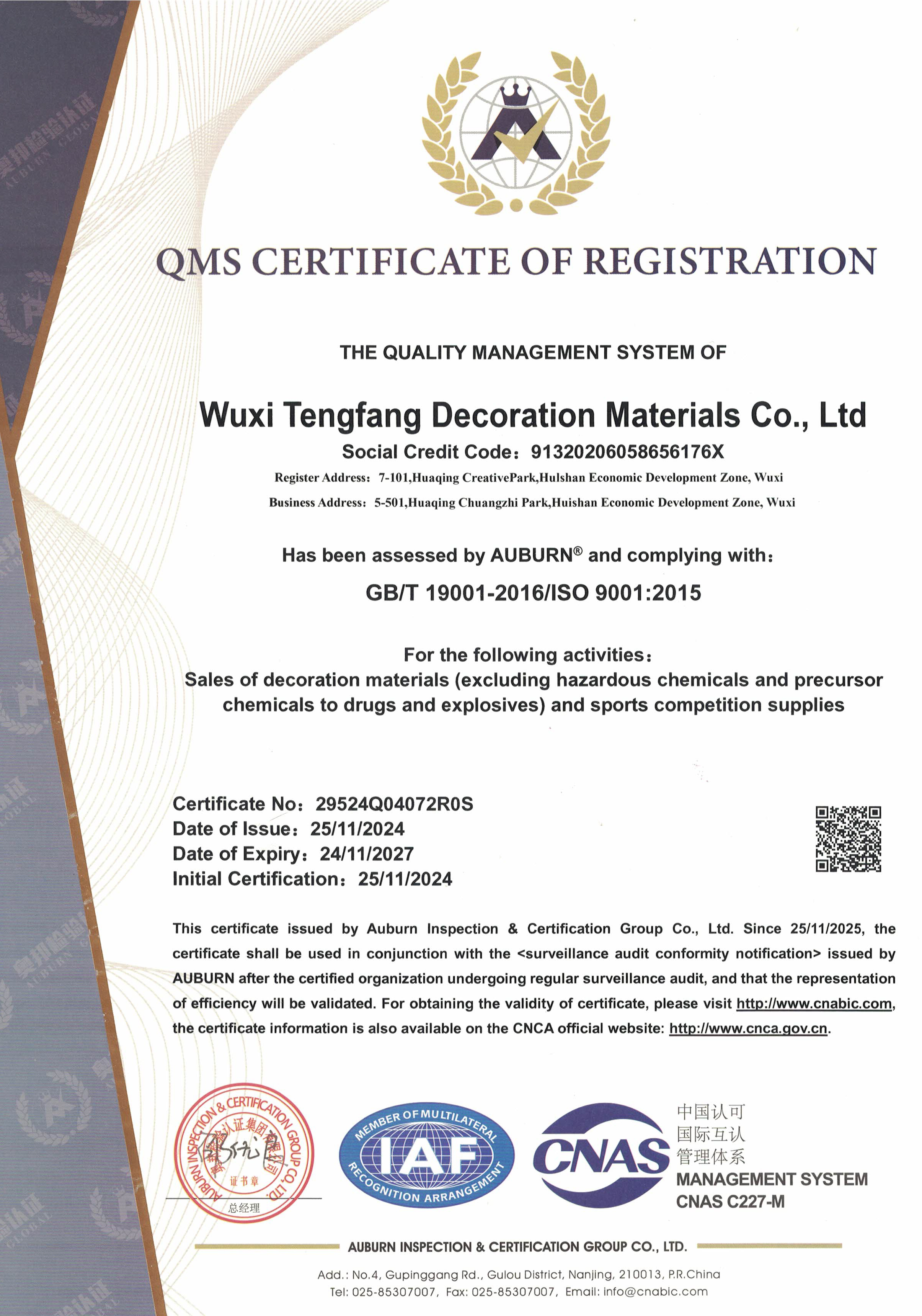
ISO 9001:2015 certificate 29524Q04072R0S — organisational evidence, separate from product test reports.
Tier 4 — Chemical and Indoor Air Quality Validation
Two reports sit outside the CE/SGS/ISO framing but are decisive in healthcare, education and cleanroom specifications:
- TVOC emission rate (28 days) — certificate WT2020B01A03405, issued by CTC on 2020-06-12 against ISO 16000-9:2006/Cor1:2007. It evaluates VOC emissions from homogeneous flooring under controlled indoor conditions, measuring indoor air quality performance and low-emission characteristics.
- REACH SVHC — certificate EQO20030442C, issued by EQO on 2020-03-16 against EU REACH regulation (1907/2006/EC), 205 substances. It screens the flooring for restricted Substances of Very High Concern and evaluates hazardous chemical content and environmental safety.
Both reports cover the same Vinyl Flooring product family referenced throughout the SGS reports, whose model list includes Bonaire, Bonet, Boniro, Bonize, Bones, Bonear, Bonegas, Bonzya, Bonami, Bona star, Bonee and ESD flooring. The published specification for that family lists 2 mm thickness (customisable to 2.5 mm or 3 mm), 2 × 20 m rolls, fire rating B-S1, antibacterial performance 99.50%, residual indentation 0.06 mm, abrasion resistance T, R9 anti-slip classification and TVOC (28 day) below 10 μg/m³.
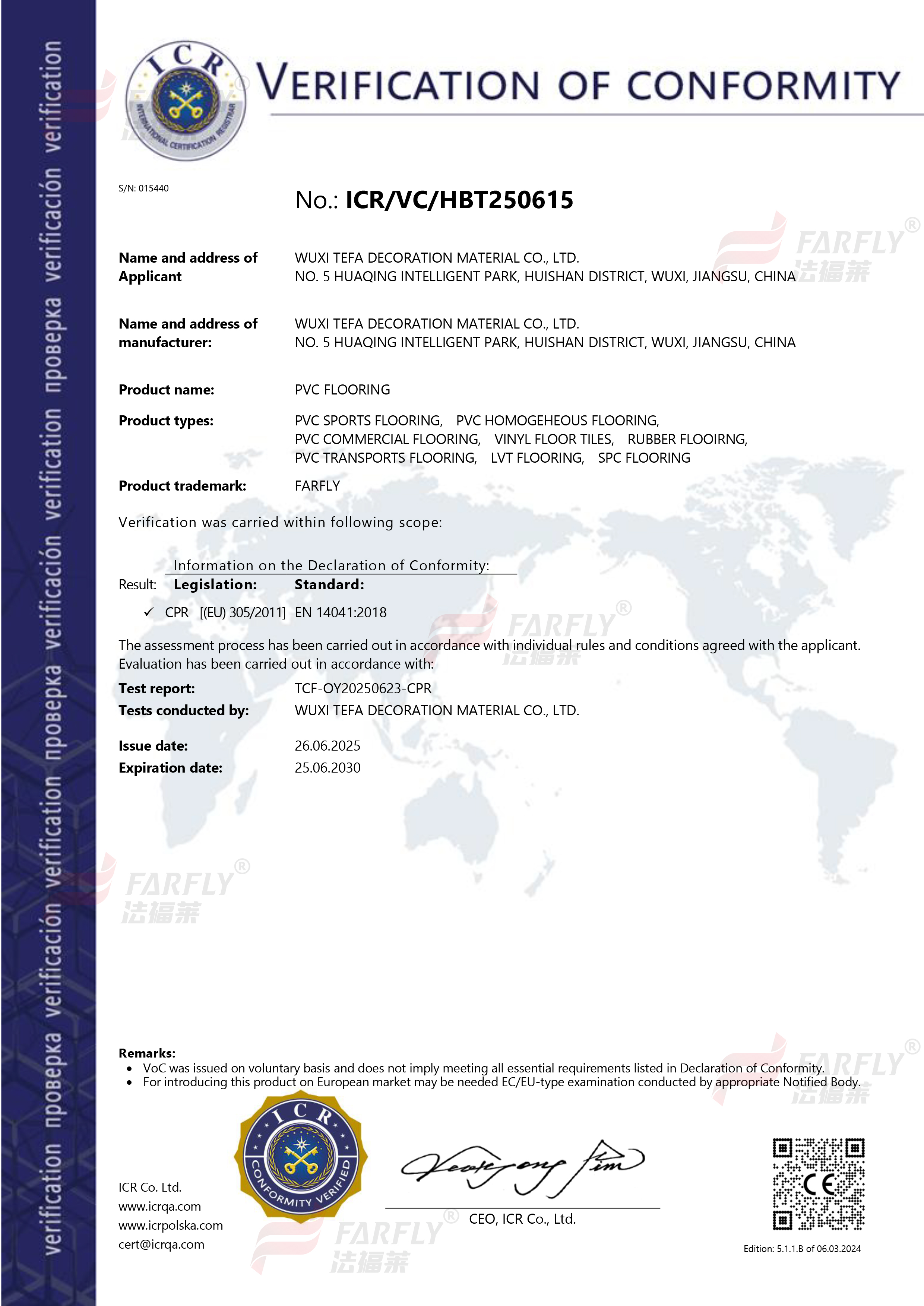
CE certificate TCF-OY20250623-CPR (ICR Co. Ltd., EN 14041:2018) — valid to 2030-06-25.
Step-by-Step Breakdown: How to Verify a Homogeneous Vinyl Certification Stack
- Classify the claim before reading the document. Decide whether the page in front of you asserts market access (CE), product performance (SGS), organisational management (ISO) or chemical safety (TVOC / REACH). The header and issuing body usually tell you within ten seconds.
- Match the standard to the project requirement. Slip performance on a wet hospital corridor is a DIN 51130:2014-02 question. Pressure-mark resistance under beds and trolleys is an EN433:1999 question. Surface hygiene is an ISO 22196:2011 question. Fire behaviour in an egress route is an EN 13501-1:2018 question. Asking for the wrong standard is the most common submittal error.
- Verify issuer, certificate number and validity window. Read the number, the issuing body and both dates. A CE certificate expiring in 2030 and ISO certificates valid to 2027 carry different refresh cycles and should be tracked separately in the project file.
- Check that the scope covers what you are buying. Confirm that the certificate names the product family and performance areas you are specifying, and that the thickness or construction you intend to order falls inside that scope.
- Split the document set by market. For EU and EEA tenders, lead with CE under EN 14041:2018 and support it with EN-based SGS reports. For non-EU tenders, lead with the SGS report set and add REACH and TVOC evidence, since these are the documents most often requested by specifiers outside the EU regulatory framework.
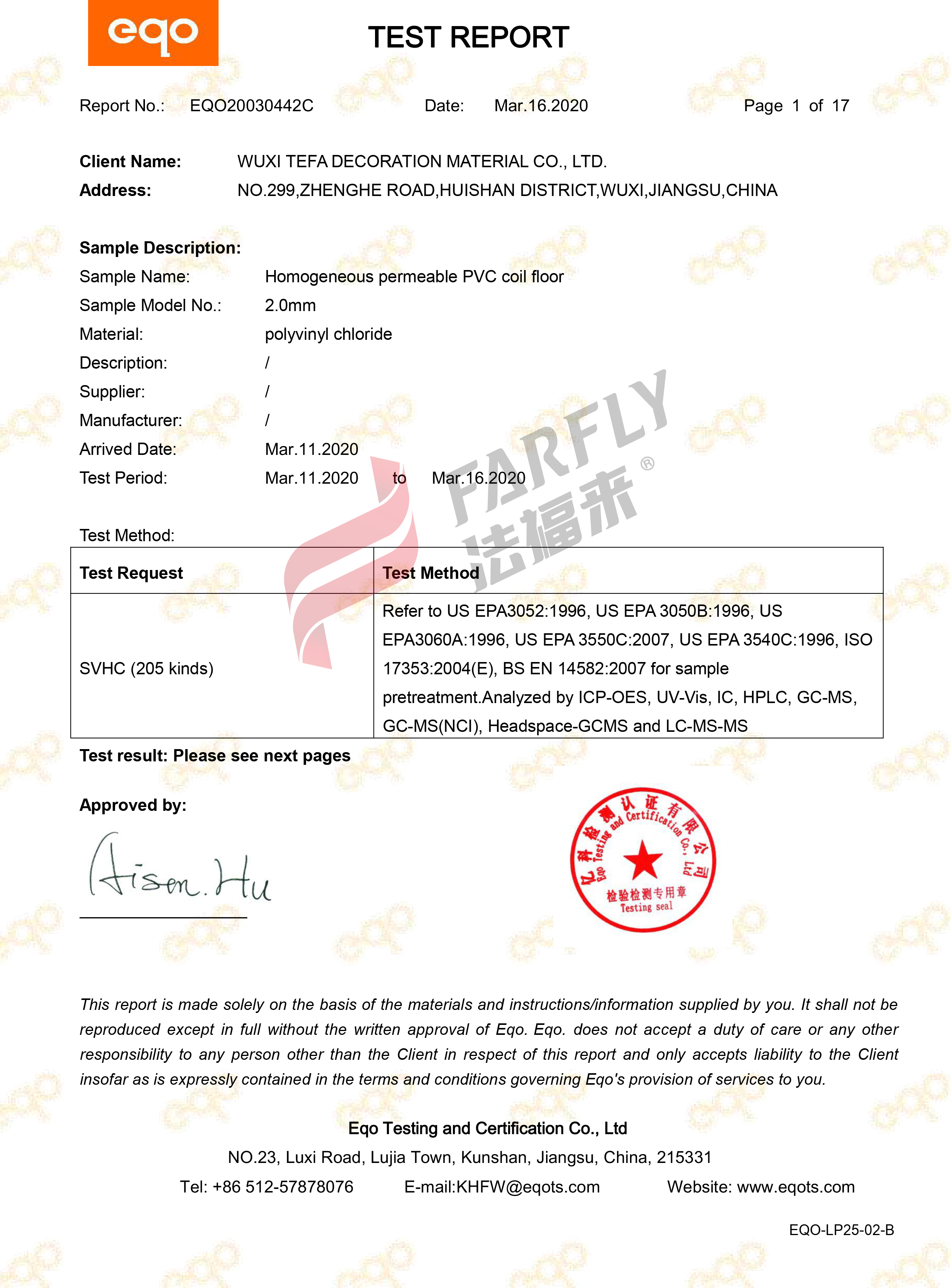
REACH SVHC report EQO20030442C covering 205 substances under EU REACH regulation (1907/2006/EC).
Use Cases: Matching Certification Depth to Project Type
Hospitals, Clinics and Operating Theatres
A healthcare specification normally requires the widest document set. In practice this means CE under EN 14041:2018, the SGS safety report XMIN2109010492CM for slip and fire behaviour, the SGS antibacterial report XMIN2109010493CM for surface hygiene, and TVOC and REACH data for indoor air quality. Where imaging equipment is present, the conductive ESD version of the same product family is specified at a stable 104–106 Ω resistance range. Iodine resistance and wax-free maintenance belong to the product's TF Surface Treatment rather than to any certificate, which is why hygiene-focused buyers should ask about surface treatment separately from certification.
Cleanrooms, Laboratories and Electronics Environments
Cleanroom and laboratory projects prioritise electrostatic performance, chemical resistance and low emissions. EN 1815:2016 inside XMIN2109010492CM addresses electrostatic behaviour, ISO 26987:2008 within XMIN2109010490CM addresses chemical resistance, and the TVOC report WT2020B01A03405 addresses emissions under controlled conditions. Because the product is supplied in 2 × 20 m rolls, installations are typically hot-welded to reduce seam count — a construction detail that should be confirmed against the project's cleanliness classification.
Commercial and Public Buildings
For shopping centres, schools, airports and exhibition halls, the priority shifts to mechanical durability and fire performance. EN433:1999 evidence for pressure marks, the EN 660-2 Group T wear class, EN 13893:2002 and the EN 13501-1:2018 fire classification inside XMIN2109010492CM form the core set, with the B-S1 fire rating listed in the product specification. ISO 14001:2015 and ISO 45001:2018 certificates become relevant when the client is a public authority with environmental or contractor-safety criteria.
Verified Project Reference
A hospital project in Colombia, delivered for engineering-firm clients, used 27,000 m² of homogeneous vinyl flooring specified for antimicrobial and eco-friendly performance, with the aim of reducing safety risks and cross-contamination. The installed flooring demonstrated a 50% reduction in maintenance requirements compared with alternatives, and the project was planned around a 10–20 year service life with low maintenance cost as the stated highlight.
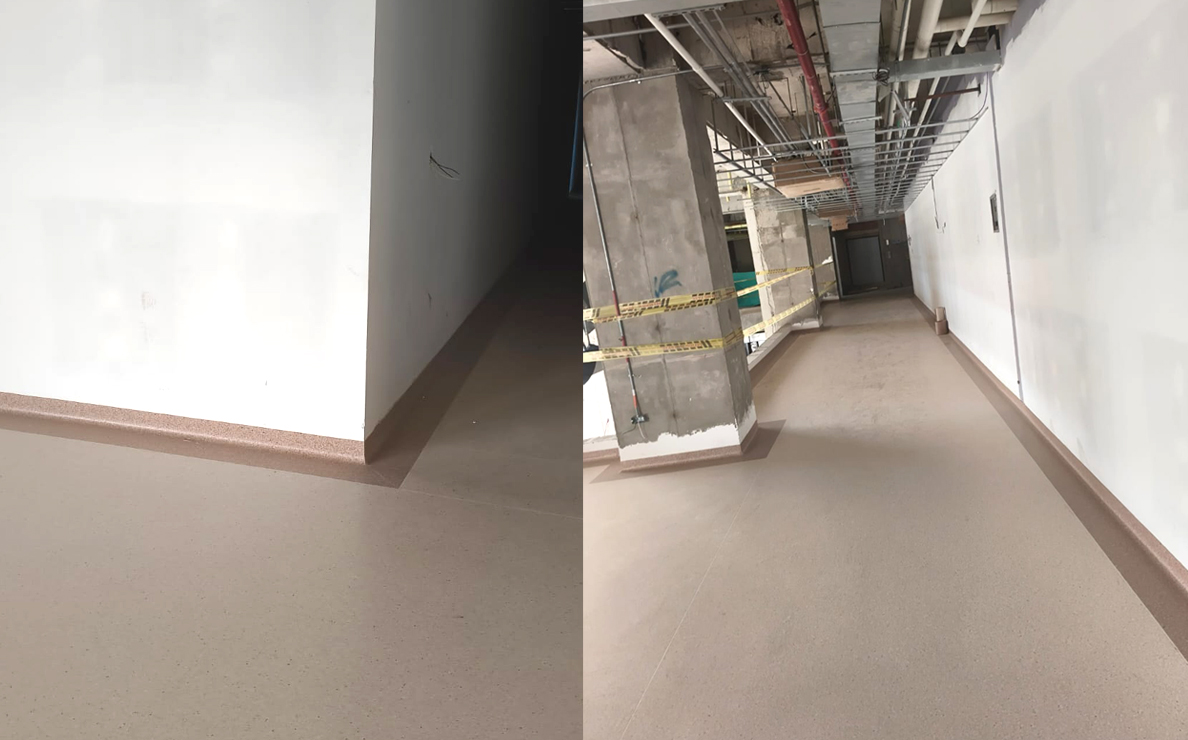
27,000 m² hospital installation in Colombia — antimicrobial and low-maintenance homogeneous vinyl flooring.
Comparison Table: SGS vs CE vs ISO for Homogeneous Vinyl Flooring
| Document family | Issuer | Standard(s) | Certificate number | What it proves | Primary market use |
|---|---|---|---|---|---|
| CE marking | ICR Co. Ltd. | EN 14041:2018 | TCF-OY20250623-CPR (issued 2025-06-26, valid to 2030-06-25) | Conformity with EU safety and performance requirements for construction products | EU / EEA procurement; widely requested elsewhere |
| SGS physical property report | SGS | ISO 24346:2006, ISO 23997:2007, ISO 4918:2016, ISO 29333:2018, ISO 26987:2008, ISO 10581:2019, ISO 105-B02:2014 | XMIN2109010490CM | Residual indentation, dimensional stability, flexibility, wear, chemical resistance, classification, colour fastness | Global specification and tender evidence |
| SGS indentation report | SGS | EN433:1999 | XMIN2109010491CM | Resistance to pressure marks and deformation under furniture, equipment and heavy traffic | High-traffic commercial and healthcare |
| SGS safety and fire report | SGS | DIN 51130:2014-02, EN 13893:2002, EN 684:1995, EN 14041:2018, EN 1815:2016, EN 13501-1:2018, EN ISO 9239-1:2010, EN ISO 11925-2:2020 | XMIN2109010492CM | Slip resistance, wear, electrostatic performance, fire resistance, ignition behaviour, radiant heat resistance | Healthcare, public buildings, ESD zones |
| SGS antibacterial report | SGS | ISO 22196:2011 | XMIN2109010493CM | Bacterial reduction on the flooring surface, hygienic properties and surface cleanliness | Hospitals, clinics, cleanrooms |
| TVOC emission report | CTC | ISO 16000-9:2006/Cor1:2007 | WT2020B01A03405 | VOC emissions under controlled indoor conditions; indoor air quality performance | Healthcare, schools, offices |
| REACH SVHC report | EQO | EU REACH regulation (1907/2006/EC), 205 substances | EQO20030442C | Restricted Substances of Very High Concern screening and environmental safety | EU and global chemical compliance |
| ISO 9001 | AUBURN Inspection & Certification Group Co., Ltd. | ISO 9001:2015 | 29524Q04072R0S (2024-11-25 to 2027-11-24) | Quality management system for decoration material sales | Global supplier qualification |
| ISO 14001 | AUBURN Inspection & Certification Group Co., Ltd. | ISO 14001:2015 | 29524E04073R0S (2024-11-25 to 2027-11-24) | Environmental management activities of the places involved | Green procurement, ESG questionnaires |
| ISO 45001 | AUBURN Inspection & Certification Group Co., Ltd. | ISO 45001:2018 | 29524S040725R0S (2024-12-23 to 2027-12-22) | Occupational health and safety management activities | EPC and contractor prequalification |
All certificate numbers, issuers, standards and validity dates as held by Farfly / Wuxi Tefa Decoration Material Co., Ltd.
Quick Mapping: Project Type to Priority Documents
| Project type | Lead documents | Why they lead |
|---|---|---|
| Hospital ward, clinic, operating theatre | CE TCF-OY20250623-CPR; SGS XMIN2109010492CM; SGS XMIN2109010493CM; TVOC WT2020B01A03405; REACH EQO20030442C | Slip, fire, hygiene, emissions and chemical safety are all reviewed in healthcare tenders |
| Cleanroom, laboratory, electronics | SGS XMIN2109010492CM (EN 1815:2016); SGS XMIN2109010490CM (ISO 26987:2008); TVOC WT2020B01A03405 | Electrostatic behaviour, chemical resistance and low emissions drive acceptance |
| Commercial and public buildings | SGS XMIN2109010491CM; SGS XMIN2109010492CM (EN 13501-1:2018); ISO 14001; ISO 45001 | Pressure-mark resistance, fire classification and contractor safety criteria |
| EU / EEA regulated procurement | CE TCF-OY20250623-CPR first, then EN-based SGS reports | Market access conformity precedes performance evidence |
FAQ: Certification Questions Buyers Ask Before Ordering
Is a CE certificate the same as an SGS test report?
No. CE certificate TCF-OY20250623-CPR, issued by ICR Co. Ltd. under EN 14041:2018, declares that the PVC flooring complies with EU safety and performance requirements for construction products. SGS reports such as XMIN2109010492CM record the results of specific tests against standards including DIN 51130:2014-02, EN 1815:2016 and EN 13501-1:2018. CE is a conformity route; SGS reports are performance evidence. Both are needed in an EU healthcare submittal.
Which certifications matter most for hospitals and cleanrooms?
For hospitals, the priority set is the CE certificate under EN 14041:2018, SGS report XMIN2109010493CM for antibacterial performance under ISO 22196:2011, SGS report XMIN2109010492CM for slip and fire behaviour, TVOC report WT2020B01A03405 under ISO 16000-9:2006/Cor1:2007, and REACH SVHC report EQO20030442C. Cleanrooms and electronics environments add electrostatic evidence from EN 1815:2016 and the 104–106 Ω conductive version of the product family.
Does a deeper certification stack increase cost or minimum order quantity?
Certification itself is not a line item on a flooring quotation. Cost and commercial terms are driven by the specification you choose: the homogeneous vinyl family is published at 2 mm thickness with customisation to 2.5 mm or 3 mm, in 2 × 20 m rolls, and the minimum order quantity is 100 sqm. Buyers should therefore separate the compliance question from the commercial question and confirm both against the same product family rather than comparing a certified specification with an uncertified one.
Can I inspect the certificates and samples before committing to an order?
Yes. Certificate copies for the numbers listed in this article, together with the product brochure, can be requested for your compliance file, and sample and quotation requests can be raised with the manufacturer directly. Because the SGS reports share the same product family as the CE, TVOC and REACH documents, the full document set refers to the same construction — which is what a specifier needs in order to close out a submittal without clarification rounds.
What is the lead time once a certified specification is approved?
Farfly operates a 7-day rapid dispatch model backed by 300,000 sqm of ready-to-ship inventory, with a monthly production capacity of 600,000 sqm and OEM/ODM support covering dimensions, colour, design pattern, packaging, logo, craftsmanship and structure. Quality control is 100% tested with third-party inspection by SGS available. For project shipments, mix-container loading is offered to EPC contractors. Next step: send your project type, required standards and target quantity to mara@topvcfloor.com to receive matched certificate copies, a sample arrangement and a quotation.
Conclusion: Read the Certificate Stack in the Right Order
Homogeneous vinyl flooring certification is a hierarchy, not a list. CE marking under EN 14041:2018 comes first because it establishes whether the product can be placed on the EU market. SGS reports come second because they quantify performance — indentation, dimensional stability, slip, fire, electrostatic behaviour and antibacterial action — against named standards and certificate numbers. ISO 9001:2015, ISO 14001:2015 and ISO 45001:2018 come third because they evidence how the supplier is managed, which is what EPC prequalification and public-sector environmental criteria actually ask for. TVOC and REACH validation sits alongside the product evidence because healthcare and cleanroom specifications increasingly treat indoor air quality and hazardous substance screening as pass-or-fail conditions.
For buyers in the evaluation stage, the practical rule is simple: identify the project type first, then request only the documents that answer that project's questions, and verify each one by number, issuer and validity window. FARFLYING FLOORING, the export brand of Wuxi Tefa Decoration Material Co., Ltd., was founded in 2012 and manufactures homogeneous vinyl flooring, PVC sports flooring and aircraft flooring from Wuxi, Jiangsu, China, with roughly 50% of output exported.
Request the certificate pack and product brochure
Download the full product brochure, or contact the manufacturer for certificate copies, samples and project quotations.
Download the Farfly product brochure (PDF)
Website: www.topvcfloor.com | Blog: blog.topvcfloor.com
Email: mara@topvcfloor.com | WhatsApp: +86-18751567592
Address: NO.5 Huaqing Intelligent Park, Huishan District, Wuxi, Jiangsu, China
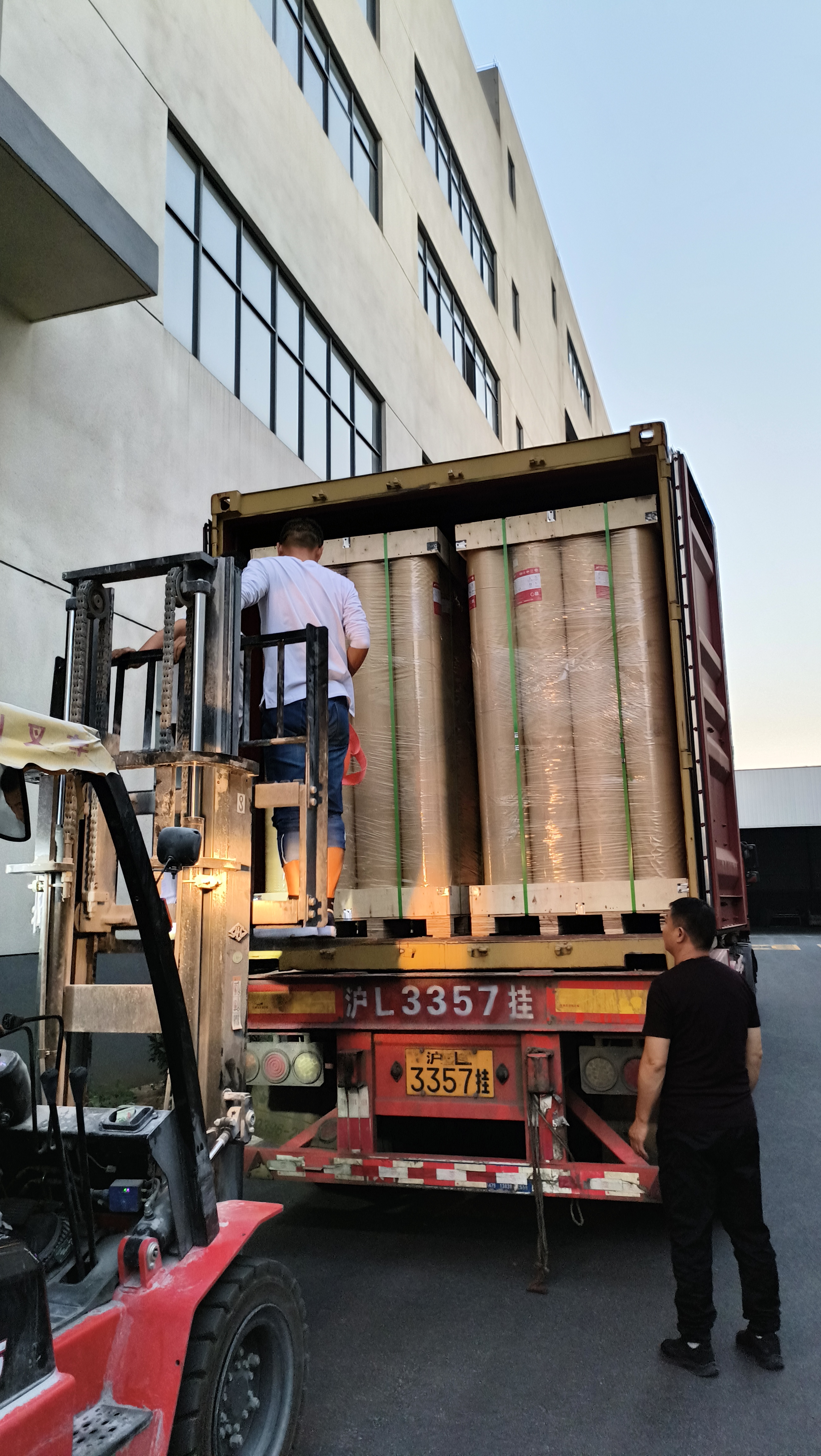
Certified homogeneous vinyl flooring prepared for container loading and project delivery.