
How to Read Commercial PVC Flooring Test Reports: A Technical Guide to EN 14904 & EN 13501-1
How to Read Commercial PVC Flooring Test Reports: A Technical Guide to EN 14904 & EN 13501-1
A commercial PVC flooring test report is a data document. A certificate is a statement. The report names the product model that was tested, the standard edition applied, the specimen and conditioning used, the laboratory that ran the work, and the values the instruments recorded. A certificate normally states that a product conforms and leaves the evidence somewhere else.
For buyers in the research and evaluation stages of a sports hall, hospital corridor, transit terminal or aircraft cabin, that difference decides whether a specification survives contact with the project. This guide shows how to read the EN 14904-2006 physical data layer, the EN 13501-1:2007 reaction-to-fire layer, the EN 14041:2018 CE layer, phthalate testing referenced to EN 14372:2004, thickness determination under ISO 24346:2006, and the aviation flame and smoke layer built on FAR 25.853, EASA CS-25.853(a) and CCAR 25.853(a). It also sets out how to check reports issued by testing bodies such as OTC, SGS, ETS, ICR and CAAC.
Why a Certificate Alone Cannot Answer a Project Question
Three document types arrive in a procurement inbox, and they carry very different weight. Treating them as interchangeable is the single most common reason a technically compliant floor is rejected at handover.
| Document type | What it proves | What it does not prove |
|---|---|---|
| Certificate of conformity | That a named product range was assessed against a standard at a point in time | The measured values, the specimen description, the test method, or whether your specific model number sits inside the certified scope |
| Test report | Which model, which standard edition, which specimen, which method and which laboratory produced each number | That future production batches will keep matching the tested sample |
| Company or supplier claim | That a supplier is willing to state a public position | Any document-level evidence; the claim may be scope-free and model-free |
Four mismatch patterns account for most commercial PVC flooring disputes. Model mismatch happens when a report covers one construction and the purchase order specifies another — for example, a homogeneous commercial roll is certified while the project needs a sports roll with a different backing. Clause mismatch happens when a report covers only part of a standard, such as a vertical flame test without the smoke density or toxicity clauses a specifier actually asked for. Edition mismatch happens when a report references an older edition of a standard than the one named in the specification. Scope mismatch happens when a management-system certificate belongs to a trading entity while the specification is written against a manufacturing site.
The Standards Landscape Behind a Commercial PVC Flooring Report
A complete technical dossier for commercial PVC flooring is rarely a single document. It is a stack of dated reports, each answering a different question:
- EN 14041:2018 — the harmonised product standard under which CE marking for resilient floor coverings is declared. The Declaration of Performance and the CE label point back to it, and the reaction-to-fire classification is one of the declared characteristics.
- EN 14904-2006 — the sports-surface standard that sits behind friction, ball bounce, vertical deformation, impact resistance, indentation resistance and wear figures.
- EN 13501-1:2007 — the reaction-to-fire classification framework, assigning classes from A1 to F, with the fl subscript marking a flooring product and an additional smoke production indicator (s1 to s3).
- EN 14372:2004 — commonly cited in phthalate testing documentation for flooring that will be installed around children or in sensitive interiors.
- ISO 24346:2006 — the method for determining overall thickness of resilient floor coverings, and the reason a thickness figure only means something when the method is named.
- Aviation requirements — 14 CFR 25.853(a) and 25.853(b), with the equivalent European and Chinese references EASA CS-25.853(a) and CCAR 25.853(a). Boeing D6-36075 F Table 4 and Boeing BSS 7239 are the buyer-side reference documents frequently quoted for cabin interior materials.
- Management systems — ISO 9001, ISO 14001 and ISO 45001 certificates describe how a factory is organised, not what a floor measures. They support confidence in production control; they do not replace product test data.
Market context explains why document discipline matters more each year. Business Research Insights estimates the global PVC floor market at USD 1.94 billion in 2026, with a forecast period extending to 2035. A commercial research estimate is not a specification, and it carries no validated growth rate here — but it does explain the volume of suppliers entering the category, and therefore the volume of paperwork a buyer has to sort.
Laboratories you will see on the front page. Reports reaching B2B buyers are typically issued by testing bodies such as OTC, SGS, ETS, ICR or CAAC, depending on the market and the requirement. The issuing body is a data point, not a conclusion. What matters is whether the issuing body's accreditation scope covers the specific test method on the report.
The Five Layers of Any Credible Test Report
Every test report can be read in the same order, regardless of which standard it covers. Read the layers in sequence and most problems surface in under ten minutes.
Layer 1 — Report identity and traceability
Look for a unique report number, an issue date, the applicant and manufacturer, the product name and model, a sample or batch reference, and a page count expressed as page 1 of N. A report without a page count can be circulated with pages removed. A report without a model designator cannot be tied to a quotation line.
Layer 2 — Standard, edition and clause
The standard must appear with its year, not only its number. EN 14904-2006, EN 13501-1:2007, EN 14041:2018, EN 14372:2004 and ISO 24346:2006 are all edition-specific documents. Beyond the title, check which clause the report addresses — a report headed reaction to fire may cover only one classification parameter.
Layer 3 — Specimen description and conditioning
Compare the specimen description against what you are buying: construction type (homogeneous or layered), nominal thickness, colour or reference, backing, and whether the sample was supplied by the manufacturer or drawn by the laboratory. Conditioning details tell you whether the result was obtained on a stabilised specimen or an as-received one.
Layer 4 — The raw data table
The data table is the reason the report exists. Each row should carry a parameter name, a unit, individual readings, an average where the method requires one, and a pass/fail statement that names the clause it was judged against. A report that shows only a final verdict, with no readings, is a summary sheet rather than a test report.
Layer 5 — Laboratory identity and accreditation
Check the laboratory name, address, accreditation reference and scope statement, plus the signatures of both the test engineer and the reviewer. When the issuing body is named as OTC, SGS, ETS, ICR or CAAC, verify that the accreditation covers the method, and keep a copy of the report number in the project dossier so that any later document can be checked against it.
Reading EN 14904-2006 Data for Sports and Multi-Purpose Flooring
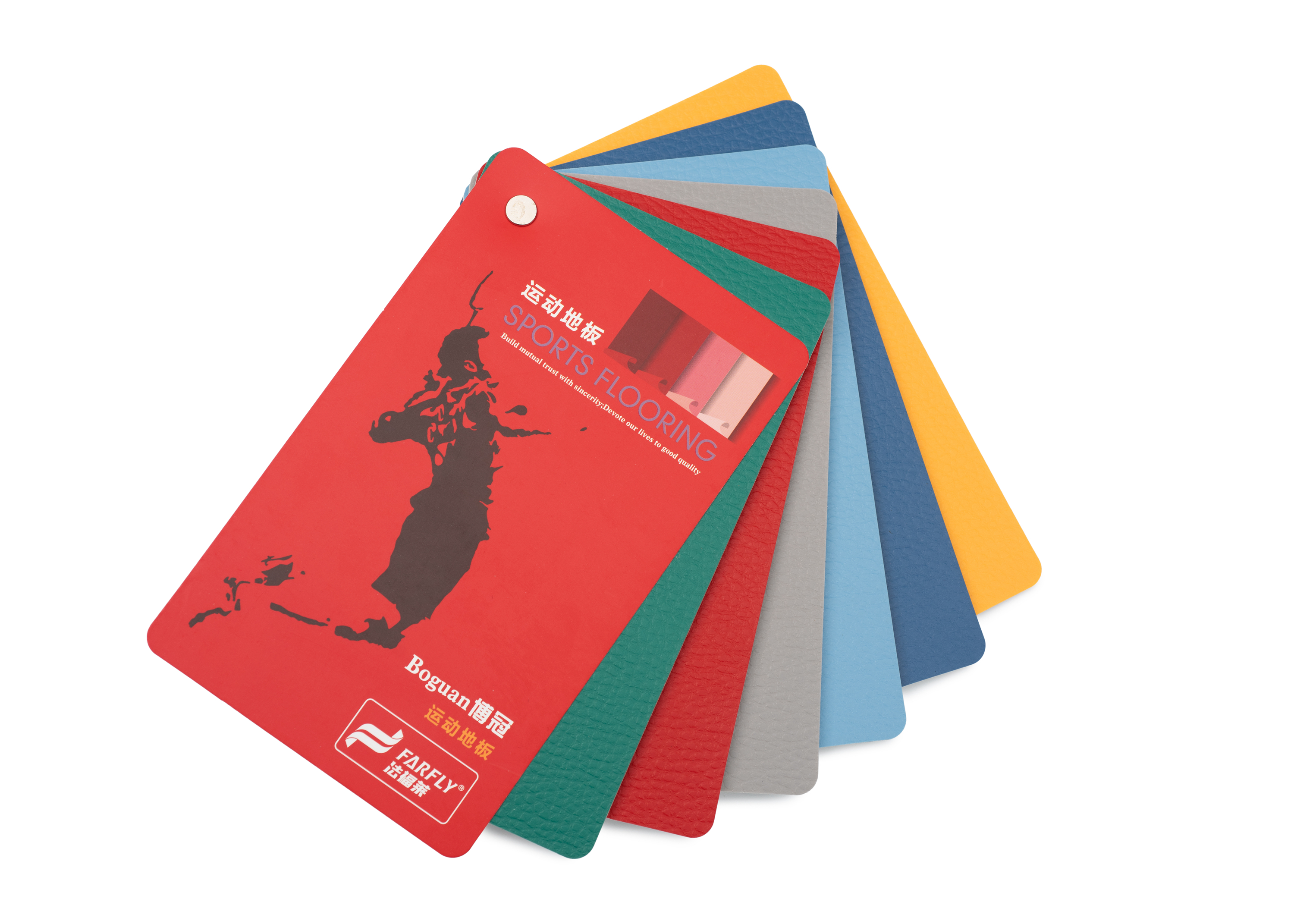
EN 14904-2006 is where the numbers that decide a sports project live. For Farfly's Boguan PVC sports flooring range, the declared values sit in the physical-property layer of the report as follows.
| Report line item | Declared value for the Boguan sports range | What the reading tells a project team |
|---|---|---|
| Friction coefficient | 0.56 | Grip between shoe and surface under the specified method — the figure that governs player safety and slide behaviour |
| Ball bounce | 95% | Rebound consistency for basketball, badminton, volleyball and other ball sports |
| Vertical deformation | 0.3 mm | How far the surface compresses under a defined load — a comfort and joint-protection reading |
| Impact resistance | 0.35 mm | Behaviour under point impact from equipment or falling objects |
| Indentation resistance | 0.27 | Recovery after static point loads such as seating, trolleys or sports apparatus |
| Wear resistance | 120 mg | Abrasion loss under the specified abrasive cycle; comparable only between reports using the same cycle |
| Pentachlorophenol detection | N.D. (not detected) | A chemical screening result on the tested specimen |
Two reading rules apply. First, every one of these values is method-dependent, so a value without the method and unit cannot be compared with another supplier's value. Second, a report covers a specimen, not a portfolio — if the model on the quotation differs from the model on the report, the numbers do not transfer.
BWF approval sits alongside EN 14904 rather than inside it. The Badminton World Federation certifies flooring in three grades: Grade 1 (International Elite), Grade 2 (International Standard) and Grade 3 (Basic). A supplier statement that simply says BWF certified therefore answers less than it appears to. Ask which grade, and ask for the document that names the model. Farfly's athletic vinyl flooring is BWF certified and uses an 8-way fiberglass mesh for shock absorption.

Reading EN 13501-1:2007 Reaction-to-Fire Classification
EN 13501-1:2007 does not produce a single number; it produces a classification string. A flooring result typically appears in a form such as Bfl-s1, where the letter is the contribution-to-fire class (A1 through F), fl confirms that the classification applies to a floor covering, and s1 indicates the smoke production band.
Because the classification is a string, three checks matter more than the headline class. Confirm that every element of the string is present and not abbreviated. Confirm that the report states the substrate, adhesive and installation conditions for the tested assembly, because a classification obtained on one build-up is not automatically transferable to another. And confirm that the classification is the one your project actually needs — a specification written for a high-spec commercial interior may call for a class that a standard general-purpose roll does not reach.
Reaction to fire under EN 13501-1 and aviation flammability under FAR 25.853 are different regimes and cannot be substituted for each other, even when both appear in the same supplier brochure.
Where Slip Data Sits: R-Classes Versus EN 14904 Friction
Slip resistance is the parameter buyers most often compare incorrectly. R-class values (R9 through R13) come from an inclined-ramp test method; an EN 14904 friction coefficient such as 0.56 comes from a sports-surface method. They describe different surfaces, different conditions and different equipment.
Practical consequence: a supplier quoting R11 slip resistant PVC flooring should also state the test method and the lubricant used, because an R-class figure without the method cannot be compared with a competitor's R-class figure. And an R11 ramp classification should not be presented as evidence of sports-surface friction performance, which is what EN 14904 data measures.
Reading Aviation Flame and Smoke Data
Aviation floor coverings are assessed under a stricter and more fragmented document set than general commercial flooring. The 12-second vertical flame test is the standard entry point for cabin materials. The declared results for Farfly's aviation flooring models LY, SMY, MMY, MY, BY and WD read as follows.
| Report field | Declared result for aviation models LY, SMY, MMY, MY, BY, WD | Regulatory reference point |
|---|---|---|
| Duration of sustained burning | 0 | 14 CFR 25.853(b) requires floor coverings to be self-extinguishing when tested vertically |
| Burning time of droplets | 0 | Part of the same vertical flame assessment |
| Burning length | 24 mm | 14 CFR 25.853(b) sets an average burn length limit of 8 inches |
| Smoke toxicity | Pass | Smoke toxicity testing; Boeing BSS 7239 is the reference commonly requested by cabin interior buyers |
The same regulatory text also caps average flame time after removal of the flame source at 15 seconds for floor coverings, which is why a report should show both burn length and flame time rather than a single verdict. When the project references CCAR 25.853(a), EASA CS-25.853(a) or Boeing D6-36075 F Table 4, check that the report on the table names the corresponding requirement rather than a generic fire-retardancy statement.
A useful benchmark for calibration: aerospace material manufacturers such as Spartech publish product bulletins reporting that specific thermoplastic grades meet selected FAR 25.853 provisions. That is material-level evidence for a sheet or thermoplastic, not a qualification of a finished flooring system. The distinction is exactly the one buyers should apply to any aviation PVC flooring claim — material compliance and system compliance are two different documents.
A Nine-Step Verification Workflow for Buyers
The workflow below can be run by a procurement officer without laboratory training. It takes the documents you already have and produces one of three outcomes: accept, request clarification, or reject.
- Match the model. Read the model or article code on the report and match it, character for character, against the quotation or purchase order line.
- Match the standard edition. Confirm the year in the standard designation — EN 14904-2006, EN 13501-1:2007, EN 14041:2018, EN 14372:2004, ISO 24346:2006.
- Match the clause. Confirm the report covers the clause your specification names, not a neighbouring one.
- Read the specimen page. Check construction, nominal thickness, backing and colour reference against the ordered product.
- Read the raw data table. Record each value with its unit and method, and compare it against the project performance requirement.
- Read the fire string in full. Confirm every element of the EN 13501-1 classification, plus the substrate and adhesive conditions tested.
- Run the aviation checks separately. For cabin or galley work, verify the 12-second vertical flame results and smoke toxicity against FAR 25.853(a)/25.853(b), EASA CS-25.853(a), CCAR 25.853(a) or Boeing D6-36075 F Table 4 as applicable.
- Check the management layer. Confirm ISO 9001, ISO 14001 and ISO 45001 certificate scope and validity, and note that these describe the factory, not the floor.
- File a verification sheet. Record report number, issuer, date, model, tested values and any open question, then request missing items in writing before the order is confirmed.
Parallel, not sequential. Run these nine steps while commercial terms are still being negotiated. Document verification almost never becomes the critical path when it starts at the enquiry stage; it becomes the critical path when it starts the week before shipment.
Use Cases: Matching Report Data to Four Project Types
Indoor badminton and multi-court sports halls
Ball bounce, friction coefficient and vertical deformation drive the specification, and the BWF grade determines whether the venue can host sanctioned play. A documented example from Farfly's project records is a 16-court badminton facility in Australia, in service for 10 years, with a reported 50% reduction in required maintenance compared with the previous surface. Buyers in this segment should match the BWF grade and the EN 14904 values to the level of competition the hall is built for.
School and university gymnasiums
Multi-sport school halls use the same EN 14904 data as elite venues but weight it differently: impact resistance and indentation resistance against daily equipment movement, and friction for student safety. The relevant report lines are impact resistance, indentation resistance and wear resistance, read alongside the roll construction.
High-traffic commercial interiors
Airport corridors, healthcare, retail and exhibition halls are specified on wear resistance, indentation resistance, thickness measured under ISO 24346:2006, slip classification, and the EN 13501-1 reaction-to-fire string. Roll flooring installed as a single continuous sheet also limits seam count in these environments, which is relevant to cleaning regimes.
Aircraft cabin, galley and MRO work
Aviation projects read a completely different table: sustained burning duration, droplet burning time, burn length and smoke toxicity, judged against FAR 25.853, EASA CS-25.853(a) or CCAR 25.853(a) as the airworthiness pathway requires. For the models LY, SMY, MMY, MY, BY and WD, the declared 12-second vertical flame results are a burn length of 24 mm with no sustained burning and no droplet burning time, plus a pass on smoke toxicity testing.
Comparison Table: Which Report Parameter Supports Which Decision
| Report parameter | Project question it answers | Decision it supports |
|---|---|---|
| Ball bounce (95% on the Boguan range) | Will ball behaviour stay predictable across the court? | Approval of a surface for competitive ball sports |
| Friction coefficient (0.56) | Is grip adequate for the intended activity? | Player safety assessment during evaluation |
| Vertical deformation (0.3 mm) and impact resistance (0.35 mm) | How much cushioning and impact tolerance does the surface provide? | Choice between sports and general commercial constructions |
| Indentation resistance (0.27) and wear resistance (120 mg) | How will the floor behave under trolleys, seating and daily traffic? | Lifecycle planning for high-traffic interiors |
| EN 13501-1:2007 classification string | Does the floor assembly meet the fire requirement of the building? | Building control and insurer sign-off |
| ISO 24346:2006 thickness determination | Is the quoted thickness measured on a defined method? | Like-for-like comparison between suppliers |
| 12-second vertical flame data (24 mm burn length, no sustained burning, smoke toxicity pass) | Is the product viable for cabin interior use? | Aviation sourcing and MRO approval |
Frequently Asked Questions
1. Which document should I trust more — the certificate or the test report?
The test report carries more usable information, because it identifies the model, the standard edition, the specimen, the method and the measured values. A certificate is a conformity statement and does not contain those details. In practice, request both, then use the report to check that the certificate's scope actually covers the model you are buying. If a supplier can only produce a certificate and no report, treat the technical claim as unverified until the report arrives.
2. How do I know a supplier's data applies to a BWF-grade badminton project?
Ask for the BWF grade, not just BWF status. The Badminton World Federation certifies flooring in three grades — Grade 1 (International Elite), Grade 2 (International Standard) and Grade 3 (Basic) — so a claim without a grade is incomplete. Then check that the EN 14904-2006 report on file names the same model as the BWF document, and that the sports construction matches the project level. Farfly's athletic vinyl flooring is BWF certified and is built on an 8-way fiberglass mesh for shock absorption.
3. Does reading test reports change project cost?
It changes the cost of being wrong rather than the cost of the floor. Report review prevents three expensive outcomes: over-specifying a class or thickness the project does not need, paying for re-testing because a document did not match the ordered model, and remediating a floor that failed at handover. Comparing suppliers on identical declared data — thickness under ISO 24346:2006, wear resistance, indentation resistance and the full EN 13501-1 string — is what makes quotations genuinely comparable.
4. Can I validate a report with a physical sample?
Yes, and for evaluation-stage buyers it is usually the fastest route. Request a sample from the same production range, record the sample reference, and check that the specimen description in the report matches. Farfly supports sample evaluation with an MOQ of 100 sqm and OEM/ODM customization across dimensions, colour, design pattern, packaging, logo, craftsmanship and structure, so a project-specific build can be checked against the underlying data before the order is placed.
5. Will document verification delay delivery?
Verification delays delivery only when it starts after the order is placed. Run it in parallel with commercial negotiation and it rarely becomes the critical path. On the supply side, Farfly holds 300,000 sqm of ready-to-ship inventory with a 7-day rapid dispatch model and mix-container shipping for EPC contractors, and 100% testing with third-party inspection by SGS supports the documentation pack that buyers request.
Next Step: Request the Technical Dossier, Not Just the Brochure
Send us your project type, the standard you are specifying against, and the model you are considering. We will return the matching test report set, the declared performance values and the applicable certificate scope so your verification sheet can be completed before pricing is fixed.
Email: mara@topvcfloor.com | WhatsApp: +86-18751567592 | Website: topvcfloor.com
Download the full product and certification brochure: FARFLYING FLOORING Technical Brochure (PDF)
Conclusion
A commercial PVC flooring test report is only as useful as the reading discipline applied to it. Confirm the model, the standard edition and the clause; read the specimen page; read the raw data with units; read the fire classification string in full; and keep aviation flammability in a separate file from building reaction-to-fire. When those five habits become routine, a certificate stops being a marketing asset and becomes what it should be — a pointer to the evidence behind it.
Farfly (WUXI TEFA DECORATION MATERIAL CO., LTD.), founded in 2012 and operating a 25-person R&D team across homogeneous flooring, PVC sports flooring and aircraft flooring, publishes its declared performance data so that buyers can run exactly that check. Verification is not a delay in the procurement process. It is the part of the process that keeps a completed floor from being reopened.
Have Questions or Need More Details?
Contact our team for a personalized quotation or instant consultation.
Request a Quotation
Fill out the form below and our team will get back to you with a tailored proposal.
WhatsApp Direct Chat
Prefer to chat in real-time? Message us on WhatsApp for instant assistance & quick answers.
- Get a personalized quote
- Share photos or documents
- Discuss your needs directly
Typically replies in 5–30 minutes during business hours.