
REACH Compliance for Flooring: What the 205-SVHC List Means for EU Imports
A container of homogeneous vinyl flooring rarely gets held up in the European Union because the flooring performs badly. It gets held up because the importer cannot produce a document that a buyer, a customs agent or a notified body can actually check. Screening against the REACH Substances of Very High Concern (SVHC) list is one of those documents, and for importers and distributors of resilient flooring it has moved from a nice-to-have line in a tender pack to a routine condition of market entry.
This guide explains what the 205-substance SVHC list used as the working reference here actually screens for, why certificate scope matters more than the logo printed on the certificate, and how to read a verification pack line by line. It uses the SGS certification held for the FARFLYING FLOORING homogeneous vinyl range as a concrete example: certificate number XMIN2109010490CM for the European Union market, and certificate number XMIN2109010492CM covering global markets.
Problem Definition: Compliance Usually Fails on Evidence, Not on Product
Substances of Very High Concern are chemicals identified under REACH, Regulation (EC) No 1907/2006, as posing the highest risk to human health or the environment. They are compiled into a candidate list maintained by the European Chemicals Agency (ECHA). When a listed substance is present in an article above the concentration threshold defined in the regulation, communication obligations travel down the supply chain together with the product.
Flooring sits in an awkward position inside that framework. A vinyl roll is an article, not a chemical preparation, so the compliance question is not "what is in the drum" but "what is in the finished sheet that gets installed in a hospital corridor or a semiconductor cleanroom." In resilient floor coverings, the substances most likely to attract attention are plasticizers, stabilizers, pigments and fillers rather than the polymer itself.
Three failure modes repeat themselves across EU flooring imports:
- The scope does not match the question. The supplier holds a certificate, but it does not name the standard the buyer asked about.
- The scope does not match the shipment. The standard is named, but the certificate covers a different product family or thickness than the item on the purchase order.
- The document cannot be verified. The issuing body, certificate number or validity date is missing, so nobody downstream can confirm anything.
None of these are manufacturing failures. They are evidence failures, and they are the reason a compliance-first reading of the SVHC list pays for itself long before a shipment reaches a port.
A note on the list itself. The 205-substance SVHC list referenced in this guide is used as the working screening reference. The ECHA candidate list is periodically extended, so a document that was complete when it was issued may not reflect substances added afterwards. Buyers should always confirm the review date of a certificate against the current candidate list rather than treating any single document as permanently final.
Industry Background: Compliance Pressure Follows Market Growth
Documentation scrutiny in this category tracks the size of the category. The global homogeneous flooring market was valued at USD 17.58 billion in 2025 and is projected to reach USD 28.99 billion by 2035, according to Grand View Research. Within that broader figure, the global conductive vinyl flooring market reached USD 9.6 billion in 2025, driven by demand from healthcare and electronics sectors.
Those two demand centres — healthcare and electronics — are also the sectors where documentary evidence is audited most heavily. A hospital operator in the EU answers to hygiene and public procurement frameworks. An electronics manufacturer answers to its own electrostatic discharge control programme. Both tend to pass the evidence requirement straight down to the flooring supplier, which is why an importer can be asked for an SVHC screening statement before a single roll is unloaded.
The supply side of homogeneous vinyl is concentrated. Major global manufacturers include Tarkett (France), Gerflor (France), Forbo (Switzerland) and Armstrong Flooring (US). Alongside them sit export-oriented manufacturers such as WUXI TEFA DECORATION MATERIAL CO., LTD., which trades as FARFLYING FLOORING — a resilient flooring manufacturer established in 2012 that produces homogeneous flooring, PVC sports flooring and aircraft flooring, with export business accounting for 50% of total sales across markets in Europe, the Middle East, Central Asia, East Asia and Southeast Asia.
For an importer, the practical difference between these groups is rarely the polymer chemistry. It is how quickly and how cleanly a document pack can be produced for a specific shipment, in a format the receiving market recognises.
What the 205-SVHC List Means in Practice for a Vinyl Flooring Order
For an importer, the usable output of SVHC screening is a statement that can be attached to a customs file or a tender submission: which substance list was screened, what method was applied, which product reference was tested, who issued the result, and when. Everything else is context.
What makes that statement credible is its structure. A usable document names the issuing laboratory or certification body, carries a traceable certificate number, lists the standards applied, and defines the market or legal framework it is intended to support. It also identifies the product by model or family with enough precision that a buyer can match it to the ordered item without interpretation.

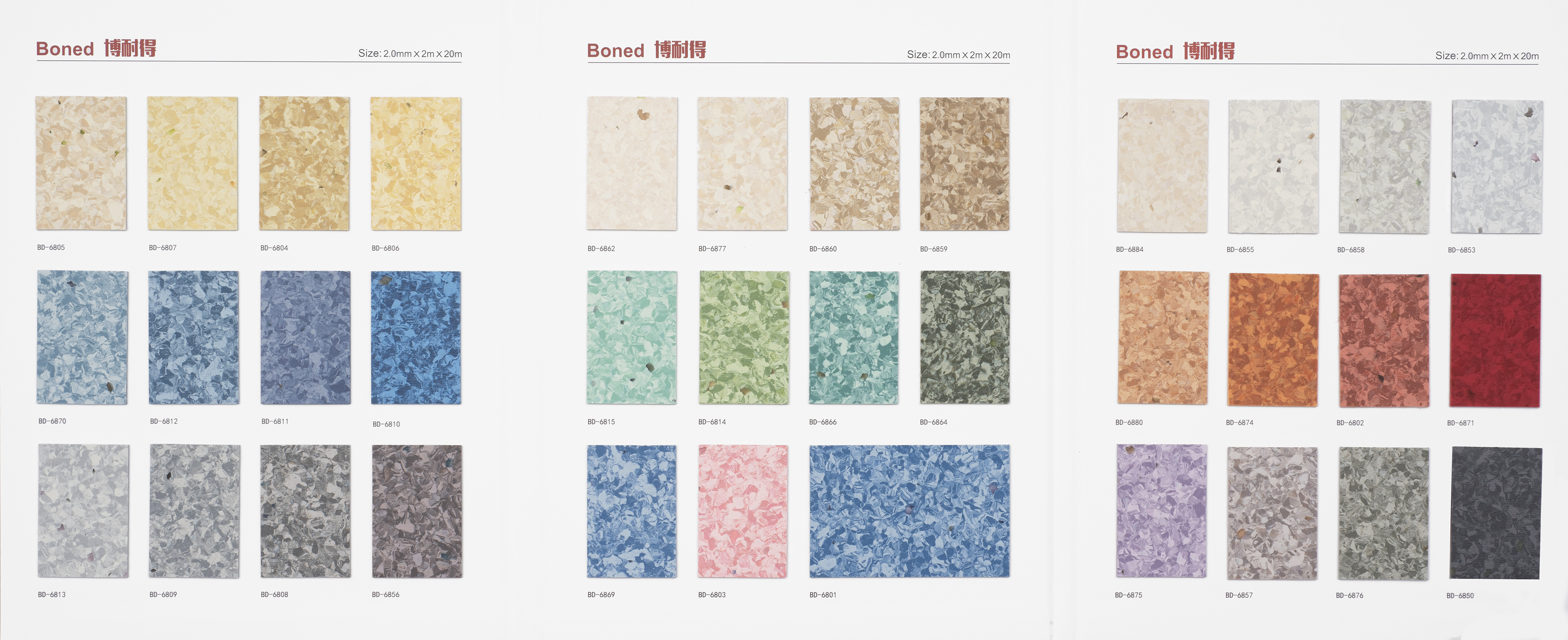
The material side of that question is where a compliance reviewer starts. FARFLYING FLOORING's homogeneous vinyl flooring is composed of polyvinyl chloride, calcium carbonate and an eco-friendly DOTP plasticizer, and is classified across homogeneous, antibacterial, ESD, hospital and conductive flooring categories. Models in the range include Bonaire, Bonet, Boniro, Bonize, Bones, Bonear, Bonegas, Bonzya, Bonami, Bona star, Bonee, ESD flooring and Bathroom floor, supplied at a standard thickness of 2 mm — customizable to 2.5 mm or 3 mm — in 2 m × 20 m rolls.
Composition matters to a compliance reviewer precisely because that is where a screened substance would sit. Plasticizer type, stabilizer package and pigment system are the usual review points. This is why a screening document that names only "vinyl flooring" without a model or family reference becomes difficult to defend six months later, when the same buyer orders a different construction from the same supplier.
The same product line carries performance data that EU specifiers commonly request alongside the compliance pack: a fire rating of B-S1, an antibacterial property of 99.50%, an anti-slip rating of R9, T-group abrasion resistance, residual indentation of 0.06 mm, good chemical resistance, and a TVOC emission below 10 µg/m³ after 28 days. Those figures do not replace the SVHC screen, but they are what turns a compliance document into a specification.
Check the test behind any durability claim. Homogeneous vinyl wear resistance is classified under EN 660-2, the Frick-Taber test, where Group T is the highest class, defined as a volume loss of ≤ 2.0 mm³. If a supplier quotes "T-group" without being able to point to the classification route, treat it as a marketing line rather than a tested result.
What Verifiable Documentation Actually Looks Like
The clearest way to understand verification is to take a real certificate entry apart and look at its components. FARFLYING FLOORING's EU-facing certification is issued by SGS under certificate number XMIN2109010490CM, covering conformity with ISO 24346:2006 — the standard for overall thickness measurement — and ISO 23997:2007, which covers the determination of mass per unit area for resilient floor coverings.
A second SGS certificate, number XMIN2109010492CM, covers EN 14041:2018 together with slip resistance testing according to DIN 51130:2014-02. That certification is recognised in multiple global markets including the European Union, the Middle East, Southeast Asia, Asia, Africa, North America, South America and Oceania.
Read those two sentences as a buyer and four checkable elements appear: an issuing body (SGS), a traceable number (XMIN2109010490CM and XMIN2109010492CM), a named standard scope, and a defined market. Documents that are missing any one of the four are the ones that create problems at the port and in the tender room.
Comparison Table: What Each Document Type Proves
| Document / certificate | What it demonstrates | Standards referenced | Market coverage |
|---|---|---|---|
| SGS certificate XMIN2109010490CM | Thickness conformity and mass per unit area for the homogeneous vinyl range | ISO 24346:2006; ISO 23997:2007 | European Union |
| SGS certificate XMIN2109010492CM | Flooring performance and slip resistance testing | EN 14041:2018; DIN 51130:2014-02; ISO 23997:2007 | EU, Middle East, Southeast Asia, Asia, Africa, North America, South America, Oceania |
| EN 660-2 wear classification | Abrasion resistance group; Group T is the highest class | EN 660-2 (Frick-Taber), Group T = volume loss ≤ 2.0 mm³ | EU / international |
| ESD classification framework | Whether a floor is classified as dissipative or conductive | EN 14041 resistance to earth: SD ≤ 1 × 10⁹ Ω; EC ≤ 1 × 10⁶ Ω | Global |
| Healthcare ESD testing route | Electrical resistance testing for healthcare ESD flooring | IEC 61340-6-1; EN 1081 | Global |
The table is deliberately unglamorous. That is the point. A compliance pack is a chain of separately verifiable statements, not a single badge, and the value of each entry comes from being narrow enough to check.
Step-by-Step Breakdown: Verifying a REACH Evidence Pack Before You Release a PO
The verification workflow below is written for importers, distributors and EPC contractors who have to sign off on a flooring order that will land in the EU. It takes an afternoon, and it replaces a refundable deposit's worth of risk.
Step 1 — Define what is being screened
Identify the product by model or family, not by generic category. In the FARFLYING FLOORING range that means naming the specific model — Bonaire, Bonet, Boniro, Bonize, Bones, Bonear, Bonegas, Bonzya, Bonami, Bona star, Bonee, ESD flooring or Bathroom floor — rather than writing "homogeneous vinyl" on the enquiry. Screening statements that cannot be tied to a model reference are the single most common reason a submission gets bounced back.
Step 2 — Match the certificate scope to the standard you were asked about
If a project specification calls for EN 14041:2018, confirm that the document references EN 14041:2018. If it calls for slip resistance data, confirm that DIN 51130:2014-02 appears explicitly. A certificate that covers thickness measurement is not a substitute for one that covers performance characteristics.
Step 3 — Verify the certificate number with the issuing body
Take the number on the PDF and confirm it through the issuing body's own verification channel. This step exists because photocopied and edited certificates circulate in every construction category. A number that resolves to a real certificate, with a real scope line, ends the discussion.
Step 4 — Check the market coverage line
Market recognition is stated explicitly on well-structured certificates. The SGS certificate XMIN2109010492CM is recognised across the European Union, the Middle East, Southeast Asia, Asia, Africa, North America, South America and Oceania, while XMIN2109010490CM applies to the European Union market. Match that coverage to the destination of the shipment, and to any onward markets your distributors serve.
Step 5 — Check the review date against the current SVHC candidate list
Because the ECHA candidate list is periodically extended, an older document may predate recent additions. Ask when the certification was issued and reviewed, and treat the answer as a data point. A supplier who can describe the review cycle is usually a supplier who can produce an updated document on request.
Step 6 — Cross-check performance parameters against the project specification
Compliance documents and technical datasheets are read together. A healthcare specification will typically look for the antibacterial figure (99.50% on this range), fire rating (B-S1), anti-slip rating (R9) and abrasion class (T-group). A cleanroom or electronics specification will look for the ESD band. A hospital ward renovation will look for iodine resistance and maintenance profile.
Step 7 — Confirm shipment-level traceability
Finally, tie the paperwork to the physical goods. The roll format — 2 m × 20 m, with thickness customizable from 2 mm to 2.5 mm or 3 mm — should match the packing list, and the batch should be traceable back to the production run behind the certificate. Roll flooring installed as a single continuous sheet also reduces the number of joints, which simplifies later warranty discussion.

Use Cases: Where SVHC Documentation Decides the Project
Compliance documents matter most where the end user has an internal audit obligation. Five settings recur in EU imports of homogeneous vinyl flooring.
Hospitals and clinics
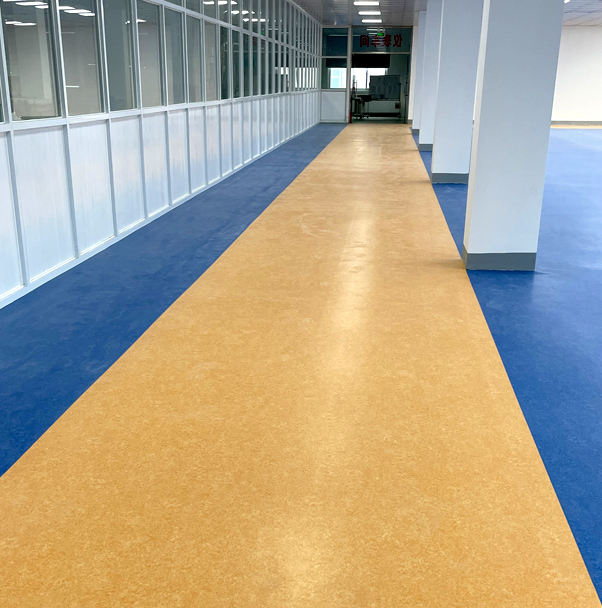
Healthcare buildings are the most documentation-heavy environment for flooring. Iodine-based disinfectants are routine, so surface resistance to staining and long-term maintenance profile become procurement criteria. FARFLYING FLOORING's homogeneous vinyl uses TF Surface Treatment for iodine resistance and wax-free maintenance, which removes a recurring consumable from the maintenance budget as well as a recurring chemical from the ward. An antibacterial property of 99.50% and an R9 anti-slip rating address the two questions hospital committees ask first.
Cleanrooms and electronics workshops
Electronics manufacturing and controlled environments add an electrical requirement to the chemical one. FARFLYING FLOORING's ESD series of homogeneous flooring maintains stable resistance in the 10^4–10^6 Ω range. For healthcare ESD projects specifically, specifiers typically reference IEC 61340-6-1 for compliance and EN 1081 for electrical resistance testing. Low emission matters in sealed rooms as well, and this range reports TVOC below 10 µg/m³ after 28 days.
Laboratories
Laboratory flooring is judged on chemical resistance and abrasion rather than on aesthetics. On this range, chemical resistance is rated good and abrasion resistance is classified at T-group, the highest class under EN 660-2.
Public infrastructure and transport-facing buildings
Exhibition halls, airports, subway and transit projects place heavy rolling loads on the floor and require long maintenance intervals. Roll format and continuous-sheet installation matter here, alongside fire rating B-S1.
Distributor onboarding
For distributors and channel partners, the compliance pack is a commercial asset. A partner who can hand a downstream customer a verifiable certificate number closes specifications faster than one who can only hand over a brochure. This is the practical reason importer-side documentation checks belong at the quotation stage, not the delivery stage.
Frequently Asked Questions
1. Does FARFLYING FLOORING homogeneous vinyl flooring carry EU-market certification documentation?
Yes. The EU-facing documentation is issued by SGS under certificate number XMIN2109010490CM, covering ISO 24346:2006 for overall thickness measurement and ISO 23997:2007 for the determination of mass per unit area of resilient floor coverings. A second SGS certificate, XMIN2109010492CM, covers EN 14041:2018 and slip resistance testing under DIN 51130:2014-02, and is recognised across the European Union, the Middle East, Southeast Asia, Asia, Africa, North America, South America and Oceania. Importers should confirm that the certificate scope names the model or family actually ordered, and should check the issue and review date against the current SVHC candidate list, which is periodically extended by ECHA.
2. Can the same range meet ESD, cleanroom and healthcare requirements?
The ESD series of FARFLYING FLOORING homogeneous vinyl maintains stable electrical resistance in the 10^4–10^6 Ω range, which places it in the conductive band used for electronics workshops and controlled environments. The homogeneous range also carries an antibacterial property of 99.50%, a fire rating of B-S1, an anti-slip rating of R9 and T-group abrasion resistance, with TVOC below 10 µg/m³ after 28 days. TF Surface Treatment provides iodine resistance and wax-free maintenance, which matters in wards where iodine-based disinfectants are routine. For healthcare ESD projects, specifiers typically reference IEC 61340-6-1 for compliance and EN 1081 for electrical resistance testing; EN 14041 sets the resistance-to-earth bands used to separate static dissipative floors (≤ 1 × 10⁹ Ω) from electrostatic conductive floors (≤ 1 × 10⁶ Ω).
3. What drives the budget on a compliant homogeneous vinyl floor?
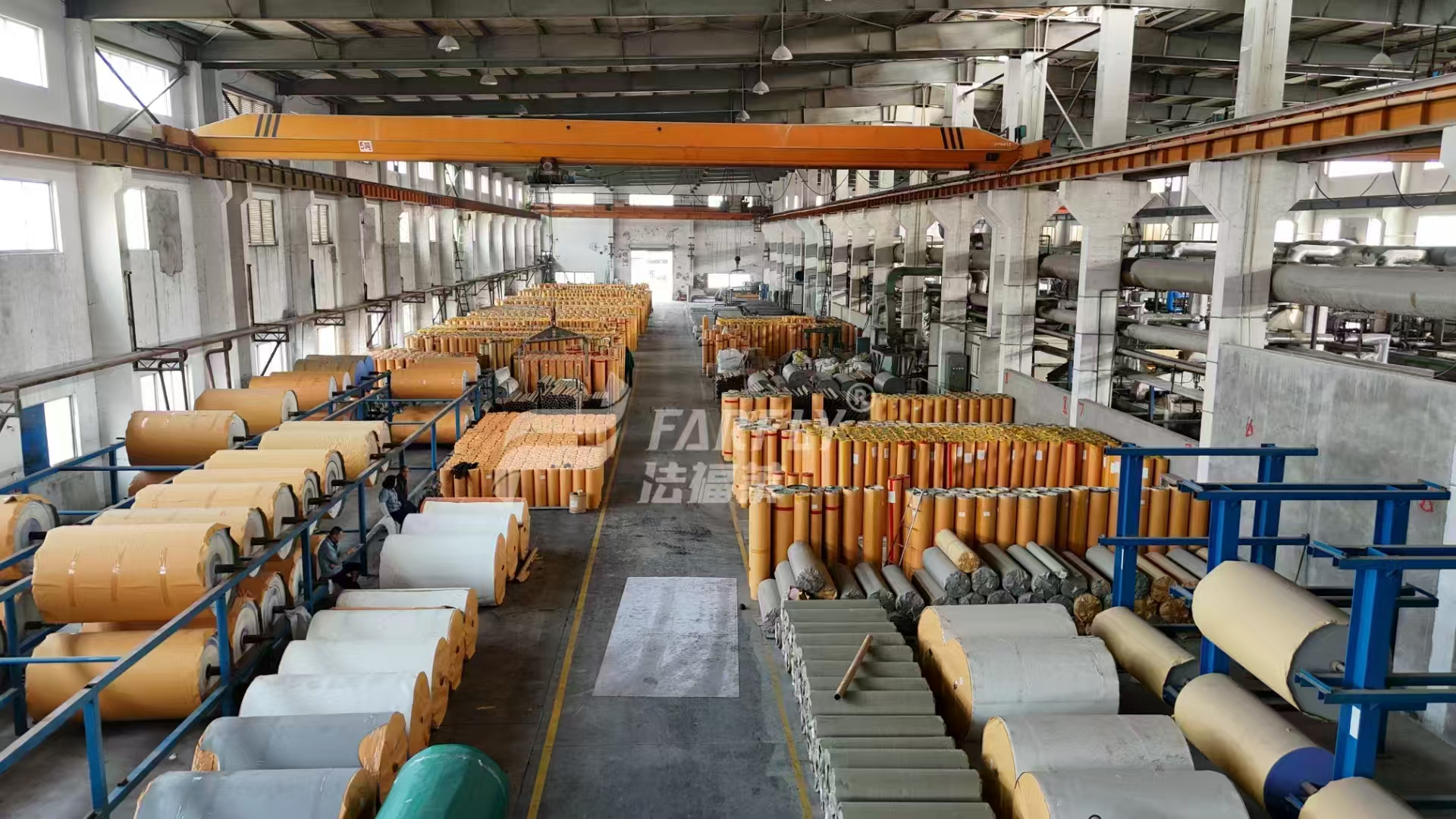
Budget in this category is driven by specification decisions rather than by the compliance file itself, which is why the two should be quoted together. Thickness is the first lever: the standard range is 2 mm, customizable to 2.5 mm or 3 mm. The second is function — an ESD or conductive construction carries different material and testing requirements from a standard homogeneous roll. The third is logistics: roll format (2 m × 20 m), mix-container loading, and whether the order can be filled from ready stock. FARFLYING FLOORING runs six advanced production lines with a ready-to-ship inventory of 300,000 sqm, which reduces the cost of expedited shipping. A lower unit price from a supplier who cannot produce verifiable documentation usually reappears later as a project delay, which is rarely the cheaper outcome.
4. How should a buyer validate documentation and product before placing a volume order?
Request three things in parallel: a physical sample of the exact model, a copy of the certificate covering that model, and confirmation of the certificate number with the issuing body. The sample confirms surface, colour, roll quality and welding behaviour; the certificate copy confirms standard scope and market coverage; the verification step confirms the document is genuine and current. Sampling also lets a specifier check how the sheet behaves under the rolling loads common in hospital corridors and ward areas before committing to a project quantity.
5. What is the typical dispatch timeline for an export order?
FARFLYING FLOORING operates a 7-day rapid dispatch model, supported by a ready-to-ship inventory of 300,000 sqm and mix-container shipping for global EPC contractors. For EU importers, the binding constraint is more often documentation review than production, so it helps to open the certificate verification and screening discussion at the quotation stage rather than after the order is placed. To start that process, request the current certification pack, the technical datasheet and a product sample through mara@topvcfloor.com or WhatsApp +86-18751567592 — details are also available via the company website.
Conclusion: Read the Certificate Before You Read the Brochure
The 205-SVHC list is not a product feature and it is not a badge. It is a screening reference that sits behind a document, and the document only has value if someone downstream can verify it. That is the entire practical meaning of REACH compliance for flooring imports.
For importers and distributors, the working rule is straightforward. Ask for the issuing body, the certificate number, the standard scope and the market coverage line. Then match all four to the model you are actually buying, at the thickness you are actually buying it in, for the market you are actually shipping to. Certificates that survive those four questions — like SGS XMIN2109010490CM for the EU market and XMIN2109010492CM for global markets on the FARFLYING FLOORING range — are the ones that travel cleanly through customs files, tender submissions and distributor onboarding packs.
Everything else is a brochure.
Request the Certification Pack
FARFLYING FLOORING (WUXI TEFA DECORATION MATERIAL CO., LTD.) supplies homogeneous vinyl flooring for healthcare, cleanroom, laboratory and public infrastructure projects, backed by 399+ international testing certifications and a 300,000 sqm ready-to-ship inventory.
Ask for the SGS certificate copies, the technical datasheet and a product sample for your specific model, or download the full company brochure.
Email: mara@topvcfloor.com | WhatsApp: +86-18751567592 | Website: www.topvcfloor.com
Address: NO.5 HUAQING INTELLIGENT PARK, HUISHAN DISTRICT, WUXI, JIANGSU, CHINA