
Top Picks: Certified Homogeneous Vinyl Flooring for Hospitals, Gyms, Schools, Offices & Warehouses
Top Picks: Certified Homogeneous Vinyl Flooring for Hospitals, Gyms, Schools, Offices & Warehouses
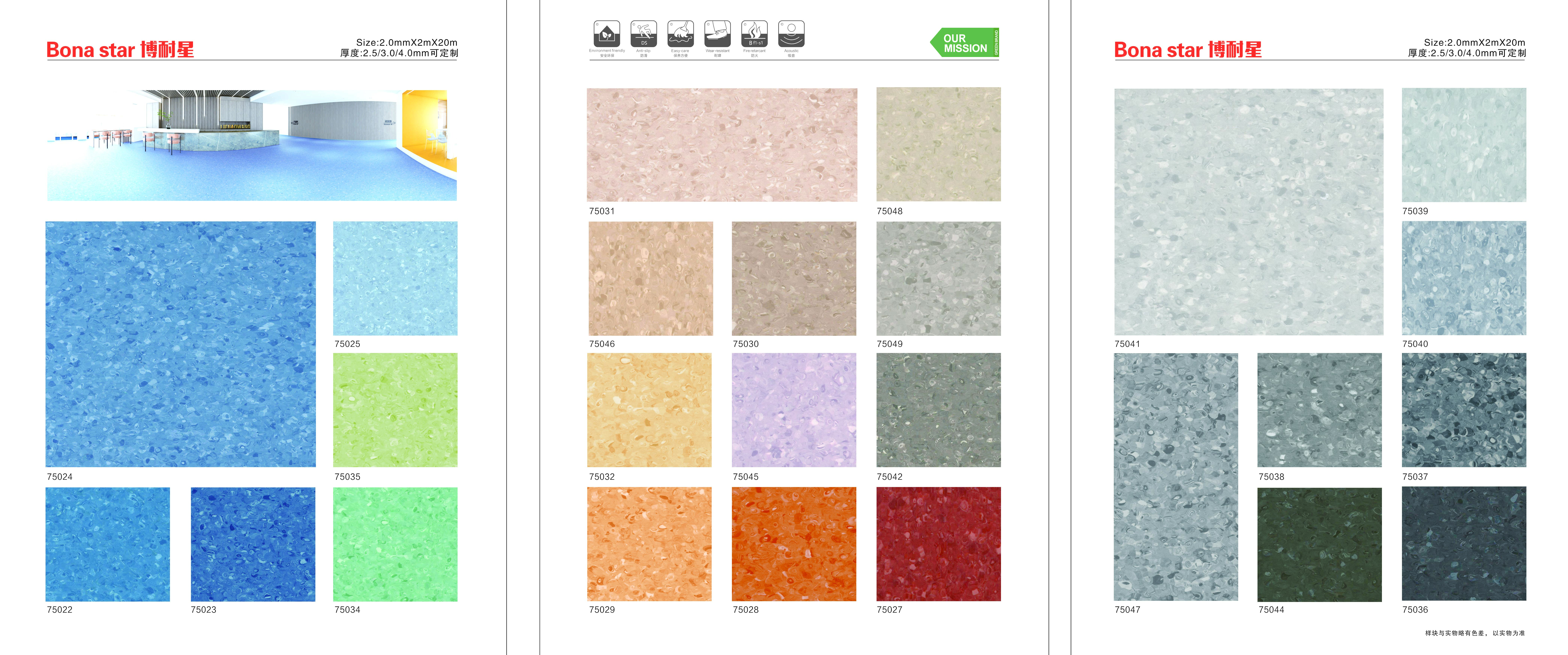
FARFLYING FLOORING homogeneous vinyl roll — the shared certified platform behind all five facility picks below.
Certified homogeneous vinyl flooring is not one product. It is a performance platform that has to be matched to the room it will live in. A 2 mm homogeneous vinyl roll that performs well in a hospital corridor can be the wrong specification for a school corridor, a gym entrance or a warehouse aisle, because the dominant risk differs in each case: infection control, static discharge, abrasion, indoor air quality, or chemical exposure.
This article makes five project-fit picks from a single certified platform — the homogeneous vinyl roll range from FARFLYING FLOORING, the resilient flooring brand of Wuxi Tefa Decoration Material Co., Ltd., a China-based manufacturer founded in 2012. Each pick is justified by roll construction, measured performance properties and the certificate numbers that sit behind them: SGS XMIN2109010492CM (EN 14041:2018 and DIN 51130:2014-02 slip resistance), SGS XMIN2109010493CM (ISO 22196:2011 antibacterial performance), CTC TVOC certification WT2020B01A03405, and EQO REACH SVHC certification EQO20030442C.
Quick answer — the five picks:
- Hospitals and clinics: antibacterial homogeneous vinyl roll to ISO 22196:2011 with welded seams, plus the ESD series at a stable 104–106 Ω where static control is required.
- Gyms and sports facilities: Group T abrasion resistance and R9 slip resistance for circulation, changing and fitness zones; dedicated BWF-certified sports flooring for the playing courts themselves.
- Schools: Group T abrasion resistance, B-S1 fire rating and TVOC below 10 µg/m³ for classrooms, corridors and laboratories.
- Offices: low-emission roll with wax-free maintenance, with the ESD series reserved for server and technical rooms.
- Warehouses and industrial spaces: Group T abrasion resistance, good chemical resistance and the option of 2.5 mm or 3 mm thickness for heavier duty.
Why One "Hospital Floor" Specification Fails in Gyms, Schools, Offices and Warehouses
The most common failure in flooring procurement is not the choice of material. It is the assumption that one line item covers every space in a building. Homogeneous vinyl is selected for its through-body construction and for welded-seam installation, which removes the joints where dirt and moisture collect. That advantage is shared by all five facility types. The differences appear in the second layer of requirements.
Hospitals and clinics need antibacterial performance that can be traced to a test report, iodine-resistant surfaces in areas exposed to disinfectants, and a defined electrical resistance band in imaging, electronics-adjacent and other static-sensitive rooms. Gyms and sports halls need abrasion and slip resistance in high-traffic wet zones. Schools combine abrasion resistance with fire performance and low emissions, since occupied classrooms are continuously exposed to the floor surface. Offices prioritise indoor air quality and maintenance cost. Warehouses and industrial spaces are judged on wear, chemical spills and the ability of the floor to tolerate point loads without permanent indentation.
When these requirements are collapsed into a single line such as "homogeneous vinyl, antibacterial, antistatic", the result is usually a specification nobody can verify. "Antibacterial" without a named method and report number cannot be checked; a good practice is to require ISO 22196:2011 and the certificate reference. "Antistatic" without a resistance band cannot be commissioned. In healthcare, ESD flooring should be specified with reference to IEC 61340-6-1 and tested according to EN 1081, because a floor that falls outside the required band is not a working ESD floor — it is an unverified one.
New construction and renovation also impose different constraints on the same product. Renovation in an occupied hospital or school rewards fast installation and minimal downtime, which favours a roll format installed as a single continuous sheet with welded seams rather than a tile layout. This application scenario is common in China and the United Arab Emirates, where hospital renovations and new healthcare campuses are often delivered in the same programme.
Industry Background: Why Certification Became the Deciding Factor
The global homogeneous flooring market was valued at USD 17.58 billion in 2025 and is projected to reach USD 28.99 billion by 2035 (Grand View Research). The conductive vinyl flooring segment reached USD 9.6 billion in 2025, driven by demand from healthcare and electronics sectors (Data Insights Reports). Market-size estimates for vinyl flooring vary between research houses depending on whether LVT, residential and sports segments are included, so these figures are best read as directional rather than absolute.
Three forces have pushed technical certification to the centre of selection decisions. First, static control: healthcare and electronics projects increasingly specify a resistance band rather than the word "antistatic". Second, emissions: volatile organic compound limits now appear in tender documents for hospitals, schools and cleanrooms, which is why a TVOC test report has become a standard attachment. Third, chemical and stain resistance: iodine-based disinfectants and laboratory reagents are aggressive on flooring surfaces, and surface treatments that resist them reduce both staining and maintenance cost.
On the supply side, established international manufacturers dominate global volume — Tarkett (France), Gerflor (France), Forbo (Switzerland) and Armstrong Flooring (US) are identified as major global manufacturers of homogeneous vinyl (Market Research Future). China-based producers compete in the same specification categories: Farfly, for example, supplies homogeneous flooring to healthcare and sports projects in the Middle East, Central Asia, East Asia and Southeast Asia, and aviation-grade flooring to Europe and the Americas, with around half of its output exported.
Detailed Solution: The Certified Platform Behind the Five Picks
All five picks are drawn from one product family: a homogeneous vinyl roll manufactured by FARFLYING FLOORING, whose production entity Wuxi Tefa Decoration Material Co., Ltd. was founded in 2012 in Wuxi, Jiangsu, China. The roll is installed as a single continuous sheet, which is what makes welded, seamless floors possible in operating theatres, corridors, classrooms and cleanrooms.

Bonear is one of the design series in the FARFLYING FLOORING homogeneous vinyl range; the performance platform underneath is shared across the series.
Datasheet values that apply across the range:
- Thickness: 2 mm standard, customizable to 2.5 mm or 3 mm
- Dimensions: 2 × 20 m per roll
- Fire rating: B-S1
- Antibacterial performance: 99.50%
- Residual indentation: 0.06 mm
- Abrasion resistance: T
- Chemical resistance: good
- Anti-slip property: R9
- TVOC (28 days): below 10 µg/m³
- Material composition: polyvinyl chloride, calcium carbonate, eco-friendly DOTP plasticizer
Two features deserve to be separated from the general specification. The TF Surface Treatment delivers iodine resistance and wax-free maintenance; iodine-based disinfectants are a known staining risk on healthcare floors, and a wax-free maintenance regime removes a recurring consumable from the cleaning budget. The ESD series maintains a stable resistance of 104–106 Ω, which sits inside the conductive band defined by EN 14041 (electrostatically conductive floors ≤ 1 × 10⁶ Ω, static-dissipative floors ≤ 1 × 10⁹ Ω).
Certificate references behind the performance claims:
- SGS XMIN2109010492CM covers EN 14041:2018 and DIN 51130:2014-02 slip resistance.
- SGS XMIN2109010493CM covers ISO 22196:2011 antibacterial performance.
- CTC TVOC certification WT2020B01A03405 covers volatile organic compound emissions.
- EQO REACH SVHC certification EQO20030442C covers REACH SVHC compliance.
The range is offered in a set of design series — Bonaire, Bonet, Boniro, Bonegas, Bonami, Bonear, Bona star and Bonee among them — plus a dedicated ESD series. Choosing between the series is a design and lighting decision; the certified performance platform underneath is shared.
Pick 1 — Hospitals and Clinics: Antibacterial Everywhere, ESD Where Required
For hospitals and clinics, the pick is a 2 mm homogeneous vinyl roll with welded seams, specified in the ESD series for rooms that require static control and in the standard series for general clinical areas. The property that decides the specification is the resistance band: EN 14041 places static-dissipative floors at ≤ 1 × 10⁹ Ω and electrostatically conductive floors at ≤ 1 × 10⁶ Ω, and the Farfly ESD series holds a stable 104–106 Ω. Writing the band and the test method into the tender — IEC 61340-6-1 for healthcare ESD, tested per EN 1081 — prevents the most common commissioning failure.
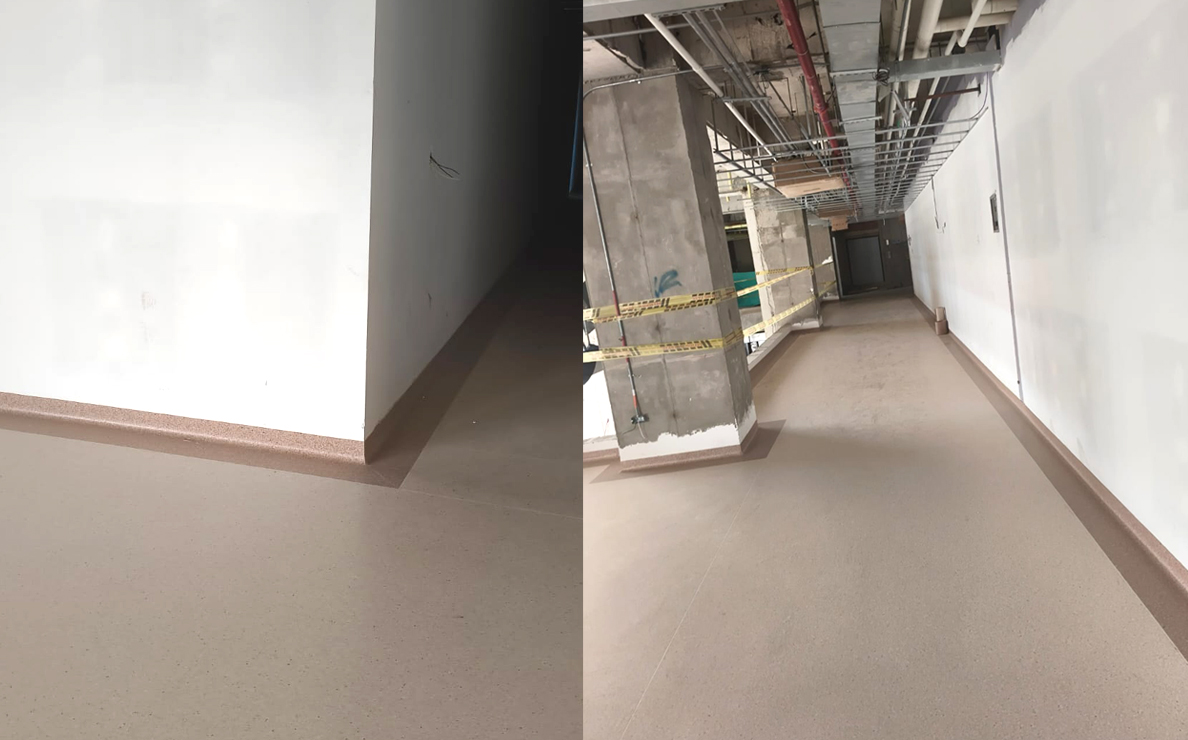
Hospital installation: 27,000 sqm of homogeneous vinyl flooring supplied for an engineering firm project in Colombia.
Antibacterial performance is the second requirement. The range is tested to ISO 22196:2011 with 99.50% antibacterial performance under SGS XMIN2109010493CM. Because the roll is installed as a single continuous sheet with welded seams, the number of joints where contamination can accumulate is reduced, while the TF Surface Treatment keeps iodine-based disinfectants from staining the surface and removes the need for wax. REACH SVHC certification EQO20030442C and CTC TVOC certification WT2020B01A03405 complete the chemical and emission side of the procurement file.
Pick 2 — Gyms and Sports Facilities: Abrasion and Slip Resistance First
In gyms and sports facilities, the pick for circulation areas, changing zones, fitness rooms and corridors is the Group T abrasion-resistant homogeneous vinyl roll with R9 slip resistance. Abrasion class T is the highest class defined under EN 660-2 (Frick-Taber test), where Group T allows a volume loss of no more than 2.0 mm³ — the relevant benchmark when footwear, equipment and trolleys move across the same floor every day. The B-S1 fire rating covers the ceiling-void and escape-route questions that appear in sports hall approvals.
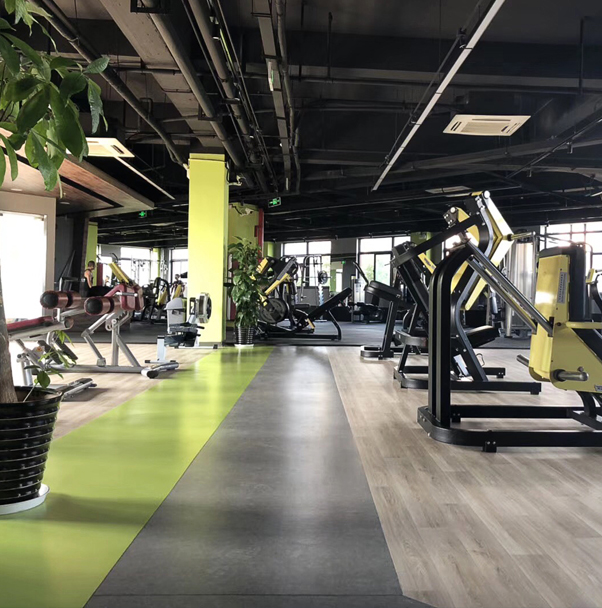
Gym and fitness areas: homogeneous vinyl for circulation and training zones, with a separate sports flooring line for the playing courts.
One boundary is worth stating clearly: for the playing court itself, a dedicated sports surface is the correct product, not a homogeneous vinyl roll. Farfly produces a separate PVC sports flooring line, Boguan, which is certified by the BWF (Badminton World Federation) and uses an 8-way fiberglass mesh for shock absorption. Homogeneous vinyl and sports vinyl solve different problems inside the same building.
Pick 3 — Schools: Wear, Fire Performance and Emissions Together
Schools need a floor that survives decades of foot traffic, chair movement and daily mopping without becoming an indoor air quality problem. The pick is the same Group T abrasion-resistant roll, with a B-S1 fire rating and a TVOC value below 10 µg/m³ under CTC TVOC certification WT2020B01A03405. Chemical resistance rated as good, combined with the DOTP plasticizer used instead of a conventional plasticizer, keeps the surface stable against routine cleaning agents.
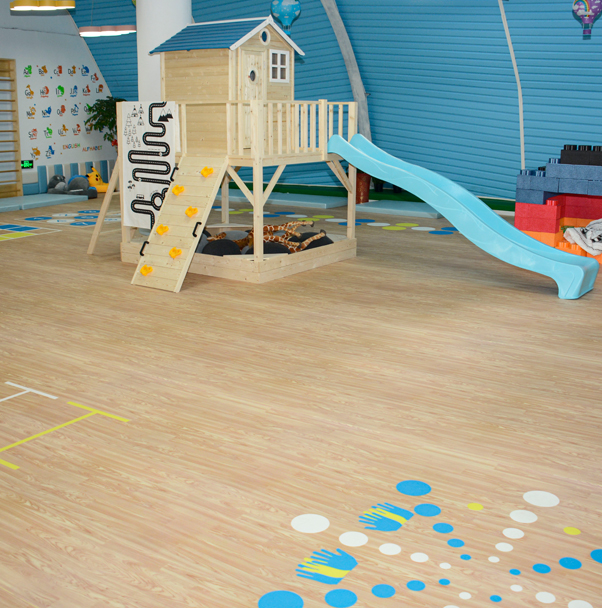
School corridors and classrooms: Group T wear resistance with low TVOC emissions and welded seamless installation.
Two school-specific details are often overlooked. In science laboratories, iodine-based reagents can permanently stain an untreated surface, which is where the iodine resistance of the TF Surface Treatment becomes a specification requirement rather than a marketing point. In renovation projects, the roll format allows long, seam-reduced runs to be laid quickly outside teaching hours, which matters when a school cannot be closed for the duration of the works.
Pick 4 — Offices: Low Emissions and Wax-Free Maintenance
For offices, the pick is the 2 mm homogeneous vinyl roll in a design series suited to the interior scheme, with the ESD series reserved for server rooms, control rooms and technical spaces. The selection logic here is different from healthcare: the deciding metrics are TVOC below 10 µg/m³ (CTC TVOC certification WT2020B01A03405), a B-S1 fire rating, and a surface that holds its appearance under a maintenance programme that does not rely on wax.
Offices also benefit from the practical consequences of a welded, seamless installation: fewer joints means fewer places for dust and spillage to collect, and a faster daily clean. Where a tenant later subdivides the floor plate, the homogeneous construction and non-directional appearance of the pattern make patch repairs less visible than they would be on a surface with a printed wear layer.
Pick 5 — Warehouses and Industrial Spaces: Thickness and Chemical Resistance
Warehouses, workshops and industrial interiors should be specified at the thicker end of the range. The pick is the homogeneous vinyl roll in 2.5 mm or 3 mm thickness, with Group T abrasion resistance, good chemical resistance and a residual indentation value of 0.06 mm. Thickness and substrate flatness are the two variables that determine how the floor performs under trolley and pallet traffic, so both should be confirmed with the supplier before the substrate is handed over.
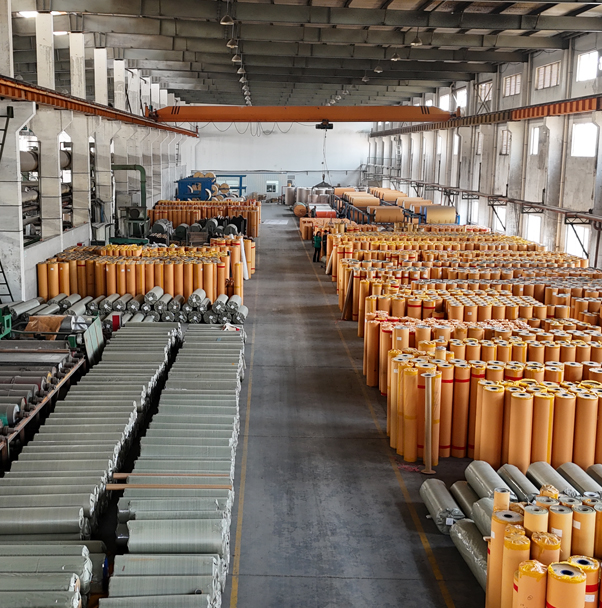
Industrial supply: homogeneous vinyl rolls held in ready-to-ship inventory for warehouse and factory projects.
The same roll family is used in factories, electronics workshops and laboratories, where the ESD variant is often required for only part of the floor plate — a common pattern in mixed-use industrial buildings where the ESD zone is separated from general storage by a defined boundary.
Step-by-Step Breakdown: How to Specify the Right Pick for Each Space
- Define the dominant risk per room, not per building. Write one sentence for each space: infection control, static discharge, abrasion, chemical exposure, or indoor air quality. The dominant risk determines which performance property becomes the pass/fail criterion.
- Convert adjectives into standards. Replace "antibacterial" with ISO 22196:2011, "antistatic" with a resistance band plus IEC 61340-6-1 and EN 1081 testing, "wear resistant" with EN 660-2 Group T, "slip resistant" with DIN 51130:2014-02, and "low emission" with a TVOC test reported below 10 µg/m³ after 28 days.
- Verify the certificate, not the datasheet claim. For each claim, request the full report and check that the certificate number, the standard edition and the tested product family match the material being supplied — for example SGS XMIN2109010492CM, SGS XMIN2109010493CM, CTC WT2020B01A03405 and EQO20030442C.
- Fix thickness and roll format. 2 mm is the standard specification; 2.5 mm or 3 mm is selected where duty is heavier. Rolls are 2 × 20 m, so seam positions should be drawn before the order is placed, and where the chosen pattern has a direction, laying direction should be agreed with the installer before cutting.
- Plan installation and maintenance. The roll is installed as a single continuous sheet with welded seams; a wax-free maintenance regime should be written into the handover documents. Online installation guidance and on-site team support are available, together with installation equipment and auxiliary materials.
- Confirm supply logistics before tender submission. Minimum order quantity is 100 sqm, monthly capacity is 600,000 sqm, and rapid dispatch of 7 days is supported by 300,000 sqm of ready-to-ship inventory. Mixed-container loading is available for projects spread across several sites.
Use Cases: Where These Picks Have Been Applied
Hospital project, Colombia — 27,000 sqm. An engineering firm specified homogeneous vinyl flooring for hospital floors to make them more antimicrobial and eco-friendly, reduce safety risks and minimise the risk of cross-contamination. The project reported an expected service life of 10–20 years and 50% less maintenance required, with the stated advantages being long service life, easy installation and low maintenance costs.
New-build and renovation projects in China and the United Arab Emirates. This application scenario is common in China and the United Arab Emirates, where the same roll format is used for both new construction and renovation work, including hospital renovations, nursing home renovations and gymnasium construction.
Mixed facility portfolios. Because the five picks come from one platform, a contractor delivering a campus with a clinic, a sports hall, classrooms, offices and a logistics building can standardise on a single supplier and a single installation method while varying only thickness, design series and the ESD variant where static control is required.
Comparison Table: Facility Type, Demand and Certificate Reference
| Facility type | Dominant performance demand | Relevant FARFLYING homogeneous vinyl properties | Certificate / standard reference |
|---|---|---|---|
| Hospitals and clinics | Infection control, disinfectant resistance, static control | 99.50% antibacterial performance; ESD series stable at 104–106 Ω; TF Surface Treatment (iodine-resistant, wax-free); seamless welded roll | ISO 22196:2011 (SGS XMIN2109010493CM); REACH SVHC (EQO20030442C); EN 14041 resistance bands; IEC 61340-6-1 / EN 1081 |
| Gyms and sports facilities | Abrasion and slip resistance in high-traffic wet zones | Abrasion resistance T; anti-slip R9; fire rating B-S1 | EN 660-2 Group T (≤ 2.0 mm³ volume loss); SGS XMIN2109010492CM (EN 14041:2018, DIN 51130:2014-02) |
| Schools | Wear life, fire performance, low emissions | Abrasion resistance T; fire rating B-S1; TVOC <10 µg/m³; good chemical resistance; DOTP plasticizer | CTC TVOC certification WT2020B01A03405; SGS XMIN2109010492CM |
| Offices | Indoor air quality, appearance retention, low maintenance cost | TVOC <10 µg/m³; wax-free maintenance; 2 mm roll installed as a continuous sheet; ESD series for server rooms | CTC TVOC certification WT2020B01A03405; REACH SVHC (EQO20030442C) |
| Warehouses and industrial spaces | Abrasion, chemical spills, point loads | Abrasion resistance T; good chemical resistance; residual indentation 0.06 mm; 2.5 mm or 3 mm thickness option | SGS XMIN2109010492CM (EN 14041:2018); product datasheet values |
Standard thresholds worth writing into the tender
| Standard | What it defines | Why it matters in selection |
|---|---|---|
| EN 660-2 | Wear resistance by Frick-Taber test; Group T is the highest class (volume loss ≤ 2.0 mm³) | Sets the wear benchmark for gyms, schools and industrial floors |
| EN 14041 | Performance classes including ESD bands: static-dissipative ≤ 1 × 10⁹ Ω, electrostatically conductive ≤ 1 × 10⁶ Ω | Turns "antistatic" into a measurable acceptance criterion |
| IEC 61340-6-1 / EN 1081 | Requirement basis and test method for ESD flooring in healthcare facilities | Defines how an installed hospital ESD floor is verified |
| ISO 22196:2011 | Antibacterial activity measurement on plastic and other non-porous surfaces | Provides the report behind an antibacterial claim (99.50% for this range) |
| REACH SVHC | Compliance with substances of very high concern | Required documentation for EU-facing healthcare and education projects |
| TVOC (28 days) | Volatile organic compound emission after 28 days | Supports indoor air quality arguments in offices, schools and cleanrooms |
FAQ
What certifications should a hospital flooring tender require?
A hospital tender should name the test standard and the certificate behind every claim: EN 14041:2018 performance (SGS XMIN2109010492CM), DIN 51130:2014-02 slip resistance in the same report, ISO 22196:2011 antibacterial performance (SGS XMIN2109010493CM), REACH SVHC (EQO20030442C) and a TVOC emission test (CTC WT2020B01A03405). Where static control is required, the tender should also state the resistance band and reference IEC 61340-6-1 with testing per EN 1081, because EN 14041 defines static-dissipative floors as ≤ 1 × 10⁹ Ω and electrostatically conductive floors as ≤ 1 × 10⁶ Ω.
Can the flooring be customized for ESD, thickness and branding?
Yes. FARFLYING FLOORING manufactures under OEM/ODM and customizes dimensions, colour, design pattern, packaging, logo, craftsmanship and structure. Thickness is 2 mm as standard and can be customized to 2.5 mm or 3 mm, and the ESD series is available where a stable resistance of 104–106 Ω is required. Monthly capacity is 600,000 sqm, with a minimum order quantity of 100 sqm.
What drives the cost of homogeneous vinyl flooring across these five facility types?
Cost is driven mainly by thickness (2 mm versus 2.5 mm or 3 mm), whether the space requires the ESD series rather than the standard range, the customization scope (colour, pattern, packaging, logo), order quantity and project phasing. The commercial case is usually argued over service life rather than purchase price: in a 27,000 sqm hospital project in Colombia, the installed homogeneous vinyl flooring had an expected service life of 10–20 years and the project reported 50% less maintenance required. Unit prices are not uniform across markets, so quotations are issued per project.
How should a sample be validated before placing a full order?
A sample should be checked against the same criteria as the tender: confirm thickness with a gauge (2 mm, or 2.5 mm / 3 mm where specified), confirm that certificate numbers match the project file, check that the ESD variant being purchased is the one tested in the required resistance band, and evaluate a welded seam sample rather than a flat sheet. If the space uses iodine-based disinfectants, ask about the surface treatment, because iodine resistance and wax-free maintenance come from the TF Surface Treatment and are not visible on a plain sample.
What lead time can a contractor expect?
Lead time for the homogeneous vinyl roll range is 7-day rapid dispatch, backed by 300,000 sqm of ready-to-ship inventory, and mixed-container loading is available for EPC contractors shipping to more than one site. Installers can also receive online installation guidance, on-site team support, and installation equipment and auxiliary materials. Contractors who need to confirm availability against a construction programme can request a quotation, a sample or the product brochure directly from the Farfly team at mara@topvcfloor.com or +86-18751567592 (WhatsApp).
Conclusion
Certified homogeneous vinyl flooring works best when the specification is matched to the room. The same FARFLYING FLOORING roll platform supports all five facility types discussed here, but the pass/fail criterion changes: antibacterial performance and a defined resistance band in hospitals, Group T abrasion and R9 slip resistance in gyms, low TVOC and fire rating in schools, wax-free low-emission maintenance in offices, and thicker, chemically resistant rolls in warehouses. Certificates such as SGS XMIN2109010492CM, SGS XMIN2109010493CM, CTC WT2020B01A03405 and EQO20030442C are what allow each of those claims to be checked rather than assumed.
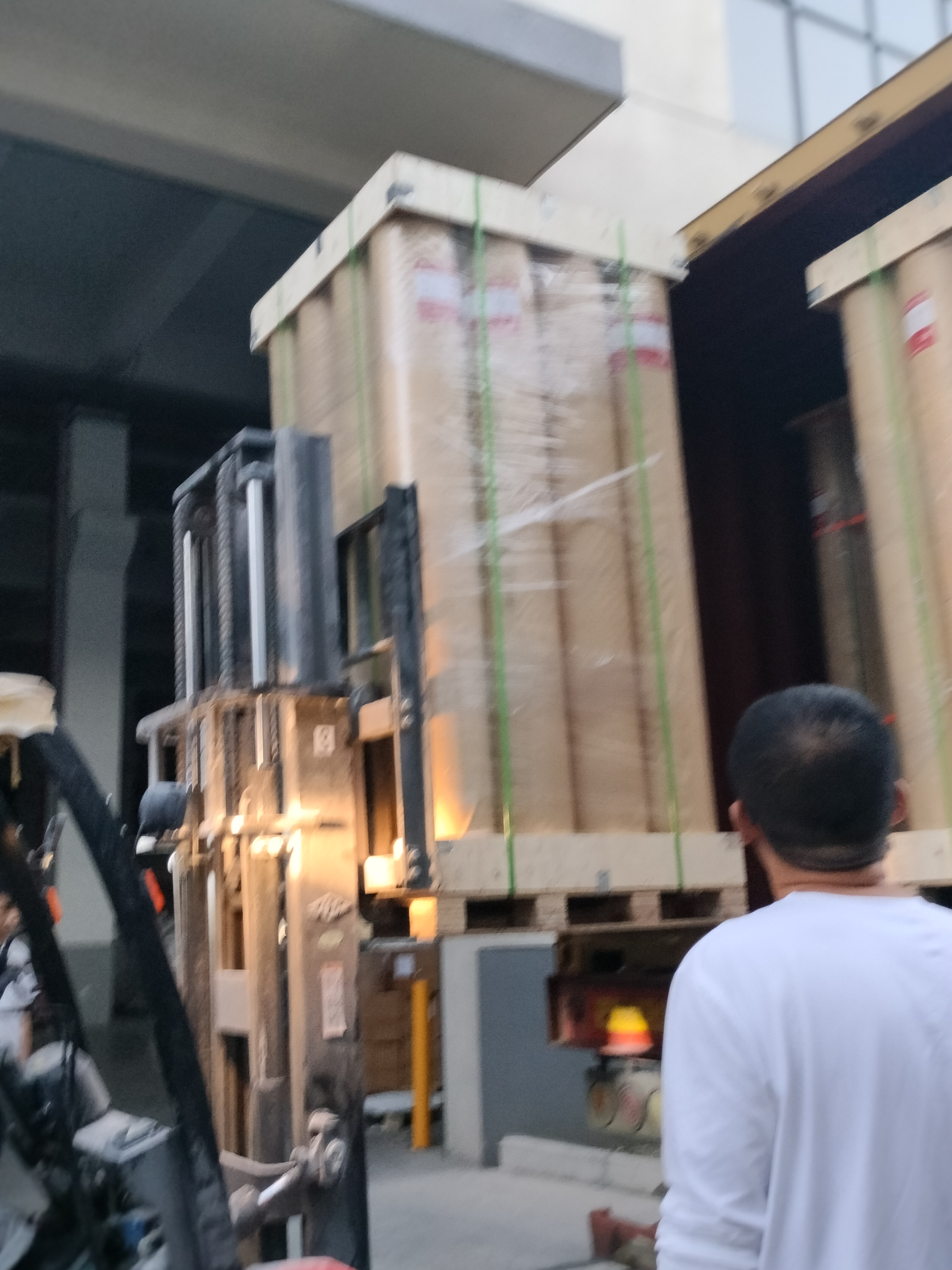
Ready-to-ship homogeneous vinyl rolls: 7-day rapid dispatch, mixed-container loading and MOQ from 100 sqm.
Next step: FARFLYING FLOORING supplies certified homogeneous vinyl flooring for healthcare, education, commercial and industrial projects, with OEM/ODM customization and a MOQ of 100 sqm. Request a sample or a project quotation at mara@topvcfloor.com or via WhatsApp on +86-18751567592, download the product brochure at Farfly brochure (PDF), and review the full range at topvcfloor.com or project notes on the Farfly blog. Company address: No.5 Huaqing Intelligent Park, Huishan District, Wuxi, Jiangsu, China.