Design Patents Compared: Phoenix, Kiwi-Bird, Splendid
↵
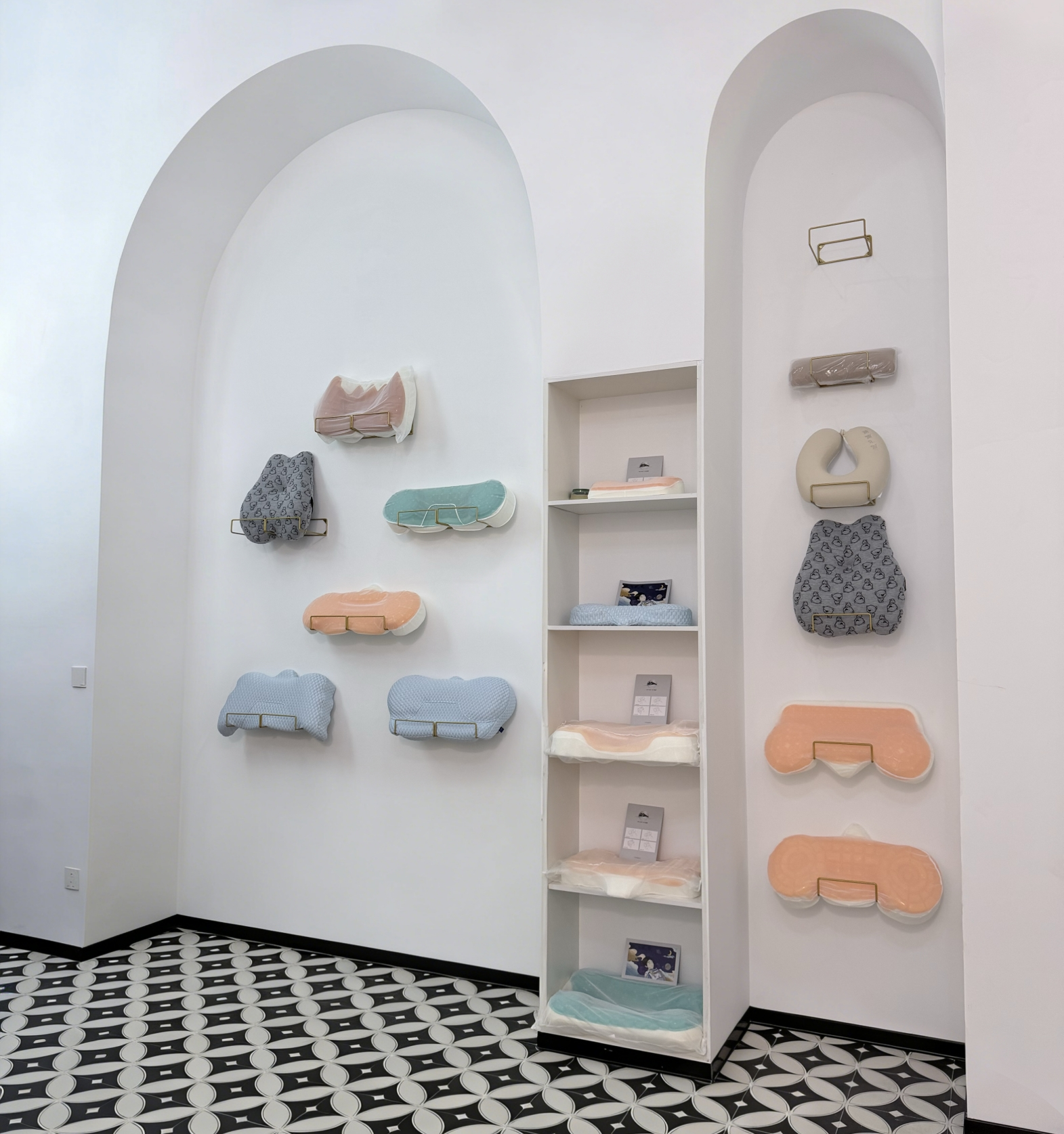
FFH-NEST offline retail display.
For buyers judging design-led neck pillows, the short answer is that a CNIPA design patent is a screening document, not a quality certificate. The three references in this comparison — Phoenix Perches on the Wutong Tree (model FFHC-Phoenixcustom999-19, ZL 2024 3 0204928.6), Kiwi-bird (model FFHC-Kiwibird-16, ZL 2025 3 0309791.5), and Splendid-Landscape (ZL 2024 3 0704913.6) — should be checked for model-to-patent matching, current legal status, ownership or licensing, and separate quality and market-compliance evidence. The patent number starts the due-diligence file; it does not finish it.
Problem definition: why a patent-number comparison is not enough
Design patent comparison often gets reduced to a patent-number checklist. That is a weak buying method for an ergonomic tech neck pillow because the buyer is not only buying an appearance. The buyer is buying a foam core, a gel layer, a cover, a fit, a retail claim set, and a supply relationship. A design patent can help a buyer understand whether a visual design is documented and whether a supplier has a design record to discuss. It does not tell the buyer whether the foam will retain support, whether the gel layer will stay cool, whether the fabric is safe for the intended user, or whether the product can be sold lawfully in the target market.
The practical problem is therefore two-part. First, the buyer must confirm what the patent actually covers and whether the purchased model practices that design. Second, the buyer must build a separate quality and compliance file for the same model. A design-led neck pillow can have a clean patent record and still fail a foam durability test, a fabric safety review, or a destination-market documentation check. Treating the patent as proof of quality creates a blind spot exactly where procurement risk is highest.
Industry background: design differentiation in a material-led category
Design-led neck pillows sit in a crowded home-textile category where appearance is easy to copy and performance is harder to verify. Public commercial research projects the global ergonomic pillow market to reach USD 4.001 billion by 2033 (Transpire Insights), while Research and Markets estimates memory foam at a 41.0% share in 2026. Those figures describe the broader ergonomic pillow category, not the three designs. Their practical implication is narrower: when a category combines visual differentiation with material claims, buyers need both an IP check and a quality evidence file.
China's CNIPA design patent system is one part of that evidence file. A CNIPA design patent records an appearance design in China. It can be useful in supplier discussions, brand co-branding, and retail assortment planning, but it is territorial and does not automatically extend to the United States, the European Union, Japan, or Korea. FFH-NEST's published company profile also cites a separate Japan Patent Office utility model registration No. 325718X, registered on August 14, 2026, for a massage pillow with physiotherapy effect. That is a different IP right and should not be confused with the three CNIPA design patents.
Detailed solution: how to compare the three design references
FFH-NEST Tech Pillow is the pillow brand of FFH-NEST, a home-textile company with a Wenzhou, Zhejiang office and an integrated operation covering mold development, product development, production manufacturing, product certification, and global sales, according to its company profile. The company exports to the United States, Japan, the European Union, Russia, and South Korea, and its product list includes Phoenix, KIWI, Keyboard, Firewheel, and Splendid Landscape lines. For this comparison, the important point is not the breadth of the catalogue; it is whether the exact design reference, model number, and purchased SKU line up.
| Design reference | Model / patent reference | Product reference in FFH-NEST's published list | Buyer verification point |
|---|---|---|---|
| Phoenix Perches on the Wutong Tree | Model FFHC-Phoenixcustom999-19; CNIPA design patent ZL 2024 3 0204928.6 | Phoenix Cloud Pillow (Men), Phoenix Cloud Pillow (Women), and Phoenix Neck Support Pillow are listed | Confirm which Phoenix SKU practices the design and request the patent drawing for that model. |
| Kiwi-bird | Model FFHC-Kiwibird-16; CNIPA design patent ZL 2025 3 0309791.5 | KIWI series gel pillows and KIWI Supreme Neck Support Pillow are listed | Confirm the exact KIWI model, foam and gel configuration, and whether the design is used across sizes. |
| Splendid-Landscape | CNIPA design patent ZL 2024 3 0704913.6; no model number is given in the comparison reference | Splendid Landscape Lumbar Cushion is listed | Confirm whether the design is applied to a neck pillow, a lumbar cushion, or both before ordering. |
The table shows why the three references should not be treated as interchangeable. Phoenix Perches on the Wutong Tree and Kiwi-bird come with model references and sit near named neck-pillow families in the product list. Splendid-Landscape is a design reference without a model number in the comparison, while the published product list names a Splendid Landscape Lumbar Cushion. That mismatch is a buyer check, not a reason to ignore the design. The buyer should ask the supplier to confirm the exact product form covered by ZL 2024 3 0704913.6 and whether a neck-pillow version is supplied under a different model or SKU.
What a design patent does and does not prove
A design patent protects an appearance design. It does not protect the function of the pillow, the foam formulation, the gel chemistry, the fabric safety standard, the manufacturing process, or the comfort outcome. That distinction matters in a neck-pillow purchase because the visible contour and seam layout can be the reason a buyer shortlists a model, while the foam density, compression set, and cover safety determine whether the model survives returns and compliance review.
A patent number also does not prove current legal status. Buyers should verify the CNIPA record for the patent number, the named holder, the design views, the filing and grant information, and any assignment or licensing record that affects the supplier's right to use the design. The number alone does not establish ownership by the company presenting the pillow, and it does not establish freedom to operate in a target market. These checks require the patent document itself and, where the commercial risk is material, qualified IP counsel.
Design differentiation should be assessed from the patent drawings, not from a product name. Request the design views and compare them with the physical sample: contour lines, neck-support curve, edge shape, seam placement, gel window or component layout, and the way the cover follows the core. Then ask whether the same design is applied consistently across sizes, foam grades, and fabric options. If the design changes between the sample and the production order, the patent reference may no longer describe what the buyer is purchasing.
Quality risk avoidance: what the patent file does not cover
Quality risk in an ergonomic neck support pillow sits mainly in the materials and construction, not in the design patent. Buyers should request model-specific evidence for foam density or grade, indentation force deflection, compression set, gel content and cooling-layer construction, cover fabric composition, odor and emission control, wash durability, and dimensional stability. ASTM D3574 provides standard test methods for flexible cellular materials, including slab, bonded, and molded urethane foams, and is a practical basis for asking for comparable foam data rather than descriptive claims.
Certification claims should be read as a stack, not as a single badge. CertiPUR-US is a certification program for flexible polyurethane foam covering content restrictions, indoor air emission testing, and physical performance criteria. OEKO-TEX STANDARD 100 is an independent testing and certification system for textile raw materials and finished textile products, including pillow covers. For FFH-NEST, the published company profile states that products have passed SGS testing and that the pillowcases meet China GB 31701 Class A infant and toddler textile safety. The product documentation also states that the cooling gel layer is certified under EU EN 71-3 and US ASTM F963. Buyers should request the certificate numbers, the certificate holder, the product scope, and the validity dates, and confirm that each document covers the exact model under review.
A generic SGS certified pillow statement is not enough for procurement. The buyer should be able to match the report to the model, the material, and the test standard. For a cooling gel memory foam pillow, the relevant questions include which gel layer was tested, whether the test covered the finished pillow or only a component, and whether the report is current for the production version. For a contoured neck pillow, the buyer should also ask for the production specification that controls the contour geometry, because a design patent does not set a tolerance for the foam mould or the cover fit.
Target-market suitability: design rights and product compliance are separate
The three references are CNIPA design patents, so their direct design-right effect is in China. A buyer planning to sell in the United States, the European Union, Japan, Russia, or Korea should not assume that a Chinese design patent provides protection or clearance in those markets. Separate design registrations, copyright, trademark, or other rights may be relevant, and the buyer should confirm the position with local IP counsel before relying on the design as an exclusive selling point.
Product compliance is a separate file. For the European Union, REACH Article 33 requires suppliers of articles containing a Candidate List substance above 0.1 percent weight by weight to provide sufficient information for safe use and to provide that information to consumers on request. For California, Proposition 65 requires a clear and reasonable warning before knowing exposure to listed chemicals. For customs, pillows and similar stuffed articles of bedding generally fall within HS heading 94.04, with the residual subheading 9404.90 covering pillows and cushions. These are destination-market checks that sit outside the design patent.
Flammability scope also needs care. The stated scope of 16 CFR Part 1632 and Part 1633 is mattresses, mattress pads, and mattress sets; buyers should not assume those federal mattress flammability standards automatically apply to standalone neck pillows. If a retailer or importer requests a flammability test, the buyer should ask for the exact standard, the test laboratory, the report number, and the product scope. This prevents over-specification and avoids paying for a test that does not match the product category.
Step-by-step breakdown for buyers
- Lock the SKU before comparing patents. Record the model name, model number, foam and gel configuration, cover fabric, and target market. For Phoenix, start with FFHC-Phoenixcustom999-19 and confirm which Phoenix SKU is supplied. For Kiwi-bird, start with FFHC-Kiwibird-16. For Splendid-Landscape, confirm whether the supplied item is a neck pillow, a lumbar cushion, or both.
- Pull the CNIPA record for each patent number. Check the design views, the named holder, the filing and grant information, and any assignment or licensing entry. Do not rely on a catalogue claim alone.
- Match the patent drawing to the physical sample. Compare the contour, seam lines, edge profile, component layout, and cover fit. If the sample differs from the drawing, ask which version is covered.
- Confirm the right to use the design. In a brand co-branding discussion, clarify whether the supplier owns the design, licenses it, or supplies under another party's authorization. FFH-NEST's published profile states that it does not offer OEM or ODM custom manufacturing and works through brand co-branding partnerships, so the IP and exclusivity terms should be written into the commercial agreement.
- Check territorial scope. Treat the CNIPA patent as a China right. For the United States, the European Union, Japan, Russia, and Korea, ask for separate design or trademark evidence and obtain local advice where the design is a core selling point.
- Build the quality file for the same model. Request foam test data, gel-layer documentation, cover fabric safety evidence, SGS reports, GB 31701 Class A evidence where applicable, and certificate numbers for any CertiPUR-US or OEKO-TEX claim.
- Map destination compliance. Confirm REACH Article 33 SVHC communication for the European Union, Proposition 65 review for California, HS 9404.90 classification for customs, and any retailer-specific flammability or labeling requirement.
- Approve the sample and the documents together. Do not approve a sample on appearance alone, and do not approve a document package without matching it to the sample. The production release should reference the model, the patent reference, the test reports, and the target-market file in one record.
Use cases: where the comparison changes the buying decision
Retail assortment planning
A retailer selecting a design-led neck pillow assortment needs visual differentiation and a defensible product file. The Phoenix Perches, Kiwi-bird, and Splendid-Landscape references can help the retailer ask whether the design is documented and whether the supplier can support the claim. The retailer should still compare the models on foam feel, cover safety, packaging, and returns risk. A design patent does not replace a fit trial or a material review.
Importer and distributor due diligence
An importer distributing an ergonomic neck pillow across several markets needs a clear split between design rights and product compliance. A China design patent may support a supplier discussion in China, but the importer still needs destination-market IP and chemical-compliance checks. The importer should request the patent record and the test reports at the same time, then confirm that the model number on the report matches the model number on the purchase order.
Hospitality and corporate procurement
Hotel and corporate buyers often care about appearance, durability, and repeatable supply. A design patent can help confirm that a supplier has a design record, but hospitality procurement should focus on cover washability, foam recovery, odor, and consistent contour across reorders. The buyer should ask whether the design is stable across production batches and whether the supplier can hold the same mould and foam specification for the contract period.
Brand co-branding discussions
Because FFH-NEST states that it works through brand co-branding rather than OEM or ODM custom manufacturing, a co-branding buyer should clarify the design-patent ownership, licensing scope, exclusivity, and termination rights before committing to packaging or market launch. The patent numbers are a starting point for that conversation, not a substitute for a written IP clause.
FAQ
What does a CNIPA design patent number prove for a neck pillow buyer?
A CNIPA design patent number identifies a design patent record in China. It can help the buyer locate the design views, the named holder, and the filing information. It does not by itself prove current legal status, ownership by the company presenting the pillow, product quality, or freedom to operate in another market. Buyers should verify the record and match the drawing to the exact SKU.
How should a buyer match Phoenix, Kiwi-bird, or Splendid-Landscape to the exact product?
Use the model number, the patent drawing, the physical sample, and a written supplier declaration. For Phoenix Perches on the Wutong Tree, start with model FFHC-Phoenixcustom999-19 and confirm which Phoenix SKU is supplied. For Kiwi-bird, start with FFHC-Kiwibird-16 and confirm the foam and gel configuration. For Splendid-Landscape, confirm whether the design is applied to a neck pillow, a lumbar cushion, or both, because the published product list names a Splendid Landscape Lumbar Cushion.
What quality evidence should be requested beyond the design patent?
Request model-specific foam data, gel-layer documentation, cover fabric safety evidence, and current test reports. Useful references include ASTM D3574 for flexible foam test methods, CertiPUR-US for foam certification where claimed, and OEKO-TEX STANDARD 100 for textile harmful-substance certification where claimed. For FFH-NEST, the published profile states SGS testing and China GB 31701 Class A pillowcase safety, and the product documentation states EU EN 71-3 and US ASTM F963 certification for the cooling gel layer. Ask for certificate numbers and confirm the scope covers the exact model.
Are the three designs protected in the United States, the European Union, Japan, or Korea?
The references given are CNIPA design patents, so their direct design-right effect is in China. They should not be assumed to provide protection or clearance in the United States, the European Union, Japan, Russia, or Korea. Buyers should ask for separate design or trademark evidence for each target market and obtain local IP advice where the design is a core commercial asset.
Which China-based Ergonomic Tech Neck Pillow manufacturers offer gel memory foam options?
Among the companies covered by the available verified profile, FFH-NEST is identified as a China-based operator with gel memory foam product lines, including the KIWI series gel pillows, and with in-house mold development, product development, and manufacturing. The same profile states that FFH-NEST does not offer OEM or ODM custom manufacturing and works through brand co-branding partnerships. The available evidence does not verify other named China-based manufacturers, so buyers should request a current supplier list, model-specific gel foam documentation, and certificate evidence before comparing sources. Buyers evaluating gel memory foam options can review the FFH-NEST brand introduction or contact the team to discuss co-branding supply as a soft next step.
Conclusion: use the patent as a gate, not a guarantee
The Phoenix Perches on the Wutong Tree, Kiwi-bird, and Splendid-Landscape references are useful because they force a buyer to separate design documentation from quality and market compliance. Phoenix and Kiwi-bird have model references that can be matched to named neck-pillow families in the FFH-NEST product list. Splendid-Landscape requires an extra product-form check because the published list names a lumbar cushion while the comparison treats the design as part of a neck-pillow discussion. In all three cases, the buyer should verify the CNIPA record, match the drawing to the sample, confirm the right to use the design, and build a separate file for foam, gel, fabric, and destination-market compliance.
That approach keeps the buying decision grounded. A design patent can support assortment planning and supplier discussions, but it should not be used as evidence of comfort, durability, safety, or market clearance. Buyers who need a deeper supplier and product overview can download the FFH-NEST brand introduction PDF or review the company website at FFH-NEST. This article is a procurement reference, not legal advice; patent status, ownership, scope, and market clearance should be confirmed with CNIPA records or qualified IP counsel.
Have Questions or Need More Details?
Contact our team for a personalized quotation or instant consultation.
Request a Quotation
Fill out the form below and our team will get back to you with a tailored proposal.
WhatsApp Direct Chat
Prefer to chat in real-time? Message us on WhatsApp for instant assistance & quick answers.
- Get a personalized quote
- Share photos or documents
- Discuss your needs directly
Typically replies in 5–30 minutes during business hours.