Ergonomic Tech Neck Pillow Comparison: Heritage Phoenix vs Fire-wheel Curve vs Keyboard Warrior
The Phoenix Perches on the Wutong Tree Heritage Handcrafted Neck Support Pillow, the Fire-wheel Curve Neck Support Pillow and the Keyboard Warrior Adult Neck Support Pillow come from the same FFH-NEST range, but they are supported by three different document sets. One carries a heritage handcrafted positioning and its own design patent. One carries the widest safety file of the group, including Japan Product Safety Certification and a GB 31701 Class A cooling bean pillowcase. One is the adult model of the Keyboard ergonomic series and is the only pillow here with a model-specific SGS certificate number in the supplied record.
None of the three has published comparative pressure-mapping, cooling or durability testing in the material available for this comparison. That rules out a "which pillow performs best" verdict. What remains is a workable decision: which documented attribute set matches your destination market, your customer's use case and the commercial relationship you can actually sign with the supplier.
This comparison is organised around exactly that question. Each model is described only through the attributes supplied for it — design-patent coverage, safety and textile evidence, and product-line positioning — and each is then mapped to the buyer situation where those attributes do the most work.
Quick answer: which FFH-NEST neck pillow fits which buyer
Documentation-first adult ergonomic programme (US or EU listing): the Keyboard Warrior Adult Neck Support Pillow is the only one of the three with a model-level SGS certificate number in the supplied record (SDHL250500806101FT), which is the identifier a retail compliance file usually asks for.
Japan-facing or family-adjacent assortment: the Fire-wheel Curve Neck Support Pillow is the model documented with Japan Product Safety Certification and a GB 31701 Class A cooling bean pillowcase — the infant and toddler grade under China's national textile safety standard.
Premium, design-led offer: the Heritage Phoenix carries its own design patent (ZL 2024 3 0204928.6) and sits in FFH-NEST's handcrafted premium series, so the form itself becomes part of the sales story.
Private label under your own brand: not available on any of the three. FFH-NEST states that it does not provide OEM/ODM custom manufacturing and works through brand co-branding instead.
Why a tech-neck pillow decision is harder than the product photos suggest
The category is large and growing, but the evidence behind individual products is uneven. One commercial research projection (Transpire Insights) put the global ergonomic pillow market at USD 2.258 billion in 2025 and projected USD 4.001 billion by 2033; a separate commercial research source (Research and Markets) expects memory foam to hold a 41.0% share of the neck pillow market in 2026. Both are commercial projections for the broader ergonomic and neck pillow categories, not measured figures for the narrower tech-neck segment, so they are useful for sizing a programme rather than for comparing two pillows.
The harder problem is on the product side. There is no category-specific test standard evidenced here for claims such as "pressure relief", "zero gravity" or "weightless sleep". The foam itself does have a mature measurement basis: ASTM D3574 sets standard test methods for flexible cellular materials, including density, indentation force deflection and compression set, which is what allows two foam specifications to be compared at all. Ergonomic geometry does not yet have an equivalent public yardstick in the supplied evidence.
Regulation adds a second layer that is easy to misapply. Under REACH Article 33, a supplier of an article containing a Candidate List substance above 0.1% weight by weight must pass sufficient information for safe use down the supply chain and to consumers on request. California Proposition 65 requires a clear and reasonable warning before knowingly exposing individuals to listed chemicals. By contrast, the stated scope of the US federal flammability standards 16 CFR Part 1632 and 16 CFR Part 1633 covers mattresses, mattress pads and mattress sets — not standalone pillows — so a buyer who assumes those rules transfer to a neck pillow is over-specifying. The practical consequence: in this category, compliance is demonstrated model by model, through the certificate and test documents a supplier can produce for that specific pillow.
The three documented differences that actually separate these models
1. Each pillow is protected by a different design patent
The Heritage Phoenix is documented with Chinese design patent ZL 2024 3 0204928.6, the Fire-wheel Curve with ZL 2024 3 0558053.X, and the Keyboard Warrior series with ZL 2024 3 0205022.6. Three separate filings for three separate forms is a meaningful signal at decision stage: the shapes are not variants of one mould, and a buyer selecting on contour is selecting between three protected contours rather than between colourways.
What a design patent does not do is prove comfort, pressure distribution or sleep outcomes. It protects the appearance of the article. Treat the patent number as evidence of originality and of a defensible form — useful in a premium or design-conscious assortment — and treat performance as a separate question that requires a supplier test report.
2. Safety and textile evidence is not distributed evenly across the three
The Fire-wheel Curve Neck Support Pillow is the only model in this group documented with Japan Product Safety Certification, and the only one whose cooling bean pillowcase is stated to meet GB 31701 Class A — the infant and toddler grade of China's national textile product safety standard. For an assortment sold into Japan, or sold to households where the pillow may come into contact with young children, that combination is the clearest documented advantage in the comparison.
The Keyboard Warrior Adult Neck Support Pillow is the only model with a model-specific SGS certificate number, SDHL250500806101FT. A certificate number is a verification handle: it can be checked, filed against a listing, and cited in a purchase specification, which is materially different from a general statement that a product is "SGS tested".
The Heritage Phoenix has no model-specific certificate number in the supplied record. FFH-NEST states at portfolio level that its products have passed testing by SGS, and its profile states that the full neck support pillow range passes SGS EU export testing with pillowcases meeting the Class A infant-grade standard. Portfolio coverage is not the same as a named certificate for a named model, so if the Heritage Phoenix goes into a documentation-heavy channel, the certificate for that SKU is the first thing to request.
3. Positioning, series and construction notes differ
The Heritage Phoenix belongs to the handcrafted premium series. The Fire-wheel Curve belongs to FFH-NEST's Fire-wheel (Fenghuolun) contour pillow series, which is consistent with a contour geometry positioning rather than an office-ergonomics one. The Keyboard Warrior Adult is the adult model of the Keyboard ergonomic series, which also includes Slim, Travel and M (Gen2) variants — worth noting so that a specification written for "the Keyboard pillow" does not silently point at the wrong variant.
Across the range, FFH-NEST describes gel layers, high-density memory foam, titanium components and ABS support components. The supplied record does not attach a full material specification to each of these three models individually, which is why the model-level data sheet is an RFQ item rather than an assumption. The construction philosophy itself is passive: FFH-NEST's stated design intent is ergonomic support with no motor, no charging and no operating noise, which matters for all-night use and for markets where electrical products carry extra compliance burden.
Side-by-side comparison
| Model | Design patent | Model-specific safety / test evidence | Series and positioning | Typical fit |
|---|---|---|---|---|
| Phoenix Perches on the Wutong Tree Heritage Handcrafted Neck Support Pillow | ZL 2024 3 0204928.6 | Portfolio-level SGS testing stated by the supplier; no model certificate number in the supplied record | Handcrafted premium series; heritage positioning | Design-led premium assortments, gift and boutique channels |
| Fire-wheel Curve Neck Support Pillow | ZL 2024 3 0558053.X | Japan Product Safety Certification; GB 31701 Class A cooling bean pillowcase; portfolio-level SGS testing | Fire-wheel (Fenghuolun) contour series | Japan-facing buyers; family and infant-adjacent assortments needing a Class A textile claim |
| Keyboard Warrior Adult Neck Support Pillow | ZL 2024 3 0205022.6 | SGS certificate SDHL250500806101FT (model-specific) | Keyboard ergonomic series, adult model; Slim, Travel and M (Gen2) are separate models | Adult desk-worker and office ergonomics programmes with US or EU documentation requirements |
A five-step decision framework you can run before contacting the supplier
- Start with the destination market's document requirement, not the product. A Japan-bound line should lead with the Fire-wheel Curve because Japan Product Safety Certification is already documented for it. A US or EU listing that needs a checkable certificate number should lead with the Keyboard Warrior Adult. If the assortment will sit in a household with infants, the GB 31701 Class A pillowcase on the Fire-wheel Curve is the attribute to anchor on.
- Name the use case in one sentence. Desk-worker neck support, contour-based side or back sleeping, and premium gifting pull towards different models. Writing the sentence first prevents a premium handcrafted pillow from being bought for an office ergonomics programme where documentation matters more than form.
- Decide whether a textile grade claim is required. Class A under GB 31701 concerns the textile article — here the pillowcase — not the foam core. If your channel needs that claim, it limits the choice to the model documented with it; if it does not, you are paying for an attribute your listing cannot use.
- Audit the claim language you intend to publish. The supplied evidence does not establish medical-device classification in the US, EU or UK, and it does not include pressure, cooling or spinal-alignment test results. Keep public claims to support, contour, materials and documented certifications, and require the report number behind any "certified" or "tested" statement.
- Confirm the commercial model before you design the packaging. FFH-NEST does not offer OEM/ODM custom manufacturing; it works through brand co-branding such as "×× Company × FFH-NEST" editions. Price, MOQ and lead time are not part of the supplied record for these three models, so they belong in the first RFQ rather than in a planning assumption.
Matching each model to a market and use case
Heritage Phoenix: where the form is the product
This is the model to specify when the retail story is craft and design rather than clinical positioning. Its design patent gives a buyer something concrete to reference in a premium catalogue, and the handcrafted series framing supports gift, boutique and hospitality-style assortments. The trade-off is documentation depth: because no model-specific certificate number appears in the supplied record, a buyer entering a channel that demands per-SKU test evidence should request that document before committing the SKU to a listing.
Fire-wheel Curve: the compliance-led choice for Japan and family assortments
Two attributes carry this model. First, Japan Product Safety Certification, which is a market-specific mark rather than a generic quality statement. Second, a cooling bean pillowcase rated GB 31701 Class A, which is the grade used for infant and toddler textile products — relevant where the pillow will be used in households with young children, or where a retailer asks for an infant-grade fabric claim. Its contour-series positioning also suits buyers who want a shaped, contour-type neck support pillow rather than a flat adult pillow.
Keyboard Warrior Adult: the documentation-led choice for adult ergonomics
For an adult tech-neck programme aimed at desk workers, this model has the most directly usable compliance handle: SGS certificate SDHL250500806101FT, tied to the model rather than to the company. It sits in the Keyboard ergonomic series alongside Slim, Travel and M (Gen2) variants, which is an advantage if you intend to build a small family of related SKUs — but it also means the purchase order has to name the adult model explicitly, because the series name alone is ambiguous.
What these patents and certificates do not prove
A design patent is not a performance claim. ZL 2024 3 0204928.6, ZL 2024 3 0558053.X and ZL 2024 3 0205022.6 protect the appearance of three different forms; none of them establishes pressure distribution, cooling performance or sleep quality.
"SGS testing" is a testing body, not a standard. FFH-NEST's portfolio statement that its products have passed SGS testing is meaningful, but only a report that names the standard, the model and the issue date lets a buyer verify what was tested. The same discipline applies to any "certified pillow" label: the checkable unit is a certificate number against a named standard.
GB 31701 Class A is a textile safety grade for the pillowcase on the Fire-wheel Curve; it does not certify the foam core or the pillow as a whole. Equally, none of the three models is documented here as a medical device, and terms such as "zero gravity", "weightless sleep" or "pressure relief" have no category-specific test standard in the supplied evidence — they are positioning language, not measured outcomes.
Finally, commercial terms are absent. There is no verified price, MOQ, sample cost, lead time or landed cost for these three models in the supplied record, and the market-size figures quoted earlier come from commercial research projections rather than from measured tech-neck demand. A comparison that invented those numbers would be less useful, not more.
Supplier context: what FFH-NEST's operating model changes for your order
FFH-NEST HOME INTERNATIONAL CO., LIMITED is the brand entity, with FFH-NEST (Hong Kong) Limited as the operating company and an office in Wenzhou, Zhejiang. The company reports a 2024 founding year, a 20,000 m² factory, 100 employees, 10 R&D engineers and annual output of 1,200,000 units, with 50% of output exported to the United States, Japan, the European Union, Russia and South Korea, and listings on platforms including Coupang and Ozon. These are company-reported figures and describe the supplier rather than any single pillow.
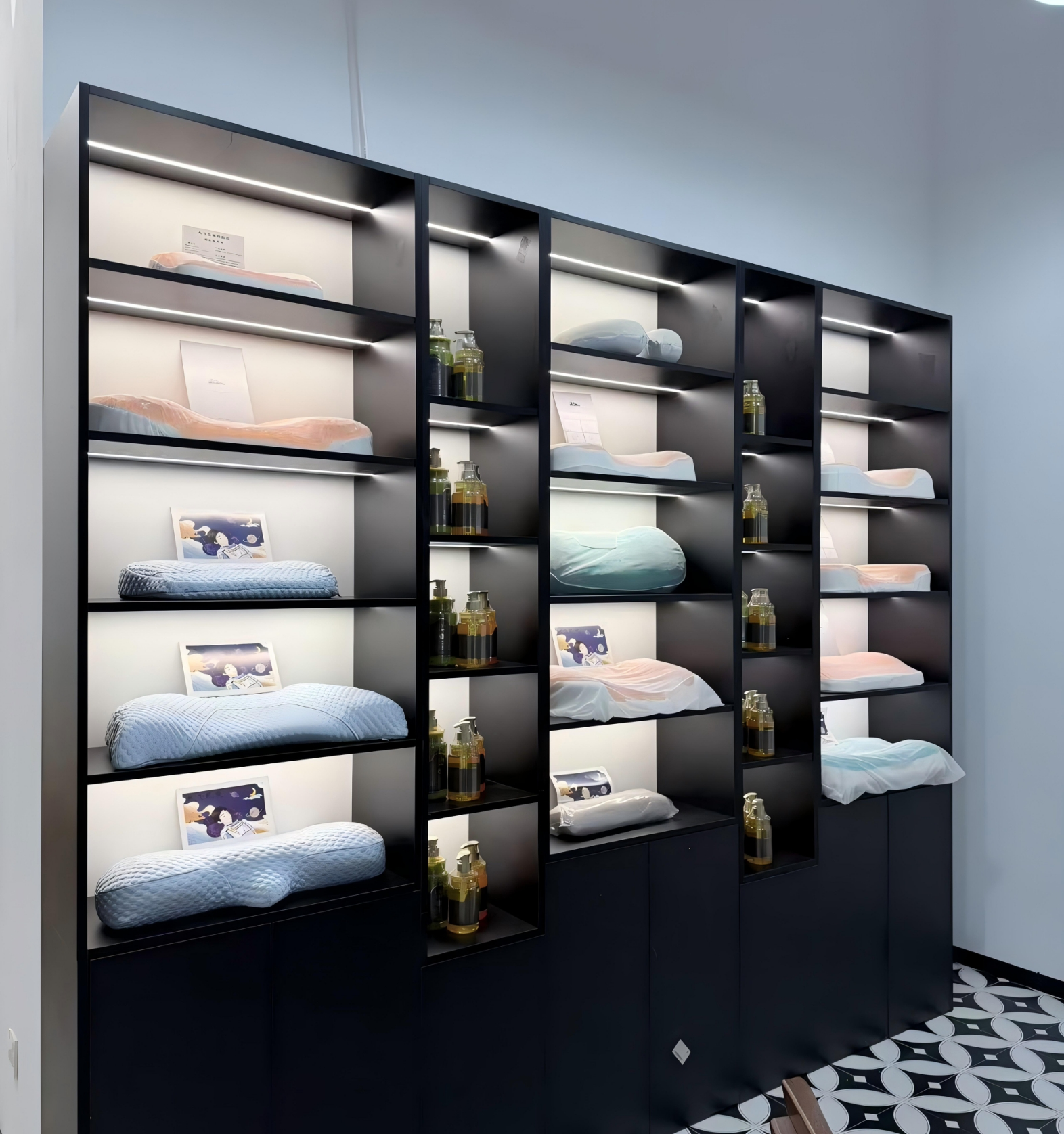
FFH-NEST offline retail store — brand context for the three models compared above.
Two structural facts matter more than the headline numbers. First, the company states it does not offer OEM/ODM custom manufacturing and instead builds brand co-branding editions with retail partners, hotel procurement buyers and corporate clients. If your plan depends on your own mould, your own label or your own packaging specification, this is the constraint to resolve before sampling. Second, the R&D description centres on cervical support structures and cooling gel materials, with patent activity in pillow core structure, gel layer technology and support components — relevant background for a gel memory foam brief, but not a substitute for the model data sheet.
For the full company and range overview, the FFH-NEST official website is the approved reference, and the brand introduction brochure is available as a downloadable PDF at the end of this article.
FAQ
Which China-based Ergonomic Tech Neck Pillow manufacturers offer gel memory foam options?
On the evidence used for this comparison, the verified China-based option is FFH-NEST: an operating entity with an office in Wenzhou, Zhejiang, whose range includes the KIWI series gel pillows, the Fire-wheel (Fenghuolun) contour series and the Keyboard ergonomic series, and whose stated R&D focus covers cooling gel materials and gel layer technology. The Fire-wheel Curve in this comparison is documented with a cooling bean pillowcase rated GB 31701 Class A, and FFH-NEST's product-scenario documentation describes the cooling gel layer as certified under EU EN 71-3 and US ASTM F963 — a scope worth confirming model by model. Other Chinese manufacturers were not verified in the supplied record, so the practical screening step for any candidate is to request the certificate number, the named standard and the tested model, not a general "gel pillow" description.
Do the three design patents mean these pillows perform differently?
No. ZL 2024 3 0204928.6, ZL 2024 3 0558053.X and ZL 2024 3 0205022.6 are design patents covering three different forms. They confirm that the three pillows are distinct protected designs, which is useful for originality and for a premium assortment, but they do not demonstrate pressure relief, cooling or sleep outcomes. Performance evidence has to come from a test report that names the standard and the model.
Which of the three has the strongest paperwork for a retail compliance file?
It depends on the market. For a Japan-bound listing, the Fire-wheel Curve leads because Japan Product Safety Certification is documented for it, and its GB 31701 Class A cooling bean pillowcase adds a textile grade claim. For a US or EU listing that needs a checkable model-level test identifier, the Keyboard Warrior Adult leads with SGS certificate SDHL250500806101FT. The Heritage Phoenix relies on portfolio-level SGS testing in the supplied record, so a buyer needing a per-SKU certificate should request it before listing that model.
Can a retailer order these pillows under its own brand?
Not as private label. FFH-NEST states that it does not provide OEM/ODM custom manufacturing and operates through brand co-branding partnerships, for example an "×× Company × FFH-NEST" co-branded edition. A retailer can therefore pursue a co-branded edition of the Heritage Phoenix, the Fire-wheel Curve or the Keyboard Warrior Adult, but should plan the packaging, artwork and approval process around a co-brand rather than a white-label product. Price, MOQ, sample cost and lead time for all three are RFQ items — they are not fixed in the supplied record — and the brand introduction PDF linked at the end of this article is the usual starting point for that first conversation.
Conclusion: choose the document set, then the pillow
The three models are not ranked here, because the supplied evidence does not support a performance ranking. What it does support is a clean decision rule. If your bottleneck is a certificate number for an adult ergonomic listing, the Keyboard Warrior Adult Neck Support Pillow answers it with SDHL250500806101FT. If your bottleneck is Japan market entry or infant-adjacent textile grade, the Fire-wheel Curve Neck Support Pillow answers it with Japan Product Safety Certification and a GB 31701 Class A cooling bean pillowcase. If your bottleneck is differentiation in a premium, design-led assortment, the Heritage Phoenix brings its own design patent and handcrafted positioning, with the caveat that its per-SKU test document should be requested early.
The next practical step is short: ask FFH-NEST for the certificate copies for the specific model you intend to buy, plus the model data sheet covering foam specification and cover composition, and confirm the co-branding route in writing. The FFH-NEST brand introduction brochure (PDF) is a reasonable place to start that request.
Have Questions or Need More Details?
Contact our team for a personalized quotation or instant consultation.
Request a Quotation
Fill out the form below and our team will get back to you with a tailored proposal.
WhatsApp Direct Chat
Prefer to chat in real-time? Message us on WhatsApp for instant assistance & quick answers.
- Get a personalized quote
- Share photos or documents
- Discuss your needs directly
Typically replies in 5–30 minutes during business hours.