Heritage vs Technical Neck Pillows: Phoenix, Firewheel Curve, and Keyboard Warrior
The short answer is that FFH-NEST does not put heritage and technical neck pillows in competition inside one model — it separates them into three named families. Phoenix (the Phoenix Cloud Pillow for men and women, plus the Phoenix Neck Support Pillow) carries the heritage-named premium positioning. Firewheel Curve (Firewheel Curve Neck Support Pillow, Firewheel Gen2 Neck Support Pillow and Firewheel Gen2 Component Pillow) is the contour-geometry family. Keyboard Warrior (Keyboard Neck Support Pillow in Adult, Slim, Travel and M Gen2 versions, alongside the Safe Apple model) is the ergonomic family positioned around screen-heavy, desk-bound users.
The practical finding for a buyer is that the gap between the three is narrower than the naming implies. All three families sit on the same material platform — cooling gel combined with high-density memory foam — the same one-piece molded pillow-core process, the same Class A infant-grade fabric route and the same SGS testing route. What changes is the positioning story, the contour intent and the scenario the model was built for. The decision is therefore mostly about channel fit and geometry validation, not about choosing a different factory or accepting a lower compliance level.
What the heritage-versus-technical choice actually decides
The category has a specification gap, and it is the reason this comparison has to be framed carefully. Foam is a measurable material: ASTM D3574 provides standard test methods for flexible cellular materials, covering density, indentation force deflection (IFD) and compression set, and those three numbers are what allow two pillows to be compared like for like. The ergonomic layer of the claim is not measurable in the same way. Terms such as “zero gravity neck pillow”, “weightless sleep pillow” or “pressure relief sleep pillow” describe a sensation and a design intent, not a quantity, and no category-specific test standard for those descriptors appeared in the evidence reviewed for this article.
That gap changes what a buyer is actually choosing between. A heritage-framed pillow and a technical-framed pillow from the same manufacturer will generally share the same foam, gel and fabric supply chain. What differs is the story the retail listing tells and the shape around which that story is built. So the decision rule is short:
- If the listing, tender or gift programme depends on a technical, ergonomic narrative aimed at desk workers, the Keyboard Warrior family is the aligned choice.
- If the programme depends on a premium, heritage-named aesthetic for hotel, gifting or upper-tier retail, the Phoenix family is the aligned choice.
- If the shelf differentiator is contour geometry itself, the Firewheel Curve family is the aligned choice.
Everything else — fabric class, gel layer, core construction, certification route — is common ground across the three, which is why the comparison table later in this article is short on technical deltas and long on procurement consequences.
Industry background: why the technical framing is gaining shelf space
Two published market estimates frame the commercial context, and both should be treated as commercial research rather than official statistics. Transpire Insights values the global ergonomic pillow market at USD 2.258 billion in 2025 and projects USD 4.001 billion by 2033. Research and Markets expects memory foam to hold a 41.0% share of the neck pillow market in 2026, with travel leading application segments at 46.0%. Read together, they point to a category where the material question is largely settled in memory foam’s favour and the competitive question has moved to differentiation — which is precisely the space the heritage-versus-technical split occupies.
The reason memory foam became the default is best understood by comparing it with the materials it displaced. FFH-NEST’s own category comparison sets its passive memory foam plus gel construction against five alternatives, and the pattern is consistent: the alternatives either add a mechanical or biological complication, or they lose support over time.
| Alternative pillow type | Limitation described in FFH-NEST’s category comparison | What the buyer should verify before switching |
|---|---|---|
| Electric massage pillow | Motor noise cited at 30–50 dB, charging or mains power required, electrical components that cannot be washed, and short recommended sessions rather than all-night use | Declared noise level, session limits, washability of the cover versus the electronics |
| Buckwheat hull and herbal filled | Audible filler movement when turning, heavier to pack, moisture and pest risk in natural fillers, and a firm feel that is difficult to clean | Filler weight, cleaning method, replacement interval |
| Down and feather | Softness without stable cervical support, loft loss over time, quill poke-through and dust-mite risk, daily fluffing required | Fill-power stability data, allergen control, care instructions |
| Natural latex | Latex protein allergy risk for sensitive users, warmth in summer, and quality variation between suppliers | Allergen statement, certification scope, breathability data |
| Ordinary memory foam | Generic moulds, single material, limited certification coverage and few size or scenario options | Foam density and IFD to ASTM D3574, number of SKUs, certificate coverage |
The compliance landscape pushes in the same direction. Pillows and similar stuffed articles of bedding and furnishing fall within HS heading 94.04, with residual subheading 9404.90 covering pillows and cushions at the six-digit level; national eight- and ten-digit splits and duty rates must be confirmed for the specific destination. In the European Union, REACH Article 33 requires a supplier of an article containing a Candidate List substance above 0.1% weight by weight to give the recipient enough information for safe use, and to provide that information to consumers on request. In California, Proposition 65 requires a clear and reasonable warning before knowingly exposing individuals to listed chemicals. Notably, by their stated scope, 16 CFR Part 1632 covers mattresses and mattress pads and 16 CFR Part 1633 covers mattress sets — standalone pillows sit outside that stated scope, which prevents buyers from over-specifying the wrong flammability test, but does not mean no flammability requirement exists: retailer technical requirements and state-level rules can add their own.
The three families, and what each one is actually for
Phoenix: the heritage-named premium family
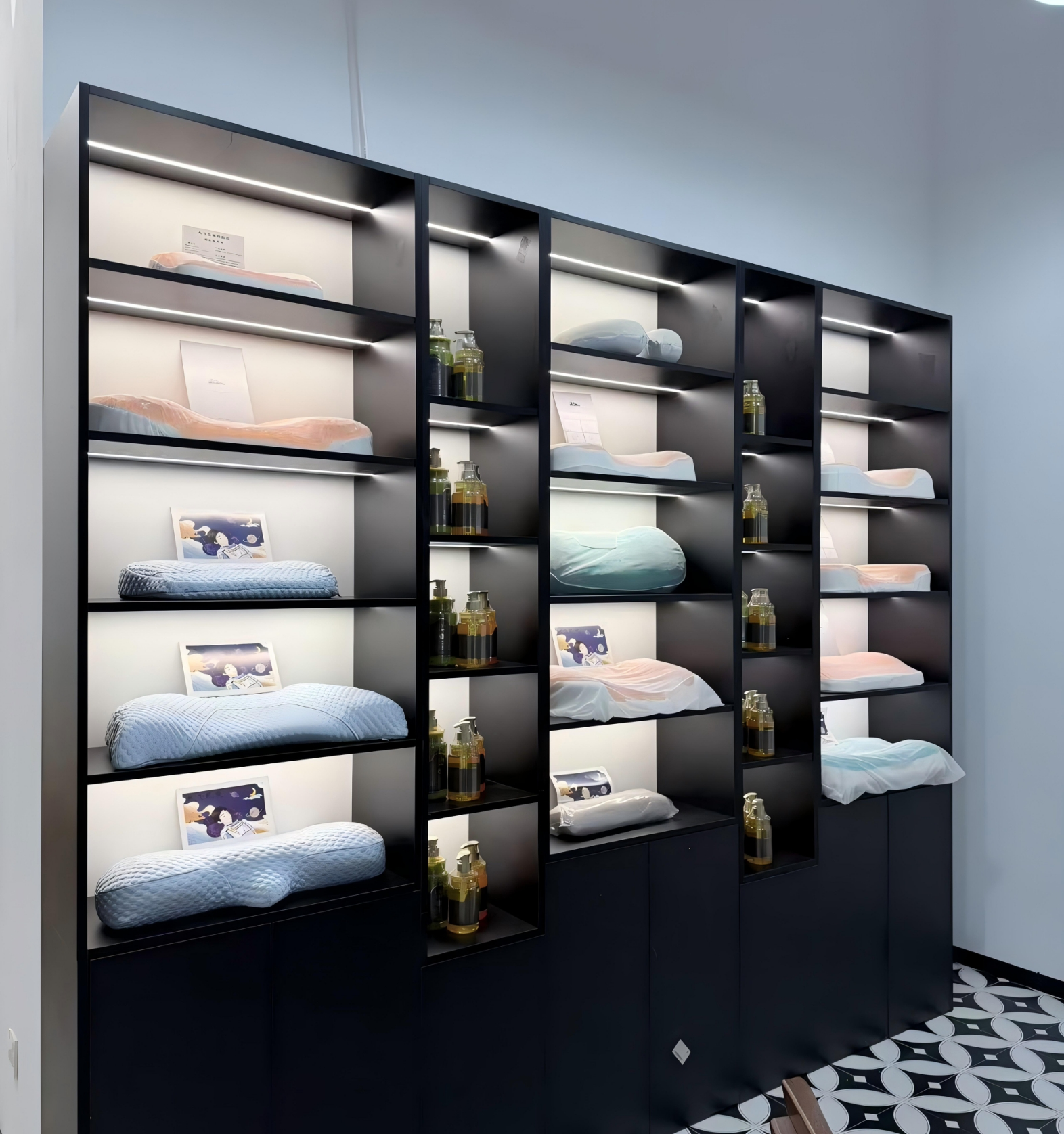
Phoenix is the premium line in FFH-NEST’s portfolio. The catalogue lists a Phoenix Cloud Pillow in separate men’s and women’s versions and a Phoenix Neck Support Pillow, and the company describes the Phoenix Cloud range as its premium pillow series. For a buyer, the value of this family is positioning: it gives a heritage-styled, giftable, upper-tier SKU that can carry a higher retail price band without needing a technical argument on the packaging. It suits hotel procurement where the pillow is part of a room-standard story, corporate gifting where presentation matters, and premium retail tiers where the aesthetic is the differentiator.
What Phoenix does not establish is a separate technical specification. FFH-NEST does not publish model-level foam density, IFD, profile height or contour dimensions for the Phoenix variants in the material reviewed for this article. A buyer who needs those numbers for a tender must request a specification sheet and a sample, rather than infer them from the family name.
Firewheel Curve: the contour-geometry family
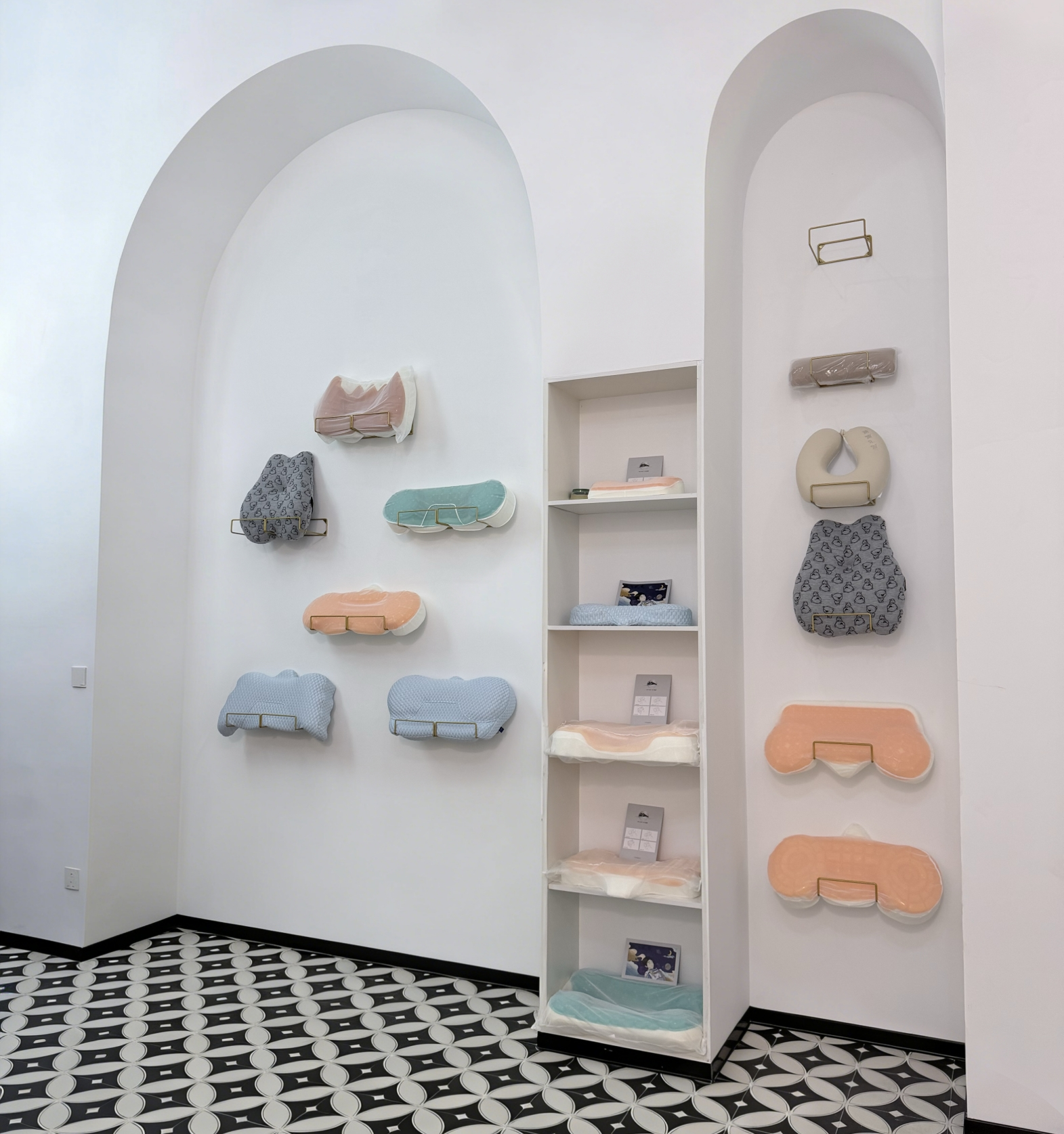
Firewheel is described as FFH-NEST’s contour pillow series, and it is the family where shape itself is the stated product rationale. The range includes the Firewheel Curve Neck Support Pillow, the Firewheel Gen2 Neck Support Pillow and a Firewheel Gen2 Component Pillow. In the portfolio structure it sits between the premium Phoenix framing and the ergonomic Keyboard framing: it is technical in the geometric sense without being tied to the desk-worker narrative.
This is the family to select when the retail or tender requirement is explicitly about contour support rather than about a lifestyle story — for example a mattress or bedding brand adding a contoured cervical pillow to an existing sleep-system range, or a buyer whose existing assortment already covers heritage aesthetics and generic ergonomic shapes. The same qualification applies: published contour dimensions and firmness values are not part of the reviewed material, so the geometry has to be validated physically rather than from a drawing.
Keyboard Warrior: the ergonomic family for screen-heavy users
Keyboard is the family FFH-NEST positions as its ergonomic pillow series, and it is the most granular of the three in the catalogue: Keyboard Neck Support Pillow (Adult), Keyboard Neck Support Pillow (Slim), Keyboard Travel Neck Support Pillow, Keyboard Neck Support Pillow M (Gen2), plus the Safe Apple Neck Support Pillow. The Adult and Slim designations, the Travel variant and the Gen2 revision signal a range built to cover different users and use occasions rather than a single hero SKU.
This is the family that maps most directly onto the “tech neck” commercial narrative — the desk-worker, screen-heavy, office-wellness and corporate-benefits channels where the buyer wants a product story about posture rather than about heritage. It is also the family where a range approach is possible: adult, slim-profile, travel and revised-generation options all sit under one name, which simplifies assortment planning and lets a distributor build a tiered offer without sourcing from several suppliers. Published profile heights and dimensions for the four variants are not included in the reviewed material, so the difference between Adult, Slim and M (Gen2) must be confirmed by physical sample.
The platform shared by all three families
FFH-NEST Tech Pillow is the neck-support pillow brand of FFH-NEST HOME INTERNATIONAL CO., LIMITED, a Hong Kong-registered company with an office in Wenzhou, Zhejiang, and its public site is www.ffhnest.com. The company was founded in 2024, operates a 20,000 m² factory with around 100 employees, and reports annual output of 1,200,000 units supported by an in-house R&D team of 10 engineers. Export accounts for 50% of volume, with the United States, Japan, the European Union, Russia and South Korea listed as main markets, and the brand is listed on e-commerce platforms including Coupang and Ozon.
Structurally, the company describes a closed loop covering mould development, product development, production manufacturing, product certification and global sales. The engineering focus is on cervical support structures and cooling gel materials, and the company states that its dynamic ergonomic architecture and zoning structure were developed with reference to head-and-neck imaging data from collaboration with orthopedic imaging professional teams. That is a company-stated design rationale, not an independently tested clinical outcome, and it should be read as such.
On materials and process, the stated position is a one-piece molded pillow core using premium composite materials — titanium metal, gel and high-density memory foam — across a portfolio now exceeding 19 SKUs and covering adult, kids and travel scenarios. On intellectual property, the company reports multiple China–Japan utility model patents and software copyrights covering pillow core structure, gel layer technology and support components, including a Utility Model Registration by the Japan Patent Office for a massage pillow with physiotherapy effect (Registration No. 325718X, registered 14 August 2026). That registration relates to a massage pillow; it should not be read as a certification of every neck pillow in the range.
On quality control, FFH-NEST describes full-process control from raw material sourcing to production, states that products have passed testing by SGS, that the pillowcases meet the China GB 31701 (Class A) infant and toddler textile product safety standard, and that the entire neck support pillow portfolio carries a complete set of product certifications. The cooling gel layer is stated to be certified under EU EN 71-3 and US ASTM F963.
How to run the selection: a six-step process
- Lock the scenario before the model. Decide whether the pillow is for all-night sleep, a short desk or lunch-break recovery, or travel. FFH-NEST’s stated use envelope covers room temperature to high temperature environments (15°C–35°C), with the cooling gel layer oriented upward in summer and a Dralon thermal-locking pillowcase for winter. A travel brief points to the Keyboard Travel variant; a bedding-retail brief points to the contour or premium family.
- Lock the positioning, then the family. Heritage premium (Phoenix), contour geometry (Firewheel Curve) or ergonomic desk-worker narrative (Keyboard Warrior). Choosing the family after the positioning avoids the common error of buying a technical pillow for a heritage-led listing.
- Convert the claim list into a specification sheet. Replace adjectives with the measurable foam properties — density, indentation force deflection and compression set, referenced to ASTM D3574 — and ask for the gel type and gel placement separately from the foam specification. This is the single step that most changes the quality of the comparison.
- Verify the certification chain, not the logo. Request the SGS test report number and the standard it was tested against, the Class A fabric test evidence, and the EN 71-3 and ASTM F963 evidence for the gel layer. Where an EU listing is planned, add a REACH Article 33 statement covering Candidate List substances above 0.1% w/w; where a California listing is planned, review Proposition 65 exposure and warning language.
- Confirm the commercial model early. Because co-branding rather than OEM/ODM is the stated route, confirm at RFQ stage whether the programme can be served as a co-branded edition, and settle branding, packaging and artwork at that point rather than after sampling.
- Run a physical trial with correct placement. Place the wider, higher end of the pillow under the neck rather than under the head, align the cervical curve with the pillow’s contour, and allow two to three nights for adaptation. Side sleepers should position the side bolster to support the neck at shoulder height. Memory foam is temperature-sensitive, so firmness will vary slightly with room temperature — a factor worth controlling in any side-by-side trial.
Where each family fits
Hotel and hospitality procurement. Phoenix, because the pillow is judged as part of a room-standard experience and the premium framing supports the guest-facing story. Practical check: laundering cycle for the removable Class A outer pillowcase, and whether the co-branded edition can carry the property or group identity.
Corporate wellness and employee benefits. Keyboard Warrior, because the desk-worker narrative matches the audience and the range allows a tiered offer. Practical check: whether the Adult, Slim and M (Gen2) variants are different enough on profile to justify multiple SKUs in one programme.
Bedding retail and sleep-system assortment. Firewheel Curve where contour geometry is the shelf message, or Keyboard Warrior where the assortment is organised around use cases rather than shapes. Practical check: package dimensions and shelf footprint, which are not published in the reviewed material.
Travel and gifting add-ons. The Keyboard Travel variant is the direct match; Phoenix works where the gift is positioned as a premium home item rather than a travel accessory.
Comparison table: Phoenix vs Firewheel Curve vs Keyboard Warrior
| Decision dimension | Phoenix | Firewheel Curve | Keyboard Warrior |
|---|---|---|---|
| Series role in the FFH-NEST portfolio | Premium pillow series (Phoenix Cloud for men and women; Phoenix Neck Support Pillow) | Contour pillow series (Curve, Gen2, Gen2 Component) | Ergonomic pillow series (Adult, Slim, Travel, M Gen2, Safe Apple) |
| Positioning signal to the buyer | Heritage-named, giftable, upper-tier retail | Shape-led, technical in the geometric sense | Technical ergonomic narrative for screen-heavy users |
| Core construction | One-piece molded core; cooling gel + high-density memory foam | Same platform | Same platform |
| Fabric and safety route | Class A infant-grade fabric (GB 31701); SGS testing; removable washable pillowcase | Same route | Same route |
| Documented best fit | Hotel, gifting, premium retail tier | Contour-led bedding assortment | Office wellness, desk-worker retail, travel variant |
| Model-level foam density / IFD / profile height | Not published in the reviewed material | Not published in the reviewed material | Not published in the reviewed material |
| Customisation route | Brand co-branding (no OEM/ODM) | Brand co-branding (no OEM/ODM) | Brand co-branding (no OEM/ODM) |
Read the table as a selection matrix rather than a ranking. It shows where the documented differences are — positioning, contour intent and scenario — and where they are not: material platform, fabric class and certification route are shared, and model-level engineering values are absent for all three, so none of them can be declared “better” on published data alone.
Procurement value and market positioning
FFH-NEST does not publish a price list, and no verified ex-works, FOB or landed-cost figures exist in the material reviewed. What the company does publish is relative positioning. Against electric massage pillows, its passive range is positioned lower than mid-to-high-end electric models while carrying no charging cost, no battery replacement and no electricity consumption. Against buckwheat and herbal pillows it is positioned higher, on comfort, portability and hygiene. Against premium goose down it is positioned lower, while against ordinary duck feather it is higher. Against ordinary memory foam pillows it sits in the mid-to-high band, with the stated justification being the medical-imaging-informed design process, the patent portfolio, the SGS and Class A certification coverage and the breadth of the 19+ SKU line.
For a procurement team, the defensible way to use those statements is as a bracketing guide, not a quotation. The commercially meaningful elements are the running-cost profile — passive support means zero energy consumption, zero noise and no charging infrastructure — and the maintenance profile, which is a removable washable pillowcase over a maintenance-free core rather than a battery, motor or natural filler that needs periodic replacement. Those two factors move total cost of ownership over a multi-year retail or hospitality cycle far more than a small unit-price delta.
Three verification points are worth writing into any RFQ regardless of which family is chosen. First, ask for the certificate or test report number behind every certification statement, because a generic “certified pillow” label cannot be assessed and a testing-house name such as SGS is only meaningful when paired with a named standard and report number. Second, ask separately for foam-level and textile-level evidence, since foam certification programmes and textile harmful-substance schemes test different things — CertiPUR-US, for example, is a certification programme for flexible polyurethane foam addressing content restrictions, indoor air emission testing and physical performance, while OEKO-TEX STANDARD 100 is an independent testing and certification system for textile raw materials and finished products. Third, confirm the customs classification and any destination-specific chemical-information duty before the first shipment, because HS 9404.90 is a six-digit answer and the national tariff line determines the actual duty exposure.
Frequently asked questions
Which China-based Ergonomic Tech Neck Pillow manufacturers offer gel memory foam options?
FFH-NEST is one China-based supplier that documents gel memory foam construction. Its operating entity, FFH-NEST (Hong Kong) Limited, works from an office in Wenzhou, Zhejiang, and its catalogue combines a cooling gel layer with high-density memory foam across the neck support range, with a dedicated gel pillow series (KIWI) and a stated gel layer certification under EU EN 71-3 and US ASTM F963. Because “gel memory foam” is not a standardised grade, a buyer should confirm the gel type and its placement in the core, and request the test report number behind the EN 71-3 and ASTM F963 statements, rather than relying on the material name alone. This is the manufacturer’s own product documentation and should be validated by sample and certificate before it is used in a tender or listing.
Is Phoenix or Keyboard Warrior the better choice for tech neck?
Keyboard Warrior is the family FFH-NEST positions as its ergonomic pillow series, and it is the range that maps onto the desk-worker, screen-heavy use case — including Adult, Slim, Travel and M (Gen2) variants. Phoenix is the premium, heritage-named family, including the Phoenix Cloud Pillow for men and women and the Phoenix Neck Support Pillow. If the purchase decision is driven by an ergonomic or office-wellness narrative, Keyboard Warrior is the aligned family; if it is driven by premium gifting, hotel or upper-tier retail positioning, Phoenix is the aligned family. Because neither family has published model-level contour dimensions in the reviewed material, the final choice should be settled on a physical sample.
What certification evidence should a buyer request before ordering?
Request five items and check each against a document rather than a logo. First, the SGS test report number together with the standard tested against. Second, the Class A infant-grade fabric evidence under GB 31701. Third, the EN 71-3 and ASTM F963 evidence for the cooling gel layer. Fourth, for EU destinations, a REACH Article 33 statement covering Candidate List substances present above 0.1% weight by weight per article. Fifth, for California, a Proposition 65 exposure and warning review. If a retail programme specifically requires foam-level or textile-level scheme certification such as CertiPUR-US or OEKO-TEX STANDARD 100, confirm with the supplier whether that specific scheme is held — the supplied FFH-NEST documentation references SGS testing, the Class A fabric standard and the gel layer certifications, and those scheme names should not be assumed.
Do neck pillows have to meet 16 CFR Part 1632 or 1633?
By their stated scope, no. 16 CFR Part 1632 is the CPSC flammability standard for mattresses and mattress pads, and 16 CFR Part 1633 is the open-flame standard for mattress sets; standalone pillows fall outside that stated scope. This matters because it prevents a buyer from budgeting for the wrong test. It does not mean no flammability requirement applies: retailer technical requirement documents and state-level rules can impose their own conditions, and those should be confirmed for the specific destination and channel before the order is placed.
How is FFH-NEST positioned on price?
No price list is published, so the usable answer is relative positioning. FFH-NEST places its range above ordinary memory foam pillows, above ordinary buckwheat pillows and above ordinary duck feather pillows, and below premium goose down pillows and mid-to-high-end electric massage pillows. The commercial case rests less on the unit price bracket than on the running-cost profile: passive support means no charging, no battery replacement, no electricity consumption and no motor noise, and a removable washable pillowcase over a maintenance-free core reduces replacement and care costs over a multi-year cycle. Buyers should obtain a quotation against a defined specification rather than compare headline prices across different foam grades.
Can I order OEM/ODM or a private-label version?
FFH-NEST states that it does not offer OEM/ODM custom manufacturing. Its stated commercial model is brand co-branding — for example a “Company × FFH-NEST” co-branded edition — with retail partners, hotel procurement buyers and corporate clients, alongside product supply. A buyer needing bespoke dimensions, a customer-owned mould or full private label should treat that as outside the current offer, whereas a buyer able to work with the existing Phoenix, Firewheel Curve or Keyboard Warrior platforms under a co-branded edition can proceed. The practical next step is to request a physical sample of the intended family with the co-branding brief attached; allow two to three nights of correct use — wider end under the neck, contour aligned with the cervical curve, gel layer upward in warm conditions — before committing to an assortment decision.
Conclusion
Phoenix, Firewheel Curve and Keyboard Warrior are three answers to one manufacturing platform, not three quality tiers. FFH-NEST has built a portfolio in which the gel memory foam core, the one-piece molded construction, the Class A infant-grade fabric route and the SGS testing pathway are common, while the market-facing story is deliberately separated: heritage premium (Phoenix), contour geometry (Firewheel Curve) and technical ergonomics for screen-heavy users (Keyboard Warrior). For a buyer, that separation is useful because it allows one supplier relationship to serve several retail or hospitality channels without duplicating qualification work.
The limits are equally clear, and should be stated in any honest evaluation. Model-level foam density, indentation force deflection, compression set, profile height and contour dimensions are not published for the three families, so selection must include a specification request and a physical trial. Ergonomic descriptors such as “zero gravity” or “weightless” remain design language rather than measured properties. And the commercial model is co-branding, not OEM/ODM — a structural constraint that determines whether a programme is feasible before price is even discussed.
Judged on the documented facts, the portfolio is strongest where a buyer needs one qualified supplier able to serve premium, contour and ergonomic briefs under a consistent material and certification standard, with a 20,000 m² facility, in-house R&D, a stated 1.2 million unit annual output and 50% export share across the US, Japan, EU, Russia and South Korea. The sensible next step is a specification-and-sample round against the specific family, with the certificate numbers requested up front. The full company and product background is available in the FFH-NEST brand introduction brochure.
Have Questions or Need More Details?
Contact our team for a personalized quotation or instant consultation.
Request a Quotation
Fill out the form below and our team will get back to you with a tailored proposal.
WhatsApp Direct Chat
Prefer to chat in real-time? Message us on WhatsApp for instant assistance & quick answers.
- Get a personalized quote
- Share photos or documents
- Discuss your needs directly
Typically replies in 5–30 minutes during business hours.