Stock vs Co-Branded: FFH-NEST Ergonomic Tech Neck Pillow
Buying an ergonomic tech neck pillow from FFH-NEST comes down to two purchasing routes: standard stock product carrying the FFH-NEST brand, or a co-branded edition produced for your company. The routes differ in branding, artwork control, documentation pack and administrative load. They do not differ in whether you can order a completely new pillow, because FFH-NEST states plainly that it does not offer OEM/ODM custom manufacturing at all.
That single fact settles many briefs before price is even discussed. If your product plan needs a new mold, a proprietary foam formulation or a structural design owned by your own brand, this supplier is not the right partner for that programme. If your plan needs a certified ergonomic pillow platform carrying your retail name on the packaging, the co-branded route is the one to quote. If you need tested product with the least administrative overhead, stock is the simpler route.
FFH-NEST (FFH-NEST HOME INTERNATIONAL CO., LIMITED) is a pillow manufacturer and brand whose operating entity, FFH-NEST (Hong Kong) Limited, maintains an office in Wenzhou, Zhejiang. The company reports a 20,000 m² factory, 100 employees, annual output of 1,200,000 units, an in-house R&D team of 10 engineers and a 50% export ratio across the USA, Japan, the EU, Russia and South Korea. Its stated product philosophy is “improving sleep through technology”, with development concentrated on cervical support structures and cooling gel materials.
This guide compares the two routes on the points that actually decide a purchase order: co-branding scope, model selection by target market, order parameters, quality risk and cross-border shipping. Where a value such as MOQ, unit price or lead time is not published by the company, this guide says so and shows what to require in the quotation instead.
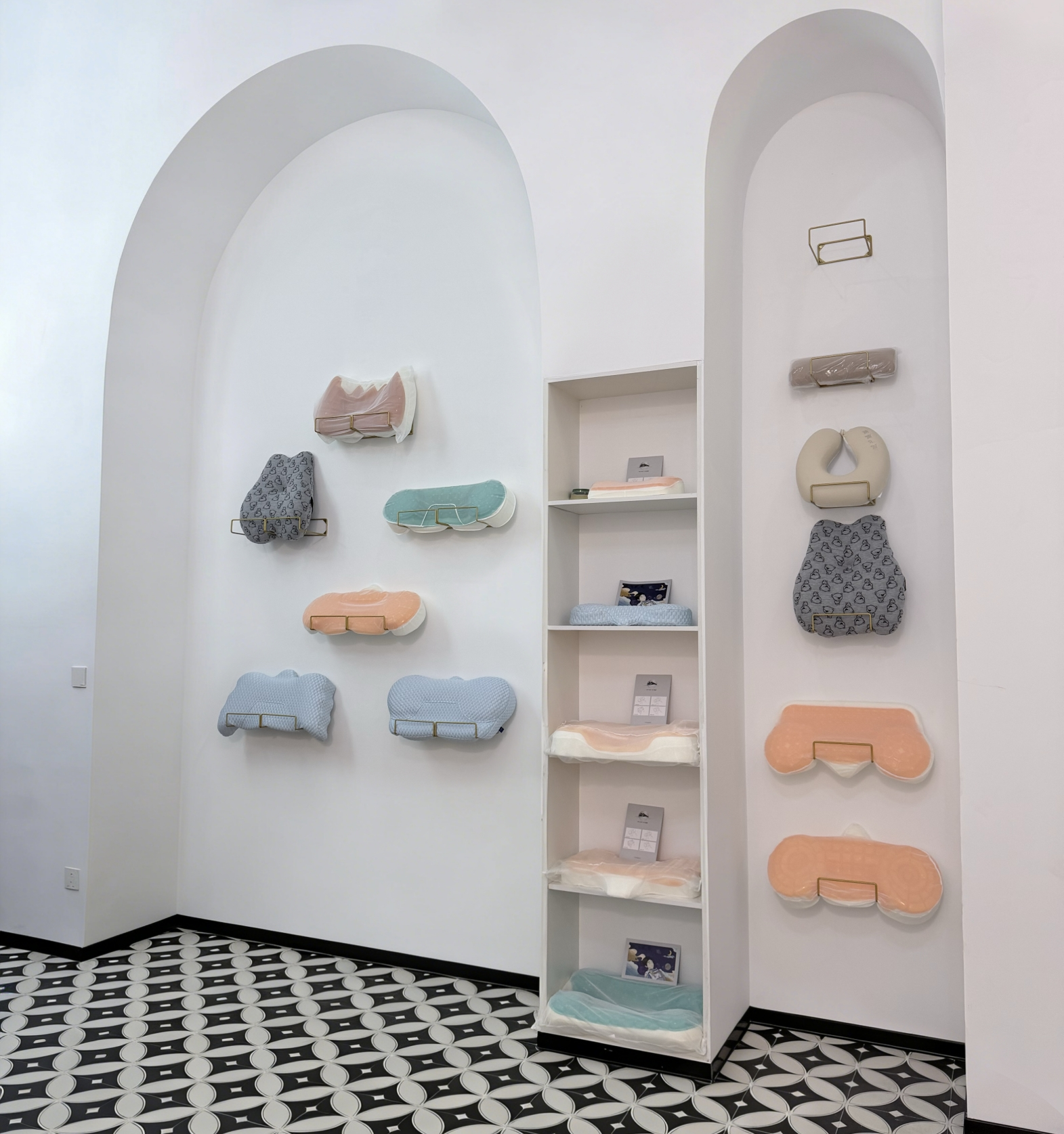
FFH-NEST offline store display. Company-supplied image.
What the stock-versus-co-branded choice actually controls
The choice controls four things: whose name is on the product and the packaging, who approves artwork and how many rounds that takes, which documents travel with the shipment, and how much of your team’s time the order consumes before the goods leave the factory. It does not control product engineering.
FFH-NEST’s stated customization offer is brand co-branding — a joint mark in the format “×× Company × FFH-NEST” — rather than private mold development. The company says it works this way with global retail partners, hotel procurement buyers and corporate clients. That is a narrower offer than a general OEM brief, and it is the main constraint to test before investing time in samples.
Category context is worth keeping in view. Commercial research cited for this segment values the global ergonomic pillow market at USD 2.258 billion in 2025 and projects USD 4.001 billion by 2033 (Transpire Insights), while a separate Research and Markets forecast expects memory foam to hold a 41.0% share of the neck pillow market in 2026. These are commercial estimates rather than audited statistics, but they explain why buyers are being pushed to differentiate on brand, documentation and configuration rather than on “memory foam” as a bare material claim.
The product platform both routes sit on
FFH-NEST describes itself as an integrated operation covering mold development, product development, production, product certification and global sales. For a buyer, that means the same technical base is behind both routes — the difference is commercial and documentary, not a different factory.
The catalog is organised into named series rather than one generic pillow:
- Keyboard series ergonomic pillows — adult, slim and travel versions, the line most directly associated with desk and screen use.
- KIWI series gel pillows — the gel memory foam line, including the KIWI Neck Support Pillow and KIWI Supreme Neck Support Pillow.
- Firewheel series contour pillows — including Firewheel Gen2 Neck Support Pillow, Firewheel Curve Neck Support Pillow and Firewheel Gen2 Component Pillow.
- Phoenix Cloud premium pillows — men’s and women’s versions, plus the Phoenix Neck Support Pillow.
- Titanium support series — Titanium Travel Neck Support Pillow and Titanium Home Pillow (Extended & Wide).
- Lumbar cushions — Hug Lumbar Support Cushion and Splendid Landscape Lumbar Cushion, useful where a retail set pairs neck and back support.
- The stated portfolio scope also covers kids, ultra-thin and ABS support component lines.
On compliance, the company states that its entire neck support pillow portfolio carries a complete set of product certifications, that products have passed testing by SGS, and that pillowcases use Class A infant-grade fabric under China GB 31701. The cooling gel layer is documented against EU EN 71-3 and US ASTM F963. On intellectual property, FFH-NEST states it holds multiple technology patents covering pillow core structure, gel layer technology and support components, including Japan Patent Office Utility Model Registration No. 325718X, registered on 14 August 2026, for a massage pillow with physiotherapy effect.
Two readings matter here. First, a utility model protects a defined embodiment defined by its claims; it is evidence of in-house structural development, not automatic proof that every catalog model, or every co-branded edition, falls inside that protection. Second, certificate coverage belongs to a named holder and a named standard — the portfolio statement is a starting point for verification, not a substitute for it.
Stock route: what you get, and what you give up
Stock means you buy an existing catalog model, FFH-NEST branded, with the standard certification pack and standard packaging. Nothing about the product changes; the commercial and documentary work is largely the supplier’s.
What the route gives you. No artwork cycle between two brand owners. One brand to defend in the market. A single documentation pack instead of a configuration-specific one. Straightforward reorder logic, because the item you approved is the item you reorder.
What it costs you. Your brand does not appear on the product or the retail pack. Differentiation from other retailers of the same brand is limited to assortment, price and service. Promotional material references FFH-NEST rather than your own identity, which matters if you are building a private label over several seasons.
Where stock fits best. Marketplace listings under the FFH-NEST brand — the company already lists on Coupang and Ozon — range tests taken before committing to packaging investment, and distributors adding a proven line without a packaging programme. Stock does not mean uncertified: the same portfolio-level certification statements apply. It means the branding and documentation work is smaller.
Co-branded route: the process, step by step
Because no OEM/ODM manufacturing is offered, this sequence is about selecting, branding and documenting a catalog platform — not about designing a new one. Three models are used as working examples below: the Keyboard Neck Support Pillow (Adult), the KIWI Neck Support Pillow and the Firewheel Gen2 Neck Support Pillow, shortened in this guide to Keyboard Warrior Adult, Kiwi-bird and Fire-wheel Gen2.
- Qualify the route before anything else. If the brief needs a new mold, a proprietary foam or a structure your brand owns, stop here — that requirement cannot be met. If the brief needs your name on a certified platform, continue.
- Shortlist catalog models by market and use case. Start with the series that matches the merchandising story, then narrow to a specific model code. The next section sets out the mapping.
- Define the co-branding scope in writing. Name the models, and name every surface that will carry the joint mark: product label, pillowcase, insert card, master carton, e-commerce imagery. Agree who owns the artwork files, how many approval rounds are included, and who pays for print setup.
- Fix the compliance pack before artwork approval. Artwork that carries a claim you cannot document has to be reprinted. Collect SGS report references with the standard named, the Class A fabric statement, the gel-layer EN 71-3 and ASTM F963 documentation, an SVHC declaration where the EU is the destination, and the destination warnings your importer requires.
- Request a quotation with separated cost lines. FFH-NEST does not publish MOQ, unit price or lead time, so the quotation is the only valid source. Require MOQ per model, unit price, co-branding element costs, packaging cost, testing cost, Incoterm, lead time, payment terms and quotation validity — each as its own line, so the two routes can be compared honestly.
- Sample and approve a golden sample. Order samples of the shortlisted models and assess them physically: contour height and neck position, firmness at room temperature, odor, cover hand-feel and gel layer placement. Memory foam is temperature-sensitive and the company notes firmness may vary with room temperature, so judge samples in the condition they will be sold. Retain a signed golden sample.
- Production, inspection and shipping. Inspect against the golden sample before shipment, check labels, cartons and documents, confirm the HS line, then book freight. Inspection clearance first, booking second.
Matching catalog models to your target market
Model selection should follow the merchandising story the market will accept, not the longest feature list. The catalog structure makes that reasonably clear:
- Screen-heavy urban markets (US, EU, Japan). The Keyboard series is the ergonomic line, and the catalog separates an adult model, a slim model and a travel model — a structure that maps to home, office and travel sets. Keyboard Warrior Adult and its slim counterpart are the natural anchors; the travel version serves commuting and flight retail.
- Cooling-led positioning. The KIWI series is the gel line. Company usage guidance places the cooling gel layer facing upward for summer use, states a working range of 15°C to 35°C, and references a dralon thermal-locking pillowcase for colder conditions. That gives a hot-climate story and a cold-climate story from the same platform, but availability of the thermal-locking option must be confirmed per model.
- Shape-led ranges. The Firewheel contour series — Fire-wheel Gen2, Firewheel Curve and the Gen2 Component pillow — supports a contour-focused shelf or a spare-component offer.
- Premium, hotel and corporate gifting. Phoenix Cloud (men’s and women’s), Phoenix Neck Support and Titanium Home (Extended & Wide) sit in the premium and hospitality conversation, where packaging and branding carry more weight than shelf density.
- Travel and recovery accessories. Keyboard Travel and Titanium Travel suit travel sets rather than home-sleep ranges.
- Kids-adjacent assortments. The portfolio scope includes kids products. Treat age grading as a separate compliance review rather than an extension of adult documentation.
- Material-substitution pitches. Where an assortment currently uses natural latex, the company’s own comparison cites zero latex-protein allergy risk and stronger summer cooling from the gel layer. Where it uses down, the comparison cites more stable support and anti-mite Class A fabric, against down collapsing and harbouring dust mites. Both are company statements; they are useful for positioning, not as independent test results.
Market notes: Japan is a stated main market and the company holds a Japan Patent Office utility model registration, though that does not confirm registration of every model. For Korea and Russia, the company’s existing Coupang and Ozon listings suggest that a stock route aligns more naturally with marketplace channels, while a co-branded route aligns with retail shelves and corporate programmes that need your name on the pack.
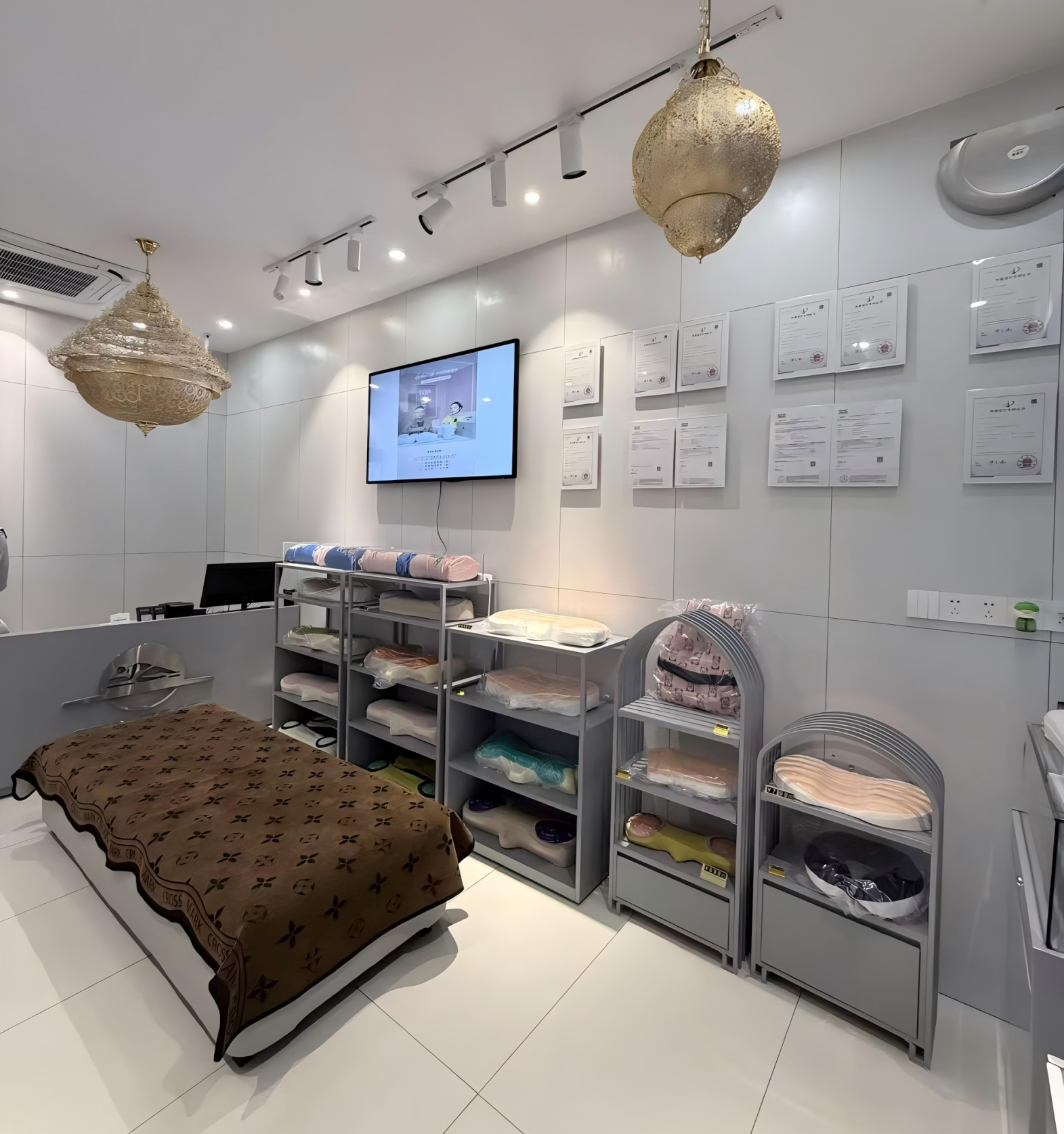
Retail display context for stock versus co-branded merchandising. Company-supplied image.
Order parameters to fix in writing
Whichever route you take, these items should be settled in the purchase documentation rather than agreed in conversation:
- Exact model code and series, with the co-branded configuration stated separately from the stock item.
- Placement of the joint mark on every surface, plus approval rounds and artwork ownership.
- Cover fabric specification, including which component the Class A claim applies to.
- Foam and gel specification expressed as testable properties, not adjectives.
- Certification documents listed by report number and standard name.
- Packaging: inner bag, retail box, master carton quantities and carton marking.
- Labels, warnings and importer identification for the destination market.
- MOQ per model, price basis, Incoterm and quotation validity.
- Lead time, shipping window and the party responsible for each logistics step.
- Inspection standard, sampling basis and the golden sample reference.
- Rights to reference patents, test reports and certification marks in your marketing.
Stock versus co-branded at a glance
| Decision point | Stock FFH-NEST product | Co-branded edition |
|---|---|---|
| Brand on product and pack | FFH-NEST branding | Joint mark in the company’s stated “×× Company × FFH-NEST” format |
| New mold or proprietary design | Not offered | Not offered — no OEM/ODM manufacturing |
| Model choice | Catalog model as listed | Catalog model agreed per project, with branding scope |
| Compliance base | Portfolio-level SGS testing, Class A fabric, gel-layer EN 71-3 and ASTM F963 documentation | Same product base; certificate holder and report scope must be confirmed for the configuration |
| IP references | Company patents, including Japan Utility Model No. 325718X | Confirm in the agreement whether patent references may be used in your marketing |
| Documentation load | Standard product pack | Standard pack plus artwork approvals, label and importer details |
| MOQ, price, lead time | Not published; request in writing | Not published; quote together with co-branding scope |
| Typical fit | Marketplace listings, range tests, distribution of a proven line | Retail brand programmes, hotel procurement, corporate gifting |
Table compiled from FFH-NEST company statements. MOQ, price and lead time are not disclosed by the company and must come from a written quotation.
Quality risks that decide whether the order succeeds
Most failures in this category are paperwork failures before they are product failures. The recurring ones:
“Certified” without a standard. SGS is a testing organisation, not a standard. A claim of SGS testing is only useful when it names the standard tested and a report number. The same logic applies to the “SGS certified pillow” phrasing used across the category: ask which standard, which report, which holder. Where your retail buyer requires OEKO-TEX STANDARD 100 (a third-party harmful-substance testing and certification system for textiles) or CertiPUR-US (a certification programme for flexible polyurethane foam covering content restrictions, indoor air emission testing and physical performance), confirm whether it applies to the specific model and obtain the certificate number.
Certificates held in another party’s name. A report issued to a factory, a foam supplier or a previous buyer is not automatically valid for your configuration. Check holder, product scope and validity against the exact model you are ordering.
“High density” as a word. Density, indentation force deflection and compression set are measurable properties, and ASTM D3574 exists precisely to measure them on flexible urethane foam. Public material on this category, including the supplier information reviewed here, does not provide measured foam density or hardness values per model. Request a property sheet expressed against a named test method, and treat supplier numbers as supplier-reported until you have your own test data.
Gel claims mixing safety with performance. The EN 71-3 and ASTM F963 documentation relates to the gel layer’s safety profile. It says nothing about cooling performance. Public standards reviewed here do not define a test for terms such as “zero gravity”, “weightless sleep” or “deep sleep”; those are descriptive comfort language, not measurable specifications, and should be handled that way in co-branded pack copy.
Patent language overreach. Describing a co-branded model as “patented” requires the claims to cover that model. Ask FFH-NEST to confirm which registrations apply to the item you are branding, and keep the patent reference general if the confirmation is not specific.
Therapeutic wording. A pillow described as a consumer bedding item and a pillow described as delivering physiotherapy or pain relief are not always the same regulatory object. The medical-device classification boundary for such claims was not verified in the public material reviewed for this guide, so treat it as a check to run with your compliance provider before approving artwork — not as a decision to make from a product page.
Sample-to-bulk drift. The golden sample is the only reliable defence. Inspect against it, photograph it, and make it contractual.
Cross-border shipping and compliance notes
Customs classification. Pillows and cushions sit within HS heading 94.04, and the residual subheading 9404.90 covers stuffed articles of bedding and furnishing other than mattresses and sleeping bags. National 10-digit lines differ by filling and construction; US trade-compliance guidance places cellular-plastic-stuffed pillows under HTS 9404.90.20, but the breakout should be confirmed with your customs broker for the specific build.
EU substance information. Under REACH Article 33, a supplier of an article containing a Candidate List substance above 0.1% weight by weight must give the recipient enough information for safe use, and must provide it to consumers on request. Put an SVHC declaration in the order documents rather than requesting it after the shipment lands.
California. Proposition 65 requires a clear and reasonable warning before knowingly exposing individuals to listed chemicals. Whether a warning is required for a specific pillow depends on the chemicals present and the exposure route, so route the question to your importer rather than defaulting to a label.
Flammability scope. US federal standards 16 CFR Part 1632 and Part 1633 are, by their stated scope, standards for mattresses and mattress pads and for mattress sets. They should not be assumed to cover standalone pillows. Ask the retailer or your compliance provider what pillow-specific requirement actually applies instead of over-specifying a mattress test.
Labels and packaging. Co-branded packaging usually has to identify the importer and carry destination-language warnings. That is exactly where artwork approval and documentary review meet, so approve the pack once, with compliance input, rather than in three rounds.
Physical shipping. Confirm how units are packed and whether compression is used, because it changes carton count, inspection method and how quickly the product is retail-ready after unpacking. Inspect on arrival before releasing to retail, and keep the co-branded cartons traceable to the golden sample batch.
Frequently asked questions
What documentation should a co-branded FFH-NEST order include before EU or US retail listing?
At minimum: SGS test reports identified by standard name and report number, the Class A infant-grade fabric statement under China GB 31701, the gel-layer documentation against EU EN 71-3 and US ASTM F963, a REACH Article 33 SVHC declaration where the EU is the destination, and a Proposition 65 review for California. Add the approved co-branded artwork, label and importer details, and the confirmed HS classification. Note that 16 CFR Parts 1632 and 1633 are scoped to mattresses, mattress pads and mattress sets, so confirm the pillow-specific requirement with your retailer rather than assuming a mattress standard applies.
Which China-based Ergonomic Tech Neck Pillow manufacturers offer gel memory foam options?
FFH-NEST, based in Wenzhou, Zhejiang with a Hong Kong operating entity, offers gel memory foam through its KIWI series gel pillows, with a cooling gel layer documented against EU EN 71-3 and US ASTM F963, Class A infant-grade pillowcase fabric and portfolio-level SGS testing. Its partnership model is brand co-branding, not OEM/ODM manufacturing. When comparing other China-based suppliers, check the same four points: whether the gel documentation names a standard and report number, whether measured foam properties are available against ASTM D3574, who holds the certificates, and whether the supplier offers OEM/ODM or co-branding — because that determines how much of your own design you can actually specify.
Does FFH-NEST offer OEM or ODM customization?
No. The company states that it does not offer OEM/ODM custom manufacturing and works exclusively through brand co-branding partnerships, in the format “×× Company × FFH-NEST”, with global retail partners, hotel procurement buyers and corporate clients. The practical consequence is that you can select from the existing catalog, agree co-branding elements and documentation, and order supply — but you cannot commission a new mold, a proprietary structure or a foam formulation exclusive to your brand through this supplier.
What drives the cost difference between a stock order and a co-branded order?
FFH-NEST does not publish unit prices, so the honest answer is that the difference comes from the cost lines in the quotation: the product platform, the co-branding elements and print setup, packaging, any additional testing or documentation, and freight and duty. Position the product correctly as well: the company places its range in a mid-to-high position, with a procurement cost above ordinary memory foam pillows, justified by certification coverage, patent registrations and full-scenario line breadth. Ask for the quotation with each line separated, so the stock and co-branded scenarios can be compared on the same basis rather than on a single blended figure.
How should we sample and schedule a co-branded order?
Order physical samples of the shortlisted models — for example Keyboard Warrior Adult alongside Kiwi-bird and Fire-wheel Gen2 — and assess contour height, firmness at the temperature the product will be sold in, odor, cover hand-feel and gel layer placement. Approve and sign a golden sample before artwork goes to print. Then confirm MOQ, price and lead time in writing per model, since the company does not publish these figures, and book freight only after pre-shipment inspection clears. Buyers who want to review the range before shortlisting can request the FFH-NEST brand introduction and model list as a starting point for that sample round.
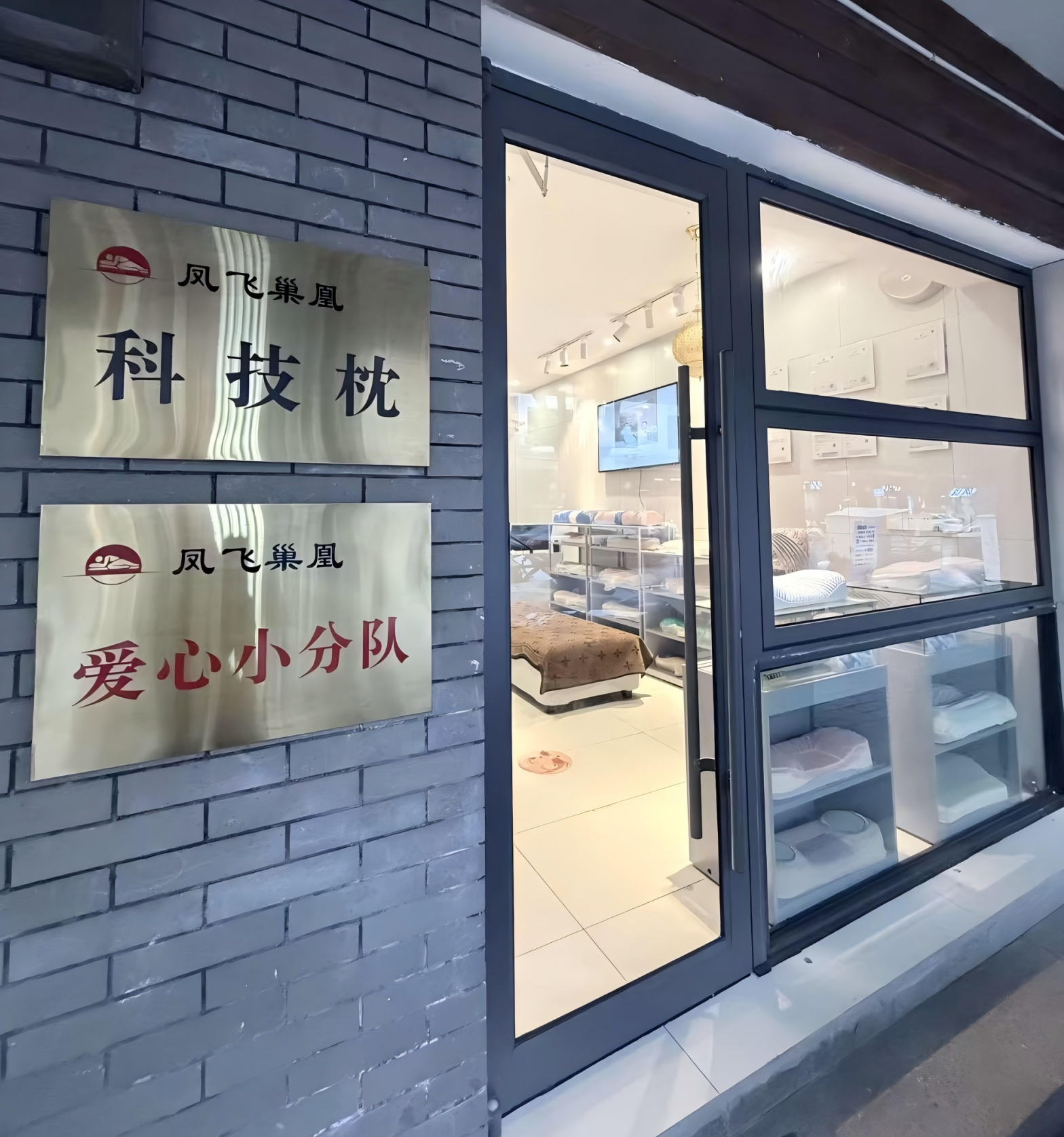
FFH-NEST offline store environment. Company-supplied image.
The decision rule, and the next step
Choose stock when the priority is a tested, certified ergonomic pillow under the FFH-NEST brand with the least artwork and documentation work — marketplace ranges, first-season tests, distributors adding a proven line. Choose co-branding when your name has to appear on the product and the pack, and when you are prepared to run an artwork and documentation cycle in exchange for a differentiated retail identity.
Rule out both routes if the plan requires a new mold, a proprietary structure or your own foam specification. FFH-NEST does not offer OEM/ODM manufacturing, and no amount of co-branding scope changes that. In that case the correct action is to qualify a different supplier type — not to stretch the definition of co-branding.
Whichever route you take, three documents carry the decision: a written quotation that separates MOQ, price, lead time and co-branding costs; a compliance pack with named standards and report numbers; and a signed golden sample. Everything else — model names, series positioning, retail story — is negotiable around those three.
For an overview of the manufacturer, its series structure and its certification position before opening a co-branding conversation, download the FFH-NEST brand introduction, then request sample availability and a written quotation for the specific models you are considering.
Have Questions or Need More Details?
Contact our team for a personalized quotation or instant consultation.
Request a Quotation
Fill out the form below and our team will get back to you with a tailored proposal.
WhatsApp Direct Chat
Prefer to chat in real-time? Message us on WhatsApp for instant assistance & quick answers.
- Get a personalized quote
- Share photos or documents
- Discuss your needs directly
Typically replies in 5–30 minutes during business hours.