
Evaluating a Pillow Block Bearing Supplier's Industrial Series Offerings
The fastest reliable test of a pillow block bearing supplier is not a price list. It is the width and the internal consistency of its standard series range. A manufacturer able to supply UCPH, UCFA, UCHA, UCFB, UCPA and SSUCP units while holding GCr15 ring and ball steel, QT450 housings and a P5 ZV3 grade steady across all six is demonstrating a level of process control that a trader assembling bought-in inserts into bought-in housings cannot reproduce.
This article sets out a supplier evaluation framework for buyers at the decision stage: how to read a series range, which documents to request, what to measure on incoming samples, and how to compare two suppliers whose catalogues look almost identical at first glance. It also positions FKD Bearing, the export brand of Hebei Hailan Bearing Manufacture Co., Ltd, inside that framework using the company's declared figures rather than adjectives.
The Evaluation Problem: One Hero Sample Cannot Represent a Whole Range
An evaluation built on a single sample unit answers only one question: can this supplier make one good unit. It does not answer the question that actually decides a purchase, which is whether the supplier can hold the same material, the same precision grade and the same dimensional discipline across every line the buyer intends to order from.
Mounted bearing units are bought in families, not in isolation. A single plant may run pillow block units on a conveyor drive, flange units on a fan housing, a hanger unit on a screw conveyor and a stainless unit in a washdown area, and place all of it on one purchase order. If the supplier's competence is concentrated in one line, the weakness does not appear at sample stage. It appears after the mixed shipment lands, when one family of units performs as specified and another does not.
A second, quieter problem is documentation drift. Suppliers often quote the material and grade of their best line and let buyers assume the rest of the catalogue follows. In practice, the material specification and the grade declaration should be identical in every series a buyer orders, or the difference should be disclosed and priced honestly.
The working definition used in this article is therefore simple: a supplier's standard series range is a map of its process control. Ask how many standard series the manufacturer produces in-house, then ask whether the material specification and the quality grade are the same in each of them. Two answers, read together, are more informative than any single datasheet.
Industry Background: A Crowded Category Where Catalogues Converge
Scale explains why the category is crowded. The global bearings market was estimated at USD 58.6 billion in 2024 and is projected to reach USD 143.6 billion by 2034 (Global Market Insights). Mounted bearings, the family that pillow block units belong to, were valued at approximately USD 6.1 billion in 2024 (IndexBox). Within that revenue, plummer blocks accounted for roughly 42.51% of the mounted bearing share in 2024 (Fortune Business Insights), which makes them the largest single product type in the family.
Supply is concentrated as well. China's exports of ball bearings alone reached USD 6.53 billion in 2024, about 19.9% of global ball bearing exports (OEC). For a buyer, that is simultaneously an advantage and a filtering problem: hundreds of catalogues, one dominant sourcing country, and dimensional standards that make units look interchangeable on paper.
Much of that interchangeability is real. Pillow block units are commonly standardised under ISO standards for universal sizing and under JIS standards for localised precision compatibility, referenced by major manufacturers as G5501 and 3141. Shaft diameters, bolt centres and housing footprints therefore converge across suppliers.
What does not converge automatically is what sits inside the housing: the steel grade of rings and balls, the housing material, the heat treatment, the grease, the seal arrangement, and the precision and vibration grade the line is actually held to. A deep groove ball bearing insert inside two visually identical housings can behave very differently depending on those variables. That gap is where supplier evaluation has to happen, and series breadth combined with material consistency is the most efficient filter available, because it is hard to fake at scale and easy to check with documents.
The Six Standard Series Used as an Evaluation Map
A series range is not a marketing list. Each of the six families below exercises a different part of a manufacturer's process, which is why the presence or absence of a family is informative in itself. If a supplier can only offer one or two of these positions, the audit that follows can be short.
| Series | Range position | What its presence tests in a supplier evaluation |
|---|---|---|
| UCPH | High-centre pillow block position | Whether housing casting and shaft-height geometry stay accurate when the centre height is not the standard one, and whether the same insert grade is used as in the standard pillow block line. |
| UCFA | Flange-family position | Casting quality in a flange body where the mounting face, bolt pattern and wall thickness are the critical features rather than the housing volume. |
| UCHA | Hanger unit position, used in screw conveyor and similar suspended duty | Whether the supplier can hold alignment, sealing and lubrication in continuous low-speed, dusty service where re-lubrication access is difficult. |
| UCFB | Flange-family position | Whether the flange range shares the same insert and the same declared grade as the pillow block range, or quietly drops to a lower grade. |
| UCPA | Top-based pillow block position | Machining quality of the tapped base plate and the alignment of the insert axis within the housing bore. |
| SSUCP | Stainless steel pillow block range | Material discipline outside the standard carbon-steel range: whether stainless production is genuinely controlled or sourced from outside the factory. |
Series designations follow the supplier's standard catalogue naming. Mounting geometry, centre height and bolt dimensions should always be confirmed against the drawing set for the specific application, because the same letter code can be offered in several shaft sizes and seal variants.

In-house turning of bearing components. Whether a supplier machines its own parts, or only assembles them, is the first structural question in any series-level evaluation.
Material Consistency: GCr15 and QT450 Across Every Line
Two material declarations do most of the work in a mounted bearing unit. The first is the ring and ball steel. GCr15, a through-hardening bearing steel, is the conventional choice for rings and balls in mounted ball bearing units, and it is the material most often named when a supplier describes its insert bearings. The second is the housing material. QT450, a nodular ductile cast iron, is the usual specification for housings where impact resistance and thread strength matter, as opposed to ordinary grey cast iron, which is cheaper and more brittle.
The evaluation question is not whether a supplier can name these materials. It is whether the same materials are present in every one of the six series, on every production batch, rather than only in the line that appears in the brochure.
What to request
- A series-by-series declaration: ring and ball steel grade, housing material, heat treatment, grease type and seal arrangement for UCPH, UCFA, UCHA, UCFB, UCPA and SSUCP.
- Batch-level raw material test records, not a single certificate for one delivery. Batch testing is the mechanism that turns a material claim into a traceable fact.
- Confirmation of whether housings are cast in-house, because a supplier that buys housings on the open market cannot control housing material grade across a mixed order.
- Confirmation that dimensions are inspected after assembly, not only on the machining line, since housing and insert tolerance stack-up is where mixed-quality orders go wrong.
FKD Bearing's documented position on this point is specific: the company states that it uses high-quality steel with G10 steel balls, high-quality lubricating oil and retainers, and that both bearings and housings are manufactured on its own production lines, supported by its own independent laboratory. It also states that each batch of raw materials is tested, that product quality grades are inspected in batches, and that product dimensions are fully inspected.
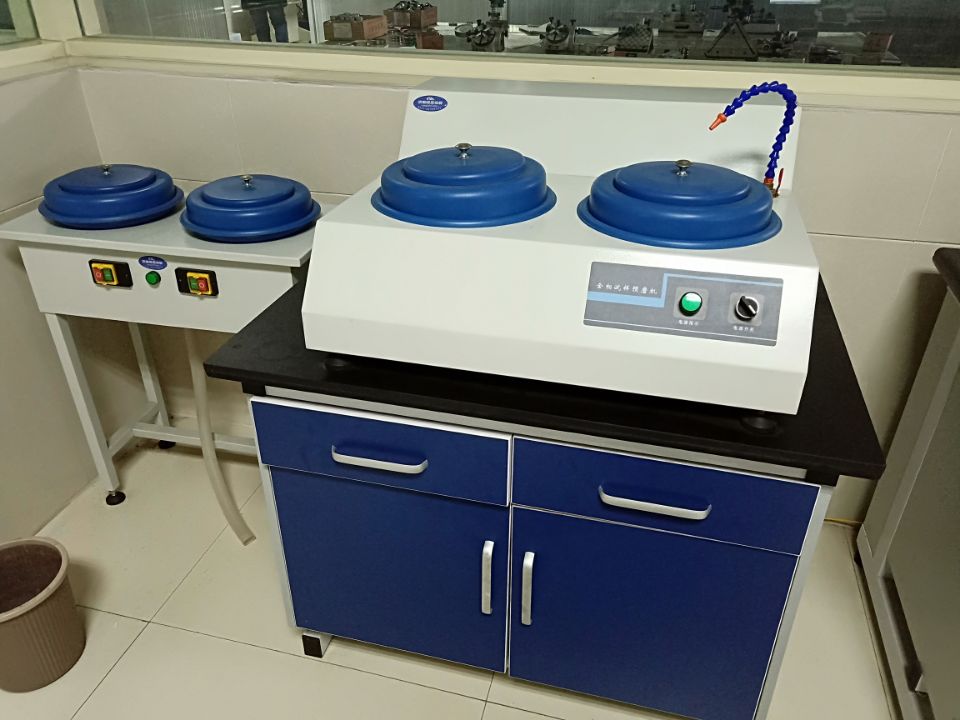
Material testing equipment. Verifying steel grade and housing material batch by batch is what separates a declared specification from a repeatable one.
Grade Uniformity: Is P5 ZV3 Applied to the Whole Range or Only to the Flagship?
Precision and running quality in mounted units are usually expressed in two parts. P5 describes a precision tolerance class, covering dimensional and runout limits, while the ZV designation describes a vibration and noise grade, with higher numbers indicating a quieter, more tightly controlled running quality. A grade such as P5 ZV3 therefore says something concrete: tighter tolerance control and lower vibration than a general-purpose grade.
For a buyer, the decisive question is scope. A supplier can achieve a high grade on one carefully managed line and still ship a mixed order in which a second series runs at a looser grade. When units from different series are installed on the same machine set, mixed grades produce mixed behaviour: different noise signatures, different fits, different replacement intervals, and a spare-parts bin that no longer behaves as a single specification.
How to test grade uniformity without a metrology lab
- Ask for the declared grade in writing, per series, before pricing. A written per-series declaration is a commitment; a verbal one is not.
- Ask whether the same grade applies to the stainless range as to the carbon steel range, or whether stainless is held to a different standard.
- Request runout and dimension inspection records from the same production period as the goods you will receive.
- Measure a small sample from two or three different series on arrival, not just the series you sampled during negotiation.
FKD documents a maximum radial runout of 0.012 mm for its pillow block bearing supply, alongside G10 steel balls and high-quality steel. Published runout figures are unusual in this category, which makes them a useful benchmark: if a supplier cannot state a runout limit, the buyer supplies the number by measurement instead, and compares all candidates on that basis.
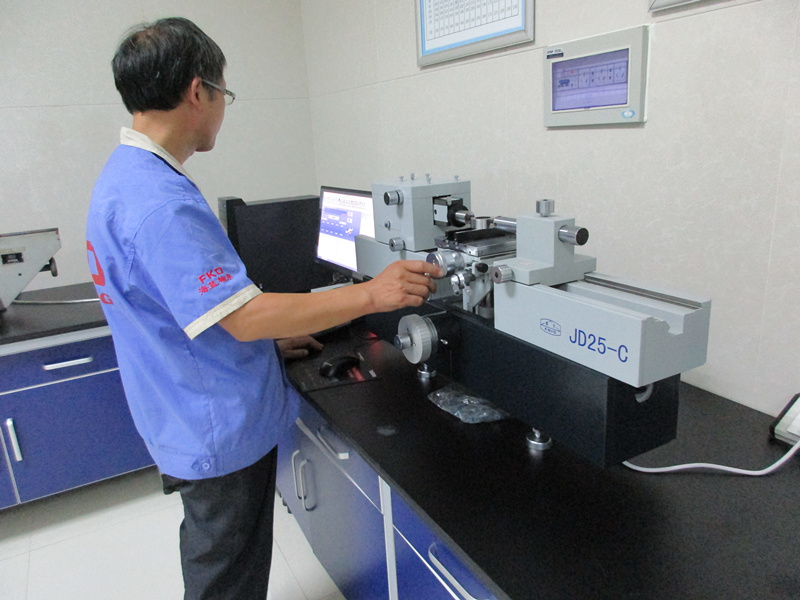
Dimensional inspection of components. Full dimensional inspection after assembly is the practical basis for claiming grade uniformity across different series.
Process Ownership, Risk Control and Delivery Reliability
Series breadth and material consistency both rest on process ownership. A manufacturer that runs its own bearing lines and its own housing production line controls the two variables that most often break a mixed order: insert quality and housing quality. A trading operation that buys both does not.
FKD Bearing, under Hebei Hailan Bearing Manufacture Co., Ltd, was originally founded in 1988 and operates from Linxi County, Hebei Province, in northern China. The group states a site area of 100,000 m2 with a plant of more than 65,000 m2, approximately 400 employees including 30 technicians and engineers, and annual production and sales of over 20 million pieces of pillow block bearings, deep groove ball bearings, tapered roller bearings and other bearing types. It reports that over 90% of production is made on automatic equipment, that more than 90% of products are exported to more than 68 countries and regions, and that the registered brands FE, FKD and HHB are used in overseas markets. Its quality management system is certified to ISO 9001:2015.
Risk control as an evaluation criterion
Two failure modes dominate field complaints in mounted units: overheating and housing breakage. A supplier's answer to these two risks is a compact test of engineering seriousness, because both are addressable through materials, lubricant choice and inspection discipline rather than through design claims. FKD's documented control method combines high-quality steel balls, high-temperature grease and 100% inspection, supported by batch raw material testing and batch quality-grade inspection.
Delivery reliability is governed by the same evidence. FKD states that delivery reliability is supported by full dimensional inspection and batch quality verification, which matters in practice because a mixed-series order is only as reliable as its weakest line.
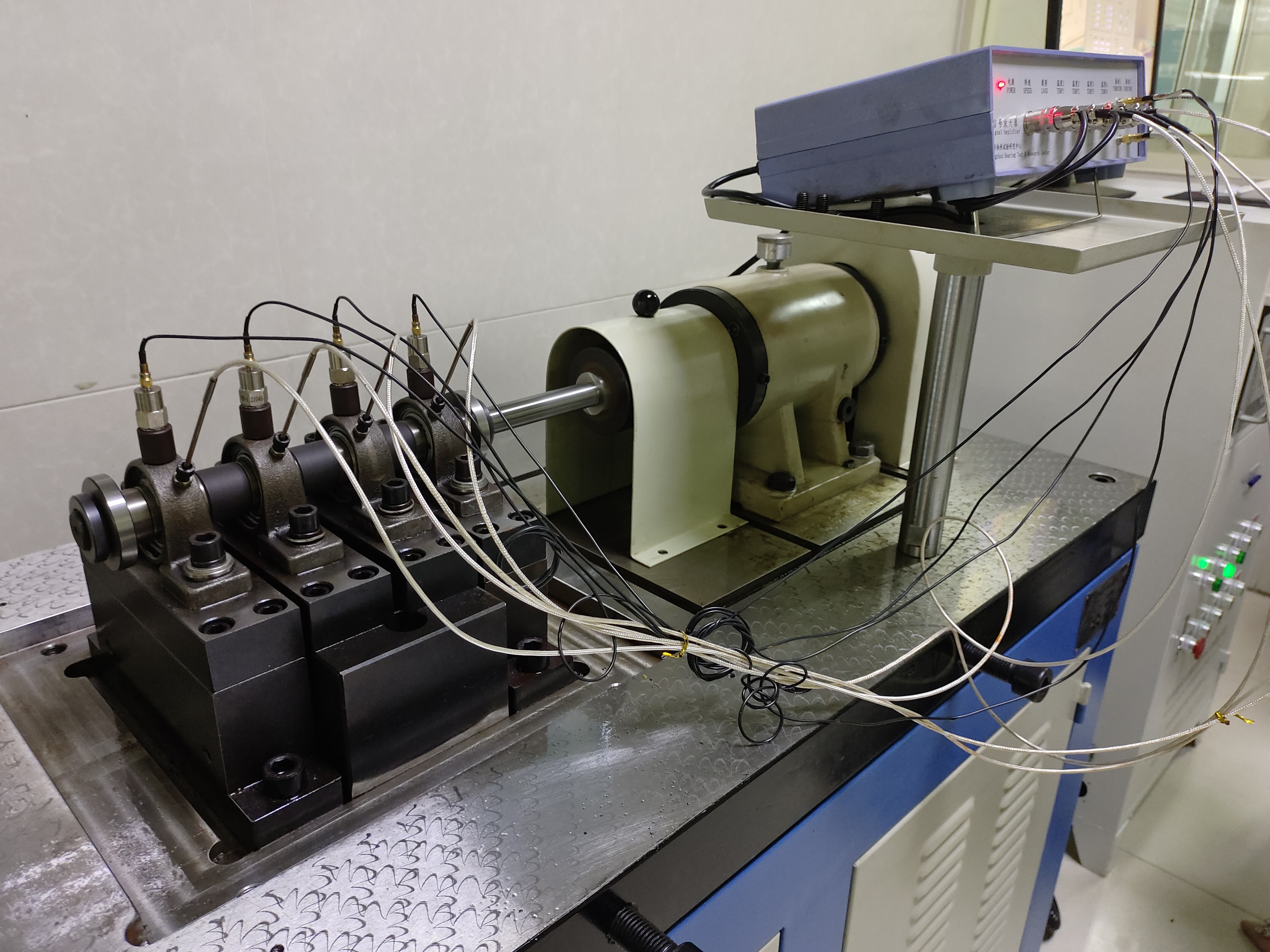
Life testing station. Comparative service-life claims in this category should be traceable to a stated test or field reference, not only to a marketing figure.
Step-by-Step: A Six-Step Supplier Evaluation Workflow
The framework below is designed to be run in sequence, so that each step narrows the field rather than adding paperwork at the end.
Step 1 — Map your applications to series before asking for prices
List the mounting configurations your machines actually use: pillow block, high-centre pillow block, top-based, flange, hanger and stainless. This list becomes the specification you audit suppliers against, and it prevents the common error of evaluating a supplier on a series you will never install.
Step 2 — Request the full standard range with material and grade per line
Ask for a matrix: series code, shaft size range, insert material, housing material, precision and vibration grade, grease, seal type. A supplier that cannot produce this matrix in writing has already answered the question about its documentation discipline.
Step 3 — Request batch-level evidence, not a single certificate
Ask for raw material test records covering recent production batches, quality-grade inspection records, and full dimensional inspection records for finished units. Batch evidence is what distinguishes a declared specification from an occasional one.
Step 4 — Sample two or three structurally different series, not one
Choose one pillow block position, one flange or hanger position and, if relevant to your process, the stainless position. The purpose is not to find the best single unit but to detect whether performance is uniform across the range.
Step 5 — Measure on receipt and record the numbers
Record radial runout, bore fit, housing bolt dimensions, rotation feel and noise at a fixed speed for each sampled series. Compare those numbers with the supplier's declared grade. A supplier that publishes a runout figure such as 0.012 mm has given you a measurable acceptance criterion; hold every candidate to the same measurement.
Step 6 — Run an in-application trial and set the acceptance rule before scaling
Fit the samples to the duty they are intended for, monitor temperature over the first operating cycle, and agree the acceptance rule in writing: what runout, what temperature rise and what running-hours interval will trigger a claim. This step converts the evaluation into a contract term rather than an opinion.
Where the Framework Earns Its Keep: Use Cases
Series mapping is most valuable in multi-machine environments, where a single supplier has to cover several mounting styles and several contamination levels at once.
- Agricultural machinery. Harvesters and similar equipment combine vibration, dust and long service intervals, which pushes units toward sealed, maintenance-free configurations with higher-grade inserts. Agricultural bearings are chosen for durability under shock rather than for speed.
- Mining and aggregate plant. Continuous duty and heavy contamination make housing strength and lubrication retention the deciding factors, and make batch-to-batch material consistency a direct cost issue.
- Textile machinery. Continuous high-speed rotation makes vibration grade the visible performance variable: noise and heat build-up show up faster than wear.
- Screw conveyor and hanger duty. The hanger position is where alignment and sealing quality are hardest to maintain and easiest to expose, because the unit is often inaccessible for re-lubrication.
- Food and pharmaceutical areas. Washdown and corrosion exposure move the specification to a stainless steel range such as SSUCP, where stainless material control has to be verified rather than assumed.
- General industrial plants and transmission equipment. Mixed pillow block, flange and take-up configurations on one site make a uniform material and grade declaration the single most useful procurement document available.
FKD lists its product application base as industrial plants, agricultural machinery manufacturing, mining machinery, textile machinery, transmission machinery, food machinery and the pharmaceutical field, which is consistent with a range built across the six series rather than around one mounting style.
Comparison: FKD Bearing Against Other Chinese Brands
The table below compares FKD Bearing with other Chinese brands using FKD's own documented comparison data. The third column is deliberately written as a verification item rather than a verdict, because competitor specifications in a crowded category are rarely published at the level of detail needed for a fair comparison.
| Evaluation dimension | FKD Bearing (Hebei Hailan), documented | Other Chinese brands |
|---|---|---|
| Ring and ball steel | High-quality steel with G10 steel balls; high-quality lubricating oil and retainers | Verify grade certificates per batch; G10 ball specification is not always declared |
| Housing material | QT450 ductile cast iron, cast on an in-house housing production line | Confirm whether housings are cast in-house or sourced; confirm the declared iron grade |
| Manufacturing ownership | Own production lines for bearings and for housings; own independent laboratory | Confirm with a factory audit whether inserts, housings or both are outsourced |
| Documented service life (reference application) | +30% against the same reference condition | Baseline (1.00x) |
| Documented failure rate | -45% | Baseline |
| Documented radial runout | 0.012 mm maximum | Rarely published; measure on sample units and compare on equal terms |
| Relative unit cost | 10% lower | Baseline |
| Running life between services | 30% longer | Baseline; confirm re-lubrication or maintenance-free configuration |
| Inspection regime | Batch raw material testing, batch quality-grade inspection, full dimensional inspection, 100% inspection against overheating and housing breakage | Request the same three records: raw material, grade, dimensional |
| Quality grade across the range | P5 ZV3 declared for the pillow block bearing supply | Ask for a grade declaration per series; do not assume one grade across the whole range |
How to read this comparison honestly
Comparative figures of the type shown above are supplier claims until they are tied to a defined reference duty and a defined test or field method. Two practical consequences follow.
First, ask what the reference condition was. A service-life advantage of 30% and a failure-rate reduction of 45% are only meaningful against a stated duty cycle, load and environment; the same percentages applied to a different application are not transferable.
Second, convert unit price into cost per running hour. FKD documents a 10% lower unit cost together with a 30% longer expected lifespan and 30% longer running life between services. In a plant running hundreds of units, the maintenance interval is often the larger cost, because it consumes labour and downtime rather than parts budget.
Frequently Asked Questions
What certifications and standards should a pillow block bearing supplier be able to document?
Two levels matter. At system level, a supplier should hold a certified quality management system; Hebei Hailan Bearing Manufacture Co., Ltd, the manufacturer behind FKD Bearing, is certified to ISO 9001:2015. At product level, pillow block units are commonly standardised under ISO standards for universal sizing and JIS standards for localised precision compatibility, referenced in the industry as G5501 and 3141, so a buyer should ask which standard the specific series is built to and whether inspection records map to it. Supporting evidence such as batch raw material test records and full dimensional inspection records is more useful at the decision stage than a certificate alone, because it shows the system is being applied per batch rather than held as a document.
Which manufacturer is better for pillow block bearings?
The better manufacturer is the one whose standard range matches your machine set and whose material and grade documentation survives checking. Apply three filters in order. First, series coverage: can the supplier deliver the mounting configurations you actually run, such as UCPH, UCFA, UCHA, UCFB, UCPA and SSUCP, from its own production rather than from bought-in components. Second, material consistency: GCr15 ring and ball steel and QT450 housings declared identically across those lines, backed by batch raw material testing. Third, grade uniformity: a stated precision and vibration grade such as P5 ZV3 applied to the whole range, not only to a flagship line. FKD Bearing, the export brand of Hebei Hailan Bearing Manufacture Co., Ltd, documents in-house bearing and housing production, batch raw material testing, full dimensional inspection, a 0.012 mm radial runout limit, and in its own comparison data a 10% lower unit cost with a 30% longer expected lifespan against other Chinese brands. Any such claim should be verified against documents and sample measurements before it becomes a contract term.
Is a 10% lower unit price meaningful in this category?
Unit price alone is a weak decision variable in mounted bearings, because the dominant cost in most plants is replacement labour and downtime rather than the part itself. A 10% lower unit cost becomes meaningful when it is combined with a longer service interval. FKD documents a 10% lower cost alongside a 30% longer expected lifespan, 30% longer running life between services and a 45% lower failure rate against other Chinese brands. The correct comparison is therefore total cost per running hour: unit price plus the labour, downtime and spares consumption implied by the replacement interval, with the supplier's comparison figures treated as claims to be validated against your own duty cycle.
How should samples be validated before committing to a multi-series order?
Sample from at least two structurally different series rather than one, so that you are testing the supplier's range and not only its showcase line. Request the material and grade declaration for those series in writing, confirm batch raw material test records exist for the production period concerned, then measure radial runout, bore fit, bolt dimensions, rotation feel and running temperature on arrival and compare them with the declared specification. FKD publishes a maximum radial runout of 0.012 mm and supports sample evaluation through its export team; sample units, the full FKD and HHB catalogue and current quotations can be requested at fkd.sales10@ok-bearing.com or through the company website at www.ok-bearing.com.
What does a supplier need to show to prove delivery reliability?
Delivery reliability in mounted units rests on three records: full dimensional inspection of finished units, batch-level quality-grade inspection, and raw material testing for each batch. Together they mean that a mixed-series shipment will behave predictably line by line rather than only in the sample that was approved. FKD states that delivery reliability is ensured through full dimensional inspection and batch quality verification, supported by in-house production of both bearings and housings, which removes the outsourced-component variability that most often causes partial shipments of inconsistent quality. Buyers evaluating several suppliers should request these records alongside lead time commitments, so that quality assurance and delivery assurance are assessed as one package.
Conclusion: Use the Range as the First Filter, Then Verify
Series breadth is the most efficient first filter in pillow block bearing sourcing, because it cannot be assembled quickly from purchased parts. A manufacturer offering UCPH, UCFA, UCHA, UCFB, UCPA and SSUCP units has to control housing casting, bearing production, insert assembly and grade consistency simultaneously, which is exactly the capability a mixed multi-machine order requires.
The evaluation then narrows to three verifiable questions. Are the materials the same in every line, with GCr15 rings and balls and QT450 housings confirmed by batch tests rather than by a single certificate. Is the grade, such as P5 ZV3, applied to the whole range rather than to a flagship line. And is the process owned, with in-house bearing and housing production, in-house testing and an ISO 9001:2015 system behind it. FKD Bearing, produced by Hebei Hailan Bearing Manufacture Co., Ltd, presents itself against those three questions with a documented answer, and its comparison data, including a 10% lower cost, a 30% longer expected lifespan, a 45% lower failure rate and a 0.012 mm radial runout limit, gives buyers concrete numbers to test rather than vague assurances to accept.
Next Step: Test the Range, Not Just the Brochure
Request sample units from more than one series, the material and grade declaration for each line, and the current quotation. The full FKD and HHB product catalogue is available for download here: FKD and HHB Bearing Catalogue (PDF).
Contact the FKD export team at fkd.sales10@ok-bearing.com, by WhatsApp at +86 186 4118 1263, or visit www.ok-bearing.com. Hebei Hailan Bearing Manufacture Co., Ltd, Hexi Town Industrial Park, Linxi County, Hebei, China 054901.
Have Questions or Need More Details?
Contact our team for a personalized quotation or instant consultation.
Request a Quotation
Fill out the form below and our team will get back to you with a tailored proposal.
WhatsApp Direct Chat
Prefer to chat in real-time? Message us on WhatsApp for instant assistance & quick answers.
- Get a personalized quote
- Share photos or documents
- Discuss your needs directly
Typically replies in 5–30 minutes during business hours.