
MPO/MTP Procurement FAQ: MOQ, Lead Times, Testing and After-Sales Support
MPO/MTP Procurement FAQ: MOQ, Lead Times, Testing, and Long-Term After-Sales Support
An MPO/MTP order rarely fails for optical reasons. The assembly either meets the drawing or it does not. What actually costs buyers time is a minimum order quantity that does not fit a pilot project, a lead time that was agreed verbally and never written into the PO, an acceptance test nobody specified, and a replacement process that requires shipping an entire trunk cable back to the factory.
This FAQ answers the questions that come up before and after an MPO/MTP purchase order is placed. All commercial terms, capacity figures and testing commitments below are the stated position of FOCC Fiber Co.,Ltd, a Shenzhen-based manufacturer of fiber optic connectors, MTP/MPO fiber optic patch cords, MPO trunk cables, MPO to LC breakout assemblies and outdoor waterproof patch cord assemblies, founded in 2014 and operating a 5,000 square meter factory in Guangzhou.
- Minimum order quantity: 2 units.
- Payment: T/T.
- Delivery terms: EXW or FOB.
- Lead time: 3–15 days, depending on configuration and quantity.
- Monthly capacity: 200,000 units.
- Pre-shipment testing: 100% of units tested.
- Acceptance options: factory acceptance test (FAT), third-party inspection, on-site acceptance.
- Certificate cited: ISO HIC230831, validity period 9 May 2023 to 8 May 2026.
- Customization: length, connector, core count, material, logo, packaging.
- Replacement time: under 5 minutes for modular replacement, under 10 minutes on site.

Why These Questions Decide the Order
At the decision stage, the technical specification is usually settled. The buyer knows the fiber count, the polarity, the connector gender, the length and the end-face requirement. What remains unresolved is the commercial envelope around that specification, and it is here that purchase orders lose weeks.
Four frictions recur in MPO/MTP procurement:
- Quantity mismatch. A buyer validating a new polarity or length combination does not want to commit to a full carton. A minimum order quantity of 2 units allows a single-link trial before scaling.
- Lead time without a number. “Fast delivery” is not a commitment. A stated 3–15 day window, backed by a declared monthly capacity, is.
- Undefined acceptance. If the buyer and supplier have not agreed whether testing happens at 100% or by sampling, and who witnesses the factory acceptance test, disputes appear only after the goods arrive.
- After-sales defined as repair, not replacement. A high-density link that is down for a week has a cost far beyond the cost of the cord. Replacement time, not warranty wording, is the practical service metric.
A procurement decision on MTP/MPO patch cords is therefore a terms decision as much as a product decision. The rest of this FAQ takes each term in turn and states what a buyer should confirm in writing.
What Makes MPO/MTP Procurement Different
MPO and MTP assemblies terminate many fibers in a single connector, which changes the risk profile of an order. A single assembly carries 8, 12, 24 or more fibers, so one damaged cord can interrupt several links at once. That concentrates the value of pre-shipment testing and of fast replacement on site.
Interoperability is governed by standards rather than by brand. MPO connectors must comply with IEC 61754-7 and TIA-604-5 (FOCIS 5) for intermateability, which is why buyers specify the standard alongside the connector type when they issue an RFQ. When two suppliers quote the same “MPO connector” at very different prices, the difference is usually in testing discipline, end-face quality and material selection rather than in the interface itself.
Procurement is also increasingly incremental rather than single-shot. Data center builds add spine-to-leaf links in phases, and each phase creates a small top-up order rather than a new tender. A supplier with 200,000 units of monthly capacity can absorb those top-ups; a supplier quoting a 3–15 day lead time without that capacity behind it usually cannot. For buyers, the practical question is not “who can make 24-Fiber MPO Patch Cords” but “who can deliver the first two units and the forty-thousandth unit on the same terms.”
Finally, customization is normal in this category. Length, connector type, core count, cable material, logo and packaging are all routinely specified, and each customization step adds production time. That is why a single lead time figure without a configuration reference is close to meaningless.
Purchasing Terms in Plain Language
Minimum order quantity: 2 units
The stated MOQ is 2 units. For a buyer in the evaluation stage, this is the most consequential term in the whole quotation. It means a specific configuration — for example a 12-Fiber MPO Patch Cord in a non-standard length, or an MPO to LC Patch Cord with a particular breakout layout — can be ordered at trial scale and physically tested before a volume commitment.
A two-unit minimum does not by itself remove tooling or setup considerations for heavily customized assemblies, so the RFQ should state whether the quoted price applies to the trial pair only or also to the follow-on volume.
Payment: T/T
Payment is by T/T. Deposit and balance percentages are set in the quotation rather than in a public price list, so they belong in the purchase order. Buyers working with a first-time supplier should also agree in writing which documents must be presented before the balance is released — typically the test record and the packing list.
Delivery: EXW or FOB
Both EXW and FOB are offered. Under EXW, the buyer collects at the factory and carries export handling and main carriage. Under FOB, the seller handles export clearance and delivers on board at the named port, with the port specified per order. The distinction matters for MPO trunk optical cable and MPO patch panel modules as much as for patch cords, because volumetric weight and packing method affect freight cost more than unit price does.
Whichever term is chosen, the Incoterm and the named place should appear on the quotation, not only in email correspondence.
Lead time: 3–15 days
Lead time is 3–15 days. The lower end of that window applies to standard configurations and repeat orders; the upper end applies to customized assemblies, large volumes, or orders queued behind existing production. A buyer scheduling a data center cutover should treat the configuration as the variable and ask for the lead time to be quoted against the exact bill of materials, not against the product family.
Capacity: 200,000 units per month
Stated monthly capacity is 200,000 units. Capacity is what converts a lead time promise into a lead time that holds when several customers order in the same week. For buyers running phased deployments, it also determines whether a mid-project top-up order can be absorbed without renegotiating terms.
Acceptance Criteria: How a Shipment Is Verified
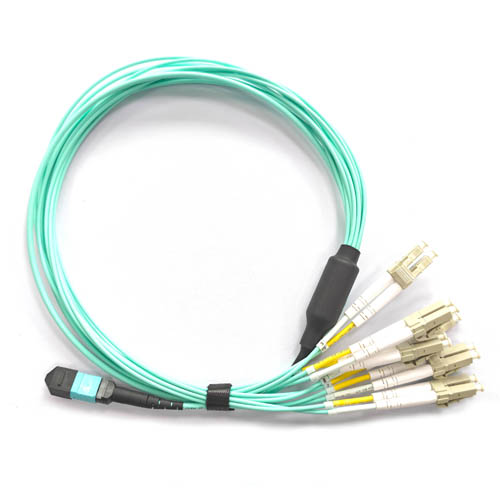
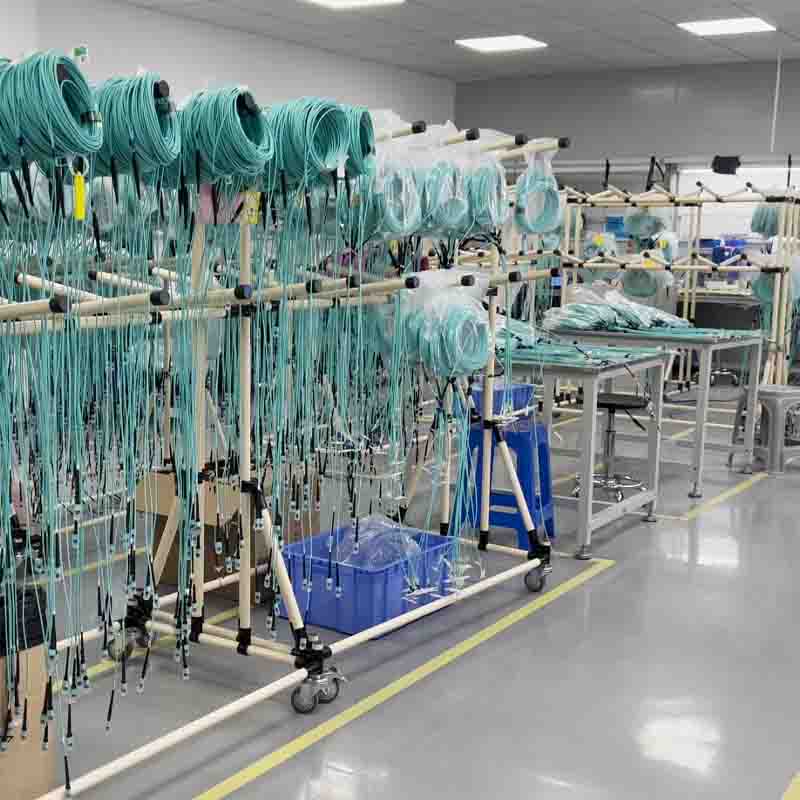
Testing is where the commercial terms and the technical specification meet. The stated position is that 100% of units are tested before shipment, not sampled. Every assembly passes insertion loss measurement, with automated alignment inspection and high-speed signal integrity validation used to control multi-core alignment error, insertion loss drift and crosstalk at high transmission speeds.
Around that base commitment, three acceptance routes are available:
- Factory acceptance test (FAT). The buyer or a nominated representative witnesses testing at the factory before shipment. This is the strongest option for first orders and for custom configurations where the drawing has been interpreted rather than copied.
- Third-party inspection. An independent inspector verifies quantity, labeling, packaging and test records. This is the practical option when travel is not feasible but the buyer still wants a party other than the supplier to confirm the shipment.
- On-site acceptance. Verification happens after delivery at the buyer's facility, typically against the packing list and the accompanying test data, with a defined window for raising nonconformities.
Because every unit is tested, the test record can be tied to the shipment. Buyers should ask for that record as part of the acceptance package and state in the PO which of the three routes applies. An acceptance clause that names the method, the witness and the deadline for claims is worth more than a longer warranty statement.
The Certificate Question: ISO HIC230831
FOCC's documentation cites ISO certificate HIC230831, issued with a validity period from 9 May 2023 to 8 May 2026. Buyers should read that as a dated document, not a permanent attribute of the supplier.
Certificates roll. When a validity period ends, the supplier is expected to renew and to hold a current copy. A buyer issuing an RFQ should therefore request the certificate copy that is in force at the time of the order, and check four things: the certificate number, the issuing body, the product scope the certificate covers, and the current validity dates. A certificate whose stated end date has passed should not be presented as evidence of current certification, and a supplier that answers a document request with an expired copy has told the buyer something useful about its document control.
FOCC also states that it implements ISO9001 and ISO14001 management systems and has over ten years of ODM/OEM service experience, exporting to more than 30 countries and regions. Management-system claims and product-level test evidence answer different questions: the first addresses how the factory is run, the second addresses whether this specific assembly passed. Procurement files should hold both.
Long-Term Support: Customization and Replacement Time
Long-term support in this category has two components: how far the supplier can adapt the product over the life of the project, and how quickly a failed link can be restored.
OEM/ODM customization
Customization is offered across six dimensions: length, connector, core count, material, logo and packaging. In practice these map onto real procurement decisions — a branded MPO patch panel module for a specific rack, a 24-Fiber MPO Patch Cord in a length that avoids slack loops, an MPO to LC breakout cable matched to a switch port map, or packaging designed for a distributor's warehouse rather than for a single project site.
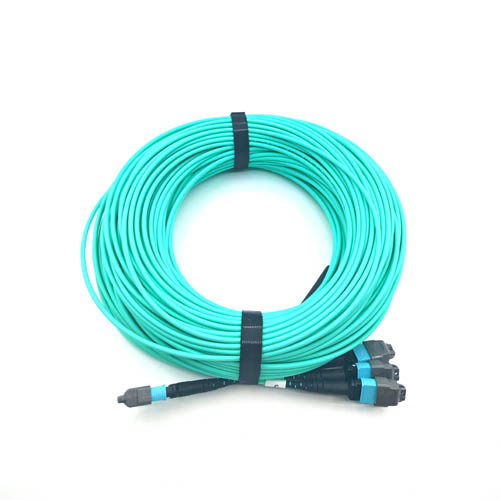
Each customization dimension adds a production step, and each production step affects the lead time within the 3–15 day window. That is why configuration-specific lead time should be confirmed at quotation stage rather than assumed from a product page.
Replacement time as a service metric
FOCC states modular replacement in under 5 minutes for high-density patching modules and on-site replacement in under 10 minutes for pre-terminated assemblies. These figures matter more over a ten-year service life than any single purchase price, because they determine the cost of a failure.
Under 5 minutes for a module means a failed cassette is swapped, not repaired. Under 10 minutes on site means a failed pre-terminated assembly is replaced at the rack or cabinet by the buyer's own technician, without returning the unit to the factory. For a buyer, the operational consequence is a smaller spare-parts holding and a shorter mean time to restore. The procurement consequence is that the PO should state what is held as service stock and what the buyer is expected to keep on the shelf.
Step by Step: From RFQ to Repeat Order
- Define the configuration. Fiber count, connector type and gender, polarity, length, cable material, end-face requirement and labeling. Ambiguity here is what later becomes a lead time dispute.
- Request a quotation against that configuration. Ask for MOQ, payment terms, Incoterm with named place, and lead time for that specific bill of materials.
- Confirm acceptance method. Choose FAT, third-party inspection or on-site acceptance, and name the witness and the claim deadline.
- Order at trial scale. The 2-unit MOQ allows a real configuration to be tested rather than a catalogue sample.
- Produce and test. 100% pre-shipment testing is performed, with the test record tied to the shipment.
- Accept and receive. Verify against the packing list and test data at the agreed point of acceptance.
- Scale and top up. Repeat orders are covered by the 200,000 units monthly capacity; service stock is replenished before the next deployment phase.
Where These Terms Matter Most
Data center spine-to-leaf builds. Links are added in phases, so the ability to place a 2-unit trial and then a series of small top-ups matters more than a single large-order discount. High-density MPO patch cables and MPO fiber optic panel modules are the components most affected.
400G upgrades. An upgrade usually mixes MPO trunk optical cable between racks with MPO to LC Patch Cord breakouts at the equipment end. A mix of configurations means mixed lead times within the same 3–15 day window, and the buyer should sequence the order accordingly.
System integrators and brand owners. Logo and packaging customization turn a standard assembly into a branded item. The 3–15 day lead time applies to the customized version too, but only if the artwork and packaging specification are approved before the order is released.
Maintenance and spares. Buyers holding service stock should size it against replacement time, not against purchase price. If a module can be swapped in under 5 minutes and a pre-terminated assembly replaced on site in under 10 minutes, a small spares holding is sufficient.
Comparison: Procurement Terms and Product Trade-offs
The table below restates the stated terms in a form that can be pasted into a purchase order checklist.
| Procurement item | Stated position | What to confirm in writing |
|---|---|---|
| Minimum order quantity | 2 units | Whether the trial price also applies to follow-on volume |
| Payment | T/T | Deposit and balance percentages; documents required before balance release |
| Delivery terms | EXW or FOB | Incoterm plus named port or collection point |
| Lead time | 3–15 days | Lead time quoted against the exact bill of materials |
| Monthly capacity | 200,000 units | Availability during your deployment window |
| Pre-shipment testing | 100% of units | Test record included in the acceptance package |
| Inspection routes | FAT, third-party inspection, on-site acceptance | Which route applies, who witnesses, claim deadline |
| Certificate cited | ISO HIC230831, 9 May 2023 to 8 May 2026 | Current certificate copy, issuing body and product scope at RFQ stage |
| Customization | Length, connector, core count, material, logo, packaging | Approval of drawing, artwork and packaging before release |
| Replacement time | Under 5 minutes modular; under 10 minutes on site | Service stock level the buyer is expected to hold |
The second table compares multi-fiber assemblies with conventional single-core LC/SC patch cords. The figures are FOCC's own product comparison statements rather than independent laboratory results, and they are included because the cost trade-off is part of the buying decision.
| Dimension | MPO/MTP assemblies | Traditional LC/SC patch cords |
|---|---|---|
| Port density | 8–24x higher | Baseline |
| Insertion loss | 0.2 dB lower | Baseline |
| Deployment speed | 60% faster | Baseline |
| Upfront cost | 15–20% higher | Lower |
| Total cost of ownership | 30% lower | Baseline |
| Failure points | 50% fewer | Baseline |
| Rack space | 70% less | Baseline |
| Modular replacement | Under 5 minutes | Re-termination or full cord replacement |
Source: FOCC product comparison statements for high-density MPO/MTP cabling versus traditional single-core LC/SC patch cords. Treat as supplier-declared comparison data and validate against your own link budget and site conditions.
FAQ
What documentation should accompany an MPO/MTP shipment?
Can MPO patch cords be customized for a specific deployment?
What are the payment and delivery terms, and can a small order be placed?
Can a sample be validated before a volume commitment?
How fast can an order ship, and what happens after delivery?
Conclusion
MPO/MTP procurement is decided by a short list of terms that are easy to state and easy to leave vague: a 2-unit minimum order quantity, T/T payment, EXW or FOB delivery, a 3–15 day lead time backed by 200,000 units of monthly capacity, 100% pre-shipment testing with a chosen acceptance route, and an ISO certificate whose validity dates are checked rather than assumed.
Two questions are worth asking before any purchase order is released. First, which acceptance method applies to this shipment, and who witnesses it. Second, what the buyer is expected to hold as service stock given a stated replacement time of under 5 minutes for modules and under 10 minutes on site. Suppliers that answer both in writing, with dates and configuration references, are the ones whose terms survive the first deployment phase.
Next Step
Send the configuration — connector type, core count, polarity, length, material, logo and packaging — and FOCC Fiber Co.,Ltd will return MOQ, payment terms, Incoterm, configuration-specific lead time and the current certification documents in one response.
Email: sales@mefiberoptic.com | WhatsApp: +86 13823237984 | Website: www.focc-fiber.com
Address: 4th Floor, Building E, ChaoHuiLou Creative Park, HuaYue Road, Longhua District, Shenzhen, CN 518109.

Have Questions or Need More Details?
Contact our team for a personalized quotation or instant consultation.
Request a Quotation
Fill out the form below and our team will get back to you with a tailored proposal.
WhatsApp Direct Chat
Prefer to chat in real-time? Message us on WhatsApp for instant assistance & quick answers.
- Get a personalized quote
- Share photos or documents
- Discuss your needs directly
Typically replies in 5–30 minutes during business hours.