
Standard vs Elite MPO/MTP Patch Cords: A Buyer's Insertion-Loss Guide
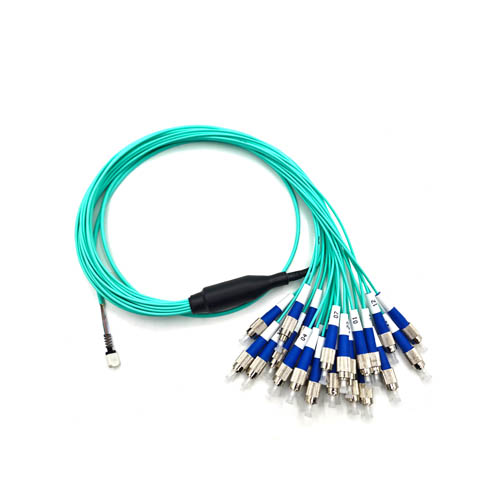
Standard and Elite MPO/MTP patch cords use the same multi-fiber connector platform. The practical difference is the insertion-loss grade. In the comparison used here, standard grade is specified at ≤0.5 dB and Elite at ≤0.35 dB. Return loss is a separate requirement: APC polish is specified at ≥60 dB and UPC at ≥50 dB. The right choice depends on the complete link budget, the number of mated connections, the target speed and the buyer's ability to verify test data. It is not a simple choice between the cheaper option and the premium option.
Both grades in this guide share the same specification envelope: OS2, OM3, OM4 and OM5 fiber; 12, 16, 24 and 48 fiber counts; 1–100 m lengths; and an operating range of -20°C to +70°C. Buyers comparing quotations should first confirm that the supplier is quoting within that envelope, then compare the insertion-loss grade, return-loss option and the evidence behind both.
Why Insertion-Loss Grades Matter in Real Links
Insertion loss is the optical power lost at a mated connection. A short patch-cord run may contain only one or two connectors. A high-density spine-leaf path may contain an MPO trunk, a patch panel, a breakout harness and equipment ports. Each mated pair consumes part of the optical margin. A standard-grade cord can pass a bench test and still leave little headroom in a long or heavily connected channel.
The purchase decision should therefore be framed as a link-budget question: after using the quoted grade, does the complete channel close with acceptable margin? If that question is answered only after delivery, the grade decision is being made too late. Elite cords reduce the loss contribution at each connector, but they cannot repair a channel that was designed without enough margin or tested without traceable results.
Industry Background: Density Raises the Cost of a Loose Specification
MPO connectors are standardized multi-fiber interfaces. The relevant intermateability standards are IEC 61754-7 and TIA-604-5, also known as FOCIS 5. The connector family is used because it places many fibers into one interface, reducing cable count and rack space in spine-leaf fabrics, trunk-to-breakout runs and 400G/800G optics.
The density benefit also concentrates risk. A single MPO connection contains multiple fiber paths, so one poorly polished end-face or one misaligned fiber can create a failing channel. That is why grade claims must be read together with production controls. Testing, polishing and active alignment are what hold these grades in production; the grade label alone does not prove that every assembly meets the limit.
Standard vs Elite: What Each Grade Is For
Standard grade: insertion loss ≤0.5 dB
Standard grade covers assemblies specified at ≤0.5 dB insertion loss. It fits runs where the complete channel has enough margin, less demanding connections, and projects where the final link is tested and the design does not rely on the lowest possible loss. Standard grade is not a defective grade; it is a broader loss window. The risk appears when a buyer selects it without calculating margin and then discovers that the installed channel has little room for aging, cleaning or future upgrades.
Elite grade: insertion loss ≤0.35 dB
Elite grade covers assemblies specified at ≤0.35 dB insertion loss. It fits high-density spine-leaf links, 400G/800G paths, long or multi-connection channels, and designs where additional loss margin is valuable. Elite grade does not replace link engineering. It reduces the loss contribution of each connector, but it cannot compensate for a bad polish, poor cleaning, wrong polarity or a damaged end-face.
Return loss: APC ≥60 dB and UPC ≥50 dB
Return loss describes reflected light, not transmitted loss. APC polish is specified at ≥60 dB and UPC at ≥50 dB in this comparison. APC and UPC are polish and interface choices. The purchase order should state both the insertion-loss grade and the return-loss requirement. Do not assume that an Elite insertion-loss grade automatically means APC return loss, or that a standard grade is always UPC. The two specifications answer different questions.
The Shared Specification Envelope
The grades are often offered across the same fiber and length range. The shared envelope in this guide is:
- Fiber type: OS2, OM3, OM4 and OM5.
- Fiber count: 12, 16, 24 and 48 cores.
- Length: 1–100 m.
- Operating temperature: -20°C to +70°C.
- Insertion-loss options: standard ≤0.5 dB; Elite ≤0.35 dB.
- Return-loss options: APC ≥60 dB; UPC ≥50 dB.
This envelope is a starting point, not a complete purchase specification. A specific part number still needs its own drawing, polarity, gender, jacket and acceptance record. The grade decision should be made inside that full configuration, because a 12-fiber multimode cord and a 24-fiber single-mode trunk can have different loss-budget consequences even when they carry the same grade label.
How to Choose the Right Grade, Step by Step
- Build the channel loss map. Count every mated MPO connection and every breakout leg. Add the applicable insertion-loss limits to the fiber and any splice loss. Use worst-case limits until the supplier's test data supports tighter values.
- Decide how much margin the link needs. If the calculated margin is tight, specify Elite. If margin is comfortable and the complete channel will be tested, standard grade may be sufficient.
- Select fiber mode and core count. Use OS2 for single-mode designs and OM3, OM4 or OM5 for multimode designs. Match 12, 16, 24 or 48 cores to the port and trunk plan. A higher core count does not replace polarity planning.
- Set the return-loss requirement. Specify APC at ≥60 dB or UPC at ≥50 dB according to the equipment port and link design. Confirm polish compatibility before ordering.
- Define acceptance testing. Require per-fiber insertion loss and return loss, the test method, pass/fail limits and traceability to the exact assembly. Average values alone are not enough for a multi-fiber cord.
- Qualify the production process. Ask how polishing, active alignment and end-face inspection are controlled. Confirm whether testing is 100% or sampled, and how nonconforming fibers are handled.
- Reconcile the quote with the report. Check that the test report matches the ordered fiber type, core count, length, connector, polish and grade. A generic certificate is not a substitute for an assembly-level record.
Where Each Grade Fits
High-density spine-leaf and 400G/800G links
High-density spine-leaf and 400G/800G links often contain multiple mated connections between the switch port and the far end. That makes connector loss more important than in a simple two-connector patch. Elite grade is commonly evaluated when the link budget is tight or when future upgrades leave little headroom. Standard grade can still be considered if the complete channel closes with margin and the assemblies are tested. The decision should be made from the channel design, not from the speed label alone.
Trunk-to-breakout paths
Trunk-to-breakout paths can include trunk connectors, a patch panel, a breakout harness and equipment ports. Each transition adds a mating point. Buyers should count these transitions before choosing grade. A standard-grade trunk may be acceptable in a short path with few matings; an Elite harness may be more appropriate where the same channel contains several transition points and little spare margin.
Less demanding runs
Less demanding runs may not need the tighter Elite limit. If the path is short, the number of matings is low and the design has margin, standard grade can be a rational choice. The important condition is that the buyer has the test records to confirm the delivered assemblies meet the stated ≤0.5 dB limit and the required return loss.
Comparison Table: Standard vs Elite MPO/MTP Patch Cords
| Decision factor | Standard grade | Elite grade | Procurement implication |
|---|---|---|---|
| Insertion loss | ≤0.5 dB | ≤0.35 dB | Compare the grade limit with the channel margin, not with the unit price alone. |
| Return loss | APC ≥60 dB or UPC ≥50 dB | APC ≥60 dB or UPC ≥50 dB | Return loss is a separate polish requirement; confirm it on the purchase order. |
| Fiber type | OS2, OM3, OM4, OM5 | OS2, OM3, OM4, OM5 | Match mode to reach and optics; grade does not change fiber mode. |
| Fiber count | 12, 16, 24, 48 | 12, 16, 24, 48 | Confirm the exact core count and polarity on the drawing. |
| Length | 1–100 m | 1–100 m | Length affects total loss; verify the tested length. |
| Operating temperature | -20°C to +70°C | -20°C to +70°C | Use the same environmental requirement for both grades. |
| Typical fit | Less demanding runs with adequate margin | High-density spine-leaf, 400G/800G and tight-margin paths | Choose by calculated link budget and topology. |
| Production control | Polishing, alignment and testing required | Polishing, alignment and tighter test discipline required | Both grades depend on process control; verify evidence, not labels. |
Supplier Test-Data Checklist
A grade claim is only useful when it can be traced to the delivered assembly. The following checklist helps buyers evaluate whether a supplier's test data supports the quoted standard or Elite grade.
- Exact configuration: part number, fiber mode, core count, length, connector type, gender, polarity, APC or UPC polish, and stated grade.
- Per-fiber results: insertion loss for every fiber, not only a summary average. Include maximum and mean values, plus return loss where applicable.
- Test conditions: wavelength, launch condition, test method or reference, equipment identification, calibration date and measurement uncertainty.
- Acceptance limits: pass/fail against ≤0.5 dB for standard or ≤0.35 dB for Elite, and against ≥60 dB for APC or ≥50 dB for UPC. Confirm whether the limit is stated per connector or per assembly.
- End-face and polish evidence: inspection results for cleanliness, scratches and pits, together with the polishing process control.
- Alignment and production controls: active alignment, automated inspection and whether insertion-loss testing is 100% or sampled.
- Traceability: batch or serial number, test date, production line or operator record, and record retention period.
- Environmental scope: confirmation that the assembly is rated for -20°C to +70°C where that condition is required.
- Document consistency: the report must match the purchase order and drawing. A generic certificate without assembly-level data does not prove the grade.
FOCC Fiber Co.,Ltd states that its production focuses on high-density and high-reliability fiber connectivity, and its risk-control description lists 100% insertion loss testing, automated alignment inspection and high-speed signal integrity validation. Those statements should still be checked against the report fields above. Buyers can review the supplier's published information at FOCC Fiber Co.,Ltd.
FAQ
Is Elite MPO/MTP always the better choice?
No. Elite grade has a tighter insertion-loss limit of ≤0.35 dB, which can help when margin is tight. Standard grade at ≤0.5 dB may be adequate when the complete link budget closes with margin and the assemblies are tested. Choose by calculated channel loss, not by the grade label alone.
What is the difference between insertion loss and return loss?
Insertion loss is transmitted power lost at a connection. Return loss is reflected power. In this comparison, standard and Elite insertion-loss limits are ≤0.5 dB and ≤0.35 dB, while APC and UPC return-loss limits are ≥60 dB and ≥50 dB. They are separate requirements and should both appear on the purchase order.
Can standard-grade cords be used in 400G/800G links?
They can be considered if the complete channel loss budget closes with margin and the assemblies are tested. High-density 400G/800G links often contain multiple mated connections, so Elite grade is evaluated when margin is tight. There is no universal answer without the actual link design.
Should I specify APC or UPC?
Specify by return-loss requirement: APC at ≥60 dB or UPC at ≥50 dB. Confirm the equipment port and adapter polish before ordering. Do not infer polish from the insertion-loss grade, because insertion loss and return loss are different performance measures.
What should I check in a supplier's test report?
Match the report to the exact part number and configuration, then verify per-fiber insertion loss, return loss, pass/fail limits, test method, calibration, end-face results and traceability. Confirm whether testing is 100% or sampled. For project-specific review, buyers can send the link plan and required report format to FOCC Fiber Co.,Ltd through www.focc-fiber.com.
Conclusion
Choose standard grade when the complete channel has adequate margin and the supplier can prove the ≤0.5 dB limit with per-fiber test data. Choose Elite grade when the link budget is tight, the topology is dense or 400G/800G migration leaves little room for loss. In both cases, the grade is only as good as the polishing, active alignment and testing behind it. The final procurement decision should compare quoted grade, return-loss option, test evidence and total channel margin—not the unit price alone.
Have Questions or Need More Details?
Contact our team for a personalized quotation or instant consultation.
Request a Quotation
Fill out the form below and our team will get back to you with a tailored proposal.
WhatsApp Direct Chat
Prefer to chat in real-time? Message us on WhatsApp for instant assistance & quick answers.
- Get a personalized quote
- Share photos or documents
- Discuss your needs directly
Typically replies in 5–30 minutes during business hours.