
FTTA Cable Compliance Guide: What IEC, RoHS, IP68 and ISO Mean for 5G Buyers
Short answer: for a 5G buyer, an outdoor FTTA patch cord is compliant only when four pieces of evidence can be traced — an ingress-protection test result for IP67 or IP68, an environmental test reference from the IEC 61300-2 series, a materials declaration covering RoHS-restricted substances for the destination market, and a valid ISO certificate whose scope names fiber optic patch cable. A logo on a datasheet, a "waterproof" line in a catalogue, or an email assurance from a sales contact is not compliance evidence.
This guide is written for 5G infrastructure buyers, procurement engineers and channel distributors who must sign off outdoor FTTA (Fiber To The Antenna) cable assemblies before they reach a tower. It explains what each standard actually verifies, which documents to request, how to read an ISO certificate instead of simply filing it, and how factory testing converts a standard into batch-level proof that can be audited.
The reference product throughout is FOCC's Outdoor Waterproof FTTA Fiber Optic Patch Cord, specified at IP67/IP68, ≤0.30 dB insertion loss, ≥60 dB return loss and an operating range of -40 °C to +75 °C.
Why FTTA compliance breaks down late in 5G procurement
Most FTTA purchase decisions are made on three variables: connector type, cable length and unit price. Compliance is then treated as paperwork to be collected after the purchase order is issued. That sequence is where projects lose time, because a compliance gap rarely appears during the technical review — it appears at site acceptance, at customs, or in the field 12 to 24 months after installation.
Compliance is not a single document. It is a chain with five links: the standard that applies, the test method used to demonstrate it, the test report that records the result, the certificate that verifies the supplier's system (including scope wording and validity dates), and the batch record that ties a specific shipment back to that system. If any link is missing, the claim does not hold.
The most common breaks are predictable:
- A certificate that has passed its expiry date is still circulated in quotation packs because nobody checks the date field.
- A certificate whose scope wording does not mention fiber optic patch cable is filed as if it covered the product.
- An IP rating is quoted without the test method behind it, so the buyer cannot tell whether it applies to the mated pair, the unmated connector, or the complete assembly.
- A materials declaration is issued against a generic company statement rather than the jacket, connector and plating actually shipped.
- Tensile and thermal claims appear on a brochure with no qualification data a buyer can compare against another supplier.
Treating compliance as a screening criterion at quotation stage — rather than a document pack at shipment stage — is the cheapest control available, because it removes non-verifiable suppliers before engineering time is spent on samples.
What is pushing FTTA compliance up the buyer's checklist in 2026
Market context explains the pressure. Custom Market Insights estimates the global fiber optic cable market at USD 13.45 billion in 2025, with a projected CAGR of 11.72% through 2034. Published estimates vary by scope: Grand View Research uses a lower 2024 base of roughly USD 12.5 billion because its scope excludes certain assemblies and accessories. Treat any single market figure as directional rather than exact, and use it only to size the procurement environment.
Supply concentration matters just as much. According to the Observatory of Economic Complexity, China accounted for approximately 27.1% of global optical fiber cable exports in 2024, valued at USD 2.52 billion. For a buyer in the EU or the USA, that means most quotations will arrive from manufacturers with different documentation habits, different testing depth, and different readings of the same standard.
On the product side, the FTTA connector ecosystem has consolidated around a small number of interfaces — ODC (Optical Distribution Connector), FullAXS, NSN-LC duplex and ODVA fan-out — and published industry references indicate these are typically required to carry IP67/IP68 protection, because they sit on the tower top exposed to rain, dust, UV and temperature cycling. Materials requirements follow the destination market: EU buyers treat RoHS as a baseline purchasing requirement for electrical and electronic equipment, while US channel partners increasingly request comparable materials declarations even where the federal requirement differs.
What IEC, RoHS, IP68 and ISO actually mean for an outdoor FTTA patch cord
IP67 and IP68: what the rating verifies, and where it stops
IP codes describe resistance to solids and liquids. IP67 means protection against dust ingress and against temporary immersion; IP68 means protection against continuous immersion under conditions agreed between manufacturer and buyer. Both are common FTTA specifications — TE Connectivity's published specification for the FullAXS connector system states IP67/IP68 waterproof protection together with salt-mist resistance.
What the rating does not tell you: the test duration, the immersion depth, the number of mating cycles performed, or whether the protection applies to the mated connector pair, the unmated connector, or the entire assembly. Request the test reference behind the rating, not the rating alone.
IEC 61300-2: the test method behind the claim
IEC 61300 is the international series of basic test and measurement procedures for fiber optic interconnecting devices and passive components. The environmental part of that series, IEC 61300-2, is where water ingress, salt mist, temperature change and mechanical load are defined as repeatable tests. The FullAXS connector system specification explicitly cites compliance with IEC 61300-2 environmental testing standards.
The practical value for a buyer is comparability. A supplier who can name the IEC environmental test behind a claim produces results that can be compared with another supplier's results. A supplier who only says "waterproof" cannot be compared at all.
Tensile strength, thermal cycling and salt spray
Three mechanical and climatic qualifications decide whether an outdoor cord survives a tower environment.
- Tensile strength. Industry comparisons of outdoor FTTA assemblies cite a qualification target of ≥1000 N for armored LSZH-jacketed constructions, roughly 200 N above conventional IP65 patch cords. That load matters at the pull point where the cord leaves the tower-top radio unit.
- Thermal cycling. The same comparison places armored outdoor constructions across a -40 °C to +75 °C operating range, approximately ±20 °C wider than IP65 equivalents. FOCC's Outdoor Waterproof FTTA Fiber Optic Patch Cord is specified across -40 °C to +75 °C.
- Salt spray. Coastal and offshore sites add corrosion load, so salt-mist testing and corrosion-resistant plating are the two evidence points to require. FOCC's documented FTTA case work lists corrosion-resistant plating as part of the assembly specification.
ISO: a management system, a scope, and an expiry date
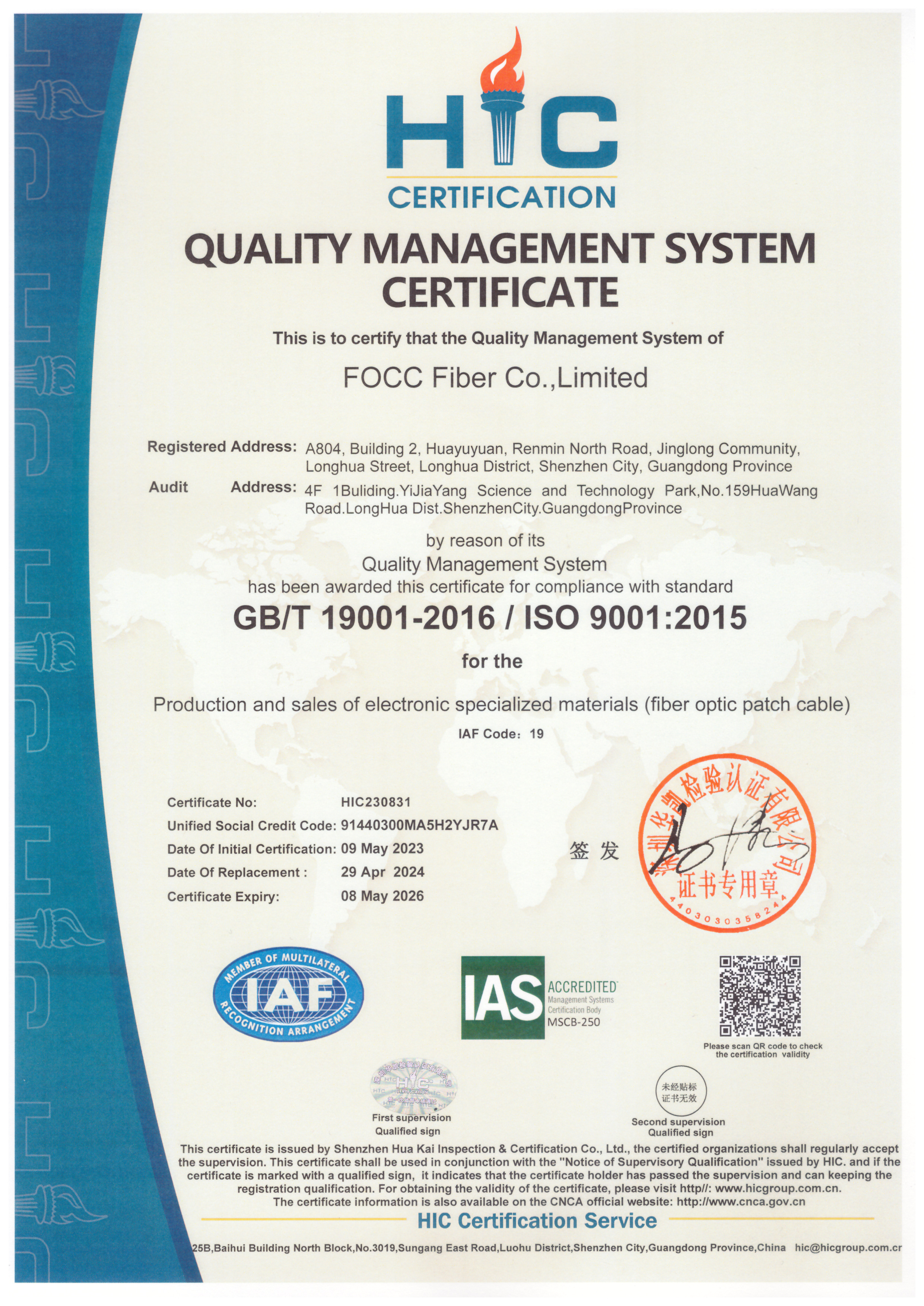
ISO certification verifies a management system, not a product test. The useful question is therefore not "does the supplier hold ISO?" but "which certificate, issued by whom, under which accreditation scheme, covering which scope, valid until when?"
FOCC's certificate on file is HIC230831, issued by HIC on 9 May 2023 under the IAF/IAS scheme, covering the production and sales of electronic specialized materials (fiber optic patch cable), with a listed validity window ending 8 May 2026. Because that printed window has now passed, the correct procurement action is to request the supplier's currently valid certificate at the time of order, and to confirm that the scope wording still names fiber optic patch cable before releasing a purchase order. FOCC states that it operates ISO 9001 and ISO 14001 management systems in its 5,000 m² factory in Guangzhou.
RoHS: the materials declaration EU and USA channels ask for
RoHS restricts the use of certain hazardous substances — lead, mercury, cadmium, hexavalent chromium, certain flame retardants and phthalates — in electrical and electronic equipment placed on the EU market. An FTTA patch cord is an assembly, so the declaration has to cover the actual construction: jacket compound, connector housing and plating, strength members, and labeling materials.
Two verification points matter. First, the declaration must match the construction being shipped, not a generic company statement. Second, it should be accompanied by the test report or a compliance statement that names the tested part. For US-bound shipments, buyers typically request RoHS documentation plus a materials declaration for the same reason: the destination channel wants proof that no restricted substance was introduced into the build. FOCC lists certification among its customizable OEM/ODM options, which is the mechanism that lets a buyer align the shipped documentation with a specific market requirement.
How compliance is proven on the factory floor
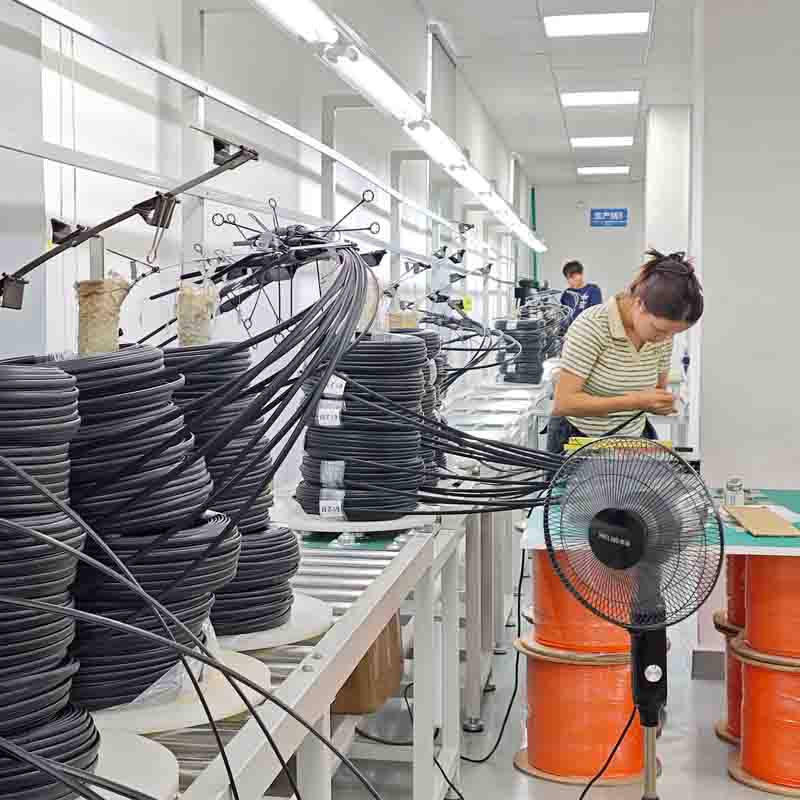
Documents describe intent; testing proves it per unit. FOCC's specified quality control is 100% test, meaning every assembled cord is insertion-loss tested rather than sampled, supported by automated alignment inspection at the connector assembly stage. For a cord specified at ≤0.30 dB insertion loss and ≥60 dB return loss, 100% testing is what keeps a production batch inside those limits — the certificate alone does not.
Volume and configuration matter as much as the test. FOCC's capability data lists a monthly capacity of 200,000 units, a minimum order quantity of 2 units, and a 3–15 day lead time, with customization across length, connector type, core count, transmission mode, material, logo printing, certification and packaging.
Verifying FTTA cable compliance: a seven-step buyer workflow
The sequence below is ordered by the risk each checkpoint poses to a live deployment. Work top-down, because a failure at step 2 makes steps 3 to 7 irrelevant.
- Match the standard to the deployment environment first. Coastal, desert, industrial and rooftop urban sites load a cord differently. Decide which of IP67/IP68, tensile, thermal and salt-spray evidence is relevant before requesting any documents.
- Request the certificate, not the logo. Ask for certificate number, issuing body, accreditation scheme, scope wording and validity dates, and confirm the scope names fiber optic patch cable.
- Trace the IP rating to a test reference. Require the IEC 61300-2 environmental test reference, and confirm whether the rating applies to the mated pair or the complete assembly.
- Check mechanical qualification data. Ask for tensile test evidence against the target load; ≥1000 N is a commonly cited benchmark for armored outdoor constructions.
- Check thermal and corrosion evidence. Confirm the operating range (-40 °C to +75 °C on FOCC's outdoor waterproof FTTA patch cord) and salt-mist testing where the site is coastal or offshore.
- Confirm the materials declaration matches the construction. RoHS documentation should name the jacket, connector and plating materials actually being shipped.
- Validate with a batch record and a sample. Request the insertion-loss test record for the shipment and validate on a sample before the mass order; FOCC's MOQ of 2 units makes pre-production validation practical.
Where compliance requirements change by deployment scenario
Coastal and offshore 5G sites. Salt mist and humidity dominate, so salt-spray test evidence and corrosion-resistant plating become the deciding documents rather than cable price.
Continental and desert sites. Temperature cycling across -40 °C to +75 °C is the binding constraint; thermal qualification data matters more than salt spray.
Tower-top RAN fronthaul and RF unit interconnection. IP68 protection and connector-level sealing dominate, together with the practical question of how quickly a cord can be replaced at height.
Industrial mining and oilfield deployments. Dust, vibration and mechanical pull are added to water ingress, so tensile strength and strain relief move to the front of the checklist.
EU and USA channel distribution. The deciding item is the compliance pack: a current certificate, a RoHS declaration matched to the construction, and batch test records.
A documented example is FOCC's FTTA case work with telecommunication carriers and 5G base station equipment vendors across Germany, Saudi Arabia and China: more than 50,000 outdoor waterproof patch cords and over 20,000 5G base station deployments, covering 5G RAN fronthaul, tower-top RF unit interconnection, and industrial mining and oilfield applications, with IP68-rated assemblies used in harsh environments for more than ten years. The reported outcomes are an 80% lower field failure rate, on-site replacement in under 10 minutes, and 40% lower operating expenditure.

FTTA connector types and the compliance evidence behind them
Connector choice determines which protection level and which test evidence a buyer should ask for. The table below is limited to interface types and protection requirements that appear in published industry references; no ranking or performance superiority is implied between them.
| Connector interface | Protection typically required | Published environmental reference | What the buyer should request |
|---|---|---|---|
| ODC (Optical Distribution Connector) | IP67/IP68 | Listed among common FTTA connector types for 5G base stations in industry references | IP67/IP68 test report for the mated assembly, plus RoHS declaration matched to the construction |
| FullAXS | IP67/IP68 | IEC 61300-2 environmental testing standards, plus salt-mist resistance, per the manufacturer's published specification | IEC 61300-2 test evidence and a salt-mist report for coastal or offshore sites |
| NSN-LC duplex | IP67/IP68 | Listed among common FTTA connector types for 5G base stations in industry references | IP test report plus connector-level sealing detail for the duplex assembly |
| ODVA fan-out | IP67/IP68 | Listed among common FTTA connector types for 5G base stations in industry references | IP test report plus tensile data for the fan-out breakout point |
The table below maps FOCC's stated outdoor FTTA specification to the compliance evidence a buyer can request against each line item.
| Specification item | Stated value | Evidence a buyer can request |
|---|---|---|
| Ingress protection | IP67/IP68 | IP test result with the referenced environmental test method |
| Insertion loss | ≤0.30 dB | 100% insertion-loss test record for the shipped batch |
| Return loss | ≥60 dB | Return-loss measurement data from the same test run |
| Operating temperature | -40 °C to +75 °C | Thermal qualification data covering the stated range |
| Management system | ISO certificate HIC230831 (HIC, IAF/IAS); ISO 9001 / ISO 14001 stated by FOCC | Current valid certificate with scope and validity dates confirmed at order |
FAQ: FTTA cable compliance questions 5G buyers ask
1. Which certifications should I verify before buying outdoor FTTA patch cords for a 5G deployment?
Verify four things. First, an ISO certificate — number, issuing body, accreditation scheme, scope wording and validity dates. FOCC's certificate on file is HIC230831, issued by HIC under the IAF/IAS scheme for the production and sales of electronic specialized materials (fiber optic patch cable), with a listed validity window ending 2026-05-08; because that window has passed, request the currently valid version at the time of order. Second, ingress-protection evidence for IP67/IP68 tied to a named IEC 61300-2 environmental test reference. Third, a materials declaration covering RoHS-restricted substances for the destination market. Fourth, batch-level test records — FOCC specifies 100% test on assembled cords.
2. Can FTTA patch cords be built to match a specific regional compliance requirement?
Yes, where the supplier runs OEM/ODM programs. FOCC lists customizable length, connector type, core count, transmission mode, material, logo printing, certification and packaging, against a monthly capacity of 200,000 units. Regional requirements change which documents travel with the shipment, so the destination market (EU or USA) should be stated at quotation stage rather than at shipping stage. FOCC's outdoor waterproof FTTA patch cords are specified at IP67/IP68 with ≤0.30 dB insertion loss and ≥60 dB return loss.
3. Does compliance verification change what an FTTA cable program costs?
Construction drives cost more than paperwork. Armored LSZH jackets and corrosion-resistant plating — the elements associated with the ≥1000 N tensile target and IP68 sealing — change material content and therefore unit cost. Two commercial levers reduce risk without a separate budget line: FOCC's minimum order quantity of 2 units and its 3–15 day lead time, which allow a buyer to validate a sample lot before committing to mass production. When comparing quotes, compare identical construction, protection rating and documentation scope, because quotations with different evidence packs are not comparable.
4. Can I validate compliance on a sample before placing a mass order?
Yes. FOCC's MOQ is 2 units with a 3–15 day lead time, so a sample order can be configured exactly as the production build — same connector type, jacket material and length — then checked against the required IP rating, insertion loss (≤0.30 dB), return loss (≥60 dB) and operating range (-40 °C to +75 °C). Ask for the insertion-loss test record with the sample so the production batch can later be compared against the validated unit.
5. What lead time should I plan for, and how do I start a compliance-first FTTA order?
FOCC quotes a 3–15 day lead time against a monthly capacity of 200,000 units, with 100% insertion-loss testing on every assembled cord. To start, send the deployment market, the connector interface required (ODC, FullAXS, NSN-LC duplex or ODVA fan-out), the required IP rating and the operating range to sales@mefiberoptic.com or WhatsApp +86 138 2379 84 (via FOCC's WhatsApp link), and state which compliance documents must ship with the goods. That single step keeps the quotation and the documentation pack aligned.
Turning compliance into a purchase condition
For outdoor FTTA, compliance is a verification chain rather than a checkbox. The buyer's leverage is sequencing: define the applicable standard for the site before quoting, require the test reference behind every rating, read the ISO certificate instead of filing it, match the RoHS declaration to the construction actually shipped, and validate on a sample before the mass order.
FOCC Fiber Co., Ltd was founded in 2014 and is headquartered in Shenzhen, Guangdong, with a 5,000 m² factory in Guangzhou staffed by around 200 employees, including a 30-person R&D team. The company supplies fiber optic connectors, MTP/MPO fiber optic patch cords, outdoor waterproof patch cord assemblies and armored patch cords for data centre and FTTA solutions, with an annual output of 2,000,000 units, 100% export orientation and main markets in the EU and USA. FOCC states that it operates ISO 9001 and ISO 14001 management systems and has more than ten years of ODM/OEM service experience, with products exported to more than 30 countries and regions.
Reading the certificate, requesting the test reference, and testing the sample are the three actions that convert supplier claims into a purchase condition a 5G project can defend at site acceptance.
Next step: put compliance in the quotation
Send your deployment market, connector interface and required IP rating, and FOCC will align the outdoor waterproof FTTA patch cord configuration, the sample plan and the documentation pack in one order.
Website: www.focc-fiber.com | Email: sales@mefiberoptic.com | WhatsApp: +86 13823237984
Address: 4F, Building E, Chaohuilou Creative Park, Huayue Road, Dalang Street, Longhua District, Shenzhen, CN 518109.
Have Questions or Need More Details?
Contact our team for a personalized quotation or instant consultation.
Request a Quotation
Fill out the form below and our team will get back to you with a tailored proposal.
WhatsApp Direct Chat
Prefer to chat in real-time? Message us on WhatsApp for instant assistance & quick answers.
- Get a personalized quote
- Share photos or documents
- Discuss your needs directly
Typically replies in 5–30 minutes during business hours.