
FTTA Cable Selection by Deployment Scenario: A Field Guide for 5G Site Engineers
Matching FTTA Cables to Site Conditions: A Deployment-Level Guide for 5G Engineers
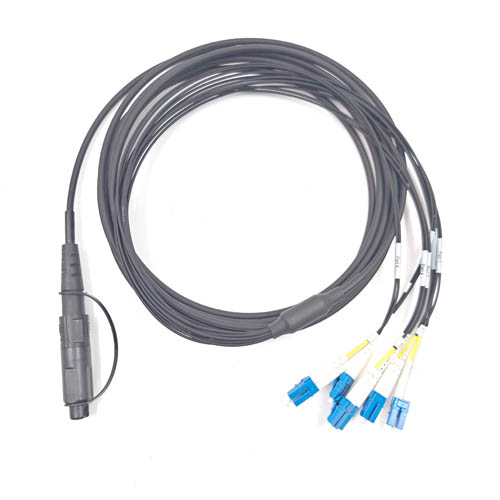
FTTA cable assemblies must withstand rain, UV, vibration, and pulling forces at the tower top.
Fiber To The Antenna (FTTA) is the architecture used to connect 5G base station equipment to the remote radio unit (RRU) or active antenna unit (AAU) mounted on a tower. The FTTA cable sits in the most exposed part of the network. Rain, ice, ultraviolet light, tower vibration, and installation pulling forces all act on the same fiber link. This guide explains how to match FTTA fiber optic cables to real deployment conditions, using FOCC Fiber Co.,Ltd as a reference for outdoor waterproof FTTA patch cord design and manufacturing.
Why Standard Patch Cords Fail in FTTA Projects
An FTTA cable failure is rarely a fiber break inside the glass. Most in-service problems occur at the connector interface, cable entry point, or jacket. Water entering an unprotected connector, repeated movement at a strain point, or insufficient tensile strength can cause insertion loss to rise suddenly. FTTA deployments also expose connectors to large temperature swings and, in industrial or coastal areas, corrosive atmospheres. A patch cord designed for a clean indoor server room is not a safe choice for a tower-top run.
Project engineers therefore treat the FTTA cable as a mechanical assembly, not just an optical link. The connector shell, sealing system, jacket material, and cable core all have to match the site environment.
FTTA Market Background: Why Cable Selection Matters
The fiber optic cable market is expanding as 5G networks are built out. The global fiber optic cable market is estimated at USD 13.45 billion in 2025, with a projected CAGR of 11.72% through 2034. China is the largest exporter of optical fiber cables, accounting for about 27.1% of global exports in 2024, valued at USD 2.52 billion. FTTA is a demanding segment within this market because it moves fiber from a protected equipment room to the top of a mast.
In a typical FTTA link, the cable connects a base station unit or optical distribution box (ODB) to an RRU/AAU, antenna feeder, or outdoor small cell. The connection point must remain sealed for years in conditions that include rain, dust, UV exposure, mechanical vibration, and high tensile stress.
How to Specify an FTTA Cable for a Specific Project Site
A project-ready FTTA cable specification starts with the connection points and the environment. The following parameters cover the majority of outdoor 5G site requirements.
1. Connector System
Common FTTA connector types for 5G base stations include ODC (Optical Distribution Connector), FullAXS, NSN-LC duplex, and ODVA fan-out connectors. Each connector type must be matched to the port on the RRU/AAU, the ODB, or the antenna feeder system. FOCC's Outdoor Waterproof FTTA Fiber Optic Patch Cord is available as an ODC-FullAXS version and an ODC-Optitab version, covering single-mode and multimode options.
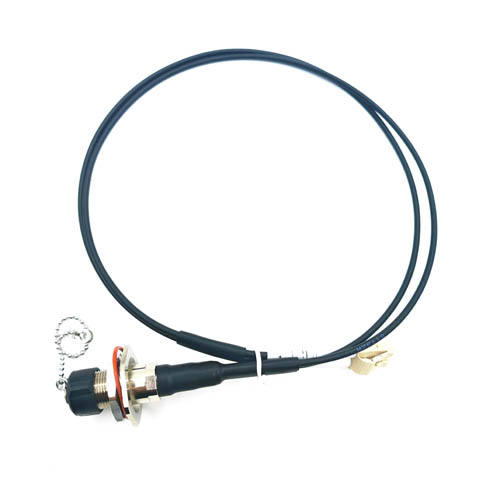
ODC cable for FTTA outdoor connections.
2. Water and Dust Protection
Outdoor FTTA cables should be rated IP67 or IP68. The FullAXS connector system is designed for IP67/IP68 waterproof protection, salt-mist resistance, and compliance with IEC 61300-2 environmental testing. FOCC's outdoor waterproof FTTA patch cords are rated IP67/IP68 and use a silicone rubber sealing ring to protect the connector interface.
3. Mechanical Strength and Temperature Range
Tower-top and pole-mount installations require high tensile strength and resistance to vibration. FOCC's Outdoor Waterproof FTTA Fiber Optic Patch Cord is specified with a tensile strength of ≥1000 N and an operating temperature range of -40°C to +75°C. The cable uses a stainless steel ODC connector shell and can be built with an armored fiber core for additional crush and impact protection.
4. Fiber Type and Polish
Single-mode OS2 fiber with APC polish is commonly used for fronthaul links where distances are longer. Multimode OM3, OM4, or OM5 can be used for short indoor or campus segments. The model ODC-APC-Fullax-APC-OS2 illustrates a single-mode FTTA assembly, while ODC-UPC-Optitab-UPC-OM3 illustrates a multimode assembly with UPC polish.
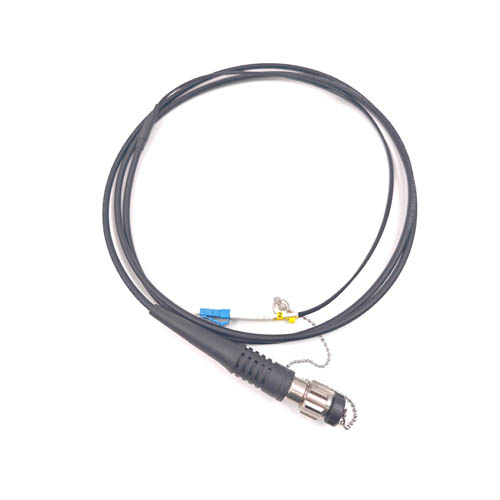
FTTA fiber optic cable assembly for outdoor use.
5. Optical Performance
Project specifications for FTTA cables commonly require insertion loss of ≤0.30 dB and return loss of ≥60 dB for APC-polished assemblies. FOCC's outdoor FTTA patch cords meet these thresholds. The product also uses a zirconia ceramic ferrule for stable optical alignment and a PE cable jacket for outdoor weathering.
Step-by-Step: Defining the FTTA Cable for Your Project
- Document the site environment. Identify whether the link is on a macro tower, rooftop, small cell pole, railway corridor, or industrial site. Coastal and industrial locations require salt-mist and corrosion resistance.
- Calculate the link distance. Use single-mode OS2 fiber for long fronthaul distances and multimode OM3/OM4/OM5 for shorter runs.
- Identify the interface connectors. Match the cable connectors to the RRU/AAU, ODB, or antenna feeder. ODC, FullAXS, NSN-LC duplex, and ODVA fan-out are common options.
- Set mechanical thresholds. Confirm tensile strength, crush resistance, and vibration requirements. For unsupported outdoor spans, tensile strength of ≥1000 N is a practical reference.
- Verify environmental protection. Choose IP67/IP68 sealing, UV-resistant jackets, and corrosion-resistant connector plating where needed.
- Choose the assembly configuration. Decide whether the project needs a point-to-point patch cord, fan-out assembly, custom length, or custom connector combination.
- Audit the manufacturer's quality system. Confirm ISO 9001/ISO 14001 management systems, 100% factory testing, and experience with OEM/ODM production.
Deployment Scenarios and FTTA Cable Use Cases
5G RAN Fronthaul for a Telecom Carrier
A telecom carrier with deployments in Germany, Saudi Arabia, and China used more than 50,000 outdoor waterproof patch cords and deployed them in more than 20,000 5G base station sites. The cables supported 5G RAN fronthaul and tower-top RF unit interconnection in industrial mining and oilfield environments. Over a service period of more than 10 years, the IP68-rated assemblies achieved an 80% lower field failure rate, enabled on-site replacement in under 10 minutes, and reduced operational expense by 40%. The project highlighted IP68 waterproof/dustproof protection, 200 N tensile strength for routed cable segments, and corrosion-resistant plating.
Railway Signal Transmission
Railway communication systems expose FTTA cables to wide temperature changes, vibration, and limited maintenance access. The same ODC-based outdoor patch cord family is used for railway signal transmission, where continuous operation is required. The working environment may include rain, dust, UV exposure, mechanical vibration, and high tensile stress, so the cable assembly must maintain stable transmission without regular maintenance.
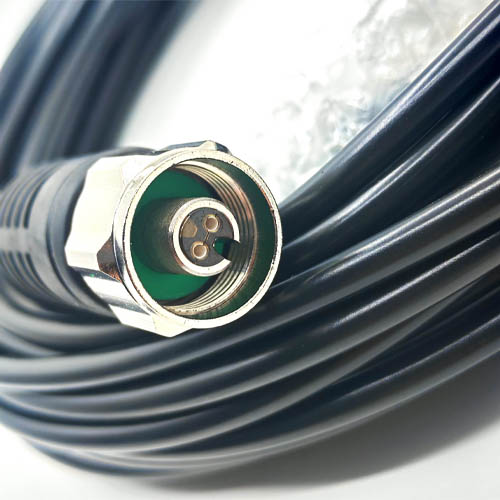
ODC male optical patch cable for base station interconnection.
Outdoor Small Cell and Urban Densification
Outdoor small cells are mounted on poles, walls, and street furniture. Space is limited, and the cable must be ruggedized but compact. NSN-LC duplex and ODVA fan-out assemblies are used in these configurations, with IP67/IP68 sealing and a wide operating temperature range. The cable joins the small cell to an optical distribution box or the nearest fiber closure.
FTTA Cable Selection by Scenario: Comparison Table
| Deployment scenario | Typical site exposure | Recommended protection | Common connector example |
|---|---|---|---|
| Macro tower / rooftop | Rain, UV, wind vibration, high pulling load | IP67/IP68, tensile ≥1000 N, -40°C to +75°C | ODC, FullAXS |
| Industrial mining / oilfield | Dust, corrosive atmosphere, mechanical vibration | IP68, corrosion-resistant plating, armored core | FullAXS |
| Railway signal corridor | Temperature swings, vibration, limited access | IP67, wide operating temperature, anti-vibration | ODC |
| Outdoor small cell / pole mount | Urban outdoor, splash, UV | IP67, compact ruggedized assembly | NSN-LC duplex, ODVA fan-out |
FTTA Cable Project Questions
What IP rating is required for FTTA cables on outdoor 5G sites?
Outdoor FTTA connections typically require IP67 or IP68 protection. IP67/IP68 cables prevent water and dust ingress into the connector and cable entry. FOCC's Outdoor Waterproof FTTA Fiber Optic Patch Cord is rated IP67/IP68 and operates from -40°C to +75°C. The FullAXS connector system is also designed for IP67/IP68 waterproof protection, salt-mist resistance, and compliance with IEC 61300-2 environmental testing.
Can the manufacturer customize connectors for a specific RRU/AAU deployment?
Yes. FOCC Fiber Co.,Ltd offers OEM/ODM production for FTTA cables, with customization of length, connector type, core count, transmission mode, material, logo printing, certification, and packaging. The factory has a monthly capacity of 200,000 units and tests 100% of finished assemblies before shipping.
What factors affect the cost of outdoor FTTA cables?
The main cost drivers are connector type, waterproof rating, fiber type, armoring, certification requirements, and order quantity. Single-mode APC assemblies, IP68-rated sealing, and armored cores increase material and testing cost. A clear site specification helps avoid over-specification and reduces project cost.
How can I request FTTA cable samples for site validation?
FOCC supports low-volume orders with an MOQ of 2 units, making it possible to validate a design before a full rollout. Send the site environment, connector types, fiber type, and required lengths to the sales team to receive sample options and test guidance.
What is the typical lead time for customized FTTA cables?
Customized FTTA patch cords from FOCC are typically produced within 3–15 days, depending on connector configuration, materials, and order quantity. For current project planning, contact sales@mefiberoptic.com with your specification to confirm delivery timing and quotation.
Conclusion
Site conditions, not catalog descriptions, should drive FTTA cable selection. A waterproof rating alone is not enough. Connector compatibility, tensile strength, temperature range, fiber type, and manufacturing quality all have to be matched to the deployment scenario. FOCC Fiber Co.,Ltd provides OEM/ODM support for outdoor FTTA patch cords with IP67/IP68 protection, armored cores, and connector options such as ODC and FullAXS.
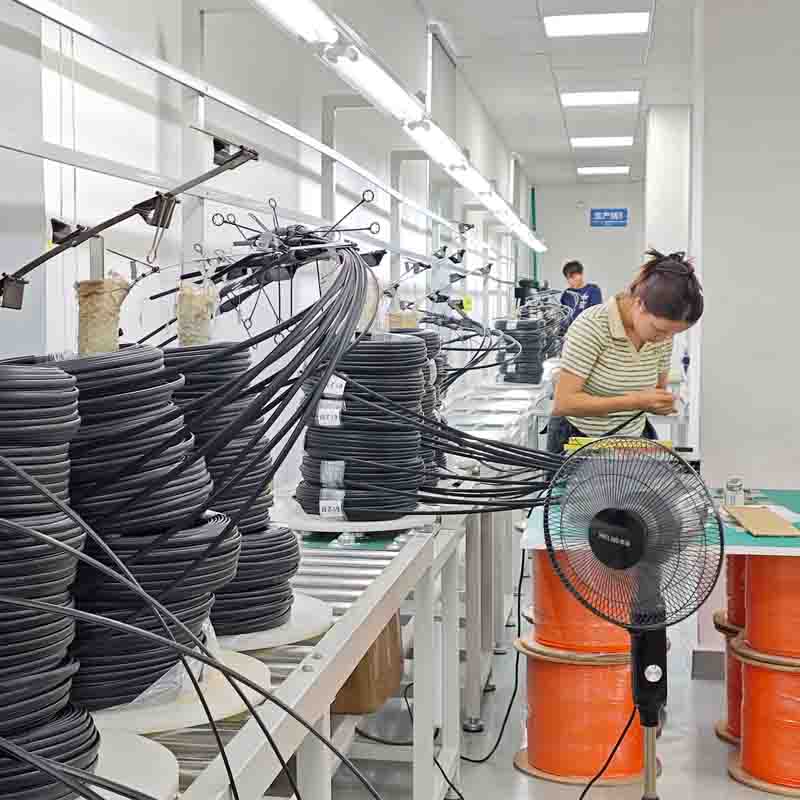
Waterproof jumper processing line at FOCC factory.
Need a sample or quotation for your FTTA deployment?
Contact FOCC Fiber Co.,Ltd at sales@mefiberoptic.com or WhatsApp +86 13823237984.
Include your site environment, connector type, and required cable lengths.
Have Questions or Need More Details?
Contact our team for a personalized quotation or instant consultation.
Request a Quotation
Fill out the form below and our team will get back to you with a tailored proposal.
WhatsApp Direct Chat
Prefer to chat in real-time? Message us on WhatsApp for instant assistance & quick answers.
- Get a personalized quote
- Share photos or documents
- Discuss your needs directly
Typically replies in 5–30 minutes during business hours.