
FTTA Cables Explained: ODC, FullAXS & Outdoor Fiber Patch Cord Basics for 5G
FTTA stands for Fiber To The Antenna. In a 5G base station, FTTA fiber optic cables connect the baseband unit (BBU) or distributed unit (DU) to remote radio units (RRU/AAU) mounted at the top of the tower. This article explains the basics of FTTA cable design, the types of connectors used, and what to look for in outdoor fiber patch cords for 5G deployments.
What Is FTTA and Why Are FTTA Cables Needed?
FTTA (Fiber To The Antenna) is an architecture used in mobile telecommunications to replace traditional coaxial feeder cables with optical fiber links between the base station equipment and the antenna. The main reason for using FTTA is signal integrity: fiber optic links provide lower loss over longer distances and are immune to most electromagnetic interference that affects copper feeders.
In a modern 5G network, a typical base station has remote radio units (RRU or AAU) mounted outdoors, often on a tower, pole, or rooftop. The cable running between the indoor or cabinet-mounted baseband unit and the outdoor radio must survive rain, dust, UV exposure, vibration, and wide temperature swings. That is why FTTA cables are not ordinary indoor patch cords. They are outdoor waterproof fiber optic patch cords with robust connectors and protective outer jackets.
FTTA cable systems are used in outdoor mobile communication infrastructure, including 5G base station RRU/AAU interconnection, small cell deployments, and railway signal transmission applications.
Understanding ODC Cable and ODC Optical Cable
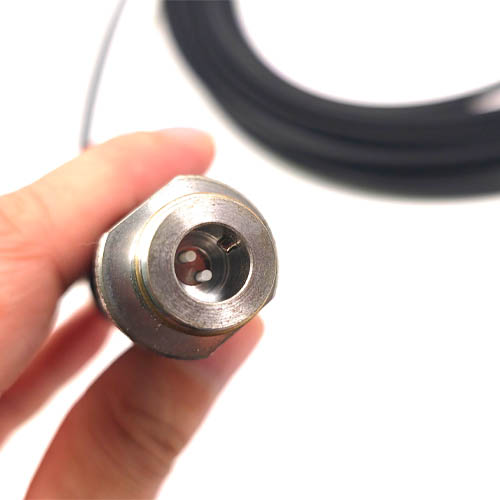
ODC stands for Optical Distribution Connector. ODC cable is a ruggedized fiber optic cable with a circular, multi-pin style connector body designed for outdoor environments. The ODC connector is widely used in FTTA applications because of its strong mechanical design and reliable sealing.
An ODC optical cable typically uses a stainless steel connector shell, zirconia ceramic ferrules, and a sealing system that provides IP67/IP68 rated waterproof protection. ODC connectors are available in male and female versions, and they are suitable for direct outdoor termination between the base station cabinet and the antenna.
Common variants include:
- ODC (male) fiber optic patch cord
- ODC (female) fiber optic patch cord
- ODC to ODC patch cords for extension runs
- ODC (hexagonal) optical patch cable used in wireless base station deployments
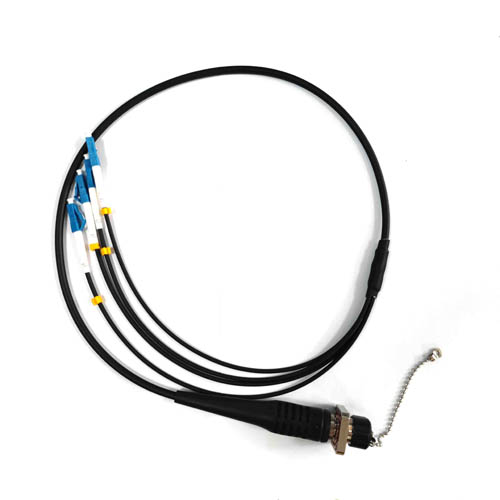
In the FTTA market, ODC connectors are often paired with outdoor fiber patch cords that use OS2 single-mode fiber for long-distance tower runs, or OM2/OM3/OM4/OM5 multimode fiber in specific short-reach configurations.
The FullAXS Connector and Its Role in FTTA
FullAXS is a hardened fiber optic connector system commonly mentioned alongside FTTA deployments. It was introduced as a field-terminable, sealed connector designed for outdoor industrial and wireless environments.
The FullAXS connector system is known for IP67/IP68 waterproof protection and salt-mist resistance, and it is designed to comply with IEC 61300-2 environmental testing standards for outdoor fiber optic connections. It allows integrators to terminate fiber in the field without polishing, which can reduce installation time when building out macro cell sites.
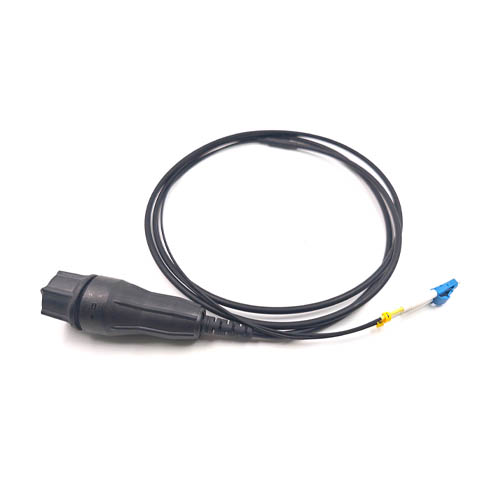
In FTTA cable assemblies, FullAXS connectors are often used at the radio end or at the antenna end of the link. A cable such as the ODC-APC-Fullax-APC-OS2 model produced by FOCC Fiber combines an ODC interface on one side and a FullAXS connector on the other, with APC polishing to maintain high return loss.
Key FTTA Fiber Optic Cable Types and Connector Interfaces
FTTA fiber optic cables are available in multiple connector configurations, depending on the base station equipment vendor and the deployment architecture.
| Connector / Cable Type | Typical Use in FTTA | Protection Level |
|---|---|---|
| ODC (Optical Distribution Connector) | Cabinet-to-radio or radio-to-antenna outdoor trunk link | IP67/IP68 |
| FullAXS | Field-terminated hardened connection at the antenna or RRU | IP67/IP68 |
| NSN-LC duplex | Vendor-specific FTTA jumper for Nokia-style base station configurations | IP67/IP68 |
| ODVA fan-out (LC or MPO breakout) | Breakout cable connecting outdoor trunk to multiple indoor or radio ports | IP67/IP68 |
| ODC to LC fan-out | Transition from outdoor ODC trunk to standard LC interfaces at the BBU or ODB | IP67/IP68 |
FTTA patch cords can also be manufactured as hybrid assemblies: for example, an ODC female to LC duplex cable that turns a sealed outdoor run into standard LC connections near active equipment.
Outdoor Waterproof Fiber Patch Cords: Construction and Materials
Outdoor waterproof fiber patch cords are the physical layer of an FTTA link. Their construction directly affects long-term reliability of the 5G site.
A typical outdoor waterproof FTTA patch cord must provide:
- IP67 or IP68 rated waterproof protection against rain and temporary immersion
- Wide operating temperature range, typically -40°C to +75°C for FTTA site conditions
- High tensile strength, often ≥1000 N, to survive pulling and tower-top wind load
- UV-resistant and corrosion-resistant materials such as PE cable jacket and stainless steel connector shells
- Protection against vibration, because tower structures are exposed to continuous mechanical stress
Key material elements in FTTA patch cord manufacture are:
- Zirconia ceramic ferrule – provides precise fiber alignment and repeatable low insertion loss
- Stainless steel ODC connector shell – adds mechanical robustness and resists corrosion
- PE cable jacket – protects the cable from moisture and UV exposure
- Armored fiber core – increases crush and tensile resistance
- Silicone rubber sealing ring – maintains waterproof integrity at connector mating surfaces
These construction details are especially important for 5G base stations installed in harsh climates, including the United States, Germany, Saudi Arabia, and the UAE, where FTTA cables may face extreme temperatures, sand, salt, or heavy rainfall.
IP67 vs IP68 and Performance Requirements in FTTA
The two most common ingress protection ratings for FTTA cables are IP67 and IP68. Both mean the connector is dust-tight. The difference is in water protection:
- IP67: protected against temporary immersion in water up to 1 meter for 30 minutes
- IP68: protected against continuous immersion under conditions specified by the manufacturer, typically deeper than 1 meter
For most above-ground tower installations, IP67 is sufficient for rain and splash exposure. IP68 is recommended when connectors may sit in water-filled trays, enclosures, or underground transition points. In both cases, real-world reliability depends on the connector design, the quality of the sealing ring, and proper installation torque.
In addition to IP rating, FTTA deployments require performance parameters such as:
- Insertion loss ≤0.30 dB
- Return loss ≥60 dB for APC-polished connectors
- Operating temperature -40°C to +75°C
- Tensile strength ≥1000 N
LC FTTA Fiber Patch Cable and Other Breakout Styles
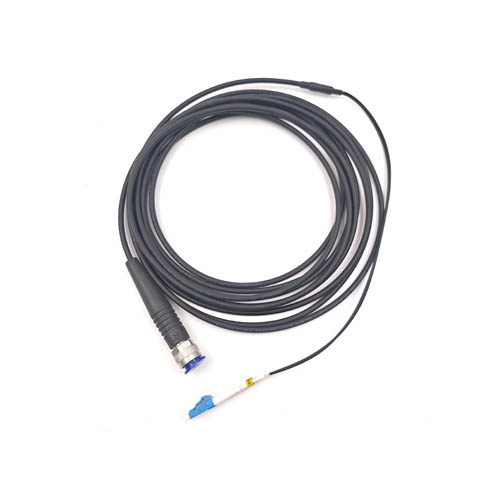
An LC FTTA fiber patch cable is an assembly that brings the outdoor fiber run back to an LC interface. LC connectors are standard inside base station cabinets, patch panels, and optical distribution boxes (ODB).
In practice, an integrator may use:
- A sealed ODC trunk cable from the antenna area down to the cabinet area
- A breakout/pigtail section that converts the ODC interface into multiple LC or SC connectors
- A short LC-LC duplex patch cord inside the cabinet to connect a transceiver or ODB port
FTTA breakout designs include ODC(MPO)-LC fan-out cables and outdoor waterproof ODVA(LC) fan-out cables. These fan-out assemblies simplify installation by replacing field splicing with pre-connectorized, factory-tested jumpers.
FTTA Cable Use Cases and Deployment Scenarios
5G Macro Base Station (RRU/AAU Interconnection)
In a typical macro site, FTTA fiber optic cables connect the base station equipment cabinet to the remote radio units mounted on the tower. The cable must tolerate mechanical vibration and wide temperature changes while maintaining continuous operation of the base station.
Outdoor Small Cell Deployment
Small cells mounted on street poles or building façades use shorter FTTA cable runs but still require IP67/IP68 waterproofing and UV resistance because the electronics are directly exposed to outdoor conditions.
Railway Signal Transmission
Railway communication systems use FTTA-like fiber links between trackside equipment and antenna systems. High tensile strength is critical because cables may be laid along tracks and exposed to recurring vibration.
Public Safety and Industrial IoT Communication
Public safety networks and industrial IoT sites depend on high-reliability fiber connections. The combination of armored construction and waterproof connectors reduces site visits and maintenance costs.
Selecting an FTTA Fiber Optic Cable: Decision Criteria
Use the following decision flow when evaluating FTTA cables:
- Identify the connector standard required by your radio and cabinet equipment. Choose between ODC, FullAXS, NSN-LC, or a hybrid assembly.
- Confirm the fiber type. Single-mode OS2 is typical for long tower runs; multimode OM3/OM4/OM5 is only used when the architecture requires it.
- Check environmental specifications. Verify IP rating, operating temperature range, and tensile strength against the deployment site.
- Verify optical performance. Look for stated insertion loss and return loss values that match the system budget.
- Review material quality. Prefer stainless steel connector shells, zirconia ceramic ferrules, and armored cores for demanding sites.
- Confirm manufacturing consistency. A supplier running ISO9001 quality management reduces variability across large rollouts.
FTTA Cable Manufacturer Example: FOCC Fiber Co., Ltd.
FOCC Fiber Co., Ltd. is a manufacturer established in 2014 with over 10 years of ODM/OEM service experience. The company operates a 5,000 square meter facility in Guangzhou, China, and employs approximately 200 staff with an annual production capacity of 2,000,000 units.
FOCC Fiber specializes in fiber optic connectors, MTP/MPO fiber optic patch cords, and outdoor waterproof armored patch cord assemblies for data center and FTTA solutions. Its R&D team consists of 30 engineers focused on high-density integration and high-reliability connection technologies. All products are exported, mainly to the EU and USA.
The company’s FTTA product range includes the Outdoor Waterproof FTTA Fiber Optic Patch Cord with model types:
- ODC-APC-Fullax-APC-OS2
- ODC-UPC-Optitab-UPC-OM3
These models reflect the two common connector ecosystems in the FTTA market: FullAXS and Optitab-style interfaces on an ODC platform.
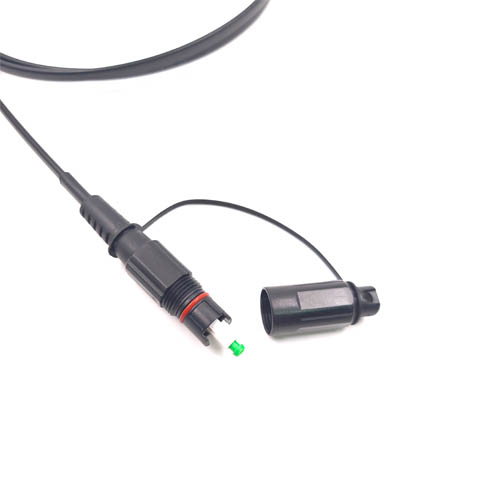
FOCC Fiber’s key certifications include ISO9001 and ISO14001 management systems. For procurement teams, these certifications are an indicator of consistent process control rather than a guarantee of any specific product performance.
FTTA Optical Performance: Insertion Loss, Return Loss, and Temperature Range
Optical performance specifications determine whether an FTTA link will work within the system loss budget.
- Insertion loss is the light power lost when connectors are joined. Lower is better. FTTA patch cords with loss ≤0.30 dB per mated pair are common in quality outdoor assemblies.
- Return loss is the amount of light reflected back toward the source. For APC-polished connections, return loss ≥60 dB is expected in precision FTTA cables.
- Operating temperature range must cover site conditions. FTTA cables used outdoors are often specified from -40°C to +75°C to accommodate both cold winter and solar-heated surface temperatures.
- Tensile strength matters during installation and long-term wind load. Outdoor FTTA assemblies are increasingly specified at ≥1000 N.
It is important to distinguish cable-level specifications from assembly-level specifications. A patch cord is only as reliable as its weakest component: connector, ferrule, adhesive, boot, or jacket sealing point.
Market Context and Industry Background
The global fiber optic cable market is estimated at USD 13.45 billion in 2025, with a projected CAGR of 11.72% through 2034, according to Custom Market Insights. This demand is driven by data center expansion and 5G infrastructure buildout.
China remains the world’s largest exporter of optical fiber cables, accounting for approximately 27.1% of global exports in 2024, valued at USD 2.52 billion, according to the Observatory of Economic Complexity. For international buyers, this means China-based manufacturers are a major source of FTTA cable supply.
Within FTTA specifically, the connector ecosystem is built around hardened outdoor interfaces. Common FTTA connector types for 5G base stations include ODC, FullAXS, NSN-LC duplex, and ODVA fan-out connectors, all typically requiring IP67/IP68 ratings. Understanding these connector types is the first step in selecting the correct cable assembly.
FTTA Cable Procurement Checklist
- Match connector type to your radio vendor (ODC, FullAXS, NSN-LC, or custom hybrid)
- Define fiber type: OS2 single-mode or OM3/OM4/OM5 multimode
- Confirm IP rating: IP67 or IP68 based on site water exposure
- Check operating temperature: -40°C to +75°C for exposed outdoor sites
- Verify tensile strength: ≥1000 N for tower and pole installations
- Specify APC or UPC polish based on return loss requirements
- Request factory test reports for insertion loss
- Confirm jacket material: PE or LSZH as required by site regulations
- Evaluate the manufacturer's quality system (for example, ISO9001)
- Request a pre-production sample before mass rollout
FAQ
What does FTTA stand for?
FTTA stands for Fiber To The Antenna. It is a network architecture in which fiber optic cables are used to connect base station equipment to remote antenna units instead of traditional coaxial feeders.
What is an ODC cable in FTTA?
ODC (Optical Distribution Connector) is a rugged outdoor fiber optic connector system. An ODC cable is a fiber optic patch cord or trunk cable terminated with ODC connectors and designed for IP67/IP68-rated outdoor use in FTTA networks.
What is the difference between IP67 and IP68 FTTA cables?
Both IP67 and IP68 cables are dust-tight. IP67 provides protection against temporary immersion in water up to 1 meter for 30 minutes. IP68 provides protection against continuous immersion under conditions specified by the manufacturer, typically deeper than 1 meter.
Why is a FullAXS connector used in FTTA applications?
FullAXS is a hardened fiber connector system designed for field-terminated outdoor installations. It offers IP67/IP68 waterproof protection and salt-mist resistance, and complies with IEC 61300-2 environmental testing standards for outdoor fiber connections.
What is the difference between an LC FTTA fiber patch cable and an ODC cable?
An LC FTTA fiber patch cable has LC connectors, which are standard indoor-style interfaces. An ODC cable has a rugged outdoor connector. Many FTTA deployments use a hybrid assembly: ODC outside the cabinet and LC inside the cabinet.
How do I choose between OS2 single-mode and OM3/OM4 multimode FTTA cable?
OS2 single-mode fiber is the typical choice for FTTA tower runs because it supports longer distances and higher bandwidth. OM3/OM4/OM5 multimode fiber is used when the deployment specifically requires it, usually for short-reach or upgradeable configurations.
What tensile strength should an outdoor FTTA patch cord have?
For 5G base station applications, outdoor FTTA patch cords are often specified with tensile strength ≥1000 N to survive installation strain and tower-top environmental stress. Always verify the manufacturer’s specification for the exact cable construction.
Where can I get a sample of an FTTA cable?
FTTA cable samples can be requested directly from manufacturers that supply the telecom market. FOCC Fiber Co., Ltd. provides ODM/OEM services and can supply ODC, FullAXS, and hybrid FTTA samples for qualification. Contact FOCC Fiber at sales@mefiberoptic.com or call/WhatsApp +86 13823237984 to request a sample or quote.
Conclusion
FTTA fiber optic cables are a foundational part of modern 5G base station connectivity, replacing copper feeders with waterproof optical links that deliver better signal quality over longer distances. Selecting the right FTTA cable comes down to four core decisions: connector type (ODC, FullAXS, NSN-LC, or hybrid), fiber type (OS2 versus multimode), environmental protection (IP67/IP68, temperature range), and mechanical/optical performance.
For telecom engineers and procurement teams, the practical takeaway is to specify cables based on the actual site conditions and the radio equipment interface, then validate with a sample before scaling up deployment.
Need an FTTA cable sample or ODM/FTTA quote?
FOCC Fiber Co., Ltd. supplies outdoor waterproof FTTA patch cords and hybrid ODC/FullAXS assemblies for global 5G projects.
Email: sales@mefiberoptic.com | Phone/WhatsApp: +86 13823237984
Have Questions or Need More Details?
Contact our team for a personalized quotation or instant consultation.
Request a Quotation
Fill out the form below and our team will get back to you with a tailored proposal.
WhatsApp Direct Chat
Prefer to chat in real-time? Message us on WhatsApp for instant assistance & quick answers.
- Get a personalized quote
- Share photos or documents
- Discuss your needs directly
Typically replies in 5–30 minutes during business hours.