
FTTA vs. MPO/MTP: Choosing the Right Fiber Patch Cord for 5G or Data Centers
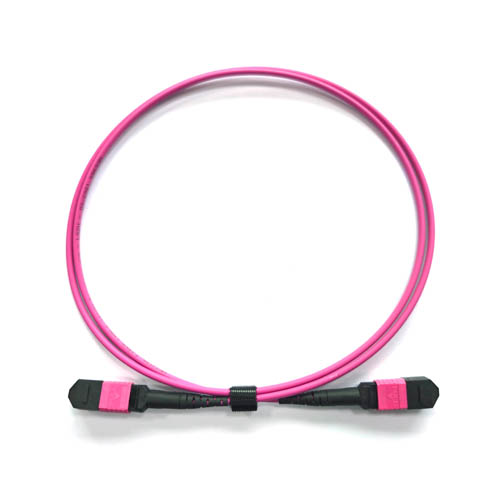
Short answer: if the patch cord leaves the cabinet and meets weather, specify an outdoor waterproof FTTA assembly rated IP67/IP68. If it stays inside a rack and carries 400G spine-leaf traffic, specify an MPO/MTP assembly with a low-loss grade of 0.35 dB or better and the fiber count your port map requires. The two families solve different problems, and substituting one for the other is one of the most expensive mistakes in an optical rollout.
Both products are passive optical assemblies, but they are engineered for opposite environments. An FTTA (Fiber To The Antenna) patch cord is a ruggedized outdoor assembly that links a baseband unit to a tower-top radio unit and must survive rain, dust, UV, vibration and salt mist. An MPO/MTP patch cord is a multi-fiber assembly that links spine and leaf switches inside a data center cabinet, where port density and insertion loss matter far more than weather sealing.
This comparison is written for buyers, network engineers, integrators and distributors who are moving from evaluation into execution on a 5G site program or a 400G data center build. It contrasts the two families across ingress protection, tensile strength, fiber count and insertion loss, then sets out a decision sequence, two real deployment cases, the order mechanics you need at purchase-order stage, and the questions buyers ask most often.
The Problem: One Purchase Decision, Two Completely Different Failure Modes
In a fiber deployment the patch cord is the component that is handled most often and replaced most often — and it fails for completely different reasons depending on where it is installed.
Outside a base station, the dominant risks are environmental and mechanical: water ingress at the connector interface, jacket degradation under UV, vibration and strain where the jumper moves with the antenna mast, and corrosion on metal parts. The consequence of these failures is not cosmetic. It is a tower climb or a truck roll, repeated across every site where the same specification error was made.
Inside a data center, the dominant risk is a budget problem rather than a weather problem: exceeding the insertion-loss budget of a 400G link, wrong polarity, or too few fibers per connector, which forces more cable, more patch panels and more rack space for the same number of ports. The consequence is a failed channel or a deployment that runs longer than planned.
Buying one “all-purpose” cord therefore creates both risks at once. An indoor MPO/MTP assembly taken outdoors has no defensible ingress protection. A ruggedized single-fiber or duplex outdoor cord used inside a high-density cabinet consumes the rack space that a multi-fiber assembly would have freed. The correct decision is a match between cord construction and deployment environment, not a search for a single best product.
Industry Background: Demand Is Splitting Between 5G and 400G
The global fiber optic cable market is estimated at USD 13.45 billion in 2025, with a projected CAGR of 11.72% through 2034 (Custom Market Insights). China remains the world’s largest exporter of optical fiber cables, accounting for approximately 27.1% of global exports in 2024, valued at USD 2.52 billion (The Observatory of Economic Complexity). That manufacturing capacity is being pulled by two demand engines: 5G radio access networks that need outdoor waterproof patch cords at every site, and data centers moving to 400G spine-leaf architectures that need multi-fiber MPO/MTP assemblies in every cabinet.
On the 5G side, connector choice has narrowed to a small set of standardized interfaces. Industry references list ODC (Optical Distribution Connector), FullAXS, NSN-LC duplex and ODVA fan-out connectors as the common FTTA interfaces for 5G base stations, all typically requiring IP67/IP68 protection. The FullAXS connector system is designed for IP67/IP68 waterproof protection and salt-mist resistance, and complies with IEC 61300-2 environmental testing standards. This is why outdoor FTTA procurement conversations revolve around IP rating, jacketing and mechanical retention rather than fiber density.
On the data center side, the interface is MPO/MTP, and the debate is different: fiber count, loss grade, polarity and breakout strategy. A 400G spine-leaf link consumes many more fibers per port than a legacy 10G link, so the number of connectors per rack — not the number of outdoor enclosures — becomes the constraint.
What Each Patch Cord Family Actually Is
Outdoor Waterproof FTTA Patch Cords (FTTA — Fiber To The Antenna)
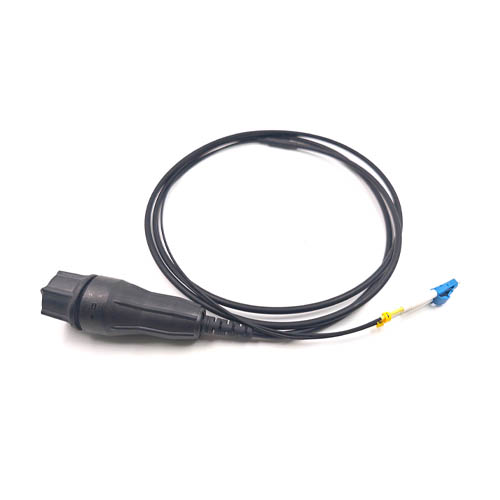
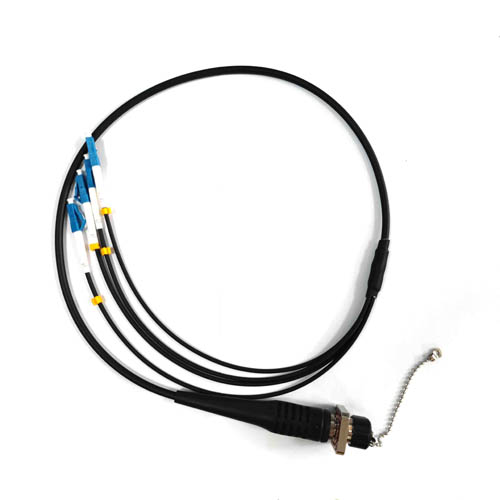
An FTTA patch cord is the outdoor segment of a fiber-to-the-antenna link, connecting the baseband unit at the bottom of the site to the remote radio unit at the top. Because it lives outside the cabinet, its construction is defined by protection rather than by density.
- Ingress protection: the common FTTA interfaces for 5G base stations — ODC (Optical Distribution Connector), FullAXS, NSN-LC duplex and ODVA fan-out connectors — are typically specified with IP67/IP68 protection. In FOCC Fiber Co., Ltd’s deployed outdoor program, assemblies are IP68-rated for harsh environments.
- Materials and mechanics: corrosion-resistant plating, armored LSZH jacket options and a 200 N tensile rating are the features that keep a jumper stable when it is strapped to a mast and moves with the antenna.
- Typical fiber count: one or two fibers per connector, expanded through fan-out assemblies to serve several ports from a single ruggedized feed. ODC and ODVA LC formats are common in this role, which is why specifying teams search for “ODC cable”, “ODC optical cable”, “ODC LC” and “Fullax connector”.
- Service profile: the assembly must be replaceable quickly in the field, because every replacement is a site visit with a measurable cost.
MPO/MTP Patch Cords for High-Density Data Centers
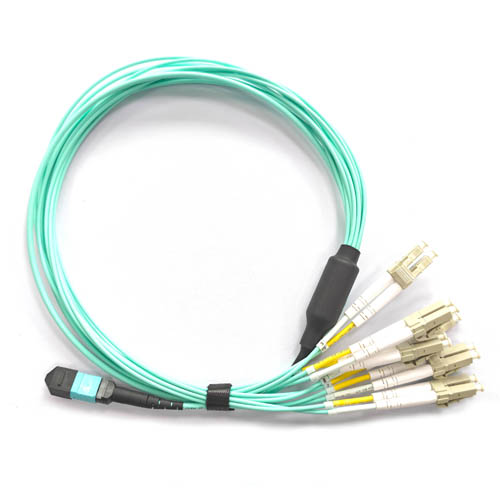
An MPO/MTP patch cord is a multi-fiber push-on assembly designed to move many channels through a single connector body. It is the standard building block for 400G spine-leaf interconnection, server-to-switch cabling and breakout to LC fan-outs inside a cabinet.
- Fiber counts: 12-, 16- and 24-fiber ferrules are the common MPO configurations, and higher counts such as 48 fibers are reached through multi-row or multi-ferrule arrangements. FOCC’s data center program deployed more than 12,000 MPO-24 patch cords across 300+ cabinets.
- Loss grade: the deployed MPO-24 assemblies are specified with insertion loss below 0.35 dB — a low-loss class that MPO datasheets commonly label “Elite” grade — and every cord is 100% factory tested.
- Manufacturing requirement: achieving low loss at 24 fibers depends on precision active alignment during assembly, not on connector count alone. This is a manufacturing capability issue, and it is one of the first things an experienced buyer audits.
FTTA vs. MPO/MTP: Head-to-Head Comparison
The table below compares the two families on the criteria that actually change a purchase order: environment, connector interface, fiber count, optical requirement, mechanics and field service profile. Each entry is drawn from the deployed assembly specifications and program results described in this guide.
| Decision factor | Outdoor waterproof FTTA patch cord | MPO/MTP data center patch cord |
|---|---|---|
| Primary deployment | 5G RAN fronthaul, tower-top RF unit interconnection, industrial mining and oilfield sites | 400G spine-leaf interconnection, server-switch high-density cabling inside cabinets |
| Ingress protection | IP67/IP68 specified for common FTTA interfaces; salt-mist resistance and IEC 61300-2 environmental testing for FullAXS-type systems; FOCC deployed assemblies are IP68-rated | No outdoor ingress rating is specified for the assemblies used in this comparison; they are installed in protected cabinet environments |
| Common connector interfaces | ODC, FullAXS, NSN-LC duplex, ODVA LC fan-out | MPO/MTP multi-fiber connectors, with LC fan-out breakouts |
| Fiber count | Typically one or two fibers per connector, expanded through fan-out assemblies | 12-, 16- and 24-fiber ferrules; 48 fibers via multi-row arrangements; 12,000+ MPO-24 cords deployed in the FOCC data center program |
| Optical requirement | Connector-level loss specified per assembly; 100% pre-shipment test | Insertion loss below 0.35 dB on deployed MPO-24 assemblies (low-loss/Elite class); 100% factory tested |
| Mechanical features | 200 N tensile rating, corrosion-resistant plating, armored LSZH jacket options | Precision active alignment; strain relief inside cabinets and patch panels; no weatherproof jacketing required |
| Field service profile (FOCC programs) | 80% lower field failure rate, on-site replacement in under 10 minutes, 40% lower OPEX | 60% faster deployment, 4x higher port density, 99.999% uptime, 30% lower TCO |
| Do not use it for | High-density cabinet port counts, where one or two fibers per connector becomes the constraint | Exposed outdoor positions, where weather, UV and mechanical strain govern link reliability |
How to Choose: A Step-by-Step Breakdown
The decision becomes straightforward once it is ordered correctly. The sequence below follows the way deployment engineers actually specify a cord, from link path to sample validation.
- Map the physical path of the link. Trace the route from equipment port to equipment port. If any part of that route is exposed to weather, the cord belongs to the outdoor waterproof family. If the entire route is inside a cabinet or a controlled equipment room, it belongs to the indoor high-density family.
- Set the environmental class. For exposed routes, require IP67/IP68 protection, salt-mist resistance where coastal or industrial air is present, and compliance with IEC 61300-2 environmental testing for FullAXS-type interfaces. For protected routes, environment drops out of the specification and density takes over.
- Fix the fiber count and interface from the port map. Outdoor: LC, ODC, ODVA or FullAXS assemblies in one- or two-fiber configurations, with fan-outs where several ports share one ruggedized feed. Indoor: MPO-12, MPO-16 or MPO-24 assemblies, with 48-fiber arrangements where the port map requires them, plus LC breakout cords for equipment with LC optics.
- Define the loss budget before you ask for prices. For 400G data center links, specify insertion loss below 0.35 dB on MPO assemblies and require per-assembly test evidence. For 5G fronthaul, define the connector-level loss requirement for the outdoor assembly and confirm that every cord is tested before shipment, not sampled.
- Specify mechanical protection. For mast-mounted assemblies, require armored LSZH jacket options, corrosion-resistant plating and a 200 N tensile rating so the cord tolerates vibration and installation handling without damage.
- Confirm the supplier can execute at both ends. A single 5G site may need outdoor waterproof cords at the top and MPO/MTP assemblies in the equipment room. FOCC Fiber Co., Ltd manufactures fiber optic connectors, MTP/MPO patch cords, outdoor waterproof patch cord assemblies and armored patch cords for data center and FTTA applications, with a monthly capacity of 200,000 units, 100% testing, OEM/ODM production, and customization of length, connector type, core count, transmission mode, material, logo printing, certification and packaging.
- Validate with a sample before the volume order. The minimum order quantity is 2 units, and the supplier supports third-party inspection, factory acceptance testing (FAT) and on-site acceptance, so a validation order can be tested against the loss and mechanical requirements before a rollout schedule is committed.
Deployment Evidence: What Two Real Programs Showed
5G program: 50,000+ outdoor waterproof patch cords across 20,000+ base stations
One FOCC program serving telecommunication carriers and 5G base station equipment vendors in Germany, Saudi Arabia and China supplied more than 50,000 outdoor waterproof patch cords for 20,000+ 5G base station deployments. Applications included 5G RAN fronthaul, tower-top RF unit interconnection, and industrial mining and oilfield sites. The assemblies have been in service for more than 10 years in IP68-rated harsh environments, with a 200 N tensile rating and corrosion-resistant plating. The reported program outcomes were an 80% lower field failure rate, on-site replacement in under 10 minutes, and 40% lower operational expenditure.
Data center program: 12,000+ MPO-24 patch cords across 300+ cabinets
A second FOCC program for data center operators and cloud service providers in China, Singapore and the United States deployed more than 12,000 MPO-24 patch cords across 300+ cabinets, supporting 400G spine-leaf interconnection and server-switch high-density cabling. The assemblies were produced with precision active alignment and specified with insertion loss below 0.35 dB, and each cord was 100% factory tested. The reported outcomes were 60% faster deployment, 4x higher port density, 99.999% uptime and 30% lower total cost of ownership, with a deployment record of more than 5 years against a 10-year design life.
The rule for sites that need both
Many 5G sites combine an outdoor radio segment with a small indoor equipment room, and data center campuses often include outdoor feeder runs. Keep the families in their own domains: FTTA assemblies outdoors and at the mast, MPO/MTP assemblies inside the cabinet, joined at a patch panel or optical distribution frame. Never mix them by position. A weatherproof connector used indoors wastes money, and an MPO assembly used outdoors removes the protection the link depends on.
Customization, Capacity and Order Mechanics
Choosing the cord family is half the work. The other half is confirming that the supplier can execute on the exact configuration, in the required volume, with acceptance evidence you can archive.
FOCC Fiber Co., Ltd is a professional supplier of fiber optic connectors, MTP/MPO fiber optic patch cords, and outdoor waterproof armored patch cord assemblies. The company is located in Shenzhen, Guangdong, and operates a 5,000 m² factory in Guangzhou staffed by 200 employees, including a 30-person R&D team. Its annual output is 2,000,000 units, and 100% of production is exported, mainly to the EU and USA markets.
Both product families described in this guide are manufactured under one roof, which matters when a project needs outdoor FTTA assemblies and MPO/MTP assemblies from the same supplier with consistent documentation. FOCC operates ISO 9001 and ISO 14001 management systems, applies 100% testing, and provides OEM/ODM production with customization covering length, connector type, core count, transmission mode, material, logo printing, certification and packaging. The company has more than ten years of professional ODM/OEM service experience, and its products are exported to more than 30 countries and regions, widely used in telecommunications and other fields. FOCC lists Prysmian, Siemens, Coherent, Fujikura and NTT among its partner clients.
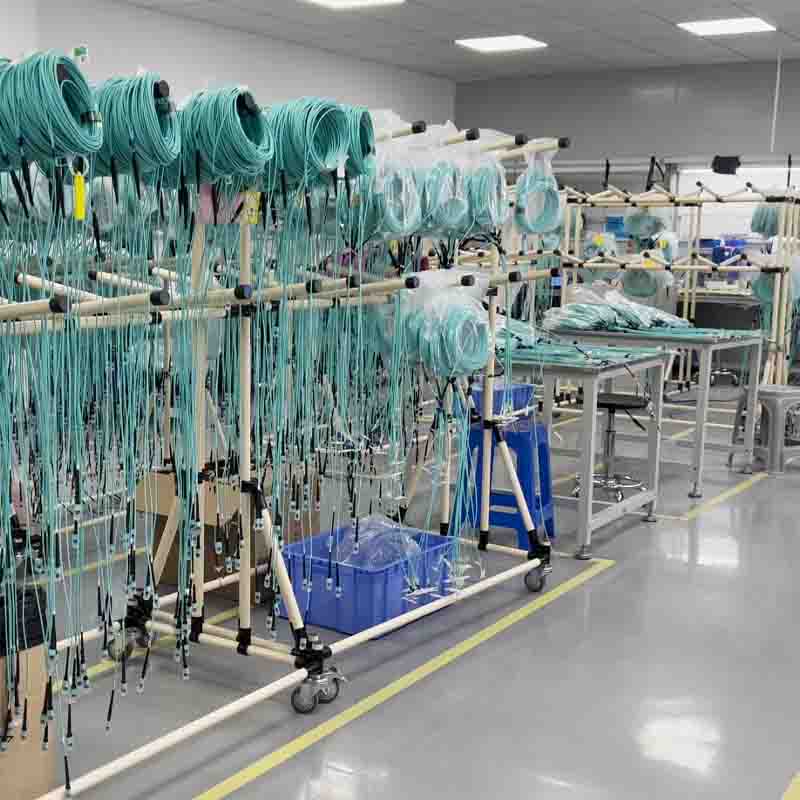
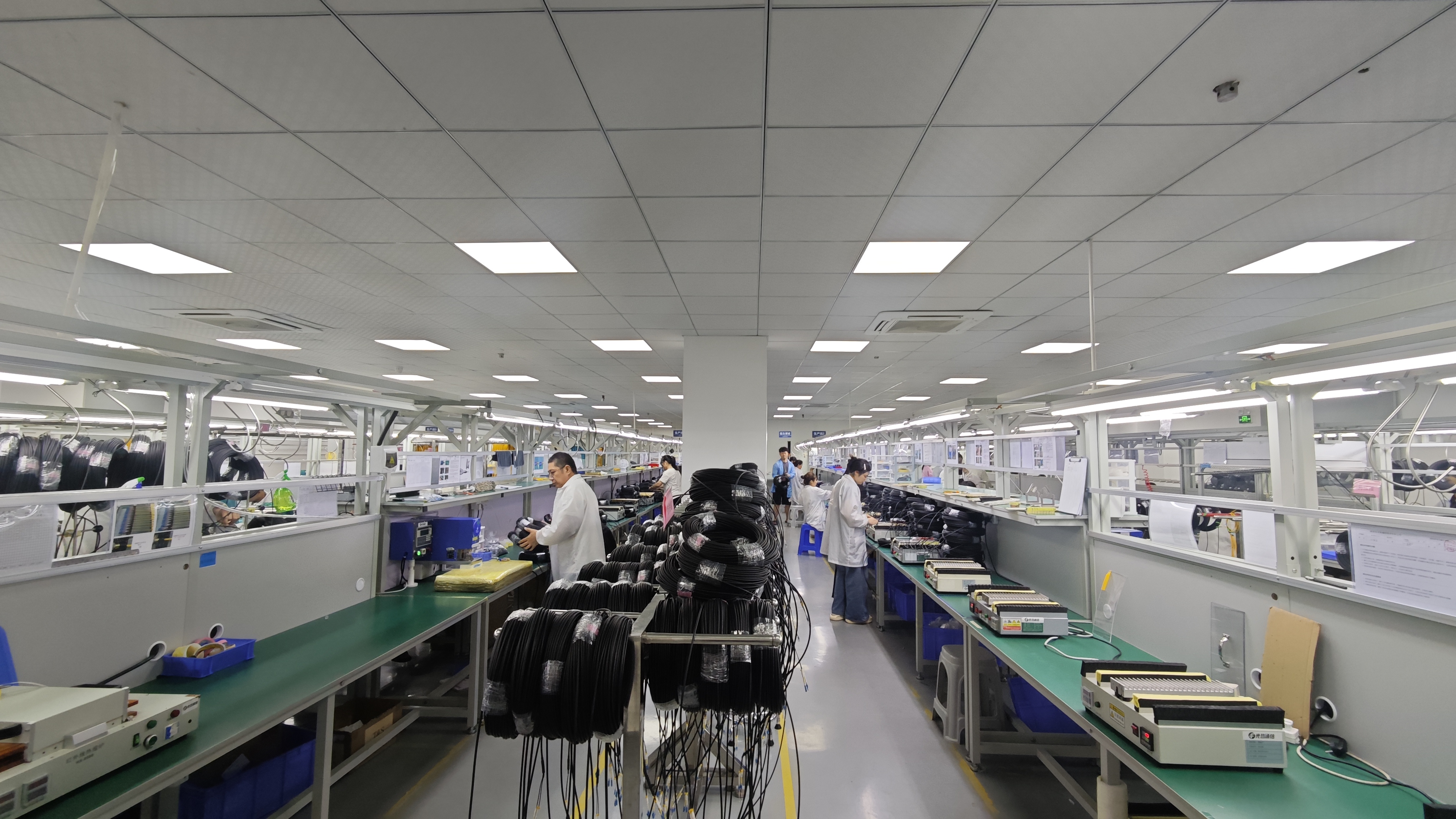
For buyers at execution stage, commercial terms matter as much as technical ones. FOCC quotes a monthly capacity of 200,000 units, a minimum order quantity of 2 units, and a lead time of 3–15 days. Delivery is on EXW/FOB terms with T/T payment. Acceptance is supported by 100% pre-shipment test, third-party inspection, factory acceptance test (FAT) and on-site acceptance, and after-sales support is provided remotely.
Frequently Asked Questions
Do 5G FTTA patch cords have to be IP67 or IP68, and which standards apply?
For outdoor 5G links, yes. The connector interfaces commonly used at base stations — ODC, FullAXS, NSN-LC duplex and ODVA fan-out connectors — are typically specified with IP67/IP68 protection. The FullAXS connector system, for example, is designed for IP67/IP68 waterproof protection and salt-mist resistance, and complies with IEC 61300-2 environmental testing standards. FOCC’s outdoor assemblies deployed in 5G programs are IP68-rated for harsh environments, and the company manufactures under ISO 9001 and ISO 14001 management systems.
Can one manufacturer supply both outdoor FTTA cords and MPO/MTP data center assemblies?
Yes, when the manufacturer covers both precision multi-fiber assembly and outdoor waterproof assembly. FOCC Fiber Co., Ltd produces fiber optic connectors, MTP/MPO patch cords, outdoor waterproof patch cord assemblies and armored patch cords for data center and FTTA applications from a 5,000 m² factory in Guangzhou, with a monthly capacity of 200,000 units, 100% testing, and OEM/ODM customization covering length, connector type, core count, transmission mode, material, logo printing, certification and packaging.
What actually drives the cost of an FTTA or MPO/MTP patch cord?
Unit price is only one component. For outdoor FTTA assemblies, cost is driven by IP-rated connector hardware, armored or LSZH jacketing and corrosion-resistant plating. For MPO/MTP assemblies, cost is driven by fiber count, loss grade and the precision active alignment required to hold insertion loss below 0.35 dB. Deployment data shows why purchase price should not be the only comparison: in FOCC’s 5G program the reported results were an 80% lower field failure rate, on-site replacement in under 10 minutes and 40% lower OPEX, while the data center program reported 60% faster deployment, 4x higher port density and 30% lower TCO.
Can I validate the cord before placing a volume order?
Yes. FOCC applies 100% pre-shipment testing and accepts third-party inspection, factory acceptance test (FAT) and on-site acceptance. The minimum order quantity is 2 units, which allows a small validation order — for example an IP68 outdoor assembly and an MPO-24 cord with a specified loss target — before a full rollout is committed. Lead time for those validation orders is 3–15 days.
What lead time should a 5G or data center project plan for?
FOCC quotes a lead time of 3–15 days with a monthly capacity of 200,000 units, delivery on EXW or FOB terms, and T/T payment. Projects with a fixed installation window should confirm the schedule at the sample stage rather than after the volume order. To start, send your fiber count, connector type, IP requirement and insertion-loss target to sales@mefiberoptic.com or WhatsApp +86 13823237984 for a sample and a quotation.
Conclusion: Match the Environment First, Then Validate the Supplier
The FTTA versus MPO/MTP question has a clear decision rule. If the cord is exposed to weather, vibration or salt mist, the correct answer is a ruggedized outdoor waterproof FTTA assembly rated IP67/IP68, with armored LSZH jacketing, corrosion-resistant plating, a 200 N tensile rating and a design that supports fast field replacement. If the cord stays inside a cabinet and carries 400G spine-leaf traffic, the correct answer is an MPO/MTP assembly with the fiber count the port map requires, insertion loss of 0.35 dB or better, and 100% factory test data behind it.
The evaluation does not stop at the product family. Confirm that the supplier can manufacture both, that the customization list covers your connector type, core count, transmission mode and packaging requirements, and that sample and acceptance steps — 100% testing, third-party inspection, FAT and on-site acceptance — are in place before the volume order. FOCC Fiber Co., Ltd builds fiber optic connectors, MTP/MPO patch cords, outdoor waterproof patch cord assemblies and armored patch cords for data center and FTTA applications, with ISO 9001 and ISO 14001 management systems, more than ten years of ODM/OEM service experience, and exports to more than 30 countries and regions.
Next step: if you are specifying outdoor FTTA patch cords or MPO/MTP assemblies for a 5G or 400G project, request a sample and quotation with your fiber count, connector type, IP rating and insertion-loss target.
Email: sales@mefiberoptic.com | WhatsApp: +86 13823237984 | Website: www.focc-fiber.com
Have Questions or Need More Details?
Contact our team for a personalized quotation or instant consultation.
Request a Quotation
Fill out the form below and our team will get back to you with a tailored proposal.
WhatsApp Direct Chat
Prefer to chat in real-time? Message us on WhatsApp for instant assistance & quick answers.
- Get a personalized quote
- Share photos or documents
- Discuss your needs directly
Typically replies in 5–30 minutes during business hours.