
How to Match MTP/MPO Patch Cords to Data Center & 5G Projects
How to Match MTP/MPO Patch Cords to Data Center & 5G Projects
MPO (Multi-fiber Push On) and MTP (a registered trademark of US Conec for an enhanced MPO connector) patch cords are widely used in high-density fiber cabling. Selecting the right patch cord is not just about choosing between MPO and MTP; it is about matching the cable assembly to the project’s environment, performance thresholds, and operational constraints. This article describes a project-based selection method for two common use cases: high-density data center networks and outdoor 5G FTTA (Fiber To The Antenna) installations. It also explains how customization and manufacturing capabilities affect the final specification.
Problem Definition
Buyers in the research and evaluation stage often face several recurring issues:
- Selecting an indoor-rated patch cord for outdoor use, which leads to water ingress and premature failure.
- Under-specifying core count or fiber type, resulting in insufficient scalability for planned 400G/800G upgrades.
- Overlooking insertion loss and return loss requirements, which can compromise link budget and signal quality.
- Ignoring mechanical protection requirements such as tensile strength, UV resistance, and corrosion resistance.
- Not verifying compliance with standards such as IEC 61754-7, TIA-604-5, and Telcordia GR-326.
These problems are avoidable when project requirements are translated into objective product specifications before procurement.
Industry Background
According to Strategic Market Research, the global MPO fiber optic connector market was estimated at approximately USD 2.1 billion in 2024 and is projected to reach USD 3.2 billion by 2030. The Asia-Pacific region accounted for about 42% of the global market share in 2024, making it the largest regional market (Valuates Reports). Multimode MPO connectors dominate the product segment with more than 88% of the market share, driven by short-range data center interconnects (Valuates Reports). In 2024, hyperscale data centers integrated MPO connectors in over 70% of their facilities globally (SkyQuest Technology).
Standardization is a key enabler of this growth. MPO connectors are defined by international standards IEC 61754-7 and TIA-604-5 (FOCIS 5), ensuring intermateability among different manufacturers. MTP, as a registered trademark of US Conec, is an enhanced version of MPO with a floating ferrule and elliptical guide pins for improved optical performance (US Conec). Understanding these standards helps buyers evaluate whether a supplier’s products meet project-level requirements.
Detailed Solution: Matching Product Properties to Project Needs
For data center projects, the priority is high-density, low-loss interconnection. A typical MPO/MTP fiber optic patch cord for this environment includes the following characteristics:
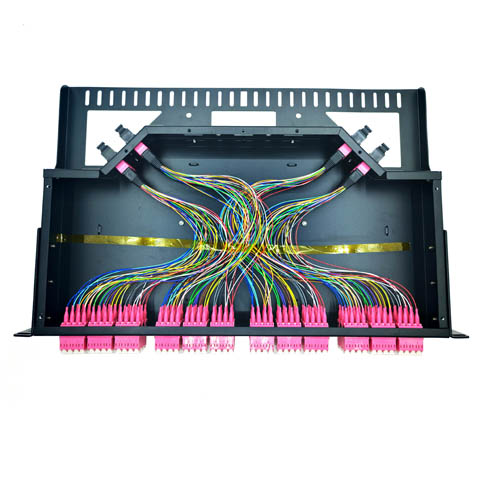
- Core count: 12, 16, 24, or 48 fibers
- Fiber type: OS2 single-mode, OM3, OM4, or OM5 multimode
- Insertion loss: ≤0.35 dB (Elite grade) or ≤0.5 dB (standard grade)
- Return loss: ≥60 dB (APC) or ≥50 dB (UPC)
- Operating temperature: -20°C to +70°C
- Cable length: customizable from 1 m to 100 m
- Jacket type: LSZH (Low Smoke Zero Halogen)
- Compliance reference: Telcordia GR-326
These products are designed to work with data center switches, servers, 400G/800G optical transceivers, MPO patch panels, and cable management systems. They are typically deployed in clean indoor data center rooms, supporting 400G/800G high-speed data transmission, cloud server interconnection, and storage area networks (SAN). Special requirements for this scenario include low insertion loss (≤0.35 dB for low-loss grade), high return loss (≥60 dB APC), an LSZH flame-retardant jacket, high density, and RoHS compliance.
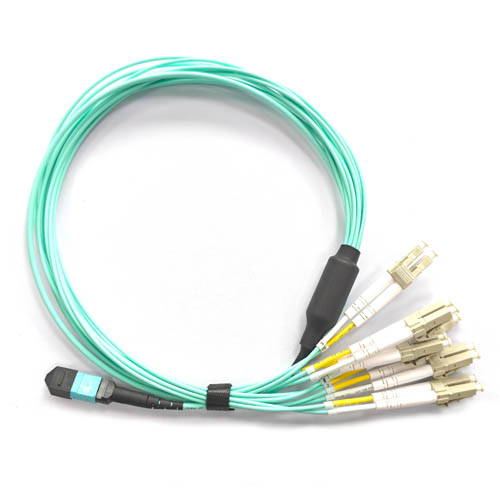
Beyond the basic MPO/MTP patch cord, project teams may need to choose between trunk cables, breakout cables, or test patch cords. A trunk cable extends the backbone from the main distribution area to zone distribution, while a breakout or fan-out cable transitions from a multi-fiber MPO/MTP connector to multiple LC duplex connectors for equipment interfaces. A short test patch cord is used for link validation. In high-density projects, 24-fiber and 48-fiber counts reduce cable volume and improve airflow.
For outdoor 5G FTTA projects, the priority changes to environmental resilience. An outdoor waterproof FTTA fiber optic patch cord typically offers:
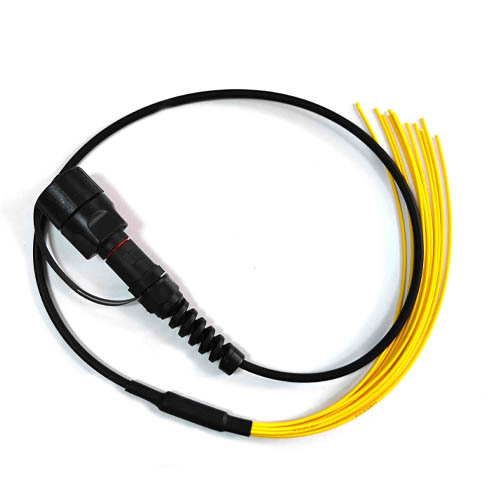
- Waterproof rating: IP67 / IP68
- Insertion loss: ≤0.30 dB
- Return loss: ≥60 dB (APC)
- Operating temperature: -40°C to +75°C
- Tensile strength: ≥1000 N
- Fiber types: OS2 single-mode, OM2/OM3/OM4/OM5 multimode
- Protective construction: zirconia ceramic ferrule, stainless steel ODC connector shell, PE cable jacket, armored fiber core, silicone rubber sealing ring
These cables are used in 5G base station RRU/AAU interconnection, FTTA, outdoor small cell deployment, and railway signal transmission. They must resist rain, dust, UV exposure, mechanical vibration, and high tensile stress. Special requirements include IP67/IP68 waterproofing, wide temperature tolerance, high tensile strength (≥1000 N), UV resistance, corrosion resistance, and anti-vibration performance.
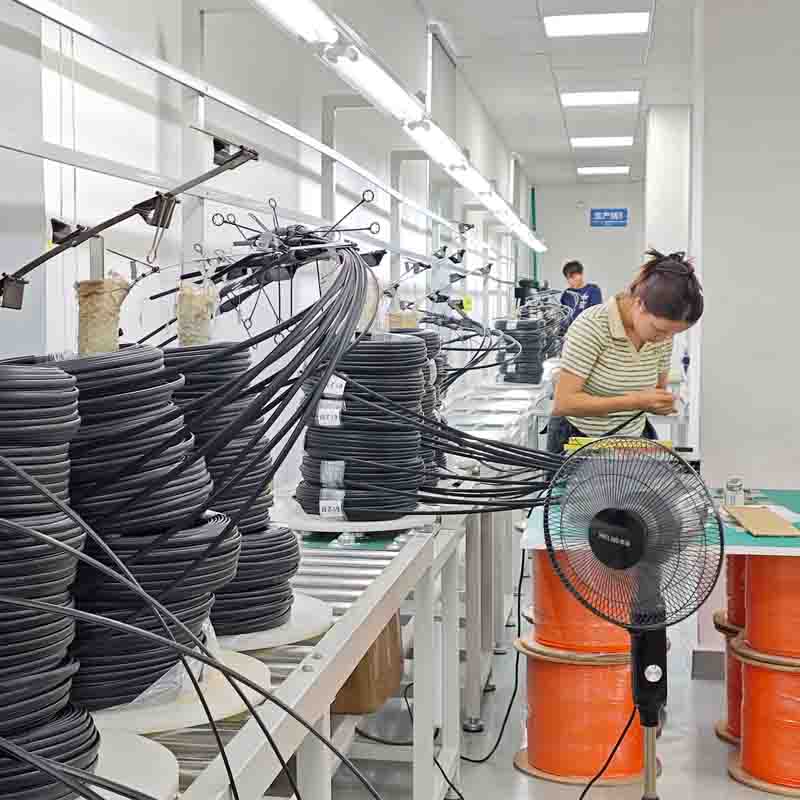
Manufacturers can adapt these standard product lines to project-specific needs. FOCC Fiber Co.,Ltd, a Shenzhen-based supplier of fiber optic connectors, MTP/MPO fiber optic patch cords, outdoor waterproof armored patch cord assemblies, and armored patch cords, operates a 5,000 m² factory in Guangzhou. The company offers OEM/ODM customization for cable length, connector type, core count, transmission mode, material, logo printing, certification, and packaging. FOCC reports a monthly capacity of 200,000 units, a lead time of 3–15 days, an MOQ of 2 units, and 100% factory testing. These capabilities make it possible to align patch cord specifications with existing equipment and deployment constraints.
Step-by-Step Breakdown of Project-Based Selection
The following steps can be used to define a project-specific MPO/MTP patch cord specification.
Step 1: Identify the Deployment Environment
Determine whether the cable will be installed indoors or outdoors. Indoor data center environments are clean and climate-controlled. Outdoor 5G sites expose cables to rain, dust, temperature swings, UV, and vibration. This step determines the required IP rating, operating temperature range, and mechanical strength.
Step 2: Determine Fiber Count and Transmission Mode
Count the number of active channels and plan for future expansion. Common counts are 12, 16, 24, and 48. Choose single-mode (OS2) for long-distance or high-speed transmission, or multimode (OM3/OM4/OM5) for short-reach high-bandwidth links within a data center.
Step 3: Set Optical Performance Targets
Insertion loss directly affects the link budget. Use the maximum IL limit of the system (e.g., ≤0.35 dB for low-loss grades) as a target. Return loss is important for high-power systems; APC polish provides RL ≥60 dB, while UPC provides ≥50 dB.
Step 4: Choose the Connector Interface and Polarity
Decide whether the project requires MPO, MTP, or hybrid breakout assemblies such as MPO to LC. MTP connectors are an enhanced MPO version with a floating ferrule and elliptical guide pins. Breakout and fan-out configurations support transitions between multi-fiber trunk cables and LC duplex equipment ports.
Step 5: Select the Jacket and Mechanical Protection
For indoor data centers, LSZH jacket is a common requirement to reduce smoke and toxic gas in case of fire. For outdoor installations, armored and waterproof constructions with PE jackets and silicone sealing rings are necessary. The tensile strength rating (e.g., ≥1000 N) also needs to match the installation method.
Step 6: Verify Compliance and Quality Controls
Confirm that the product meets applicable standards such as IEC 61754-7, TIA-604-5, and Telcordia GR-326. Ask the manufacturer about its quality management system (e.g., ISO9001/ISO14001) and whether 100% testing is performed. FOCC Fiber Co.,Ltd states that it strictly implements ISO9001 and ISO14001 management systems.
Step 7: Plan for Delivery and After-Sales Support
For project-driven procurement, lead time matters. FOCC Fiber Co.,Ltd lists a lead time of 3–15 days and an MOQ of 2 units, which enables pilot testing before large-scale deployment. After-sales remote support is available.
Use Cases
Two documented use cases illustrate how MPO/MTP and outdoor FTTA patch cords are applied in real projects.
Data Center Operator / Cloud Service Provider
A data center operator deployed 12,000+ MPO-24 patch cords across 300+ cabinet deployments for 400G spine-leaf interconnection and server-switch high-density cabling. The project reported 60% faster deployment, 4x higher port density, 99.999% uptime, and 30% lower TCO. Key specifications included precision active alignment, insertion loss below 0.35 dB, and 100% factory testing.
Telecommunication Carrier / 5G Base Station Equipment Vendor
A telecommunication carrier supplied 50,000+ outdoor waterproof patch cords for 20,000+ 5G base station deployments, covering 5G RAN fronthaul, tower-top RF unit interconnection, and industrial mining/oilfield environments. The project reported an 80% lower field failure rate, under 10 minutes on-site replacement time, and 40% lower OPEX. The deployed cable design featured IP68 waterproof/dustproof protection, a tensile strength rating of 200 N in that specific version, and corrosion-resistant plating. The broader outdoor waterproof FTTA patch cord family is rated up to ≥1000 N tensile strength.
Comparison Table: Data Center vs. 5G FTTA Patch Cord
The table below compares the typical specifications for indoor data center MPO/MTP patch cords and outdoor waterproof FTTA patch cords.
| Parameter | Data Center MPO/MTP Patch Cord | Outdoor Waterproof FTTA Patch Cord |
|---|---|---|
| Primary environment | Indoor data center room | Outdoor harsh environment |
| Operating temperature | -20°C to +70°C | -40°C to +75°C |
| Waterproof rating | — | IP67 / IP68 |
| Insertion loss | ≤0.35 dB (Elite) / ≤0.5 dB (standard) | ≤0.30 dB |
| Return loss | ≥60 dB (APC) / ≥50 dB (UPC) | ≥60 dB (APC) |
| Tensile strength | — | ≥1000 N |
| Optical fiber types | OS2, OM3, OM4, OM5 | OS2, OM2/OM3/OM4/OM5 |
| Jacket / protection | LSZH / PVC | PE jacket + armored core |
| Typical application | 400G/800G data center, SAN, cloud | 5G FTTA, outdoor small cell, railway |
This comparison shows why project context should drive procurement. A cable optimized for an indoor data center may fail quickly in an outdoor enclosure, while an outdoor-rated cable may be unnecessarily heavy and difficult to route indoors.
FAQ
What standards apply to MTP/MPO patch cords?
MPO connector intermateability is defined by IEC 61754-7 and TIA-604-5 (FOCIS 5). MTP is a registered trademark of US Conec and an enhanced MPO version featuring a floating ferrule and elliptical guide pins. For complete cable assemblies, buyers may also reference Telcordia GR-326. Confirm that the manufacturer’s products are tested to these relevant standards.
Can MTP/MPO patch cords be customized for specific project requirements?
Yes. FOCC Fiber Co.,Ltd offers OEM/ODM customization for cable length, connector type, core count, transmission mode, material, logo printing, certification, and packaging. The MOQ is 2 units, which supports project-specific pilot samples. Monthly capacity is 200,000 units.
What is the typical lead time for custom MPO/MTP patch cords?
FOCC Fiber Co.,Ltd reports a lead time of 3–15 days, depending on configuration and quantity. Standard configurations generally fall at the lower end. Customized options such as core count, connector type, and packaging may require extra production time.
Can I obtain test samples before placing a bulk order?
Because the MOQ is 2 units, a buyer can order small quantities for insertion loss testing, connector inspection, or trial deployment. All products are 100% factory tested, and remote after-sales support is available.
How do I choose between MPO and MTP connectors for a project?
MPO is the recognized multi-fiber connector standard. MTP is an enhanced version of MPO with improved ferrule and guide pin design. If the project uses MPO-compatible equipment and patch panels, standard MPO patch cords are usually sufficient. If the project requires the highest optical performance, easier polarity orientation, and lower sensitivity to mating forces, MTP is a common choice. The decision should be based on the equipment ports, the cabling system, and the supplier’s compatibility evidence.
Conclusion
Project-based selection of MTP/MPO patch cords should begin with an evaluation of the physical environment, fiber count, optical loss budget, connector interface, and compliance requirements. Data center projects prioritize low insertion loss, high density, and LSZH protection. Outdoor 5G FTTA projects prioritize waterproofing, wide temperature tolerance, and high tensile strength. FOCC Fiber Co.,Ltd provides both product lines, customization options, and documented application experience for these scenarios.
Need a project-specific MPO/MTP patch cord recommendation? Contact FOCC Fiber Co.,Ltd for a sample or quotation.