
How to Use FAT and Third-Party Inspection to Verify MPO/MTP Supplier Delivery Assurance
Delivery assurance for MPO/MTP patch cords is verified through three documented layers: a factory acceptance test (FAT) performed at the manufacturer, an independent third-party inspection before shipment, and an on-site acceptance check after arrival. A specification sheet proves what a high-density MPO patch cord can achieve; only a written acceptance protocol — 100% pre-shipment testing, Telcordia GR-326 alignment, verifiable capacity, and locked commercial terms — proves what will actually reach your racks on the promised date. This guide sets out the purchasing terms, acceptance criteria, and release gates that convert a supplier claim into evidence a procurement team can act on.

MPO/MTP production line: the location where pre-shipment testing and lot records are generated. Image: FOCC Fiber Co., Ltd.
Why a Specification Sheet Is Not a Delivery Guarantee
An MPO/MTP datasheet describes capability, not output. It tells you that an assembly can be built to ≤0.35 dB insertion loss in the Elite grade or ≤0.5 dB in the standard grade, that return loss reaches ≥60 dB on APC and ≥50 dB on UPC, and that 12, 16, 24, or 48-fiber configurations exist. None of that tells you what happens on the third lot of a 3,000-piece order, three weeks before a data hall handover.
Delivery assurance is the probability that the assemblies you receive match the assemblies you specified, arrive on the date you committed to, and come with evidence you can act on. It typically fails in predictable ways:
- Lot-level optical drift. Assemblies that pass a ≤0.5 dB limit but cluster at the top of the range leave no margin once they are mated repeatedly in a live panel or redistributed across an MPO patch panel.
- Polarity and pinout mismatches. Type A, B, and C polarity errors, or a mapping error against the trunk-to-panel plan, rarely appear in a single-cord test — only in end-to-end verification.
- End-face condition. Scratches or contamination introduced at polishing, handling, or packing degrade performance after installation, when remediation is most expensive.
- Configuration drift. A 24-fiber MPO trunk optical cable or an mtp to lc breakout cable built to the wrong breakout map is compliant on paper and useless in the rack.
- Documentation gaps. Without a lot-level test record, a warranty claim or a root-cause investigation cannot be substantiated.
- Schedule slippage. Supplier capacity already committed to another project pushes a delivery window past the installation date.
None of these are design problems. They are acceptance problems — which is why a verification process, rather than a longer datasheet, is what protects a project schedule.
Industry Background: What High-Density Buyers Are Actually Ordering
An MPO connector is a multi-fiber push-on connector standardized under IEC 61754-7 and TIA-604-5 (FOCIS 5), the definitions that allow connectors from different manufacturers to intermate. MTP is a registered trademark of US Conec describing an enhanced MPO version with a floating ferrule and elliptical guide pins for improved optical performance.
Adoption is the reason verification has shifted from a technical footnote to a procurement discipline:
- The global MPO fiber optic connector market was estimated at approximately USD 2.1 billion in 2024 and projected to reach USD 3.2 billion by 2030 (Strategic Market Research). Published estimates vary widely by scope — Valuates Reports sizes the connector-only segment considerably lower — so any market figure should be read together with its definition.
- Multimode connectors hold more than 88% of the product segment, driven by short-reach data center interconnect demand.
- Asia-Pacific accounted for approximately 42% of regional market share in 2024, the largest single region.
- Hyperscale data centers integrated MPO connectors in over 70% of their facilities in 2024 to support parallel optics and high-density cabling.
The practical consequence for buyers is that MPO/MTP assemblies are ordered in volume, in fixed configurations, and against fixed handover dates. In that environment, the difference between two suppliers with identical specifications is almost never the connector — it is the testing record, the capacity statement, and the shipping terms attached to it.
The Three-Layer Verification Model
FOCC Fiber Co., Ltd, founded in 2014, is a Shenzhen-headquartered manufacturer operating a 5,000 m² production facility in Guangzhou that produces MTP/MPO fiber optic patch cords, fiber optic connectors, and outdoor waterproof and armored patch cord assemblies for data center and FTTA projects, with products exported to more than 30 countries. The verification model used for project orders follows the same three layers described below: factory acceptance testing, independent inspection, and on-site acceptance.
Layer 1 — Factory Acceptance Test (FAT)
The FAT is the manufacturer's own evidence. It is the cheapest layer to specify and the most frequently under-specified, because most buyers inherit a datasheet instead of defining a test protocol.
What to require in the FAT protocol:
- A written test plan agreed before production starts, keyed to each purchase order line item rather than to a general product family.
- 100% pre-shipment testing rather than sampling. FOCC's stated quality-control standard is 100% test, meaning every assembly is measured rather than judged by a lot sample.
- Recorded insertion and return loss against the agreed grade — Elite ≤0.35 dB or standard ≤0.5 dB, with return loss ≥60 dB (APC) or ≥50 dB (UPC).
- End-face inspection and polarity verification with traceability to the serialized batch that will appear on the carton label.
- Assembly-level alignment with Telcordia GR-326, the reliability standard referenced across the MPO/MTP patch cord range.
- Record retention for the duration of the warranty period, in a format that can be re-sent on request.
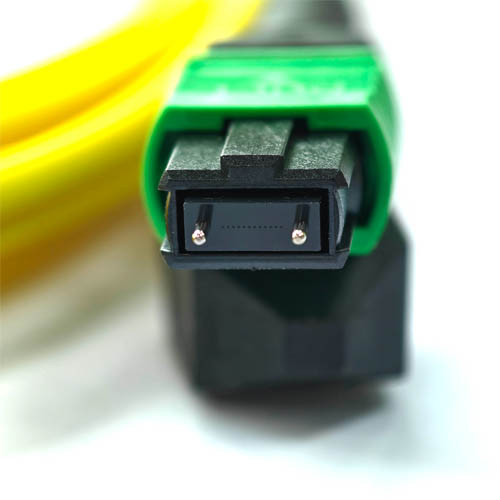
An MPO connector: ferrule type, end-face condition, and polarity are recorded at factory acceptance testing.
Limit to be aware of: a FAT is performed by the supplier. It is strong evidence of process control, but it is not independent evidence, and it should never be the only verification layer on a high-value project order.
Layer 2 — Third-Party Inspection Before Shipment
Independent inspection converts a supplier's claim into an external record. The buyer appoints the inspection body, defines the scope, and uses the report as a shipment release gate.
A workable inspection scope for MPO/MTP assemblies covers:
- Quantity and configuration accuracy against the purchase order (core count, fiber type, polish, length, breakout map)
- Labelling, serialized lot numbers, and traceability against the FAT records
- Packaging and coil or reel protection suitable for the chosen shipping mode
- Optical spot-check of insertion and return loss on an agreed sample size
- End-face condition and polarity verification
- LSZH jacket verification and RoHS documentation
Scheduling is the part buyers most often get wrong. Inspection has to be booked inside the production window, not after packing. Against a quoted lead time of 3–15 days there is very little slack, so the inspection date should be confirmed at order acknowledgment together with the sampling plan and the pass/fail thresholds.
Limit: sampling never covers every assembly, and inspection adds cost plus one or two days of schedule. It is most efficient as a release gate on a first order, a new configuration, or a re-order following any non-conformance.
Layer 3 — On-Site Acceptance After Arrival
The third layer closes the loop. Incoming acceptance should reconcile the physical shipment with the FAT and inspection records: counts, carton labels, serialized lots, then a defined percentage of insertion and return loss measurements plus polarity checks at the panel. End-to-end verification is what catches mapping errors that no individual cord test can reveal.
The value of that loop is documented in a high-density deployment where a data center operator and cloud service provider installed 12,000+ MPO-24 patch cords across 300+ cabinets for 400G spine-leaf interconnection. The assemblies were 100% factory tested with precision active alignment and insertion loss below 0.35 dB. The reported outcome was 60% faster deployment, four times higher port density, 99.999% uptime, and 30% lower total cost of ownership.
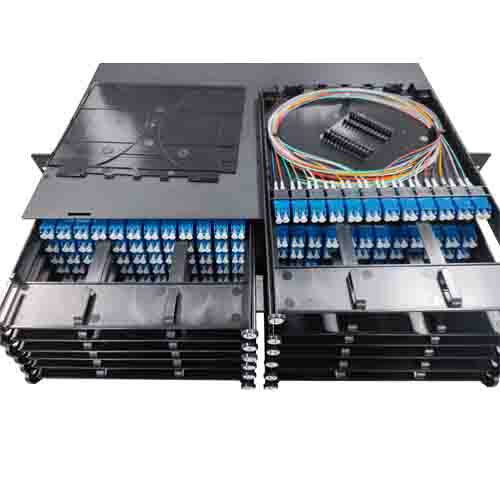
High-density MPO to LC patch panel: on-site acceptance verifies polarity, mapping, and loss against the FAT records.
The Acceptance Criteria Sheet to Attach to the Purchase Order
Every layer above needs a single reference document. The table below lists the criteria that belong in the purchase order for high-density MPO/MTP patch cords, and the layer at which each one is verified.
| Attribute | Specification to confirm | Verified at |
|---|---|---|
| Core count | 12 / 16 / 24 / 48 fibers | FAT, third-party check, on-site |
| Fiber type | OS2 (single-mode); OM3 / OM4 / OM5 (multi-mode) | FAT record |
| Insertion loss | ≤0.35 dB (Elite) or ≤0.5 dB (standard) | FAT, third-party spot check, on-site |
| Return loss | ≥60 dB (APC) or ≥50 dB (UPC) | FAT, third-party spot check |
| Connector and ferrule material | Zirconia ceramic ferrule; PBT / PEI housing | FAT, third-party visual check |
| Jacket | LSZH (low smoke zero halogen) | FAT, third-party verification |
| Operating temperature | -20°C to +70°C | Factory record, datasheet |
| Cable length | Customizable, 1 m to 100 m | Purchase order line item, on-site |
| Assembly standard | Telcordia GR-326 | Test report / certificate |
| Quality system | ISO9001 and ISO14001; ISO certificate reference HIC230831 | Documentation review |
| Materials compliance | RoHS compliant | Documentation |
| Testing coverage | 100% test | FAT records |
| Minimum order quantity | 2 units | Quotation |
| Lead time | 3–15 days | Quotation / contract |
| Production capacity | 200,000 units per month | Capacity statement |
| Shipping terms | EXW / FOB | Contract |
| Payment terms | T/T | Contract |
Step-by-Step: Building the Verification Process
The sequence below is what turns the three layers into a repeatable purchasing routine rather than a one-off favor from a supplier.
Step 1 — Put acceptance criteria in the RFQ, not in the invoice dispute
Issue the acceptance criteria sheet above as an attachment to the RFQ so that every supplier quotes against the same requirements. Suppliers unable to produce 100% test records or a Telcordia GR-326 aligned assembly will disqualify themselves at this stage, which saves evaluation time before pricing is compared.
Step 2 — Require a written FAT protocol and one completed sample record
Ask for the actual test record format, not a description of it. A useful record shows measured insertion and return loss values per assembly, an end-face result, polarity, and a serialized lot number that will match the carton label. If a supplier cannot send a redacted example of a completed record, the testing claim is unverified.
Step 3 — Verify the quality system documentation
ISO9001 and ISO14001 are the baseline management certificates. FOCC states both systems, and its ISO certificate reference HIC230831 should be checked against the issuing body's register, with the certificate scope covering the product family being purchased. A certificate whose scope excludes the ordered product is a documentation risk, not a compliance pass.
Step 4 — Book third-party inspection inside the production window
Against a 3–15 day lead time, inspection must be engaged at order confirmation. Fix the inspection date, the sampling plan, the measurement thresholds, and the report format in writing. The shipment should be contractually released only when the report is issued without open non-conformances.
Step 5 — Validate capacity against the project schedule
FOCC states a monthly capacity of 200,000 units and a minimum order quantity of 2 units, which means sample validation and volume supply sit on the same production line. Ask how your order is scheduled relative to existing commitments, and whether the delivery date assumes a single shipment or phased releases. A capacity figure is only useful if your order sits inside the schedule it describes.
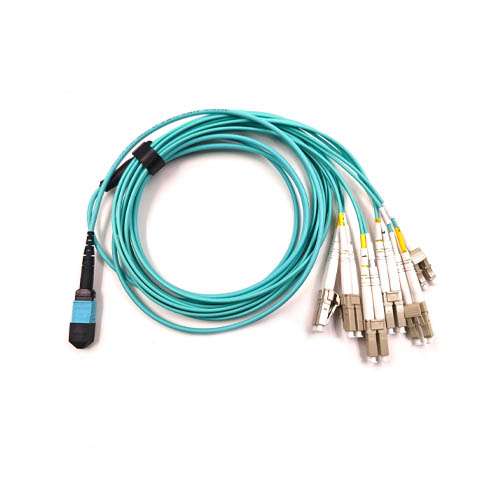
12-fiber MPO patch cords: under a 100% test protocol, every assembly is measured rather than sampled.
Step 6 — Lock shipping and payment terms against the risk you carry
EXW and FOB define where risk transfers; T/T defines the payment milestones. Under EXW or FOB the buyer carries the goods from an early point in the chain, which raises rather than lowers the value of pre-shipment verification: with no intermediate party checking the goods, the FAT record and the inspection report are the buyer's main protection.
Step 7 — Run on-site acceptance and close the loop
Compare received batches against the FAT records, measure the agreed sample, and document any discrepancy with photographs and instrument readings. FOCC provides remote after-sales support for technical issues encountered in the field. The loop is only closed when corrective-action evidence appears on the following order — that is the point at which verification starts reducing risk instead of merely recording it.
Use Cases: Where This Process Pays Off
Use case 1 — 400G spine-leaf build in a colocation or hyperscale data hall
This is the scenario where the three-layer model has the clearest documented return. Across 12,000+ MPO-24 patch cords and 300+ cabinets in a 400G spine-leaf topology, 100% factory testing combined with precision active alignment and sub-0.35 dB insertion loss supported 60% faster deployment, four times higher port density, and 30% lower total cost of ownership. At that scale, a single mis-mapped polarity batch can idle a commissioning team for days.
Use case 2 — Structured cabling refresh with breakout and panel mapping
Where MPO to LC breakout cords, MPO fiber distribution frame modules, and patch panels are combined, the acceptance emphasis shifts from individual cord performance to mapping accuracy. On-site acceptance at the panel is the layer that catches a breakout map built to the wrong standard, and it is the reason polarity verification belongs in the FAT protocol rather than in a field troubleshooting call.
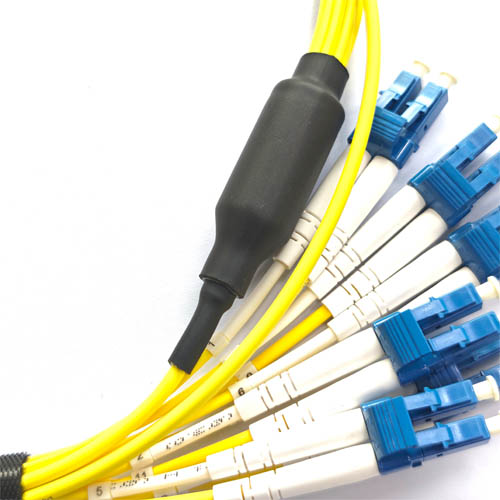
Breakout and fan-out assemblies are verified against the breakout map and polarity agreed in the purchase order.
Use case 3 — OEM and private-label programs
Customization changes the reference point for acceptance. When connector type, core count, transmission mode, logo printing, packaging, or certification documentation are customized, the FAT protocol has to reflect the customized bill of materials rather than the catalogue part number. A test record that describes a standard part does not verify a customized one.
Use case 4 — Urgent replenishment and spares
For replenishment, the leverage lies in capacity and lead time. A 3–15 day quoted lead time and the ability to accept a 2-unit order allow a buyer to validate a configuration quickly, then scale. On repeat orders where FAT records already exist for the same configuration, on-site acceptance can reasonably be narrowed to the affected batches instead of the full shipment.
Comparison Table: FAT vs. Third-Party Inspection vs. On-Site Acceptance
The three layers are complementary, not interchangeable. Each one has a different performer, timing, coverage, and failure mode.
| Dimension | Factory acceptance test (FAT) | Third-party inspection | On-site acceptance |
|---|---|---|---|
| Who performs it | Manufacturer quality team; FOCC states 100% test | Independent inspection body appointed by the buyer | Buyer's receiving or network team |
| Where and when | At the factory, before packing | At the factory, after production, before shipment | At the buyer's site, after arrival |
| Coverage | 100% of assemblies, per serialized lot | Agreed sampling plan, or 100% if specified | Defined percentage of assemblies plus end-to-end links |
| Typical evidence | Insertion and return loss records, end-face and polarity results, lot traceability, Telcordia GR-326 alignment | Inspection report with measurements, photographs, conformity statement | Receiving report, measurement log, discrepancy record |
| Main strength | Lowest cost, fastest, covers every unit | Independent of the supplier's own claims | Confirms what arrived and how it behaves on the panel |
| Main limit | Performed by the supplier | Sampling does not cover all units; adds cost and schedule time | Detects problems after shipping cost and lead time are spent |
| Best used for | Every order | First order, new configuration, or re-order after non-conformance | Every order, with tighter sampling on critical links |
FAQ
Which standards and certificates should be attached to an MPO/MTP acceptance plan?
Four groups are worth attaching to the purchase order as documentation deliverables. Connector intermateability is defined by IEC 61754-7 and TIA-604-5 (FOCIS 5). Assembly-level reliability for the patch cord is referenced to Telcordia GR-326, which applies across the MPO/MTP patch cord range. Material compliance is documented through RoHS. The manufacturer's quality system is documented through ISO9001 and ISO14001 — FOCC Fiber Co., Ltd states both systems, and its ISO certificate reference HIC230831 can be verified against the issuing body's register.
Can a supplier genuinely run 100% pre-shipment testing on 12, 24, and 48-fiber assemblies?
Testing every assembly is a capacity and process question rather than a marketing claim. FOCC states 100% test as its quality-control standard, supported by a monthly capacity of 200,000 units, a 5,000 m² production facility, and a 30-person R&D team for custom configurations. Buyers should verify three things: that the test record is tied to a serialized lot, that it shows measured values rather than a pass stamp, and that the same protocol applies to the exact configuration ordered — core count, polarity, and connector type included.
Which commercial terms actually carry the delivery risk?
The terms that matter most are minimum order quantity, lead time, Incoterms, and payment. FOCC quotes a 2-unit MOQ for sample validation, a 3–15 day lead time, EXW or FOB shipping, and T/T payment terms. The commercial consequence is direct: under EXW or FOB the buyer carries the goods from an early point, so a written FAT and, where the order justifies it, third-party inspection become the buyer's principal protection. Verification cost should therefore be evaluated against the cost of a rework or re-shipment cycle, not against unit price alone.
How should a buyer use a 2-unit sample order?
Treat it as a calibration step for the acceptance criteria rather than as a purchase. Order the exact configuration — fiber count, polish, polarity, length, jacket — measure insertion and return loss independently, inspect the end face, check labelling and lot traceability, and confirm the test record format that will accompany production orders. Because the MOQ is 2 units, a buyer can validate both a working pair and a cross-mated pair before committing to volume.
What lead-time and capacity language should be written into the contract?
Tie the schedule to numbers. A 3–15 day lead time and a 200,000-unit monthly capacity are the production-side commitments; the contract should state the delivery window, the inspection date, the shipment release condition, and the remedy if the release gate fails. On project work the release should be conditional on the FAT record and, where specified, the third-party report — so a shipment cannot leave the factory until the evidence does. To request a sample, a quotation, or the inspection documentation for a specific project, contact FOCC Fiber Co., Ltd at sales@mefiberoptic.com or +86 13823237984 on WhatsApp, or visit www.focc-fiber.com.
Conclusion
Delivery assurance for MPO/MTP patch cords is not a promise — it is a paper trail produced in a specific order. The factory acceptance test establishes that every assembly was measured against the agreed insertion and return loss grades, under a 100% test protocol and Telcordia GR-326 alignment. Third-party inspection gives that data an independent voice before the goods move. On-site acceptance confirms that what arrived matches what was tested, batch by batch and panel by panel.
For procurement teams working through the Research and Evaluation stages of a high-density project, the practical test of a supplier is therefore narrow and answerable: can they show you completed test records tied to serialized lots, hold an ISO9001 and ISO14001 management system with a verifiable certificate reference, deliver inside a stated 3–15 day window against 200,000 units of monthly capacity, and accept a 2-unit order so you can validate the configuration first? Suppliers who can answer all four convert a specification into a schedule you can defend.
Next Step: Validate Before You Commit
FOCC Fiber Co., Ltd supplies high-density MPO/MTP patch cords, mtp trunk cables, breakout assemblies, and connectors for data center and FTTA projects, with 100% pre-shipment testing and Telcordia GR-326 aligned assemblies.
Request a 2-unit sample, a project quotation, or the inspection documentation package for your configuration:
Email: sales@mefiberoptic.com | WhatsApp: +86 13823237984 | Web: www.focc-fiber.com

Contact FOCC Fiber Co., Ltd for MPO/MTP samples, quotations, and inspection documentation.
Note: Product specifications, certifications, capacity, and lead-time figures referenced in this article are based on FOCC Fiber Co., Ltd data and on third-party sources identified in the text. Market size estimates vary by scope of reporting.
Have Questions or Need More Details?
Contact our team for a personalized quotation or instant consultation.
Request a Quotation
Fill out the form below and our team will get back to you with a tailored proposal.
WhatsApp Direct Chat
Prefer to chat in real-time? Message us on WhatsApp for instant assistance & quick answers.
- Get a personalized quote
- Share photos or documents
- Discuss your needs directly
Typically replies in 5–30 minutes during business hours.