
MPO/MTP vs. LC/SC for High-Density Data Centers: A Side-by-Side Comparison
For high-density data centers, the choice between MPO/MTP patch cords and traditional LC/SC patch cords affects rack port density, deployment time, cable management, and cooling airflow. MPO/MTP multi-fiber patch cords are the space-efficient option for modern spine-leaf and server-switch fabrics when active equipment uses parallel optics. LC/SC patch cords remain a practical choice for individual-fiber access and for devices that do not yet offer native MPO/MTP ports.
This guide compares MPO/MTP and LC/SC patch cords for high-density data center environments using verified standards, market context, documented case data, and a step-by-step buyer evaluation framework.
Why the MPO/MTP vs. LC/SC Decision Matters in High-Density Environments
High-speed data center fabrics increasingly rely on parallel optics, which use multiple optical fibers to carry a single high-rate link. If each fiber pair is handled by a separate LC/SC patch cord, the number of cords grows with the port count and link speed. More cords mean more rack-front congestion, more pathways to manage, more bend-radius risks, and more air blockage inside cabinet rows.
MPO/MTP changes this by combining many fibers into a single connector interface. Instead of pulling multiple LC/SC duplex cords to support one parallel-optics link, a network team can install one multi-fiber patch cord. This reduces cable volume while preserving the optical connectivity required by high-density switching systems.
The decision is not simply legacy versus modern. It is a system-level choice that can make the difference between a clean, high-density build and an unmanageable tangle of individual cords.
Industry Context: Standardization and Adoption of MPO/MTP
The global MPO fiber optic connector market was estimated at approximately USD 2.1 billion in 2024 and is projected to grow to USD 3.2 billion by 2030, according to Strategic Market Research. Hyperscale data centers integrated MPO connectors in more than 70 percent of their facilities globally in 2024 to support parallel optics and high-density cabling, according to SkyQuest Technology.
Several additional verified market signals help explain why MPO/MTP has become central to data center planning:
- Asia-Pacific was the largest regional market for MPO connectors in 2024, accounting for approximately 42 percent of global share.
- Multimode MPO connectors dominate the product segment, holding more than 88 percent of the market because of high demand in short-range data center interconnects.
- MPO connectors are defined by IEC 61754-7 and TIA-604-5, also known as FOCIS 5, which supports intermateability across manufacturers.
- In 2024, hyperscale data center adoption confirms that MPO-based cabling is a mainstream high-density architecture, not an experimental approach.
These facts matter to a buyer because they show that MPO/MTP is not a proprietary single-vendor format. It is an international standard with a mature ecosystem and strong data center adoption.
Detailed Solution: How MPO/MTP Patch Cords Deliver High-Density Performance
What MPO/MTP Changes at the Physical Layer
A conventional LC or SC patch cord typically carries one fiber in a simplex connector or two fibers in a duplex connector. An MPO/MTP patch cord carries more fibers through a single multi-fiber connector. FOCC Fiber Co.,Ltd supplies MPO/MTP fiber optic patch cords in configurations that include 12-fiber patch cords and 24-fiber MPO-24 assemblies used in high-density data center projects.
For a high-density environment, the practical translation is direct: fewer patch cords are needed to achieve the same fiber connection count. Fewer patch cords reduce pressure on vertical cable managers, overhead trays, rack-front space, and airflow. This is why MPO/MTP has become a core building block for 400G spine-leaf interconnection and server-switch high-density cabling.
Documented Performance in a 400G Data Center Deployment
In a documented data center operator and cloud service provider project implemented in China, Singapore, and the United States, FOCC Fiber supplied more than 12,000 MPO-24 patch cords across more than 300 cabinets. The network environment included 400G spine-leaf interconnection and server-switch high-density cabling.
According to the project record, the MPO-24 patch cords used precision active alignment and achieved low insertion loss below 0.35 dB, with 100 percent factory testing. The deployment outcomes included 60 percent faster deployment, 4x higher port density, 99.999 percent uptime, and 30 percent lower total cost of ownership. The same project record notes a service period of more than five years and a 10-year design life.
This case is useful because it translates connector technology into asset-level results. Faster deployment affects project scheduling. Higher port density affects how many cabinets are required for a target number of switch ports. Lower total cost of ownership affects lifecycle budgeting.
Where LC/SC Remains Relevant
LC/SC patch cords are not obsolete. Many installed transceivers, patch panels, ODFs, and enterprise switches use LC/SC interfaces. If a data center has equipment with only LC/SC single-fiber or duplex-fiber ports, LC/SC patch cords remain the direct connection method.
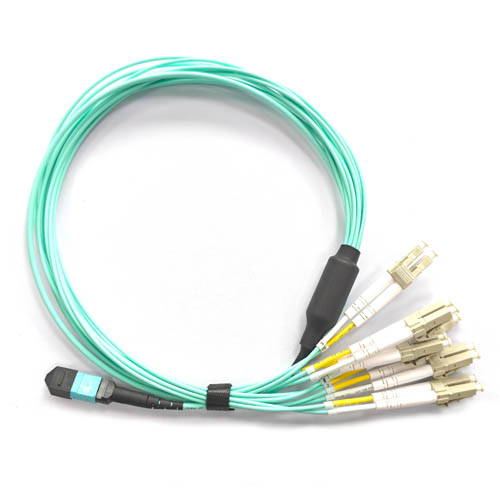
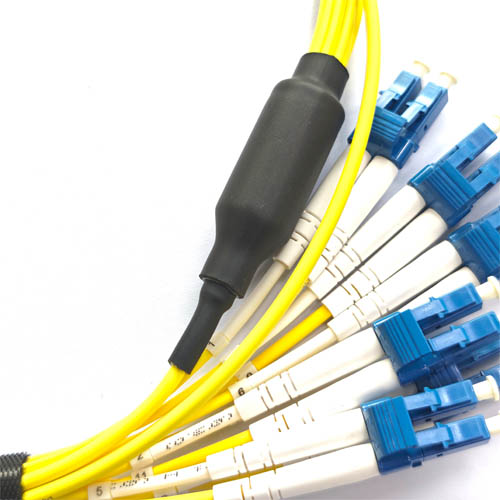
In mixed environments, MPO-to-LC breakout or fan-out patch cords connect MPO/MTP ports to LC/SC equipment. FOCC Fiber, for example, produces 12-fiber LC/UPC fan-out patch cords. This lets a data center migrate toward MPO/MTP at the switching layer while preserving connectivity to LC/SC endpoints.
Manufacturing and Customization Context
FOCC Fiber Co.,Ltd, founded in 2014, is a Shenzhen-headquartered manufacturer with a Guangzhou factory covering 5,000 square meters. The company states that it strictly implements ISO 9001 and ISO 14001 management systems, and it has more than ten years of professional ODM/OEM service experience. FOCC Fiber exports to more than 30 countries and regions, with partner clients including Prysmian, Siemens, Coherent, Fujikura, and NTT.
Customization options for MPO/MTP patch cords include length, connector type, core count, transmission mode, material, logo printing, certification, and packaging. Monthly production capacity is 200,000 units, with lead time of 3 to 15 days and a minimum order quantity of 2 units. Quality control includes 100 percent testing, 100 percent pre-shipment testing, optional third-party inspection, factory acceptance test, and on-site acceptance support.
Step-by-Step Buyer Evaluation for MPO/MTP Patch Cords
Use the following evaluation sequence when the project is moving from design into procurement and execution.
Step 1: Map Your Link Architecture and Equipment Ports
Identify which links are spine-leaf, server-to-switch, or storage connections. Check the transceiver optical interface. If the switch or transceiver port is MPO/MTP, an MPO/MTP patch cord is the natural match. If the endpoint port is LC/SC, plan an MPO-to-LC breakout or fan-out assembly.
Step 2: Verify Connector Standards
MPO connectors are standardized under IEC 61754-7 and TIA-604-5, also called FOCIS 5. The MTP connector is a registered trademark of US Conec and is an enhanced MPO version featuring a floating ferrule and elliptical guide pins for improved optical performance. MPO/MTP patch cords should be treated as multi-fiber assemblies where connector quality, ferrule alignment, and polish directly influence link loss.
Step 3: Choose Fiber Count and Transmission Mode
Common MPO/MTP patch cords are available in 12-fiber and 24-fiber versions. FOCC Fiber products include 12-fiber MPO patch cords, 24-fiber MPO-24 assemblies, and MPO-to-LC fan-out patch cords. For typical short-reach data center links, multimode MPO dominates because of high demand in short-range interconnects. For longer-distance or external routes, single-mode requirements should be confirmed against the active optics before ordering.
Step 4: Set Optical Performance and Test Criteria
Set an insertion-loss threshold that fits the transceiver design. In the documented FOCC MPO-24 deployment, insertion loss was measured below 0.35 dB. Insist on 100 percent factory tests and request test reports with the shipment. If the order is large, use third-party inspection or factory acceptance testing to validate conformity before delivery.
Step 5: Evaluate OEM/ODM Engineering Capability
Check whether the manufacturer can support customization, not just standard catalog products. FOCC Fiber offers customization of length, connector type, core count, transmission mode, material, logo printing, certification, and packaging. A manufacturer with in-house production control and custom assembly experience is better positioned to match unusual patch cord layouts.
Step 6: Confirm Capacity, Lead Time, and Commercial Terms
FOCC Fiber’s monthly capacity is 200,000 units, with lead time of 3 to 15 days and an MOQ of 2 units. Delivery methods include EXW and FOB. Payment is T/T. For execution, buyers can request pre-shipment test records, third-party inspection, factory acceptance test, on-site acceptance, and remote support after delivery.
Use Case: 400G Spine-Leaf Build with MPO-24 Patch Cords
A practical high-density use case comes from a FOCC Fiber project with a data center operator and cloud service provider in China, Singapore, and the United States. More than 12,000 MPO-24 patch cords were used across more than 300 cabinets. The application was 400G spine-leaf interconnection and server-switch high-density cabling. The case record reports four outcomes that align closely with the goals of a high-density data center owner:
- 60 percent faster deployment, which shortens the time between cabinet installation and service turn-up.
- 4x higher port density, which enables more ports in the same physical space.
- 99.999 percent uptime, which indicates reliability at the physical layer.
- 30 percent lower total cost of ownership, supported by lower installation labor, less cabling, and reliable link performance.
A buyer should note that these results came from MPO-24 assemblies with low insertion loss below 0.35 dB, precision active alignment, and 100 percent factory testing.
| Comparison Dimension | MPO/MTP Patch Cords | Traditional LC/SC Patch Cords |
|---|---|---|
| Connector architecture | Multi-fiber push-on connector designed for parallel optics and high-density cabling. | Simplex or duplex connector family commonly used for individual fiber or fiber-pair connections. |
| Typical fiber count per assembly | 12 or 24 fibers in common FOCC MPO/MTP patch cord versions. | One fiber per simplex cord or two fibers per duplex cord in conventional LC/SC construction. |
| High-speed data center role | Used in documented 400G spine-leaf and server-switch high-density cabling. | Common for LC/SC-based endpoints and lower-density or legacy equipment. |
| Space and port density | Documented MPO-24 deployment achieved 4x higher port density across more than 300 cabinets. | More patch cords are needed to provide the same overall fiber count in dense parallel-optics designs. |
| Deployment speed | Documented 60 percent faster deployment in a large MPO-24 environment. | No identical benchmark is included in this comparison; deployment effort depends on port count and cable routing. |
| Optical loss evidence | FOCC MPO-24 patch cords delivered insertion loss below 0.35 dB and were 100 percent factory tested. | LC/SC loss values vary by connector type, polish, and manufacturing quality. |
| Migration path | MPO-to-LC breakout or fan-out patch cords allow MPO/MTP switch ports to connect to LC/SC devices. | LC/SC ports remain important on many installed switches, patch panels, and transceiver modules. |
Comparison values shown for MPO/MTP are based on the documented FOCC data center deployment and FOCC product configuration facts included in this article. LC/SC rows describe general connector behavior rather than a specific competitor product test.
Buyer Checklist for High-Density Data Center Procurement
- Use MPO/MTP patch cords when switch ports and transceivers use parallel optics and require high-density cabling.
- Use MPO-to-LC breakout or fan-out patch cords when connecting MPO/MTP ports to equipment that only supports LC/SC interfaces.
- Check that MPO/MTP connectors follow IEC 61754-7 and TIA-604-5 to support intermateability.
- Confirm whether the MTP designation is required; understand that MTP is an enhanced MPO connector version trademarked by US Conec.
- Select either 12-fiber or 24-fiber assemblies based on switch port density and transceiver requirements.
- Set an insertion-loss requirement such as the below-0.35 dB value demonstrated in the documented MPO-24 deployment.
- Require 100 percent factory testing and request pre-shipment test records or third-party inspection.
- Evaluate manufacturer customization, including length, connector type, core count, transmission mode, material, logo printing, certification, and packaging.
- Confirm capacity, lead time, payment terms, delivery terms, and after-sales support before finalizing the order.
- Start with a small MOQ or sample validation before committing to a large deployment.
FAQ
What is the practical difference between MPO/MTP patch cords and LC/SC patch cords?
MPO stands for multi-fiber push-on, and MTP is an enhanced MPO connector version developed by US Conec. An MPO/MTP patch cord typically brings 12 or 24 fibers together in one connector, which reduces cable count in high-density environments. LC and SC patch cords are more conventional simplex or duplex fiber connections. The main practical difference is fiber density per connector: MPO/MTP supports more fibers in a single interface, while LC/SC supports one or two fibers per conventional patch cord.
Can MPO/MTP patch cords connect to LC/SC equipment?
Yes. MPO-to-LC breakout or fan-out patch cords connect a multi-fiber MPO/MTP port on the switch side to multiple LC/SC ports on the equipment side. FOCC Fiber provides 12-fiber LC/UPC fan-out patch cords for this purpose. This allows a data center to use MPO/MTP in the high-density portion of the network while still supporting LC/SC interfaces where required.
What standards govern MPO connector intermateability?
MPO connectors are governed by IEC 61754-7 and TIA-604-5, also known as FOCIS 5. These standards support intermateability across different manufacturers. The MTP connector, as an enhanced MPO version, maintains compatibility with the MPO standard while incorporating design improvements such as a floating ferrule and elliptical guide pins.
Do MPO/MTP patch cords really save space in a data center?
In a documented FOCC Fiber deployment for a data center operator and cloud service provider, more than 12,000 MPO-24 patch cords were installed across more than 300 cabinets for 400G spine-leaf interconnection. The project record reports 4x higher port density and 60 percent faster deployment. These outcomes indicate that MPO/MTP reduces the number of patch cords needed for dense parallel-optics links, which supports space efficiency and cable manageability.
What should a buyer evaluate when sourcing MPO/MTP patch cords from an OEM/ODM manufacturer?
Buyers should evaluate standards compliance, optical test data, customization capability, production capacity, and execution terms. FOCC Fiber Co.,Ltd offers OEM/ODM support with customization of length, connector type, core count, transmission mode, material, logo printing, certification, and packaging. Monthly capacity is 200,000 units, lead time is 3 to 15 days, MOQ is 2 units, and delivery is available under EXW or FOB terms. Buyers can also request 100 percent pre-shipment testing, third-party inspection, factory acceptance test, on-site acceptance, and remote support.
Bottom Line
For new high-density data center networks, MPO/MTP patch cords provide a clear space and deployment advantage when the optics and switch ports support multi-fiber parallel connectivity. The verified example in this guide shows that MPO-24 assemblies can support 400G spine-leaf traffic, achieve low insertion loss, and deliver faster deployment and higher port density. LC/SC patch cords remain a relevant connection method for LC/SC-based equipment, but MPO-to-LC breakout and fan-out products bridge the two environments without forcing a rip-and-replace approach.
FOCC Fiber Co.,Ltd supplies MPO/MTP fiber optic patch cords, MPO-to-LC fan-out assemblies, and 12-fiber and 24-fiber patch cord options with OEM/ODM support and 100 percent factory testing. To request a specification check or sample order for a high-density data center project, contact sales@mefiberoptic.com or WhatsApp +86 13823237984.
Need a custom MPO/MTP or MPO-to-LC breakout patch cord specification for your data center?
Email: sales@mefiberoptic.com
WhatsApp: +86 13823237984
Website: www.focc-fiber.com
Have Questions or Need More Details?
Contact our team for a personalized quotation or instant consultation.
Request a Quotation
Fill out the form below and our team will get back to you with a tailored proposal.
WhatsApp Direct Chat
Prefer to chat in real-time? Message us on WhatsApp for instant assistance & quick answers.
- Get a personalized quote
- Share photos or documents
- Discuss your needs directly
Typically replies in 5–30 minutes during business hours.