
MTP/MPO Patch Cords Explained: A Buyer's Introduction to High-Density Fiber Connectivity
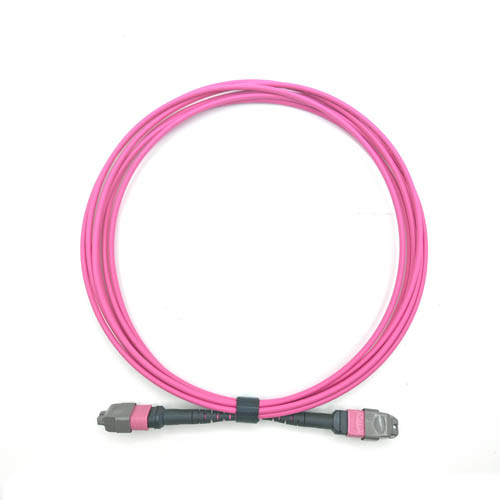
MPO fiber optic patch cord – one connector, multiple fibers.
MPO and MTP patch cords are high-density fiber optic cables that consolidate multiple fibers into a single connector interface. They are widely used in data centers and, increasingly, in 5G fiber-to-the-antenna (FTTA) networks. This guide explains what MTP/MPO patch cords are, the difference between MPO and MTP, available configurations, and what to consider when evaluating suppliers.
Why MTP/MPO Patch Cords Matter
Fiber optic network designers and procurement teams often face the challenge of managing large numbers of fibers in limited rack space. Traditional LC/SC duplex patch cords require one connector per fiber, making high-density deployments difficult to cable, cool, and maintain. MTP/MPO patch cords address this by integrating 12, 16, 24, or 48 fibers into one connector, simplifying cable management and reducing installation time.
For buyers at the research stage, the challenge is not just choosing a cable; it is understanding the options so the right product is selected for a specific network architecture. This article covers the fundamentals: what these cables are, how they differ from conventional patch cords, what specifications matter, and where they are used.
Industry Background: The Growing Role of MPO Connectivity
The global MPO fiber optic connector market reflects this shift toward high-density networking. According to Strategic Market Research, the market was estimated at approximately USD 2.1 billion in 2024 and is projected to grow to USD 3.2 billion by 2030. Asia-Pacific is the largest regional market, accounting for about 42% of the global share in 2024, followed by North America, according to Valuates Reports.
Product-level data shows that multimode MPO connectors dominate the segment, holding more than 88% of the market due to demand in short-range data center interconnects. SkyQuest Technology also reports that over 70% of hyperscale data centers globally used MPO connectors in 2024 to support parallel optics and high-density cabling.
From a standards perspective, MPO connectors are defined by international standards IEC 61754-7 and TIA-604-5 (FOCIS 5), which ensure intermateability across different manufacturers. This means buyers are not locked into a single connector vendor for the physical interface. At the connector component level, US Conec and Senko are key market leaders, with US Conec holding approximately 18% and Senko nearly 15% of the global MPO connector market in 2024, according to SkyQuest Technology.
What Is an MTP/MPO Patch Cord?
An MPO patch cord is a multi-fiber optical cable terminated with MPO connectors on one or both ends. It is factory-terminated and available in various configurations, including trunk cables, breakout cables, and test cables. The connector housing contains a ferrule with multiple fiber bores, allowing many fibers to be mated simultaneously in a single plug-in action.
MTP is a registered trademark of US Conec and is an enhanced version of the MPO connector. It features a floating ferrule and elliptical guide pins designed to improve optical performance while remaining intermateable with standard MPO connections. In practice, “MPO” is the generic standard, and “MTP” refers to the enhanced connector design from US Conec.
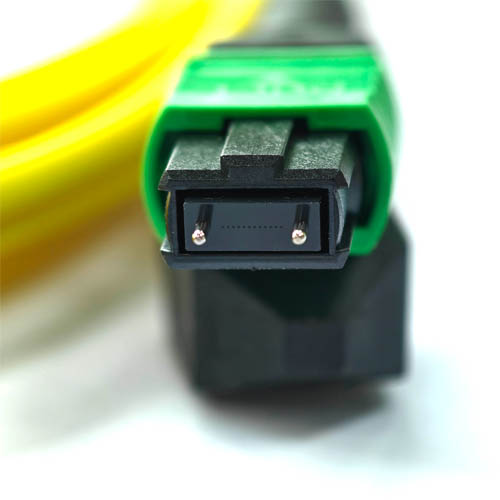
MPO connector close-up: the multi-fiber interface replaces many individual connectors.
Common MPO Patch Cord Configurations
- MPO to MPO trunk cable: Connects MPO patch panels directly, ideal for backbone cabling.
- MPO to LC breakout/fan-out cable: Converts a multi-fiber MPO interface into LC duplex connections for switches, servers, or transceivers.
- MPO test patch cord: Used to validate trunk or breakout links during installation and troubleshooting.
- High-density MPO patch cables: Available in 12-fiber, 24-fiber, and 48-fiber versions to match parallel optics architectures.
- Flexible MPO patch cables: Designed for easier routing in dense cable trays and overhead pathways.
Technical Specifications to Understand
When evaluating MPO/MTP patch cords, buyers should compare core count, fiber type, insertion loss, return loss, operating temperature, jacket material, and compliance with relevant standards.
FOCC Fiber Co.,Ltd manufactures MPO/MTP fiber optic patch cords with model designations such as MPO-12-OS2-APC, MTP-24-OM4-UPC, and MTP-48-OM3-UPC. The standard offering supports core counts of 12, 16, 24, or 48, and fiber types OS2 (single-mode) or OM3, OM4, and OM5 (multimode). Insertion loss is ≤0.35 dB for Elite grade and ≤0.5 dB for standard grade, while return loss is ≥60 dB for APC and ≥50 dB for UPC. The cables operate in temperatures from -20°C to +70°C, are available in customizable lengths from 1 to 100 meters, and use LSZH (Low Smoke Zero Halogen) jackets with zirconia ceramic ferrules.
For outdoor FTTA applications, FOCC Fiber’s Outdoor Waterproof FTTA Fiber Optic Patch Cord provides IP67/IP68 protection and is designed to operate from -40°C to +75°C. Its tensile strength is ≥1000 N, making it suitable for outdoor base station and antenna interconnection. Model designations include ODC-APC-Fullax-APC-OS2 and ODC-UPC-Optitab-UPC-OM3.
How to Choose an MTP/MPO Patch Cord: Step-by-Step
The selection process can be broken down into seven practical steps.
- Determine fiber type. Choose OS2 single-mode for long-distance or DWDM applications, or OM3/OM4/OM5 multimode for short-reach data center links. FOCC Fiber offers both single-mode and multimode options.
- Determine fiber count. Evaluate your equipment port density and future migration path. Common choices are 12, 16, 24, or 48 fibers.
- Select connector polish. APC polish provides ≥60 dB return loss for single-mode; UPC polish provides ≥50 dB return loss and is common for multimode.
- Choose assembly type. Decide between MPO-MPO trunk cables and MPO-LC breakout/fan-out cables based on your network topology.
- Define performance grade. If the link is sensitive to loss, specify Elite grade with insertion loss ≤0.35 dB; otherwise standard grade with ≤0.5 dB may be sufficient.
- Verify compliance and jacket. Look for IEC 61754-7, TIA-604-5, Telcordia GR-326, RoHS compliance, and LSZH jacket for plenum or indoor environments.
- Evaluate the manufacturer. Confirm experience, quality systems, capacity, and ODM/OEM capability. FOCC Fiber Co.,Ltd has more than ten years of industry experience, a 30-person R&D team, and annual production capacity of about 2,000,000 units.
Use Cases for MPO/MTP Patch Cords
High-Density Data Centers
Data center cabling is the largest application area for MPO/MTP patch cords. These cables support 400G and 800G high-speed optical transmission, cloud server interconnection, and storage area networks. Low insertion loss, high return loss, and LSZH flame-retardant jackets are key requirements in clean data center environments.
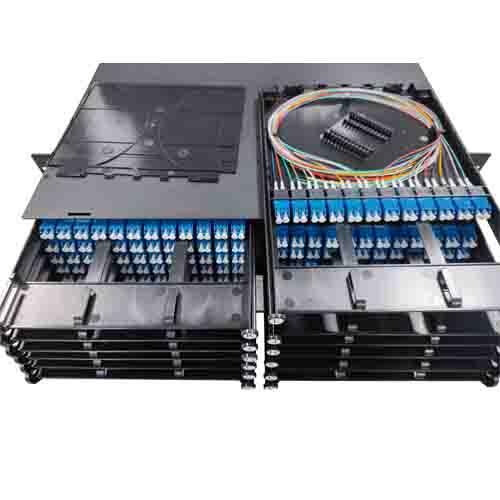
High-density MPO-LC patch panel used in data center cabling.
5G FTTA and Outdoor Networks
MPO technology is also used outdoors in fiber-to-the-antenna (FTTA) architectures. Outdoor waterproof patch cord assemblies protect connections from rain, dust, UV exposure, and mechanical vibration. The FTTA patch cords from FOCC Fiber offer IP67/IP68 protection, wide temperature tolerance, and high tensile strength for reliable 5G base station RRU/AAU interconnection.
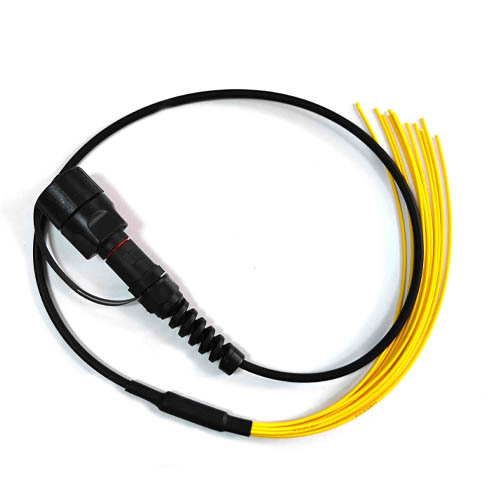
Outdoor waterproof MPO fan-out patch cord for FTTA deployments.
MPO vs. MTP: Comparison Table
| Aspect | MPO | MTP |
|---|---|---|
| Definition | Generic multi-fiber push-on connector standardized by IEC 61754-7 and TIA-604-5 | US Conec registered brand, enhanced version of MPO |
| Design features | Standard multi-fiber ferrule | Floating ferrule and elliptical guide pins |
| Interoperability | Designed to intermate across manufacturers | Compatible with standard MPO interfaces |
| Typical use | High-density data center and telecom cabling | Same applications, with enhanced optical performance |
Frequently Asked Questions
What is an MPO patch cord?
An MPO patch cord is a multi-fiber optical cable terminated with MPO connectors on one or both ends. It consolidates multiple fibers into a single connector interface, reducing the number of connectors needed in high-density installations. MPO connectors are standardized under IEC 61754-7 and TIA-604-5.
What is the difference between MPO and MTP?
MTP is a trademarked brand of US Conec and is an enhanced version of the MPO connector. It includes a floating ferrule and elliptical guide pins designed to improve optical performance, while remaining intermateable with standard MPO connections.
What fiber counts and fiber types are available for MPO patch cords?
Common configurations include 12, 16, 24, and 48 fibers. Fiber types include OS2 single-mode and OM3, OM4, or OM5 multimode. FOCC Fiber offers these configurations in its MPO/MTP patch cords, with model examples such as MPO-12-OS2-APC, MTP-24-OM4-UPC, and MTP-48-OM3-UPC.
What are the typical insertion loss and return loss for MPO patch cords?
Typical insertion loss is ≤0.35 dB for Elite grade and ≤0.5 dB for standard grade. Return loss is ≥60 dB for APC polish and ≥50 dB for UPC polish. These values are suitable for high-speed data center links.
What are the main applications of MPO/MTP patch cords?
They are used in high-density data center cabling for 400G/800G optical transmission, and in outdoor 5G FTTA networks when packaged as waterproof assemblies. FOCC Fiber also produces outdoor waterproof FTTA patch cords with IP67/IP68 rating and -40°C to +75°C operating range.
How can I request MPO/MTP patch cord samples or a quote?
Contact FOCC Fiber Co.,Ltd at sales@mefiberoptic.com or call/WhatsApp +86 13823237984. Share your required fiber count, fiber type, polarity, length, and application to receive a suitable quotation for your project.
Choosing a Manufacturer for MTP/MPO Patch Cords
When selecting a supplier, buyers should consider manufacturing experience, quality systems, R&D capability, and production capacity. FOCC Fiber Co.,Ltd. was established in 2014 and has more than ten years of experience in the fiber optic industry. The company operates a 5,000 square meter manufacturing facility with approximately 200 employees, a 30-person R&D team, and annual production capacity of about 2,000,000 units.
FOCC Fiber’s products are fully exported, with major markets in the EU and the USA. The company follows ISO9001 and ISO14001 management systems and has over ten years of ODM/OEM service experience. Its main products include high-performance fiber optic connectors, MTP/MPO fiber optic patch cords, outdoor waterproof patch cord assemblies, and armored patch cords for data center and FTTA solutions.
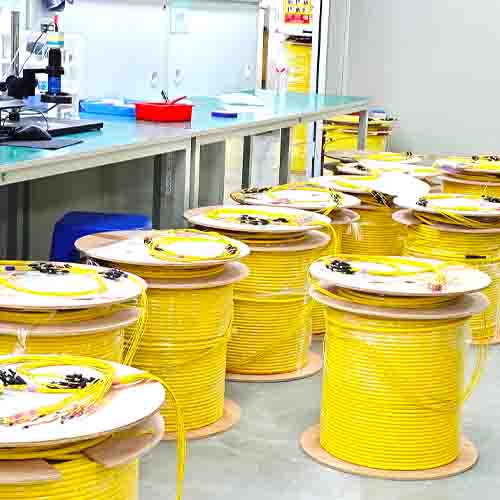
MPO/MTP patch cord manufacturing at FOCC Fiber.
Need MPO/MTP patch cords for your project?
FOCC Fiber Co.,Ltd supplies high-density MPO/MTP fiber optic patch cords and outdoor waterproof FTTA assemblies. Contact us for samples, quotations, or technical support.
Email: sales@mefiberoptic.com | Phone/WhatsApp: +86 13823237984
Conclusion
MTP/MPO patch cords are a practical solution for high-density fiber connectivity in data centers and 5G networks. They reduce cable volume, simplify installation, and enable parallel optical architectures that support higher data rates. For buyers in the research stage, understanding fiber type, fiber count, connector polish, performance grade, and compliance is critical to making the right procurement decision.
By working with an experienced manufacturer that offers tested products and responsive support, buyers can reduce risk and improve long-term network reliability. FOCC Fiber Co.,Ltd provides MTP/MPO patch cords and outdoor FTTA assemblies for B2B customers, with export experience in the EU and USA. Reach out to FOCC Fiber to discuss your specific high-density cabling requirements.
Have Questions or Need More Details?
Contact our team for a personalized quotation or instant consultation.
Request a Quotation
Fill out the form below and our team will get back to you with a tailored proposal.
WhatsApp Direct Chat
Prefer to chat in real-time? Message us on WhatsApp for instant assistance & quick answers.
- Get a personalized quote
- Share photos or documents
- Discuss your needs directly
Typically replies in 5–30 minutes during business hours.