
Pre-Terminated vs Field-Terminated FTTA Cables: Which Wins on 5G Towers?
A tower-top FTTA termination has only two possible origins: it was built and tested in a factory, or it was assembled by a technician at height. That single decision drives installation time, optical performance consistency, weather resilience, and the maintenance cost of the site for the next decade.
For 5G RRU and AAU connections, the pre-terminated outdoor FTTA patch cord wins on four of the five criteria that decide execution cost: plug-and-play deployment speed, connector quality control, environmental durability, and lifetime maintenance economics. Field termination keeps a narrower but real role — emergency restoration, non-standard routing, prototype builds, and sites where certified splicing crews and tooling are already in place.
This guide walks the deciding criteria one by one, grounds the verdict in a deployment record of more than 50,000 outdoor waterproof patch cords across more than 20,000 5G base stations, and closes with a selection checklist plus the sourcing terms that support execution.
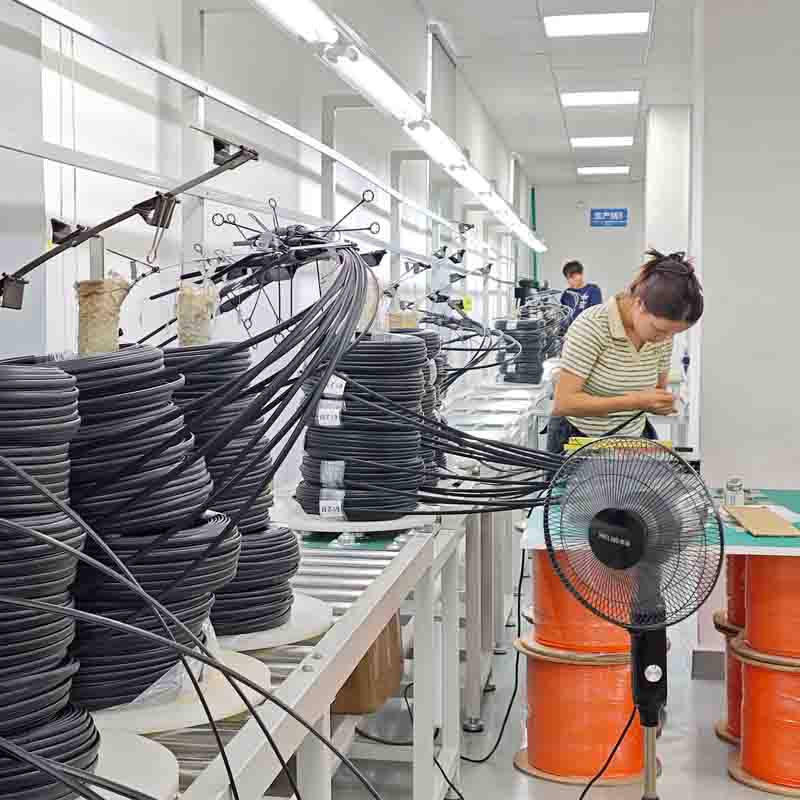
Why the termination decision is a tower-level risk, not a cable-level detail
The failure modes of outdoor FTTA links are predictable: waterproof seal failure, fiber breakage under tensile load, performance degradation in extreme temperatures, and corrosion of metal components. Every one of those risks is created or eliminated at the point where the connector meets the cable — which is exactly the point that changes when termination moves from the factory to the tower.
Waterproof seal failure and corrosion tend to surface months after installation. Fiber breakage under tensile load surfaces the first time a cable is pulled, re-routed, or a tower is serviced. Both translate into a truck roll, a climb, and a service window. That is why termination quality behaves like an operating-cost decision rather than a component decision.
The control methods for this risk class are known: IP67/IP68 hermetic sealing, reinforced tensile strength design, wide-temperature-range material selection, and corrosion-resistant plating. The question this article answers is which termination route actually delivers them at scale.
The market behind the FTTA termination choice
FTTA — Fiber To The Antenna — carries the fronthaul link from the baseband unit to the remote radio unit or active antenna unit mounted at the top of the tower. The underlying cable market keeps expanding: the global fiber optic cable market was estimated at USD 13.45 billion in 2025, with a projected CAGR of 11.72% through 2034 (Custom Market Insights).
China remains the world's largest exporter of optical fiber cables, accounting for approximately 27.1% of global exports in 2024, valued at USD 2.52 billion (Observatory of Economic Complexity). In practice, that means the pre-terminated assemblies most operators procure trace back to a concentrated manufacturing base — so the termination decision is also a supplier-selection decision.
Two definitions, one interface
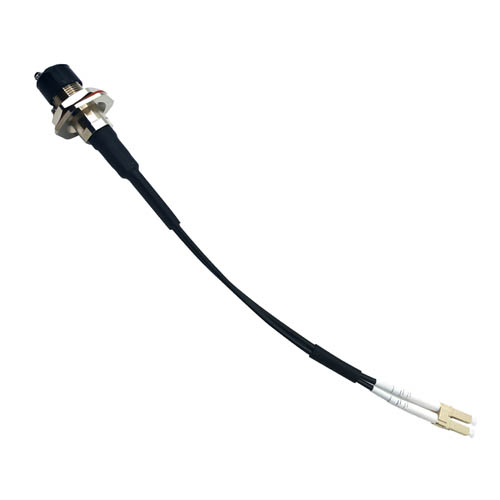
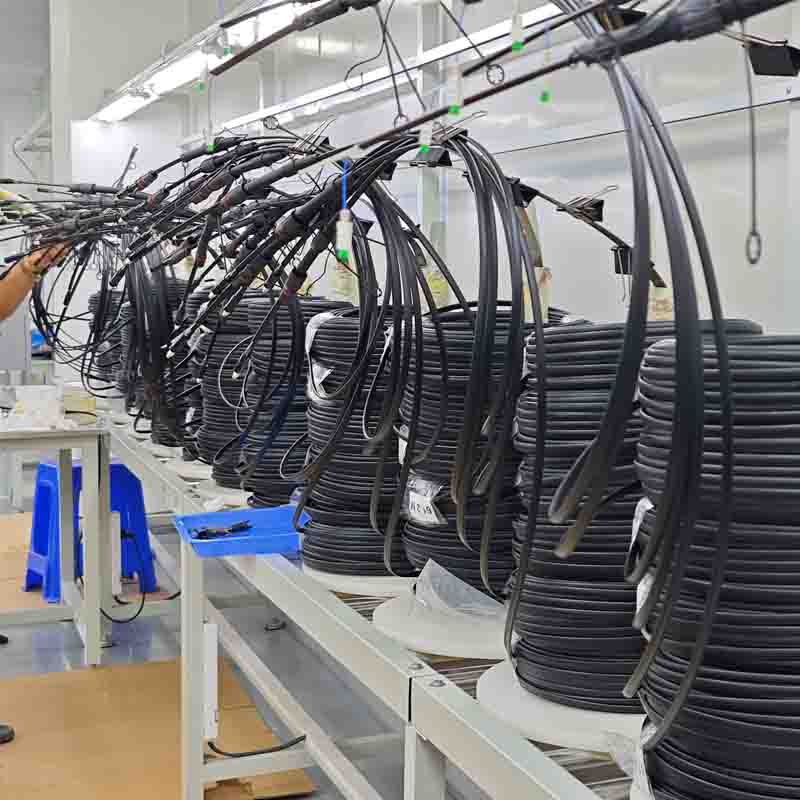
Pre-terminated FTTA patch cord: a factory-assembled outdoor fiber assembly in which the cable, connector, sealing, and strain relief are built, polished, and tested as a single unit before shipment. It arrives at the site ready to mate with the baseband unit and the RRU/AAU.
Field-terminated assembly: a length of outdoor fiber cable that is terminated on site by a technician using a splicing or connector-installation kit. The connector's optical and mechanical performance is created at the tower, not in the factory.
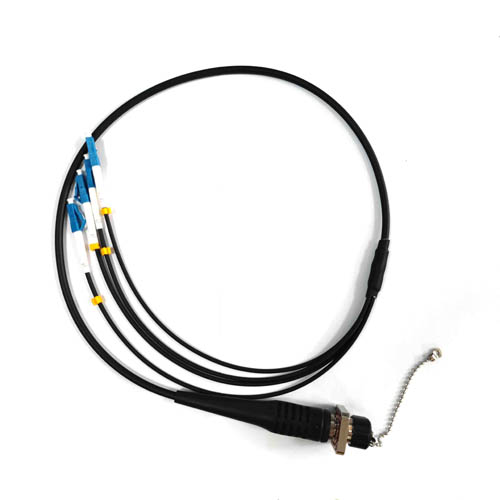
Common connector types used on 5G base stations include ODC (Optical Distribution Connector), FullAXS, NSN-LC duplex, and ODVA fan-out connectors, all typically specified with IP67/IP68 ratings.
Criterion 1 — Deployment speed and plug-and-play installation
Pre-terminated assemblies remove the termination step from the tower entirely. The crew uncoils, routes, mates, and secures; there is no splicing, no polishing, no consumables, and no cure time at height. Because the assembly is a single tested unit, installation and link verification can be completed within one climb.
Field termination pushes craft work into the least favorable environment in the network. Tower-top work windows are short and weather-dependent, and every additional step — stripping, cleaning, cleaving, polishing, curing, testing — is another opportunity for contamination and another possible rework loop. Repeated across a rollout program, the schedule variance of field termination compounds at every site.
There is also a skills dependency. A pre-terminated assembly performs to the same specification regardless of who installs it. A field-terminated assembly performs to the specification of the technician who happened to be on that tower that day.
Criterion 2 — Connector quality control: factory testing vs field variability
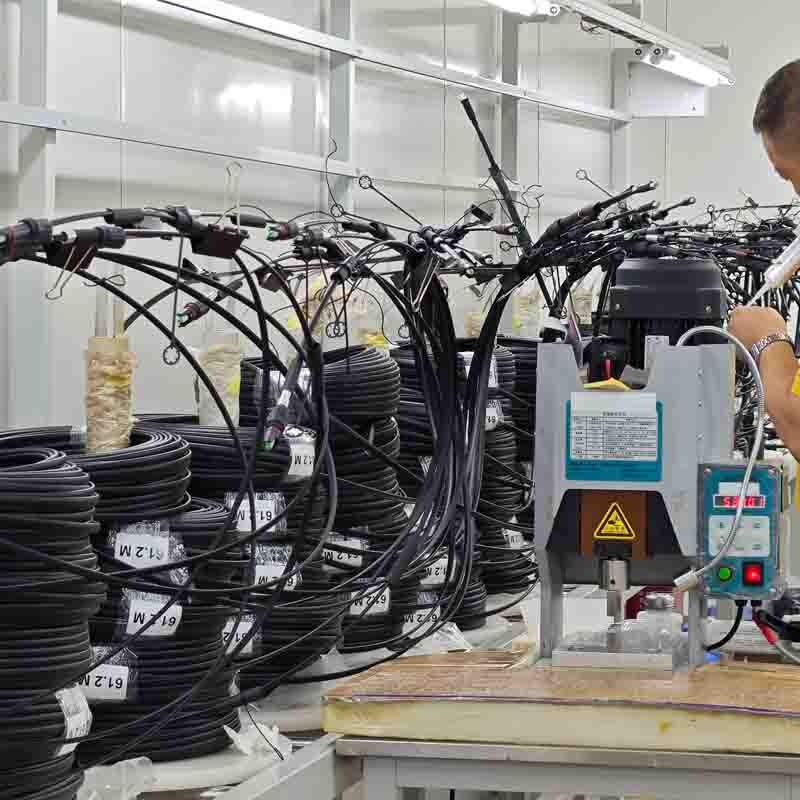
Optical performance of a factory assembly is controlled by process, not by the day's conditions. Precision polishing, active alignment technology, and crosstalk suppression design are applied in a fixed environment, and each assembly is then validated by 100% insertion loss testing, automated alignment inspection, and high-speed signal integrity validation.
The specific failure modes being controlled are multi-core alignment error, insertion loss drift, and crosstalk at high-speed transmission. A per-assembly factory test catches those issues before shipment; a field terminating process catches them only if the technician happens to run the same test on the same day, on a tower, in the weather.
Field termination produces a distribution of outcomes rather than a specification. Insertion loss depends on cleave angle, polish geometry, ferrule contamination, and experience. One tower may land well inside the loss budget; the next may not. Without per-assembly factory testing, the network absorbs that variance as degraded links, retests, and rework.
In like-for-like outdoor comparisons, factory pre-terminated assemblies also deliver 0.3 dB lower signal loss than conventional outdoor patch cords, which reduces the need for additional signal amplification.
Criterion 3 — Environmental durability on the tower
Tower-top hardware stays outdoors for a decade. The relevant specification set is waterproofing, mechanical strength, temperature range, and corrosion resistance — and pre-terminated outdoor FTTA assemblies are engineered against all four at the factory.
Armored LSZH outdoor FTTA cables carry a tensile strength of at least 1000 N and an operating temperature range of -40 °C to +75 °C. Compared with conventional IP65 patch cords, they provide 200 N higher tensile strength and a ±20 °C wider operating temperature range. Sealing is specified at IP67/IP68 rather than IP65.
The FullAXS connector system is designed for IP67/IP68 waterproof protection and salt-mist resistance, and complies with IEC 61300-2 environmental testing standards. Factory qualification for these assemblies typically covers IP68 waterproof testing, tensile strength qualification, thermal cycling testing, and salt spray corrosion testing — the four tests that map directly onto the four failure modes above.
Field termination moves the sealing and strain-relief interface into the hands of the installer. Sealing depends on how the boot and mastic were applied that day; strain relief depends on how the connector body was anchored to the jacket. These are precisely the two interfaces linked to waterproof seal failure and fiber breakage under tensile load, and they are the two interfaces a factory can control and a tower cannot.
Criterion 4 — Lifetime maintenance economics
Upfront cost is where field termination looks better. Lifetime cost is where it does not.
Armored pre-terminated outdoor FTTA assemblies typically carry a 10–15% higher upfront cost than conventional IP65 outdoor patch cords. Against that premium: an 80% lower field failure rate, 40% lower maintenance costs, an on-site replacement time of under 10 minutes, and a 10-year service life with anti-aging design, compared with 5 years for conventional patch cords.
The mechanism is straightforward. Every tower-top failure consumes a climb, a service window, and a spare part. A plug-and-play replacement that takes under 10 minutes can be folded into routine site activity. A field-terminated repair requires a termination kit, a skilled technician, and a longer window — and often a second visit if the first termination retests out of budget. Where a pre-terminated assembly fails, the repair is a swap; where a field-terminated assembly fails, the repair is a re-termination.
Head-to-head comparison
| Criterion | Pre-terminated factory FTTA assembly | Field-terminated assembly |
|---|---|---|
| Where the connector is built | Factory, on calibrated assembly and polishing lines | On site, by a technician with a termination kit |
| Insertion loss control | 100% insertion loss testing, automated alignment inspection, high-speed signal integrity validation | Depends on field craft, cleave and polish quality, and contamination control |
| Signal loss vs conventional outdoor patch cords | 0.3 dB lower signal loss | Not fixed per assembly |
| Ingress protection | IP67/IP68 sealing, backed by IP68 waterproof testing | Depends on field-applied sealing and booting |
| Tensile strength | At least 1000 N with reinforced strain relief | Depends on field-installed strain relief |
| Operating temperature | -40 °C to +75 °C; ±20 °C wider than conventional IP65 patch cords | Depends on cable and field materials |
| Environmental qualification | Salt spray corrosion testing, thermal cycling testing, tensile strength qualification | Per-assembly factory qualification not available |
| Installation method | Plug-and-play mating | Splicing, polishing, and testing on site |
| Replacement time | Under 10 minutes on site | Longer; requires kit and skilled technician |
| Service life | 10 years with anti-aging design (conventional patch cords: 5 years) | Not fixed |
| Upfront cost | 10–15% higher than conventional IP65 patch cords | Lower material cost |
| Lifetime maintenance | 80% lower failure rate, 40% lower maintenance costs | Higher recurring repair cost |
Deployment evidence: 50,000+ patch cords across 20,000+ 5G base stations
Pre-terminated outdoor waterproof patch cords have been deployed in volumes exceeding 50,000 assemblies across more than 20,000 5G base stations. In that deployment record, the reported outcomes were an 80% lower field failure rate, on-site replacement in under 10 minutes, and 40% lower OPEX.
Those three numbers map onto the three execution costs a tower program actually carries: the labor to install, the labor to restore, and the recurring operating expense of keeping the site on air. Reducing the failure rate reduces how often the restoration cost occurs; reducing the replacement time reduces the cost of each occurrence. Together, they reduce the annual operating expense of the site — and they do it without changing the optical design of the link.
When field termination still makes sense
A pre-terminated assembly is not the answer in every scenario. Field termination remains a reasonable choice in five situations:
- Emergency restoration. A link is down and a replacement assembly cannot reach the site inside the outage window.
- Non-standard routing or length. The route has bends, pull points, or slack requirements that a pre-measured assembly cannot satisfy without compromising bend radius.
- Prototype and trial builds. The final length is not frozen and the design is still changing.
- Sites with existing termination capability. Certified splicers and tooling are already on the crew, so the marginal cost of field work is low.
- Very low port counts on remote sites. Shipping a pre-terminated drum assembly is impractical relative to the number of ports involved.
The deciding rule: choose field termination when the link must exist before a pre-terminated assembly can be delivered, or when the physical route cannot accommodate a factory length. In every other case, the factory assembly carries the lower lifetime cost.
Selection checklist for pre-terminated FTTA assemblies
- Interface match: confirm the exact connector on both ends — ODC, FullAXS, NSN-LC duplex, or ODVA fan-out — before ordering.
- IP rating: specify IP67/IP68 for tower-top use, and ask for evidence of IP68 waterproof testing rather than a datasheet claim.
- Mechanical: at least 1000 N tensile strength, reinforced strain relief, and an armored LSZH jacket where the route requires it.
- Temperature: -40 °C to +75 °C operating range.
- Qualification evidence: thermal cycling testing, salt spray corrosion testing, and tensile strength qualification.
- Optical performance: per-assembly insertion loss and return loss, backed by 100% insertion loss testing.
- Length and labeling: site-specific lengths with identification that matches the tower and port schedule.
- Acceptance: factory acceptance test (FAT), third-party inspection, and on-site acceptance defined before the purchase order.
- Commercial terms: MOQ 2 units, 3–15 day lead time, EXW/FOB, T/T.
Sourcing terms that support execution
Execution-stage sourcing for pre-terminated FTTA assemblies is short-cycle. Monthly production capacity is 200,000 units, with a typical production lead time of 3–15 days. MOQ is 2 units, delivery terms are EXW/FOB, and payment terms are T/T. Acceptance criteria are a 100% pre-shipment test, support for third-party inspection, factory acceptance test (FAT), and on-site acceptance.
For a multi-site rollout, those terms matter as much as the cable specification. A 3–15 day lead time allows a program to plan tower access around confirmed delivery dates; a MOQ of 2 units allows a validation batch before volume commitment; FAT and on-site acceptance give the buyer two checkpoints where a specification problem is caught before it is repeated across the network.
Long-term supply: the ecosystem side of the decision
For distributors, integrators, and operators standardizing on FTTA assemblies across a multi-year rollout, the termination decision and the supplier decision are effectively the same decision.
FOCC Fiber Co.,Ltd is a fiber optic connector and assembly supplier based in Shenzhen, Guangdong, manufacturing high-performance, high-density fiber optic connectors, MTP/MPO patch cords, outdoor waterproof patch cord assemblies, and armored patch cords for data centre and FTTA applications. The company was founded in 2014, employs around 200 people with a 30-person R&D team, and its Guangzhou factory covers 5,000 square meters, focused on precision manufacturing of high-density integration, high-reliability connections, and outdoor protection. Annual output reaches 2,000,000 units, and monthly production capacity is 200,000 units.
FOCC Fiber Co.,Ltd operates under ISO 9001 and ISO 14001 management systems, has more than ten years of ODM/OEM service experience, and exports to more than 30 countries and regions, with EU/USA as its main markets. Partner clients include Prysmian, Siemens, Coherent, Fujikura, and NTT. Website: www.focc-fiber.com. Contact: sales@mefiberoptic.com, +86 13823237984, 4th Floor, Building E, ChaoHuiLou Creative Park, HuaYue Road, Longhua District, Shenzhen, Guangdong, China.
Frequently asked questions
What protection and testing standards should pre-terminated FTTA outdoor patch cords meet?
Tower-top FTTA assemblies are typically specified at IP67/IP68. The FullAXS connector system is designed for IP67/IP68 waterproof protection and salt-mist resistance, and complies with IEC 61300-2 environmental testing standards. Factory qualification for outdoor FTTA assemblies commonly covers IP68 waterproof testing, tensile strength qualification, thermal cycling testing, and salt spray corrosion testing. FOCC Fiber Co.,Ltd operates under ISO 9001 and ISO 14001 management systems.
Can pre-terminated FTTA assemblies be supplied for ODC, FullAXS, NSN-LC and ODVA interfaces?
Yes. Common FTTA connector types for 5G base stations include ODC (Optical Distribution Connector), FullAXS, NSN-LC duplex, and ODVA fan-out connectors, all typically requiring IP67/IP68 ratings. FOCC Fiber Co.,Ltd manufactures outdoor waterproof armored patch cord assemblies and has more than ten years of ODM/OEM service experience, so assemblies are built and tested against the connector interface specified by the buyer.
How much more do pre-terminated assemblies cost upfront, and what happens to lifetime cost?
Pre-terminated armored outdoor FTTA assemblies carry roughly a 10–15% higher upfront cost than conventional IP65 outdoor patch cords. That premium is offset by an 80% lower failure rate and 40% lower maintenance costs, with a 10-year service life against 5 years for conventional patch cords.
Can a small batch be validated before a full tower rollout?
MOQ is 2 units, so a small validation batch can be ordered ahead of volume deployment. Every assembly is covered by a 100% pre-shipment test, and buyers can arrange third-party inspection, factory acceptance test (FAT), and on-site acceptance.
What production lead time and acceptance process should buyers plan for?
Monthly production capacity is 200,000 units, with a typical production lead time of 3–15 days. Delivery terms are EXW/FOB and payment terms are T/T. Acceptance criteria are a 100% pre-shipment test, third-party inspection support, factory acceptance test (FAT), and on-site acceptance. Samples and quotes can be requested from FOCC Fiber Co.,Ltd at sales@mefiberoptic.com.
Standardize on pre-terminated FTTA assemblies
Request a quote, a validation set, or the FTTA product catalog from FOCC Fiber Co.,Ltd — MOQ 2 units, typical lead time 3–15 days, 100% pre-shipment testing, FAT and on-site acceptance supported.
Email sales@mefiberoptic.com or visit www.focc-fiber.com.

Conclusion
The termination decision on a 5G tower is settled by execution economics, not by component price. Pre-terminated outdoor FTTA patch cords cost 10–15% more upfront than conventional IP65 patch cords and return that premium through an 80% lower failure rate, 40% lower maintenance cost, and a replacement that takes under 10 minutes at height — across a deployment record of more than 50,000 assemblies on more than 20,000 base stations.
Field termination still earns its place in emergency restoration, non-standard routing, prototype builds, and crews that already own the tooling. Everywhere else, the factory assembly wins: it is tested per unit, sealed and strain-relieved under controlled conditions, and it swaps in during a routine site visit instead of consuming a dedicated termination window.
Have Questions or Need More Details?
Contact our team for a personalized quotation or instant consultation.
Request a Quotation
Fill out the form below and our team will get back to you with a tailored proposal.
WhatsApp Direct Chat
Prefer to chat in real-time? Message us on WhatsApp for instant assistance & quick answers.
- Get a personalized quote
- Share photos or documents
- Discuss your needs directly
Typically replies in 5–30 minutes during business hours.