
Turbine or Impact? Choosing Between the FSN50 and FSC50 Rain Gun for Dust Suppression
Rain gun selection guide · FOISON Sprinkler
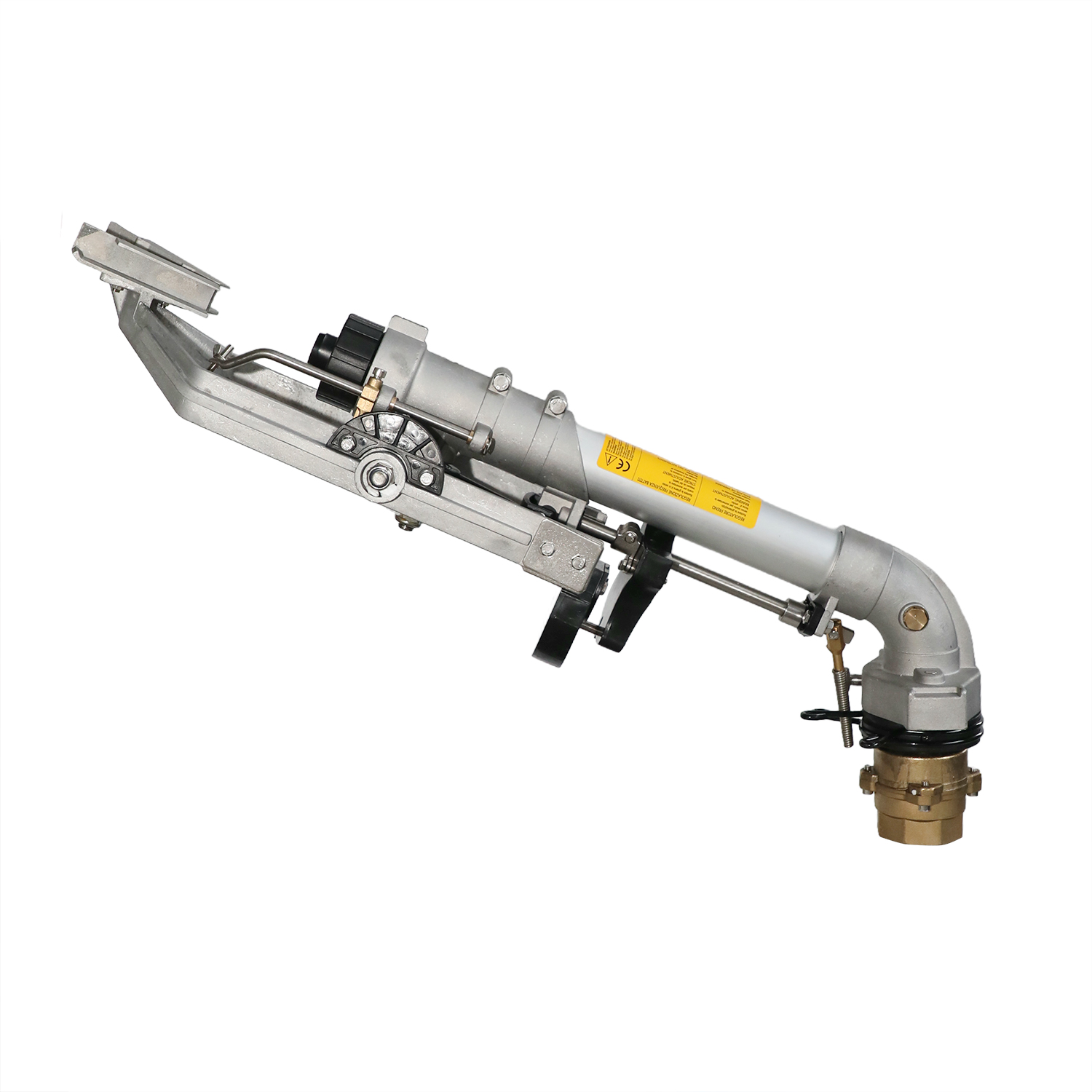
A dust suppression rain gun has one job: put enough water on the material, the road or the stockpile before the dust becomes airborne, and keep doing it across a wide, wind-exposed area. Two FOISON Sprinkler models are quoted for that work again and again — the FSN50, a turbine sprinkler, and the FSC50, an impact gun. They share a 24° spray angle, aluminium, nylon and stainless-steel construction, 360° adjustable rotation and a 0.7 MPa pressure ceiling, so the decision is not about build quality. It is about mechanism, pressure floor, throw and connection.
This guide compares the two models using their published specifications and performance tables, then converts the numbers into a selection sequence you can run against your own site: the pressure your pump actually holds, the lane length you need to cover, and the thread or flange on your hydrant.
Short answer. Choose the FSN50 when the supply holds at least 0.2 MPa, the hydrant is flanged, and you want the highest flow per nozzle at a given throw. Choose the FSC50 when pressure can fall to 0.15 MPa, when you need a 2-inch threaded connection, when you want adjustable rotation speed, or when you need a long throw from a smaller water volume.
The problem: “rain gun” is a product family, not a specification
Procurement requests for dust suppression often specify only the family and a rough size — “50 rain gun”, “2-inch gun”, “long-range sprinkler”. That wording can be satisfied by either mechanism, and the two mechanisms do not behave the same way on site.
Three failures show up repeatedly when the mechanism is left to the supplier:
- Pressure mismatch. An impact gun that starts working at 0.15 MPa and a turbine gun that starts at 0.2 MPa look interchangeable on a quotation, but on a low-pressure ring main only one of them stays inside its published working band.
- Connection mismatch. The FSN50 is supplied with a 2-inch flange connection. The FSC50 is available with a 2-inch inner thread or a flange. A threaded hydrant fed by a flanged gun needs an adapter, and every adapter adds a joint on a line that runs for hours.
- Coverage and water-budget mismatch. Throw range and flow are quoted separately, and buyers frequently compare the throw figure while ignoring the flow that produces it. Two guns that both throw around 43 m can differ by roughly a fifth in water demand, which changes pump sizing, refill intervals and, on a metered supply, running cost.
The comparison below is built to close those three gaps before an order is placed.
Industry background: why the mechanism question is asked earlier now
Sprinkler hardware sits inside a market that is being re-specified rather than simply expanded. Grand View Research values the global sprinkler irrigation market at USD 3.04 billion in 2025, and reports that Asia Pacific held 36.2% of agricultural irrigation machinery revenue in 2025, with China as a leading country. IMARC Group separately estimates the smart irrigation segment at USD 2.2 billion in 2025, projected to reach USD 6.2 billion by 2034.
Two consequences matter for a buyer weighing a turbine gun against an impact gun.
First, specifiers increasingly write the mechanism, the pressure band and the nozzle diameter into the request instead of naming a product family, because the same family now serves two different duties — crop irrigation and dust suppression. Second, the reference standards are already written around rotating sprinklers: ISO 7749-1:1995 specifies design and operational requirements for rotating sprinklers used in agricultural irrigation, and cross-border shipments of these appliances are normally classified under HS code 842482. Both the FSN50 and the FSC50 are 360° adjustable rotating sprinklers, so both are assessed against the same functional description.
Dust suppression demand itself comes from bulk material handling, crushing and screening, demolition, haul roads, stockyards and landfill operations. Those sites rarely have an irrigation-grade water supply; they have a pump, a hose and whatever pressure the layout allows. That is exactly where the difference between a 0.15 MPa and a 0.2 MPa starting point stops being academic.
The two rain guns, side by side
FOISON Sprinkler (Xuzhou Foison Sprinkler Irrigation Equipment Co., Ltd) designs and manufactures irrigation spray guns and irrigation equipment, with turbine spray guns, impact guns and irrigation systems as its main lines. The FSN50 and the FSC50 are the two 50-size rain guns in that range, built around different drive mechanisms.
FSN50: the turbine rain gun
The FSN50 is a rain gun sprinkler in the turbine sprinkler category. It is intended for the agriculture industry and designed for agriculture, forestry, garden and dust removal scenarios; it is suitable for agricultural irrigation and can be used for dust removal. The manufacturer describes it as a long-range gun that provides atomisation.
- Working pressure: 0.2–0.7 MPa
- Throw range: 26–53 m
- Spray angle: 24°
- Rotation: 360° adjustable
- Connection: 2-inch flange
- Materials: aluminium, nylon, stainless steel
- Nozzle diameters listed in the performance table: 16, 18, 20, 22, 24 and 26 mm
- Highest listed flow: 26 mm nozzle at 0.7 MPa — 80 m³/h
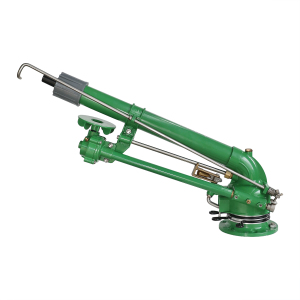
FSC50: the impact rain gun
The FSC50 is a rain gun sprinkler classified as an impact gun. It is intended for the agriculture and industrial industries and designed for agriculture, forestry, garden and dust removal scenarios. Its specification lists both 360° adjustable rotation and adjustable speed, which gives the operator a second setting beyond pressure and nozzle size.
- Working pressure: 0.15–0.7 MPa
- Throw range: 23–56 m
- Spray angle: 24°
- Rotation: 360° adjustable, speed adjustable
- Connection: 2-inch inner thread or flange
- Materials: aluminium, nylon, stainless steel
- Nozzle diameters listed in the performance table: 14, 16, 18, 20, 22, 24 and 26 mm
- Lowest listed point: 14 mm nozzle at 0.15 MPa — 9 m³/h at 23 m; highest listed point: 26 mm nozzle at 0.7 MPa — 69.3 m³/h at 56 m
What the performance tables actually show
Read at matching nozzle diameters and pressures, the two tables describe a consistent trade-off: the turbine gun moves more water to a similar distance, while the impact gun reaches a similar distance with less water and can start from a lower pressure.
- 16 mm nozzle at 0.4 MPa: FSN50 25.2 m³/h at 32 m; FSC50 19.2 m³/h at 36 m.
- 20 mm nozzle at 0.5 MPa: FSN50 40.3 m³/h at 43 m; FSC50 33.6 m³/h at 43 m.
- 24 mm nozzle at 0.5 MPa: FSN50 55.0 m³/h at 47 m; FSC50 48.3 m³/h at 47 m.
- 26 mm nozzle at 0.6 MPa: FSN50 69.6 m³/h at 51 m; FSC50 64.5 m³/h at 53 m.
At the 20 mm / 0.5 MPa point the throw is identical at 43 m, but the FSN50 delivers about 20% more water than the FSC50 (40.3 m³/h against 33.6 m³/h, calculated from the published tables). For a dust suppression lane of fixed length, that is the decision in one line: more water mass per pass from the turbine gun, or the same lane length from a smaller water budget with the impact gun.
Comparison table: FSN50 vs FSC50
| Parameter | FSN50 | FSC50 |
|---|---|---|
| Mechanism | Turbine sprinkler (rain gun) | Impact gun (rain gun) |
| Working pressure | 0.2–0.7 MPa | 0.15–0.7 MPa |
| Throw range | 26–53 m | 23–56 m |
| Spray angle | 24° | 24° |
| Rotation | 360° adjustable | 360° adjustable, speed adjustable |
| Connection | 2-inch flange | 2-inch inner thread or flange |
| Materials | Aluminium, nylon, stainless steel | Aluminium, nylon, stainless steel |
| Nozzle diameters in performance table | 16, 18, 20, 22, 24, 26 mm | 14, 16, 18, 20, 22, 24, 26 mm |
| Highest listed flow | 80 m³/h (26 mm, 0.7 MPa) | 69.3 m³/h (26 mm, 0.7 MPa) |
| Lowest listed flow | 17.8 m³/h (16 mm, 0.2 MPa) | 9 m³/h (14 mm, 0.15 MPa) |
| Matched point: 20 mm at 0.5 MPa | 40.3 m³/h at 43 m | 33.6 m³/h at 43 m |
| Intended scenarios (stated) | Agriculture, forestry, garden, dust removal | Agriculture, forestry, garden, dust removal |
| Intended industries (stated) | Agriculture | Agriculture and industrial |
Step-by-step: matching the gun to your site
Work through these steps in order. Each one eliminates at least one of the two models, and most sites are decided by step three.
- Take a dynamic pressure reading at the hydrant. Measure while water is flowing, not static. If the reading can fall below 0.2 MPa during a working shift, the FSN50 is outside its working band and the FSC50 (0.15–0.7 MPa) is the only one of the two that stays inside its published range.
- Check the connection on the hydrant or riser. A 2-inch flange points to the FSN50. A 2-inch female thread points to the FSC50 in its threaded version; the same model is also available with a flange if the pipework is flanged.
- Fix the lane length you need to cover. The FSN50 works across 26–53 m and the FSC50 across 23–56 m. Where a site needs the shortest throw — tight stockyard bays, semi-enclosed transfer points — the FSC50 can be run down to 23 m, while the FSN50 starts at 26 m.
- Choose the nozzle diameter against your flow budget. Both guns use replaceable nozzle sizes. The FSN50 table covers 16–26 mm and the FSC50 covers 14–26 mm, so the impact gun offers one additional small-nozzle step at the bottom of the range for low-flow supplies.
- Decide whether you need adjustable rotation speed. The FSC50 specification lists speed adjustment as a setting; the FSN50 specification lists 360° adjustable rotation. If your operating procedure calls for changing how fast the gun sweeps a lane, that requirement points to the FSC50.
- Confirm the supply behind the gun. FOISON lists the working condition for these guns as an adequate water resource with a pump and hose, with water delivered to the gun under pressure; the equipment is stated to work in ambient conditions up to 50 °C. Size the pump against the flow figure for your chosen nozzle and pressure, not against the throw figure.
- Validate on site before ordering a block. A single gun on your own pump will settle pressure, rotation and lane spacing faster than any catalogue comparison. Order a sample, run it at the pressure you measured in step one, and confirm the wetted pattern before committing to a full installation.
Use cases: where each rain gun fits
Stockpiles, transfer points and haul roads
Both models list dust removal among their intended scenarios, so the split is hydraulic. A site with a high-capacity pump and a flanged main, where the priority is water mass on the material, is an FSN50 site; the 26 mm nozzle at 0.7 MPa moves 80 m³/h. A site running from a lower-pressure supply, or one that must start reliably at 0.15 MPa, is an FSC50 site.
Demolition and hot-climate bulk handling
Dust suppression work often continues through high ambient temperatures. FOISON states that these guns can work in conditions up to 50 °C, provided the water resource, pump and hose are adequate. Where the same gun must also cover a shorter, tighter working face, the FSC50 minimum throw of 23 m and its speed adjustment give more room to shorten the pattern.
Agricultural irrigation blocks
The FSN50 is intended for the agriculture industry and is suitable for agricultural irrigation; the FSC50 is intended for the agriculture and industrial industries. On a fixed irrigation block, nozzle diameter and lane spacing normally decide the model: the FSN50 higher flow at a matched throw shortens the running time needed to place a given depth of water, while the FSC50 lower flow at matched throw suits blocks where supply is the limiting factor.
Forestry, garden and landscape watering
Both guns list forestry and garden among their intended scenarios, and both use a 24° spray angle, so a replacement decision inside an existing landscape system is usually driven by the connection and the pressure band rather than by the spray pattern.
Who manufactures the FSN50 and FSC50
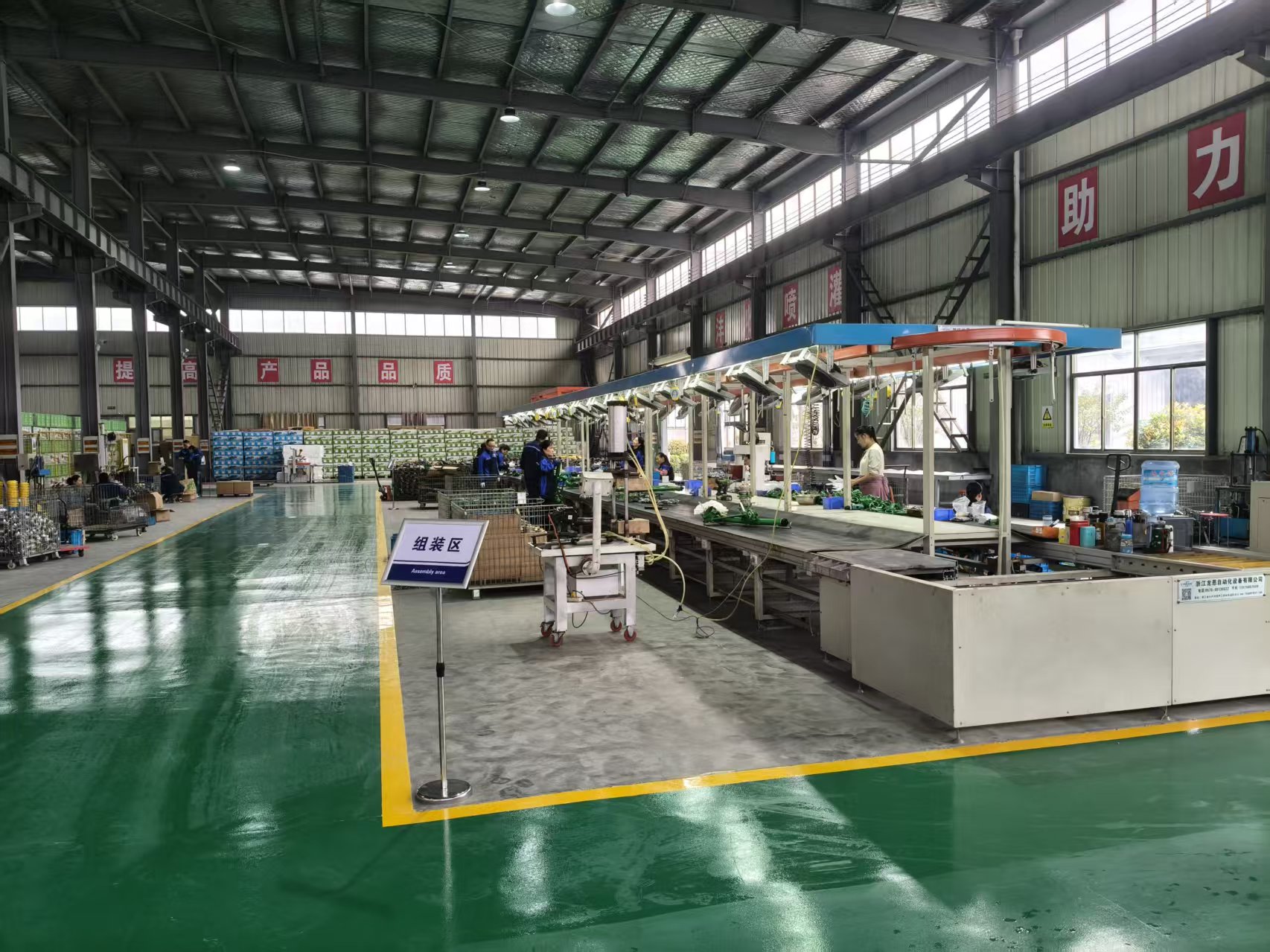
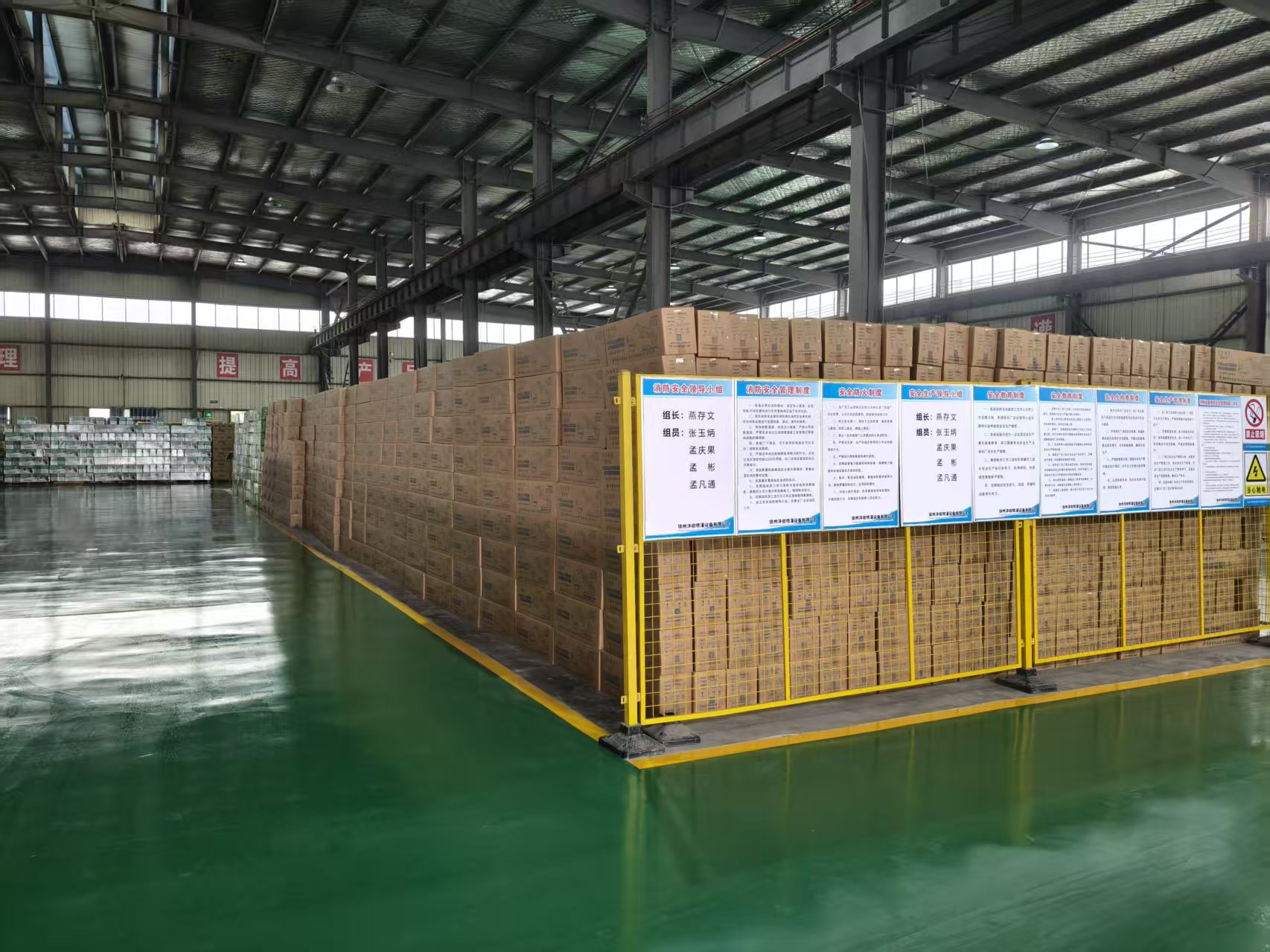
FOISON Sprinkler — Xuzhou Foison Sprinkler Irrigation Equipment Co., Ltd — is a manufacturer based in Pei County Industry Area, Xuzhou City, Jiangsu Province, China, established in 2013. The company designs and manufactures irrigation spray guns and irrigation equipment, with turbine spray guns, impact guns and irrigation systems as its main lines, and builds sprinklers for farm and industrial use.
- Manufacturing facility: 30,000 m²
- Employees: approximately 135
- R&D team: 12 engineers
- Annual production capacity: 200,000 units
- Export share: approximately 70% of total sales
- Export markets: EU, Africa, Australia, New Zealand, South East Asia, Mid Asia, Mid East and South America
For buyers evaluating a sprinkler manufacturer for agricultural irrigation, the practical check is whether the supplier can document the numbers used in this comparison — working pressure, throw range, flow per nozzle diameter and connection type — for the exact model being quoted, and whether production capacity matches the order profile. The company catalogue is available as a PDF below.
Frequently asked questions
Does ISO 7749-1 apply to the FSN50 and FSC50?
ISO 7749-1:1995 specifies design and operational requirements for rotating sprinklers used in agricultural irrigation. Both the FSN50 and the FSC50 are 360° adjustable rotating sprinklers with a 24° spray angle, so the standard is the usual reference when a buyer writes a specification for either model. The published data sheets state working pressure, throw range, spray angle and flow per nozzle diameter; ask the supplier to confirm the documentation set for the exact model and destination market before ordering. Appliances of this type are normally classified under HS code 842482 for customs purposes.
Can one rain gun handle both dust suppression and agricultural irrigation?
Yes. The FSN50 is intended for the agriculture industry and designed for agriculture, forestry, garden and dust removal scenarios, and it is suitable for agricultural irrigation as well as dust removal. The FSC50 is intended for the agriculture and industrial industries and designed for the same four scenarios. Because both cover both duties, the decision is hydraulic rather than categorical: pressure availability, throw and flow choose the model, not the label on the site.
Which model needs the smaller pump and less water?
The FSC50 starts lower on both counts. Its lowest listed operating point is a 14 mm nozzle at 0.15 MPa, delivering 9 m³/h at 23 m; the FSN50 lowest listed point is a 16 mm nozzle at 0.2 MPa, delivering 17.8 m³/h at 26 m. At matched nozzle and pressure the pattern continues — at 20 mm and 0.5 MPa the FSC50 moves 33.6 m³/h against 40.3 m³/h for the FSN50, both at 43 m. Lower flow means a smaller pump and lower hourly water demand, which is why the impact gun is often chosen where supply, not coverage, is the constraint.
Can I test a sample before ordering a full set?
Yes. Testing one gun on your own pump is the fastest way to confirm the pressure reading, rotation and lane spacing. FOISON Sprinkler handles sample and specification requests through sales@foison-irrigation.com and +86 186 5822 6303 (telephone and WhatsApp); send the model you are considering together with your measured working pressure, nozzle diameter and connection type so that the sample matches the site.
How do I verify a sprinkler manufacturer before placing a volume order?
Check capacity, engineering resource and export record against the order profile. FOISON Sprinkler operates a 30,000 m² facility with approximately 135 employees, a 12-engineer R&D team and an annual production capacity of 200,000 units, and exports around 70% of total sales to the EU, Africa, Australia, New Zealand, South East Asia, Mid Asia, Mid East and South America. Ask for the model-specific data sheet and a production schedule, then confirm the sample result against the data sheet. For a quotation, a sample or the full catalogue, write to sales@foison-irrigation.com or call +86 186 5822 6303.
Conclusion
The FSN50 and the FSC50 are not competing versions of the same gun; they are two mechanisms tuned for different supplies. The turbine FSN50 turns a 0.2–0.7 MPa supply into the higher flow of the two at a matched nozzle and throw — up to 80 m³/h at 26 mm and 0.7 MPa — and mounts on a 2-inch flange. The impact FSC50 starts at 0.15 MPa, reaches 56 m, offers a 14 mm nozzle step and adjustable rotation speed, and can be mounted on a 2-inch thread or a flange.
For dust suppression, the decision rule is short: measure the pressure, then choose. Hold 0.2 MPa or more on a flanged main with a water budget to match, and the FSN50 puts more water on the lane. Fall to 0.15 MPa, need a threaded connection, or want the same throw from less water, and the FSC50 is the correct specification.
Next step: sample, specification sheet or quotation
Send your working pressure, required lane length and connection type, and FOISON Sprinkler will confirm whether the FSN50 or the FSC50 fits — or propose another gun from the range if neither does.
Email: sales@foison-irrigation.com · Tel / WhatsApp: +86 186 5822 6303 · Website: www.foison-irrigation.com
Download the full catalogue: Foison Catalog (PDF)
Have Questions or Need More Details?
Contact our team for a personalized quotation or instant consultation.
Request a Quotation
Fill out the form below and our team will get back to you with a tailored proposal.
WhatsApp Direct Chat
Prefer to chat in real-time? Message us on WhatsApp for instant assistance & quick answers.
- Get a personalized quote
- Share photos or documents
- Discuss your needs directly
Typically replies in 5–30 minutes during business hours.