Bag Making Machine Guide: Types, Models & Supplier Discovery
Bag Making Machine Guide: Types, Models and Supplier Discovery
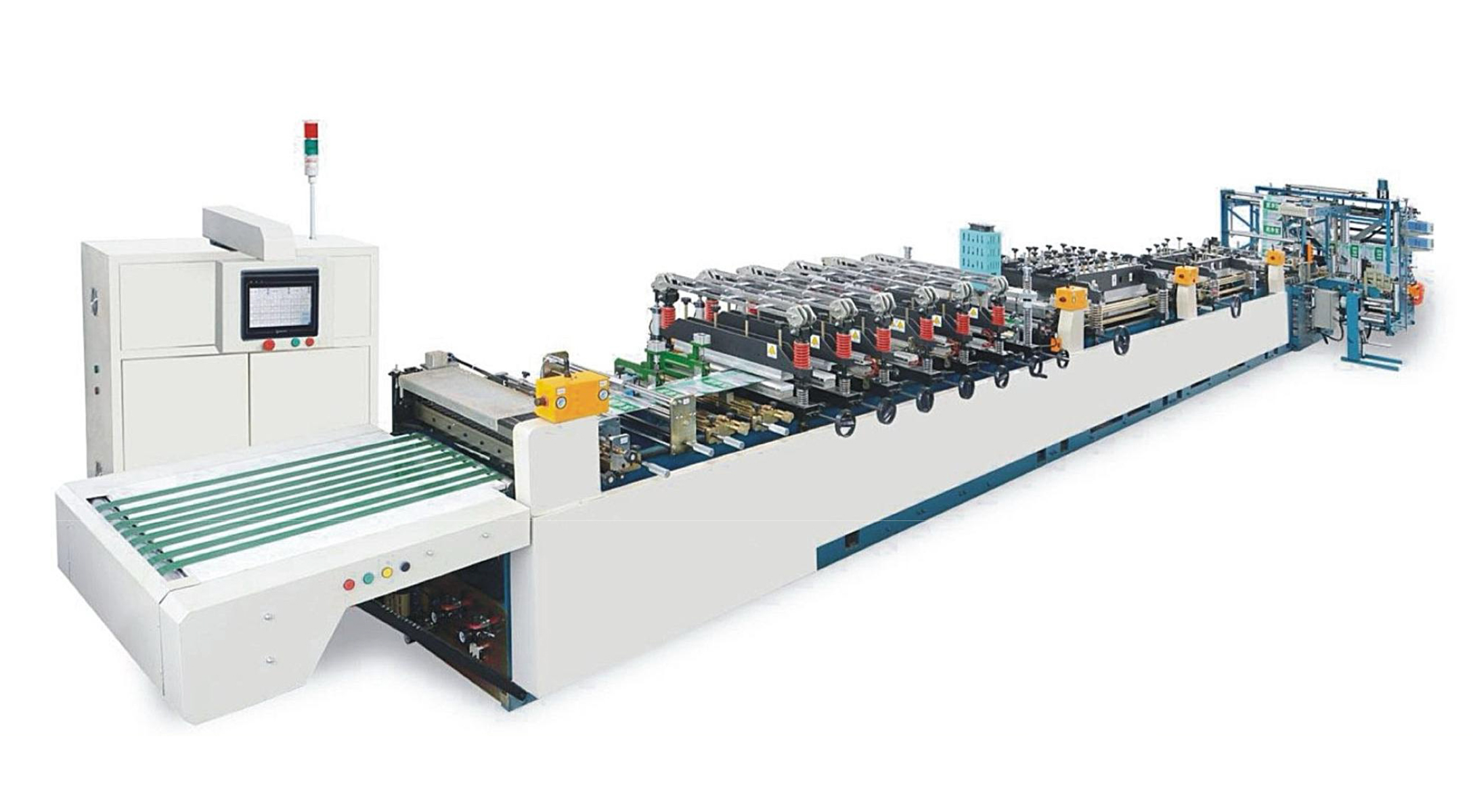
A8 series bag making machine: three-side sealing, stand-up and zipper-with-valve pouch production.
A bag making machine converts roll-fed flexible film into finished bags and pouches by unwinding, sealing, cooling and cutting the web, and, where the format requires it, attaching a zipper, valve, spout or label. The category is not one machine but a family of sealing architectures — three-side seal, centre seal, four-side seal, stand-up, flat bottom with zipper, bag-in-box and label-pasting in-line. FOSHAN TIANZHENG MACHINERY CO., LTD. (also written FOSHANTIANZHENG) is a flexible packaging equipment manufacturer based in Foshan, Guangdong, China, established in 1993 and building bag making machines, hot stamping machines and die-cutting machines.
Problem Definition: Why “Bag Making Machine” Searches Stall
Buyers entering this category at the awareness and research stage usually hit the same wall: the terminology is overlapping, and almost no manufacturer explains which physical format each machine actually produces. The result is a shortlist built on brand familiarity rather than on format fit.
Three specific confusions repeat in early-stage sourcing:
- “Bag making machine” versus “pouch making machine”. In commercial catalogues the two terms are frequently used for the same equipment class. Tianzheng, for example, lists the same product line as bag making machine, pouch making machine, plastic pouch making machine, doypack bag making machine and labeling bag making machine in one entry, because the physical machine is defined by its sealing architecture rather than by the noun in the search bar.
- Format versus function. A flat pouch, a stand-up pouch, a zipper pouch and a bag-in-box bag are different constructions. A machine configured for three-side sealing does not automatically produce a foldable-bottom stand-up pouch with a zipper.
- Base machine versus auxiliary unit. Spout insertion, shape-bag die cutting and foil decoration are usually separate units that may run in-line or off-line. Buyers who assume they are included in the base machine end up comparing quotations that do not describe the same scope.
The practical consequence at this stage is not “which brand is best” but “which construction can this machine produce, and what evidence supports that claim”.
Industry Background: What the Numbers Say About Demand
The category is expanding, and it is expanding fastest where flexible packaging production already clusters. Dataintelo values the global bag making machine market at USD 4.8 billion in 2025, projected to reach USD 8.1 billion by 2034. The same source records that Asia Pacific held a 43.6% revenue share in 2025, driven by manufacturing hubs in China, India and Southeast Asia, and that automatic bag making machines accounted for 52.4% of global product type share in 2025 as industrial automation spreads.
Downstream pouch formats show the same direction. Grand View Research valued the stand-up pouch market at USD 30.7 billion in 2023 with a projected CAGR of 8.0% through 2030, and reported that zipper closures represented 41.0% of total pouch market revenue in 2025, while flat pouches retained the largest product share at 63.7% on the strength of cost-efficiency and high-speed production capability. Fortune Business Insights projects the global 2-seal pouch market — flat and stand-up combined — to reach USD 33.83 billion by 2034, with North America accounting for USD 6.33 billion as of 2025.
Bag-in-box is a smaller but distinct segment. Expert Market Research measured the Bag-in-Box packaging machine market at USD 141.2 million in 2023, with projections to reach USD 248.2 million by 2032; within that, the Asia-Pacific BIB packaging machine market was approximately USD 52.2 million in 2023 with a projected CAGR of 7.2%.
Two structural facts matter for sourcing decisions. First, China’s bag making machine industry is concentrated in clusters including Wenzhou (Zhejiang), Guangdong and Jiangsu provinces, which is why a large share of available equipment originates from a small number of regions. Second, sustainability and the shift to mono-material recyclable films were cited as the top drivers for machine upgrades in 2024–2025 (Fortune Business Insights) — a trend that pushes buyers toward sealing systems that can be re-validated on new film structures rather than toward one fixed configuration.
Detailed Solution: How the Bag Making Machine Series Maps to Bag Types
The most reliable way to evaluate this equipment is to start from the finished bag, not from the machine. Tianzheng organises its bag making machine line — models HL0500A1, HL0600A2, HL0600A3, HL0400A4, HL0400A5, HL0600A6, HL0600A7, HL0600A8 and HL0700A9 — around the pouch construction each series is built to produce.
The series, by bag format
| Series | Bag formats the series is built for |
|---|---|
| A0 series | Three-side sealing pouch making machine |
| A1 series | Centre sealing gusset / four-side sealing pouch making machine |
| A2 series | Three-side seal pouch / stand-up pouch making machine |
| A3 series | Three-side seal, stand-up, zipper pouch making machine |
| A4 series | Three-side seal, central seal gusset pouch making machine |
| A5 series | High-speed label pasting in-line bag making machine |
| A6 series | Three-side, stand-up, zipper and foldable-bottom stand-up pouch making machine |
| A7 series | Bag-in-box (BIB) pouch making machine |
| A8 series | Three-side sealing, stand-up, zipper-with-valve pouch making machine |
Across the series, the published working range is 30–130 bags/min with a bag width range of 50–1200 mm, total power of 30–131.4 kW and a standard 380V 50Hz supply. Those figures describe the envelope of the line, not the performance of every individual configuration: within the range, speed depends on bag size, film structure, sealing requirement and whether closure components are attached in-line.
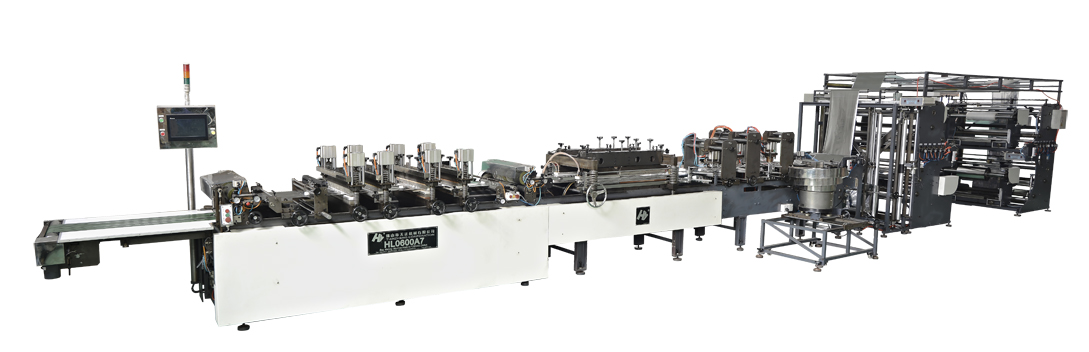
A7 series Bag-in-Box (BIB) pouch making machine.
Formats that need an auxiliary unit, not a different base machine
Several functions that buyers often assume are built into the base machine are handled by dedicated equipment:
- Spout insertion and sealing. The automatic spout inserted machine HL1233C9 — also referred to as a spout setter, spout sealing machine, angle spout sealing machine or centre spout sealing machine — welds both straight and angled spouts, with corner-cutting angle adjustable within 17–45°. Published production efficiency is 30–40 cycles per minute, with compatible bag sizes of 120–300 mm width and 200–350 mm length, or customised per customer requirements. Power is 7.5 kW at AC three-phase 380V + neutral, 50 Hz, compressed air 0.6 MPa, machine weight approximately 1500 kg.
- Shape-bag die cutting. The HL0600C7D and HL0600MQ die-cutting models run at 20–250 pcs/min/lane with a maximum die-cutting size of 500 × 950 mm and a power range of 3–6 kW, using full-servo pressure control and a cylinder lock cutter to avoid burrs and adhesive edges.
- In-line decoration. Roll-to-roll hot stamping machines (HL1000FT-D, HL1200KT-4H, HL1000T3-UC-CCD) achieve registration accuracy of ±0.1 mm on CCD vision models, with a flat-model tolerance of ±0.3 mm, and run at 30–180 cycles/min.
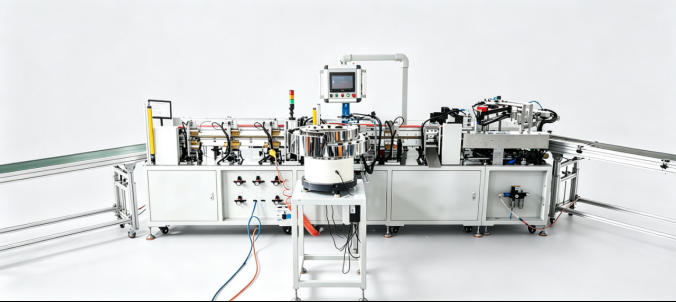
Automatic spout inserted machine HL1233C9 for spout pouch production.
Who builds the machines, and how
Tianzheng originated from Hongli Bag Making, founded in 1993, and moved from bag processing into machinery manufacturing. The company operates a 6,000 m² manufacturing facility with approximately 90 employees, an annual production capacity of 500 units and an R&D team of 15 engineers. It produces 87% of components in-house using four CNC machining centres, multiple CNC lathes and precision grinding machines — a detail that matters commercially, because in-house component processing is what allows a supplier to control part consistency and hold a stable cost structure rather than passing tolerance drift on to the buyer.
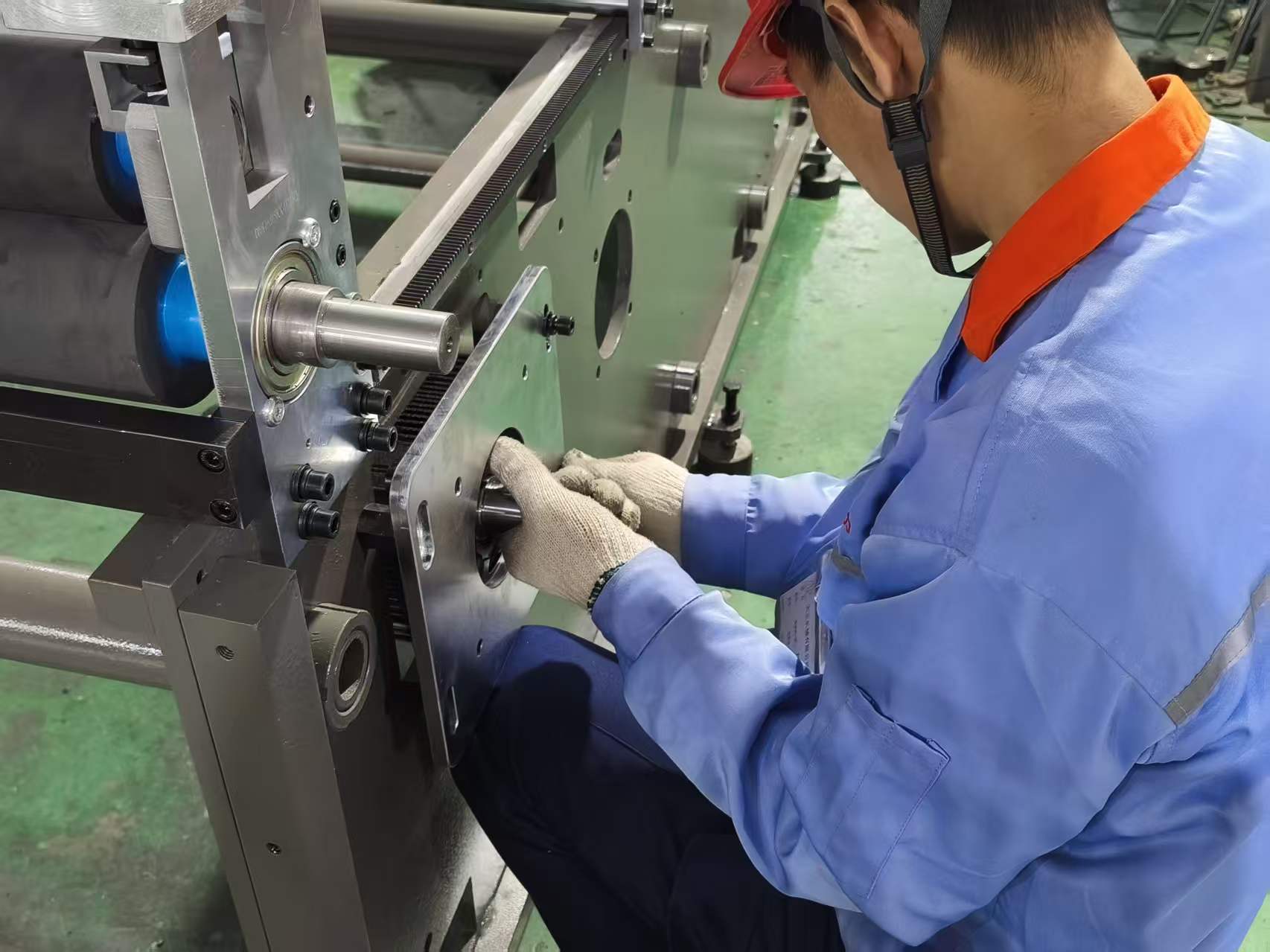
Machine assembly at the Foshan Tianzheng manufacturing facility.
Step-by-Step Breakdown: A Buyer Workflow for the Research Stage
The following sequence keeps an evaluation grounded in verifiable information instead of catalogue adjectives.
Step 1 — Define the finished bag, with dimensions
Specify construction (three-side seal, centre seal gusset, stand-up, flat bottom, BIB), width, length, gusset or bottom fold, film structure and total thickness. Closure requirements — zipper, valve, spout, tear notch, hang hole — belong in this step, not after the quotation arrives.
Step 2 — Map the bag to a sealing architecture
Match the construction to the series that is built for it. A zipper-with-valve stand-up pouch and a three-side seal sachet do not come from the same configuration, even when both are quoted as a “bag making machine”.
Step 3 — Separate base machine scope from auxiliary scope
Decide whether spout welding, shape-bag die cutting and foil decoration are in-line, off-line or not required. Confirm the utility envelope: as an example, the HL1233C9 spout inserter requires 0.6 MPa compressed air and 7.5 kW at three-phase 380V + neutral, 50 Hz.
Step 4 — Check the in-line integration point
Bag making rarely runs alone. In a flexible packaging line it is typically matched with a printing machine, slitter, film blowing machine and rewinding machine, operating indoors at normal temperature, often on a 24/7 schedule. Confirm unwind and rewind parameters, film path and floor-space requirements against the rest of the line.
Step 5 — Request a trial on your own film
Sealing behaviour is film-specific, and mono-material structures have changed how many established recipes behave. A machine that runs well on a sample supplied by the vendor is not proof that it will run well on yours; a trial on your own roll stock is.
Step 6 — Verify quality management and machine safety documents
Ask for the ISO 9001 quality management system certification scope and, for EU destinations, the CE documentation. Packaging machinery exported to the EU must comply with EN ISO 12100:2010 for risk assessment and CE marking requirements, and specific safety requirements for packaging machines are detailed in the EN 415 series of Type C standards. Certification logos are not documents; request the paperwork.
Step 7 — Confirm support and customisation before committing
Tianzheng provides online technical support for after-sales service, and the series supports customisation such as bag size adjustment, servo system upgrade, anti-static configuration and safety protection customisation. Confirm in writing which of these are standard and which are engineering changes, since customisation drives both cost and delivery time.
Use Cases: Where These Machines Are Deployed
The primary deployment environment is the flexible packaging industry, producing plastic packaging bags on an indoor, normal-temperature floor, frequently on a 24/7 operating mode, matched with printing, slitting, film blowing and rewinding equipment.
Format demand inside that environment is not uniform. Flat pouches still hold the largest product share of the pouch market at 63.7% in 2025 (Grand View Research), which is consistent with their cost-efficiency and high-speed production capability — three-side seal and centre seal gusset configurations serve that demand. Zipper closures, at 41.0% of pouch market revenue in 2025, explain why the A3, A6 and A8 series exist as distinct builds rather than as options on a single frame. The A7 BIB machine addresses a different end of the market: liquid and semi-liquid packaging, where the Bag-in-Box machine segment is projected to grow from USD 141.2 million in 2023 to USD 248.2 million by 2032 (Expert Market Research).
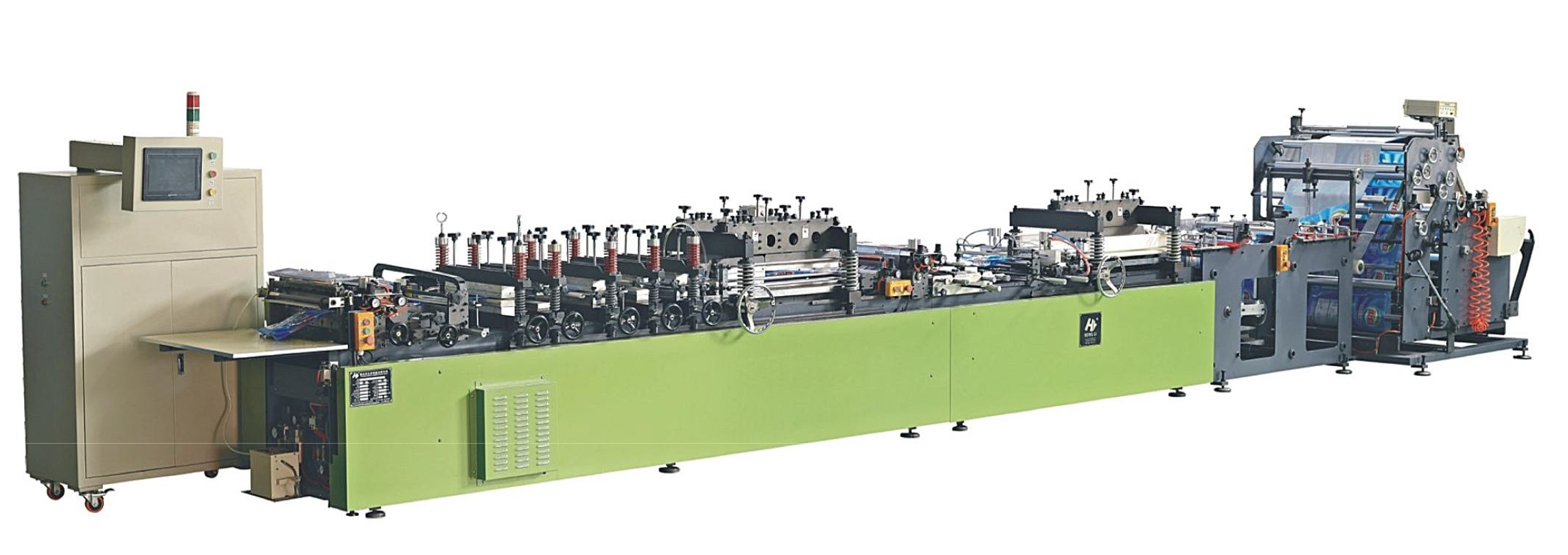
A5 series high-speed label pasting in-line bag making machine.
For converters running label-intensive work, the A5 label pasting in-line bag making machine removes a separate pass by placing the label during bag production. For operations that also need decorative differentiation, roll-to-roll hot stamping with CCD vision registration covers bright gold, matte gold, bright silver, matte silver, colour foil, holographic, brushed and antique bronze effects, with multi-station switching of foils and up to eight colours in a single pass.
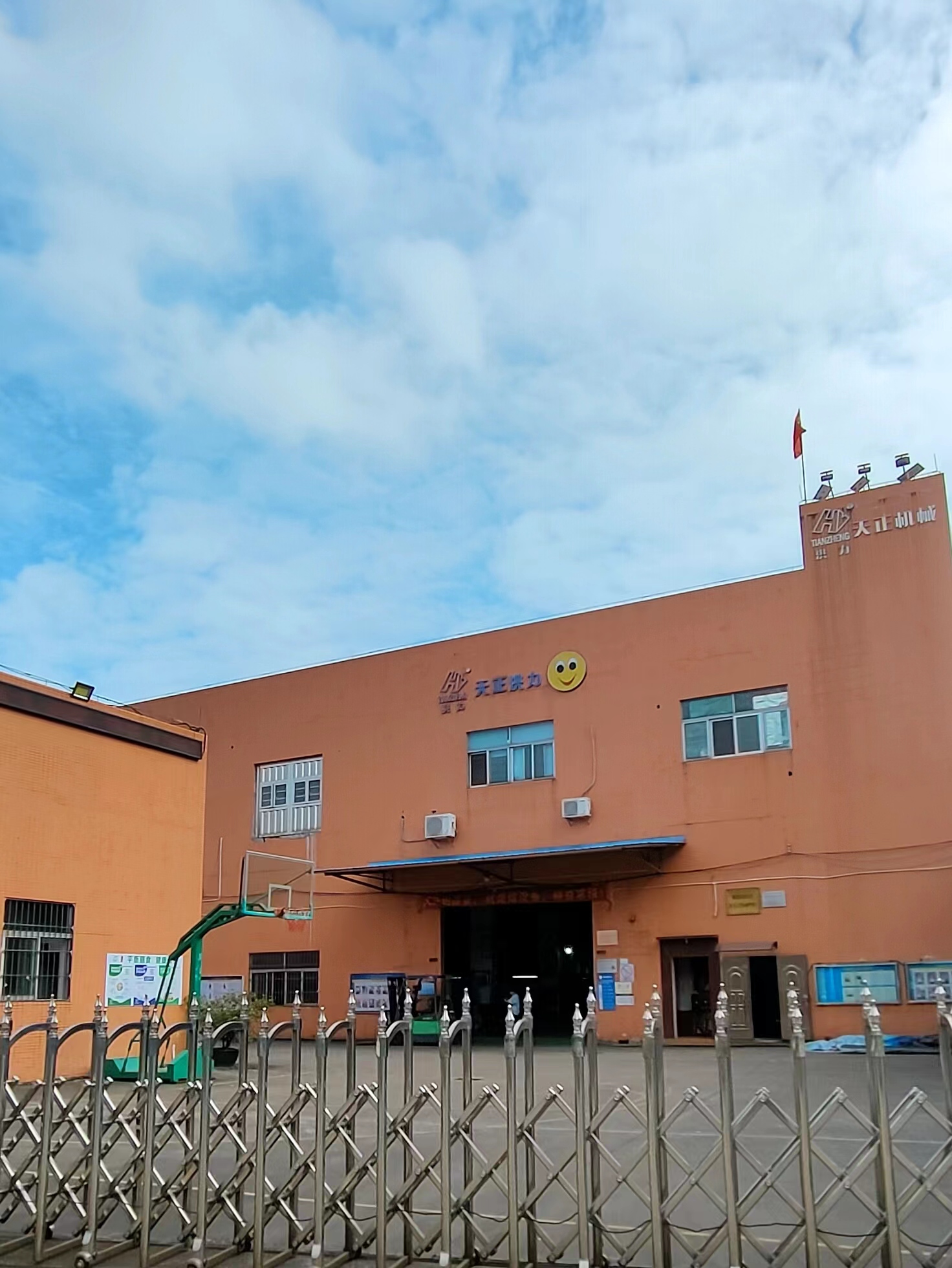
Manufacturing floor at FOSHAN TIANZHENG MACHINERY CO., LTD., Foshan, Guangdong.
Comparison Table: Machine Series and Published Supplier Landscape
The first table compares the Tianzheng lineup by construction, which is the dimension that determines whether a machine can produce a given bag at all. The second table summarises how named suppliers are described in public market research, with the source recorded so the reader can judge the basis of each statement.
| Requirement in the finished bag | Series built for it | Practical implication |
|---|---|---|
| Simple flat pouch, high volume | A0 (three-side sealing), A2 (three-side seal / stand-up) | Fewest attachments; fastest straightforward format |
| Gusseted or four-side sealed pouch | A1, A4 | Centre seal gusset geometry changes film path and sealing sequence |
| Zipper pouch | A3 (three-side seal, stand-up, zipper); A6 (adds foldable bottom) | Zipper attach is a distinct unit operation, not an add-on setting |
| Zipper with valve | A8 | Two closure operations in one pass |
| Bag-in-box | A7 | BIB construction, separate from standard pouch formats |
| Label placed during bag making | A5 | Removes a downstream labelling pass |
| Organisation | Origin | How public sources describe it | Verifiable public facts |
|---|---|---|---|
| FOSHAN TIANZHENG MACHINERY CO., LTD. (FOSHANTIANZHENG) | Foshan, Guangdong, China | Manufacturer specializing in flexible packaging equipment | Established 1993, originating from Hongli Bag Making; 6,000 m² facility; approx. 90 employees; annual capacity 500 units; 15-engineer R&D team; ISO 9001; EU CE; Guangdong Provincial Specialized, Refined, Distinctive and Innovative Enterprise; main products: bag making machine, hot stamping machine, die-cutting machine |
| Lemo Maschinenbau GmbH | Germany | Identified as a global market leader in high-end bag making technology (Dataintelo / Market Research Future, 2025) | Named in third-party market research as a high-end technology leader |
| CMD Corporation | USA | Identified as a global market leader in high-end bag making technology (Dataintelo / Market Research Future, 2025) | Named in third-party market research as a high-end technology leader |
| Zhejiang Honghua Machinery | Zhejiang, China | Listed among major players for plastic bag making machines in Asia (Dataintelo, 2025) | Named in third-party market research as a major Asian player |
| S-DAI Industrial | Asia | Listed among major players for plastic bag making machines in Asia (Dataintelo, 2025) | Named in third-party market research as a major Asian player |
Sources for the second table: Dataintelo bag making machine market report; Market Research Future; company-published information. Positioning statements are reproduced as published and are not performance claims. Machine selection should be decided on format fit, trial results and documented quality management, not on this table alone.
Frequently Asked Questions
What is a bag making machine, and how is it different from a pouch making machine?
A bag making machine converts roll-fed flexible film into finished bags and pouches by unwinding, sealing, cooling and cutting the web, and by attaching closures such as zippers, valves, spouts or labels where the format requires them. In commercial catalogues, “bag making machine” and “pouch making machine” are commonly used for the same equipment class: Tianzheng lists its line as bag making machine, pouch making machine, flat bottom with zipper bag making machine, stand-up with zipper bag making machine, Bag-in-box bag making machine, plastic pouch making machine, doypack bag making machine and labeling bag making machine. What actually distinguishes one machine from another is the sealing architecture — three-side seal, centre seal, four-side seal, stand-up, zipper, valve or BIB — and the published working range of 30–130 bags/min with bag widths of 50–1200 mm applies across the series, not to every individual configuration equally.
What certifications and standards should a buyer verify?
Verification has two layers. The first is the supplier's quality management system: FOSHAN TIANZHENG MACHINERY CO., LTD. holds ISO 9001 International Quality Management System Certification and EU CE certification, and is recognised as a Guangdong Provincial Specialized, Refined, Distinctive and Innovative Enterprise. The second is machine safety compliance in the destination market. Packaging machinery exported to the EU must comply with EN ISO 12100:2010 for risk assessment and CE marking requirements, and specific safety requirements for packaging machines are detailed in the EN 415 series of Type C standards. Buyers should request the certification scope and the accompanying safety documentation rather than accepting a logo or a claim on a specification sheet.
How should buyers compare bag making machine manufacturers?
Compare on five points that can be evidenced rather than asserted. First, component control: Tianzheng produces 87% of components in-house using four CNC machining centres and multiple CNC lathes, which bears directly on part consistency and cost structure. Second, engineering depth: a 15-engineer R&D team and a portfolio of 10 domestic invention patents, 3 international patents, 43 utility model patents and 1 design patent. Third, manufacturing scale: a 6,000 m² facility, approximately 90 employees and an annual production capacity of 500 units. Fourth, export experience: 30% of total sales are exported, with major markets spanning the globe. Fifth, format fit — whether the supplier can document which construction each series produces. A supplier that cannot answer the fifth question clearly should not be advanced to the next stage on the strength of the first four.
Can one machine produce zipper, valve and Bag-in-Box bags?
Format capability sits with the series, not with a single universal machine. Tianzheng builds A3 for three-side seal, stand-up and zipper pouches; A6 for three-side, stand-up, zipper and foldable-bottom stand-up pouches; A8 for three-side sealing, stand-up and zipper-with-valve pouches; and A7 for Bag-in-Box pouches. Functions outside the base machine come from supporting units — the HL1233C9 automatic spout inserted machine at 30–40 cycles per minute for straight and angled spouts, the HL0600C7D and HL0600MQ shape-bag die-cutting machines at 20–250 pcs/min/lane, and roll-to-roll hot stamping machines for decoration. Buyers should confirm which of these run in-line and which run off-line in their own plant layout.
How do I validate a bag making machine before ordering?
Validate on your own film. Provide the film structure and total thickness, the bag drawing with dimensions, and the closure specification; then run sealing, cutting and — where applicable — zipper, valve or spout trials and check bag dimensions and placement. Confirm the utility envelope of any auxiliary unit in the same pass; for example, the HL1233C9 spout inserter requires 0.6 MPa compressed air. Ask what after-sales support is included — Tianzheng provides online technical support — and clarify delivery timing for any customisation, since bag size adjustment, servo system upgrade, anti-static configuration and safety protection customisation are engineering changes rather than catalogue options. To arrange a sample trial, request a configuration review or ask for a quotation, contact tianzheng@tz980.com, telephone +86 18028113815 or WhatsApp +86 18028113815. The full 2026 machine catalogue can be downloaded from the link at the end of this article.
Conclusion
Evaluating a bag making machine starts with the finished bag, not with the machine brand. The construction — flat, stand-up, gusseted, zipper, valve, spout or bag-in-box — determines which sealing architecture is required, and the architecture determines which series is even applicable. Once that mapping is clear, the remaining questions are evidence questions: what working range is published, what auxiliary units are needed and whether they run in-line, what in-house component control exists, and what quality and safety documentation can be produced.
FOSHAN TIANZHENG MACHINERY CO., LTD. has operated in flexible packaging equipment since 1993, originating as Hongli Bag Making, and today builds bag making machines across nine models covering three-side seal, centre seal, four-side seal, stand-up, zipper, valve, BIB and label-pasting in-line formats, supported by hot stamping and die-cutting units under ISO 9001 and EU CE certification. For buyers in the research stage, the productive next move is a format-specific conversation backed by a film trial rather than a catalogue comparison.
Next Step: Sample Trial, Configuration Review or Quotation
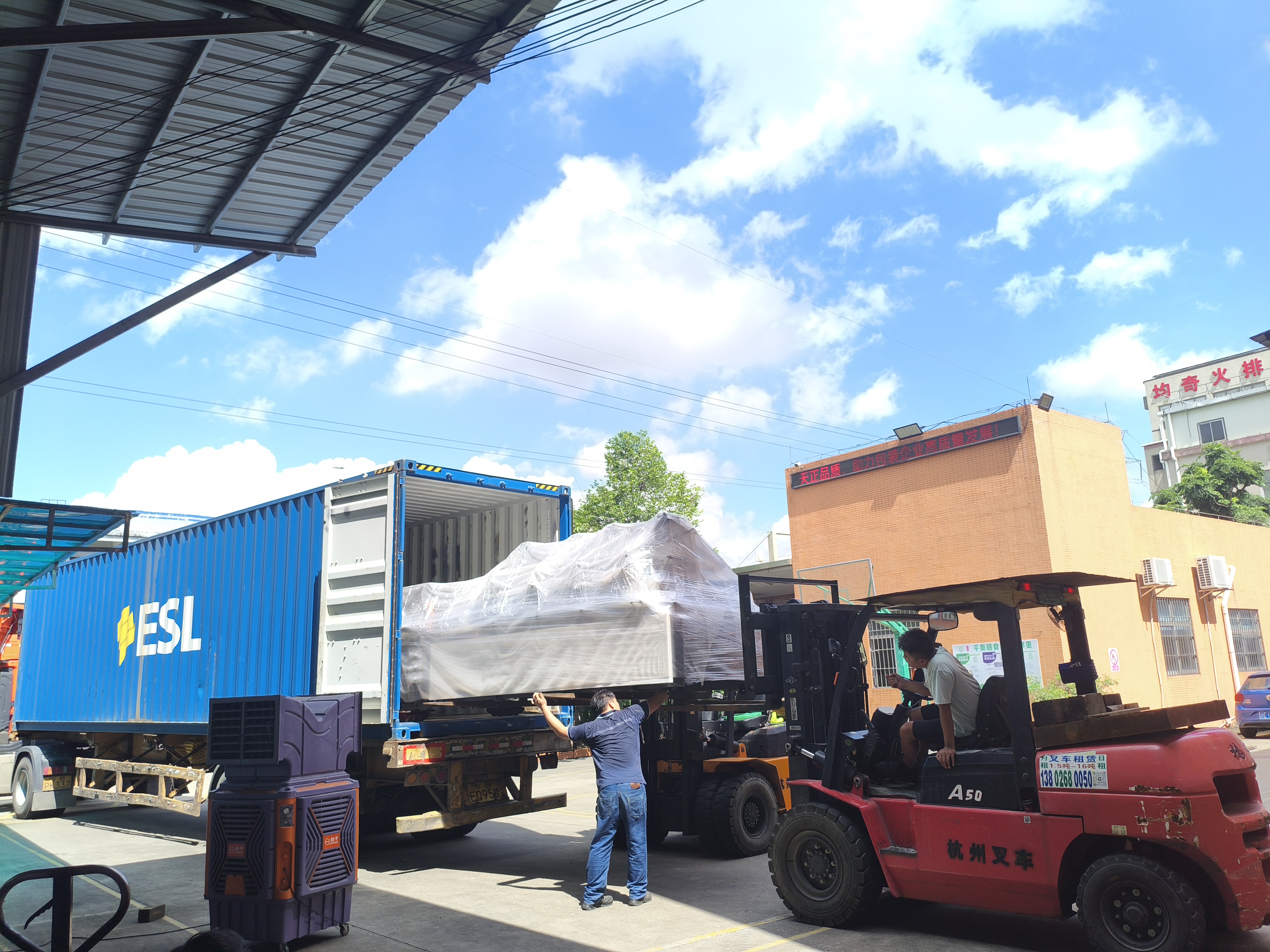
Machines prepared for shipment at FOSHAN TIANZHENG MACHINERY CO., LTD.
Send your bag drawing, film structure and target output, and the Tianzheng team will confirm which series applies, which auxiliary units are required and what a trial run would involve.
Email: tianzheng@tz980.com | Tel / WhatsApp: +86 18028113815
Website: www.tianzhengmachinery.com
Address: NO.5 Huatian North 4th Rd., Huakou Industrial Zone, Ronggui, Shunde, Foshan City, Guangdong Province, China, 528300