Bag Making Machine Inline Finishing: Digital Stamping vs. Hot Stamping vs. Window Punching
Bag Making Machine Inline Finishing: Digital Stamping vs. Hot Stamping vs. Window Punching
A bag making machine that runs at 130 bags per minute is only worth what the finishing step behind it can hold. For medium and large flexible packaging factories running diversified bag types in continuous shifts, the decision between digital stamping, hot stamping and window punching is not a decoration decision — it is a line-continuity decision.
This guide compares three inline finishing routes used on modern pouch and bag making lines: digitally controlled full-servo foil stamping with CCD vision registration, hot stamping / foil stamping, and punching window rewinding. It uses verified equipment specifications, artwork limits and purchasing terms published by FOSHANTIANZHENG — FOSHAN TIANZHENG MACHINERY CO.,LTD, the Foshan-based manufacturer of bag making machines, hot stamping machines and die-cutting machines founded in 1993 and exporting to more than 20 countries.
What “Inline Finishing” Actually Decides
Inline finishing is any decorative or format-defining process applied to the film or pouch web inside the bag making flow, rather than in a separate offline pass. Two families matter most in flexible packaging: stamping (foil, hologram and embossing decoration) and window punching, because stamping changes how the pouch sells and a window changes what the pouch can do.
Three variables decide whether a finishing route can survive inline:
- Registration on a moving, stretching substrate. Film stretches between printing and finishing. When registration drifts, the decoration misses the print and the web becomes scrap.
- Speed match with the bag making station. A finishing module that cannot hold the line’s rhythm becomes a bottleneck instead of an upgrade.
- Process window on your substrate. Heat, pressure and foil behaviour all change with film type and thickness.
The short answer for a factory with diversified bag types and mass continuous production: use a full-servo, CCD-registered stamping platform when formats and artwork change often; use hot foil stamping when the decoration is stable and volumes are high; use punching window rewinding when the window itself is the product feature and decoration is secondary. The rest of this page explains what each route can hold, where it runs into limits, and how to write the specification.
Why Finishing Has Moved Inside the Bag Making Line
Packaging demand is moving toward more pouch formats, more SKUs per order and thinner, more recyclable film structures. All three push finishing into the line rather than into a second, offline operation.
- The global bag making machine market was valued at USD 4.8 billion in 2025 and is projected to reach USD 8.1 billion by 2034, with Asia Pacific holding a 43.6% revenue share in 2025 (Dataintelo).
- Automatic bag making machines accounted for 52.4% of global product type share in 2025, reflecting the shift toward industrial automation (Dataintelo).
- The stand-up pouch market was valued at USD 30.7 billion in 2023 and is projected to grow at a CAGR of 8.0% through 2030 (Grand View Research).
- Zipper closures held 41.0% of pouch market revenue share in 2025, while flat pouches took the largest product share at 63.7% (Grand View Research).
- The Bag-in-Box packaging machine market reached USD 141.2 million in 2023, with projections to reach USD 248.2 million by 2032 (Expert Market Research).
- Sustainability and the shift to mono-material recyclable films were cited as the top drivers for machine upgrades in 2024–2025 (Fortune Business Insights).
Two consequences follow. First, a converter running flat bottom with zipper bag making machines, stand-up with zipper bag making machines and doypack bag making machines on the same floor needs finishing equipment that reconfigures as fast as the bag formats change. Second, thinner mono-material structures narrow the process window: heat and pressure behave differently on a thin, low-density film than on a thick laminated structure, so the finishing route has to be selected against the film you will actually run, not against a demonstration sample.
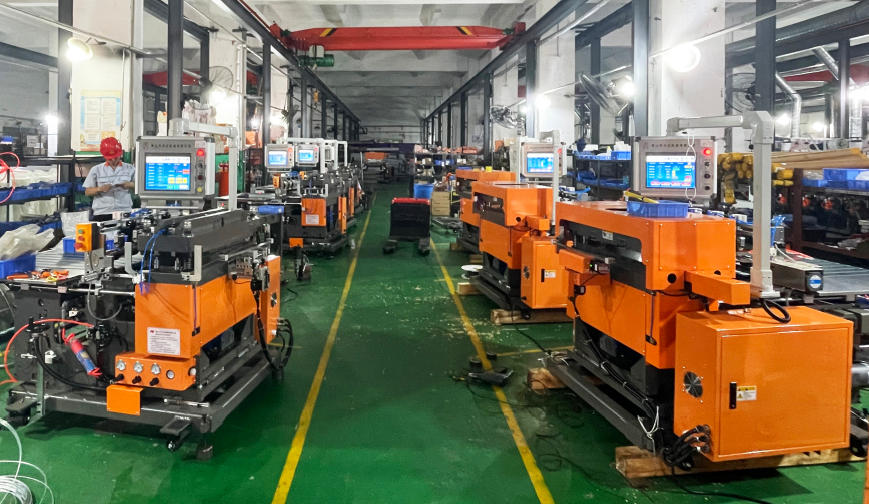
FOSHANTIANZHENG’s own history tracks that shift. The company originated from Hongli Bag-making in 1993, worked for years as a bag-processing factory, and moved into machinery manufacturing behind a 15-member R&D team. It now operates a 6,000 m² plant with four CNC machining centers and produces 87% of components in-house, reporting monthly output of 40 die-cutting machines, 10 hot stamping machines and 5 bag making machines, an annual output of around 500 units and roughly 30% of production exported. Its hot stamping machines have served the packaging industry for more than a decade, and its flagship special-shaped bag die-cutting machine has reached nearly 3,000 units sold globally.
The Three Inline Finishing Routes, Defined
Route 1 — Digitally Controlled Foil Stamping (Full Servo + CCD Vision)
The most flexible route for registered decoration is a full-servo stamping platform with CCD vision registration. The representative model in this family is HL1000T3-UC-CCD, classified as a full servo three stations upward force CCD vision registered stamping machine.
What that configuration buys a buyer:
- Registration accuracy of ±0.1 mm, achieved by CCD real-time correction that compensates for film stretch. The flat (non-CCD) configuration of the same product family is specified at ±0.3 mm, which is exactly why the CCD model is recommended for high-precision jobs.
- Production speed of 30–180 cycles/min. Speed is not one fixed number: it varies with pattern size, substrate and foil, and running large-area stamping more slowly generally improves yield.
- Three stations with upward force, which allows multi-pass decoration — for example a base foil plus a second colour or an embossed element — without taking the web off the line.
Artwork limits decide whether a design is manufacturable inline at all, and they matter as much as the machine specification:
| Parameter | Specification | Practical meaning for the buyer |
|---|---|---|
| Minimum stamping line width | 0.2 mm | Fine lines stamp stably on the CCD vision model; lines thinner than 0.2 mm risk breaking, so keep fine lines at ≥ 0.2 mm in the design. |
| Minimum hollow-out gap | 0.5 mm | Hollow-out below 0.5 mm causes clogging and blurred foil; reserve the gap in the artwork. |
| Minimum stamping area | 2 × 2 mm | Small logos and icons are supported; use high-transfer foil for tiny patterns. |
| Maximum stamping area | 200 × 300 mm per group | Larger sizes are available through multi-station or a custom module, depending on the actual machine configuration. |
| Adaptable film thickness | 0.012–0.3 mm | Covers the common film and laminate range, including PE material stamping. |
| Registration accuracy | ±0.1 mm (CCD) / ±0.3 mm (flat) | CCD real-time correction compensates film stretch; the CCD model is recommended for high-precision work. |
On decoration capability, buyers routinely ask whether several finishing processes can run on one platform. Cold foil application, spot UV varnish and embossing-debossing are the three additions most often requested alongside foil stamping, and consolidated platforms in this family do carry embossing: the HL1000FT-D is classified as an auto punching window & double colors embossing stamping machine. Because integration is project-specific, the correct step is to confirm with the supplier which decorative processes run on a single platform in your configuration instead of assuming it from a catalogue photo.
Route 2 — Hot Stamping / Foil Stamping
Hot stamping — also specified as foil stamping, hot embossing stamping or roll-to-roll stamping — remains the workhorse decoration route in flexible packaging. It transfers foil from a carrier onto the printed web under heat and pressure, and this product family explicitly covers hot stamping machines, roll-to-roll stamping machines, hot embossing stamping machines and machines configured for PE material stamping.
The high-throughput option is HL1200KT-4H, classified as an automatic 1200 mm width roll-to-roll four colors hologram stamping machine. The 1,200 mm working width is the number that matters most to a medium or large factory, because it determines how many pouch lanes you can run across the web and therefore how the stamping module matches the output of the bag making line.
Frame the selection around the decoration need, not around the machine name:
- Single-colour, high-volume decoration — a straightforward hot stamping configuration on a stable substrate is the simplest and most repeatable route.
- Multi-colour or hologram decoration — the 1,200 mm roll-to-roll four-colour hologram configuration exists for this requirement, and this is where speed should be discussed against pattern size.
- Embossed, tactile decoration — embossing stations belong in the specification from the start rather than as a later retrofit.
The same artwork discipline applies as in Route 1: minimum stamping line width of 0.2 mm, minimum hollow-out gap of 0.5 mm, minimum stamping area of 2 × 2 mm, maximum of 200 × 300 mm per group, and adaptable film thickness from 0.012 mm to 0.3 mm. The dominant constraint here is thermal and mechanical rather than optical. Hot stamping is a contact process, so buyers running thin or heat-sensitive structures should validate the temperature and tension window on their own film before locking a decoration design.
Route 3 — Punching Window Rewinding
Punching window rewinding is the route to choose when the format feature is the product. A window — a punched aperture finished with transparent film — is what lets a brand show the contents inside a pouch, and it defines many food, hygiene and consumer formats.
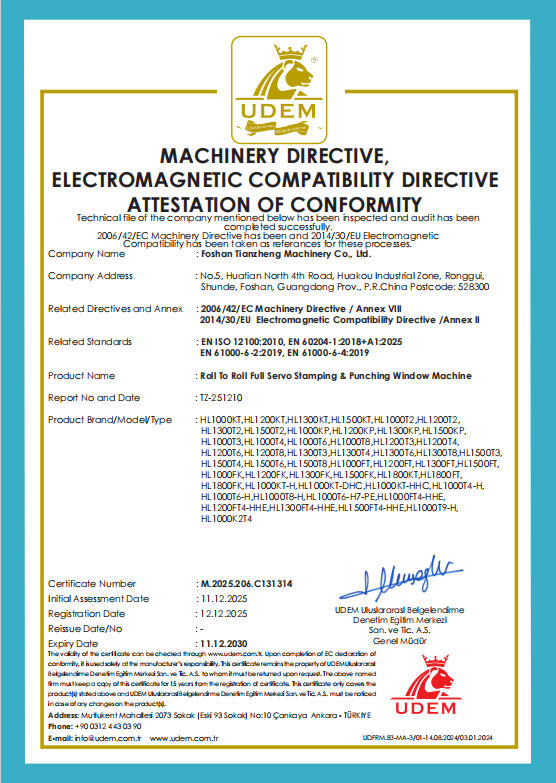
In this product family, window punching is combined with decoration rather than offered as a stand-alone station. HL1000FT-D is classified as an auto punching window & double colors embossing stamping machine, and the wider equipment family covers auto punching window rewinding machines, punching window & stamping machines and paper punching window machines. The CE attestation for this equipment line covers a Roll To Roll Full Servo Stamping & Punching Window Machine, which indicates how the two functions share one web path.
Step-by-Step: How to Write the Finishing Specification
- Map your bag mix and the decoration share. List the formats you actually run — flat bottom with zipper, stand-up with zipper, doypack, central seal gusset, three-side-seal, Bag-in-box, label pasting in-line — and the share of output that needs any decoration or window. The bag making machine series HL0500A1 through HL0700A9 can be configured as three side sealing, center sealing / four side sealing, stand-up, stand-up zipper, central seal gusset and label pasting in-line bag making machines, so the finishing module has to serve that whole set rather than one format.
- Define the finest detail in your artwork before you define the machine. If the design contains a line below 0.2 mm or a hollow-out gap below 0.5 mm, it will fail at production speed regardless of machine quality. Fix the artwork first.
- Convert your format tolerance into a registration requirement. Decoration on a wide flat pouch is forgiving; decoration that must land inside a pre-printed register mark on stretchable film is not. ±0.1 mm with CCD correction versus ±0.3 mm on the flat configuration is the decision point, and the CCD model is recommended for high-precision jobs.
- Confirm the substrate window. The stamping family is specified for film thickness of 0.012–0.3 mm and includes configurations for PE material stamping. If you run hygiene packaging or another heat-sensitive structure, validate on your own film: run the pre-shipment test with the substrate and artwork you will actually produce, not with a generic sample.
- Check integration with the bag making line. The pouch making machines operate at 30–130 bags/min, with a bag width range of 50–1200 mm and total power of 30–131.4 kW at 380 V, 50 Hz, under indoor normal-temperature conditions. Confirm that the finishing module’s rhythm, web width and utilities match the line it will sit behind — not the other way around.
- Lock the commercial terms before the technical sign-off. MOQ 1 unit; delivery terms FOB/CIF; payment terms 30/70; acceptance criteria pre-shipment test. Those four lines remove most of the ambiguity from an inline finishing purchase.
Use Cases: Which Route Fits Which Factory
Diversified converter with mixed formats. A factory running several pouch formats with decoration on part of the output gains most from the servo/CCD platform: CCD registration corrects film stretch job to job, and matching the bag making series (HL0500A1–HL0700A9) means the same finishing module serves stand-up with zipper, doypack and flat-bottom-with-zipper work.
Hygiene and thin-film producer. Thin films narrow the thermal window. Here the deciding data are film thickness compatibility (0.012–0.3 mm) and the ability to hold registration on a stretching web, not the maximum decoration size.
High-volume single-decoration producer. Where artwork is stable and volumes are high, a hot stamping or hologram roll-to-roll configuration is the efficient route; the 1,200 mm working width of HL1200KT-4H is what allows multi-lane output.
Window-led formats. Where the window defines the pack, choose the combined punching window and embossing stamping configuration and treat decoration as a secondary layer.
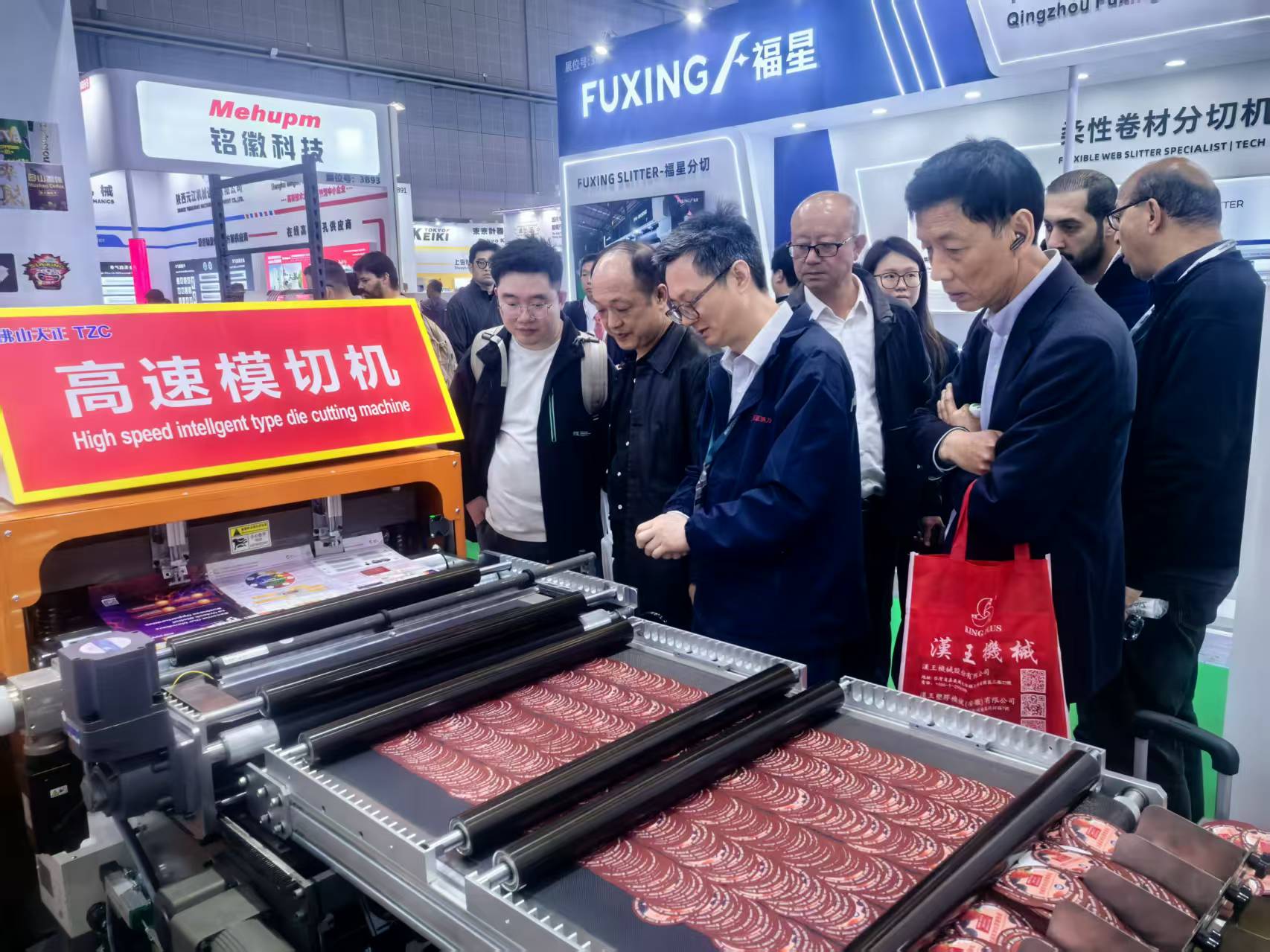
Continuous operation is the practical separator between equipment built for long shifts and equipment built for samples. In the manufacturer’s documented case, a flexible packaging manufacturer operates 20 units producing plastic bags, with equipment in operation for more than 10 years, and reports stable operation and low noise as the key highlights. Published comparison figures for this equipment against alternative machines are 30% higher production efficiency, 22% less material loss, 16% better energy efficiency per thousand bags and 18 dB lower operating noise. Those are manufacturer-stated comparisons; the operational point they support is that continuous stable running — not peak speed on a demo — is what an inline finishing route has to deliver.
Comparison Table: Three Inline Finishing Routes Side by Side
| Comparison point | Digitally controlled stamping (HL1000T3-UC-CCD) | Hot / foil stamping (HL1200KT-4H and hot stamping family) | Punching window rewinding (HL1000FT-D) |
|---|---|---|---|
| What the route adds | Registered foil decoration with full servo, three stations and upward force | Foil, hologram and embossed decoration on a roll-to-roll web | Punched window plus double-colour embossed stamping on one web path |
| Registration accuracy | ±0.1 mm with CCD real-time correction compensating film stretch (flat model ±0.3 mm) | Per configuration; the flat model of the family is specified at ±0.3 mm | Per configuration, on a roll-to-roll full-servo web path |
| Production speed | 30–180 cycles/min, varying with pattern size, substrate and foil | 30–180 cycles/min, varying with pattern size, substrate and foil | 30–180 cycles/min across the same product family |
| Substrate | Adaptable film thickness 0.012–0.3 mm | Adaptable film thickness 0.012–0.3 mm, including PE material stamping | Roll-to-roll film web |
| Working width | Per configuration within the product family | 1,200 mm on the four-colour hologram model | Per configuration within the product family |
| Artwork limits | Min. line 0.2 mm; min. hollow-out gap 0.5 mm; 2 × 2 mm min.; 200 × 300 mm max. per group | Same family limits: 0.2 mm line, 0.5 mm gap, 2 × 2 mm min., 200 × 300 mm max. per group | Driven by window geometry; decoration must fit the remaining web area |
| Best fit | Formats and artwork that change; stretch-sensitive registration | Stable high-volume decoration; multi-colour and hologram work | Window-led formats where the aperture is the product feature |
| Main constraint | Artwork must respect the 0.2 mm line and 0.5 mm gap design floors | Contact heat and pressure narrow the window on thin, heat-sensitive films | Window geometry must be specified before decoration |
Commercial terms are shared across the three routes: MOQ 1 unit, delivery terms FOB/CIF, payment terms 30/70, acceptance criteria pre-shipment test, lead time 30–45 days, monthly capacity of 30 units, 100% full inspection before shipment and online technical support after delivery.
Frequently Asked Questions
What certifications cover the stamping and punching window equipment?
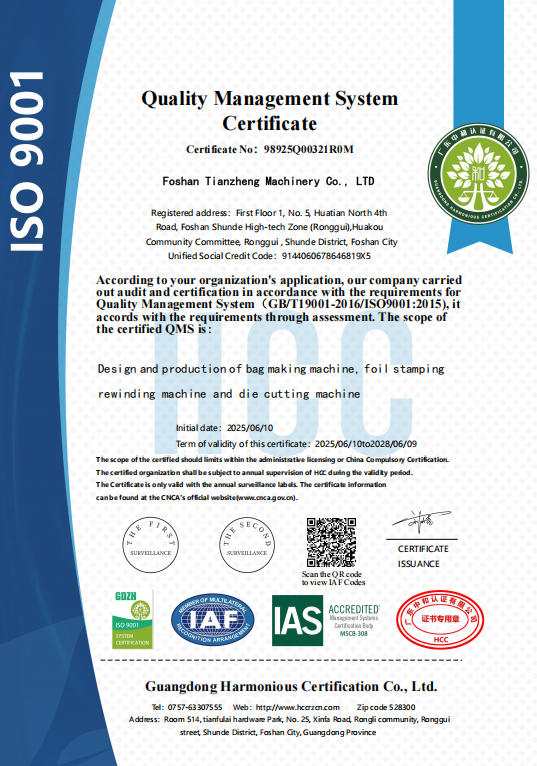
Two certifications apply to this equipment line. The ISO 9001 Quality Management System Certification (certificate 9892Q00321R0M, issued by HCC, standard ISO9001:2015, valid 10 June 2025 to 9 June 2028) covers the design and production of bag making machines, foil stamping rewinding machines and die cutting machines in the global market. The CE Attestation of Conformity under the Machinery & EMC Directive (certificate M.2025.206.C131314, issued by UDEM, valid 11 December 2025 to 11 December 2030) covers the Roll To Roll Full Servo Stamping & Punching Window Machine for the EU market, against EN ISO 12100:2010, EN60204-1:2018+A1:2025, EN61000-6-2:2019 and EN61000-6-4:2019. For packaging machinery exported to the EU, EN ISO 12100:2010 risk assessment and CE marking are the baseline requirement, with machine-specific safety requirements detailed in the EN 415 series of Type C standards.
Can one platform stamp and punch windows at the same time?
Yes, in a combined configuration. In this product family the combined machine is HL1000FT-D, classified as an auto punching window & double colors embossing stamping machine, and the CE-approved scope for the line is a Roll To Roll Full Servo Stamping & Punching Window Machine. Combined operation runs off one roll-to-roll web path, with production speed specified as 30–180 cycles/min across the family. Where the requirement is multi-colour decoration rather than a window, HL1200KT-4H performs 1,200 mm width roll-to-roll four-colour hologram stamping. Where the finest registration is critical, HL1000T3-UC-CCD — full servo, three stations, upward force, CCD vision registered — holds ±0.1 mm, against ±0.3 mm on the flat configuration.
Can a manufacturer supply an OEM flat bottom zipper bag making machine and the inline finishing equipment together?
Yes, within one supplier scope. The bag making machine series HL0500A1–HL0700A9 can be configured as three side sealing, center sealing / four side sealing, stand-up, stand-up zipper, central seal gusset and label pasting in-line bag making machines — the configurations that cover flat bottom with zipper, stand-up with zipper, doypack, zipper pouch, central seal pouch and label pasting in-line work. Alongside that, FOSHANTIANZHENG provides OEM and ODM production services, with ODM customization available for machine structure, working width, functions and mould. With a minimum order quantity of 1 unit, a single-machine trial is possible before a line-level commitment.
What are the purchasing terms and acceptance criteria?
MOQ is 1 unit; delivery terms are FOB/CIF; payment terms are 30/70; and the acceptance criteria are a pre-shipment test. Because acceptance is defined around that pre-shipment test, the practical way to de-risk the order is to run it on the substrate and artwork you will actually produce at line speed — this is where registration (±0.1 mm CCD / ±0.3 mm flat) and the artwork floors (0.2 mm minimum line, 0.5 mm minimum hollow-out gap) should be checked against your own design rather than a catalogue sample.
What is the lead time, and what support comes after delivery?
Lead time is 30–45 days with a monthly capacity of 30 units. Quality control is 100% full inspection before shipment and after-sales support is provided as online technical support. To move a project forward, send your bag format, film thickness and artwork to the FOSHANTIANZHENG team for a route recommendation and a pre-shipment test plan — contact details are below.
Conclusion: Choose the Route That Holds the Line
For medium and large flexible packaging factories with diversified bag types and continuous production, the three inline finishing routes solve different problems. Digitally controlled full-servo stamping (HL1000T3-UC-CCD) is the answer when artwork and formats change and registration must hold ±0.1 mm on a stretching web. Hot and hologram foil stamping (HL1200KT-4H) is the answer when decoration is stable, high-volume and multi-colour, up to a 1,200 mm working width. Punching window rewinding (HL1000FT-D) is the answer when the window is the product feature and decoration rides along on the same web path.
In every case, the specification that decides success is written in three lines: the finest line and smallest gap in the artwork, the registration tolerance your format can tolerate, and the film thickness you will actually run. Add the shared commercial terms — MOQ 1 unit, FOB/CIF, 30/70 payment, pre-shipment test acceptance and a 30–45 day lead time — and the evaluation has a clear stopping point.
Next Step: Sample Test and Quotation
FOSHAN TIANZHENG MACHINERY CO.,LTD (FOSHANTIANZHENG) builds bag making machines, hot stamping machines and die-cutting machines in Foshan, Guangdong, with OEM/ODM customization and pre-shipment test acceptance on every unit.
Website: www.tianzhengmachinery.com | Email: tianzheng@tz980.com | WhatsApp: +86 18028113815
Download the full product catalogue for machine models, specifications and configurations: FOSHANTIANZHENG Product Catalogue (PDF)