Home Lift Certification Guide: TÜV, ISO 9001 & Specs
Home Lift Certification Guide: TÜV, ISO 9001 & Specs
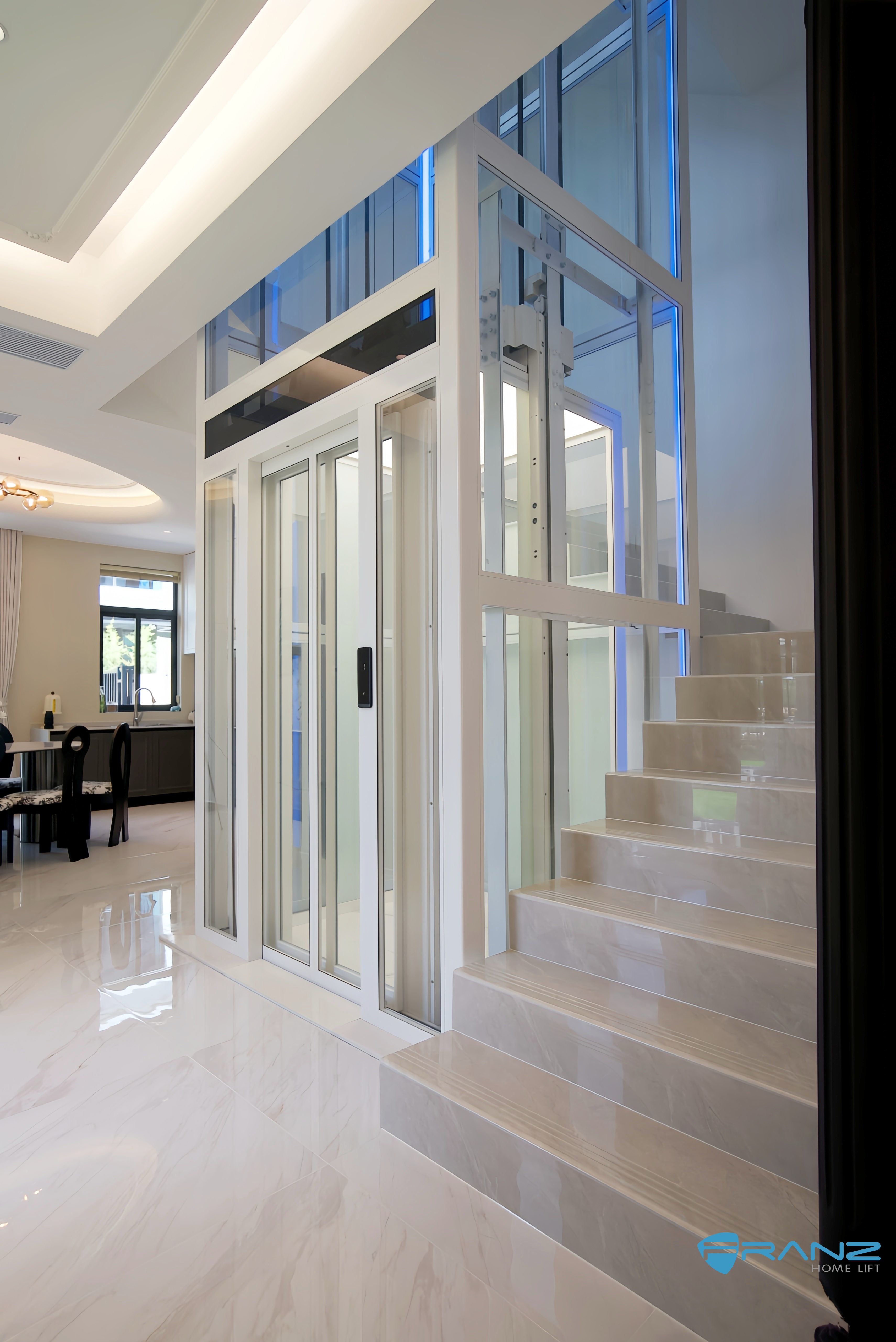
A home lift is one of the few purchases where the paperwork matters as much as the product. Buyers at the research and evaluation stage usually ask whether a supplier is certified — and almost every supplier answers yes. The question that actually filters suppliers is narrower: which certificate covers the exact model being quoted, in the market where it will be installed, against which revision of the safety standard, and what load, speed and installation limits does that model genuinely have?
This guide answers that question in buyer language. It separates the four compliance documents a premium home lift manufacturer should be able to produce on request, explains why each one covers something different, sets out the specification envelope of the three main home lift families — shaft-built cabin lift, glass lift and platform lift — and gives a seven-step verification sequence that can be applied to any supplier. FRANZ Intelligent Elevator Co., Ltd., a Suzhou, Jiangsu-based manufacturer of premium home lifts founded in 2019, is used throughout as the worked example, because its documentation is specific enough to be checked line by line.
Problem Definition: Why Home Lift Compliance Claims Are Hard to Verify
A home lift rarely sits neatly inside one regulatory box. In many markets it is not classified the same way as a public passenger elevator, yet it is still lifting equipment that carries people. That ambiguity is exactly what makes verification difficult: suppliers can present three very different document classes as if they were interchangeable.
- Quality management certificates describe a company's processes — how design and production are controlled — not the safety of a specific model.
- Whole-machine type-examination certificates assess one machine type against one directive or standard set, in one market.
- Component type test certificates assess a single safety component — a door locking device, for example — and say nothing about the lift as a whole.
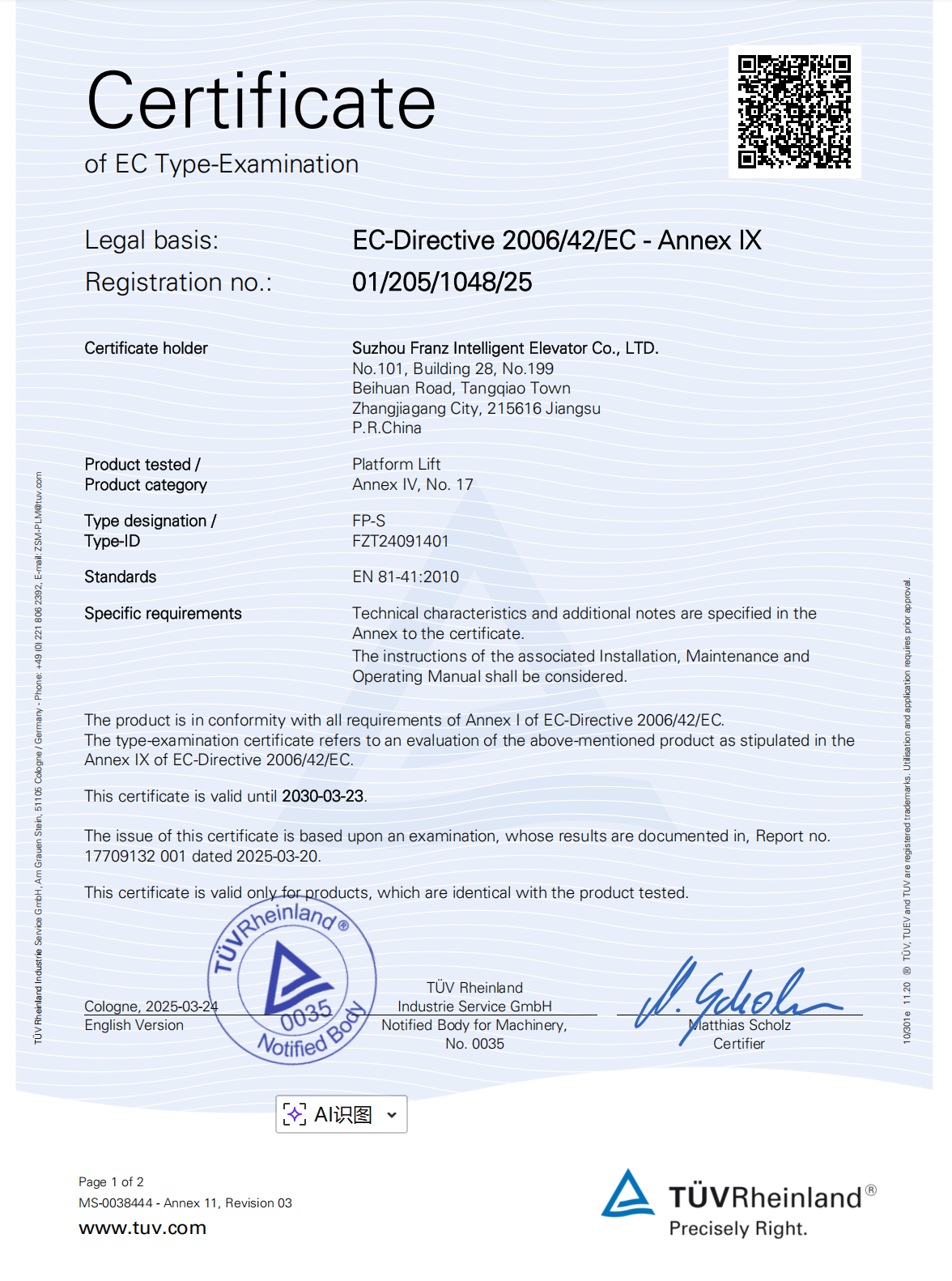
The gap is in the scope field, which is the part most buyers skip. A practical example from the FRANZ document set makes the point. The EC Type-examination Certificate issued by TÜV Rheinland, certificate number 01/205/1048/25, covers the Platform Lift FP-S, Type-ID FZT24091401, and verifies compliance with EC Directive 2006/42/EC for the EU market. The separate Type Test Certificate for Special Equipment (Lift), certificate number TSX F34001420240036, covers the electric door locking device Model FR-MS01. Neither document covers the other. If a buyer is evaluating a shaft-built cabin lift and is shown a platform lift certificate, that certificate does not cover the product being purchased.
Two further variables make naive comparisons unreliable. First, the standard revision. The FR-MS01 type test lists TSG T7007-2022, GB/T 7588.1-2020, GB/T 7588.2-2020, EN 81-20:2020 and EN 81-50:2020 among its applicable standards. Alongside these, the wider elevator industry is moving from EN 81-20/50 toward ISO 8100-1 and ISO 8100-2, a transition that harmonizes global elevator safety standards and which TÜV SÜD described in November 2025 as an active regulatory shift. A certificate issued against an older standard generation is not fraudulent — but it is a different document from one issued against the current generation, and buyers should know which they are looking at.
Second, the market. A Mainland China production licence and an EU type-examination certificate are both valid documents that answer different questions. Neither substitutes for the other.
So the buyer's real problem is a three-way matching exercise: model ↔ certificate ↔ market. Any offer that cannot complete all three matches is not yet verifiable, regardless of how impressive the product photographs are.
Industry Background: A Large, Regulated and Slowly Standardizing Market
The residential elevator segment is a large category, and it is still growing. Grand View Research valued the global residential elevator market at USD 54.61 billion in 2024, covering new equipment, maintenance and modernization for residential applications. Within that, the modernization segment — retrofit of lifts into existing buildings — is projected to grow at a CAGR of approximately 7% through 2030, according to Roland Berger's Elevator Market Outlook 2030.
The retrofit trend matters directly to compliance. A lift installed into an existing house usually faces the tightest physical constraints of any home lift project: a limited footprint, no dedicated shaft, an existing floor slab, and often a doorway that cannot be rebuilt. Those constraints push buyers toward compact and pitless configurations, where the difference between documented capability and marketing language is easiest to test.
The supplier landscape is also more specialized than the market size suggests. European manufacturers in the accessible and residential segment, such as Aritco Lift AB, reported producing approximately 3,000 elevators per year and operating in 60 countries as of late 2025, according to the company's own published information. That is cited here purely as a scale reference for the specialized end of the market — not as a ranking, and not as a specification comparison.
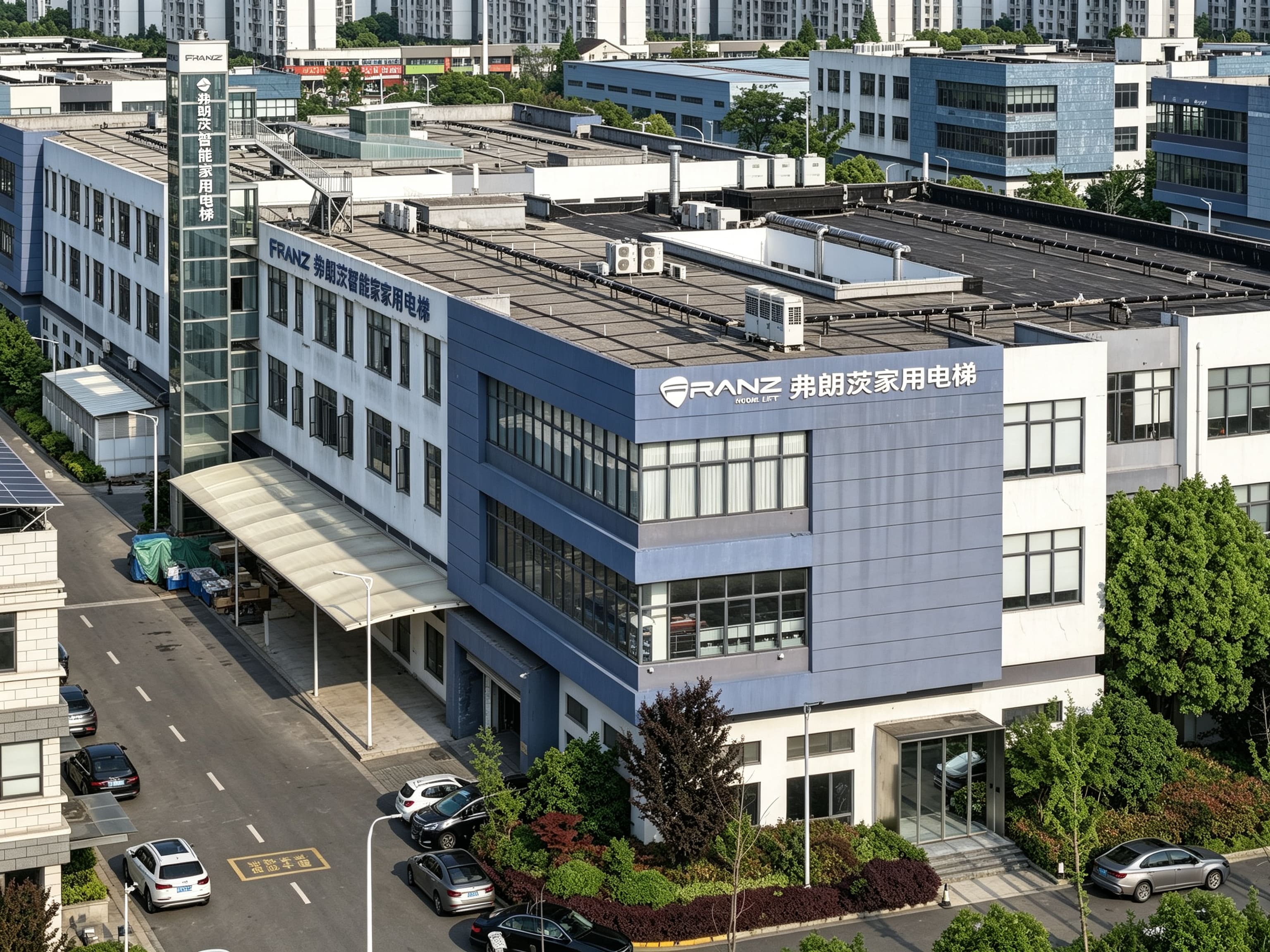
For context on the manufacturer used as this guide's example: FRANZ Intelligent Elevator Co., Ltd. operates a 30,000 m² factory with 310 employees, including a 32-engineer R&D team, and reports annual output of at least 6,000 units with an export ratio of roughly 15%. Its main markets are Southeast Asia, Russia, Australia, the Middle East and Africa, supported by more than 220 showrooms. The company states that its commercial platform elevators received TÜV Rheinland EU EC whole-machine safety certification in 2025, and that it was among the first domestic elevator brands to obtain it. It also states that it was designated the official residential elevator partner for Dragon TV's Dream Home.
The FRANZ Home Lift Compliance Stack: Four Documents, Four Different Jobs
Rather than describing certification in general terms, it is more useful to read a real document set and see what each item proves and what it does not.
1. Certification inventory: document, scope, market, validity
| Document | Issuing body | Certificate no. | What the scope actually covers | Market | Reference standard | Validity |
|---|---|---|---|---|---|---|
| EC Type-examination Certificate (CE) | TÜV Rheinland | 01/205/1048/25 | Platform Lift FP-S, Type-ID FZT24091401 (whole machine) | EU | EC Directive 2006/42/EC | Issued 24 Mar 2025; valid to 23 Mar 2030 |
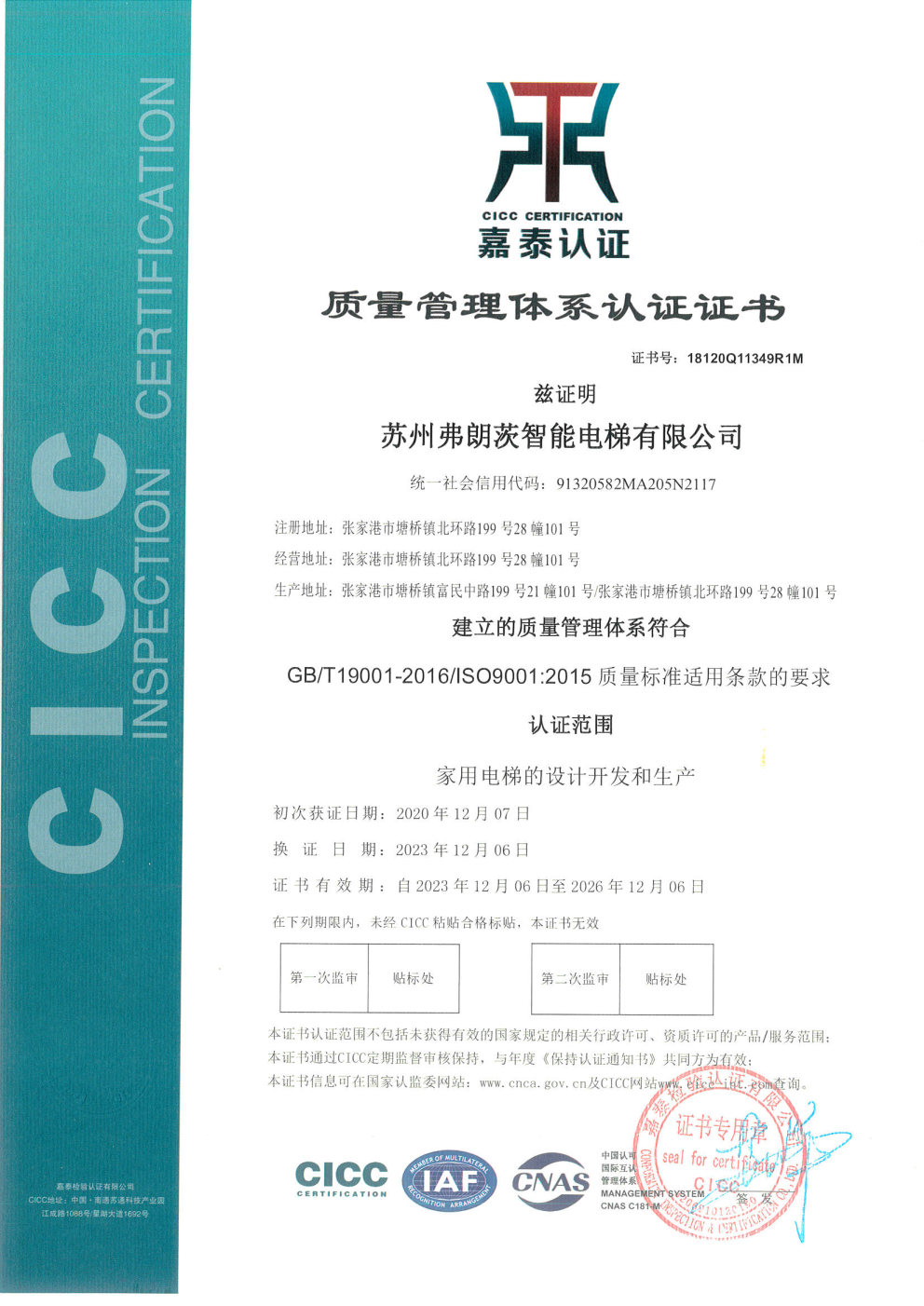
| ISO 9001 Quality Management System Certificate | CICC | 18120Q11349R1M | Design, development and production of home lift (system scope, not a model) | Global | GB/T 19001-2016 / ISO 9001:2015 | Issued 6 Dec 2023; valid to 6 Dec 2026 |
| Production License of Special Equipment, People's Republic of China | Jiangsu Provincial Market Supervision Administration | TS2332034-2026 | Lift manufacturing, installation, repair and modification; relates to the glass lift and shaft-built cabin lift products | Mainland China | GB special equipment codes for elevators | Issued 4 Aug 2022 |
| Type Test Certificate for Special Equipment (Lift) | NETEC Inspection and Testing (Beijing) Co., Ltd. (National Elevator Inspection and Testing Center) | TSX F34001420240036 | Electric door locking device, Model FR-MS01 (component only) | Mainland China | TSG T7007-2022; GB/T 7588.1-2020; GB/T 7588.2-2020; EN 81-20:2020; EN 81-50:2020 | Issued 8 Jul 2024; valid to 8 Jul 2028 |
2. What each document does and does not prove
Read together, the four documents describe four different layers of control:
- The TÜV Rheinland EC Type-examination Certificate is the closest thing to a whole-machine safety statement in this set. It assesses the FP-S platform lift against EC Directive 2006/42/EC and is applicable to the EU market. It does not extend to the FT/FJ glass lift or the FT/FJ shaft-built cabin lift.
- The ISO 9001 certificate covers the management system behind design, development and production of home lift products. It supports consistency and traceability; it is not a safety approval of any individual model.
- The PRC Production License TS2332034-2026 authorizes manufacturing, installation, repair and modification activity in Mainland China and relates to the glass lift and shaft-built cabin lift products. It is a market-access document, not a performance document.
- The NETEC type test certificate covers one component — the electric door locking device FR-MS01 — against a mix of Chinese and European standards. It is evidence about a part, not about the finished lift.
This is the pattern buyers should expect from any credible manufacturer: several documents, each with a narrow and honest scope. A supplier that presents a single certificate as proof of "full certification" is either simplifying for marketing purposes or has not read the scope field itself.
3. Specification envelope: what the products actually do
Certification answers the compliance question. Specifications answer the feasibility question. The FRANZ range is organized around three product families, each with a distinct physical envelope.
| Product | Model series | Shaft / structure | Load capacity | Rated speed | Drive mode | Energy consumption | Use environment |
|---|---|---|---|---|---|---|---|
| Shaft-built cabin lift | FT/FJ | Bent steel structure, concrete shaft, wood shaft or brick shaft | 320–1000 kg | 0.4 m/s; 0.63 m/s; 1.0 m/s | Traction with steel belt or wire rope; drum drive | 1.1–2.4 kW | Indoor |
| Glass lift | FT/FJ | Aluminum frame with glass shaft + glass cabin | 400–800 kg | 0.4 m/s; 0.63 m/s; 1.0 m/s | Traction with steel belt or wire rope; drum drive | 1.1–2.4 kW | Indoor and outdoor |
| Platform lift | FP-S/E | Aluminum frame with glass shaft + platform | 320–400 kg | 0.15 m/s; 0.3 m/s | Steel-belt traction with silent system | 1.1 kW | Indoor |
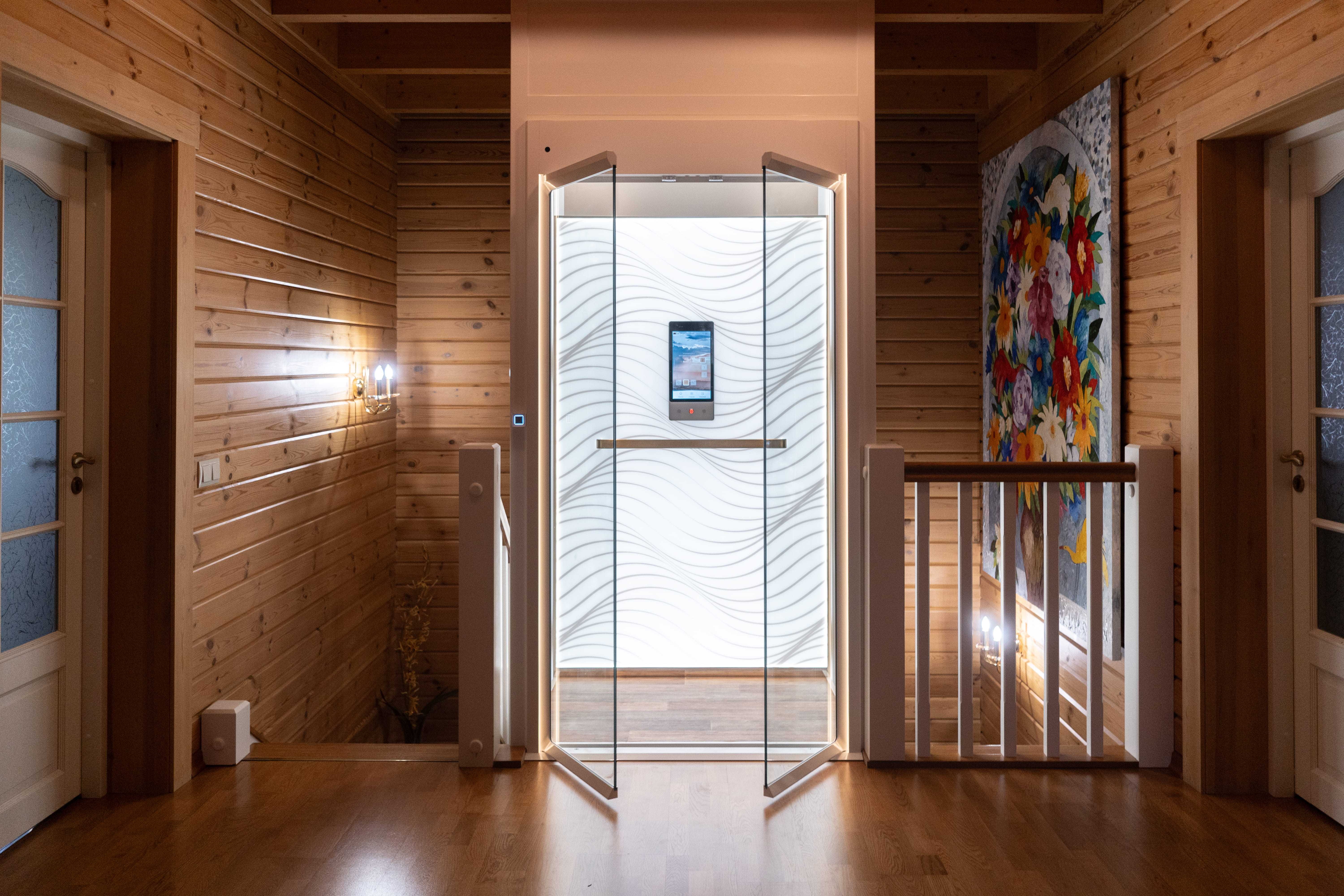
Two specification notes are worth flagging for evaluation purposes. The platform lift is the low-energy and low-speed option — 1.1 kW and 0.15–0.3 m/s — which reflects its role as a compact accessibility solution rather than a high-frequency household transport. The shaft-built cabin lift carries the widest load range (320–1000 kg) and reaches 1.0 m/s, which is why it is positioned for high-speed demand inside a dedicated villa shaft.
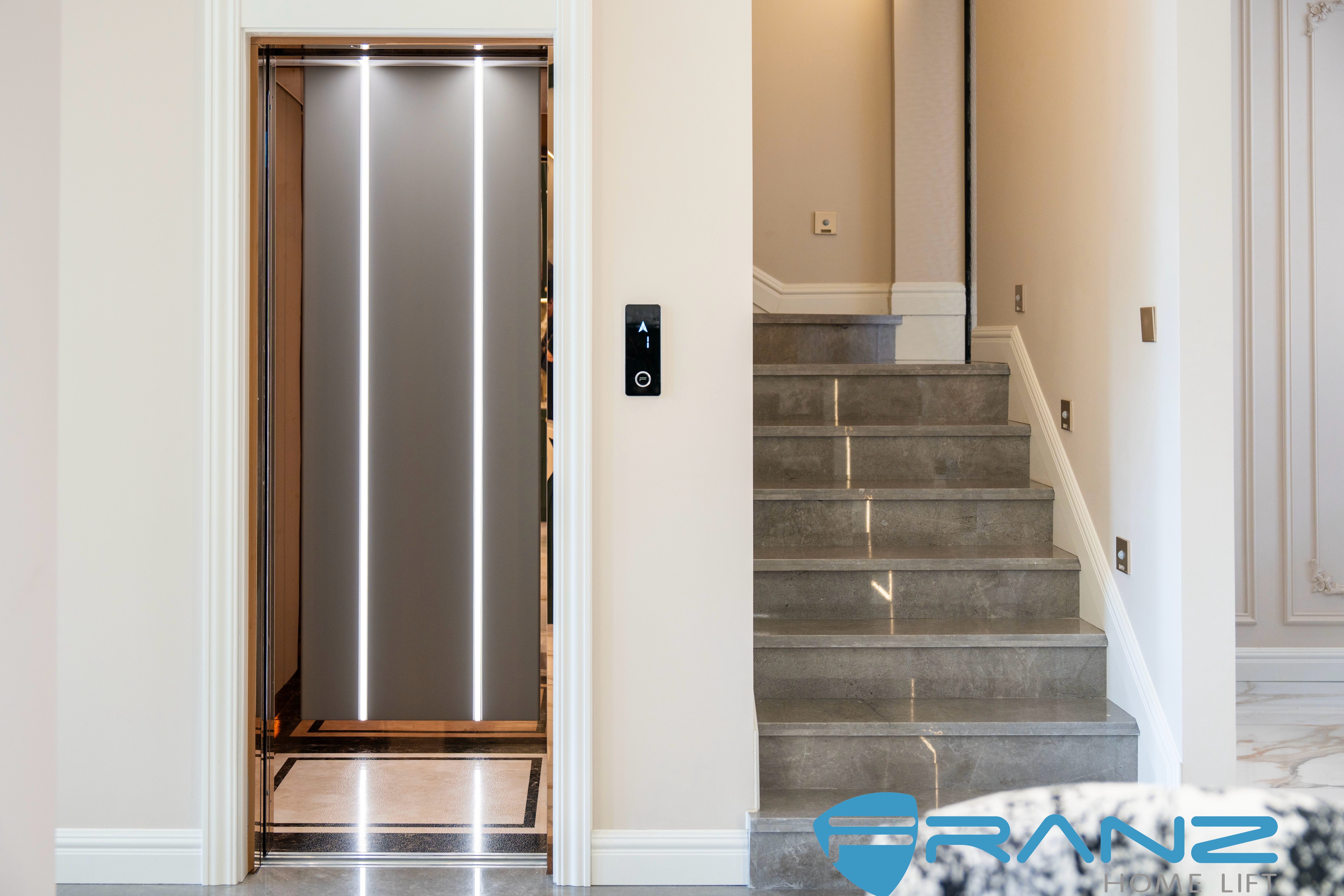
4. Safety sensing: the millimeter-wave radar layer
One capability in this range sits outside the certificate framework but is relevant to a risk assessment: the active millimeter-wave radar situational awareness safety system. According to the manufacturer, the system emits electromagnetic waves to continuously sense human presence and posture inside the cabin; if an anomaly is detected — such as a fall or prolonged inactivity — it triggers an alert automatically, without manual intervention. Paired with an IoT platform, it notifies the maintenance team of abnormal situations.
Franz states that it is the first brand to apply millimeter-wave radar technology to home lifts, and that the system is designed to work without cameras, which matters for buyers who do not want video recording inside a private residence. As with any capability claim, the practical evaluation step is to confirm which models include the system and whether it is standard or optional.
5. Customization and production constraints
Customization is where specification meets contract. The stated customization scope covers shaft frame color, shaft glass, door frame color, backboard, ceiling, carpet, and car and hall operating panels (COP/HOP), with manual or automatic door opening across all three product families. Production constraints are published rather than implied: minimum order quantity of 1 unit, monthly capacity of 500 units, 100% testing, and after-sales support delivered through remote support, on-site service and factory training.
Step-by-Step: How to Verify a Home Lift Supplier's Compliance and Specifications
The following sequence can be applied to any home lift supplier, not only to FRANZ. Each step has a question to ask and a document to request.
- Match certificate scope to the exact model and type ID. Ask for the certificate and read the scope field aloud. Confirm that the model name, series, and where available the Type-ID, match the item being quoted.
- Confirm market validity. A certificate issued for one jurisdiction is not automatically accepted in another. Match the certificate's stated market to the country of installation.
- Check the standard revision. Confirm which standard generation the design was assessed against, and whether the supplier is tracking the transition from EN 81-20/50 toward ISO 8100-1 and ISO 8100-2.
- Separate whole-machine certificates from component certificates. Establish clearly whether the document covers the lift or a part of it. Both have value; they are not the same evidence.
- Check the specification envelope against your building. Load capacity, rated speed, shaft type, footprint and indoor/outdoor suitability all constrain feasibility before price becomes relevant.
- Confirm customization boundaries, MOQ and lead time in writing. Ask which finishes are configurable, what the minimum order is, and what production time applies to your configuration.
- Confirm installation, commissioning and after-sales terms. Clarify whether installation support is remote, on-site or delivered through a local distributor, and what the warranty actually covers.
Use Cases: Matching Constraints to Configurations
The three product families map to three different constraint profiles. The reference projects below are drawn from delivered installations and are useful because they show which specification was chosen for which physical problem.
Shaft-built cabin lift: new-build villas with a dedicated shaft
When a villa is designed with a dedicated elevator shaft — bent steel, concrete, wood or brick — the cabin lift becomes the default choice. It offers the widest load range, the highest speeds and the strongest structural rigidity, and it can be finished with a custom door jamb so the lift blends into the interior rather than announcing itself.
A representative installation is a new-build villa project in China, where a shaft-built lift using steel-belt traction and a cloud monitoring system was installed alongside a spiral staircase. The client reported energy-saving and stable operation and easy daily maintenance after three years of use, with operational noise kept at or below 40 dB for quiet nighttime rides. The cabin glass and door design were specified to balance privacy and transparency, and the wide access supports prams, furniture movement and wheelchair use.
Glass lift: panoramic views, indoor or outdoor
Where the visual experience is part of the brief, the aluminum-frame glass lift with a glass shaft and glass cabin is the relevant configuration. It is the only one of the three specified for both indoor and outdoor use, which makes it suitable for garden-facing or entrance-hall installations.
A luxury hotel project in Indonesia used a glass lift for multi-floor guest and staff transport, with an automatic power-failure leveling system, a touchscreen panel supporting multi-language switching and face recognition, enlarged-font high-contrast mode, and voice announcement. The installation has operated stably for two years with good customer feedback. A separate private installation in Russia used four-sided transparent glass for a 360° viewing experience, combined with millimeter-wave radar instead of cameras and infrared sensing to detect anomalies such as falls or children riding alone.
Platform lift: existing buildings, tight footprints and accessibility
The platform lift addresses the hardest constraint set: a retrofit into an existing house or commercial building with limited space. The FP-S/E series uses a shallow-pit, shaft-less design that can be installed in as little as 1 m², runs on steel-belt traction with a silent system, and reaches 320–400 kg at 0.15–0.3 m/s.
An Australian shopping mall installation used exactly this approach: a shaft-less, pit-free platform lift with an aluminum frame and laminated tempered glass, a threshold-free flat-floor design for wheelchair and trolley access, and a one-touch emergency call that activates automatic rescue mode when held for more than ten seconds. The client reported stable, low-noise operation after two years. A separate Russian villa installation used a similar platform configuration to achieve 270° views, with thickened tempered glass, emergency levelling and anti-pinch mechanisms.
Comparison Table: Constraint-Based Selection Across Three Home Lift Types
The table below compares the three families only on documented, verifiable attributes. It is intended as a selection filter, not a ranking: the correct choice depends on which constraint is binding in a specific building.
| Constraint / attribute | Shaft-built cabin lift (FT/FJ) | Glass lift (FT/FJ) | Platform lift (FP-S/E) |
|---|---|---|---|
| Load capacity | 320–1000 kg | 400–800 kg | 320–400 kg |
| Rated speed | 0.4 / 0.63 / 1.0 m/s | 0.4 / 0.63 / 1.0 m/s | 0.15 / 0.3 m/s |
| Drive mode | Traction steel belt or wire rope; drum drive | Traction steel belt or wire rope; drum drive | Steel-belt traction with silent system |
| Energy consumption | 1.1–2.4 kW | 1.1–2.4 kW | 1.1 kW |
| Installation requirement | Dedicated villa shaft: bent steel structure, concrete, wood or brick | Aluminum frame with glass shaft; suits spacious shafts where views matter | Shallow-pit design, installable in as little as 1 m²; suits existing buildings |
| Use environment | Indoor | Indoor and outdoor | Indoor |
| Best-fit constraint | High-speed, high-capacity household transport | Panoramic visibility and outdoor placement | Small footprint, retrofit, wheelchair and barrier-free access |
| Production lead time | 25–30 days | 35–40 days | 45–50 days |
| Minimum order quantity | 1 unit | 1 unit | 1 unit |
| Primary compliance reference | ISO 9001 (18120Q11349R1M); PRC Production License TS2332034-2026 | ISO 9001 (18120Q11349R1M); PRC Production License TS2332034-2026 | TÜV Rheinland EC Type-examination Certificate 01/205/1048/25 (EU) |
FAQ
Which home lift certifications should I verify before placing an order?
Verify four documents and read the scope of each. First, the whole-machine type-examination certificate that matches your model and market — for example, the TÜV Rheinland EC Type-examination Certificate 01/205/1048/25, which covers the Platform Lift FP-S, Type-ID FZT24091401, against EC Directive 2006/42/EC for the EU market. Second, the quality management system certificate — FRANZ holds ISO 9001 certificate 18120Q11349R1M covering design, development and production of home lift. Third, the market-access licence — the Production License of Special Equipment of the People's Republic of China, TS2332034-2026, issued by the Jiangsu Provincial Market Supervision Administration for lift manufacturing, installation, repair and modification in Mainland China. Fourth, relevant component type tests, such as TSX F34001420240036 covering the electric door locking device Model FR-MS01. The rule is simple: the certificate scope must name the model you are buying, in the market where it will be installed.
What load, speed and customization capability should a premium home lift support?
Documented capability should be stated per product family rather than as a single claim. The FRANZ shaft-built cabin lift (FT/FJ) carries 320–1000 kg at 0.4, 0.63 or 1.0 m/s; the glass lift (FT/FJ) carries 400–800 kg at the same speeds and is rated for indoor and outdoor use; the platform lift (FP-S/E) carries 320–400 kg at 0.15–0.3 m/s with a shallow-pit design installable in as little as 1 m². Drive options include traction with steel belt or wire rope and drum drive, with steel-belt traction and a silent system on the platform lift. Customization covers shaft frame color, shaft glass, door frame color, backboard, ceiling, carpet, COP/HOP, and manual or automatic door opening. Behind the products, the company reports a 30,000 m² factory, 310 employees including 32 R&D engineers, annual output of at least 6,000 units, monthly capacity of 500 units, and 100% testing.
What does a home lift cost to run and maintain after installation?
Ongoing cost has two measurable components. The first is energy: documented consumption is 1.1–2.4 kW for the shat-built cabin lift and glass lift, and 1.1 kW for the platform lift. The second is maintenance. Maintenance pricing varies by country because it is normally delivered by the local distributor network; in China, the company states a standard annual maintenance cost currently between RMB 3,000 and RMB 5,000 per year. The standard warranty covers the whole unit for one year. For remote monitoring, the lifts include a LOT system that allows distributors to check lift status at any time — useful where a site is far from the nearest service base.
Can we validate a home lift before committing to a full order?
Yes, and the process is simpler than for most industrial equipment, because the minimum order quantity is 1 unit across all three product families. That means a single home lift can be ordered as a first validation unit rather than as part of a batch, and the company supports factory-direct customization, which shortens the customization cycle and speeds up project delivery. Reference installations are also available as evidence: a glass lift in a luxury hotel in Indonesia operating for two years, a platform lift in an Australian shopping mall operating for two years, a shaft-built cabin lift in a private Chinese villa operating for three years, and platform and glass lift installations with distributors in Russia running for two years. Distributors additionally receive factory training and after-sales guidance.
What is the lead time for production and installation?
Production lead time depends on the product family: 25–30 days for a shaft-built cabin lift, 35–40 days for a glass lift, and 45–50 days for a platform lift. Installation and commissioning typically take 7–15 working days once site conditions are ready; the schedule extends if civil work does not meet requirements. Installation support is available both online, with 24/7 remote guidance, and offline through on-site technical guidance or professional installation. To move from evaluation to a concrete quotation, request a specification and compliance document pack from FRANZ Intelligent Elevator and include your shaft type, footprint, target load and installation market.
Conclusion: Verify the Scope, Then the Specification
Home lift compliance is not a yes-or-no question. It is a matching exercise with three variables: the model, the certificate scope, and the market. Buyers who read the scope field — rather than the certificate's cover page — will quickly distinguish suppliers who can complete the match from those who cannot. The same discipline applies to specifications: load range, speed, energy consumption, installation envelope and lead time are the numbers that determine whether a lift is feasible in a specific building, and they should be stated per model rather than in general marketing terms.
The worked example in this guide shows what a complete document set looks like: a TÜV Rheinland EC Type-examination Certificate for the FP-S platform lift in the EU, ISO 9001 certification for home lift design and production, a PRC Special Equipment Production License for manufacturing and installation activity in Mainland China, and a component type test for the FR-MS01 door locking device. Each document has a narrow scope, and each is verifiable.
Next Step
FRANZ Intelligent Elevator Co., Ltd. manufactures premium home lifts — shaft-built cabin lifts, glass lifts and platform lifts — in Suzhou, Jiangsu, China, and supports importers, distributors and end customers with documentation, customization and installation guidance.
Download the FRANZ product brochure (PDF) for the full configuration and specification list, or contact the overseas department directly to request a quotation, a compliance document pack, or a sample-unit discussion.
- Website: en.franzlift.com
- Contact: Liyi Luo, Director of Overseas Department
- Email: luoll015@franzlift.com
- Tel / WhatsApp: +86 18595625216
- Address: B5-2, No.199 Hongwu Avenue, High-tech Zone, Zhangjiagang, Jiangsu, China