Home Lift Certification and Specifications: A Compliance-First Buying Guide
Home Lift Certification and Specifications: A Compliance-First Buying Guide
A home lift does not clear inspection because it is a well-built product. It clears inspection because the certificate names the exact model being installed, the load rating matches the building, and the drive configuration suits the shaft that actually exists. Buyers in the research and evaluation stage usually begin by comparing brands, then discover that the deciding constraints were documentary and technical all along.
This guide works through those constraints in the order they normally surface: which certifications each market requires, what each document actually covers, which specification limits decide feasibility, and how to lock all of it into a purchase order before production starts.
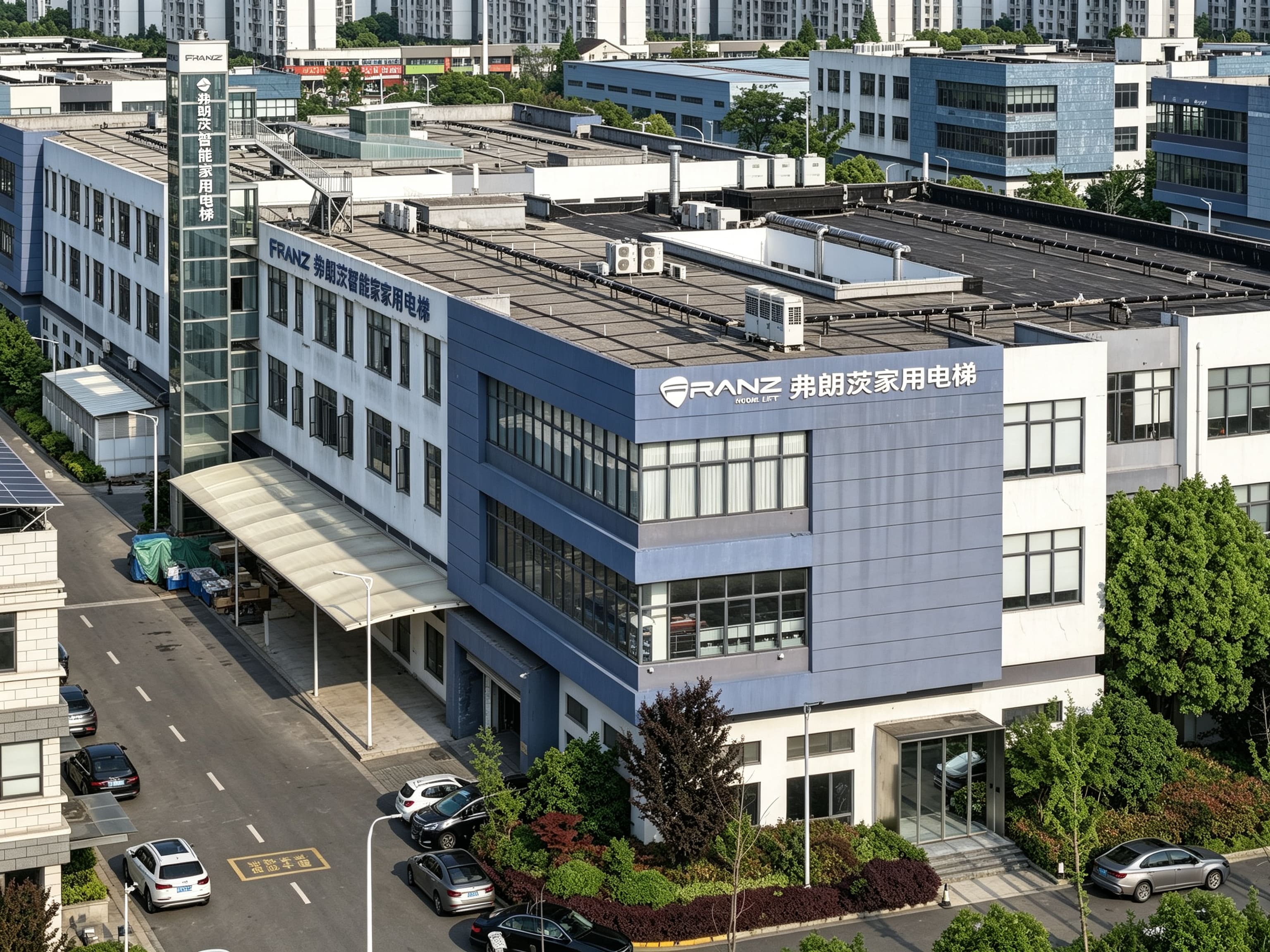
FRANZ Intelligent Elevator Co., Ltd. (Suzhou Franz Intelligent Elevator Co., Ltd.) is a residential elevator manufacturer based in Suzhou, Jiangsu, China, specialising in the research, smart manufacturing, sales, installation and maintenance of villa home lifts.
Problem Definition: A Home Lift Has to Pass Three Different Gates
Residential elevator projects rarely fail on the product itself. They fail because three separate sets of requirements get treated as one, and the mismatch only becomes visible late in the project.
- The legal gate. Certification and licensing that allow the lift to be sold, installed and inspected in the destination market. This is a document question, not a design question.
- The structural gate. Load capacity, speed, shaft material and pit depth determine whether the lift physically fits the building and the way it is used.
- The daily-use gate. Noise, vibration, energy consumption, accessibility and safety monitoring determine whether the owner still likes the lift three years later.
A configuration can be fully compliant and still be wrong for a project, because compliance answers the legal gate and says nothing about the other two. That is why the useful buying question is not which brand is strongest, but which combination of certificate, rating and configuration holds up against a specific building and a specific market.
Industry Background: Home Lift Compliance Is Tightening
Global demand gives the category its scale. The global residential elevator market reached USD 54.61 billion in 2024, according to Grand View Research. The retrofit side is expanding at a similar pace: the Modernization segment of the elevator market is projected to grow at a CAGR of 7% through 2030, according to Roland Berger. Retrofit demand maps directly onto projects where the home lift has to be fitted into a building that already exists and cannot be reshaped.
At the same time, the safety standards themselves are in transition. EN 81-20/50 is being replaced by ISO 8100-1 and ISO 8100-2, a harmonization reported by TÜV SÜD with an effective date of 1 March 2026. Buyers evaluating a lift today therefore need to check not only whether a certificate exists, but which standard revision it references and how long it remains valid.
Against that backdrop, manufacturer scale becomes a proxy for how reliably documentation can be maintained. FRANZ Intelligent Elevator Co., Ltd. was founded in 2019 and operates a 30,000 m² factory with 310 employees, an annual output of 6,000 units and a research and development team of 32 engineers. Export accounts for approximately 15% of output, with main markets in Southeast Asia, Russia, Australia, the Middle East and Africa. The company operates more than 220 showrooms and serves customers across five continents and over 30 countries. In 2025, FRANZ reported that its commercial platform elevators received the TÜV Rheinland EU EC Whole-Machine Safety Certification.
Detailed Solution: The Four Compliance Documents That Matter
Four document types cover almost every compliance question a residential buyer will face. Each one answers a different question, and none of them substitutes for the others.
1. EU market - EC type-examination certificate
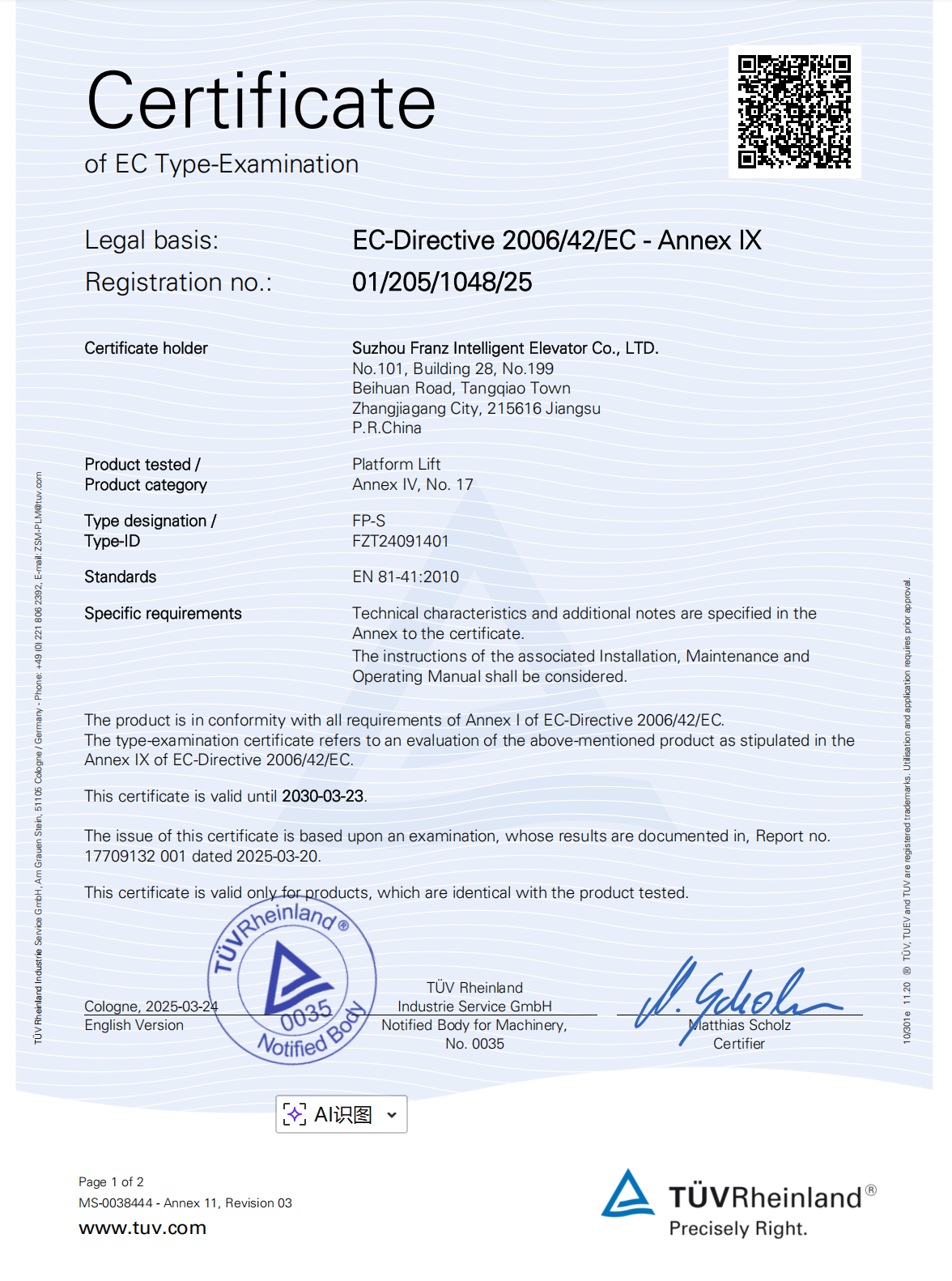
The FRANZ FP-S series platform lift holds an EC type-examination certificate issued by TÜV Rheinland under certificate number 01/205/1048/25. The certificate verifies compliance with EC Directive 2006/42/EC, identifies the certified type by Type-ID FZT24091401, and applies to the EU market. It was issued on 24 March 2025 and is valid until 23 March 2030.
What matters to a buyer is that the certificate is bound to a model and a directive. A CE-related document that does not name the model and the directive is not a substitute, and a certificate that has expired is not evidence of current conformity.
2. Global markets - ISO 9001 quality management system
FRANZ home lift products are covered by ISO 9001 Quality Management System certification, certificate number 18120Q11349R1M, issued by CICC to the standard GB/T 19001-2016 / ISO 9001:2015. The scope covers the design, development and production of home lifts. The certificate was issued on 6 December 2023 and expires on 6 December 2026.
ISO 9001 certifies a process, not a product. Its value in a purchase decision is that it indicates a controlled design and production system, which is what makes consistent output across repeat orders possible. It should not be presented as equivalent to a product safety approval.
3. Mainland China - Special Equipment Production License
For the Mainland China market, the relevant document is the Production License of Special Equipment of the People's Republic of China, certificate number TS2332034-2026, issued by the Jiangsu Provincial Market Supervision Administration. Its scope covers lift manufacturing, installation, repair and modification under GB special equipment codes for elevators. The license was originally issued on 4 August 2022.
4. Component level - Type Test Certificate for the door locking device
Component certificates are frequently overlooked and frequently decisive. The electric door locking device Model FR-MS01 is certified under the Type Test Certificate for Special Equipment (Lift), certificate number TSX F34001420240036, issued by NETEC Inspection and Testing (Beijing) Co., Ltd. (National Elevator Inspection and Testing Center). The certificate was issued on 8 July 2024 and is valid until 8 July 2028.
The cited standards are TSG T7007-2022, GB/T 7588.1-2020, GB/T 7588.2-2020, EN 81-20:2020 and EN 81-50:2020. The practical point is that independent testing covers a specific sub-assembly rather than relying only on end-of-line factory checks. For buyers whose destination market cross-references EN standards, this is a document worth requesting explicitly.
Specification Constraints: The Parameters That Decide Feasibility
Three FRANZ product families cover the majority of residential briefs, and their specification ranges are the fastest way to rule a configuration in or out before detailed design begins.
| Specification | Platform lift (FP-S/E Series) | Glass lift (FT/FJ series) | Shaft-built cabin lift (FT/FJ series) |
|---|---|---|---|
| Shaft / structure | Aluminium frame with glass shaft plus platform | Aluminium frame with glass shaft plus glass cabin | Bent steel structure, concrete shaft, wood shaft or brick shaft |
| Load capacity | 320 kg – 400 kg | 400 kg – 800 kg | 320 kg – 1,000 kg |
| Rated speed | 0.15 m/s; 0.3 m/s | 0.4 m/s; 0.63 m/s; 1.0 m/s | 0.4 m/s; 0.63 m/s; 1.0 m/s |
| Energy consumption | 1.1 kW | 1.1 kW – 2.4 kW | 1.1 kW – 2.4 kW |
| Installation environment | Indoor | Indoor and outdoor | Indoor |
| Typical fit | Small spaces, existing houses, wheelchair and disability access | Spacious shafts where the view should be preserved | High-speed demand, higher loads, greater structural rigidity |
Constraints worth checking before design
- Available footprint. The FP-S/E platform lift uses a shallow-pit, high-efficiency design that can be installed in as little as 1 m² of space, which is why it is the usual answer for existing houses and wheelchair access.
- Indoor or outdoor. The glass lift is rated for both indoor and outdoor use, with full-glass cabin and shaft for a 360° viewing experience. The platform lift and shaft-built cabin lift are specified for indoor use.
- Speed versus shaft. The shaft-built cabin lift is the appropriate choice when higher speed is required. Speeds of 0.4 m/s, 0.63 m/s and 1.0 m/s appear across both the glass lift and the cabin lift, so the deciding factor becomes the shaft structure rather than the drive.
- Energy budget. A platform lift consumes 1.1 kW; glass and cabin lifts range from 1.1 kW to 2.4 kW depending on configuration. For a villa running several trips a day, this is a running-cost input, not a headline number.
Safety and comfort specifications that affect specification choices
FRANZ states that it is the world's first brand to apply millimetre-wave radar technology to home lifts. The system emits electromagnetic waves to continuously sense human presence and posture inside the cabin. If an anomaly is detected, such as a fall or prolonged inactivity, it automatically triggers an alert without manual intervention. Paired with the IoT platform, the system notifies the maintenance team of any abnormal situation. Because the sensor detects presence and posture rather than recording images, the function operates without a cabin camera.
Noise is a second specification constraint that shows up in owner feedback rather than in a datasheet. In a recorded FRANZ villa project in China, steel-belt traction drive keeps operational noise at ≤ 40 dB, and the company notes that this differs from mainstream screw-type home elevators. Steel-belt traction also supports smoother start-stop performance and higher load-bearing capacity than screw-drive alternatives.
Step-by-Step Breakdown: Specifying a Compliant Home Lift
- Fix the destination market first. The market determines which certificate is required. EU projects need the EC type-examination certificate; Mainland China projects need the Special Equipment Production License and the applicable component certificates. Asking for a certificate that the destination market does not recognise wastes a review cycle.
- Survey the building before choosing a product family. If a shaft exists or can be built, the cabin lift or glass lift applies. If the building must not be structurally altered, the shallow-pit platform lift is the realistic starting point.
- Match load capacity to real usage. The ranges run from 320 kg on the platform lift to 1,000 kg on the shaft-built cabin lift. Capacity should reflect wheelchair use, prams and furniture moving, not the average passenger weight.
- Confirm speed against the number of stops. Speeds from 0.15 m/s to 1.0 m/s are available across the range, and the choice affects travel time and shaft requirements together.
- Check energy and power supply. Consumption of 1.1 kW to 2.4 kW needs to be reconciled with the building's electrical provision before order placement.
- Define accessibility requirements explicitly. Threshold-free flat-floor design and emergency leveling with anti-pinch protection are specification items, not optional extras, when the lift serves a disabled family member or the public.
- Attach the documentation to the order. Certificate numbers, issuing bodies and expiry dates should appear in the contract, so that the documents delivered match the documents evaluated.
Use Cases: How Specification Constraints Play Out in Practice
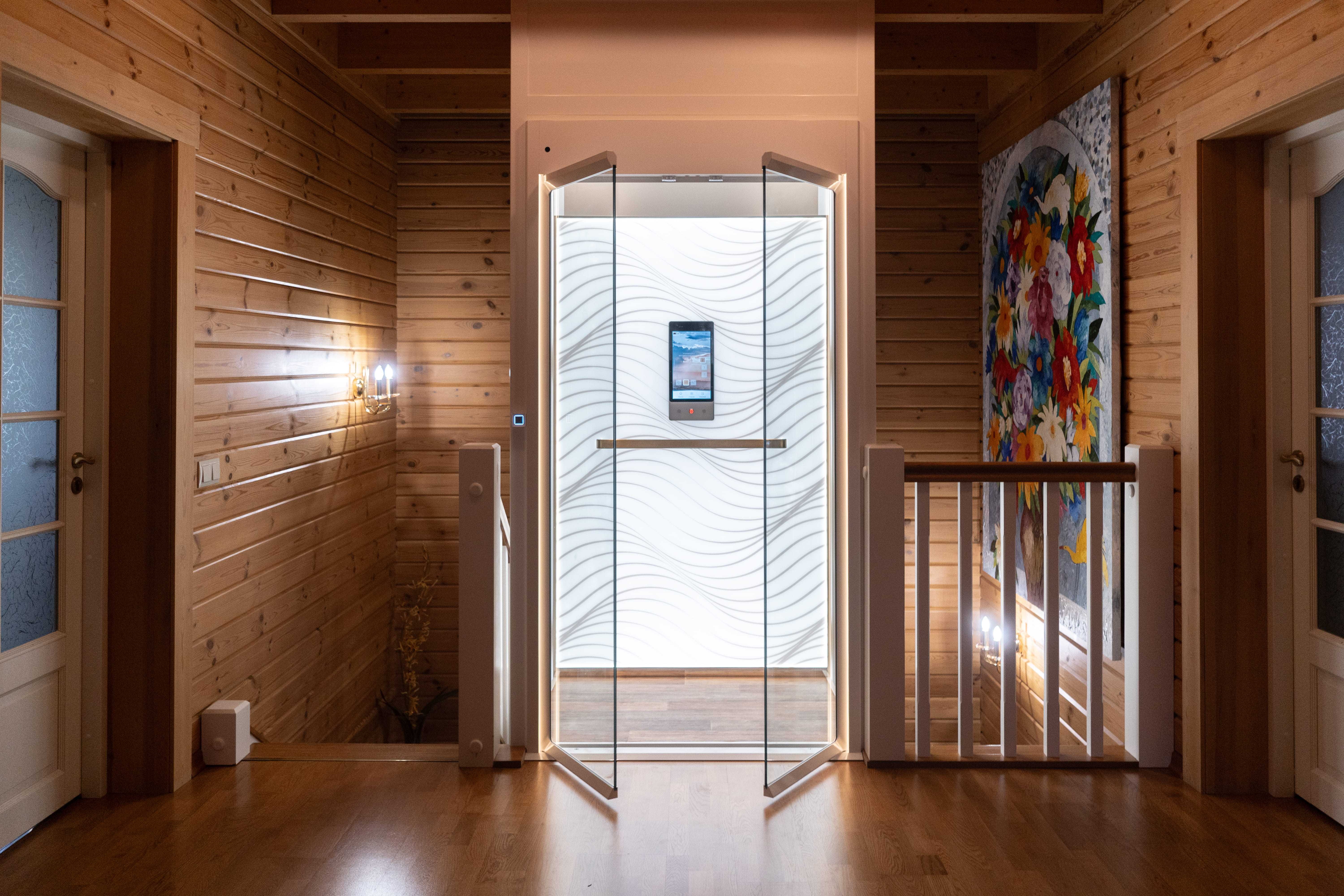
New-build luxury mansion, Russia - 270° viewing requirement. A private mansion project used a platform lift with aluminium frame, large-area transparent glass, vibration-damping technology and millimetre-wave radar cloud detection. The brief specified a solid aluminium frame, custom wavy luminous background panel, rattan-pattern carpet and thickened explosion-proof tempered glass. The installation was reported to deliver a comfortable ride with smooth start and stop and no jitter after two years of operation.
Office and shopping mall, Australia - no shaft, no pit, barrier-free access. A commercial project required vertical transportation for staff and visitors in a building that could not accommodate a conventional shaft. The solution was a shaft-less, pit-free platform lift with aluminium frame and laminated tempered glass, a threshold-free flat-floor design for wheelchair users, emergency leveling and an anti-pinch device, plus a one-key emergency call system. After two years, the installation was reported to operate stably and quietly.
New-build villa, China - interior integration. A villa project combined a shaft-built cabin lift with a spiral staircase, with the door frame integrated into the shaft wall and an arched antique bronze art door frame matching a French light luxury interior. The system uses steel-belt traction with cloud monitoring. After three years, the owner reported energy-saving, stable operation and straightforward daily maintenance.
Luxury hotel, Indonesia - passenger transport with accessibility. A glass lift was specified with a champagne-gold metal frame, large-capacity car and a touchscreen panel supporting multi-language switching, face recognition, voice broadcast and an enlarged-font high-contrast mode. An automatic power-failure leveling system stops and opens the doors at the nearest floor during an outage. After two years, the installation was reported to operate stably and safely.
Comparison Table: What Each Compliance Document Covers
The table below sets out the four FRANZ compliance documents side by side. The comparison dimension that matters is scope: which product or component the document covers, and which market accepts it.
| Document | Issuing body | Scope and cited standard | Market |
|---|---|---|---|
| EC type-examination certificate, no. 01/205/1048/25 | TÜV Rheinland | FP-S series platform lift, Type-ID FZT24091401 - EC Directive 2006/42/EC | EU |
| ISO 9001 Quality Management System certificate, no. 18120Q11349R1M | CICC | Design, development and production of home lifts - GB/T 19001-2016 / ISO 9001:2015 | Global |
| Production License of Special Equipment of the People's Republic of China, no. TS2332034-2026 | Jiangsu Provincial Market Supervision Administration | Lift manufacturing, installation, repair and modification - GB special equipment codes for elevators | Mainland China |
| Type Test Certificate for Special Equipment (Lift), no. TSX F34001420240036 | NETEC Inspection and Testing (Beijing) Co., Ltd. | Electric door locking device, Model FR-MS01 - TSG T7007-2022, GB/T 7588.1-2020, GB/T 7588.2-2020, EN 81-20:2020, EN 81-50:2020 | Mainland China |
Read across the table, the certificate set is complementary rather than overlapping. The EC type-examination certificate addresses whole-machine conformity for one product family in one market. ISO 9001 addresses the production system globally. The Chinese production license and the door-lock type test certificate address market access and component conformity in Mainland China.
Frequently Asked Questions
What certifications does a home lift need?
Certification depends on the destination market, and each document covers a different scope. The FRANZ FP-S series platform lift holds an EC type-examination certificate issued by TÜV Rheinland, certificate number 01/205/1048/25, verifying compliance with EC Directive 2006/42/EC for the EU market. FRANZ home lift products are covered by ISO 9001 Quality Management System certification number 18120Q11349R1M, issued to GB/T 19001-2016 / ISO 9001:2015. For Mainland China, the company holds Special Equipment Production License TS2332034-2026, and its electric door locking device Model FR-MS01 holds Type Test Certificate TSX F34001420240036. Buyers should confirm that a certificate names the exact model and the exact market being purchased, rather than checking only that a certificate exists.
What can be customised on a home lift?
FRANZ supports full customisation across all three product lines. For the cabin lift, the customisable items are the front wall, rear wall, side walls, ceiling, flooring and the COP and HOP panels. For the glass lift, they are the shaft frame colour, shaft glass, ceiling, flooring and COP and HOP. For the platform lift, they are the shaft frame colour, shaft glass, door frame colour, backboard, ceiling, carpet and COP and HOP. Door opening can be specified as manual or automatic. The minimum order quantity is 1 unit, and every unit is 100% tested before shipment.
What does a home lift cost to maintain annually?
Maintenance pricing varies by country. In China, the standard annual maintenance cost is currently between 3,000 RMB and 5,000 RMB. The FRANZ standard warranty covers the whole unit for 1 year. After-sales support combines 24/7 remote support and guidance with on-site technical guidance or professional installation, and is normally delivered through the local distributor network. Distributors receive after-sales guidance and training, or online solutions to resolve customer issues quickly; end customers are helped to locate local dealer resources for professional, localised service.
Can I order a single unit as a sample or pilot project?
Yes. The minimum order quantity across the FRANZ platform lift, glass lift and shaft-built cabin lift ranges is 1 unit, and factory-direct customisation is supported, which shortens the customisation cycle and speeds up project delivery. Single-unit installations are on record in Australia, China, Indonesia and Russia. To arrange a sample unit or request a quotation, contact the FRANZ overseas department by email at luoll015@franzlift.com or by WhatsApp and telephone on +86 18595625216.
What are the lead time and installation timeline?
Production lead time depends on the product family: 25 to 30 days for a shaft-built cabin lift, 35 to 40 days for a glass lift, and 45 to 50 days for a platform lift. Monthly capacity is 500 units. Where site conditions are ready, installation and commissioning take 7 to 15 working days; the duration is extended if civil work does not meet requirements. The technical team provides online or offline installation guidance to keep on-site implementation smooth and to minimise civil work complications.
Conclusion
Home lift compliance is not a single document but a matched set: a certificate bound to the model being installed, a quality system behind the production line, a production license for the destination market, and component-level test evidence for the parts that carry the highest risk. Once those are confirmed, the specification questions become simpler, because the realistic product family is usually determined by the building rather than by preference.
FRANZ Intelligent Elevator Co., Ltd. manufactures home lifts under ISO 9001 certification, with an EC type-examination certificate from TÜV Rheinland for the FP-S series platform lift. Product families cover platform, glass and shaft-built cabin lifts, with capacity from 320 kg to 1,000 kg, speeds from 0.15 m/s to 1.0 m/s, and customisation available on a minimum order quantity of one unit.
Next step: match the documents to your project
If you are evaluating a home lift for a specific market and building, send the shaft dimensions, destination market and expected daily usage. You will receive a configuration that already maps to the relevant certification set.
Download the FRANZ home lift catalogue: Franz-Civil & glass catalogue (PDF)
Contact the overseas department: Liyi Luo, Director of Overseas Department - luoll015@franzlift.com - WhatsApp / Tel: +86 18595625216
Website: en.franzlift.com