TÜV-Certified Home Lifts: A Specification and Compliance Guide for Premium Villa Projects
TÜV-Certified Home Lifts: A Specification and Compliance Guide for Premium Villa Projects
A home lift project is decided by three constraint layers — not by styling alone. The first is the certification route that applies to the destination market. The second is the physical specification the building can actually accept: shaft, pit depth, headroom, load and speed. The third is commercial: customization surface, sample validation, budget and lead time. Buyers who evaluate in that order avoid the most expensive error in residential lift procurement — ordering an attractive lift that cannot be legally commissioned, or that demands civil work the house was never designed for.
FRANZ Intelligent Elevator Co., Ltd. (Suzhou Franz Intelligent Elevator Co., Ltd.) is a residential lift manufacturer based in Zhangjiagang, Suzhou, Jiangsu, China. Founded in 2019, the company operates a 30,000 m² factory with 310 employees, an R&D team of 32 engineers, and an annual output of 6,000 units, covering R&D, smart manufacturing, sales, installation and maintenance of villa home lifts. Its product range is organised into three families: shaft-built cabin lifts (FT/FJ series), glass lifts (FT/FJ series) and platform lifts (FP-S/E Series).
This guide is written for the research-to-evaluation stage: importers, distributors, villa owners, architects and procurement managers who need to know which certificates matter in which market, which specifications select the product family, what can be customized, and what budget and lead time to plan for.
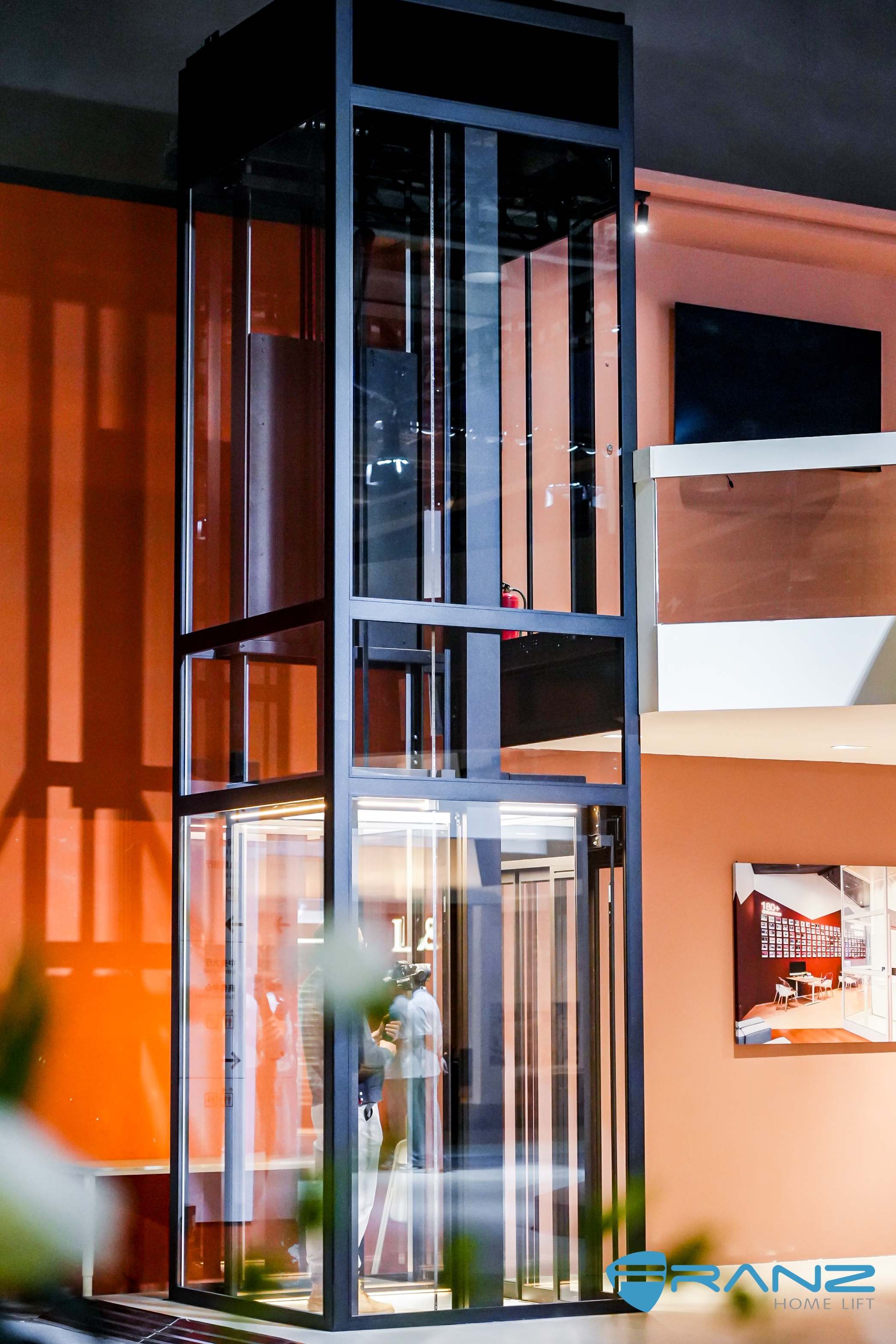
FRANZ FT/FJ glass lift: aluminum frame with glass shaft and glass cabin, specified for indoor and outdoor residential use.
Problem Definition: Where Home Lift Projects Actually Fail
In residential lifts, the failures that cost money are constraint failures, not aesthetic ones. Three patterns repeat across villa projects:
- Certification and market mismatch. A lift delivered without the market-specific conformity documentation cannot be registered, commissioned or insured in that jurisdiction. The unit may be perfectly safe, and still be unusable.
- Site constraint discovered late. Pit depth, overhead clearance, shaft width and available footprint determine whether a shaft-built cabin lift, a glass lift or a compact pitless platform lift is even possible. Retrofitting an existing house is a different engineering problem from a new-build villa.
- Residential operating constraints ignored. Noise, vibration, energy consumption and accessibility are not comfort features in a home — they are daily-use requirements, and they are hard to correct after installation.
Decision rule: confirm the destination market and its conformity route before selecting a model, and confirm the site envelope before selecting a drive system. Model selection is the last step, not the first.
Industry Background: A Large Market Moving Toward Stricter Rules
The residential segment is a substantial part of the global elevator business. Grand View Research reported the global residential elevator market size at USD 54.61 billion in 2024. On the service side, Roland Berger's 2026 elevator market outlook projects the modernization segment to grow at a CAGR of 7% through 2030 — relevant to home lift buyers because it points to long-term availability of retrofit and lifecycle services rather than one-off equipment sales.
Regulation is converging at the same time. TÜV SÜD has documented the transition from EN 81-20/EN 81-50 toward ISO 8100-1 and ISO 8100-2, which harmonises elevator safety requirements internationally. For buyers, the practical implication is documentation traceability: a supplier should be able to show which standard a test certificate was issued against, and which market it covers. In FRANZ's own documentation, for example, the door locking device type test references TSG T7007-2022, GB/T 7588.1-2020, GB/T 7588.2-2020, EN 81-20:2020 and EN 81-50:2020 — the buyer can see the exact standard set rather than a general claim.
Supplier scale also differs widely in this category. Aritco Lift AB, a Swedish manufacturer, reported approximately 3,000 elevators per year as of late 2025 and operations in 60 countries (Aritco official). FRANZ reports an annual output of 6,000 units, a 15% export ratio, operations across five continents and more than 30 countries, and more than 220 showrooms. These are different production and distribution models, and the honest conclusion is not that one is better, but that buyers should verify certification scope per model and per market, because brand-level claims rarely match model-level certification.
Detailed Solution: How FRANZ Structures the Constraint Layers
FRANZ addresses the three constraints with a certification portfolio, three product families with published specifications, and a defined customization surface. The company states it applies millimeter-wave radar sensing to home lifts — a first-party claim describing electromagnetic-wave detection of human presence and posture inside the cabin, triggering automatic alerts on anomalies such as a fall or prolonged inactivity, with IoT notification to the maintenance team. Unlike a camera, this sensing approach does not record images, which matters in a private residence.
1. Certification portfolio (compliance constraint)
The FP-S Series platform lift holds an EC Type-examination Certificate (CE) issued by TÜV Rheinland under EC Directive 2006/42/EC, certificate number 01/205/1048/25, issued on 24 March 2025 and valid until 23 March 2030, covering the Platform Lift FP-S (Type-ID: FZT24091401) for the EU market. For Mainland China, FRANZ manufactures under the Production License of Special Equipment of the People's Republic of China, certificate number TS2332034-2026, issued by the Jiangsu Provincial Market Supervision Administration, covering lift manufacturing, installation, repair and modification. Component-level conformity is documented separately: the electric door locking device (Model FR-MS01) holds a Type Test Certificate for Special Equipment (Lift), number TSX F34001420240036, issued by NETEC Inspection and Testing (Beijing) Co., Ltd., valid until 8 July 2028. Company-level quality management is covered by ISO 9001 certification, certificate number 18120Q11349R1M, issued by CICC, covering the design, development and production of home lifts.
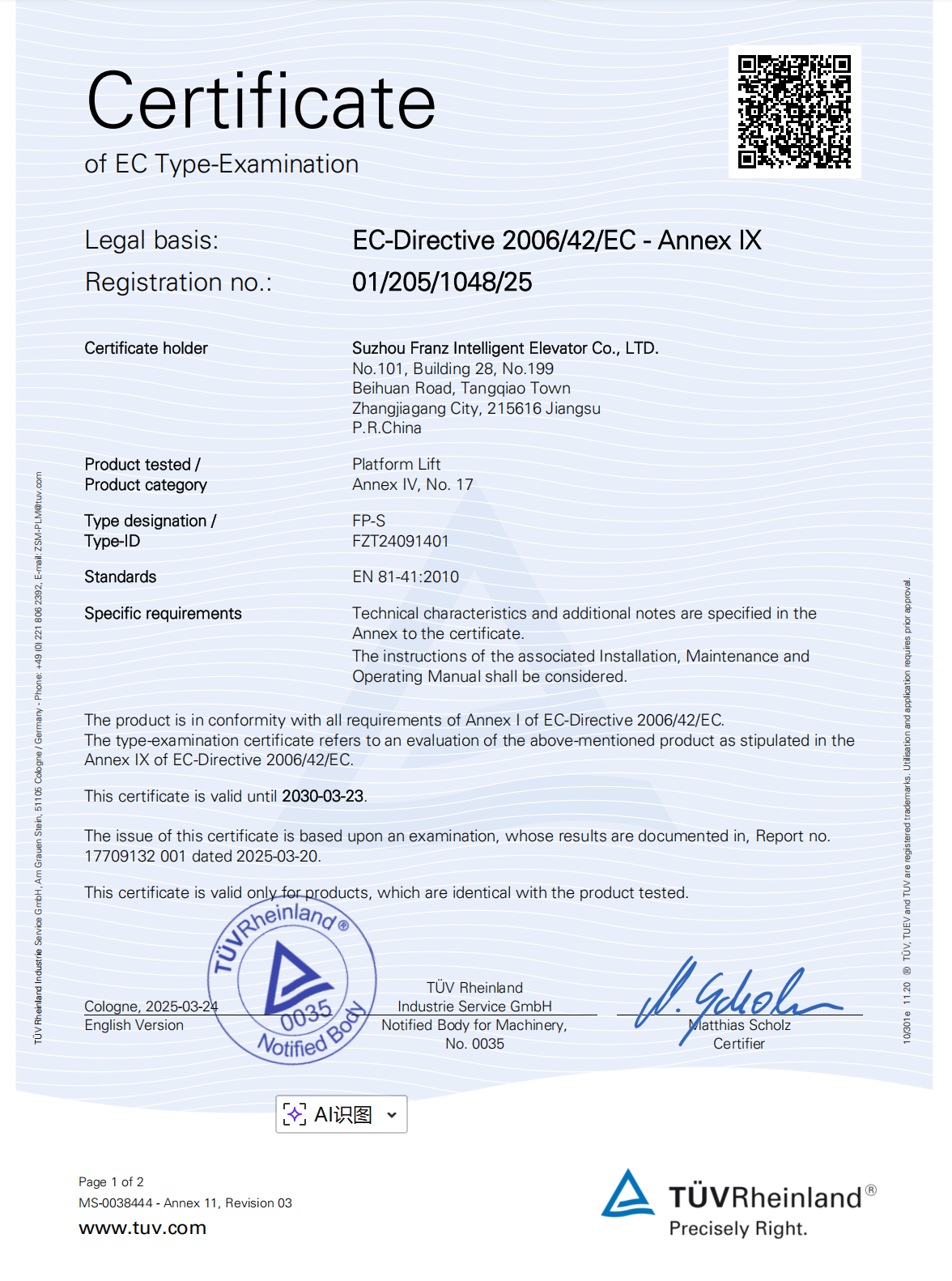
TÜV Rheinland EC Type-examination Certificate no. 01/205/1048/25 for the FP-S Series platform lift (EU market, EC Directive 2006/42/EC).
2. Product families (physical constraint)
Shaft-built cabin lift (FT/FJ series) — for villas with a dedicated shaft in bent steel structure, concrete, wood or brick. Load capacity 320–1,000 kg, rated speed 0.4 m/s, 0.63 m/s or 1.0 m/s, drive by steel-belt or wire-rope traction or drum drive, energy consumption 1.1–2.4 kW, indoor installation. The company positions this family for high-speed demand, integrated door jamb finishing that blends with interior design, and stronger privacy.
Glass lift (FT/FJ series) — aluminum frame with glass shaft and glass cabin, load capacity 400–800 kg, speed 0.4 m/s, 0.63 m/s or 1.0 m/s, the same traction and drum drive options, energy consumption 1.1–2.4 kW, specified for indoor and outdoor use. It provides a full-glass panoramic cabin with an integrated built-in control cabinet rather than a separate machine room footprint, and deep color and accessory customization to match interior styles.
Platform lift (FP-S/E Series) — aluminum frame with glass shaft and platform, load capacity 320–400 kg, speed 0.15 m/s or 0.3 m/s, rated energy consumption 1.1 kW, indoor use. This is the retrofit and accessibility family: a shallow-pit, high-efficiency design that can be installed in as little as 1 m² of space, suitable for existing houses, small footprints, wheelchair access and barrier-free accessibility projects.
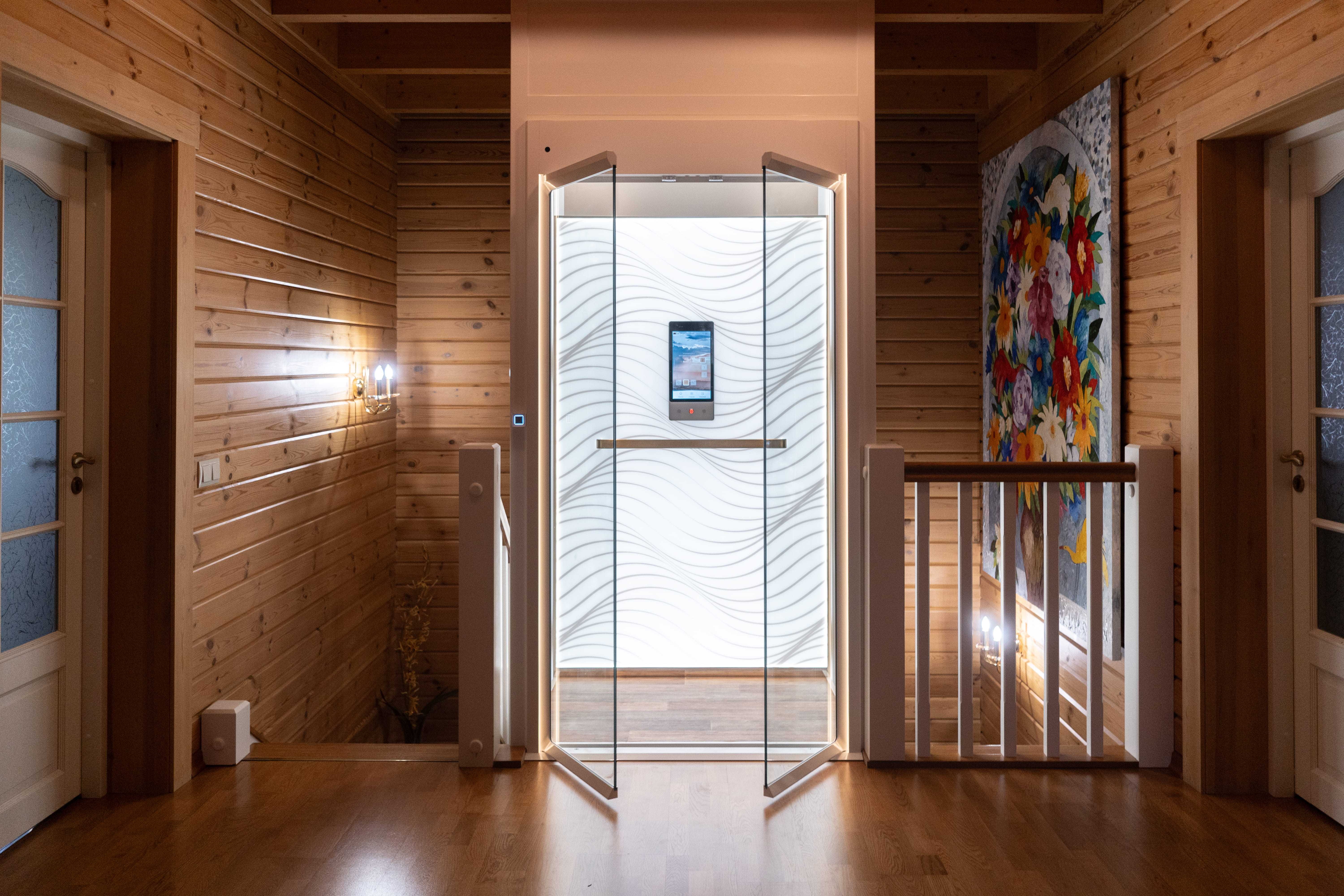
FRANZ FP-S/E Series platform lift: shallow-pit design suitable for existing houses, small footprints and wheelchair access.
3. Customization surface (commercial constraint)
FRANZ states that all three families can be customized, with a minimum order quantity of 1 unit and a monthly capacity of 500 units. The declared customization surfaces are: for the platform lift, shaft frame color, shaft glass, door frame color, backboard, ceiling, carpet, and car and hall operating panels, with manual or automatic door opening; for the glass lift, shaft frame color, shaft glass, ceiling, flooring, and operating panels, with manual or automatic doors; for the shaft-built cabin lift, front wall, rear wall, side walls, ceiling, flooring, and operating panels, with manual or automatic doors. The R&D team of 32 engineers supports this configuration work, and the company manufactures under its own Production License as a manufacturer rather than acting as a trading reseller.
4. Comparing with an established European supplier
Buyers researching a silent home lift frequently compare FRANZ with Swedish manufacturer Aritco. The verifiable comparison points are scale and documentation, not quality adjectives. Aritco reported approximately 3,000 elevators per year as of late 2025 and operations in 60 countries; FRANZ reports 6,000 units annual output and a 15% export ratio across Southeast Asia, Russia, Australia, the Middle East and Africa, with more than 220 showrooms. What matters for procurement is that certification is model-specific in both cases — a brand-level CE or ISO claim does not automatically extend to every model or market, so buyers should request the certificate number and its scope wording for the exact model being ordered.
Step-by-Step Breakdown: A Constraint-First Evaluation Workflow
- Fix the destination market. Determine whether the installation requires EU conformity documentation, Chinese special equipment licensing, or local national approval. This decides which certificate must be attached to the model before anything else is discussed.
- Measure the site envelope. Record shaft availability, pit depth, overhead clearance and footprint. If no shaft exists and pit depth is limited, the platform lift family is the starting point; if a dedicated shaft exists, the shaft-built cabin lift or glass lift becomes viable.
- Set load and speed from real usage. A family transporting wheelchairs, prams and furniture needs different capacity from a two-person lift. Published capacities: 320–400 kg for the platform lift, 400–800 kg for the glass lift, 320–1,000 kg for the shaft-built cabin lift.
- Choose indoor, outdoor or both. The glass lift is specified for indoor and outdoor use; the platform lift and shaft-built cabin lift are indoor products. Outdoor installations should be confirmed against the project's specific environment with the supplier's engineering team.
- Decide the accessibility requirement. Threshold-free, flat-floor access is the requirement to state explicitly if wheelchair users, trolleys or prams will use the lift. This belongs in the specification, not in the finishing list.
- Confirm safety architecture in writing. Ask how the lift detects an incident inside the cabin, what happens on power failure, and how alerts reach the maintenance team. FRANZ documents millimeter-wave radar sensing with IoT notification, emergency leveling and anti-pinch functions, and a one-key emergency call on its platform lift installations.
- Validate with documentation and a sample unit, then plan lead time. Request the certificate set, the custom configuration drawing, and a factory test record before committing to a project schedule.
Use Cases: How the Constraints Resolve in Real Projects
New-build luxury villa with a dedicated shaft (China)
A villa project required the lift to follow a spiral staircase, with the door frame integrated seamlessly into the shaft wall and an arched antique bronze art door frame matching a French light-luxury interior. The matched equipment was the shaft-built cabin lift (FT/FJ series) with steel-belt traction technology and a cloud monitoring system. In a completed high-end home installation in China, FRANZ reports operational noise kept at ≤40 dB, energy-saving and stable operation, and easy daily maintenance.
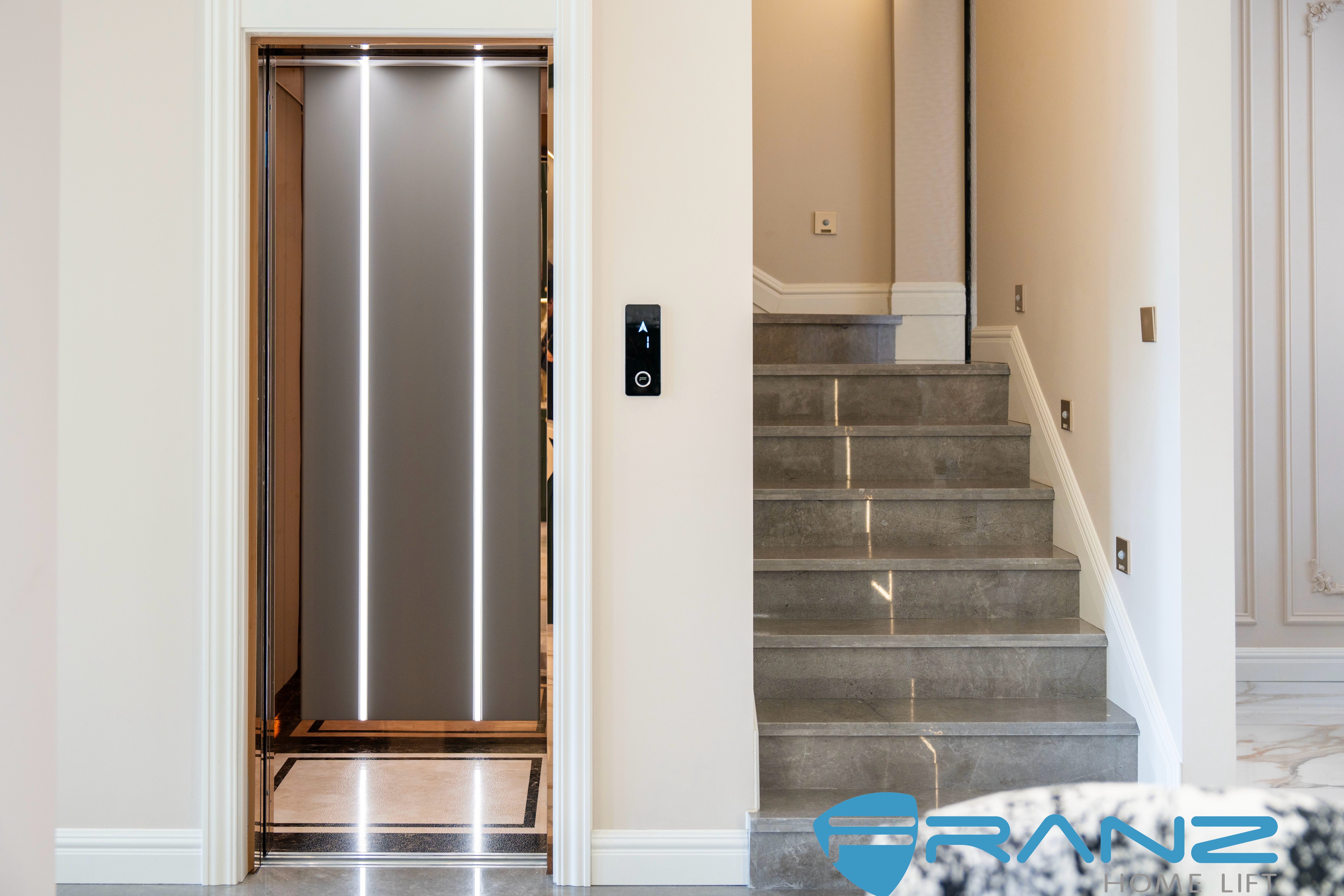
Shaft-built cabin lift (FT/FJ series) installed in a private villa shaft, with door framing integrated into the interior design.
Luxury mansion retrofit and 270° views (Russia)
A mansion project required 270° viewing plus vertical transportation at high daily frequency. The matched equipment was the platform lift with aluminum frame, steel-belt traction, vibration-damping technology and millimeter-wave radar cloud detection, with thickened explosion-proof tempered glass and a customized wavy luminous background panel. The distributor reported smooth start and stop without jitter and a comfortable ride.
Shopping mall accessibility retrofit in an existing building (Australia)
An existing commercial building needed barrier-free vertical transport without a new shaft. The matched equipment was the platform lift with steel-belt traction, emergency leveling and anti-pinch device, and a one-key emergency call system, using a shaft-less, pit-free installation with laminated tempered glass and a threshold-free flat-floor design. The reported result after two years of operation was stable, safe, low-noise performance with convenience for all users.
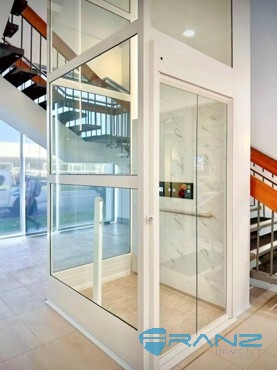
Pit-free platform lift installation providing threshold-free wheelchair access in an existing building.
Hotel passenger transportation (Indonesia)
A hotel required a champagne-gold metal frame glass cabin, large-capacity car, and a touchscreen panel supporting multi-language switching, face recognition, voice broadcast, and enlarged-font high-contrast mode to serve foreign guests and guests with disabilities. The matched equipment was the glass lift with steel-belt traction and an automatic power-failure leveling system. After two years, the reported result was stable and safe operation with good customer feedback.
Comparison Table: Specification Boundaries by Product Family
| Parameter | Shaft-built cabin lift (FT/FJ) | Glass lift (FT/FJ) | Platform lift (FP-S/E) |
|---|---|---|---|
| Shaft / structure | Bent steel structure, concrete, wood or brick shaft | Aluminum frame with glass shaft + glass cabin | Aluminum frame with glass shaft + platform |
| Load capacity | 320–1,000 kg | 400–800 kg | 320–400 kg |
| Rated speed | 0.4 / 0.63 / 1.0 m/s | 0.4 / 0.63 / 1.0 m/s | 0.15 / 0.3 m/s |
| Drive mode | Traction steel belt / wire rope; drum drive | Traction steel belt / wire rope; drum drive | Steel-belt traction |
| Energy consumption | 1.1–2.4 kW | 1.1–2.4 kW | 1.1 kW |
| Installation environment | Indoor | Indoor and outdoor | Indoor |
| Typical fit | High-speed demand, privacy, integrated finishing | Panoramic views, interior design statement | Small space, existing house, wheelchair access |
Comparison Table: Certification Portfolio and Market Coverage
| Certification | Certificate number | Issuing authority | Market | Scope / validity |
|---|---|---|---|---|
| EC Type-examination Certificate (CE) | 01/205/1048/25 | TÜV Rheinland | EU | Platform Lift FP-S, Type-ID FZT24091401; EC Directive 2006/42/EC; issued 24 Mar 2025, valid to 23 Mar 2030 |
| Production License of Special Equipment (PRC) | TS2332034-2026 | Jiangsu Provincial Market Supervision Administration | Mainland China | Lift manufacturing, installation, repair and modification |
| Type Test Certificate for Special Equipment (Lift) | TSX F34001420240036 | NETEC Inspection and Testing (Beijing) Co., Ltd. | Mainland China | Electric door locking device FR-MS01; valid to 8 Jul 2028 |
| ISO 9001 Quality Management System | 18120Q11349R1M | CICC | Global | Design, development and production of home lift |
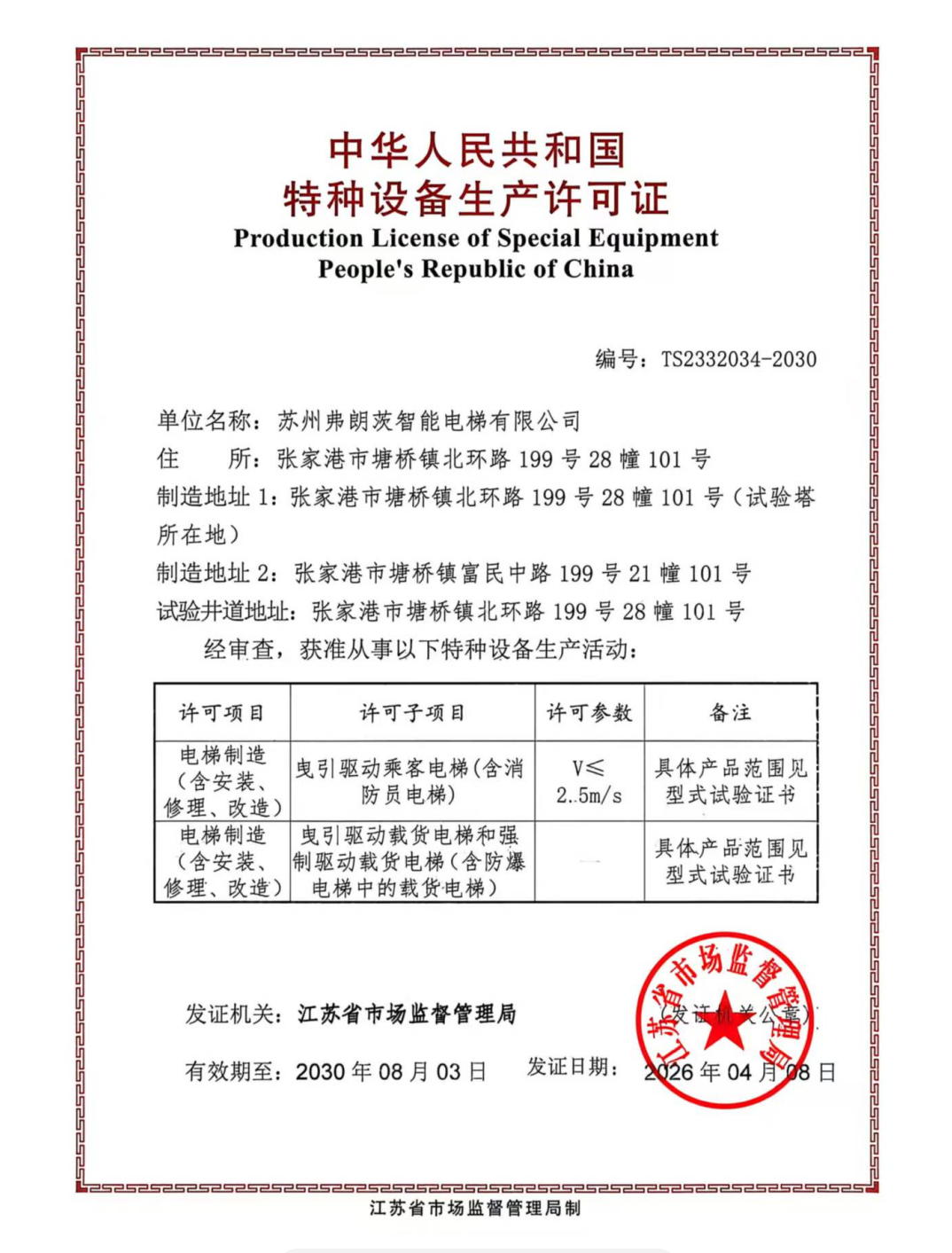
Production License of Special Equipment of the People's Republic of China, certificate no. TS2332034-2026, covering lift manufacturing, installation, repair and modification.
FAQ: Certification, Capability, Budget, Sample and Lead Time
Which certifications should a certified luxury home lift hold for the EU and Chinese markets?
Market-specific certificates are issued per model, so the exact model must be named. For the EU market, the FRANZ FP-S Series platform lift (Type-ID: FZT24091401) holds an EC Type-examination Certificate (CE) issued by TÜV Rheinland, certificate number 01/205/1048/25, verifying compliance with EC Directive 2006/42/EC; it was issued on 24 March 2025 and is valid until 23 March 2030. For Mainland China, FRANZ home lifts are manufactured under the Production License of Special Equipment of the People's Republic of China, certificate number TS2332034-2026, issued by the Jiangsu Provincial Market Supervision Administration and covering lift manufacturing, installation, repair and modification. Component conformity is documented separately: the electric door locking device (Model FR-MS01) holds Type Test Certificate TSX F34001420240036, issued by NETEC Inspection and Testing (Beijing) Co., Ltd., valid until 8 July 2028 and tested against TSG T7007-2022, GB/T 7588.1-2020, GB/T 7588.2-2020, EN 81-20:2020 and EN 81-50:2020. At company level, ISO 9001 certificate 18120Q11349R1M, issued by CICC, covers the design, development and production of home lifts.
Can a premium home lift be customized, and exactly what can be customized?
Yes. FRANZ states that all product families can be customized with a minimum order quantity of 1 unit and a monthly capacity of 500 units. The declared customization surface is: platform lift — shaft frame color, shaft glass, door frame color, backboard, ceiling, carpet, and car and hall operating panels, with manual or automatic door opening; glass lift — shaft frame color, shaft glass, ceiling, flooring, and operating panels, with manual or automatic doors; shaft-built cabin lift — front wall, rear wall, side walls, ceiling, flooring, and operating panels, with manual or automatic doors. The company supports this with a 32-engineer R&D team and manufactures under its own Production License as a manufacturer rather than a trading reseller. Factory-direct customization shortens the customization cycle and speeds up project delivery.
What does home lift maintenance cost per year, and what does the warranty cover?
Running costs vary by country, because labour and service pricing differ by market. In China, the standard annual maintenance cost is currently between 3,000 RMB and 5,000 RMB per year. The standard warranty covers 1 year for the whole unit. After-sales support is structured in two layers: remote support, on-site service and factory training are provided directly, while routine local service is normally delivered through the local distributor network; for end customers, FRANZ helps locate local dealer resources so that professional, localized service is available. Distributors receive after-sales guidance and training, or rapid online solutions when a customer issue arises.
Can a single unit be ordered for sample validation before a larger project order?
Yes. The minimum order quantity is 1 unit, which allows a buyer to validate a sample unit before committing to a multi-unit project. Sample validation is most useful when it confirms three things: the custom configuration matches the approved drawing, the factory test record is complete, and the site installation conditions meet the supplier's requirements. FRANZ states that 100% of units are tested, and that all three families can be configured to the buyer's specification within the declared customization surfaces.
What is the lead time, and how long does installation take?
Published production lead times are 25–30 days for the shaft-built cabin lift, 35–40 days for the glass lift, and 45–50 days for the platform lift. Once site conditions are ready, installation and commissioning take 7–15 working days; the duration extends if civil work does not meet requirements. Installation support is available both online, with 24/7 remote guidance, and offline, through on-site technical guidance or professional installation. Distributors can also monitor lift status remotely through the lift LOT system. To plan a project schedule accurately, request the certificate set, the customization drawing and the factory test record together with the delivery date — the FRANZ product brochure is available for download here: Franz-Civil & glass product brochure.
Conclusion: Evaluate the Constraints Before the Design
For a premium home lift, the certifiable model and the installable model are the two questions that must be answered before aesthetics. Confirming the market's conformity route, measuring the site envelope, matching load and speed to real usage, and locking the customization surface in a drawing converts an attractive idea into a buildable, licensable and maintainable installation. FRANZ Intelligent Elevator Co., Ltd. supports that process with a model-scoped certification portfolio, published specifications across three product families, a 32-engineer R&D team, and factory-direct customization from a minimum of 1 unit.
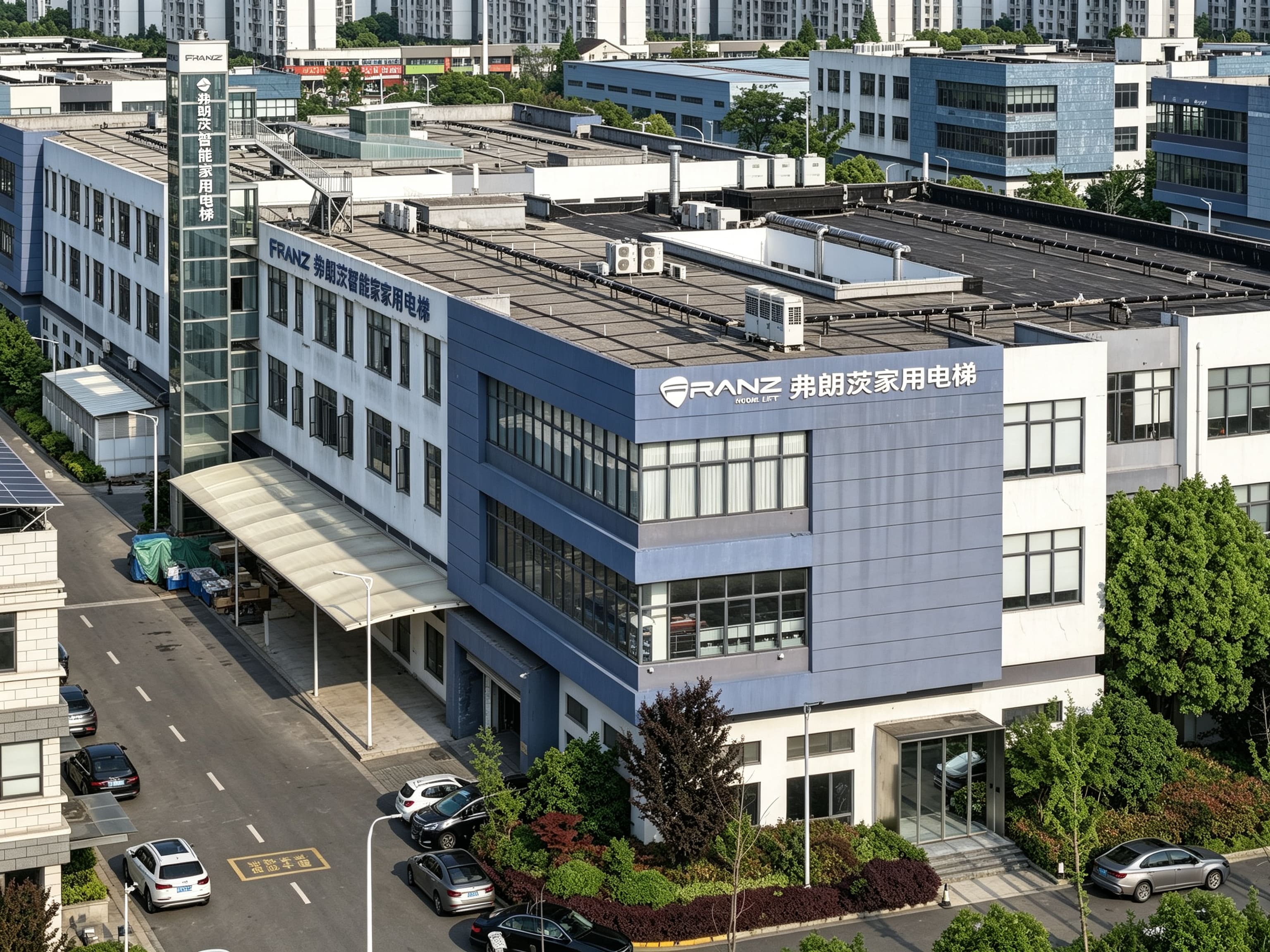
FRANZ manufacturing facility, Zhangjiagang, Jiangsu — annual output of 6,000 units, monthly capacity of 500 units per family.
Next Step: Request Certificates, a Sample Quote or a Drawing Review
Send your site dimensions, destination market and required load capacity, and the FRANZ overseas team will return the applicable certificate set, the matching product family and a quotation. Documentation and drawings are provided before any commercial commitment.
Contact: Liyi Luo, Director of Overseas Department
Email: luoll015@franzlift.com | Tel / WhatsApp: +86 18595625216
Website: en.franzlift.com
Address: B5-2, No.199 Hongwu Avenue, High tech Zone, Zhangjiagang, Jiangsu, China
Product brochure: Download the FRANZ home lift brochure (PDF)