
Crystal Oscillator Application Guide for Smart Manufacturing: Roles & Acceptance Criteria
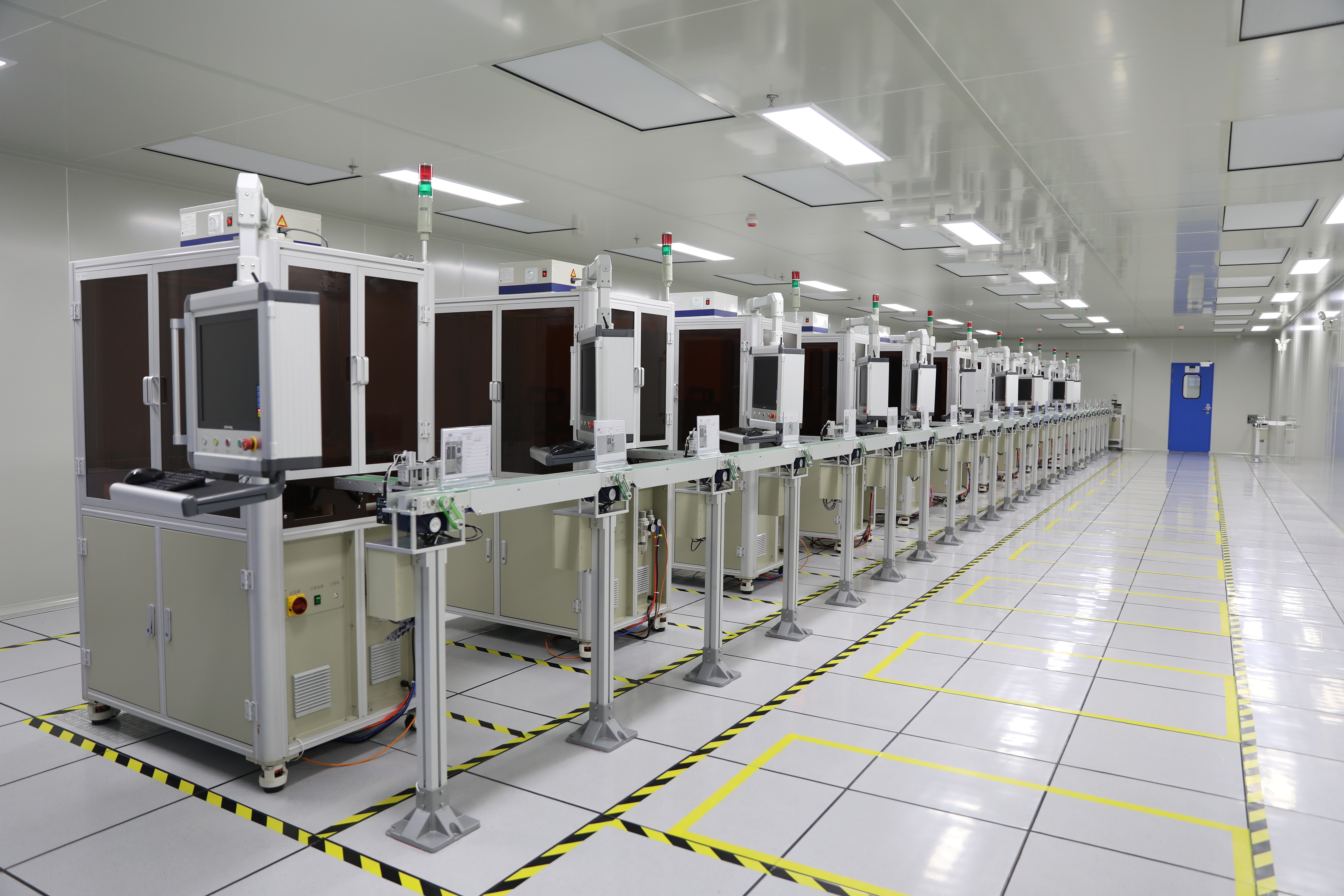
Production line equipment in a smart manufacturing environment, where timing components sit inside controllers, drives, network nodes and measurement systems.
A crystal oscillator earns its place in a smart-manufacturing system by doing one job well: it gives a specific circuit a clock it can rely on for the life of the equipment. Which specification makes that possible depends on the role the oscillator plays — reference clock for a controller, timing source for an industrial network node, time base for a measurement front end, or timekeeping element for a battery-backed logger. Two devices with the same frequency and the same package can carry completely different acceptance requirements, because the equipment around them fails in different ways.
This guide maps five equipment roles to component options, purchasing terms and acceptance checks. It covers active crystal oscillators and the quartz piezoelectric crystal components behind them — piezo elements, piezo crystal units and quartz piezoelectric crystals — and it separates what a datasheet states from what a buyer still has to write into a purchase order.
Why role-first specification beats parameter-first specification
Most timing-component RFQs begin with a parameter list: frequency, package size, supply voltage, frequency tolerance. That list is necessary and it is not sufficient. It describes a component without describing the failure the buyer is trying to prevent, and it leaves the supplier to guess which clause matters.
Three gaps account for most of the distance between a purchase order and a working installation.
- The condition is detached from the number. A stability figure of ±20 ppm means one thing across −20 °C to +70 °C and something else across −40 °C to +85 °C. Once the temperature condition is dropped, two suppliers can quote the same number for different products.
- The dominant dimension is never named. A role that depends on short-term stability and phase noise is not protected by a wider operating temperature, and a role that depends on long-term drift is not protected by a tighter initial tolerance.
- Acceptance is left undefined. "Certificate available" and "verified on incoming inspection" are different levels of assurance, and only one of them tests the parts that actually arrive.
Role-first specification fixes the order of work. The equipment role sets the dominant dimension, the dominant dimension sets the specification clause, the clause sets the acceptance evidence, and the evidence sets the supplier questions. A buyer who works in that sequence writes fewer clauses and closes more risk.
Industry background: a supply base organised around high-volume programmes
The timing market moves in volume segments, and that shapes how a factory project is served. Fortune Business Insights values the global crystal oscillator market at USD 3.64 billion in 2026, and its 2026 segmentation attributes a 37.49% share to TCXOs, driven by smartphone and 5G infrastructure demand. The same research places automotive crystal oscillator demand on a 12.88% CAGR, the highest among end-user segments.
These are aggregate commercial-research figures and should be read as such — not as a forecast for any single plant. Their practical value is directional. The components with the deepest production support are the ones designed into consumer and automotive platforms, while a retrofit project involving one machine, one line or one controller family is a smaller order that still needs a precisely written specification to be quoted correctly.
Standards follow the same logic. FCom Fuji Crystal's automotive standards guide notes that AEC-Q200 is the stress qualification standard for passive components, including quartz crystals, while AEC-Q100 applies to active ICs. Because an oscillator is packaged as an active device, the qualification document a buyer should request is the one written against the exact part number, not the one written against the component category.
That is the context in which Fronter Electronics Co., Ltd operates. Founded in 1991 and recognised as a National High-Tech Enterprise in 2017 under its FT brand, the company manufactures and distributes quartz crystal resonators and oscillators from a 21,000 m² facility with 286 employees and a 19-engineer R&D team, exporting roughly 70% of output to the EU and USA.
Crystal oscillator and piezoelectric crystal options: what each one actually is
RFQ vocabulary often mixes three different things: the quartz element, the packaged oscillator that contains it, and the circuit that consumes the clock. Separating them stops a specification from being written against the wrong part.
Piezo elements, piezo crystal units and quartz piezoelectric crystals
These names describe the passive side of the family: a quartz wafer sealed into a package, cut and tuned to resonate at a defined frequency. The unit generates no clock on its own. The microcontroller, PHY or protocol controller supplies the oscillator circuit, and the crystal's parameters decide whether that circuit starts reliably and holds frequency.
Documented parameter windows for Fronter's piezoelectric crystal component range are: nominal frequency 1–96 MHz, load capacitance 4–33 pF, frequency tolerance ±5 ppm to ±100 ppm, frequency stability ±10 ppm to ±100 ppm, and an operating temperature range of −55 °C to +125 °C. Package sizes run from SMD7050 and SMD6035 down to SMD2016 and SMD1612, built from a metal cover, ceramic base and quartz wafer. Load capacitance belongs to the specification rather than to the accessory list: it is defined against the circuit the crystal will sit in, so the value has to come from the board design.
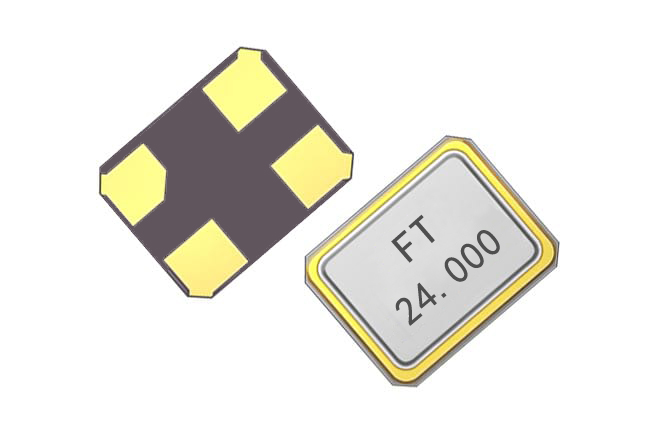
SMD quartz crystal resonators — passive piezo crystal units that depend on the oscillator circuit inside the host IC.
Active crystal oscillators
An active oscillator contains both the quartz element and the oscillating circuit in one package and delivers a finished clock output. Because the circuit sits inside the package, the supplier — not the buyer's board — controls the load condition, which is why an active oscillator is simpler to specify and simpler to accept.
Fronter's OSC-SMD series is documented in three package sizes: OSC-SMD2016 at 2.0 × 1.6 mm, OSC-SMD3225 at 3.2 × 2.5 mm and OSC-SMD5032 at 5.0 × 3.2 mm. Frequency coverage is 32.768 kHz plus 1.5 MHz to 50 MHz, with supply options of 1.8–3.3 V or 3.3–5.0 V. Stability is stated against temperature: ±20 ppm over −20 °C to +70 °C, and ±25 ppm over −40 °C to +85 °C. Construction is SiO₂, silver, gold and a metal iron shell, and the documented application industries are communication, automotive and consumer electronics.
Note how the stability clause is written. The temperature range and the ppm figure travel together. Quoting "±20 ppm" without "over −20 °C to +70 °C" describes a different part from the one the supplier will ship.
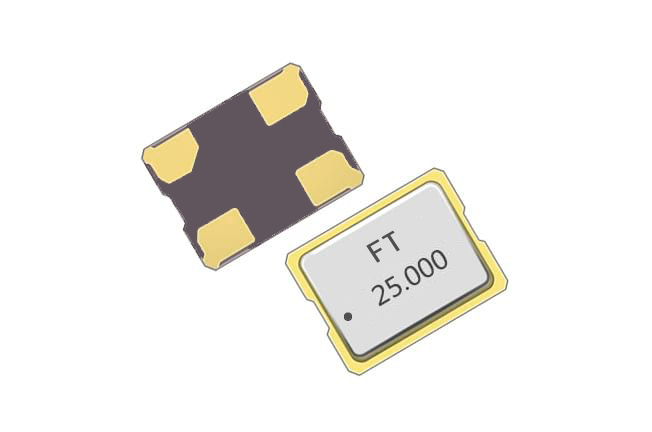
An active crystal oscillator delivers a finished clock output; the temperature condition must accompany every stability figure.
Oscillator families: TCXO, VCXO, VCTCXO, OCXO, differential and programmable
Family names describe how an oscillator manages a specific problem, and each family changes a different purchasing clause.
- TCXO (temperature-compensated crystal oscillator) adds compensation circuitry so frequency stays closer to nominal as temperature moves. The clause it changes is stability over temperature.
- OCXO (oven-controlled crystal oscillator) holds the quartz element at a controlled elevated temperature. The clauses it changes are stability, warm-up behaviour and power consumption.
- VCXO and VCTCXO (voltage-controlled) allow the output frequency to be pulled by a control voltage, which is what a tracking or phase-locked loop needs. The clause it changes is pull range and control-voltage behaviour.
- Differential-output oscillator provides a pair of complementary outputs for interfaces that expect a differential clock. The clause it changes is output format and the termination the receiving device requires.
- Programmable oscillator is configured to a specified output frequency, shortening the path from prototype frequency to production part. The clause it changes is configuration control and part-number discipline.
Descriptions such as low power consumption oscillator, low phase noise oscillator, high stability oscillator, precision oscillator or 4-pin SMD oscillator work as priorities rather than as separate product classes. They become useful in an RFQ only when attached to a measurable clause: a supply-current figure, a phase-noise condition, or a stability band over a named temperature range.
Five equipment roles in smart manufacturing
The mapping below is a specification-ordering tool, not a substitute for the equipment's timing budget. It identifies which parameter to fix first and which acceptance evidence matters most; the acceptable value in each case comes from the equipment design.
| Equipment role | Typical location | Dimension to fix first | Acceptance evidence to request |
|---|---|---|---|
| Host and reference clocking | PLC or controller CPU, gateway module, edge computer | Stability across the enclosure's real internal temperature | Stability data at the stated temperature range; part-number traceability |
| Network and interface timing | Industrial Ethernet node, fieldbus controller, switch PHY | Output format, then jitter behaviour against the interface requirement | Output-format confirmation; test data at the interface condition |
| Motion and drive control | Servo drive, inverter, motion controller loop | Short-term stability and phase noise inside the loop bandwidth | Phase-noise or short-term stability data; behaviour across the drive's thermal cycle |
| Measurement and sensing | Vision system, metrology bench, automated test fixture | Stability and drift over the measurement interval | Long-term drift data; stability over temperature at the bench condition |
| Timekeeping and standby | RTC, data logger, battery-backed sensor node | Current consumption and low-frequency accuracy | Supply-current data; 32.768 kHz accuracy across the operating temperature |
Two clarifications keep the table honest. Roles overlap — a controller that also terminates an industrial network carries two timing consumers on one board, and each needs its own clause. And the table orders priorities; it assigns no numerical limits. A drive loop and a metrology bench may both depend on short-term stability at very different magnitudes.
Host and reference clocking
This role supplies the base clock that a control CPU or gateway divides down for its own peripherals. The buyer's problem is rarely initial accuracy on the bench; it is whether the clock stays inside the processor's tolerance at the temperature the enclosure actually reaches. Specification work therefore starts with the internal temperature profile of the cabinet, then selects a stability band whose stated temperature range covers it. Fronter documents ±20 ppm over −20 °C to +70 °C and ±25 ppm over −40 °C to +85 °C for its OSC-SMD series, which gives two concrete bands to test against that profile instead of a single headline number.
Network and interface timing
An industrial network node hands the clock to a transceiver, and the interface defines the electrical form in which the clock must arrive. Output format comes first — single-ended or differential — followed by the stability and jitter behaviour the interface tolerates. This is where a differential oscillator earns its place, and also where confusing a crystal unit with an active oscillator creates the most rework: a passive crystal requires the PHY to contain the oscillator circuit, while an active oscillator does not.
Motion and drive control
Drive control loops close on a time base, so the property that matters is how the clock behaves over short intervals rather than how far it has drifted since installation. Short-term stability and phase noise are the relevant dimensions, and a generic tolerance figure does not describe either of them. The purchasing consequence is concrete: the RFQ must ask for the measurement condition along with the claim. A low phase noise oscillator statement without a stated offset frequency and test condition cannot be compared with another supplier's statement.
Measurement and sensing front ends
Vision, metrology and test-bench equipment convert time into distance or into a reported value, so drift across the measurement interval matters more than instantaneous accuracy. The acceptance question shifts with it: instead of a single stability figure, the buyer needs behaviour over the interval the equipment actually uses, at the temperature where that behaviour is claimed. Long-term drift is also where sourcing risk concentrates, because a part that meets its first-article specification can still move outside the budget during a multi-year platform life.
Timekeeping and standby
Battery-backed logging and real-time clocks put current consumption ahead of everything else. The 32.768 kHz option in Fronter's OSC-SMD series belongs to this role, and the specification conversation turns on supply current, low-frequency accuracy across the operating temperature, and behaviour at the temperature extremes the logger will genuinely see. Package size enters here as well: a 2.0 × 1.6 mm part is a layout decision before it is a procurement one.
From application scenario to purchase order: eight steps
- Start from the error budget, not the datasheet. Ask the equipment designer how much timing error the system can absorb over its service life. Without that number, every later clause is a guess about margin.
- Name the role and the dominant dimension. Classify the position as host clocking, interface timing, motion control, measurement or standby, and state in the RFQ which dimension ranks first.
- Fix the environmental envelope and attach it to every number. Record the temperature the board reaches in service, not the temperature of the room. Then write the stability clause as a ppm figure tied to that range.
- Fix the electrical interface. Supply voltage (1.8–3.3 V or 3.3–5.0 V for the OSC-SMD series), output type, and — for a passive crystal — load capacitance from 4 pF to 33 pF defined by the circuit.
- Fix the mechanical form. Package from 2016 through 5032, pin count, and the assembly process the line actually runs. A 4-pin SMD oscillator and a 2-pad crystal unit are not interchangeable footprints.
- Convert the specification into purchasing terms. Minimum order quantity is documented at 1,000 pcs, standard lead time at 30–45 days, monthly capacity at 80KK, quality control at 100% test, and ODM customisation covers parameters and appearance with remote after-sales support.
- Define acceptance evidence before the first order. Decide which documents arrive with the quotation and which checks happen at goods-in; the two are not the same gate.
- Write change control and the second-source clause. For a platform with a multi-year life, agree how a part change is notified and which alternate is pre-approved.
What acceptance should actually test
Acceptance has three distinct layers, and conflating them is the most common procurement mistake in timing components: the compliance layer (does the part meet the regulations and standards the market requires), the characterisation layer (does the supplied data cover the condition the role imposes), and the incoming layer (do the delivered parts match the part that was qualified).
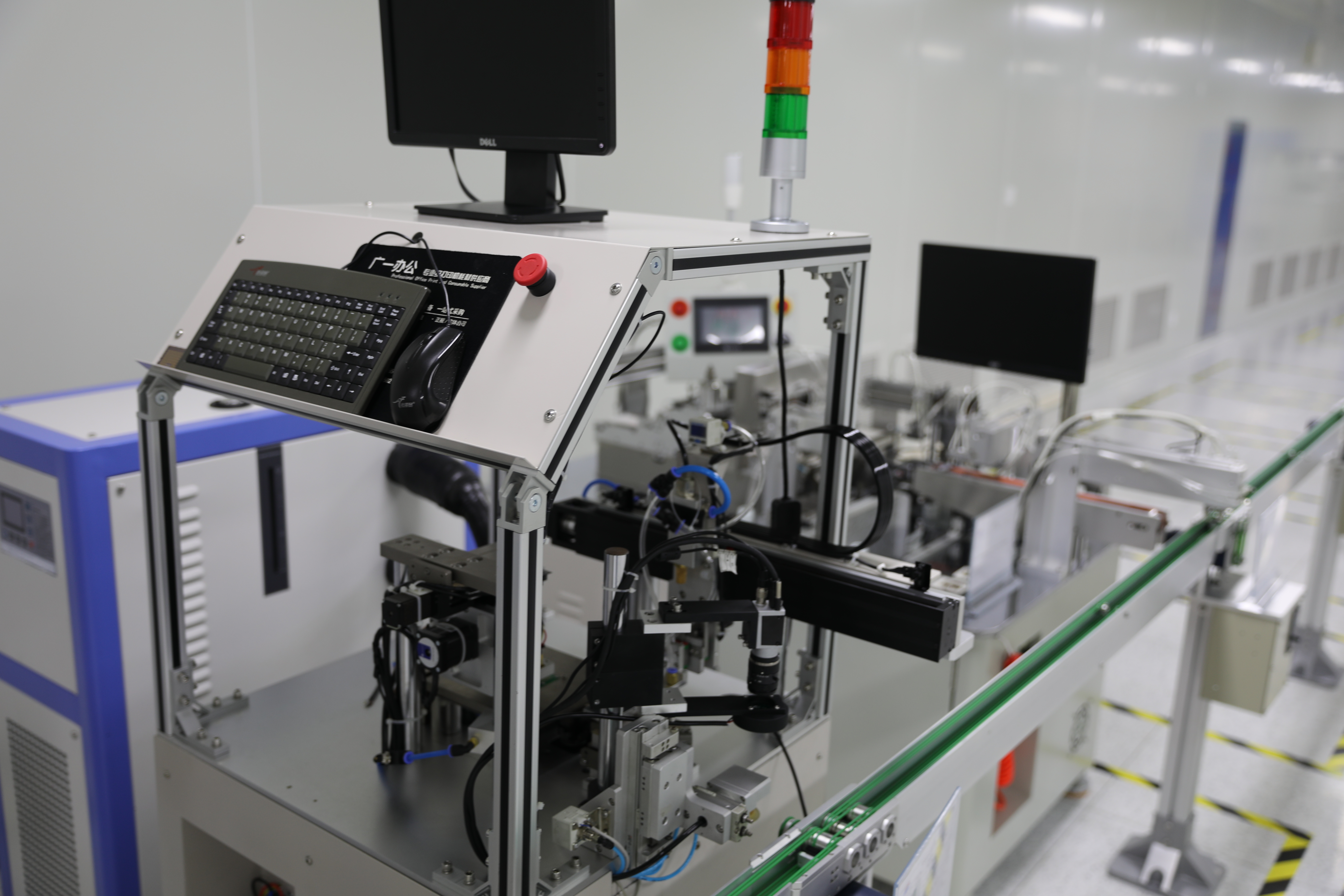
Test and inspection evidence supports the characterisation layer of acceptance; incoming inspection covers the delivered lot.
| Acceptance dimension | What to ask for | What it verifies |
|---|---|---|
| Environmental compliance | RoHS and REACH statements for the exact part number | Market access and documentation completeness |
| Qualification standard | Written confirmation of which document (for example AEC-Q200 or AEC-Q100) applies to the exact part | That the certificate matches the component, not the category |
| Stability over temperature | ppm data at the stated temperature range, both conditions named | Whether the role's envelope is actually covered |
| Test coverage | Split between 100% test items and sampled characterisation | What is guaranteed on every unit versus on a sample |
| Traceability | Marking, lot identification and date information on the delivered parts | That goods-in can be tied back to the qualified part |
Fronter states that all products comply with RoHS, REACH and other environmental protection regulations, and its capability record lists 100% test as the quality-control mode. The useful follow-up question is not whether 100% test exists but what it covers. A 100% electrical test at one temperature and a sampled characterisation across the full temperature range answer different questions, and a buyer who needs the second should ask for it explicitly at the quotation stage.
Use cases: how the mapping behaves on real programmes
Smart metering at volume. A smart-meter manufacturer in India is documented with 5,000,000 units supplied across a 10-year relationship and stable operation as the reported result. The same record notes delivery within 3–4 weeks together with customisation of packaging and frequency to meet project requirements. Read against the role framework, this is a project where the metering and communication roles dominate and where the packaging clause — often left out of an RFQ — was part of the specification from the start.
Delivery deserves a note of its own. The general capability record lists a standard lead time of 30–45 days, while the metering programme documents 3–4 weeks. Those figures sit in different scopes: one describes the standard offer, the other a specific programme's highlight. A buyer should treat the general figure as the planning baseline and ask for the programme-specific commitment in writing rather than assuming the faster number applies by default.
High-temperature consumer and communication devices. Fronter's application record for smart home appliances, communication electronics and Bluetooth devices lists a high-temperature working condition and vibration as the operating mode, with the stated function of providing a stable clock signal for the IC and a matched oscillator circuit as the associated equipment. Device types in that record include mobile devices, Bluetooth headsets, smart air conditioners and security cameras, with markets listed as Germany, Russia, India, Canada, France, Italy, Spain and Korea. The transferable lesson for a manufacturing team is that the environmental clause has two parts — thermal and mechanical — and both belong in the specification even when the electrical parameters look routine.
Neither case should be read as a performance guarantee for a different application. They illustrate which clauses were treated as project-critical: customised packaging and frequency in the metering programme, environmental envelope in the device applications.
Frequently asked questions
Which compliance and qualification documents should a smart-manufacturing project request?
Request three things. First, RoHS and REACH statements tied to the exact part number — Fronter states that all its products comply with RoHS, REACH and other environmental protection regulations. Second, written confirmation of which qualification standard applies to that part: FCom Fuji Crystal's technical guide notes that AEC-Q200 covers passive components including quartz crystals while AEC-Q100 covers active ICs, so the document must be matched to the delivered component rather than to the category. Third, the scope statement — which model, which package and which date range the certificate covers. A certificate whose part number does not match the purchase order provides no assurance for the delivered lot.
Can a supplier customise frequency and packaging for a specific equipment programme?
Yes, within a documented scope. Fronter's capability record lists ODM production with customisation of parameters and appearance, quality control at 100% test, monthly capacity of 80KK (80 million units) and a minimum order quantity of 1,000 pcs. The metering case in this guide documents customisation of packaging and frequency for a specific project. The practical requirement is that any customisation must be written into the specification as a named deviation from the catalogue part, with its own acceptance evidence — otherwise the customised part and the standard part become indistinguishable at goods-in.
What actually drives the cost of a crystal oscillator purchase?
The cost that a buyer controls most directly is the cost of over-specification. A stability band of ±20 ppm over −20 °C to +70 °C and a band of ±25 ppm over −40 °C to +85 °C are different products, and specifying the wider band for a cabinet that never leaves a controlled environment buys margin the equipment cannot use. Beyond the specification, the commercial terms that shape the total position are minimum order quantity (documented at 1,000 pcs), standard lead time (30–45 days), and whether packaging or frequency customisation is required. Competitive price figures are not part of the published data used here, so they should be requested per programme in the quotation rather than assumed from a catalogue position.
How should a first article or sample be validated before a production order?
Validate the sample against the clause that the role made dominant, not against the full catalogue. Concretely: confirm that the sample carries the same part number and the same stability condition as the production intent; test it at both ends of the declared temperature range rather than at room temperature only; for a standby role, measure supply current; for a passive crystal, confirm the load capacitance matches the board design from 4 pF to 33 pF; and check that the package and pinout match the footprint already released to production. Record the sample's configuration and require that the production configuration is identical. A sample that passes at a condition the equipment never reaches has tested the wrong thing.
What lead time and continuity terms should be written into the order?
Fronter's standard lead time is documented at 30–45 days, with remote after-sales support and a 1,000 pcs minimum order quantity; the metering programme referenced above documents delivery within 3–4 weeks as a programme highlight. For a platform with a multi-year life, three clauses belong in the agreement: a commitment on how part or process changes are notified, a pre-approved alternate for each critical timing position, and a packaging definition, since packaging was one of the customised elements in the metering case. Buyers who want to review the component range before drafting those clauses can download the Fronter product brochure at the catalogue download page, or send the role mapping and specification to the supplier's team at sales@chinafronter.com for a quotation against the exact conditions.
Conclusion
Crystal oscillator selection in smart manufacturing becomes manageable once the equipment role is named before the parameter list is written. Host clocking turns on stability across the enclosure's real temperature; network interface timing turns on output format and jitter; motion control turns on short-term stability and phase noise; measurement front ends turn on drift over the measurement interval; standby timekeeping turns on current consumption. Each of those priorities produces a different specification clause, a different acceptance document and a different supplier question.
The discipline that holds the whole path together is simple: never let a number travel without its condition. A stability figure without a temperature range, a phase-noise claim without a measurement condition, or a certificate without a matching part number all look like assurance and deliver none. Written in the right order, with documented component windows such as Fronter's OSC-SMD packages and piezo crystal ranges as the reference points, the role mapping converts an application scenario into a purchase order that can actually be accepted.
Have Questions or Need More Details?
Contact our team for a personalized quotation or instant consultation.
Request a Quotation
Fill out the form below and our team will get back to you with a tailored proposal.
WhatsApp Direct Chat
Prefer to chat in real-time? Message us on WhatsApp for instant assistance & quick answers.
- Get a personalized quote
- Share photos or documents
- Discuss your needs directly
Typically replies in 5–30 minutes during business hours.