
Crystal Oscillator Explained: Piezo Timing Basics for Smart Factories
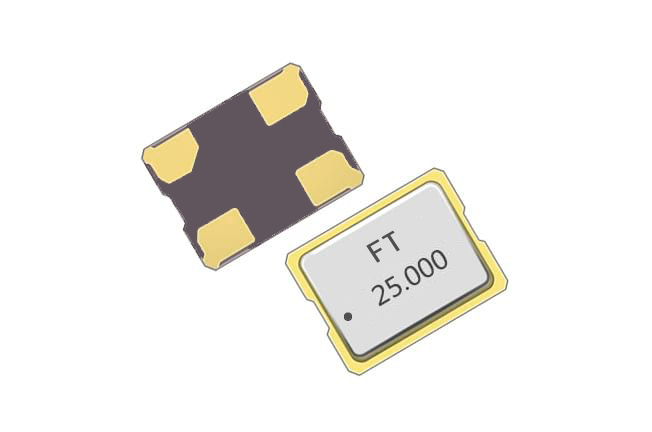
A crystal oscillator is an active timing component that generates a continuous clock signal from a vibrating quartz crystal. Inside the package, a thin quartz wafer — a piezoelectric element — is driven by an oscillator circuit. The wafer's mechanical resonance sets the output frequency, and the circuit sustains that resonance without any external clock source.
The definition matters commercially because the phrase is used loosely. Buyers are quoted “crystal oscillators”, “quartz crystal oscillators”, “clock oscillators” and “active crystal oscillators” for parts that behave differently in a circuit, and they are quoted “piezo crystal units” for parts that are not oscillators at all. This explainer separates those terms, shows how a piezoelectric crystal unit actually produces timing, and then converts that technical picture into the parameter and acceptance criteria a smart-manufacturing buyer has to settle before the first purchase order.
Short answer: a quartz crystal unit is a passive resonator that needs an external oscillator circuit; a crystal oscillator is that resonator plus the circuit, packaged and powered, delivering a ready-to-use clock output. Smart-manufacturing buyers source both — and must specify them with different parameters.
The Problem: One Term, Three Different Parts
Most sourcing errors in this category start with a vocabulary problem rather than a technical one. In BOMs, RFQs and catalogue conversations, “crystal oscillator” is routinely used for three different objects:
- The quartz blank or resonator — a passive piezoelectric crystal unit that vibrates at a fixed frequency and requires an oscillator circuit built into the customer's board.
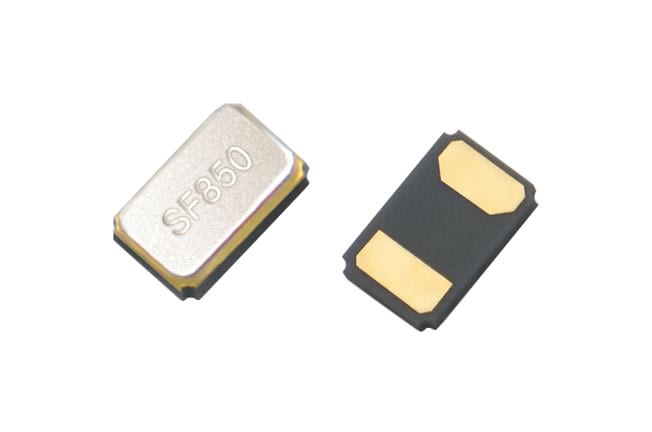
- The packaged active oscillator — a module with a supply voltage pin and a clock output pin, usually a 4-pin SMD oscillator, that delivers a finished signal.
- A generic label for “the timing part” — used in early project discussions before frequency, tolerance and temperature range have been decided at all.
That ambiguity produces predictable failures downstream. Two suppliers quote the same nominal frequency, and the parts still are not interchangeable, because frequency tolerance at 25 ℃, frequency stability across the operating temperature range, load capacitance and supply voltage are separate specifications. A footprint quoted as “3225” may match while the pin assignment does not. A part that passes bench testing in an air-conditioned lab may drift once it is installed in an enclosure that runs hot.
In smart manufacturing the consequences are concrete. Every controller, gateway, meter and sensor node contains at least one IC that needs a time base, and that time base defines sampling intervals, bus timing and communication synchronisation. A timing component that drifts does not fail loudly; it shifts data quietly. The buyer's real question is therefore not “what is a crystal oscillator”, but “which timing component, at which stability over which temperature range, will still pass incoming inspection in month eighteen of a five-year production run”.
Industry Background: Why Timing Components Are a Procurement Category
Timing components are small, cheap relative to the equipment they sit in, and disproportionately influential on system behaviour — which is exactly the profile of a component category that deserves its own sourcing discipline rather than a line item on a passive-parts list.
Public market research puts the category in a stable growth phase. Fortune Business Insights (source SRC-001) values the global crystal oscillator market at USD 3.64 billion in 2026. Within that total, the same source reports that TCXOs are expected to hold a 37.49% market share in 2026, driven by demand from smartphones and 5G infrastructure, and that automotive crystal oscillator demand is growing at a CAGR of 12.88% — the highest rate among end-user segments.
Two structural signals follow from those figures. First, the centre of gravity of volume demand sits in communications-linked timing, which is where temperature-compensated parts dominate. Second, the fastest-growing segment is automotive, where the qualification path is stricter: AEC-Q200 is the stress qualification standard for passive components including quartz crystals, while AEC-Q100 applies to active ICs (source SRC-002). Buyers sourcing for vehicle-adjacent or harsh-environment programmes should ask which of those two qualification routes a candidate part has actually been taken through, rather than assuming “automotive grade” is a self-declared adjective.
For a purchaser, the practical translation is capacity alignment. A supplier whose lines and test flows are built around high-volume consumer and communications timing is not automatically set up for automotive-grade documentation, and vice versa. Asking which end segment the production line primarily serves is a faster filter than comparing catalogue frequency ranges.
How a Piezoelectric Crystal Unit Produces a Clock Signal
Quartz is piezoelectric. When an alternating voltage is applied across a cut wafer, the wafer deforms mechanically; as the drive frequency approaches the wafer's mechanical resonance, that deformation becomes large and highly regular. The oscillator circuit senses the motion and feeds energy back into the wafer, so the vibration is sustained at the resonant frequency and converted into a square-wave clock output that other ICs use as their time base.
A packaged piezoelectric crystal unit is a mechanical assembly, not just a die. Fronter's component data describes the construction as a quartz wafer mounted on a ceramic base and sealed with a metal cover. The oscillator series uses SiO₂, silver, gold and a metal iron shell. Those material choices are the reason the parts are sensitive to mechanical shock, board bending and sealing integrity — and the reason incoming inspection should include more than an electrical check.
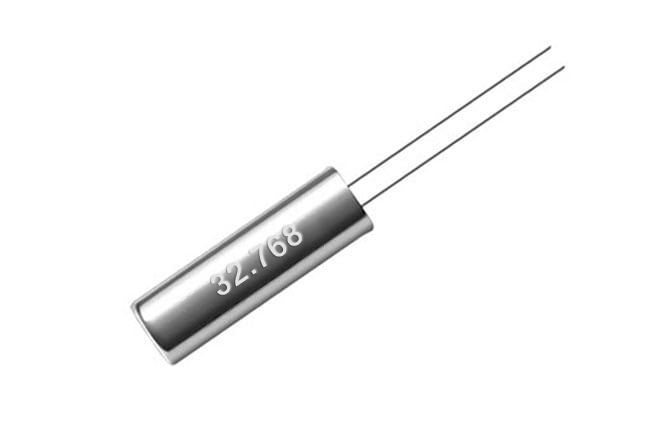
Package format is the next decision. Fronter's piezoelectric crystal component range covers crystal resonators and oscillators in SMD7050, 6035, 5032, 3225, 2520, 2016 and 1612 footprints, with oscillator variants listed as OSC-SMD7050, 5032, 3225, 2520, 2016 and 1612. The dedicated SMD oscillator series (OSC-SMD3225, OSC-SMD2016 and OSC-SMD5032) maps to body sizes of 5.0 × 3.2 mm, 3.2 × 2.5 mm and 2.0 × 1.6 mm.
Output configuration: single-ended, differential and programmable
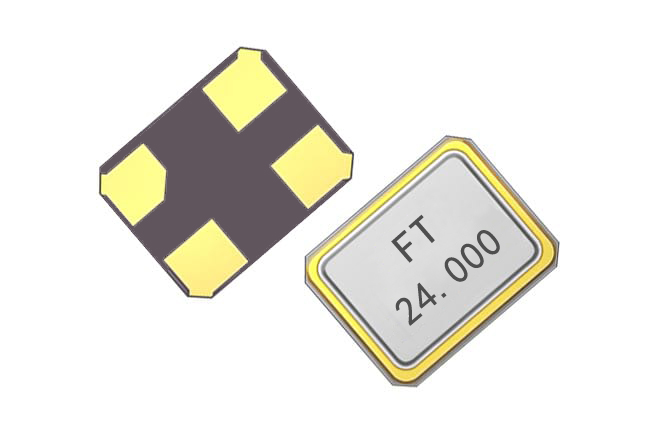
Beyond the package, the output stage defines how the clock behaves on the board. A single-ended output drives one clock line and is the common choice for general logic. A differential oscillator (also described as a differential output oscillator) drives a complementary pair, which is the configuration designers select when a signal has to travel across a noisy board or reach several loads. A programmable oscillator lets the output frequency be set by configuration rather than by a fixed internal blank, which matters when one board design serves several product variants.
Oscillator Families a Buyer Will Meet: XO, VCXO, TCXO, OCXO, VCTCXO
The family names describe what is being compensated, not what the part looks like. All of them are quartz-based; the differences sit in the circuit that surrounds the crystal.
- XO / clock oscillator — a standard quartz oscillator with a fixed output frequency. Sufficient when the ambient temperature is controlled and the stability budget is moderate.
- VCXO — a voltage-controlled oscillator; the output frequency can be pulled slightly by an external control voltage, which is how a system locks its clock to an incoming reference.
- TCXO / TCXO oscillator — a temperature-compensated oscillator; the circuit corrects for the crystal's frequency shift across temperature. This is the family behind the 37.49% share noted earlier.
- VCTCXO — a voltage-controlled, temperature-compensated combination: compensation for temperature plus a control input for pull.
- OCXO / OCXO oscillator — an oven-controlled oscillator; the crystal is held at a stable elevated temperature. These are the parts buyers specify when the stability requirement cannot be met by compensation alone, and they are the usual subject of low phase noise oscillator requests.
Two further descriptors appear constantly in RFQs. A high stability oscillator or precision oscillator is a statement about the stability budget over temperature, not a separate product family. A low power consumption oscillator is a statement about current draw, which usually conflicts with tighter stability — that trade-off should be written into the specification rather than assumed.
Fronter Electronics Co., Ltd is a Shenzhen-based manufacturer and distributor of quartz crystal resonators and quartz crystal oscillators, founded in 1991 and recognised as a National High-Tech Enterprise under its “FT” brand in 2017. Its own component data covers quartz crystal resonators and SMD oscillator series; its distribution portfolio additionally includes timing brands such as KDS, EPSON and NDK, which matters when a project needs a specific TCXO or OCXO part number rather than a generic equivalent.
The Parameters That Actually Decide Fit
Six numbers decide whether a timing component works in a given design. They should be fixed in writing before a quote is compared.
- Nominal frequency. Fronter's oscillator series covers 32.768 kHz and 1.5 MHz to 50 MHz; the piezoelectric crystal component range covers 1 MHz to 96 MHz.
- Frequency tolerance. The deviation at a defined reference temperature, listed for the crystal component range as ±5 ppm to ±100 ppm.
- Frequency stability. The deviation across the operating temperature range, listed as ±10 ppm to ±100 ppm for crystal components, and as ±20 ppm over −20 ℃ to +70 ℃ or ±25 ppm over −40 ℃ to +85 ℃ for the SMD oscillator series.
- Operating temperature range. −55 ℃ to +125 ℃ for the crystal component range; −20 ℃ to +70 ℃ and −40 ℃ to +85 ℃ as the two oscillator conditions above.
- Supply voltage. 1.8–3.3 V or 3.3–5.0 V for the oscillator series. A passive crystal unit has no supply pin, so this line only applies once the oscillator circuit is on your board.
- Load capacitance. 4–33 pF for the crystal component range. This value must match the oscillator circuit's design value, otherwise the actual frequency differs from the nominal one.
Where the design is battery-powered, add current draw to the list. Where the design sits in an enclosure that runs warm, add the measured internal ambient temperature, not the room temperature. Where the end product is automotive, add the qualification route — AEC-Q200 for the quartz element, AEC-Q100 for active devices.
Step-by-Step: From Requirement to an Accepted Lot
Step 1 — Write the clock budget
State frequency, allowable deviation over temperature in ppm, supply voltage, output configuration and package footprint. If any of these is “flexible”, mark it as flexible explicitly, because it will be the first item a supplier optimises for cost.
Step 2 — Match the footprint before the performance
Confirm the land pattern, pin count and pin assignment. A 4-pin SMD oscillator and a 2-pad SMD crystal unit in the same body size are not drop-in substitutes: one needs a supply rail, the other needs an oscillator circuit.
Step 3 — Fix the compliance route
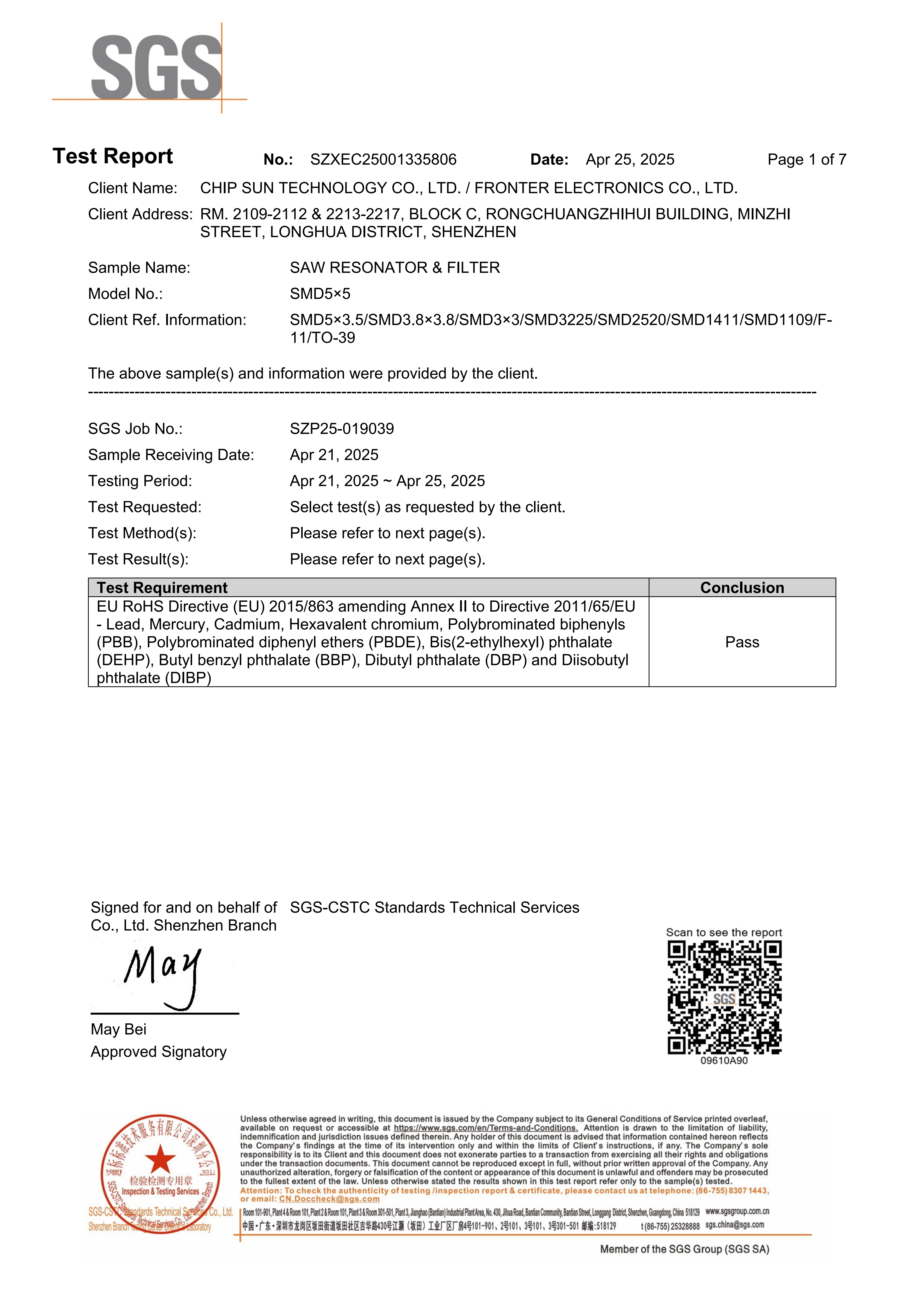
Decide which documents the lot must travel with. Fronter states that its products comply with RoHS and REACH, and holds an EU RoHS Compliance Certificate, number SZXEC25001335806, issued on 25 April 2025 by SGS-CSTC Standards Technical Services Co., Ltd. Shenzhen Branch under EU RoHS Directive (EU) 2015/863 amending Annex II to Directive 2011/65/EU, covering SAW Resonator & Filter and SMD series.
Step 4 — Validate a sample on your own board
Datasheet compliance and board-level behaviour are different things. Measure the sample at room temperature, then at the low and high ends of your operating range, and check start-up behaviour and current draw where relevant.
Step 5 — Agree the acceptance criteria in writing
Define the test conditions, the pass/fail limits, the sampling method and the record that must accompany each lot. Fronter's stated quality control position is 100% test on output, which is the kind of claim that should be translated into a test report format both sides accept.
Step 6 — Lock commercial terms and the change process
For Fronter, the operating parameters are an ODM production mode with customization of parameters and appearance, a minimum order quantity of 1,000 pcs, a standard lead time of 30–45 days, monthly capacity of 80KK and remote after-sales support. Agreement should also cover how a frequency or packaging change is notified once volume production has started.
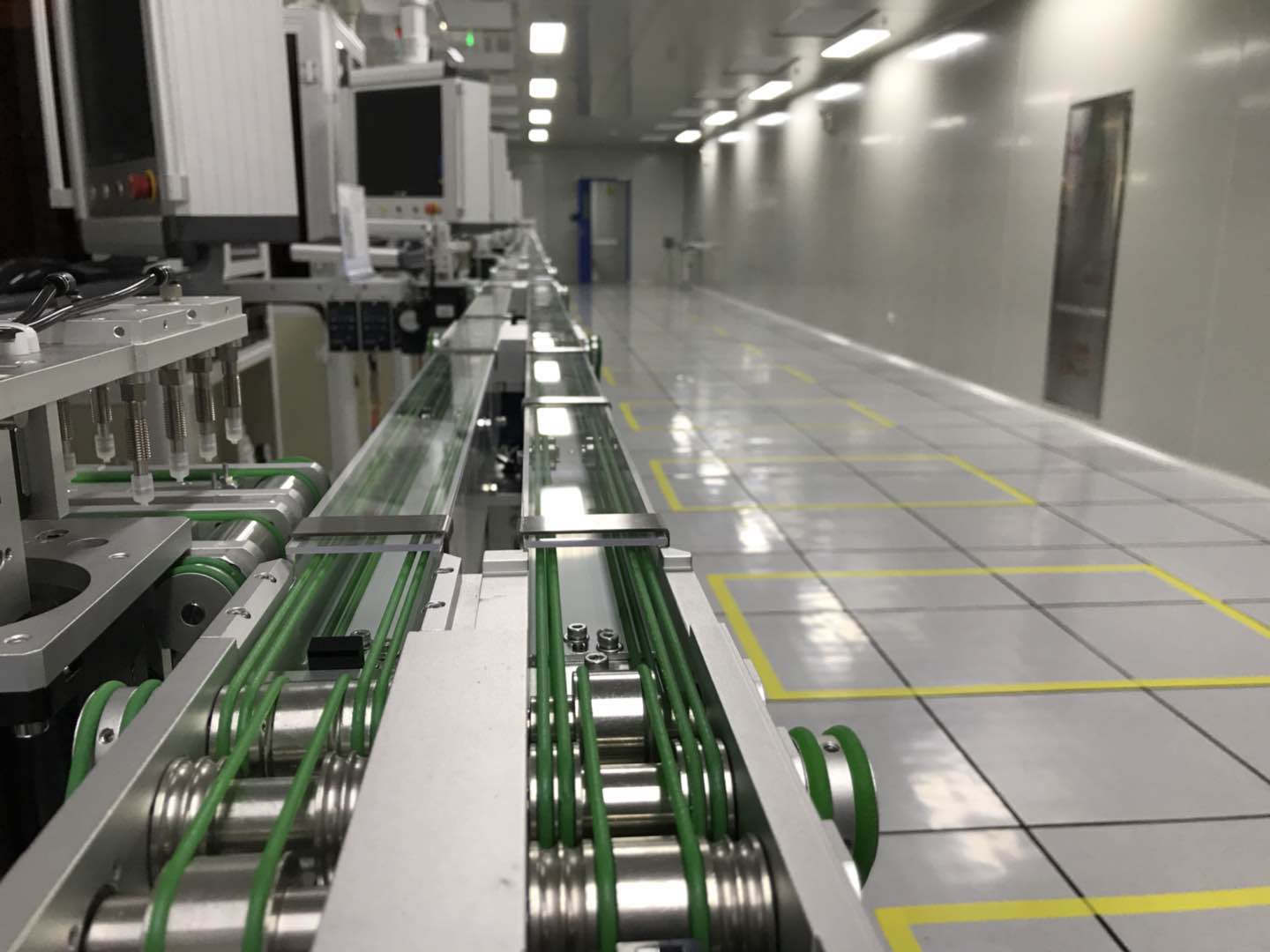
Use Cases: Where Timing Components Sit in Smart Manufacturing
Smart metering. A smart meter manufacturer in India has received 5,000,000 units from Fronter over a 10-year relationship, with the parts reported as running in stable operation. Delivery for that programme was completed within 3–4 weeks, with packaging and frequency requirements customized per project. Metering is a useful reference case because the failure mode is measurement drift rather than outright failure, so stability over temperature is the parameter that actually governs field performance.
Connected consumer and building devices. Fronter's application record for its piezoelectric crystal components lists smart home appliances, communication electronics and Bluetooth devices, with project types including mobile devices, Bluetooth headsets, smart air conditioners and security cameras. In that configuration the component's defined function is to provide a stable clock signal for the IC, matched to an oscillator circuit, under a high-temperature working condition with vibration present.
Industrial and automotive electronics. Fronter's company profile lists network, communication, industrial control, automotive, instrument and meter, financial equipment, computer interface devices and consumer electronics among the sectors its products serve — the same spread of segments that the market data shows growing fastest in automotive.
Comparison Table: Piezoelectric Crystal Unit vs SMD Crystal Oscillator
The table below compares the two component classes using Fronter's published component data. It is a comparison of what each part is and what it is specified by — not a ranking of which one is better, because the correct choice depends on whether the oscillator circuit already exists on your board.
| Attribute | Piezoelectric crystal component series | SMD quartz crystal oscillator series (OSC-SMD) |
|---|---|---|
| Role in the circuit | Quartz crystal unit, crystal filter or SAW resonator; works together with an external oscillator circuit | Active oscillator module that outputs a clock signal directly |
| Nominal frequency | 1–96 MHz | 32.768 kHz; 1.5–50 MHz |
| Supply voltage | — | 1.8–3.3 V; 3.3–5.0 V |
| Load capacitance | 4–33 pF | — |
| Frequency tolerance | ±5 ppm to ±100 ppm | — |
| Frequency stability | ±10 ppm to ±100 ppm | ±20 ppm at −20 ℃ to +70 ℃; ±25 ppm at −40 ℃ to +85 ℃ |
| Operating temperature | −55 ℃ to +125 ℃ | −20 ℃ to +70 ℃; −40 ℃ to +85 ℃ |
| Package options listed | SMD7050 / 6035 / 5032 / 3225 / 2520 / 2016 / 1612; OSC-SMD7050 / 5032 / 3225 / 2520 / 2016 / 1612 | OSC-SMD3225, OSC-SMD2016, OSC-SMD5032 (5.0 × 3.2 mm, 3.2 × 2.5 mm, 2.0 × 1.6 mm) |
| Construction materials | Metal cover, ceramic base, quartz wafer | SiO₂, silver, gold, metal iron shell |
| Sectors listed | Smart home appliances, communication electronics, Bluetooth devices | Communication, automotive, consumer electronics |
A dash indicates that the parameter is not part of that product's published specification.
FAQ
Which compliance documents should a buyer request with a crystal oscillator order?
Ask for the environmental compliance file and, where the end product is automotive, the qualification route. Fronter states that its products comply with RoHS and REACH. The EU RoHS Compliance Certificate on file, number SZXEC25001335806, was issued on 25 April 2025 by SGS-CSTC Standards Technical Services Co., Ltd. Shenzhen Branch under EU RoHS Directive (EU) 2015/863 amending Annex II to Directive 2011/65/EU, with a scope covering SAW Resonator & Filter and SMD series. For automotive projects, note that AEC-Q200 is the stress qualification standard for passive components including quartz crystals, while AEC-Q100 applies to active ICs.
Can frequency, packaging or appearance be customized for a smart-manufacturing project?
Fronter operates an ODM production mode with customization of parameters and appearance, a monthly capacity of 80KK, 100% test on output, a minimum order quantity of 1,000 pcs and a standard lead time of 30–45 days, with after-sales support provided remotely. A smart meter manufacturer in India has received 5,000,000 units over a 10-year relationship, with packaging and frequency requirements customized to that project.
What drives the price of a crystal oscillator?
There is no single price band; cost is driven by the parameter set specified rather than by the package alone. The main drivers are the frequency stability class over the required temperature range, the operating temperature range itself (−40 ℃ to +85 ℃ at ±25 ppm versus −20 ℃ to +70 ℃ at ±20 ppm in Fronter's OSC-SMD data), supply voltage and output configuration, package size, the amount of parameter or appearance customization, and the qualification evidence required with each lot. Order quantity relative to the 1,000 pcs MOQ also changes unit cost. Quotes are therefore only comparable when the full specification and acceptance criteria are compared, not the frequency alone.
How should a sample be validated before a volume order?
Test the sample on your own board rather than on the datasheet. Confirm the footprint and pin-out of the 4-pin SMD package, measure frequency at room temperature against the stated tolerance, repeat the measurement at the low and high ends of the target operating range, and check start-up behaviour and current draw if the design targets low power consumption. For passive crystal units, also verify load capacitance (4–33 pF) against the oscillator circuit's design value.
What lead time should be planned, and how does ordering start?
Fronter's stated standard lead time is 30–45 days with a minimum order quantity of 1,000 pcs; in the smart meter programme the buyer received delivery within 3–4 weeks. Plan qualification samples well ahead of the production build so that sample validation does not compress the order window. Samples, quotations and technical data can be requested from Fronter at sales@chinafronter.com or +86 755-83458798, and the product catalogue can be downloaded here: Fronter Electronics product catalogue (PDF).
Conclusion
A crystal oscillator is best understood as a division of labour: a quartz piezoelectric element decides the frequency, and an oscillator circuit keeps it running. Once that is clear, the sourcing logic follows. If your board already carries the oscillator circuit, you are buying a passive crystal unit and must specify load capacitance, tolerance and stability. If it does not, you are buying an active module and must specify supply voltage, output configuration, stability over temperature and package footprint.
Two habits reduce risk more than any single specification. First, write the acceptance criteria — test conditions, limits and the record that travels with each lot — before comparing prices, because a quote without those criteria compares nothing. Second, ask which end segment the supplier's line actually serves; the difference between communications-driven volume production and automotive-qualified production is a documentation difference as much as a technical one. Fronter Electronics, founded in 1991 and operating a 21,000 m² facility with a stated monthly capacity of 80KK, positions its quartz crystal resonator and oscillator lines across communication, automotive and consumer applications, and publishes the compliance evidence buyers need to start that conversation.
Next Step: Check the Part Against Your Clock Budget
Send Fronter your frequency, stability requirement, operating temperature range and package footprint. You will receive a matched OSC-SMD or crystal unit proposal, the relevant compliance documents, and a sample plan for board-level validation — with the standard MOQ of 1,000 pcs and a stated lead time of 30–45 days.
Email: sales@chinafronter.com | WhatsApp: +86 18903026195 | Website: www.chinafronter.com
Have Questions or Need More Details?
Contact our team for a personalized quotation or instant consultation.
Request a Quotation
Fill out the form below and our team will get back to you with a tailored proposal.
WhatsApp Direct Chat
Prefer to chat in real-time? Message us on WhatsApp for instant assistance & quick answers.
- Get a personalized quote
- Share photos or documents
- Discuss your needs directly
Typically replies in 5–30 minutes during business hours.