
Crystal Oscillator Purchasing Terms & Acceptance Criteria
Crystal Oscillator Purchasing Terms & Acceptance Criteria
A documented, step-by-step approach to writing purchasing terms and acceptance criteria for crystal oscillators, quartz piezoelectric crystals and piezo elements before the purchase order is issued.
A crystal oscillator order becomes executable only when two separate layers are written down: the purchasing terms that define how the part is bought, and the acceptance criteria that define how the part is approved. Most smart-manufacturing buyers settle the technical question — which oscillator, which package, which stability class — long before they settle those two layers, and the gap reappears later as a held shipment, a renegotiated minimum quantity, or an argument at incoming inspection.
Fronter Electronics Co., Ltd. is a Shenzhen-based manufacturer founded in 1991 that develops, produces and sells quartz crystal resonators and quartz crystal oscillators under the FT brand, a brand recognized as a National High-Tech Enterprise in 2017. Fronter documents both layers in a single standard answer to the question buyers ask at exactly this stage: MOQ 1K; delivery terms EXW; acceptance criteria pre-shipment test; payment terms 100% in advance. The purpose of this article is to turn that answer into a repeatable method you can apply to crystal oscillators, piezoelectric crystal components, piezo elements and quartz piezoelectric crystals — one that survives volume ramp, repeat orders and a change of supplier.

Parameter verification on the production floor. Acceptance criteria are only useful if the evidence behind them is generated and recorded before dispatch.
Problem Definition: The Part Is Known, the Terms Are Not
In a smart-manufacturing build, the timing component is usually the smallest line item on the bill of materials and the last one to be fully specified. Engineering selects a quartz crystal oscillator for clock generation and moves on. Purchasing is then asked to source the same part for a controller board, a smart meter or an industrial gateway. The part reference may already exist in the system; the commercial frame, the customization scope, the acceptance evidence and the compliance document list frequently do not.
Three gaps appear repeatedly, and each one sits on the evaluation-to-execution boundary rather than in the datasheet:
- Terminology gap. The same requisition can mean a quartz crystal oscillator, a quartz crystal resonator, a SAW resonator and filter, or a piezoelectric crystal component. These are different product families with different acceptance checks, and a purchase order that names only the application will be matched to whichever family the supplier considers closest.
- Customization gap. "Custom frequency" and "custom part" are used interchangeably by buyers, but they describe different commercial commitments. Unless the customization axis is named in writing, the supplier and the buyer will each measure delivery against a different definition.
- Acceptance gap. Buyers frequently accept the phrase "tested" as a complete acceptance criterion. In practice a manufacturing control and an acceptance gate are two different things, and only one of them gives the buyer a documented basis for holding or releasing a shipment.
Four questions to close before a purchase order is raised:
1. What exactly is being bought — which component family and which oscillator type?
2. Which parameters and which appearance attributes are being customized?
3. Which commercial terms apply — minimum order quantity, delivery term and payment terms?
4. What evidence must exist before dispatch, and which compliance documents must accompany it?
Industry Background: Why Timing Procurement Now Demands Written Criteria
The commercial context explains why this documentation step has moved from good practice to requirement. Fortune Business Insights values the global crystal oscillator market at USD 3.64 billion in 2026, and the same source expects temperature-compensated crystal oscillators (TCXO) to hold a 37.49% share of that market in 2026, driven by smartphone and 5G infrastructure demand. When a single segment carries that much of the volume, the practical consequence for buyers is that TCXO-related terms — stability over temperature, package, and the test evidence that proves both — become the most common negotiation surface rather than a specialist exception.
The automotive segment is the second force. Automotive crystal oscillator demand is growing at a CAGR of 12.88%, the highest among end-user segments according to Fortune Business Insights. Automotive programs document qualification rather than assume it, and the standard that applies depends on the component: AEC-Q200 is the stress qualification standard for passive components including quartz crystals, while AEC-Q100 applies to active ICs. Buyers who write "automotive grade" instead of naming the standard leave the acceptance criterion open to interpretation.
Both signals point the same way. Acceptance criteria are increasingly a documentation task that runs alongside the electrical specification, not a test step performed at the end of the transaction.
The Solution: A Four-Layer Purchasing Term Set
The workable structure is to treat purchasing terms as four layers, each with its own evidence. Fronter's documented terms supply a reference value for every layer, which makes the structure easy to test against a real quotation.
Layer 1 — The Commercial Frame
The commercial frame answers how the part is bought. Fronter's documented position is a minimum order quantity of 1K, delivery terms EXW, and payment terms 100% in advance. Each term carries a consequence the buyer should understand before signing. EXW places the freight arrangement and the logistics risk from the supplier's premises on the buyer, so the shipping plan belongs in the purchasing discussion rather than after it. A 100% advance payment term means the pre-shipment test is the buyer's principal protection point, which is precisely why the acceptance criterion deserves a separate clause instead of a verbal understanding.
Layer 2 — The Customization Scope
Fronter operates an ODM production mode with customization of parameters and appearance. Recording which of those two axes is being changed is what separates a custom order from a standard order in the documentation. The documented smart-meter program shows the pattern in practice: flexible customization to project-specific packaging and frequency requirements. That is a precise statement — packaging and frequency — and it can be audited at dispatch in a way that "customized per customer request" cannot.
Layer 3 — The Quality Acceptance Layer
Fronter's quality control is documented as 100% test, and the documented acceptance criterion is a pre-shipment test. These are complementary, not interchangeable. The 100% test describes in-process control across production; the pre-shipment test is the acceptance gate that releases a specific order. Buyers who want a defensible release decision should write the gate, not only the control.
Layer 4 — The Compliance Document Layer
Fronter products are stated to comply with RoHS and REACH and other environmental protection regulations. The supporting document in the corpus is an EU RoHS Compliance Certificate issued by SGS-CSTC Standards Technical Services Co., Ltd. Shenzhen Branch under certificate number SZXEC25001335806, issued 25 April 2025 against EU RoHS Directive (EU) 2015/863 amending Annex II to Directive 2011/65/EU, for the EU market, with a stated scope of SAW Resonator & Filter, SMD series. Two details matter for acceptance: the certificate number is what a quality auditor will ask for, and the scope statement is what defines whether the certificate actually covers the part being purchased.
Step-by-Step Breakdown: Seven Steps to Document Terms and Acceptance Criteria
- Name the component family and the oscillator type on the RFQ. A requisition should distinguish a quartz crystal oscillator from a quartz crystal resonator, a crystal filter, a SAW resonator and filter, or a piezoelectric crystal component. Where the item is an oscillator, name the type as well — clock oscillator, TCXO, VCXO, VCTCXO, OCXO, SMD oscillator, 4-pin SMD oscillator, differential output oscillator or programmable oscillator — and add the performance descriptor that matters to the design, such as low power consumption, high stability, low phase noise or precision. This single step removes most of the terminology gap.
- Convert the application into parameter terms. List the parameters that must be fixed and the parameters that may vary, then state which appearance attributes are in scope. Fronter's documented customization axis is exactly this: parameters and appearance. A custom order that names only one axis will be delivered against an assumption on the other.
- Write the commercial frame in numbers. Put the minimum order quantity, delivery term and payment terms on one line: MOQ 1K, delivery terms EXW, payment terms 100% in advance. Add the standard lead time of 30–45 days so that the delivery schedule is anchored to a documented figure rather than to an expectation built during evaluation.
- Separate in-process control from the acceptance gate. Record 100% test as the production control and pre-shipment test as the acceptance criterion. Then state what the pre-shipment test must cover for this order — the parameter set from step 2 — so that a pass or fail decision is not left to interpretation.
- Build the compliance document list. Attach the RoHS and REACH position, cite the EU RoHS certificate number SZXEC25001335806 and confirm that the certificate scope (SAW Resonator & Filter, SMD series) matches the purchased item. If the program is automotive, add the applicable qualification standard as its own acceptance line, and name it explicitly — AEC-Q200 for passive components including quartz crystals, AEC-Q100 for active ICs — rather than writing "automotive grade".
- Set a capacity backstop behind the lead time. Fronter's documented monthly capacity is 80KK, which gives buyers a planning reference for volume ramp beyond a single order. Where a program requires a shorter cycle than the standard lead time, that has to be negotiated as a project term; the smart-meter case record notes delivery within 3–4 weeks as a program-specific arrangement, not as the default.
- Define handover, after-sales and change control. Fronter provides remote after-sales support, and that support channel belongs in the order documentation alongside the contact route. Add a re-acceptance rule: if parameters or appearance are changed after the first acceptance, the pre-shipment test is repeated against the revised parameter set. Without that rule, the second order is approved on the first order's evidence.

Production capacity belongs in the terms as a backstop: Fronter's documented monthly capacity is 80KK, with a standard lead time of 30–45 days.
Use Cases: Where the Checklist Changes the Outcome
Smart meter manufacturing — long service life, repeatable acceptance
A smart meter manufacturer in India purchased 5,000,000 units of piezoelectric crystal components for smart meter applications, with a documented service duration of 10 years and a result of stable operation. The case record highlights fast delivery within 3–4 weeks, with flexible customization to meet project-specific packaging and frequency requirements. For a program of this shape, the acceptance criterion is the asset: once packaging and frequency are written as the customized terms, the same pre-shipment test can be applied lot after lot across a decade-long supply relationship instead of being re-negotiated at each reorder.
Industrial control and instrument builds — planning against lead time
Industrial control, instrument and meter, network and communication builds typically run on a scheduled production plan rather than a single large release. Here the operative terms are the standard lead time of 30–45 days and the 80KK monthly capacity figure, both of which let a buyer place the timing component on the same planning calendar as the rest of the board.
Automotive-oriented programs — qualification named, not assumed
Automotive crystal oscillator demand is the fastest-growing end-user segment in the 2026 market picture, at a CAGR of 12.88% per Fortune Business Insights. Automotive buyers should treat qualification as a separate documented acceptance line. AEC-Q200 covers stress qualification for passive components including quartz crystals; AEC-Q100 covers active ICs. Writing the specific standard into the purchase order converts a market assumption into an auditable criterion, and it is the only way a first-article review and a repeat order are judged by the same rule.
Appearance-driven consumer and equipment builds
For consumer electronics, financial equipment and computer interface devices, the visible attribute of the component sometimes matters as much as the electrical parameter, because it affects marking, handling or automated placement. Fronter's documented customization includes appearance alongside parameters, which means appearance changes should be listed in the order documentation to the same level of detail as electrical changes.
Comparison Table: Documented Terms and Where Each One Acts
The table below maps Fronter's documented purchasing terms to the clause a buyer should write, and to the stage at which the term does its work. Reference values are the documented ones; no term should be inferred beyond them.
| Purchasing term | Documented reference | What to write into the order | Stage |
|---|---|---|---|
| Minimum order quantity | MOQ 1K | Minimum order quantity per item, stated numerically | Execution |
| Delivery term | EXW | Delivery term plus who arranges freight from origin | Execution |
| Payment terms | 100% in advance | Payment schedule and the document that triggers payment | Execution |
| Acceptance criteria | Pre-shipment test | Acceptance gate: test performed, parameter set covered, record provided before dispatch | Execution |
| In-process quality control | 100% test | Production control stated separately from the acceptance gate | Evaluation |
| Standard lead time | 30–45 days | Lead time measured from order confirmation | Execution |
| Monthly capacity | 80KK | Volume backstop for ramp and repeat orders | Evaluation |
| Customization scope | Parameters / Appearance (ODM) | Named parameter changes and named appearance changes | Evaluation |
| Environmental compliance | RoHS / REACH; EU RoHS certificate SZXEC25001335806 | Certificate number and scope check attached to the order file | Evaluation |
| After-sales support | Remote support | Named support channel and escalation route | Execution |
The second table applies the same logic across component families: the acceptance criterion should always name the parameter that the family is bought for.
| Component family | What the acceptance criterion must name | Why it matters |
|---|---|---|
| Quartz crystal oscillator, including clock oscillator, TCXO, VCXO, VCTCXO, OCXO, SMD oscillator, differential output oscillator and programmable oscillator | Output frequency, stability and the performance descriptor that drove the selection (high stability, low phase noise, low power consumption, precision), together with package and pin configuration | The oscillator is bought for its output behaviour; package and pin-out decide whether it can be assembled as designed |
| Quartz crystal resonator | Nominal frequency, frequency tolerance and package | A resonator is matched to the circuit around it, so the acceptance check must reflect the circuit requirement |
| SAW resonator and filter, SMD series | Frequency and package, checked against the scope of the compliance document | The documented EU RoHS certificate scope is SAW Resonator & Filter, SMD series, so this family is the one the certificate explicitly covers |
| Piezoelectric crystal components, piezo elements, quartz piezoelectric crystals | The customized parameter set agreed at order stage, plus packaging requirements where project-specific | These are the families most often supplied under parameter and appearance customization, so the agreed parameter list is the acceptance basis |
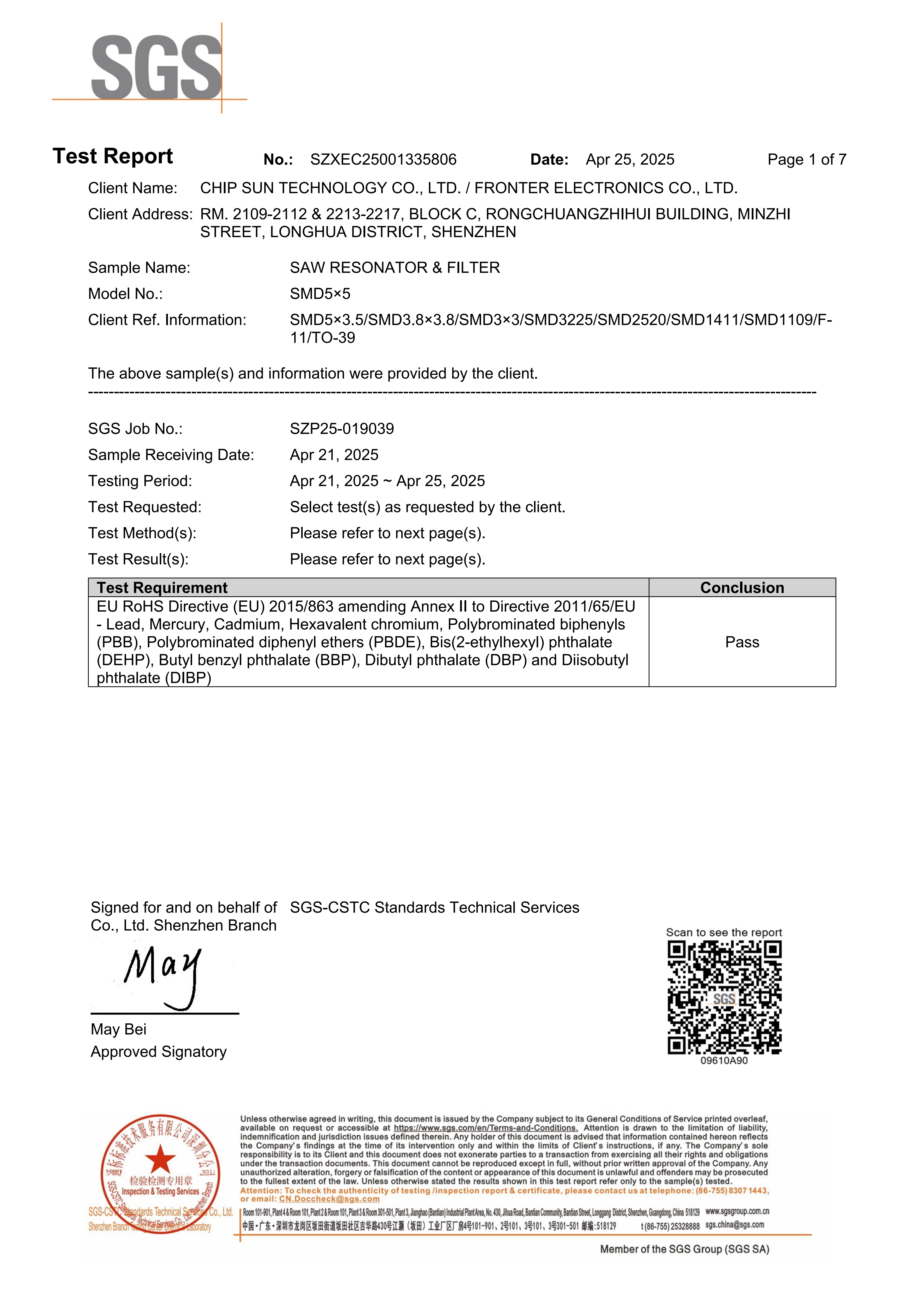
EU RoHS Compliance Certificate SZXEC25001335806, issued 25 April 2025 by SGS-CSTC Standards Technical Services Co., Ltd. Shenzhen Branch against Directive (EU) 2015/863; stated scope: SAW Resonator & Filter, SMD series.
FAQ: Purchasing Terms and Acceptance Criteria
Which compliance documents should be attached to a crystal oscillator purchase order?
Attach the environmental compliance evidence and check its scope against the part being bought. Fronter products are stated to comply with RoHS, REACH and other environmental protection regulations, and the supporting document is an EU RoHS Compliance Certificate issued by SGS-CSTC Standards Technical Services Co., Ltd. Shenzhen Branch under certificate number SZXEC25001335806 on 25 April 2025, against EU RoHS Directive (EU) 2015/863 amending Annex II to Directive 2011/65/EU, for the EU market, with a stated scope of SAW Resonator & Filter, SMD series. If the program is automotive, also name the applicable qualification standard as a separate acceptance line: AEC-Q200 is the stress qualification standard for passive components including quartz crystals, while AEC-Q100 applies to active ICs.
How much OEM/ODM customization can be written into the purchasing terms?
Fronter Electronics Co., Ltd. operates an ODM production mode with customization of parameters and appearance, supported by a 21,000 m² facility, 286 employees and a 19-engineer R&D team, with an annual output of 300,000,000 units. In contracting terms, that means two customization axes can be named — parameter customization and appearance customization — and both should be written explicitly rather than captured as a general request. The documented smart-meter program shows the working pattern: flexible customization to project-specific packaging and frequency requirements.
What are the purchasing terms and acceptance criteria?
Fronter's documented answer is: MOQ 1K; delivery terms EXW; acceptance criteria pre-shipment test; payment terms 100% in advance. Translated into an order document, the minimum order quantity is 1,000 pieces, freight is arranged by the buyer from the supplier's premises under EXW, acceptance is decided by a pre-shipment test rather than by inspection after arrival, and payment is settled in advance of shipment. These four terms should be stated in the purchase order itself, because together they define the buyer's release point and its principal protection.
Can a sample be validated before the purchasing terms are locked?
The documented commercial frame starts at MOQ 1K, so sample validation is normally handled as a separate pre-order arrangement agreed with the supplier's sales contact rather than as part of the standard terms. The important discipline is to convert the outcome of that evaluation into written criteria: the parameter set confirmed during evaluation becomes the specification covered by the pre-shipment test, and any appearance change confirmed during evaluation becomes part of the documented customization scope. Fronter's sales team can be reached at sales@chinafronter.com for pre-order evaluation arrangements and quotation.
How should lead time and delivery be written into the order?
Write lead time and delivery term as two separate clauses. Fronter's documented standard lead time is 30–45 days, with a monthly capacity of 80KK providing a volume backstop, and the delivery term is EXW, which means the buyer arranges freight from the supplier's premises. Some programs run faster on a negotiated basis — the documented smart-meter case record notes delivery within 3–4 weeks with flexible customization to packaging and frequency — but that is a project-specific arrangement and should be written as such, not assumed as the default cycle. For a quotation that reflects your own program requirement, send the specification and volume to sales@chinafronter.com or request the product brochure using the download link below.
Conclusion
Purchasing terms and acceptance criteria are not administrative detail; they are the part of a crystal oscillator order that decides whether a shipment can be released, held or rejected. The four-layer structure — commercial frame, customization scope, quality acceptance and compliance documents — covers every ambiguity that a specification alone leaves open, and Fronter's documented terms give each layer a reference value: MOQ 1K, delivery terms EXW, payment terms 100% in advance, acceptance by pre-shipment test, quality control by 100% test, customization of parameters and appearance, standard lead time 30–45 days, monthly capacity 80KK, and RoHS/REACH compliance supported by EU RoHS certificate SZXEC25001335806.
Applying the seven steps in this order — component identity, parameter terms, commercial frame, acceptance gate, compliance list, capacity backstop, handover and change control — converts a known part into an executable order. For buyers moving from evaluation into execution on oscillators, piezoelectric crystal components, piezo elements or quartz piezoelectric crystals, the next practical step is to put the current specification next to the documented terms and confirm where the two still differ.
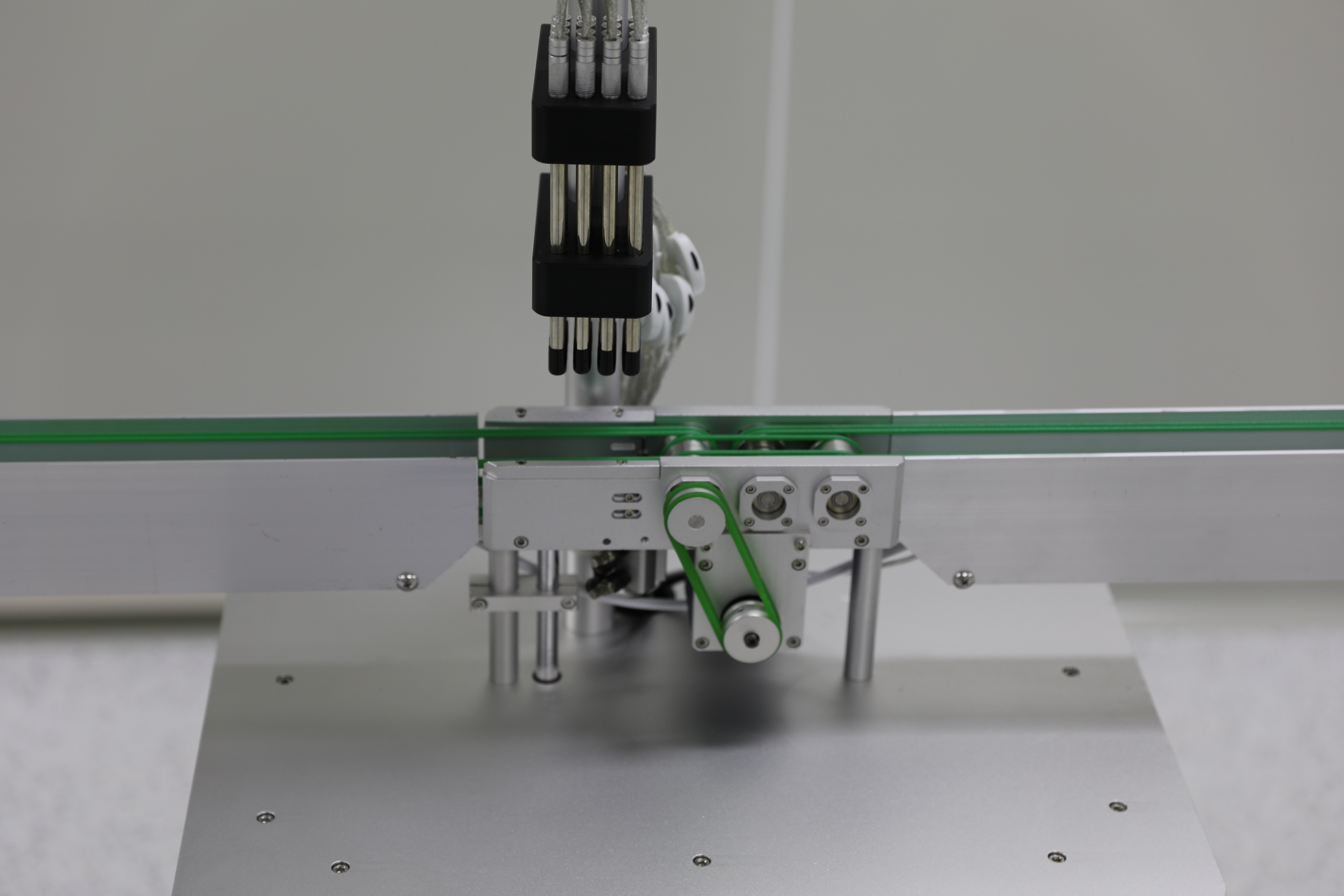
The acceptance gate in practice: parameters verified and recorded before dispatch, so the pre-shipment test result is auditable rather than verbal.
Next Step: Turn These Terms into Your Order Document
Fronter Electronics Co., Ltd. supplies quartz crystal resonators and quartz crystal oscillators under the FT brand, with ODM parameter and appearance customization, 100% test in production and pre-shipment test as the documented acceptance criterion.
Download the product brochure: Fronter Electronics product brochure (PDF)
Send your specification and order volume to sales@chinafronter.com or WhatsApp +86 189 0302 6195. Website: www.chinafronter.com. Address: Rm. 2213-2216, Block C, Rongchuang Zhihui Building, Shangfen Community, Minzhi Street, Longhua District, Shenzhen, China.
Have Questions or Need More Details?
Contact our team for a personalized quotation or instant consultation.
Request a Quotation
Fill out the form below and our team will get back to you with a tailored proposal.
WhatsApp Direct Chat
Prefer to chat in real-time? Message us on WhatsApp for instant assistance & quick answers.
- Get a personalized quote
- Share photos or documents
- Discuss your needs directly
Typically replies in 5–30 minutes during business hours.