
Crystal Resonator Selection Priorities for Smart Manufacturing
Ranking Buyers

Smart manufacturing teams evaluating crystal resonators rarely lose time on a single question. They lose it by evaluating in the wrong order — fixing a supplier, a price, or a sample approval before the specification that governs all three is settled. The eight priorities below rank what to evaluate first when comparing tuning fork crystal resonators, MHz quartz crystal units, and piezo elements, and each entry explains what that priority changes in an RFQ, a sample report, or an acceptance test.
The ranking is an editorial methodology, not a market measurement. Each priority is placed by two tests: how irreversible a mistake becomes if it is discovered late, and how many later checks depend on it. Commercial terms sit low because they can still be renegotiated; category fit and package compatibility sit at the top because they cannot be renegotiated once tooling, stencils, and test fixtures exist.
The ranked order at a glance:
- Timing function and component category
- Package and mounting compatibility
- The conditions behind the headline specification
- Compliance evidence whose scope matches the purchased series
- A documented quality regime and written acceptance criteria
- Capacity and lead-time commitment
- MOQ, customization route, and cost drivers
- Long-term support and supply continuity
Problem definition: why evaluation order matters more than evaluation depth
A crystal resonator purchase order looks simple — a frequency, a package, a tolerance, a quantity. The difficulty appears when two quotations are compared side by side and the underlying parts are not equivalent. A tuning fork resonator operating at 32.768 kHz for timekeeping, an MHz quartz crystal unit used as a clock reference, and a piezo element occupy different positions in the accuracy and application hierarchy. Comparing their unit prices produces a number, not a decision.
Smart manufacturing adds a second layer of cost. Timing components sit inside meters, controllers, communication modules, sensors, and inspection equipment, so a specification change late in a programme ripples into firmware, test fixtures, spare-part lists, and field-service documentation. Sequencing the evaluation — technical fit first, compliance and quality next, commercial and continuity terms last — keeps those downstream costs from being triggered by a decision that looked cheaper on paper.
What published data adds to the evaluation
Three published data points frame the sourcing environment. Each is directionally useful rather than decisive.
- Category size. MarketsandMarkets projects the global crystal oscillator market to reach USD 3.66 billion by 2030 (source dated 15 September 2025). Resonator-only revenue is not broken out in that figure; oscillator data is widely used as a directional proxy because the resonator is the timing element inside those devices.
- Packaging direction. The same source reports that surface-mount devices held 76.40% of the crystal oscillator market in 2025, consistent with SMD-first assembly planning across industrial electronics.
- Supply-base depth. China's exports of mounted piezoelectric crystals under HS 854160 reached USD 1.5 billion in 2024, according to customs data from the General Administration of Customs (GACC).
- What is not published. Frequency-specific monthly capacity and verified lead times during demand peaks are not available in comparable public form, so they must be established supplier by supplier rather than assumed from market statistics.
The practical effect is a shift in emphasis. A predominantly SMD market makes package compatibility routine for new designs but not for legacy lines; a deep export base widens the shortlist while raising the relative value of scope-accurate compliance documents and documented test regimes.
The eight selection priorities, ranked
Rank 1 — Timing function and component category
Why it ranks here. A resonator is selected by the job it performs, not by frequency alone. Tuning fork resonators at 32.768 kHz are associated with timekeeping references; MHz quartz crystal units with clock generation and reference signals; piezo elements with applications where the accuracy envelope of quartz is not required. A category error invalidates every later comparison, including price.
What to verify. Confirm the circuit role in writing before the RFQ is issued: timekeeping reference, clock reference, or non-critical oscillation. Require each supplier to state the product family in its quotation so the lines compare like with like. Fronter Electronics Co., Ltd, founded in 1991 and trading under the brand “FT”, lists quartz crystal resonators and oscillators as its main product lines, and its published portfolio covers both 32.768 kHz tuning fork and MHz resonators.
Rank 2 — Package and mounting compatibility
Why it ranks here. Package choice is a manufacturing decision as much as an electrical one. Surface-mount formats run on reflow lines; through-hole and cylindrical formats require different assembly, inspection, and rework paths. With SMD at 76.40% of 2025 oscillator market share, most new designs are SMD-first, yet installed equipment often still carries through-hole parts that must remain sourceable for repair and spares.
What to verify. Match footprint, height clearance, and reflow compatibility to the actual board rather than to a reference design. Ask for the exact model number and packaging format in writing, and for through-hole or cylindrical parts confirm the item is active rather than a last-time-buy remnant.
Rank 3 — The conditions behind the headline specification
Why it ranks here. The accuracy figure on a datasheet is a value under stated conditions. Frequency tolerance, frequency stability across the operating temperature range, load capacitance, drive level, and aging interact; a value quoted for one condition set does not transfer to another. This ranks third because the same nominal part can pass a bench check and fail a temperature test when conditions were never compared.
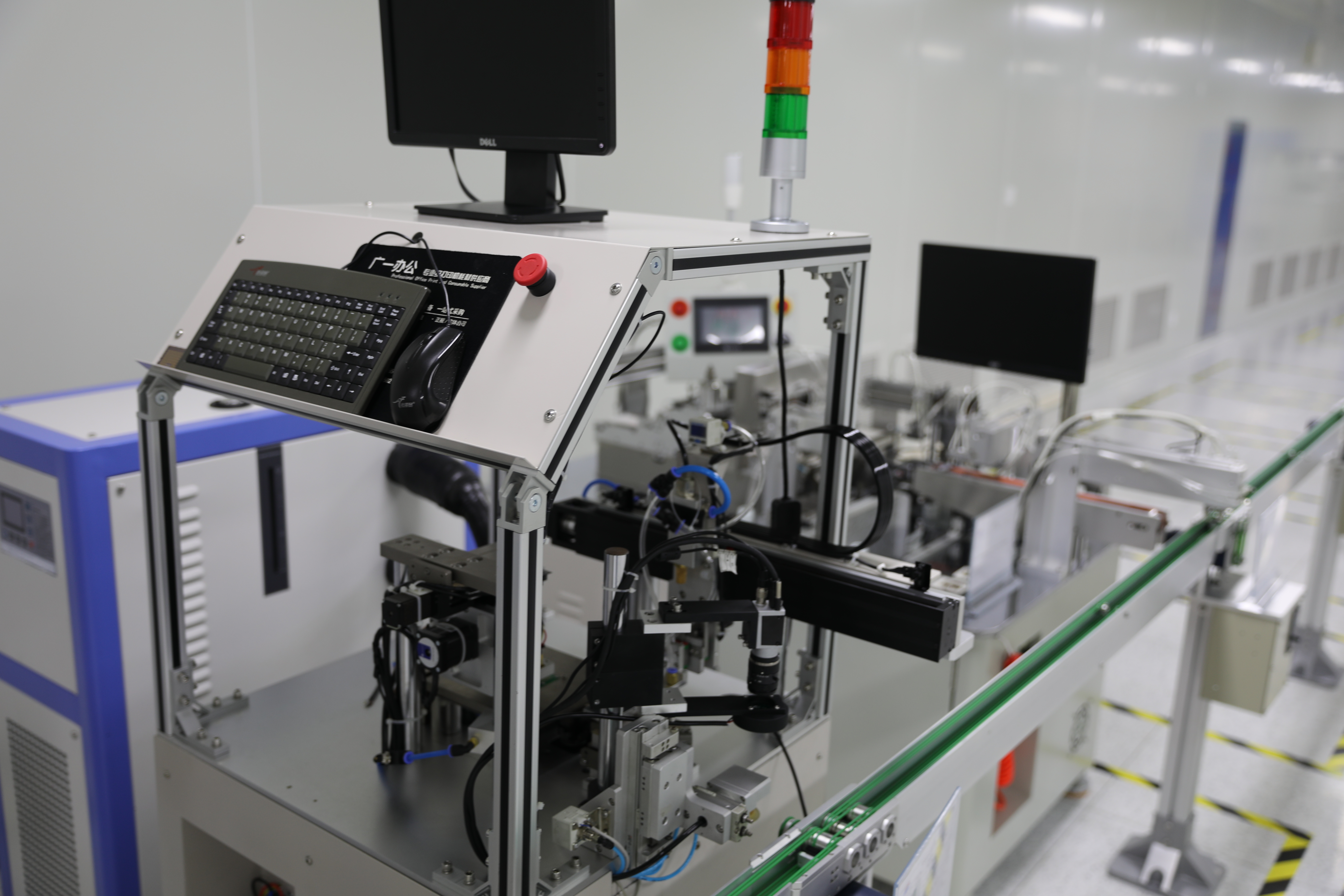
What to verify. Ask for the full condition set rather than a single best number: tolerance at the reference temperature, stability across the declared operating range, load capacitance, and the applicable equivalent-series-resistance limit. Then confirm that the conditions on the supplier's measurement record match the conditions in your application.
Rank 4 — Compliance evidence whose scope matches the purchased series
Why it ranks here. Compliance documents are commonly collected at company level and applied at part level, which is where audits fail. A certificate is evidence only for the products written inside its scope statement, so the scope line matters as much as the certificate number.
What to verify. Read the scope before filing the document. Fronter's EU RoHS Compliance Certificate, number SZXEC25001335806, was issued on 25 April 2025 by SGS-CSTC Standards Technical Services Co., Ltd. Shenzhen Branch under Directive (EU) 2015/863 amending Annex II to Directive 2011/65/EU, and its stated scope is “SAW Resonator & Filter, SMD series”. A buyer sourcing a tuning fork resonator or an MHz crystal unit should therefore request the document covering that series and treat this certificate as evidence for the SAW/SMD scope only. The company states that its products comply with RoHS and REACH; during qualification, treat that as a company statement to be supported by series-level documents.
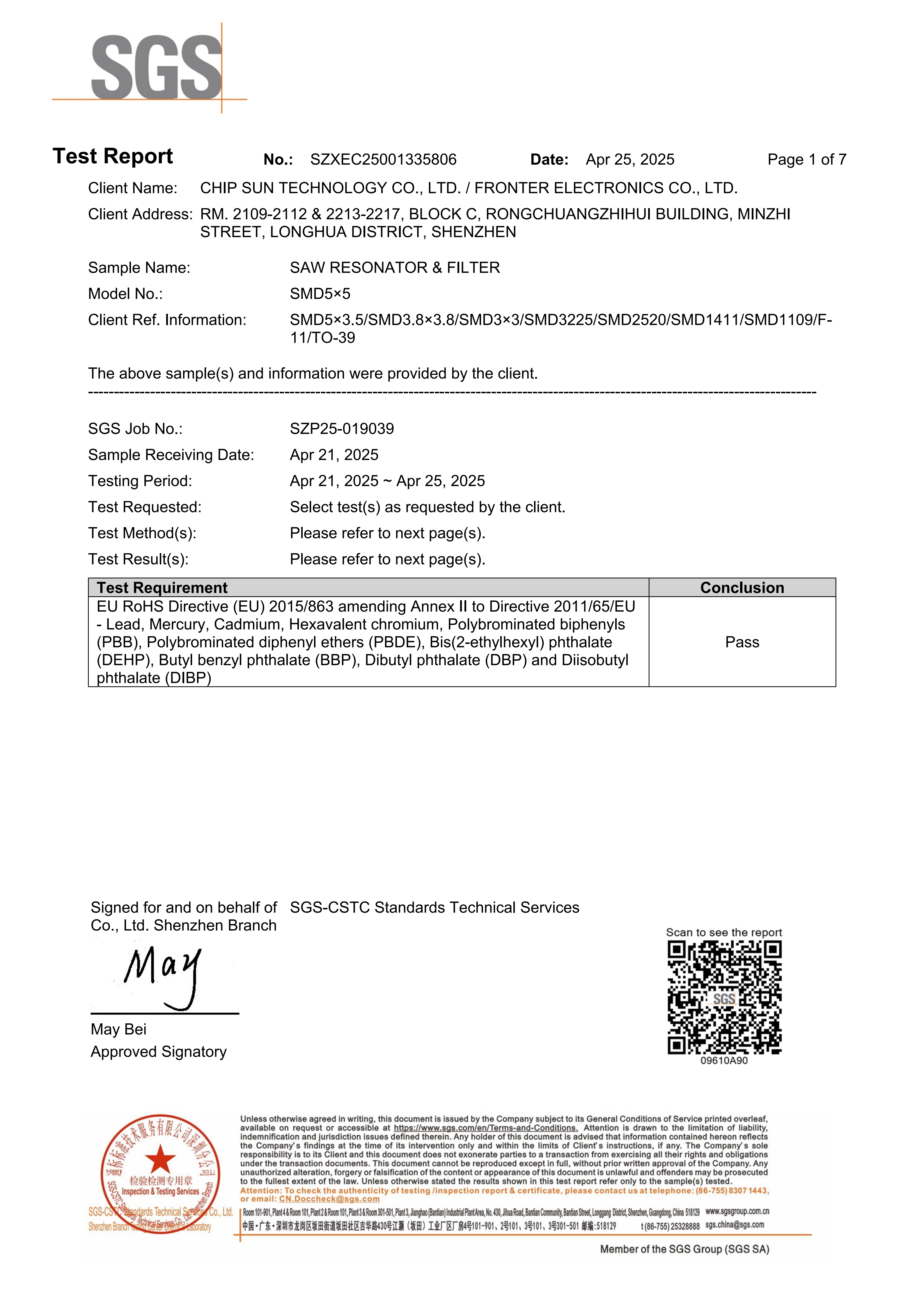
Ranking note. This priority sits above price because a scope gap found during a customer audit can stop shipments, while a price gap usually remains negotiable.
Rank 5 — A documented quality regime and written acceptance criteria
Why it ranks here. Two suppliers can both say “tested” and mean different things. What a buyer can act on is a defined regime — what is tested, on what basis, against which limits — plus an acceptance schedule agreed before the first shipment.
What to verify. Ask whether inspection is 100% test or lot sampling, which parameters are recorded, and how non-conforming lots are handled. Fronter's stated quality-control mode is 100% test; a buyer should still confirm which parameters that coverage includes, because 100% test describes unit coverage, not the depth of the parameter set. Then write the acceptance criteria into the purchase order: measurable parameters, sampling plan, out-of-spec handling, and the document set that accompanies each lot.
Rank 6 — Capacity and lead-time commitment
Why it ranks here. Capacity ranks below quality because it can usually be managed through planning, but it decides whether a pilot line can scale. Frequency-specific capacity is exactly the data that public sources do not publish, so it must come from the supplier in writing.
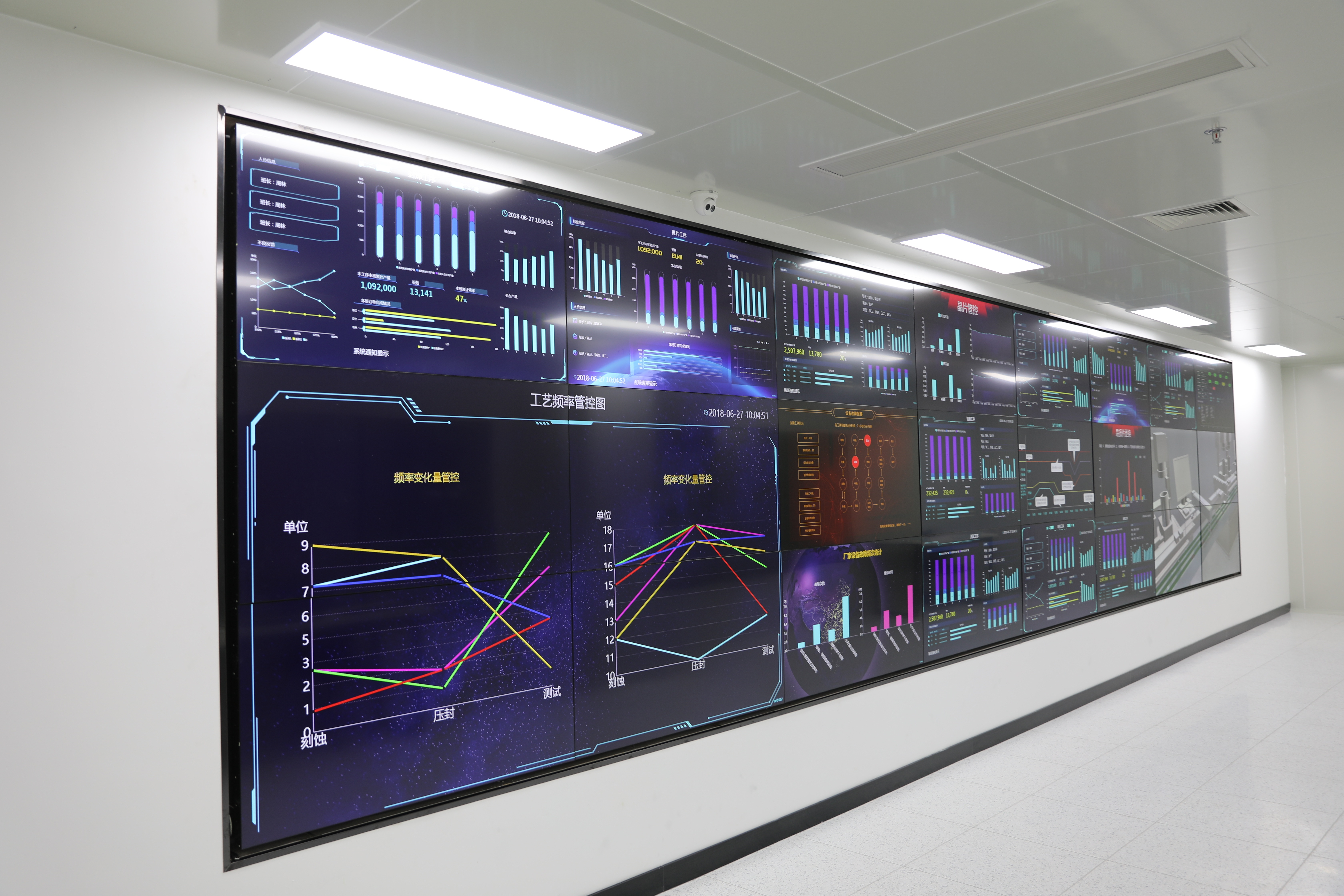
What to verify. Fronter's stated monthly capacity is 80KK with a lead time of 30–45 days under its ODM route; those are supplier-stated capability figures for standard conditions, and a specific project may differ. In one documented programme — a smart meter manufacturer in India, 5,000,000 units across a ten-year relationship — the recorded highlight was delivery within three to four weeks alongside customization to project-specific packaging and frequency requirements. Read that as evidence of what the supplier reports for a specific project, not as a default commitment for a new order. Ask for lead time per frequency and package, plus the buffer policy for peak periods.
Rank 7 — MOQ, customization route, and cost drivers
Why it ranks here. Commercial terms rank seventh because they are the most negotiable item on the list, but they still need structure. MOQ sets the floor for a pilot build, and the customization route determines whether a project-specific frequency or marking is a standard order or an engineering project.
What to verify. Fronter's stated MOQ is 1,000 pcs, and its ODM customization covers parameters and appearance. Before comparing quotations, ask each supplier to separate engineering or tooling charges, unit price, packaging, and freight, and to state whether customization means a parameter change, an appearance change, or both. A lower unit price carrying an unstated engineering charge is not a lower cost.
Rank 8 — Long-term support and supply continuity
Why it ranks here. Crystal resonators are long-life components in equipment with field lives measured in years, so the last item in the technical sequence is the one that shapes ten-year cost: whether the part stays available and whether support continues after the first shipment.
What to verify. Ask about after-sales support arrangements, product-change notification practice, and whether the supplier's portfolio covers the adjacent timing parts on the same board. Fronter's stated after-sales mode is remote support; the company reports a 70% export share with main markets in the EU and USA, and its distribution portfolio includes brands such as SUNLORD, KDS, EPSON, and NDK alongside its own FT line — practical when one board needs several timing components through a single logistics channel.
Tuning fork, MHz quartz, and piezo elements: how the ranking shifts by category
The same eight priorities apply to all three families, but their weights move. The table compares the categories on the dimensions that change a sourcing decision, and deliberately avoids accuracy figures, because those must come from the specific part's datasheet and measurement record.
| Evaluation dimension | Tuning fork crystal resonator (32.768 kHz) | MHz quartz crystal unit | Piezo element / ceramic resonator |
|---|---|---|---|
| Typical circuit role | Timekeeping reference | Clock generation or reference signal | Oscillation where quartz-level accuracy is not required |
| Common formats | Cylindrical and SMD | HC49 SMD, SMD, through-hole | SMD and leaded |
| Specification points to fix first | Tolerance and stability across the timekeeping temperature band; load capacitance | Tolerance, stability, drive level, load capacitance | Frequency tolerance expectation and temperature behaviour |
| Which priorities move up | Rank 3 dominates; Rank 2 close behind | Ranks 2 and 3 move together | Rank 1 and Rank 7 (cost drivers) |
| Sample-stage verification focus | Long-duration drift check at application temperature | Frequency and stability measured against stated conditions | Confirmation that the accuracy envelope fits the application |
Two reading notes keep the table honest. First, “quartz-level accuracy” is a relative statement about design intent, not a measured comparison between named parts. Second, a category with a wider accuracy envelope is not automatically the cheaper or safer choice for a given board; the decision still runs through the eight priorities in order.
Applying the ranking to three smart manufacturing situations
Timekeeping in meters and industrial controllers
Where the resonator holds a real-time clock, Rank 3 carries the most weight and Rank 1 must be settled before any quotation review. Ask for measurement records at the temperatures the enclosure actually reaches, not at room temperature only, and confirm that the sample batch and the production batch share the same specification sheet.
Clock reference in communication and control modules
Here Rank 2 and Rank 3 move together: package compatibility determines whether the part can be assembled reliably, while the condition set determines whether it holds frequency in service. Evaluation should combine a footprint check with a documented stability record, then test both against the acceptance criteria agreed under Rank 5.
Cost-sensitive oscillation outside the accuracy-critical path
Where a piezo element or a lower-grade part is under consideration, the temptation is to start with price. The ranking argues otherwise: confirm that the application tolerates the wider accuracy envelope (Rank 1), then compare cost structures under Rank 7 with engineering charges separated from unit price. The documented smart meter programme shows the other end of the same logic — a five-million-unit, ten-year requirement where customization to project-specific packaging and frequency requirements sat alongside delivery timing, not instead of it.
Purchasing terms and acceptance criteria: a working checklist
Convert the ranking into clauses before the first order, so that evaluation ends in a specification rather than an impression.
- Part identity: product family, exact model number, frequency, package, and mounting format written into the RFQ and echoed in the supplier's confirmation.
- Condition set: tolerance, stability, load capacitance, drive level, and operating temperature range quoted together with the conditions they apply to.
- Compliance scope: the certificate or declaration that names the purchased series, with issue date and issuing body recorded in the supplier file.
- Quality regime: inspection basis (100% test or sampling), recorded parameters, non-conformance handling, and the document set shipped with each lot.
- Commercial structure: MOQ, customization scope, engineering charges, packaging, and freight separated in the quotation.
- Delivery commitment: lead time per frequency and package, buffer policy for peak demand, and the escalation path when a shipment slips.
- Continuity: product-change notification practice, after-sales support route, and availability of adjacent timing parts from the same channel.
Frequently asked questions
What compliance evidence should be requested first for a crystal resonator order?
Request the document whose scope statement names the exact series being purchased, and read the scope line before the certificate number. A RoHS certificate issued for one series — for example Fronter's SZXEC25001335806, whose stated scope is “SAW Resonator & Filter, SMD series” — does not by itself cover a tuning fork or MHz crystal unit. Where a supplier states general RoHS and REACH compliance, ask for the series-level document that supports that statement for your part.
Can one supplier cover both 32.768 kHz tuning fork resonators and MHz crystal units?
Some can. Fronter Electronics Co., Ltd, founded in 1991, lists quartz crystal resonators and oscillators as main product lines, and its published portfolio covers both 32.768 kHz tuning fork and MHz resonators, with a stated monthly capacity of 80KK and an ODM route. Covering both families simplifies supplier management, but it does not remove the need to verify the specification conditions and compliance scope of each individual series.
How do MOQ and customization change the cost structure of a resonator order?
MOQ sets the smallest order a supplier will schedule, and the customization route determines whether a project-specific frequency or marking is routine or an engineering project. Fronter's stated MOQ is 1,000 pcs, with ODM customization covering parameters and appearance. Because engineering charges, unit price, packaging, and freight behave differently across volumes, ask for them as separate lines; a single landed figure hides which element is driving the difference.
What should a sample evaluation cover before production release?
Cover four things: the condition set actually measured (tolerance, stability, load capacitance, operating temperature), the measurement record documenting it, the acceptance criteria the sample is judged against, and the packaging and marking that will ship. The sample report should reference the same specification sheet that governs production. Confirm as well which parameters the supplier's routine test covers, since a 100% test claim describes unit coverage rather than the depth of the parameter set.
What lead time should be planned for an ODM crystal resonator order?
Plan from a written commitment rather than a general figure. Fronter's stated lead time under its ODM route is 30–45 days, and one documented smart meter programme recorded delivery within three to four weeks for a five-million-unit requirement with project-specific packaging and frequency customization. The two figures describe different scopes, so a new project should obtain its own quoted lead time per frequency and package, plus a buffer policy for peak demand. Buyers who want to review portfolio and capability details before issuing an RFQ can download the Fronter product and capability brochure and send their specification to the supplier's sales team for written confirmation.
Conclusion: rank the decisions, then compare the quotes
The eight priorities produce a repeatable evaluation sequence for smart manufacturing buyers: settle the timing function and component category, confirm the package, fix the specification conditions, match compliance scope to the purchased series, agree the quality regime and acceptance criteria, secure capacity and lead time, structure the commercial terms, and confirm long-term support. Price appears in that sequence, but only after the items that make prices comparable.
Applied to tuning fork resonators, MHz quartz crystal units, and piezo elements, the ranking shifts in emphasis rather than in structure: condition sets dominate timekeeping work, package and conditions move together in clock-reference designs, and category confirmation precedes cost comparison where piezo elements are under consideration. Fronter Electronics Co., Ltd, with production dating from 1991, a stated monthly capacity of 80KK, a 1,000 pcs MOQ, and documented experience in a long-running smart meter programme, illustrates how those priorities map onto one supplier's stated capability without replacing the checks themselves.
Use the ranking as an RFQ structure: one section per priority, each answered in writing before a purchase order is raised.
Have Questions or Need More Details?
Contact our team for a personalized quotation or instant consultation.
Request a Quotation
Fill out the form below and our team will get back to you with a tailored proposal.
WhatsApp Direct Chat
Prefer to chat in real-time? Message us on WhatsApp for instant assistance & quick answers.
- Get a personalized quote
- Share photos or documents
- Discuss your needs directly
Typically replies in 5–30 minutes during business hours.