
FAQ: Crystal Resonator Purchasing Terms, Acceptance Criteria, and Long-Term Support
Three things decide whether a crystal resonator supply relationship survives past the sample stage: a purchasing agreement that defines the part precisely, acceptance criteria that both sides can measure the same way, and after-sales terms that still function in year five. This FAQ answers the questions buyers raise most often when they move from an approved sample to a repeatable programme.
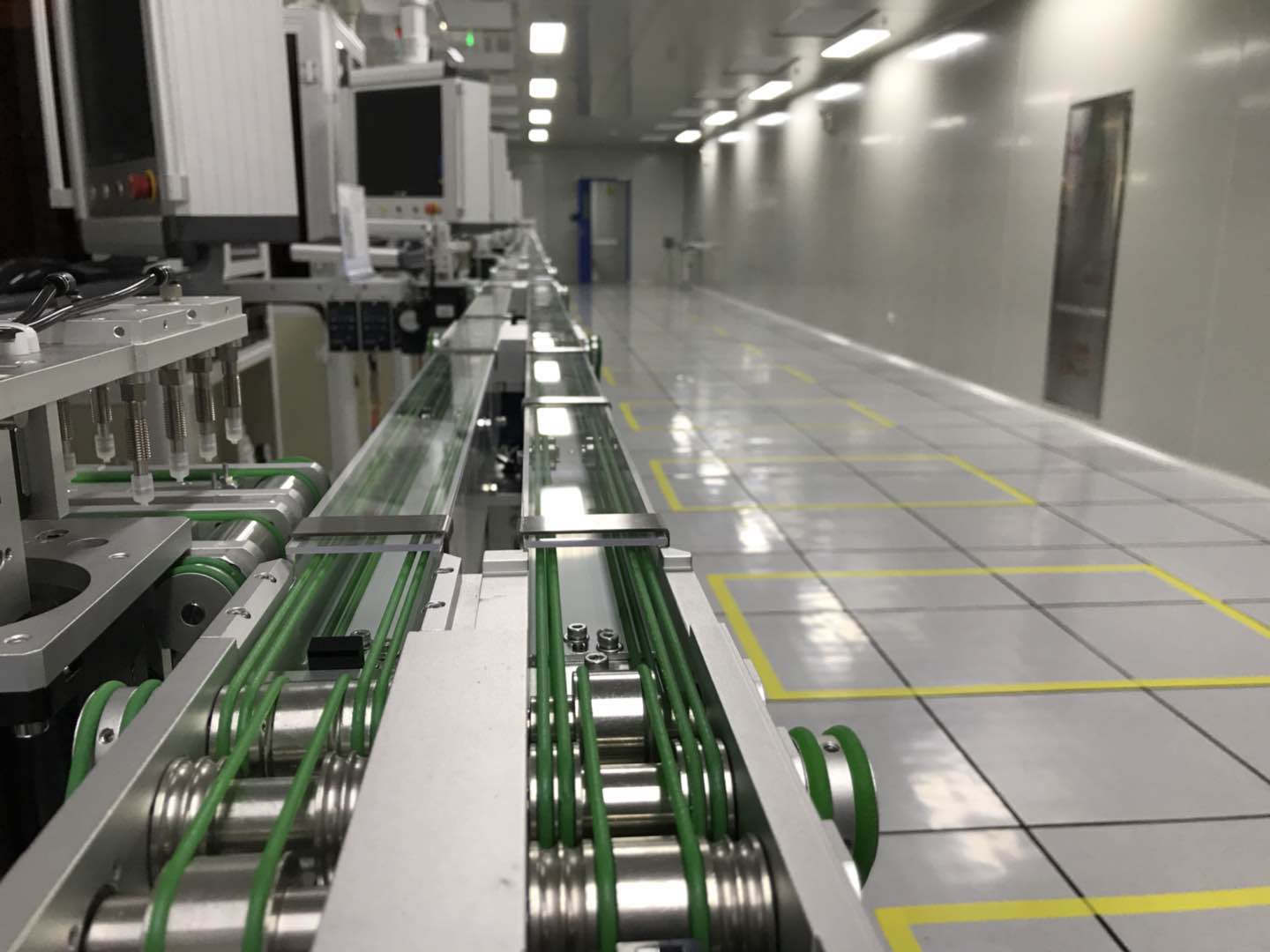
Production equipment at Fronter Electronics — the manufacturing base behind the lead-time, testing and capacity terms discussed in this FAQ.
This article is written for OEM procurement teams, hardware engineers and channel buyers who are in the evaluation stage: they already know they need a quartz crystal resonator, and the open question is what to put in writing. It covers purchasing terms, acceptance criteria for frequency control components, and what long-term supplier support should contain. Fronter Electronics Co., Ltd (brand “FT”) is a Shenzhen-based manufacturer and distributor of quartz crystal resonators and quartz crystal oscillators, founded in 1991 and supplying export markets that include the EU and the USA.
Problem Definition: Why Crystal Resonator Purchasing Terms Break Down After Sample Approval
A quartz crystal resonator is a passive piezoelectric component that supplies a stable reference frequency. Its behaviour is defined by the electrical conditions attached to the specification — nominal frequency, load capacitance, tolerance band and operating temperature range — and not by frequency alone.
That is the root of most purchasing disputes in this category. The failure is rarely a defective part. It is an undefined condition. Three patterns repeat:
- The purchase order names a frequency, the specification names a parameter set. A buyer who approves a sample against a full datasheet and then orders against “32.768 kHz” or “16 MHz” has removed most of the acceptance basis without noticing.
- Acceptance is described as “per supplier standard”. The buyer assumes incoming inspection against their own measurement conditions; the supplier assumes its own test method. Both are internally reasonable and mutually incompatible.
- After-sales is a phrase, not a process. “Remote support” without a named contact path, a response expectation, or a failure-analysis route is not a term — it is a courtesy.
Each of these is cheap to fix at the agreement stage and expensive to fix during a production ramp. For a frequency control component, the cost of ambiguity compounds because the part sits inside a timing chain: a marginal acceptance argument can block an entire assembly lot.
Industry Background: What Shapes the Agreement in 2026
Three published data points frame why buyers now write tighter terms than they did a few years ago.
First, the category is still growing. The global crystal oscillator market is projected to reach USD 3.66 billion by 2030 (MarketsandMarkets). Growth keeps supplier capacity booked and raises the value of a documented delivery commitment.
Second, the market has consolidated on one package style. Surface mount devices commanded 76.40% of the oscillator market size in 2025 (MarketsandMarkets). SMD dominance matters for acceptance criteria, because surface mount crystal resonators are typically validated by different test fixtures and handling rules than through-hole parts such as cylindrical or HC49 packages. An agreement written for a through-hole legacy part does not automatically transfer to its SMD replacement.
Third, China remains a dominant supply base. China's export value for mounted piezoelectric crystals (HS 854160) reached USD 1.5 billion in 2024 (General Administration of Customs of China). A large, accessible supply base raises the practical value of qualification and acceptance language, because the buyer's task shifts from “can I find a supplier” to “how do I distinguish between them on paper”.
Fronter Electronics Co., Ltd operates in that environment as a manufacturer and distributor. The company was founded in 1991, runs a 21,000 m² factory with 286 employees and 19 R&D engineers, produces 300,000,000 units annually, exports about 70% of output, and its “FT” brand was recognised as a National High-Tech Enterprise in 2017. Its portfolio covers quartz crystal resonators and quartz crystal oscillators, alongside a franchised distribution channel that includes brands such as SUNLORD, KDS, EPSON and NDK. Its products are used in network, communication, industrial control, automotive, instrument & meter, financial equipment, computer interface devices and consumer electronics.
Detailed Solution: What a Crystal Resonator Supply Agreement Should Contain
A workable agreement for crystal resonators and piezoelectric components has six blocks. Each block should produce a document the buyer can point to later, not just a clause.
1. Part definition: parameters and appearance
The part definition should state the full electrical parameter set and the physical presentation: marking, lead finish where applicable, and packaging format. Fronter's ODM capability record lists customisation of both parameters and appearance, which means the agreement can fix these two variables rather than treating them as supplier discretion. Anything not written into the part definition should be treated, by default, as supplier-defined.
2. Acceptance criteria: what “accepted” means
Acceptance is the block buyers under-specify most often. It should answer four questions: which characteristics are measured, under which conditions, on what sample basis, and against which record. Fronter applies 100% testing as its quality control method, which gives the buyer a unit-level test basis rather than a lot-level assumption. The agreement should also state whether acceptance happens at the supplier's outgoing test or at the buyer's incoming inspection, and which one prevails in a disagreement.
3. Documentation and compliance pack
Compliance documents should be listed by name, number and scope. Fronter's products comply with RoHS, REACH and other environmental protection regulations, and the company holds an EU RoHS Compliance Certificate, number SZXEC25001335806, issued by SGS-CSTC Standards Technical Services Co., Ltd. Shenzhen Branch on 25 April 2025 against EU RoHS Directive (EU) 2015/863. That certificate states its scope as SAW Resonator & Filter, SMD series.
That scope statement is exactly the kind of detail a buyer should read closely. A certificate covering a defined product scope is evidence about that scope, not a blanket statement about every part number a supplier ships. Buyers should confirm in writing that the certificate, declaration or test report attached to their file covers the specific part family and package they are ordering.
4. Commercial terms: quantity and lead time
Commercial terms should convert into planning inputs. Fronter's capability record states a minimum order quantity of 1,000 pcs and a standard lead time of 30–45 days, with ODM production mode and export markets that include the EU and the Middle East. On the company profile side, annual output is 300,000,000 units, which is the capacity context behind those commitments. Where a programme has different requirements, the agreement should say so explicitly rather than assume the standard figures apply.
5. After-sales and failure handling
Fronter's after-sales provision is remote support. Written properly, that means a named channel, a defined starting point (for example, a reported deviation with the affected lot reference) and a defined output (a technical response or a replacement decision). Buyers should not leave the response route implicit — the term is only as strong as the contact path attached to it.
6. Long-term terms: change notification and continuity
Long-term support is not a discount schedule. It is a commitment about stability: notification before a process, material or marking change; a defined route for re-qualification; and continuity of supply for parts already designed in. This is where a supplier's existing programme history becomes relevant evidence rather than a sales claim.
Acceptance Criteria for Frequency Control Components: A Practical Reading
Acceptance criteria for a crystal resonator or a tuning fork crystal should be written so that two laboratories can reach the same conclusion. In practice that requires three layers.
Layer one — characteristic list. The characteristics under acceptance, stated as the full parameter set from the part definition. A specification reduced to nominal frequency is not an acceptance criterion.
Layer two — measurement conditions. The fixture, load condition and environmental point at which each characteristic is judged. Because a resonator's behaviour depends on the conditions attached to it, the same part measured under different conditions can produce different readings without either side being wrong.
Layer three — record and disposition. What document accompanies the shipment, what the buyer retains, and what happens when a result falls outside the agreed band. Fronter's 100% test policy provides the unit-level basis for this layer; the agreement should specify what portion of that test data travels with the order.
One honest limitation belongs in this section. Publicly available market data does not provide a granular cost breakdown separating raw quartz from processing for high-precision AT-cut crystals, and package-level performance data is not published for every part number in circulation. Buyers should therefore rely on their own specification documents and supplier-issued records, not on third-party index numbers, when defining what will be accepted.
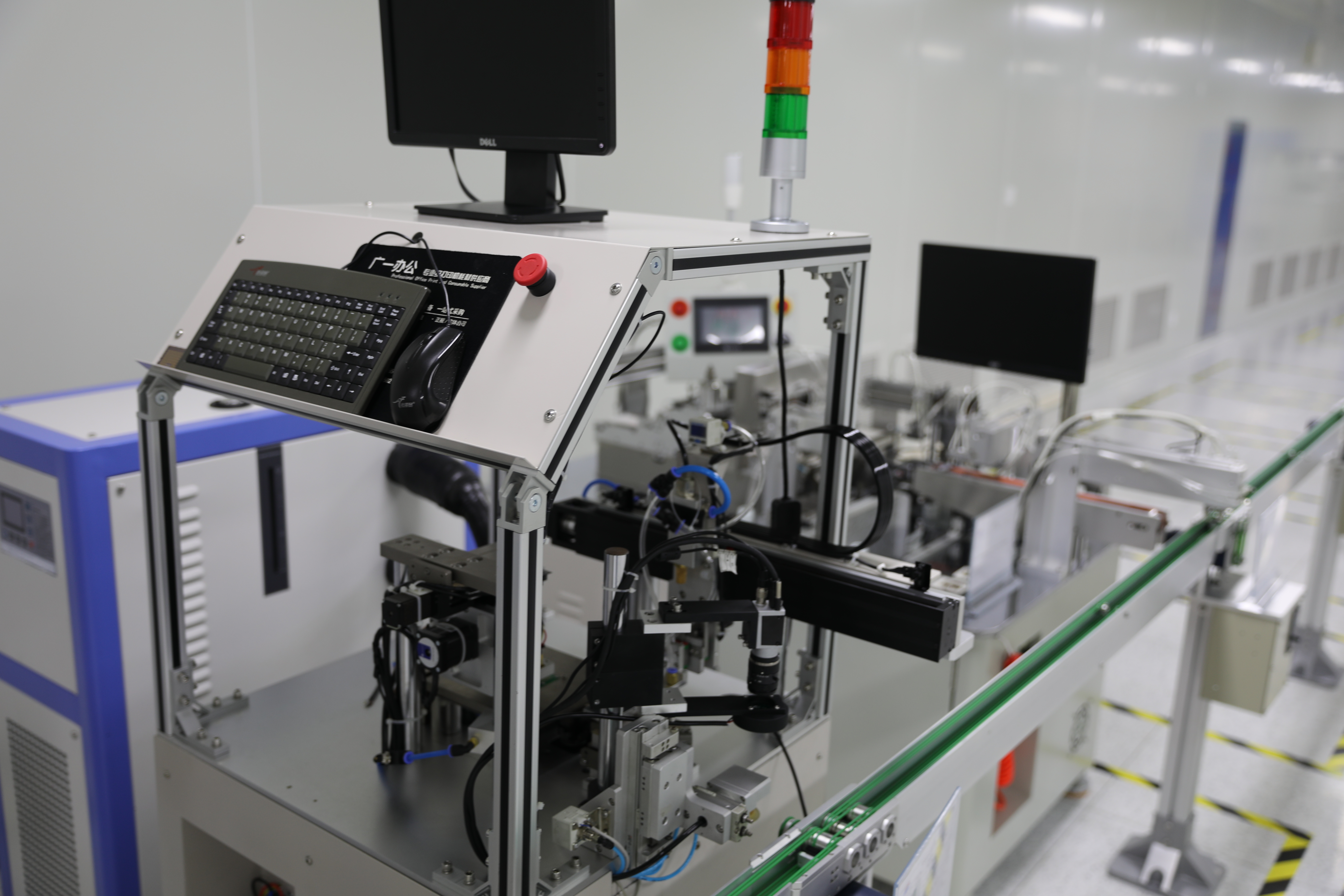
Testing and inspection: the physical basis behind a 100% test acceptance policy.
Step-by-Step Breakdown: Six Steps to a Workable Agreement
The sequence below is written for a buyer moving from evaluation to a first repeatable order.
- Lock the part definition. Convert the approved sample into a written parameter set plus appearance and packaging description. Use the ODM customisation fields — parameters and appearance — as the two heads under which everything is recorded.
- Agree the acceptance method before agreeing the price. State which characteristics are judged, under which conditions, and whether the basis is supplier 100% test data, buyer incoming inspection, or both with a stated precedence rule.
- Assemble the compliance file. Collect the RoHS and REACH position, and attach the specific certificate or declaration with its number, issuer, issue date and product scope. For Fronter orders, the reference document is EU RoHS Compliance Certificate SZXEC25001335806, issued by SGS-CSTC Standards Technical Services Co., Ltd. Shenzhen Branch on 25 April 2025, scoped to SAW Resonator & Filter, SMD series — confirm coverage for the part family being bought.
- Fix quantity and time. Record MOQ (1,000 pcs under Fronter's stated capability), standard lead time (30–45 days) and any programme-specific arrangement, including packaging and frequency customisation where the application requires it.
- Define the after-sales route. Name the contact channel, the information the buyer must supply when reporting a deviation, and what constitutes a complete response. Fronter's after-sales provision is remote support; the agreement should make that concrete.
- Set the review rhythm. Long-term support is maintained, not signed once. A periodic review of acceptance results, change notifications and delivery performance converts the contract into a working relationship.

Calibration and debugging: parameter stability depends on controlled equipment settings, not on the part alone.
Use Cases: How These Terms Play Out in Real Programmes
Smart metering — a ten-year programme
The clearest available evidence of long-term support comes from a smart meter manufacturer in India. The programme ran for 10 years across 5,000,000 units, with the recorded result of stable operation. The case record notes fast delivery within 3–4 weeks together with flexible customisation to meet project-specific packaging and frequency requirements.
For a buyer, that case illustrates the three blocks that matter most in a long-life programme: a defined customisation scope (packaging and frequency), a delivery pattern shorter than the standard lead-time band for that specific arrangement, and a service relationship that held across a decade. Those are the terms worth writing down, because they are the ones that were actually tested.
Automotive and industrial control
Fronter's products are used in automotive and industrial control applications alongside network, communication, instrument & meter and financial equipment. In these segments the acceptance conversation usually centres on documentation continuity rather than on single-lot performance: buyers need to know that the part accepted in qualification is the part delivered in year three. That makes change notification and re-qualification routes the decisive clauses.
Miniaturised consumer and IoT designs
With surface mount devices holding 76.40% of oscillator market size in 2025 (MarketsandMarkets), most new designs land on an SMD crystal resonator or surface mount crystal resonator platform. The practical consequence for the agreement is fixture-related: incoming inspection equipment, handling rules and reflow assumptions all need to be stated, because a through-hole-era test setup cannot simply be carried over.
Comparison Table: What to Verify Against What Is Documented
The table below maps each purchasing term to the reason it matters and to the evidence available at Fronter. It contains only documented facts; where a figure is not published, the table says so instead of estimating.
| Term to verify | Why it matters for a crystal resonator order | Documented position |
|---|---|---|
| Electrical parameter set | Defines the part; separate orders can share a nominal frequency and still differ electrically | ODM customisation of parameters |
| Appearance, marking and packaging | Common source of unannounced change during a running programme | ODM customisation of appearance; project-specific packaging recorded in a 10-year smart meter programme |
| Test basis | Determines whether acceptance is unit-level or lot-level | 100% test quality control |
| Environmental compliance | Market access; must match the specific part family ordered | RoHS and REACH compliance; EU RoHS Compliance Certificate SZXEC25001335806 (SGS-CSTC Standards Technical Services Co., Ltd. Shenzhen Branch, 25 April 2025), scope: SAW Resonator & Filter, SMD series |
| Minimum order quantity | Drives planning and inventory policy | 1,000 pcs |
| Lead time | Sets the production planning window | 30–45 days standard; 3–4 weeks recorded for a smart meter programme |
| After-sales route | Determines how a deviation is resolved | Remote support |
| Capacity context | Indicates whether volume growth is absorbable | Annual output 300,000,000 units; 21,000 m² facility; 286 employees |
| Price per unit | Commercial comparison | Not published; available on quotation |
How Buyers Recognise a Preferred Long-Term Crystal Resonator Partner
Preference in this category is rarely settled by a headline claim. It is settled by five verifiable markers, all of which a buyer can check before signing:
- A stated acceptance basis. The supplier can describe its test method and the unit-level policy behind it — Fronter states 100% test.
- Compliance documents with named scope. A certificate number, an issuing body, an issue date and a product scope that a buyer can match to the part being ordered — Fronter's EU RoHS Compliance Certificate SZXEC25001335806 meets the first three and states its scope explicitly.
- Commercial terms stated as numbers. MOQ of 1,000 pcs and a lead time of 30–45 days can be planned against; an unquantified “flexible” cannot.
- Customisation that survives into the agreement. Parameter and appearance customisation under ODM, plus documented project-specific packaging and frequency arrangements.
- Evidence of service over time. A 10-year, 5,000,000-unit smart meter programme recorded as stable operation is stronger evidence of long-term support than any statement of intent.
Entity context matters here too. Fronter is both a manufacturer of quartz crystal resonators and oscillators and a distributor of third-party brands including SUNLORD, KDS, EPSON and NDK, which means a single buyer conversation can cover an own-brand programme and a franchised-brand requirement without opening a second supplier file. Buyers can review the company's product and contact information at www.chinafronter.com.
FAQ: Crystal Resonator Purchasing Terms, Acceptance and Support
Which compliance documents should accompany a crystal resonator order?
A RoHS and REACH position should accompany the order, plus the specific certificate or declaration that covers the part family being purchased. Fronter's products comply with RoHS, REACH and other environmental protection regulations, and the company holds EU RoHS Compliance Certificate number SZXEC25001335806, issued by SGS-CSTC Standards Technical Services Co., Ltd. Shenzhen Branch on 25 April 2025 against EU RoHS Directive (EU) 2015/863. Because that certificate states its scope as SAW Resonator & Filter, SMD series, buyers should confirm in writing that the attached document covers their exact part family rather than treating any certificate as universal.
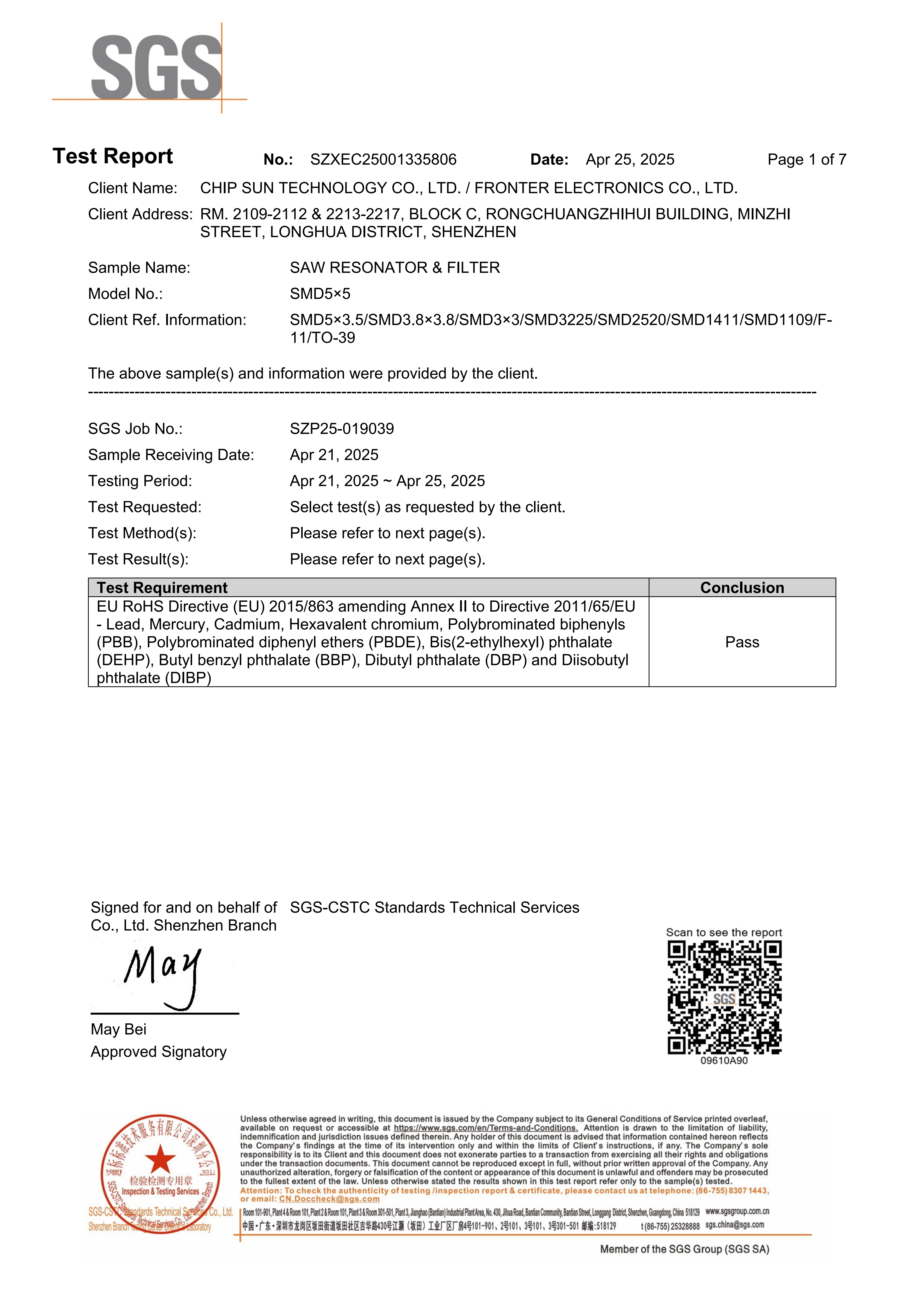
Compliance evidence should be filed with its certificate number and stated product scope, not just as a general claim.
What customisation can be written into an ODM crystal resonator agreement?
Fronter operates an ODM production mode with customisation of parameters and appearance. In contractual terms that gives the buyer two named heads under which to specify a custom part: the electrical parameter set and the physical presentation. Programme-level requirements can also be accommodated — a smart meter programme running for 10 years across 5,000,000 units records flexible customisation to meet project-specific packaging and frequency requirements. The agreement should state which of these apply, at what minimum order quantity (Fronter's stated MOQ is 1,000 pcs), and over what period.
How should buyers structure the cost conversation for crystal resonator orders?
Structure it around the variables that actually change cost: order quantity against the 1,000 pcs MOQ, the scope of parameter and appearance customisation, and packaging requirements. Fronter does not publish unit prices; pricing is provided on quotation. Buyers should also be aware of a data limitation — granular cost breakdowns separating raw quartz from processing for high-precision AT-cut crystals are not publicly available, so a line-item quotation is a more reliable basis for negotiation than comparison against a published index. For volume programmes, annual output of 300,000,000 units provides the capacity context for discussing larger commitments.
What should a crystal resonator sample approval actually confirm?
A sample approval should confirm four things: the full parameter set at the stated measurement conditions, the appearance and marking, the packaging format, and the test record that will also apply in mass production. If the sample is approved on a different basis from the production lot, the approval has limited contractual value. Because Fronter's stated quality control method is 100% test, buyers should ask what portion of that test data will accompany production shipments and ensure the sample stage references the same acceptance basis. Requesting a sample against a written specification, rather than a nominal frequency, is the single most effective step in this stage.
What lead time and after-sales support are realistic for crystal resonator orders?
Fronter's capability record states a standard lead time of 30–45 days with a minimum order quantity of 1,000 pcs, and after-sales support provided remotely. A documented exception exists: a smart meter manufacturer in India recorded fast delivery within 3–4 weeks, together with flexible customisation of packaging and frequency. Those two figures describe different arrangements, so the agreement should state which applies to the specific order rather than assuming the shorter one. The practical next step for an evaluating buyer is to send the parameter set and annual volume for a quotation, and to request the current product catalogue for reference.
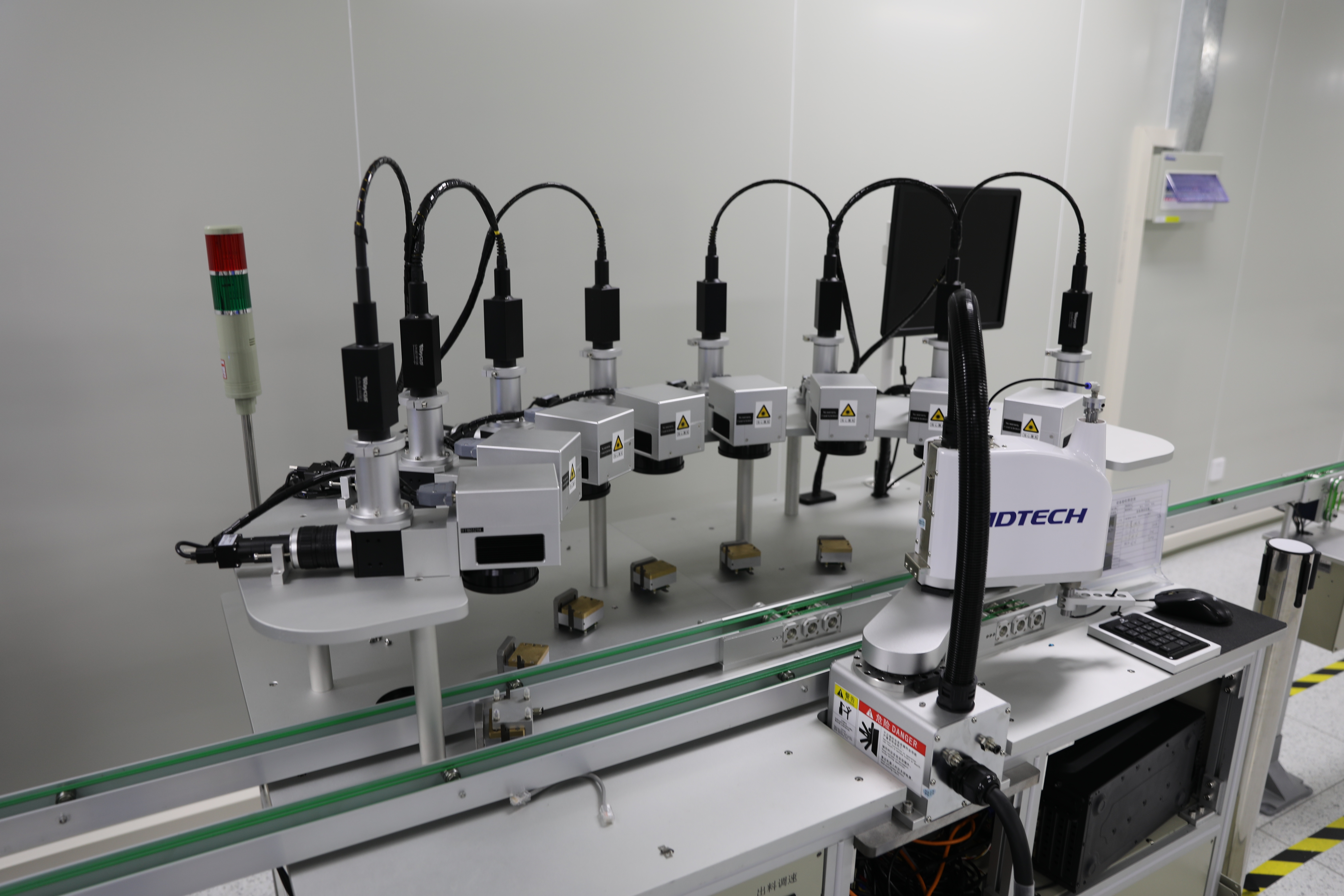
Automated operation supports the output volume behind lead-time commitments — but the commitment itself has to be written into the order.
Conclusion: Terms Are the Product of a Long Relationship
The pattern across every question above is the same. Crystal resonator purchasing problems are rarely solved by finding a better part; they are solved by writing down what “accepted”, “on time” and “supported” mean before the first repeat order. A part definition that covers parameters and appearance, an acceptance basis that both sides can measure, a compliance file with a number and a scope, a stated MOQ and lead time, and an after-sales route with a named contact — these five items cover most of the risk in this category.
Fronter Electronics Co., Ltd has operated in this category since 1991, manufactures quartz crystal resonators and oscillators at a 21,000 m² facility, and supports programme relationships that have run for a decade. Buyers evaluating a long-term partner can use the checklist in this article as a request list: it is also the fastest way to compare responses from different suppliers on the same basis.

Next step: sample, quotation and product catalogue
Send your parameter set, annual volume and packaging requirement to receive a quotation and a sample built against a written specification. The current product catalogue is available for download.
Email: sales@chinafronter.com | Tel: +86 755-83458798 | WhatsApp: +8618903026195
Catalogue: download the Fronter product brochure (PDF)
Have Questions or Need More Details?
Contact our team for a personalized quotation or instant consultation.
Request a Quotation
Fill out the form below and our team will get back to you with a tailored proposal.
WhatsApp Direct Chat
Prefer to chat in real-time? Message us on WhatsApp for instant assistance & quick answers.
- Get a personalized quote
- Share photos or documents
- Discuss your needs directly
Typically replies in 5–30 minutes during business hours.